PARK(ing) Day Assembly Manual - and Streetscape Intervention Toolkit
←
→
Page content transcription
If your browser does not render page correctly, please read the page content below
PARK(ing) Day
Assembly Manual
and Streetscape Intervention Toolkit

www.rebargroup.org
The Big
Idea Behind
PARK(ing) Day
More than 70% of most cities’
outdoor space is dedicated to
the private vehicle while only a
fraction of that land is allocated
to open space for people.

Around the world, inexpensive curbside parking         cultural expression, Rebar offers Park(ing) Day as a   Rebar invites you to participate. What you create
results in increased traffic, wasted fuel and more     prototype for open source urban design accessible      is limited only by your imagination--the future of
pollution. It’s time to rethink the way streets are    to all. In response, thousands of people around        this grassroots movement is in your hands. While
used! A metered parking spot is an inexpensive         the globe have created hundreds of parks and           Park(ing) Day may be temporary, the image of
short-term lease for a 10’x20’ plot of land. Imagine   formed an international event: Park(ing) Day. The      the possibilities it offers have lasting effects and
what you can do in a space usually dedicated to        event continues to spread virally, through the         are changing the way streets are understood.
private vehicle storage.                               Internet and word of mouth. Since its inception,       We challenge you to explore the dimensions of
                                                       Park(ing) has become a global experiment               ecological sustainability, design and creative vision
Motivated by the desire to exploit the metered         in reprogramming vehicular space for social            in the humble parking spot.
parking space as a site for art, activism, and         exchange, recreation and artistic expression.
The History of
PARK(ing) Day
                                                                                                                            The first
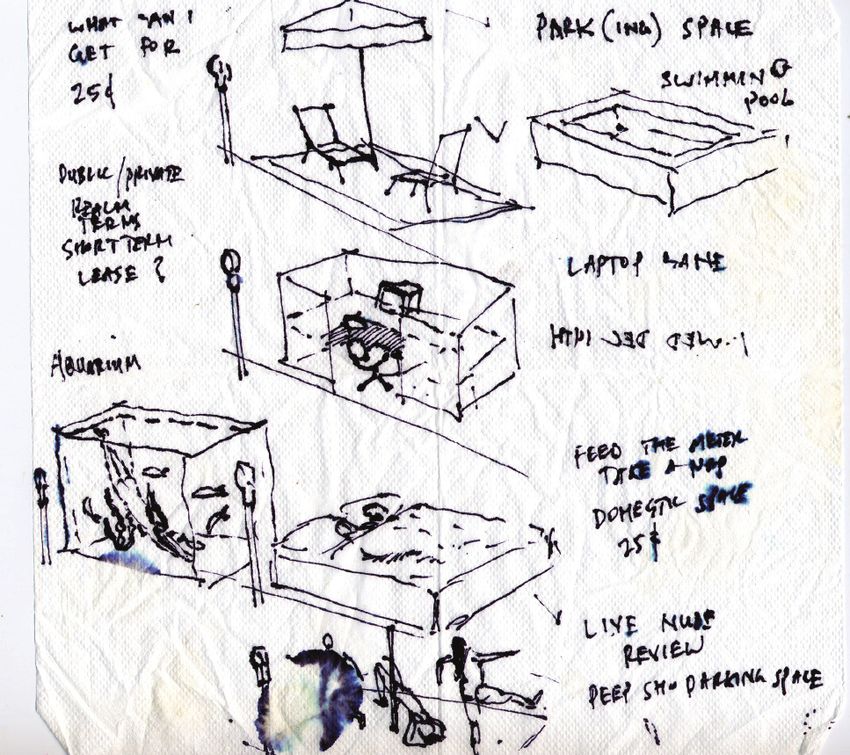
The PARK(ing) Day project                                                                                                   napkin
traces its origins to early 2005,                                                                                           sketch
when Rebar began discussions
regarding the potential of
the metered parking space as
a site for artistic expression,
political activism and social
experimentation.

                                    By approaching the parking spot as a short-term lease,   to ridiculous – an aquarium, a public bed, a brothel,
                                    we sought to explore the range of possible occupancy     and an office cube. We eventually narrowed to the
                                    activities for this unique category of urban space.      concept of the public park, to offer the daily users of
                                    And, in a discovery that was as emboldening as it        the downtown habitat a place to relax and do nothing.
                                    was surprising, the San Francisco Traffic Code did not   In early discussions, we considered a variety of park
                                    appear to expressly exclude other uses for the metered   typologies and topologies, including a national park
                                    parking space beyond the storage of the private          (complete with a redwood tree) and--in a microcosmic
                                    vehicle.1                                                ode to our home city--a park with rolling hillocks
                                                                                             and valleys. Ultimately we chose to deploy to most
                                    Yet … what to do in the space? Early ideas, like         commonly recognizable cultural signifiers of a typical
                                    many Rebar inventions, ran the gamut from clever         urban park – grass, a bench and a tree.
The History of PARK(ing) Day
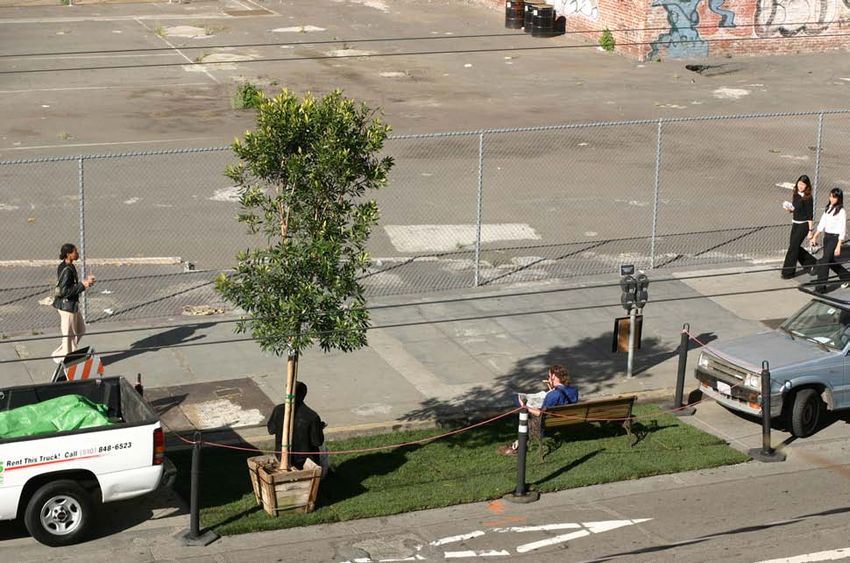
The photo
that traveled
around the
world
space, Rebar dismantled the park and returned the
space to its normative function. All that remained of
the incident were the photos and video footage shot.
We posted these on our website as a record of the
experiment.
Armed with an official San Francisco City map that Midday on November 16, 2005, equipped with fresh
describes the areas of downtown that are underserved living turf, a rented bench and a rented tree, we set Within several weeks a seminal photo had appeared in
by public open space, we set out to identify an down our park and stepped across the street to watch dozens of references on the Internet and news stories.
appropriate site for the intervention. After a few the park interact with its new urban situation. At first, Within six months Rebar had received hundreds of
bicycle trips around the city, we identified a spot on passersby reacted with a mix of indifference and inquiries about the project, which we dubbed Park(ing),
Mission Street near 1st Street that was sunny during curiosity. Eventually several people ventured into the from individuals and groups around the world. The
the lunchtime hours and, importantly, adjacent to a “park,” found a place to sit and took a place to enjoy combination of the iconic image of parking-space-as-
rooftop parking garage that would provide an excellent the novelty of cool grass and shade. Some of the park and its accompanying descriptive name created a
vantage from which to capture the project with still strangers enjoyed some unplanned social interaction “sticky” idea that transmitted readily across electronic
photos and video. by exchanging a few words with each other; others took media. Without much explanation, other groups
the occasion to rest or read. After two hours and having disposed to guerrilla intervention quickly grasped the
generated 24,000 “square foot-minutes” of public open basic tactic.The History of PARK(ing) Day
Still, the amount of interest Rebar received warranted The first
some codification of the idea, so we posted a short
“how-to” manual on our website to help others get PART I - Choosing the Spot how-to manual
Turn a Parking Spot Find a metered parking spot
in an ideal sunny location for
people to stop, rest,
into a PARK(ing) Space!
(or other open
started. The essence of the tactic was to legally claim a relax, and do nothing. Check
has a
to see if your city planning agency
map of areas underse rved by public open space.
space advocacy group) d how receptive people are to your
parking space using materials that were symbolically PARK(ing) Assembly Manu
al
in building a PARK(ing) space
in your local
Make contacts! You may
PARK(ing) idea.
be surprise
Thank you for taking an interest er way
to support your endeavor in whatev
associated with parks—trees, lawn, and a bench. Rebar urban environment. Rebar wishes
possible, and have developed
this handy guide to help you.
Please note:
es only.
Other things to consider about
the location are:
for non-commercial purpos drop-off spot. We do
te PARK( ing) it a 2-hour spot or a 1/2 hour
treated the idea itself as open source and applied a you may replica
1. Type of metered space: is
not suggest “No-Stopping” zones,
loading zones or commuter lanes.
, tourists, the down
Creative Commons license: as long as it was not used 2. People you are trying to
serve: downtown office workers
When will they be around to
see and use the
and out, or the high-rollers.
for profit, we allowed it to be replicated by anyone, space?
spots for you or your friends
to take pictures
3. Surveillance: are there nearby
anywhere. or video of the installation?
r, traffic,
ons: sun, shade, wind, weathe
4. Other environmental conditi
construction.
PART II - Building Materials
are seating, shade, a
a good outdoor public space
The following year, in collaboration with The Trust The fundamental elements of
place to watch people and view
scenery, and a sense of being
in nature.
for Public Land (a national conservation non-profit
organization) Rebar organized a one-day, global event
in which participants—mostly in San Francisco but
now joined by groups in other cities around the United
1
States and Europe—built temporary parks in parking
t © 2005 by Rebar.
Concept and materials copyrigh
spaces, in a coordinated effort to produce a greater www.rebargroup.org
critical mass and to demonstrate solidarity with the
effort to reprogram urban parking spaces.
In each of the 47 cities where Park(ing) Day took place
in 2006, different legal codes had to be negotiated company, Park(ing) Day participants paid meters and over 50 cities worldwide. The installations ranged from
by the participants: the traffic codes in San Francisco exercised their option to do something other than park dinner parties to croquet courses, dog parks to massage
were different than those in London, New York, or Eau cars in real estate that they, for the moment, owned. parlors, community health clinics to urban micro-
Claire, Wisconsin. Nowhere, however, did participants farms. Some participants did insinuate advertising and
meet with significant opposition to their installations, business promotion into their installations (in Florida,
which ranged from a do-it-yourself lemonade stand In 2007, ongoing widespread interest in Park(ing) for example, a Starbucks set up a park). But what most
to stormwater demonstration gardens to a seed concentrated in San Francisco but also now coming of the Park(ing) Day installations had in common was
giveaway. The event effectively operated within an from Europe and other American cities led us to a sense of humor and the promotion of some kind
undervalued niche space and successfully exploited a organize an even larger scale event when people of artistic, ecological, social or cultural agenda. The
legal loophole—a tactic at once radical but superficially around the world would temporarily turn parking playful yet passionate tone of the event first set in 2005
unthreatening to the system of spatial commodification spaces into parks. With help from partner organizations continues to resonate each year.
it critiqued. Although the space we collectively allocate such as The Trust for Public Land and Public
to parking—how much, where, for whom and at what Architecture and the Black Rock Arts Foundation, Rebar
1
cost—is usually hotly contested, Park(ing) Day operated set a date for the event (September 21st, the equinox) In contrast, see, e.g., the Rules of New York, which specify
within a discrete units of that contested terrain, and facilitated the participation of hundreds of that “It shall be unlawful for any person to ... prevent any
neutralizing potential backlash with a sense of humor volunteers by holding community organizing sessions vehicle from parking on a public street ... by placing any box,
and the honest application of a simple and uncontested in San Francisco and distributing how-to information on can, crate, hand-cart, dolly or any other device, including
market rule: just as it is completely within the rights the web. In all, more than 200 parks were constructed unauthorized pavement, curb or street markings or signs in
of individuals to buy up shares of a publicly-traded on September 21, 2007—entirely by volunteers—in the roadway.” The Rules of New York, 34 §4-08 (n) (7).Turn a Parking
Spot into a
PARK(ing) Space!
PARK(ing) Assembly Manual PART I - Choosing the Spot
Thank you for taking an interest in building Find a metered parking spot in an ideal sunny location for people to stop, rest, relax, and do nothing.
a PARK(ing) space in your local urban Check to see if your city planning agency (or other open space advocacy group) has a map of areas
environment. Rebar wishes to support your underserved by public open space.
endeavor in whatever way possible, and have
developed this handy guide to help you. Make contacts! You may be surprised how receptive people are to your PARK(ing) idea.
Park(ing) is available for use under a Creative Commons Other things to consider about the location are:
license and may not be used for any commercial
1
purposes. For more information about the Creative
Commons license visit http://creativecommons.org/ Type of metered space: is it a 2-hour
licenses/by-nc-sa/3.0/ spot or a 1/2 hour drop-off spot. We do
not suggest “No-Stopping” zones, loading
zones or commuter lanes.
2
People you are trying to serve:
downtown office workers, tourists, the
down and out, or the high-rollers. When
will they be around to see and use the
space?
3 Surveillance: are there nearby spots for
you or your friends to take pictures or
video of the installation?
4
Other environmental conditions: sun,
shade, wind, weather, traffic, construction.
Concept and materials copyright © 2005-2008 by Rebar.
www.rebargroup.orgTurn a Parking Spot into a PARK(ing) Space!
PART II - Building Materials
The fundamental elements of a good outdoor public space are
seating, shade, a place to watch people and view scenery, and
a sense of being in nature.
For Rebar’s first PARK(ing), we installed 200 sq. ft of lawn, a 24” box/15’ tall tree, a park bench and an Tips on using sod:
enclosing boundary. We also produced signs to indicate to the public that this space was created for
their use and enjoyment and to invite them to feed the meter to keep the PARK open. Sod is available from garden centers for
around $2.00 for a 1x5 ft roll.
Be sure to place a tarp under the sod to
1 Groundcover
Even a small piece of lawn can transform the hard concrete or asphalt into a soft, green oasis.
Other bits of nature that may work are moss, potted plants, sand, or anything that will feel
prevent absorption of chemicals from the
roadway into the sod’s matting.
good to bare feet. Other PARK(ing) Day participants have used quilts, pools, gravel, carpets
and astroturf.Turn a Parking Spot into a PARK(ing) Space!
2 Seating
The more seating you provide, the
greater the chance of unplanned
interaction among PARK(ing) visitors.
Good used park benches can be
obtained on the Internet or rented from
a film/theatre prop rental shop. Also,
don’t be afraid to utilize “Big Box” retailers
with liberal return policies – perhaps you
can buy a bench for your PARK(ing) and
return it for a full refund when you are
finished.Turn a Parking Spot into a PARK(ing) Space!
3 Shade
Some nurseries will lease trees by
the day or week. Check with your
local nursery to find a sturdy tree
with abundant foliage for shade.
Bamboo or a large indoor plant
may work in your climate. Choose
a tree you will be able to move and
manage easily.Turn a Parking Spot into a PARK(ing) Space!
4 5
Enclosure Signs
Plastic bollards linked with rope (AKA traffic tubes, Indicating that this space has been transformed
available here for about $15/each) potted plants, from a parking spot to a PARK(ing) space for public
or any self-supporting boundary is important to enjoyment and inviting visitors to feed the meter.
provide a sense of enclosure and safety for visitors
to your PARK(ing) space.
6 7
Spare change Please make sure you have a plan
to reuse, recycle, or donate the materials - such as
Don’t forget to bring change to feed the meter to get things the sod and tree - after your PARK(ing) project is
rolling before your visitors arrive. complete!Turn a Parking Spot into a PARK(ing) Space!
PART III - Planning the Event
Things you should consider organizing in advance are:
1 Sourcing materials like tree, lawn
and bench at least a week or two in
advance;
2 Transportation for the materials to and
from the site;
3 Friends or collaborators to arrive early
at the site to hold a space and to help
you setup and cleanup;
4 People to photograph/document the
event;Turn a Parking Spot into a PARK(ing) Space!
You are acting in the public interest to add to the health,
5 A plan for talking to people who come by your Park(ing) Space.
Who might want to talk to you?
comfort and vitality of your city!
Put forward the positive aspect of your action and remember that
• Curious bystanders skeptical critics can turn into key supporters and allies if you win
• People who want to get involved in Park(ing) Day them over. Your generous and creative act can set the tone for other
• Traffic and law enforcement personnel people’s positive experience of public space, so appeal to their best
• People wondering why you’re taking up a perfectly good instincts: civic pride, artistic expression, caring for others.
parking spot.
Explaining Park(ing) Day
You are part of a world-wide movement to
improve the quality of the public realm and
take back the streets for people. Your Park(ing)
space is also a unique expression of your own
ideas, creativity and identity. Think ahead to
how you will easily explain what’s happening to
curious, skeptical or appreciative audiences you’ll
encounter out there.Turn a Parking Spot into a PARK(ing) Space!
5 Continued : A plan for talking to people who come by your Park(ing) Space.
Talking to Authorities
Understand the laws governing your city’s parking
spaces. Authority figures are usually concerned
with safety, so be prepared to share your plans
to keep people out of harm. We recommend
appealing to law enforcement’s sense of civic
pride rather than antagonizing them. Remember,
you’re not protesting--you’re using your public
space to improve the quality of life for people!
Addressing People’s Concerns
If you encounter negativity or hostility from
anyone, try to find out what their concerns really
are. They may or may not understand what
Park(ing) Day is about. If you are comfortable TRUE STORY!
doing so, engage in a dialogue with them.
One Park(ing) group in San Francisco outstayed
their 2-hour meter and were asked by the
parking patrol to move their hanging garden
park...which they did, with the help of a dozen
Generosity and Humor people. They found a new parking space, and
fed the meter of course!
You are the face of Park(ing) Day. No matter what
goes wrong, take it easy, have fun, and laugh. You
may find you soon have a lot of company.Turn a Parking Spot into a PARK(ing) Space!
6
A place to donate the materials when
the project is over. Living plants, turf
and/or groundcover can returned or
permanently planted in yards – or better
yet donated to schools or neighbors who
need them.
7 Tools like a broom (for cleanup), clippers
or a pocket knife. Be prepared to
problem-solve! If you plan to clean up
after dark, bring flashlights. If you’ll use
bicycles for transportation, remember
lights and reflectors.
8 An After Party! Where will you meet
up with other Park(ers) to celebrate?Turn a Parking Spot into a PARK(ing) Space!
PART IV - Installation
Arrive early to secure your ideal space. A couple of strategies for installing PARK(ing) in heavy traffic are to:
(1) Obtain two or more spots. One spot to temporarily park your transport vehicle and one (or more) for PARK(ing);
(2) Alternatively, pull up alongside your spot. Turn on your blinkers, and place traffic safety cones or saw horses for safe unloading.
1 Begin feeding the meter.
2
Set up the boundary. This helps cars see your
installation and keeps users from straying into
traffic.
3
First lay down a tarp or plastic if your installation
is has loose soil--this will make cleanup easier.
4
Lay down the ground covering within your
Park(ing) spot. People have used turf, native
plants, carpet, wooden platforms, stones--even
swimming pools. Whatever you use, set your
Park(ing) spot apart with textures and colors
that are different from the surrounding asphalt
and concrete. Soft, comfortable surfaces help
people enjoy your Park longer. You may need
garden tools to do a neat job.
5
Unload the tree or trees, if you’re using them.
Large trees can be VERY heavy and will require
3-4 people to move safely and efficiently. Site
them so they provide shade for the duration of
your installation.
6
Place the seating, set up the boundary, then
place your signs inviting the public enjoy the
PARK you have just created for them.Turn a Parking Spot into a PARK(ing) Space!
5
Now sit back, relax and enjoy! People may
be profoundly indifferent, nonchalant,
curious or overwhelmingly excited by
your PARK. You may wish to provide them
with an explanatory flyer or an email,
website or mailing address to contact you
for more information.
6 Don’t forget to feed
the meter!Turn a Parking Spot into a PARK(ing) Space!
PART V - Wrap Up
1
Once the meter expires, the sun has gone
behind a building, or you have been
asked to leave by the police or traffic
authorities, load your tree, roll up the turf,
and pick up the bench. Carefully sweep
up any dirt or debris, and then dismantle
the boundary structure. If you are
returning a tree to the nursery, take care
not to damage it while loading.
2
Ideally you have lined up a place to
donate any materials that you don’t plan
to keep or reuse. Once you have dropped
off all the materials, returned equipment,
and cleaned up, take the time to thank all
of your friends and collaborators.
3
Don’t you want to celebrate? You and
your friends have worked hard--why
not meet up with other Park(ing) Day
participants and share stories about the
day?Turn a Parking Spot into a PARK(ing) Space!
PART VI - Getting the Word Out
If you take pictures or video of your PARK(ing),
please send them to Rebar at:
parking@rebargroup.org
We will post pictures and stories about your
PARK(ing) project on the Rebar site, and provide a
link to your local organization/website.
We would also like to incorporate your video into
a larger documentary project on the nascent
PARK(ing) movement. Please email us for more
information on the documentary.
Online groups for planning Park(ing) Day and
networking with participants exist in many cities
already. If you can’t find one in your city, start your
own! Google groups is a good platform. Use your
network to share photos, ideas and stories before
and after the event. You may find allies and friends
who have more in common with you than just
Park(ing) Day.
Now get out there
and start PARK(ing)!Turn a Parking Spot into a PARK(ing) Space! Space planner Use the pieces on the following pages to plan out ideas for your PARK(ing) Space. Draw, color, think big! Then share your vision with us and the world. Send your designs to parkingday@rebargroup.org.
Turn a Parking Spot into a PARK(ing) Space!
Turn a Parking Spot into a PARK(ing) Space!
Turn a Parking Spot into a PARK(ing) Space!
Further Reading
The Trust for Public Land - www.tpl.org

Public Architecture - www.publicarchitecture.org

Permanent Breakfast - www.p-breakfast.net

Roadwitching - www.wormworks.com/roadwitch/index.html

(P)LOT by Michael Rakowitz - www.michaelrakowitz.com

Bonnie Sherk - www.alivinglibrary.org/LivLib_home.html

Jane Martin/PlantSF - www.plantsf.org

Urban Prescriptions - www.recetasurbanas.net

Graffiti Research Lab - www.graffitiresearchlab.com

Wooster Collective - www.woostercollective.com
Content by Rebar / www.rebargroup.org
Design and layout by Spindle Desco / www.spindledesco.com

Copyright © 2008 by Rebar.

Made possible by a generous grant from Black Rock Arts Foundation
www.blackrockarts.org
You can also read


