Performance of a Mobile Single-Lead Electrocardiogram Technology for Atrial Fibrillation Screening in a Semirural African Population: Insights ...
←
→
Page content transcription
If your browser does not render page correctly, please read the page content below
JMIR MHEALTH AND UHEALTH                                                                                                        Pitman et al

     Original Paper

     Performance of a Mobile Single-Lead Electrocardiogram
     Technology for Atrial Fibrillation Screening in a Semirural African
     Population: Insights From “The Heart of Ethiopia: Focus on Atrial
     Fibrillation” (TEFF-AF) Study

     Bradley M Pitman1, BSc; Sok-Hui Chew2, BMBS; Christopher X Wong1, MSc, MBBS, PhD; Amenah Jaghoori1,
     PhD; Shinsuke Iwai1, MD, PhD; Gijo Thomas1, PhD; Andrew Chew2, BMBS; Prashanthan Sanders1, MBBS, PhD;
     Dennis H Lau1, MBBS, PhD
     1
      Centre for Heart Rhythm Disorders, The University of Adelaide, Adelaide, Australia
     2
      Flinders University, Adelaide, Australia

     Corresponding Author:
     Dennis H Lau, MBBS, PhD
     Centre for Heart Rhythm Disorders
     The University of Adelaide
     1 Port Rd
     Adelaide, 5000
     Australia
     Phone: 61 8313 9000
     Fax: 61 8362 2273
     Email: dennis.h.lau@adelaide.edu.au

     Abstract
     Background: Atrial fibrillation (AF) screening using mobile single-lead electrocardiogram (ECG) devices has demonstrated
     variable sensitivity and specificity. However, limited data exists on the use of such devices in low-resource countries.
     Objective: The goal of the research was to evaluate the utility of the KardiaMobile device’s (AliveCor Inc) automated algorithm
     for AF screening in a semirural Ethiopian population.
     Methods: Analysis was performed on 30-second single-lead ECG tracings obtained using the KardiaMobile device from 1500
     TEFF-AF (The Heart of Ethiopia: Focus on Atrial Fibrillation) study participants. We evaluated the performance of the
     KardiaMobile automated algorithm against cardiologists’ interpretations of 30-second single-lead ECG for AF screening.
     Results: A total of 1709 single-lead ECG tracings (including repeat tracing on 209 occasions) were analyzed from 1500 Ethiopians
     (63.53% [953/1500] male, mean age 35 [SD 13] years) who presented for AF screening. Initial successful rhythm decision (normal
     or possible AF) with one single-lead ECG tracing was lower with the KardiaMobile automated algorithm versus manual verification
     by cardiologists (1176/1500, 78.40%, vs 1455/1500, 97.00%; P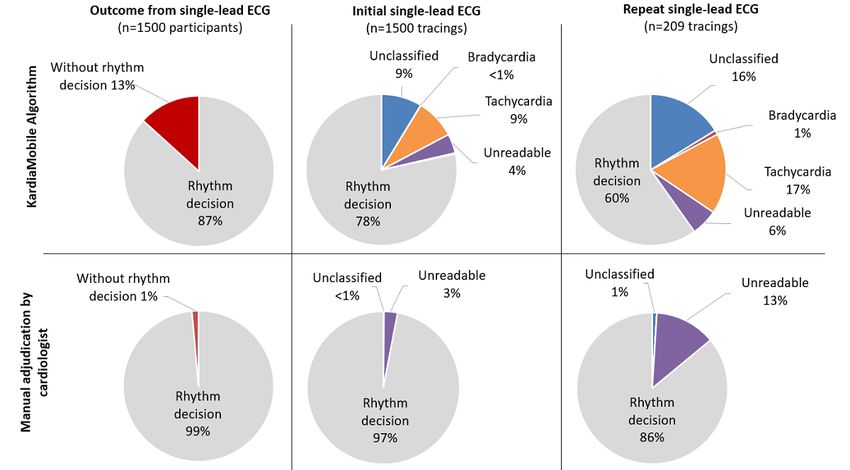
JMIR MHEALTH AND UHEALTH                                                                                                                          Pitman et al

     KEYWORDS
     atrial fibrillation; screening; sub-Saharan Africa; single-lead ECG

                                                                                   28% of unclassified ECG recordings [8-12]. The high frequency
     Introduction                                                                  of unclassified tracings may limit the effective utility of this
     Consumer use of wearable technology capable of ambulatory                     device for AF screening. Here, we sought to determine the
     assessment of heart rate and rhythm has significantly increased               real-world feasibility and utility of the KardiaMobile single-lead
     in recent years [1]. Large-scale population screening studies                 ECG device for AF screening in a semirural African population.
     have demonstrated the capability of wearable devices to detect                Specifically, this analysis evaluates the device’s accuracy for
     pulse irregularity using photoplethysmography-based                           AF detection, factors underlying unclassified ECG tracings,
     technology, with a high positive predictive value of diagnosing               and factors that may influence its screening performance from
     atrial fibrillation (AF) [2,3]. However, the adoption of these                the first 1500 subjects recruited in the ongoing TEFF-AF (The
     smart wearable devices is much lower in low-resource countries                Heart of Ethiopia: Focus on Atrial Fibrillation study).
     due to affordability and low internet penetration rate. Despite
     AF being recognized as a growing global epidemic, the 2010                    Methods
     Global Burden of Disease study has highlighted low availability
     of data on AF from several regions including sub-Saharan Africa
                                                                                   TEFF-AF Study
     and the need for better estimates through targeted population                 The TEFF-AF study (registered with the Australian New
     surveillance studies [4]. Alternative active screening strategies             Zealand Clinical Trials Registry [ACTRN12619001107112])
     for AF using pulse palpation and electrocardiogram (ECG) are                  is an AF screening study conducted at the Soddo Christian
     therefore more applicable in these low-resource countries [1,5].              Hospital (SCH). The SCH is located in the semirural town of
                                                                                   Soddo in south-central Ethiopia, with a population of around
     AF screening using single-lead ECG devices has been reported                  200,000 individuals. AF screening was undertaken by a team
     in hospital, primary care, and community settings with variable               of 5 nursing and research support staff from the SCH following
     sensitivity and specificity [6]. However, limited data exist on               specialized training on the use of the KardiaMobile device,
     the use of such devices for AF screening in low-resource                      iPhone app (version 5.7.4, KardiaAI: 1.1.7), and online Research
     countries [7]. One such device is the KardiaMobile ECG monitor                Electronic Data Capture database. The training included an
     (AliveCor Inc), which is approved by the US Food and Drug                     initial tutoring session followed by subsequent hands-on practice
     Administration (FDA) for automatic classification of 30-second                in acquiring a best-quality single-lead ECG tracing with the
     single-lead ECG tracing as normal or possible AF. However,                    KardiaMobile device. AF screening commenced at the SCH in
     the device also returns other results of too short, tachycardia,              August 2019 with inclusion criteria being any ambulant adult
     bradycardia, unreadable, or unclassified. Notably, screening                  aged 18 years and above and able to provide informed consent.
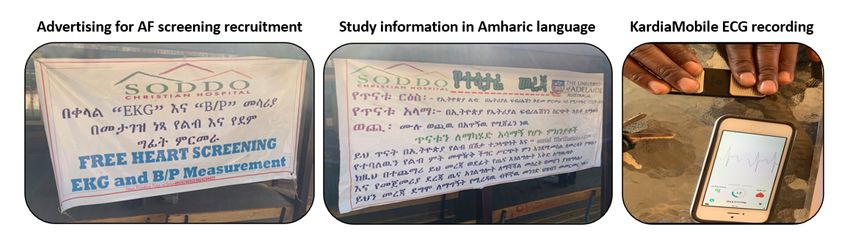
     studies using the KardiaMobile device, including the Heart                    Signage in Amharic language was erected to advertise screening
     Rhythm Society/American College of Physicians AF Screening                    to aid recruitment (Figure 1).
     and Education Initiative, have encountered between 5% and
     Figure 1. Atrial fibrillation screening advertising (left) and study information (center, in Amharic language) and single-lead electrocardiogram recording
     (right).

     All participants provided informed consent, and the study is                  obtained before single-lead ECG acquisition using the
     approved by the SCH research ethics board. Baseline                           KardiaMobile device. As per the study protocol (Figure 2), the
     demographic and clinical parameters were obtained to                          outcome of the automated algorithm assessment of rhythm
     characterize the cardiovascular risk profile of participating                 dictated the need for repeat KardiaMobile tracing and/or a
     individuals. Measurements of height, weight, and blood pressure               12-lead ECG. Participants with clinical abnormality detected
     (Intellisense T5 automatic monitor, Omron Corporation) were                   were referred for follow-up by the SCH physician.

     https://mhealth.jmir.org/2021/5/e24470                                                                   JMIR Mhealth Uhealth 2021 | vol. 9 | iss. 5 | e24470 | p. 2
                                                                                                                            (page number not for citation purposes)
XSL• FO
RenderX
JMIR MHEALTH AND UHEALTH Pitman et al
Figure 2. Atrial fibrillation (AF) screening protocol. ECG: electrocardiogram.
Statistical Analysis
KardiaMobile ECG Screening
Summary statistics were presented by frequency and percentage
The KardiaMobile mobile single-lead ECG device records a
or mean and standard deviation as appropriate. Categorical data
bipolar lead I ECG tracing when 2 or 3 fingers from each hand
were analyzed using the chi-square test. Sensitivity and
of the user are placed in contact with the 2 electrodes (Figure
specificity for the ability of the KardiaMobile to produce a
1). Participants were instructed to relax arms and hands to reduce
rhythm decision against the cardiologist ECG interpretation
noise and artefacts. The KardiaMobile device transmits a
was calculated. Linear regression analysis was performed to
frequency modulated ultrasound signal that is detected by the
assess the factors contributing to screening performance of the
smartphone (iPhone, Apple Inc) with installed Kardia app. A
KardiaMobile automated algorithm. All statistics were
30-second single-lead ECG recording can be viewed in real
performed in SPSS Statistics version 26 (IBM Corp), and
time on the smartphone app and saved as a PDF file. The
statistical significance set at PJMIR MHEALTH AND UHEALTH Pitman et al
Table 1. Baseline clinical characteristics (n=1500).
Demographic and clinical information Values
Age in years, mean (SD) 35 (13)
Gender, male, n (%) 960 (64.00)
Home region, n (%)
Southern Nations, Nationalities, and Peoples’ Region 1439 (95.93)
Omoria 30 (2.00)
Amhara 11 (0.73)
Other regions (including Somalia, B-Gumuz, Addis Ababa, Harar) 19 (1.27)
Religion, n (%)
Orthodox 416 (27.73)
Protestant 988 (65.87)
Muslim 70 (4.67)
Other or no religion 22 (1.47)
Education, n (%)
Illiterate 55 (3.67)
Primary level school 137 (9.13)
Secondary level school 599 (39.93)
Certificate, diploma, or higher 707 (47.13)
Occupation, n (%)
Unemployed 175 (11.67)
Employed 682 (45.47)
Self-employed 344 (22.93)
Others including student and retired 297 (19.80)
Clinical, mean (SD)
Height (cm) 167.7 (8.6)
Weight (kg) 67.1 (13.3)
Systolic blood pressure (mm Hg) 124.0 (17.7)
Diastolic blood pressure (mm Hg) 76.5 (11.7)
Clinical, n (%)
Hypertension 104 (6.93)
Diabetes mellitus 34 (2.27)
Congestive cardiac failure 20 (1.33)
Stroke 3 (0.20)
Coronary artery disease 2 (0.13)
Peripheral artery disease 0 (0.00)
Chronic lung disease 16 (1.07)
Chronic renal disease 5 (0.33)
Valvular heart disease 11 (0.73)
Obstructive sleep apnea 2 (0.13)
Thyroid disease 21 (1.40)
Smoker 5 (0.33)
Khat/alcohol use 14 (0.93)
Infectious disease 288 (19.20)
https://mhealth.jmir.org/2021/5/e24470 JMIR Mhealth Uhealth 2021 | vol. 9 | iss. 5 | e24470 | p. 4
(page number not for citation purposes)
XSL• FO
RenderXJMIR MHEALTH AND UHEALTH Pitman et al
Performance of the KardiaMobile Automated tachycardia (>100 bpm) and interpreted as normal rhythm not
Algorithm requiring a repeat tracing, 10.43% (12/115) proceeded directly
to a 12-lead ECG, and 6.09% (7/115) declined repeat
Of the initial single-lead ECG tracings from 1500 participants,
KardiaMobile tracing or 12-lead ECG due to time constraint.
the KardiaMobile algorithm was unable to provide a rhythm
On the repeat KardiaMobile attempt, the KardiaMobile
decision in 21.60% (324/1500) due to unclassified (130/1500,
algorithm again failed to achieve a rhythm decision in 40.19%
8.67%), tachycardia (128/1500, 8.53%), unreadable (62/1500,
(84/209). Adjudications by cardiologists showed that the reasons
4.13%), too short (3/1500, 0.20%), and bradycardia (1/1500,
underlying unsuccessful automated KardiaMobile rhythm
0.07%). Representative examples of these tracings are shown
determination (n=408 traces; 324 from first attempt and 84 from
in Figure 3. A repeat KardiaMobile tracing was obtained in
repeat attempt) were poor quality/noisy tracings (214/408,
64.50% (209/324) of the participants who did not have an initial
52.45%), tachycardia (>100 bpm; 167/408, 40.93%), frequent
rhythm decision. Of those participants without repeat
ectopy (22/408, 5.39%), inadequate recording duration (3/408,
KardiaMobile tracings, 83.48% (96/115) had an initial result
0.74%), and bradycardia (JMIR MHEALTH AND UHEALTH Pitman et al
Figure 4. Comparison of KardiaMobile algorithm versus manual assessment by cardiologists. ECG: electorcardiogram.
Table 2. KardiaMobile automated algorithm versus cardiologists’ adjudication for single-lead electrocardiogram (ECG) for rhythm decision in n=1500
participants and atrial fibrillation detection in n=1709 ECG tracings.
KardiaMobile algorithm Cardiologists’ adjudication
Rhythm decision Atrial fibrillation
Yes No Yes No
a
Rhythm decision
Yes 1168 8 —b —
No 287 37 — —
Possible atrial fibrillationc
Yes — — 9 61
No — — 3 1636
a
.
b
Not applicable.
c
.
Utility of KardiaMobile Automated Algorithm for AF
12-Lead ECG Analysis
Screening
In total, 154 participants met criteria for a 12-lead ECG, but
this was obtained in only 59.09% (91/154) due to participants We analyzed the performance of the KardiaMobile automated
not wanting to wait for the 12-lead ECG to be performed in the algorithm for providing an initial rhythm decision. There was
SCH emergency room. However, upon review of the single-lead a linear relationship between ongoing participant recruitment
ECGs meeting study criteria for a 12-lead ECG to be performed, and the occurrence of a no rhythm decision from the initial
the cardiologists adjudicated 89.61% (138/154) of these single KardiaMobile tracing (Figure 5A). Linear regression analysis
lead ECGs to be of adequate quality for a rhythm decision. In showed that there was a significant reduction in the cumulative
total, diagnoses from the 12-lead ECGs were 89.01% (81/91) incidence of no rhythm decision compared with successful
sinus rhythm, 1.10% (1/91) supraventricular tachycardia, and rhythm decision with ongoing patient recruitment (β=–14.4,
9.89% (9/91) AF. 95% CI –26.6 to –2.1; P=.02). As the KardiaMobile results of
tachycardia, unclassified, and unreadable accounted for 98.77%
(320/324) of occasions without a rhythm decision on the first
KardiaMobile attempt, their contribution to no rhythm decision
https://mhealth.jmir.org/2021/5/e24470 JMIR Mhealth Uhealth 2021 | vol. 9 | iss. 5 | e24470 | p. 6
(page number not for citation purposes)
XSL• FO
RenderXJMIR MHEALTH AND UHEALTH Pitman et al
was further analyzed. With ongoing patient recruitment, the when compared with unclassified and tachycardia tracings
occurrence of unreadable tracing was significantly reduced (β=–38.0, 95% CI –63.3 to –12.6; P=.003, Figure 5B).
Figure 5. Cumulative occurrence and contributors to no rhythm decision from KardiaMobile’s automated algorithm on initial electrocardiogram tracing:
(A) cumulative occurrence of no rhythm decision from initial electrocardiogram tracing and (B) occurrence of unreadable tracing was significantly
reduced when compared with unclassified and tachycardia tracings with increasing patient recruitment.
of 97% [13]. In a single-center, adjudicator-blinded case series
Discussion of 52 consecutive patients with AF admitted for antiarrhythmic
Principal Findings drug initiation who had serial 12-lead ECG and nearly
simultaneously acquired KardiaMobile recordings, AF detection
This study evaluated the utility of the KardiaMobile single-lead was reported at 96.6% sensitivity and 94.1% specificity [14].
ECG device for AF screening in a semirural Ethiopian However, 28% of the tracings obtained were deemed
population of 1500 individuals from the TEFF-AF study. We unclassified by the KardiaMobile automated algorithm and
found the KardiaMobile device performance to be suboptimal excluded from analysis. Similarly, others have reported the
with successful automated rhythm decision following a single KardiaMobile automated algorithm correctly detected AF with
ECG trace of only 78%. This yield increased to 87% following 93% sensitivity and 84% specificity in 100 participants with a
a second KardiaMobile ECG tracing. As experience increased history of AF who presented for a scheduled elective electrical
with ongoing patient recruitment, we encountered significant cardioversion after excluding a substantial 34% of recordings
reduction in unreadable tracings. The ongoing occurrence of with unclassified tracings [11]. Our study found that the
tachycardia and unclassified tracings contributed largely to the KardiaMobile automated algorithm failed to achieve rhythm
automated KardiaMobile algorithm’s inability to achieve decision in 22% of the tracings, comparable to previous studies.
successful rhythm decision. In contrast, manual cardiologist Consequently, this may limit the utility of the mobile single-lead
assessment was able to obtain a rhythm decision in almost all ECG device for mass AF screening and opportunity to offer
cases (97%) with a single ECG. Taken together, our findings oral anticoagulation for stroke prevention in those with newly
suggest that manual physician input remains necessary when detected AF. It remains unclear if another mobile single-lead
the KardiaMobile device is used for AF screening. ECG device that was found to have higher sensitivity and similar
The use of single-lead ECG devices is of increasing interest specificity when compared with the KardiaMobile device will
given the potential benefits of portability and scalability. yield better AF screening performance [15].
Furthermore, automated rhythm analysis may allow for the use Recently, several studies have reported on the use of other smart
of such devices by individuals without formal medical training. wearable devices using photoplethysmography-based technology
However, there are limited data on the accuracy of these devices for AF screening. The Apple Heart Study reported on the ability
and their automated rhythm analysis algorithms in such settings of a smartwatch photoplethysmography sensor and algorithm
despite the KardiaMobile device having been FDA-approved to screen individuals for an irregular pulse. Of 419,297
since 2012. In a small validation study, the KardiaMobile’s individuals, 2161 (0.52%) had a smartwatch-detected irregular
automated AF detection algorithm was reported to yield high pulse, with AF confirmed in 34% of those who returned an ECG
sensitivity of 98% and specificity of 97% with overall accuracy patch. Of the individuals who had a smartwatch-detected
https://mhealth.jmir.org/2021/5/e24470 JMIR Mhealth Uhealth 2021 | vol. 9 | iss. 5 | e24470 | p. 7
(page number not for citation purposes)
XSL• FO
RenderXJMIR MHEALTH AND UHEALTH Pitman et al
irregular pulse while simultaneously wearing an ECG patch, yield. Future studies should be undertaken to validate other
84% (78/86) were in AF at the time [2]. The Huawei Heart mobile device technology and automated algorithms in
Study similarly described the use of smartwatch or smartband real-world settings.
photoplethysmography to screen 187,912 individuals. Of 227
with suspected AF who underwent complete history,
Limitations
examination, and ECG or 24-hour Holter monitoring, 87% were Our screening protocol required a repeat tracing for occasions
confirmed to have AF [3]. Although these data highlight the without a rhythm decision. However, this was not performed
utility of automated algorithms to flag possible AF, both studies in a proportion of the participants, resulting in an incomplete
still incorporated physician review of confirmatory traces, and data set. We acknowledge that the clinical value of AF screening
there remains a paucity of data comparing in a young cohort with unknown risk factors for stroke is
photoplethysmography-based and single-lead ECG technology. unclear. Nevertheless, given the knowns and unknowns of AF
in sub-Saharan Africa and the higher prevalence of rheumatic
Clinical Implications heart disease, we did not restrict the AF screening to the typical
Our study has important clinical implications for AF screening target population of older individuals with higher stroke risk in
and highlights opportunities for future research. Prior research developed countries [16]. As with all single time point AF
has shown that automated device algorithms can achieve screening, paroxysmal AF may be missed, leading to false
accurate rhythm analysis under ideal conditions. However, our negatives. Although our liberal inclusion criteria did achieve a
real-world experience in a resource-limited setting demonstrates diverse sample of the local community, we acknowledge that
that single-lead ECG tracing artefact and other limiting factors our data may not reflect the true prevalence of AF in this
frequently prohibits algorithm interpretation. Despite limitations community due to the recruitment site being based at a local
with tracing quality, manual cardiologist adjudication can still hospital.
provide a rhythm diagnosis in the vast majority of cases. Thus,
our findings suggest that physician input remains necessary for
Conclusion
AF screening until further improvements in automated The performance of the automated algorithm of the
algorithms occur. In the meantime, repeat ECG tracings and KardiaMobile single-lead ECG device was suboptimal when
increasing familiarity with using single-lead ECG devices are used for AF screening. However, the KardiaMobile device
helpful to reduce unreadable tracings to improve diagnostic remains an excellent and affordable tool when used in
low-resource settings with appropriate clinician input.
Acknowledgments
BP is supported by a Doctoral Scholarship from the Hospital Research Foundation. CW is supported by a Postdoctoral Fellowship
from the National Heart Foundation of Australia. CW and DL are supported by Mid-Career Fellowships from the Hospital
Research Foundation. PS is supported by a Practitioner Fellowship from the National Health and Medical Research Council of
Australia and by the National Heart Foundation of Australia.
Authors' Contributions
All authors have full access to all the data and take full responsibility for the integrity of the data and the accuracy of data analysis.
BP, SHC, AC, and DHL were responsible for study design and conception. BP, SHC, CXW, AJ, SI, GT, and AC were responsible
for data acquisition and analysis. BP, CXW, AJ, SI, GT, PS, and DHL interpreted the data. BP, CXW, PS, and DHL drafted and
revised the manuscript.
Conflicts of Interest
CXW reports that the University of Adelaide has received on his behalf lecture, travel, and/or research funding from Abbott
Medical, Bayer, Boehringer Ingelheim, Medtronic, Novartis, Servier, and St Jude Medical. PS reports having served on the
advisory board of Medtronic, Abbott Medical, Boston Scientific, Pacemate, and CathRx. PS reports that the University of Adelaide
has received on his behalf lecture and/or consulting fees from Medtronic, Abbott Medical, and Boston Scientific. PS reports that
the University of Adelaide has received on his behalf research funding from Medtronic, Abbott Medical, Boston Scientific, and
MicroPort CRM. DHL reports that the University of Adelaide has received on his behalf lecture and/or consulting fees from
Abbott Medical, Bayer, Boehringer Ingelheim, Biotronik, Medtronic, MicroPort CRM, and Pfizer.
References
1. Raja JM, Elsakr C, Roman S, Cave B, Pour-Ghaz I, Nanda A, et al. Apple Watch, wearables, and heart rhythm: where do
we stand? Ann Transl Med 2019 Sep;7(17):417 [FREE Full text] [doi: 10.21037/atm.2019.06.79] [Medline: 31660316]
2. Perez MV, Mahaffey KW, Hedlin H, Rumsfeld JS, Garcia A, Ferris T, Apple Heart Study Investigators. Large-scale
assessment of a smartwatch to identify atrial fibrillation. N Engl J Med 2019 Nov 14;381(20):1909-1917. [doi:
10.1056/NEJMoa1901183] [Medline: 31722151]
https://mhealth.jmir.org/2021/5/e24470 JMIR Mhealth Uhealth 2021 | vol. 9 | iss. 5 | e24470 | p. 8
(page number not for citation purposes)
XSL• FO
RenderXJMIR MHEALTH AND UHEALTH Pitman et al
3. Guo Y, Wang H, Zhang H, Liu T, Liang Z, Xia Y, MAFA II Investigators. Mobile photoplethysmographic technology to
detect atrial fibrillation. J Am Coll Cardiol 2019 Nov 12;74(19):2365-2375. [doi: 10.1016/j.jacc.2019.08.019] [Medline:
31487545]
4. Chugh SS, Havmoeller R, Narayanan K, Singh D, Rienstra M, Benjamin EJ, et al. Worldwide epidemiology of atrial
fibrillation: a Global Burden of Disease 2010 Study. Circulation 2014 Feb 25;129(8):837-847 [FREE Full text] [doi:
10.1161/CIRCULATIONAHA.113.005119] [Medline: 24345399]
5. Jonas DE, Kahwati LC, Yun JDY, Middleton JC, Coker-Schwimmer M, Asher GN. Screening for atrial fibrillation with
electrocardiography: evidence report and systematic review for the US Preventive Services Task Force. JAMA 2018 Aug
07;320(5):485-498. [doi: 10.1001/jama.2018.4190] [Medline: 30088015]
6. Giebel GD, Gissel C. Accuracy of mHealth devices for atrial fibrillation screening: systematic review. JMIR Mhealth
Uhealth 2019 Jun 16;7(6):e13641 [FREE Full text] [doi: 10.2196/13641] [Medline: 31199337]
7. Soni A, Karna S, Fahey N, Sanghai S, Patel H, Raithatha S, et al. Age-and-sex stratified prevalence of atrial fibrillation in
rural Western India: results of SMART-India, a population-based screening study. Int J Cardiol 2019 Apr 01;280:84-88
[FREE Full text] [doi: 10.1016/j.ijcard.2018.12.016] [Medline: 30551905]
8. Zaprutko T, Zaprutko J, Baszko A, Sawicka D, Szałek A, Dymecka M, et al. Feasibility of atrial fibrillation screening with
mobile health technologies at pharmacies. J Cardiovasc Pharmacol Ther 2020 Mar;25(2):142-151. [doi:
10.1177/1074248419879089] [Medline: 31578088]
9. Rosenfeld LE, Amin AN, Hsu JC, Oxner A, Hills MT, Frankel DS. The Heart Rhythm Society/American College of
Physicians atrial fibrillation screening and education initiative. Heart Rhythm 2019 Aug;16(8):e59-e65. [doi:
10.1016/j.hrthm.2019.04.007] [Medline: 30954599]
10. Lown M, Yue AM, Shah BN, Corbett SJ, Lewith G, Stuart B, et al. Screening for atrial fibrillation using economical and
accurate technology (from the SAFETY Study). Am J Cardiol 2018 Oct 15;122(8):1339-1344. [doi:
10.1016/j.amjcard.2018.07.003] [Medline: 30131106]
11. William AD, Kanbour M, Callahan T, Bhargava M, Varma N, Rickard J, et al. Assessing the accuracy of an automated
atrial fibrillation detection algorithm using smartphone technology: the iREAD study. Heart Rhythm 2018
Dec;15(10):1561-1565. [doi: 10.1016/j.hrthm.2018.06.037] [Medline: 30143448]
12. Wegner FK, Kochhäuser S, Ellermann C, Lange PS, Frommeyer G, Leitz P, et al. Prospective blinded Evaluation of the
smartphone-based AliveCor Kardia ECG monitor for Atrial Fibrillation detection: the PEAK-AF study. Eur J Intern Med
2020 Mar;73:72-75. [doi: 10.1016/j.ejim.2019.11.018] [Medline: 31806411]
13. Lau JK, Lowres N, Neubeck L, Brieger DB, Sy RW, Galloway CD, et al. iPhone ECG application for community screening
to detect silent atrial fibrillation: a novel technology to prevent stroke. Int J Cardiol 2013 Apr 30;165(1):193-194. [doi:
10.1016/j.ijcard.2013.01.220] [Medline: 23465249]
14. Bumgarner J, Lambert C, Cantillon D, Baranowski B, Wolski K, Hussein A, et al. Assessing the accuracy of an automated
atrial fibrillation detection algorithm using novel smartwatch technology among patients presenting for elective cardioversion.
J Am Coll Cardiol 2018 Mar;71(11):A411. [doi: 10.1016/s0735-1097(18)30952-5]
15. Desteghe L, Raymaekers Z, Lutin M, Vijgen J, Dilling-Boer D, Koopman P, et al. Performance of handheld electrocardiogram
devices to detect atrial fibrillation in a cardiology and geriatric ward setting. Europace 2017 Jan;19(1):29-39. [doi:
10.1093/europace/euw025] [Medline: 26893496]
16. Linz D, Sanders P, Pitman B, Dobrev D, Lau DH. Atrial fibrillation in sub-Saharan Africa: the knowns and unknowns. Int
J Cardiol Heart Vasc 2019 Mar;22:212-213 [FREE Full text] [doi: 10.1016/j.ijcha.2019.02.008] [Medline: 30963098]
Abbreviations
AF: atrial fibrillation
ECG: electrocardiogram
FDA: US Food and Drug Administration
KM: KardiaMobile
SCH: Soddo Christian Hospital
TEFF-AF: The Heart of Ethiopia: Focus on Atrial Fibrillation study
https://mhealth.jmir.org/2021/5/e24470 JMIR Mhealth Uhealth 2021 | vol. 9 | iss. 5 | e24470 | p. 9
(page number not for citation purposes)
XSL• FO
RenderXJMIR MHEALTH AND UHEALTH Pitman et al
Edited by G Eysenbach; submitted 21.09.20; peer-reviewed by B Stambler, G Giebel; comments to author 07.10.20; revised version
received 21.11.20; accepted 12.12.20; published 19.05.21
Please cite as:
Pitman BM, Chew SH, Wong CX, Jaghoori A, Iwai S, Thomas G, Chew A, Sanders P, Lau DH
Performance of a Mobile Single-Lead Electrocardiogram Technology for Atrial Fibrillation Screening in a Semirural African
Population: Insights From “The Heart of Ethiopia: Focus on Atrial Fibrillation” (TEFF-AF) Study
JMIR Mhealth Uhealth 2021;9(5):e24470
URL: https://mhealth.jmir.org/2021/5/e24470
doi: 10.2196/24470
PMID:
©Bradley M Pitman, Sok-Hui Chew, Christopher X Wong, Amenah Jaghoori, Shinsuke Iwai, Gijo Thomas, Andrew Chew,
Prashanthan Sanders, Dennis H Lau. Originally published in JMIR mHealth and uHealth (https://mhealth.jmir.org), 19.05.2021.
This is an open-access article distributed under the terms of the Creative Commons Attribution License
(https://creativecommons.org/licenses/by/4.0/), which permits unrestricted use, distribution, and reproduction in any medium,
provided the original work, first published in JMIR mHealth and uHealth, is properly cited. The complete bibliographic information,
a link to the original publication on https://mhealth.jmir.org/, as well as this copyright and license information must be included.
https://mhealth.jmir.org/2021/5/e24470 JMIR Mhealth Uhealth 2021 | vol. 9 | iss. 5 | e24470 | p. 10
(page number not for citation purposes)
XSL• FO
RenderXYou can also read


