POSSIBLE MERGER, ENTREPRENEURSHIP EDUCATION IN TVET ENGINEERING STUDIES: A CASE FOR SOUTH AFRICA
←
→
Page content transcription
If your browser does not render page correctly, please read the page content below
Journal of Entrepreneurship Education                                                             Volume 24, Issue 2, 2021

         POSSIBLE MERGER, ENTREPRENEURSHIP
       EDUCATION IN TVET ENGINEERING STUDIES: A
                CASE FOR SOUTH AFRICA
   Charles S Masoabi, Maths, Science and Technology Education, Faculty of
          Humanities, Central University of Technology, South Africa
  Gregory Alexander, Faculty of Humanities, Central University of Technology,
                                 South Africa
                                                      ABSTRACT

          Entrepreneurship education is becoming a necessity globally, including South Africa.
  This phenomenon is booming as a response to improving economic distress, innovativeness, and
  youth unemployment. This paper explores the viability of including entrepreneurship education
  within engineering studies in Technical and Vocational Education and Training (TVET) colleges
  in South Africa. Moreover, students need to exit the TVET colleges as institutions of higher
  learning with relevant entrepreneurial skills to improve employability and growth of the
  economy. Universally, TVET colleges envisage the graduates to acquire skills, values and
  knowledge that are labour market related in response to economic demands of the countries. It is
  general knowledge among TVET lecturers that high numbers of graduates are unemployed.
  Amid COVID-19 pandemic resulting in economic lockdown around the world may exacerbate
  the unemployment rate of engineering studies TVET graduates.
          This inquiry employed a qualitative approach, by reviewing existing literature on the
  current response of entrepreneurship education within TVET sector to the global economies.
  Furthermore, interviews with TVET Engineering lecturers to establish the current state the
  TVET sector in South Africa. Content analysis was employed on reviewed literature and themes
  that emerged from interviews. Results indicate that European and Asian countries highly
  promote entrepreneurship education in the TVET sector. In some African countries,
  entrepreneurship education is included even though it is basic in its composition. While in South
  Africa entrepreneurship education is not part of engineering studies course design. Inclusion of
  Entrepreneurship education is recommended to improve employability of engineering TVET
  graduates.

  Keywords: Technical and Vocational Education and Training, Engineering Studies,
  Entrepreneurship Education, Unemployment, Economic Contribution.

                                                  INTRODUCTION

           During the apartheid regime (system of racial division) in South Africa (prior to
  democracy in 1994), technical education adopted a specific role in responding to the
  requirements of the developing industrialized (industry driven) economy as well as improving
  social status of most citizens (Alexander & Masoabi, 2017). TVET is viewed as higher learning
  sector, designed to promote a skilled workforce needed in the industry and to improve the skills
  base of citizens in a country (Bathmaker, 2013; Alexander & Masoabi, 2017). Moreover, these
  skills, including software competencies should be aspired by content knowledge and values
                                                              1                                        1528-2651-24-2-688
Citation Information: Masoabi, C.S., & Alexander, G. (2021). Possible merger, entrepreneurship education in TVET engineering
studies: A case for South Africa. Journal of Entrepreneurship Education, 24(2).
Journal of Entrepreneurship Education Volume 24, Issue 2, 2021
dictated by continually developing and technologically advancing industry for economic
development (UNESCO, 2006). TVET Colleges in South Africa were previously known as
Technical Colleges which worked like silos in one city due to racial segregation, with institutions
in the city center, having well equipped workshops for skills development, while the ones in
black townships were offering only theory without necessary technical skills due to absence of
equipped workshops. Later these institutions become known as FET (Further Education and
Training) Colleges, which was the amalgamation of several Technical Colleges into one FET
College sector with various campuses as a strategy to redress the imbalances of the apartheid era
(Wedekind, 2010). The ministerial report on the Old Technical College curriculum known as
NATED that began from National Technical Certificate (NTC1 to NTC6) currently referred to as
National N Certificates (N1-N6) (DHET, 2009a) argue that the curriculum was developed by
industry owners and stakeholders to meet the needs of industry (DHET, 2012). Thus, the
graduates’ attributes were then defined by industry that is intending to or has employed these
students. Admission to N1 required a successful completion of the then Standard 7, now equated
to Grade 9. N1 to N3 Engineering curriculum consisted of theory and practice in most colleges
depending on the state of practical workshops in terms of resources (Wedekind, 2010), mostly in
black communities, only theory would be offered. After N3, work-based training for about 83
weeks was recommended before a student could apply to do a trade test (HRDC, 2014b) to
qualify as an artisan - and this route is said to be unaligned to the NQF levels.
This manuscript explores, the inclusion of entrepreneurship in international and
intercontinental TVET sector with specific reference to technical and engineering studies -
excluding commercial and or business studies.
This assumption is made against the backdrop of high unemployment percentages of
young South Africans, up to 38% as stipulated by the Director-General of the Department of
Higher Education and Training at the National Artisan Development Consultative Conference
(DHET, 2016; Isaacs, et al. 2007). Furthermore, Statistics SA (2017) added that 31.2% of TVET
graduates are unemployed, with the majority being black graduates, and perhaps among them are
artisans and technicians with engineering qualifications. However, this issue of youth
unemployment tends to be affecting Iran in the Middle East (Karimi et al., 2010) and some
European countries also, including Austria (OECD, 2010) which had vigorous GDP about ten
(10) years ago and low youth unemployment rate. Statistics SA (2019) further indicates
employment decrease during the 3rd quarter of the year in sectors of industry relating to
technical trade and engineering such as construction, manufacturing, and utility industries. The
above further shows the necessity of incorporating entrepreneurship education for students
specializing in these sectors at TVET colleges.
HRDC (2014a) report shows that the South African government has been trying to build
relationships and collaborations with the private sector as the employer. However, these efforts
have been at face value other than improving the quality of TVET curriculum and graduates’
attributes responding to current economic needs and societal development.
The latest qualification introduced in the South African TVET sector named the NCV
(DHET, 2009b) also aims at equipping TVET students with necessary knowledge, practical skills
and values within their designated specializations. While the ultimate intention is to provide
academic progression into mainstream universities and universities of technology after students
have obtained their NCV (Level 4) qualification. However, during TVET campuses visits,
lecturers are concerned about low admission requirements (Grade 9) into NCV Level 2 as
2 1528-2651-24-2-688
Citation Information: Masoabi, C.S., & Alexander, G. (2021). Possible merger, entrepreneurship education in TVET engineering
studies: A case for South Africa. Journal of Entrepreneurship Education, 24(2).Journal of Entrepreneurship Education Volume 24, Issue 2, 2021
defeating the purpose by negatively affecting output rate at NCV Level 4. Lecturers’ main
argument lies on the quality of students enrolling at TVET colleges.
Moreover, the paper seeks to further inspect the inclusion of entrepreneurship education
into TVET engineering studies to respond to unemployment of young artisans’ and their
participation in the country’s economic development and transformation. Wedekind (2010)
further argued that the Summit on Further Education and Training was intended to explore
curriculum that is responsive to the country’s demands. Bathmaker (2013) concurs that, the
scenario is like the English TVET sector which needs review to meet ‘knowledge-driven’
economic demands of the 21st century. Beyond the COVID-19 pandemic, it is anticipated that
most companies including manufacturing, construction and utility trades may release or retrench
employees due to funding, cost and demands of services and products. The researchers,
therefore, emphasizes the need to equip current students in these sectors with entrepreneurial
skills as a means of advancing the South African economy.
Research Questions
This paper intends to respond to the following research questions.
1. How does literature describe the inclusion of entrepreneurship education in TVET engineering studies
regarding the enhancement of graduate employability?
2. How could South African TVET sector be encouraged to introduce entrepreneurship education in
engineering studies?
THE CONCEPTUAL FRAMEWORK
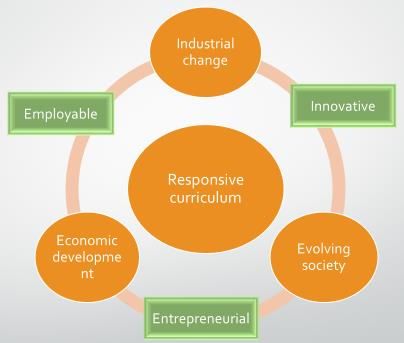
This paper draws on the responsive curriculum approach within a transformational
theoretical framework, as a concept that guides the arguments thereof. Central to this paper is the
responsiveness of the TVET curriculum in the engineering sector towards, economic
development, innovativeness, and graduates’ unemployment. Thus, TVET curriculum in the
engineering departments needs to transform according to changing societal, industrial, and
economic requirements and therefore respond adequately to these spheres within the country and
the rest of the world. Drawing from (Maringe & Osman, 2016), the researchers believe that
transformation could be explained as transfiguration from a societal slavery (‘do as the boss
says’) mindset to inventive (innovative), free-spirited thought patterns which promotes corporate
and individual growth. The University of Pretoria (2016) defines transformation broadly as
“moving from one configuration to another, characterized by on-going rethinking and renewal in
the pursuit of social and environmental justice”. Lally (n.d.) with support from Ogude et al.,
(2005), further argue that a responsive curriculum should be planned carefully to accommodate
its dynamic nature to adapt to evolving societal, industrial, and economic demands in a specific
environment. Therefore, a transforming curriculum aligns to parochial and international contexts,
and germane to social, industrial, and economic needs of whom it serves (University of Pretoria,
2016). Moreover, transformative curriculum responding to the societal, industrial, and economic
expectations (Council on Higher Education, 2015; Maringe & Osman, 2016) would require
appropriate funding to produce good quality TVET engineering graduates. Production of good
quality TVET engineering graduates could also be achieved through embracing soft skills needed
by technicians and artisans.
As espoused by Department of Higher Education and Training (DHET) in the TVET
Teaching and Learning Plan policy, TVET curricula in the South African context should be
3 1528-2651-24-2-688
Citation Information: Masoabi, C.S., & Alexander, G. (2021). Possible merger, entrepreneurship education in TVET engineering
studies: A case for South Africa. Journal of Entrepreneurship Education, 24(2).Journal of Entrepreneurship Education Volume 24, Issue 2, 2021
responsive and relevant to current economic and societal needs. We argue that the DHET needs
to articulate the rationale for a responsiveness and relevant TVET curriculum, as it is not clearly
stipulated in the current policy. Even though HDRC (2014a) states that the vision of DHET is to
make TVET colleges the ‘first choice’ institutions for skills development (Figure 1).
FIGURE 1
TVET RESPONSIVE CURRICULUM FRAMEWORK DEVELOPED
(AUTHORS’ REPRESENTATION)
THE ROLE OF THE TVET SECTOR
In most European and Asian countries, TVET education is generally purposed to meet the
needs of industrial requirements and societal needs, (Field et al., 2014; Hoeckel, 2010; Ibrahim
& Bakar, 2015; Ismail et al., 2019) hence the private sector, other stakeholders and the
government is part of curricula developing structure and processes. However, from British
Further Education (FE) perspective, Orr (2017) regards vocational education as ‘neglected
middle child’ hard-pressed between basic and tertiary education. The need for transformative
restructuring in response to evolving industrial demands is further influenced by computerized
workplace and soft skills (Karmel & Maclean, 2007).
Akoojee (2008) & Powell (2012) posit that the primary role of TVET colleges in South
Africa should be geared towards the provision of intermediate skills needed for economic growth
and moreover developing attitudes and values necessary for employability. Lately, TVET
colleges in South Africa are offering dual curricula, the NATED (old curriculum) and the
National Certificate Vocational (NCV) which was introduced in 2007. The latter is twofold- it
was introduced to equip students with practical skills and provides a reroute for those individuals
that left secondary education after Grade 9, to end up at the institutions of higher learning.
However, TVET institutions seem to not to reach their target (HDRC, 2014b) by producing
graduates with technical skills that are perceived to be misaligned to industry needs and the
progression to higher education institution. The NCS remains a preferred qualification for
admission.
After her independence, Singapore placed focus on TVET institutions to provide world
class skills and knowledge, which in turn attracted investors for manufacturing and the exporting
of finished products back to countries that rely on exporting raw materials and mineral resources
(Law, 2010). As the economic landscape evolves, so was the TVET approach in aligning its
curriculum to meet the needs of changing industrial demands. This position was led by the
autonomous Industrial Training Board, later named the Vocational and Industrial Training
Board. The Institute of Technical Education and the Economic Development Board which went
4 1528-2651-24-2-688
Citation Information: Masoabi, C.S., & Alexander, G. (2021). Possible merger, entrepreneurship education in TVET engineering
studies: A case for South Africa. Journal of Entrepreneurship Education, 24(2).Journal of Entrepreneurship Education Volume 24, Issue 2, 2021
into partnership with dominant foreign companies and investors supported the said position.
When the economy became diversified, globalized and driven by entrepreneurship, the TVET
curriculum adapted to change and became more innovation focused (Tucker, 2012). As authors
of this paper, we endorse the eastern mindset including Malaysian and Singaporean of
incorporating entrepreneurship education for all students to produce world class skills in the
South African TVET sector.
Current Curriculum Expectations in Engineering Studies
The Pathways report (HRDC, 2014b) alluded on the white paper envisioning of the
TVET college sector as the main provider of practical skills for studies, such as engineering. In
its current under resourced state (infrastructure, facilities, and workshop equipment), TVET
institutions in South Africa seem to find it difficult in responding to the latter imperative. The
LMIP Report 22 stated that the TVET sector in South Africa is detached from industry; the
employer and trainer, thus creating a misalignment of the offered curriculum and industry
expectations (Wedekind & Mutereko, 2016). Researchers, suggest that the private sector
(employer), SETA (funder), government (curriculum policy maker) and the TVET colleges
(curriculum implementer & labour force producer) collaborate in developing curricula that
responds to the industry demands and work-integrated learning (WIL) requirements (Orr, 2017;
HRDC, 2014a; HRDC, 2014b). TVET colleges in areas without relevant engineering industries,
struggle with WIL and as such opt for theoretical NATED programmes that allow large
enrolment quantities at low running costs (HRDC, 2014b) - this practice does not serve the
purpose of TVET colleges.
The researchers opinionated that engineering departments at TVET colleges should be
accredited by the Engineering Council of South Africa (ECSA) for curriculum quality assurance
and institutional accountability (Fisher, 2011) which in turn could support future investments in
infrastructure, resources, including teaching and learning. In Asia, it was noted that the quality of
skills development among students and teaching and learning (Asian Development Bank, 2009)
injecting sufficient finances to keep abreast with evolving demands of the industry. Furthermore,
we believe that engineering studies programmes encompassed with entrepreneurial skills, would
serve as an ideal platform for graduates to obtain a dual-profession and promote innovation for
the enhancement of the economy (UNESCO, 2014).
ENTREPRENEURSHIP EDUCATION
Entrepreneurship is mostly associated with the alleviation of unemployment and
contributing towards the socio-economic development of a country through self-employment
initiatives and increased productivity. Entrepreneurship further became an influential force for
economic development through innovation, development, and the execution of new ideas for
future global economic needs (Kuratko, 2005). Therefore, engineering studies as a thriving force
behind innovation would be a suitable base for inculcating entrepreneurship education in the
South African TVET college sector. According to Sanchez (2011), earlier studies focused on
personalities and traits as common variables that influenced the intent of a person to embark on
entrepreneurial ventures and as such, didn’t investigate if these attributes could be somehow
developed, based on the theory of planned behaviour. We therefore believe that entrepreneurship
education emanated as a strategy for developing specific personality traits through purposive
5 1528-2651-24-2-688
Citation Information: Masoabi, C.S., & Alexander, G. (2021). Possible merger, entrepreneurship education in TVET engineering
studies: A case for South Africa. Journal of Entrepreneurship Education, 24(2).Journal of Entrepreneurship Education Volume 24, Issue 2, 2021
training (Kuratko, 2005) and a tool to improve the intention, knowledge, and skills of students to
explore entrepreneurial ventures.
The Necessity of Entrepreneurship Education in TVET Engineering Sector
Entrepreneurship education is regarded as a type of cultural evolution, which is
ideologically constructed by government through educational practices and policies (Rae, 2010)
in responding to prevailing economic challenges. Although, TVET education was overlooked
and regarded as low-class education, latter perceptions view TVET as a contributor to economy
and innovation (Chankseliani et al., 2016). Entrepreneurship education for engineering students
should be conceptualized in such a manner that it widens students’ scope of operation in the
companies they serve (Hynes, 1996). Moreover, Bokova (2017) in UNESCO agenda for 2030
suggests that the TVET sector should be equipped to offer youth entrepreneurial skills through
entrepreneurship education, as one of the Sustainable Development Goals.
Furthermore, (Isaacs et al., 2007; European Commission, 2009; Nicolaides, 2011;
Lekoko et al., 2012; Van Aardt et al., 2014) view the concept of entrepreneurship as a “process
of conceptualizing, organizing, launching and through innovation, nurturing a business
opportunity into a potentially high growth venture”. Unpacking this definition in the context of
this paper, TVET engineering studies students need context specific entrepreneurship education
to learn how to develop a competitive business vision, which is in line with the purpose and
anticipated growth potential of envisaged enterprises (Rasmussen & Sørheim, 2006). A mission
statement, serving as a pathway guideline could possibly assist the future entrepreneur with
creative thinking solutions in establishing business ventures (Karimi et al., 2010; Nicolaides,
2011). The imbedded vision serves as a driving force to pursue this endeavor even if there are
some foreseeable calculated risks on the show of starting or growing a business in a hostile
economic environment (Echtner 1995; Murphy et al., 2007). However, in a more broader
perspective, engineering students’ creativity abilities also need to be triggered and enhanced to
bring about a sense of self-reliance towards unlocking initiatives in work places in advancing
new developments in their areas of specialization) for the betterment and satisfaction of the
society baring-in-mind the environmental impact (Kozlinska, 2011; Lackéus, 2015).
The European Commission (2009) argues that entrepreneurship education should not be
mistaken for economic or business studies since its purpose is to encourage innovation,
creativity, and self-employment. As authors, we argue that entrepreneurs with clear visions could
in the long term acquire the needed business acumen and knowledge in growing his or her
enterprise (Raposo & do Paço, 2011; O’Connor, 2012). Perhaps, the context in which
entrepreneurship education is employed appears to further contribute to claims that its impact is
untraceable as it related to the amelioration of entrepreneurial skills and self-efficacy (O’Connor,
2012). Rasmussen & Sørheim (2006) further argue that some reports perceive entrepreneurship
education to be a successful adventure in improving students’ intentions in commencing with
new enterprises in various parts of Europe, as a means of encouraging skilled self-employment
opportunities (Radipere, 2012).
The preliminary results of a pilot study on final year commercial studies student views
regarding youth intentions to explore entrepreneurship in South Africa (Musengi-Ajulu, 2009),
indicated that most of the students showed to have intentions of venturing into entrepreneurship.
However, only 22% of them stated to be informed regarding the practicalities of starting a
business. Moreover, cultural perspective has also proven to effect students’ views. Only 24% of
6 1528-2651-24-2-688
Citation Information: Masoabi, C.S., & Alexander, G. (2021). Possible merger, entrepreneurship education in TVET engineering
studies: A case for South Africa. Journal of Entrepreneurship Education, 24(2).Journal of Entrepreneurship Education Volume 24, Issue 2, 2021
these students’ immediate families regarded entrepreneurship to be an invaluable asset to
students’ employability. A similar recent study done in Malaysian TVET sector on
entrepreneurial intents of technical graduates (N=262) at two institutions revealed high
percentage (N=235 -89.7%) of moderate to high level social norms (family and culture)
influence on their intentions to embark on start-ups after graduation (Ibrahim & Bakar 2015).
These findings build to this paper’s argument that educational empowerment is necessary and
could therefore enable graduates to overrule views of the society based on the skills they have
acquired at higher learning institutions. Furthermore, there should be a way of teaching students
these skills in a more practical and authentic manner, not just as content knowledge but to
develop self-efficacy, pro-activeness and other personal traits, values, attitudes and beliefs
(Raposo & Paço, 2011; Sanchez, 2011) and to be possibly self-employed after their studies when
embarking on entrepreneurial enterprises as a first preference. Haertel et al., (2016) believe that
the fostering of creativity for engineering students to generate ideas that solve current problems,
and innovative ideas to be transferred into new business initiatives. Nieman & Niewenhuizen
(2019) have indicated twelve entrepreneurial attributes (passion, locus of control, need for
independence, need for achievement, risk taking and uncertainty, creativity and innovation,
leadership, good human relations, positive attitude, determination and persistence, persistent
problem solving and commitment) that students should be skilled for them to gauge in economic
opportunities and the establishment of conducive environments and the promotion of self-
confidence in initiating and advancing their future businesses.
It would, therefore, be necessary for lecturers in the engineering TVET sector of South
Africa to be trained and equipped with entrepreneurial education and skills that will enable them
to cultivate skills, more relevant and applicable to engineering students. If the lecturers have
developed entrepreneurial conviction and behaviours, they should be in a position of
encouraging their students to participate in entrepreneurial ventures, after the completion of their
studies (Haolader, 2015). Moreover, these kinds of lecturers would also have the ability to design
practical activities, teaching students how to start or run a small business- thereby improving
possibilities of more graduates choosing to collaborate and commence with their own small
companies. Echtner (1995) contend that the big setback in implementing entrepreneurship
education in most developing countries is the lack of qualified and experienced lecturing staff
which in turn may lead to countries, such as South Africa outsourcing skilled labour from 1st
world countries, is an expensive exercise.
Global Perspectives on Entrepreneurship Education in TVET Colleges
The global view is that TVET colleges are most appropriate to respond to the
development of entrepreneurship skills and improve employability of graduate artisans and
technicians as a measure of addressing issues of youth unemployment and exclusion in socio-
economic development. Moreover, developing countries attempted to curb high unemployment
rates amongst young people, by enrolling school leaving students in TVET colleges and
equipping them with only theoretical and technical skills (Haolader, 2015). We argue that
entrepreneurial capabilities could be a better tool for creating of self-employment opportunities
for students after they have completed their engineering studies qualifications.
For over twenty years, Bangladesh has incorporated various entrepreneurship education
in all TVET colleges with a value of two credits per programme. This country’s National Skills
7 1528-2651-24-2-688
Citation Information: Masoabi, C.S., & Alexander, G. (2021). Possible merger, entrepreneurship education in TVET engineering
studies: A case for South Africa. Journal of Entrepreneurship Education, 24(2).Journal of Entrepreneurship Education Volume 24, Issue 2, 2021
Development Policy places more emphasis on the promotion of employability and self-
employment skills (Haolader, 2015).
After realizing high unemployment of TVET graduates, the Malaysian government
decided to inject funds into the implementation of entrepreneurial education, which commenced
from primary school through to tertiary institutions. This action assists the TVET college sector
in enticing graduates’ in exploring entrepreneurial ventures after their studies (Mansor &
Othman, 2011). Moreover, the Malaysian government took upon itself to source the best
practices that would yield the intended outcomes. The government made entrepreneurial
education a compulsory course for all students, irrespective of the direction of study (Ibrahim &
Bakar, 2015). The reason being that TVET colleges offer a variety of skills that students could
use to start new businesses ventures after the completion of their studies- the acquisition of
entrepreneurial skills enhance graduates’ self-efficacy beliefs to commence with new business
enterprises. In tstudy (Ibrahim & Bakar, 2015) show that the majority of TVET graduates seem
to have intentions of venturing into enterprise. Students’ positive attitudes towards
entrepreneurship and their levels of high self-efficacy and entrepreneurial knowledge are mostly
supported by the society and cultural norms.
Moreover, Oosterbeek et al., (2010) and European Commission (2009) report that in the
majority of European countries, 90% to 100% of TVET College students partake in
entrepreneurship curricula at a certain level of their study career. In most European countries,
such as Austria, Cyprus, Denmark, Estonia and Germany, Czech Republic Hungary, Poland and
Norway, Romania, Slovenia, Spain, Netherlands and Slovakia, entrepreneurship education is
included in curriculum policies as a strategy of encouraging and increasing self-employment for
the betterment of a country’s economy. In other countries, such as Sweden, Italy, France and the
UK, entrepreneurship education is not yet compulsory but rather optional for those students who
may be interested in gaining entrepreneurial skills. Thus, students’ mini-company
(entrepreneurial) programme is leading and producing observable positive impact among
students’ intent to become self-employed.
The Iranian unemployment rate for college women and girls increased to 54% in 2002,
because of the country’s historical background of government as the main employer (Karimi et
al., 2010). In this context the higher education sector of Iran is focused on developing future
employees for the country. However, this development has evolved through government’s
injection of finances in research, promoting and encouraging entrepreneurship and innovation -
and developing education policies for inclusion of entrepreneurship education. Iran further
introduced a science and technology park and business incubator as breeding environment for
entrepreneurs with various educational specializations. Furthermore, the concern raised by
Karimi et al., (2010) is the minimal impact of entrepreneurship education when higher learning
institutions offer it as a standalone rather than being embedded in various course contents.
The State of Entrepreneurship Education in the African TVET Sector
Nigeria as one of the most populous African countries has not yet ventured into
developing its TVET college curriculum to the extent where it should have included
entrepreneurship skills as some of graduate characteristics in programmes (Maigida et al., 2013)
as to respond to the high unemployment of young people in that country. The report of the
National Steering Committee (2011) assigned to develop the National Qualification Framework
(NQF) for Nigeria listed various aspects which hinder skills development in the country, namely,
8 1528-2651-24-2-688
Citation Information: Masoabi, C.S., & Alexander, G. (2021). Possible merger, entrepreneurship education in TVET engineering
studies: A case for South Africa. Journal of Entrepreneurship Education, 24(2).Journal of Entrepreneurship Education Volume 24, Issue 2, 2021
a neglected TVET sector which isn’t prioritized and the theoretical approach to teaching and
assessment. Like in many other African countries, TVET education is also perceived as a
pathway for unintelligent individuals who could not obtain access to the traditional universities
(Dike, 2013). Limited response to the industrial needs of Nigeria, associated with a decrease in
the number of accredited technical colleges, is an indication of how the quality of training is
diminishing. The formal TVET institutions, resorting under the National Board (NBTE) range
from technical colleges, mono-technics, and polytechnics. The report further states that
entrepreneurial education for TVET sector is incubated in the policy awaiting due
implementation. Thus, Nigeria’s TVET sector is focused and prioritized on the advancement of
the country’s socio-economic status (Dike, 2013). Akpoyibo (2015) assets that high
unemployment rate of TVET graduates in Nigeria results from inadequate skills provided by
these institutions in the country; and further postulates that entrepreneurship education should be
included in TVET colleges to transform skills into merchandises and services for the betterment
of TVET graduates’ participation in the economy. Since the epoch of certification that
guaranteed employment has past, Onweh et al., (2013) further attest that, inclusion of
entrepreneurship education in TVET sector would be profitable to the country’s economic
development.
Botswana is one of the African countries that have introduced entrepreneurship education
in its TVET college sector on all the qualifications. In the study that was done in Selebi-Phikwe,
Setibi & Mapfaria (2014) indicate that the region is still experiencing high youth unemployment
with TVET qualifications. The study stipulated various factors that push graduates to seek
employment that would give them monthly wages or income, they include bursary contracts that
need repayment on regular basis after completion of studies, lack of capital to start-up and
entrepreneurial skills are offered at lower level that does not build confidence and competence
among graduates to take risks of venturing into small enterprise sector. Moreover, students are
only given theory and not exposed to real-world practices such as acquiring mentorship
relationship with existing and advancing entrepreneurs. Moreover, according to Jotia & Sithole
(2016) resent studies in Botswana indicated that about 49% of TVET graduates are hunting for
jobs due to misalignment of skills provided by TVET sector as opposed to industrial
requirements.
Furthermore, Ethiopia as one of the African countries that despised entrepreneurship in
the past - regarded as anti-social also associated with lower class citizens. But currently
entrepreneurship is prioritized as one of the eminent economic drivers in the country (Edem,
2008). Above all, Ethiopia has included entrepreneurship education within its TVET college
sector in all the departments for over a decade. The study done in two of the Addis Ababa TVET
colleges (Edem, 2008) reflects that teaching methods varied from authentic project based, group
discussions, field visits, lecture to simulations presuming most of necessary skills, values and
attributes have been properly addressed in the colleges. Students as research participants
indicated that entrepreneurship education has played positive role in improving their self-
efficacy to start-up new enterprises and majority indicated to opt for self-employment as their
first choice after completing their studies. However, in another study by (Tegegne, 2014) in
some colleges around Addis Ababa, revealed that the quality of entrepreneurial training offered
at the colleges tend to be inadequate to help the graduates start-up their own small enterprises
because time allocation was not enough. Another challenge was creating an environment that
supports graduates’ collaborations to venture into starting their own businesses from the
government and private sectors. It could, however, be inferred that Ethiopia may be regarded as
9 1528-2651-24-2-688
Citation Information: Masoabi, C.S., & Alexander, G. (2021). Possible merger, entrepreneurship education in TVET engineering
studies: A case for South Africa. Journal of Entrepreneurship Education, 24(2).Journal of Entrepreneurship Education Volume 24, Issue 2, 2021
exemplary to South Africa that entrepreneurship education - when efficiently and effectively
implemented in TVET colleges could be a major economic development model.
Like many other developing countries, Kenya also initiated to put more emphasis on
academic education which resulted in high unemployment of young people - as TVET education
was neglected. About three decades ago, Kenya began to focus its emphasis on technical and
vocational education and introduced it as, the Technical, Industrial, Vocational and
Entrepreneurship Training (TIVET) sector (Nyerere, 2009), that already included the
entrepreneurship training in the naming and categorizing of the TVET sector. Thus, it is
therefore evident that entrepreneurship education is one of the main purposes of vocational
education in this country. Moreover, the educational framework allows academic progression
within the technical education from Technical Secondary Schools, to TIVET College Diploma,
to TIVET under-grad and to the highest post-graduate levels and even crossing to the traditional
universities.
Furthermore, the Republic of Kenya (2012), states that the country’s vision 2030 directed
focus on TVET as driving force behind economic growth aimed at producing varied levels of
technical expertise. Kenya education system further invested in TVET teacher training to
produce expected skills and competencies and, also mobilizing resources and private business
sector as benefactors to increase revenue for running TVET institutions. According to Simiyu
(2009), alignment of TVET skills training to the industry requirements and the introduction of
entrepreneurship education was the best strategy ever. Which has encouraged majority of Kenya
TVET graduates to embark on entrepreneurial ventures? Moreover, the TVET sector is working
closely with private sector where students get authentic entrepreneurial training. Simiyu (2009)
further indicates that, even those trainees who opted for salary paying jobs - in the long run they
start their own enterprises. The researchers are of the opinion that South African Department of
Higher Education and Training needs to invest on sending researchers and TVET lecturers to
countries like Kenya to harness good TVET entrepreneurial skills development strategies.
The State of Entrepreneurship Education in South African TVET Colleges
One of the largest providers to employment is South Africa, is the manufacturing sector
which contributes 12% to South Africa’s GDP. South Africa demonstrates an unemployment rate
of 38.7% and a youth unemployment (15-24 years) rate of 58.1% (Stats SA 2019). Production in
the manufacturing sector fell 5.9% year-on-year in December 2029 to its biggest decline since
July 2014. In responding to this aspect and the current gloom economic prospect exacerbated by
COVID-19 in South Africa, alternatives need to be explored as to have graduates at higher
learning institutions, such as TVET colleges could be empowered with entrepreneurial skills.
According to Gamede (2019), entrepreneurship education in TVET colleges is regarded as a
critical aspect in advancing the knowledge and skill base of citizens in so far as positively
contributing to the socio-economic development and technological advancement of a country. In
South African context, the government regards entrepreneurship as any form of small enterprise
without any creativity or innovation - whether selling fruits at street corner for survival or having
political relations to access government tenders “Tenderpreneur” from state owned parastatals
(Van Aardt et al., 2014). According to Kuratko, (2005), entrepreneurship could not be limited to
a mere formation of small enterprises as it is a process driven by creativity, innovation and
implementation of new ideas and seizing opportunities with calculated risks.
10 1528-2651-24-2-688
Citation Information: Masoabi, C.S., & Alexander, G. (2021). Possible merger, entrepreneurship education in TVET engineering
studies: A case for South Africa. Journal of Entrepreneurship Education, 24(2).Journal of Entrepreneurship Education Volume 24, Issue 2, 2021
According to HRDC (2014b), entrepreneurship training is largely done by independent
providers outsourced by SETAs and not necessarily instilling the skills for entrepreneurs but
giving theories on how to start a small business. However, on TVET campuses, entrepreneurship
modules are only found in management courses. Therefore, engineering students in South
African TVET colleges are disadvantaged regarding the acquiring of entrepreneurial skills. The
Strategic Framework and Programme of Action for TVE in the SADC Region (2011) refer to the
necessity of including entrepreneurship education within the curriculum as a means of
responding to the lacking economic and skills development in the region.
In achieving the vision of Accelerated and Shared Growth Initiative of South Africa
(ASGISA) it seems it would take time for South Africa to arrive at an acceptable standard in
including entrepreneurship education at basic education and at TVET sector level (Nicolaides,
2011). We argue that this delay is because of a narrow-focused definition of entrepreneurship in
the South African context. Regarding entrepreneurial activity as solely small business sector or
start-up ventures (Museng-Ajulu, 2009) excluding creativity and innovation as major aspects of
entrepreneurial skills and training is a setback. Innovation on the other hand is viewed as being
inclusive of developing new products, improving quality of products, and advancing new
processes of production that respond to current social and environmental needs (Gürol & Atsan,
2006). We further claim that innovativeness is an integral competency of entrepreneurship
education as new opportunities evoke profitable change and business growth (Mitchelmore &
Rowley, 2010). UNESCO (2014) have identified ten key areas of TVET reform, namely:
enhancing responsiveness of TVET provision, changing perceptions of TVET, restructuring
qualifications frameworks and building new learning pathways, increasing work-based learning,
skills development for TVET lecturer and trainers, improving ICT usage at TVET, cultivating
good quality governance and partnerships and establishing sustainable financing models for
TVET sector. These key areas of anticipated reform in TVET should include entrepreneurship
education to improve responsiveness of the curriculum to youth employability.
Methods of Teaching Entrepreneurship Education
Since entrepreneurship education in South African engineering departments at TVET
colleges would be a largely new phenomenon, scholars need to search for more efficient
pedagogical approaches and theories of learning that would guide its teaching and learning
(Karimi et al., 2010). Lackéus (2015) categorized entrepreneurship education delivery methods
as “teaching about”, “teaching for” and “teaching through” entrepreneurship. While the first
entails content-based which normally gives general knowledge and understanding of the
environment? The second method of teaching is giving basic knowledge and skills for start-ups -
and he recommends these methods for high school students since they are still young. Thus,
“teaching through” entrepreneurship is proposed as more relevant for inclusion in core subjects
such as engineering division - where students would be given experiential learning to go through
the entrepreneurial process (Lackéus, 2015; Rae, 2010). Moreover, Arasti et al., (2012) listed
other recommended methods of teaching entrepreneurship education, which include case study,
group discussion, individual presentation, individual report writing, group project, formal
lectures, guest speakers, action learning, web-based learning, simulation and recorded video. It
could thus be argued that teaching students how to look after an existing business and obtaining a
managerial position as good and loyal servants, is not instilling entrepreneurial motives, skills
and graduate attributes (Aronsson, 2004) and therefore suggests that the active participation of
11 1528-2651-24-2-688
Citation Information: Masoabi, C.S., & Alexander, G. (2021). Possible merger, entrepreneurship education in TVET engineering
studies: A case for South Africa. Journal of Entrepreneurship Education, 24(2).Journal of Entrepreneurship Education Volume 24, Issue 2, 2021
students through apprenticeship is perceived to be one the best ways to teach entrepreneurship
skills and instill a climate for authentic experiences (Rae, 2010).
Therefore, to obtain these characteristics among TVET Engineering students, relevant
methods of teaching should be directed to each of the attributes. It is evident that the world’s and
South African economies are private sector driven (Maigida et al., 2013) and in turn it needs to
be noted that practical and authentic ways of teaching artisans’ entrepreneurial skills to stimulate
correct attitudes, values and culture are required ((Mwasalwiba, 2010).
Mansor & Othman (2011) listed some the world’s best delivery modes for entrepreneurial
education, which include aspects such as facilitating and coaching; experiential learning;
problem-based learning; students as leaders; people in the community; variety of methods and
lifelong learning model. Problem based and experiential learning is highly recommended.
Experiential learning by John Dewey, is highly recommended (Malindi, 2014) as one of active
learning pedagogies where experiences are reconstructed into tacit knowledge and could be
regarded as the underpinning theory behind the other fore mentioned recommended
entrepreneurial education delivery modes in obtaining the envisaged graduates’ attributes
required of Engineering students (Kozlinska, 2011). Honig (2004) further suggests that the
inclusion of both content knowledge and soft skills (values, daily experiences, and attitudes)
learnt through experiential learning could possibly be an effective way of teaching
entrepreneurship education.
METHODOLOGY
The paper is qualitative in nature where primary and secondary sources such as research
articles, curriculum policies and research reports, news publications and books were used to
draw data for this conceptual paper (Owen, 2013). The researchers attempted this research using
credible and authentic sources to ascertain the trends of entrepreneurship education globally,
within the African continent and in South Africa. The paper further, seeks to comprehend the
impact of entrepreneurship education on economic development and youth employment in
places, especially where it is part of artisan training (TVET sector) curriculum. The study
employs hermeneutics as a research approach. Thematic goals for content analysis procedures to
extract the richness of assertions from various sources were used as a form of data analysis
(Mayring, 2014). The researchers opted for document analysis as research method due to readily
available information on public sphere to hasten the identification of research gaps in the TVET
division. Research papers and policy documents from various parts of the world, European,
Middle East, Asian, African and South Africa focusing on perspectives relating to the TVET
sector and entrepreneurship education for engineering studies, were consulted. Furthermore, to
add on to the literature, the researchers integrated some data gathered via engagements
(information sharing session, a group discussion and scheduled visit) with the international office
representative at a Polytechnic in Singapore, a mechanical engineering lecturer at a TVET
college in the Free State province and NATED and NCV engineering lecturers at a TVET
college in Gauteng province South Africa.
Engagements with Participants at TVET Colleges in South Africa
As part of a larger research project on profiling the qualifications of TVET lecturers in
South Africa to assist universities develop programmes for TVET lecturer training. Our research
team focused on TVET engineering studies lecturers. When delivering the survey to the colleges
12 1528-2651-24-2-688
Citation Information: Masoabi, C.S., & Alexander, G. (2021). Possible merger, entrepreneurship education in TVET engineering
studies: A case for South Africa. Journal of Entrepreneurship Education, 24(2).Journal of Entrepreneurship Education Volume 24, Issue 2, 2021
a participatory technique was employed. We sort permission from the college principal and the
campus manager to access their institutions and their staff members. Once permission was
granted, we would then set an appointment with the campus manager and engineering lecturers.
The purpose was to hear some issues which may not be possible to ask on the survey or concerns
that may be raised by participants - as well as for introducing the purpose of the study to the
participants.
Participatory technique seeks to get more information from the participants by using
strategies such as focus groups (Campbell, 2002) which were used for the purpose of this paper.
At the TVET College in the Free State the team had a meeting with the campus manager, who
then delegated the Mechanical Engineering lecturer to take us through the workshops, where we
engaged with other lecturers briefly. It was when we saw the students’ projects in his workshop
that triggered the issue of entrepreneurship education for engineering students. We asked to have
a brief interview with him that was recorded on a phone with the lecturer’s permission. As a
follow up on the entrepreneurship education we arranged a meeting with the College senior
management team which consisted of five members including the Principal. The meeting was
also recorded on voice and video camera and took about an hour of which the main purpose was
to propose memorandum of understanding between the researchers and the college.
Furthermore, participatory research assists researchers to gain more knowledge regarding
the practices of the researched community from the community itself and gives the participants
ownership of the knowledge (Tadevosyan & Schoenhunth, n.d; Bergold & Thomas, 2012).
At the Gauteng TVET College a non-probabilistic, convenience sampling procedure was
implemented as the intention was to meet as many as possible that would be available at the
time. We met around a table with a focus group of fifteen engineering lecturers in the campus
manager’s boardroom and the manager was part of the proceedings. Six of the engineering
lecturers were in the NCV curriculum and the other nine were from the Report 911 known as
NATED curriculum. Because of the number of attendees, the meeting took about two hours due
to the introduction of the purpose of the study and familiarizing groups, researchers, and
participants.
The engineering department lecturers were engaged on the following issues, namely:
entrepreneurial skills/entrepreneurship education being included in their programmes and college
curriculum-please motivate/expound on your answer and the reasons as to why it would
advisable or profitable for students to integrate entrepreneurship education in engineering studies
programmes (Table 1).
Table 1
SNIPPETS OF ENGAGEMENTS WITH TVET PARTICIPANTS INTERVIEWS
TVET Date of
College Engagements Selective Excerpts from Engagements
Researcher - Do you offer entrepreneurship education to engineering students?
Free State Lecturer - We build gas-stove stands considering the markets outside, braai
(Mechanical stands and garbage holder-stands. They must be proactive and think of market
Engineering outside. However, we do not do entrepreneurship as a course because it is not a
lecturer) 03-04-19 prescribed part of curriculum for engineering studies. I would say that I do it
Information informally as advice, telling them when they go out of here, they should not wait
Sharing for someone to hire them, as most of them didn’t do well at schools and some have
Session a little bit of disability to go and make a living outside.
Researcher -In the townships I see a lot of these trash holders. Yes, you are right,
there is a lot of market out there for them.
13 1528-2651-24-2-688
Citation Information: Masoabi, C.S., & Alexander, G. (2021). Possible merger, entrepreneurship education in TVET engineering
studies: A case for South Africa. Journal of Entrepreneurship Education, 24(2).Journal of Entrepreneurship Education Volume 24, Issue 2, 2021
Researcher - What is your opinion about including entrepreneurship education
Free state for engineering studies students?
(Senior Principal - It is a good idea, but we already have incubators where students can
08-08-19
Management come and learn how to generate ideas for start-ups. Although they are not forced
Team) but made aware of its existence. However, the main intention is for those who
have completed their studies as well as the other rising entrepreneurs in the city.
Researcher - Do you think including entrepreneurship education in engineering
studies will be profitable to the graduates?
Respondent 1: It will be difficult with other courses such as instrumentation or
fitting & turning as they need companies with their trades. Equipment that they
Gauteng use is too expensive and some machinery are huge for small businesses.
(NATED & Respondent 2: But for others such as electricians, motor mechanics, and boiler
NCV maker could work as they may need start-up tools to start working independently
17-10-19
lecturers) or small scale. They can survive with hand tools for some time before their
Group businesses grow for high demanding tasks that need expensive and heavy
Discussion machinery.
Respondent 3: It’s not part of our curriculum, but I think it’s a good idea that
can help employability of graduates. But we need to have world class machinery
in our NCV workshops. As for NATED curriculum I don’t know because they only
do theory without practical.
International Officer - You said you are interested in entrepreneurship?
Researcher - yes.
Singapore International Officer - We do have, and this is where it’s done, and students
Polytechnic spend six months here (showing a place on the campus map). Entrepreneurship
(international 15-03-19 education is offered to all the students at the Polytechnic. We also have an
officer) Study incubator where students can go develop and work on their designs and
visit inventions. Entrepreneurship education is compulsory for all tertiary institution
students because it instil skills and values that are needed by current industry
demands. We have found entrepreneurship increasing employability chances of
our graduates.
Findings from Engagements with Participants from TVET Colleges
Entrepreneurship course: From the two South African colleges, engineering lecturers
indicated that entrepreneurship education is not part of the curriculum. However, a mechanical
engineering lecturer in a Free State TVET college alluded that he teaches his students informally;
to think of and observe societal needs that they could respond to with their skills for monetary
gains.
While from the Gauteng TVET College, no lecturer stated to be casually encouraging his
or her students to embark on start-ups with their skills. Other than that, lecturers believed
entrepreneurship education could work for other engineering courses (electricians, motor
mechanics and boiler maker) and not others like instrumentation and fitting and turning. This
shows that, if introduced in engineering studies curriculum, entrepreneurial skills for start-ups,
including those for training assertive/innovative employees would be crucial.
It could therefore be deduced that lecturers are of the opinion that entrepreneurship
education could be beneficial to TVET engineering studies students. However, from the
curriculum documents only students in Business Studies benefit by being introduced to
entrepreneurship education.
From the discussion meeting with one of Free State TVET College Management Team, it
came to our attention that various colleges including this one in the Free State, they have
established incubators for entrepreneurial developments. However, it seemed to be more of
14 1528-2651-24-2-688
Citation Information: Masoabi, C.S., & Alexander, G. (2021). Possible merger, entrepreneurship education in TVET engineering
studies: A case for South Africa. Journal of Entrepreneurship Education, 24(2).Journal of Entrepreneurship Education Volume 24, Issue 2, 2021
community development project. Not necessarily for TVET college students but the surrounding
communities. With our brief visit to the incubator, it was confirmed by the administrator that
majority of participants are members of the community already involved in small business
establishments.
Emanating from an interview with the International Officer at a polytechnic in Singapore,
it is evident that entrepreneurship education is seen as invaluable asset to all students, regardless
of their areas of specialization. It thus could be concluded that in Singapore, all students in a
polytechnic are encouraged to be entrepreneurial orientated with whatever direction of
specialization is followed by students. Moreover, every student is considered a potential
entrepreneur and innovator in their area of specialization.
Employability: lecturers from the South African TVET colleges indicated that inclusion
of entrepreneurial could enhance employability of engineering studies graduates- this could be
enacted through self-employment opportunities through the establishment of small-scale
businesses. However, the concern is on the NATED program where engineering graduates s exit
the TVET colleges without any hands-on skills other than theory. Furthermore, lecturers
confined to the NATED or Report 191 curriculum are of the opinion that their programme
should be reviewed to include current information on new technologies in different engineering
specialisation fields. During the group engagement with the Free State TVET college campus
manager and the engineering lecturers, a concern was raised as to how engineering courses could
be offered without workshop experience (practical). Students appear to be frustrated when they
are not exposed to a type of ‘apprenticeship’ in the industry, where profit is the focus. The
industry seemingly does not want to take these students to teach them what they should have
learnt at the college workshops. Industry is of the opinion that skills and values like safety
measures, use of various hand tools is a college responsibility and regards it as waste of
production time. Secondly, the central region of South Africa is not as industrialized as regions
like Gauteng or places with mining companies around. Students hardly obtain their National
Diplomas as qualified artisans.
DISCUSSION
South African TVET sector seems to be continually misplaced, therefore providing
substandard quality qualifications with obsolete skills to those required by the post-industry
(digital) economy due to inadequately qualified teaching personnel and lecturer understaffing
(Maringe & Osman, 2016; Akoojee, 2008). This unpleasant phenomenon within the TVET
seems to be prevailing in other regions of the world as well. For example, in countries such as
Pakistan, Bangladesh, Afghanistan, India and China, the TVET sector is mostly offered at high
school level therefore not meeting the current economic expectations of knowledge and
information era that is booming (Agrawal, 2013; Akoojee, 2008). It could also be understood
from the history of TVET sector in most of these countries that it has not been the priority of
governments to develop this sector to global market levels but was regarded as second-class type
of education. In South Africa, innovation and creativity for entrepreneurship could be achieved
by synchronising the TVET curriculum progression from NCV (NQF Level 4), Technical School
matric with engineering subjects to N4 by increasing the NQF level at N4 to N6 to that of the
engineering diplomas (NQF Level 6 with 360 credits) which is offered at universities of
technology to produce high skilled labour (technicians). Instead of doing N4 to N6 in almost 30
weeks, each of these levels should be offered in 10 months period. In this manner, subject
15 1528-2651-24-2-688
Citation Information: Masoabi, C.S., & Alexander, G. (2021). Possible merger, entrepreneurship education in TVET engineering
studies: A case for South Africa. Journal of Entrepreneurship Education, 24(2).You can also read


