PreCAL and VCAL Handbook 2022 - Thomas Carr College
←
→
Page content transcription
If your browser does not render page correctly, please read the page content below

PreCAL and VCAL Handbook
          2022

                           1
Contents
Introduction to PreCAL and VCAL .............................................................................................. 3
How do pathways work in Senior School?.................................................................................. 4
Contact information .................................................................................................................... 5
PreCAL and VCAL Fees ............................................................................................................ 6
Applied Learning Pathways Typical Week Structure Summary .................................................. 6
PreCAL (Year 10 Students Only) ............................................................................................... 7
   Structure of Program - Monday to Friday ................................................................................ 7
   Benefits of Program ................................................................................................................ 7
   How to Apply .......................................................................................................................... 7
   Deadlines ............................................................................................................................... 7
   PreCAL compulsory subjects .................................................................................................. 8
   PreCAL VET ........................................................................................................................... 8
VCAL (Year 11 and 12 Students Only) ....................................................................................... 2
   Program ................................................................................................................................. 2
   Structure – Year 11 VCAL (student to choose one of the following options) ........................... 2
   Structure- Year 12 VCAL ........................................................................................................ 3
   Benefits .................................................................................................................................. 3
   Expectations ........................................................................................................................... 3
   Application Process Year 11................................................................................................... 4
   Application Process Year 12................................................................................................... 4
   Structure Workplace Learning ...............................................................................................10
   School Based Apprenticeships & Traineeships......................................................................11
VCAL Subject Guide .................................................................................................................12
   Literacy..................................................................................................................................13
   Numeracy ..............................................................................................................................14
   Personal Development Skills .................................................................................................16
   Work Related Skills ...............................................................................................................16
   VCAL Religion .......................................................................................................................16
Glossary....................................................................................................................................16

                                                                                                                                              2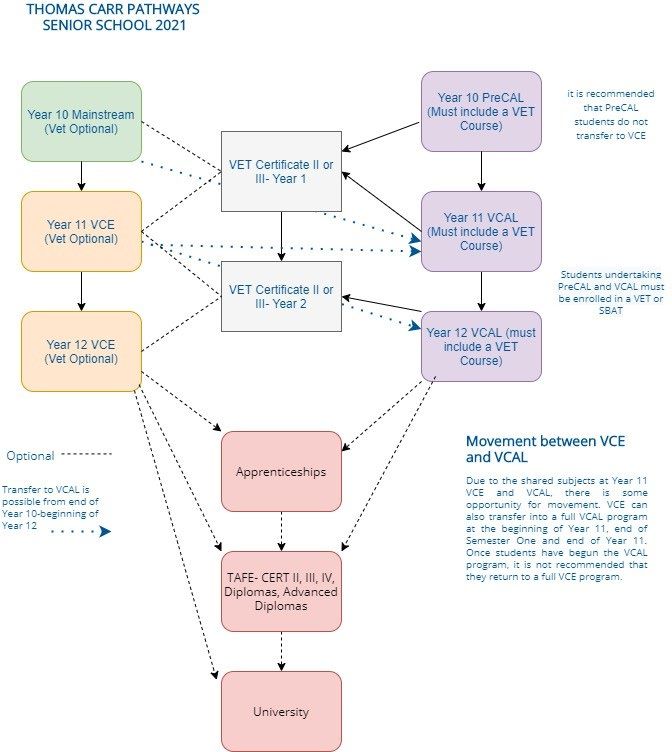
Introduction to PreCAL and VCAL

For students wishing to undertake PreCAL and VCAL studies at Thomas Carr College, this
Handbook Booklet will provide the student and their families with the information necessary to
make an informed decision. Thomas Carr College looks to ensure that students can engage in
pathways that is flexible and suit their interests in the Senior School.
Thomas Carr College’s PreCAL program for Year 10 students is designed for students who are
interested in applied learning and pathways such as VCAL, apprenticeships, traineeships and
getting into the workforce. Students involved in the PreCAL program, participate in classes more
focussed on employability skills and are required to have a Vocational Education and Training
(VET) Certificate. This is not a suitable program for students continuing into the Victorian
Certificate of Education (VCE).
The Victorian Certificate of Applied Learning (VCAL) is a nationally recognised senior school
qualification, like the VCE, for year 11 and 12 students. VCAL courses provide practical education
and training for young people. Through hands-on learning, students gain skills and knowledge
relevant to work and life in local and global communities. VCAL is administered by the Victorian
Curriculum and Assessment Authority (VCAA). Our program incorporates Vocational Education
and Training (VET) Certificates, which assists in many pathways after secondary school.

1Year 11Personal Development Skills   -

                                                                                                3
How do pathways work in Senior School?
4Contact information
VET/ VCAL Co-ordinator
Mr Casey Backhouse
8734 2444
Casey.backhouse@thomascarr.vic.edu.au
For all enquiries about:
• VET and VCAL course selection
• Content of VET and VCAL
• Enrolment of VET, PreCAL or VCAL
• SBATs
• Structured Workplace Learning for VET and VCAL students
For All Careers, Pathways and Post Thomas Carr Options
Ms Naomi Nolan
Careers Team Leader
8734 2444
Naomi.nolan@thomascarr.vic.edu.au
All Fees and Charges Enquiries
Mr Chris Knaggs
Business Manager
8734 2444
Mrs Thu Tran
Finance Manager
8734 2444
Ms Michelle Cox
Debt Management Officer
8734 2444
5PreCAL and VCAL Fees
Thomas Carr Tuition Fees will be set in Advent Term.
As VET is a requirement of PreCAL and VCAL, no additional charges will be applied for VET
tuition and material/ ancillary fees.
Applied Learning Pathways Typical Week Structure Summary
MONDAY TUESDAY WEDNESDAY THURSDAY FRIDAY
Year 10 Program 2022
VET
Normal Normal Normal
Thomas Carr Normal School Day
School Day School Day School Day
College
Year 11 Vocational
VET
Specialisation in the
VCE Normal Normal Or Normal
Normal School Day
School Day School Day School Day
(Previously VCAL) 2023 Work
Placement
Year 12 Vocational
VET
Specialisation in the SBAT
VCE Normal Normal Or
or Normal School Day
School Day School Day
(Previously VCAL) 2024 Work
SWL Day
Placement
6PreCAL (Year 10 Students Only)
In 2022, Thomas Carr will be offering an option to Year 10 students who are interested in hands
on and applied learning. The subjects will be designed for students who are interested in pathways
such as VCAL, apprenticeships and getting into the workplace.
Structure of Program - Monday to Friday
• Homeroom
• Literacy
• Numeracy
• Religious Education
• Physical Education
• VET course offered through the Wyndham Cluster
o Most courses run on a Wednesday afternoon, though there are some that run on a
Friday
o Students will also be allocated a study hall to compensate for the extra time required
to attend VET, including travel time and holiday classes. They will be supervised and
provided additional support for learning, if required
• Electives from Year 10 subject handbook
• Timetables will be confirmed in Advent Term
Students will need to maintain the College’s 90% attendance requirement for all subjects, as well
as their chosen VETIS course.
Benefits of Program
• Additional support in the areas of Literacy and Numeracy
• Tailored projects focused on pathways and life skills
How to Apply
• Complete Year 10 Online Subject Selection, choosing PreCAL
• Select VET option
• If completed by due date, students will need to attend a meeting with VCAL VET Co-ordinator
to determine their eligibility and suitability for the program.
• There will be additional enrolment paperwork if student is successful
• Once subject selections have closed, students will be emailed out VET enrolment
requirements, as well as details regarding the VET deposit
Deadlines
• Year 10 subject selection form ** August 2021.
• VET enrolment information will be emailed to students: ** August 2021
• Notice of Withdrawal from VET courses due: To be confirmed for February 2022 (to
avoid additional costs)
• Please be aware that places are limited.
PLEASE NOTE: Students who are enrolled in the PreCAL program need to be aware that entering
VCE in Year 11 is not recommended.
7PreCAL compulsory subjects
All Year 10 students are required to study the following subjects for the entire year.
Religious Education Humanities – at least one semester
Pastoral Care or STS
Literacy Health and Physical Education
Numeracy VET study
Science – at least one semester
PreCAL VET
Students can choose A VET from within the Wynbay Cluster
VET LOCATION
VET from within the WynBay Cluster Various locations around the City of Wyndham
Additional information about the VET courses that are available through the Cluster can be found in the
VET Handbook 2022.
PreCAL COMPULSORY HUMANITIES
All students will study a Humanities subject for at least ONE semester in Year 10.
Students are required to select from ONE of the below History, Geography or Commerce
options:
History
Civil Rights and Immigration
Word War II
Commerce
Business and Legal ** new in 2022
Money Matters: Accounting and Economics ** new in 2022
Geography
Human Geography ** new in 2022
PreCAL COMPULSORY SCIENCE
All students will study Science in Year 10 for at least ONE semester.
Students are required to select from ONE of the below Science options:
• Science (full year)
• Advanced Science (full year) ** new in 2022
• Science (one semester)
8VCAL (Year 11 and 12 Students Only)
Program
The VCAL program is designed to give students a more hands on and applied approach to their
learning. It is for students who know what they want to do when they finish school. The Victorian
Certificate of Applied Learning gives students the opportunity to receive leaving certificates at the
end of each year level, providing that they satisfy the certificate requirements. Students
undertaking the new Year 11 structure will have three program options to choose from. Majority
of students will complete the full VCAL program running four days a week at Thomas Carr. Other
options are available for students who choose to undertake a School Based Apprenticeship or a
full year Structured Workplace Learning program. Students who choose to undertake the SBAT
or Full Year SWL option, will need to have all documentation completed and placements/
employment secured before the Head Start program commences in 2020
Structure – Year 11 VCAL (student to choose one of the following options)
Student undertaking full VCAL Program. Student Undertaking VCAL with SBAT
Year 11 4Day VCAL (organised in 2021).
Year 11 3Day VCAL
Core subjects Core subjects
Literacy (Reading and Writing, Oral Communication)- Literacy (Reading and Writing, Oral
9 periods per cycle Communication)-
9 periods per cycle
Numeracy Units 1 and 2- Numeracy Units 1 and 2-
9 periods per cycle 9 periods per cycle
Work Related Skills Unit 1 and 2- 6 periods per cycle Work Related Skills Unit 1 and 2- 6
periods per cycle
Personal Development Units 1 and 2- Personal Development Units 1 and 2-
7 periods per cycle 7 periods per cycle
VCAL Religious Education- VCAL Religious Education-
4 periods per cycle 4 periods per cycle
Pastoral Care/ Wellness
2 period per cycle
VET Certificate- Cluster or External VET courses available Additional Requirements
Wellness- SBAT- including VET and employment
1 period per cycle 1 day per week*
Digital Technology-
1 period per cycle (timetabled within PDS)
Electives:
Students can pick one additional subject from a bank of
electives- available of Web Subject Selections
SWL completed in one-week blocks at the end of each
semester
Students undertaking full VCAL program will be at school Monday, Tuesday, Thursday and Fridays. *Students
undertaking SBAT or Year Long SWL- days at Thomas Carr will be dependant on Timetable available in Advent Term.
2Structure- Year 12 VCAL
Student undertaking full VCAL Program
Core subjects
Literacy (Reading and Writing, Oral Communication)- 9 periods per cycle
Numeracy Units 1 and 2- 9 periods per cycle
Work Related Skills Unit 1 and 2- 6 periods per cycle
Personal Development Units 1 and 2- 7 periods per cycle
VCAL Religious Education- 4 periods per cycle
VET Certificate- Cluster or External VET courses available
With SWL every Thursday during school terms
OR
SBAT- 2 days per week
Students in Year 12 VCAL will be at Thomas Carr College on Mondays, Tuesdays and Fridays.
Students will attend VET and SWL on Wednesdays and Thursdays.
If undertaking an SBAT, students will have Wednesdays and Thursdays to complete training and
employment.
Benefits
Students get a head start on their chosen career, while participating in classes that cover topics
that will help them while they are at school and beyond. Students also participate in a variety of
extra activities to support their learning as well as give them additional qualifications. Previous
students have completed training in food handling, barista and coffee art, First Aid, RSA, as well
as experiencing various external activities like the Grand Prix, team building activities. Additional
benefits.
Students undertaking the four-day VCAL program at Year 11, will benefit from having a flexible
program to suit their individual needs. It incorporates an additional elective subject, as well as
well additional skills for employability and support for their VET courses.
Through the satisfactory completion of VCAL, students will receive a VCAL certificate (equivalent
to VCE certificate), VET certificate (note: some VET certificates are partial completion) and
experience in the work force.
Expectations
Students are expected to fully participate in College life including participation in Athletics
Carnivals, Swimming Carnivals, Cross Country, year level activities like reflection days and
assemblies, Masses and all the other activities that are expected of Thomas Carr students.
Students are to maintain a 90% attendance in all subjects and VET courses. Many activities in
class require group work, so active participation is a must.
3Application Process Year 11
1. Students are to complete the Year 11 Subject Selections on Web Preferences
2. Select VCAL
3. Then they can choose a new VET course, or continue with their VET course from 2020
4. They will also need to choose an elective
5. Students can choose from a select pool of VCE/ VCAL electives, SWL or SBAT
Please note: Mid-year transfers will only be considered in Year 11, if there is space in the classes
and the student is already enrolled in a VET course. Transfer is subject to approval by the Deputy
Principal Learning and Teaching, Director of Learning and Teaching Senior School and VCAL/
VET Co-ordinator.
All students selecting VCAL for 2022 will need to attend a meeting with the VCAL/VET Co-
ordinator.
Application Process Year 12
1. Students are to complete the Year 12 Subject Selection through Web Preferences
2. They are to select VCAL and VET options
3. All students new to the VCAL program will be required to attend a meeting with the VCAL VET
Co-ordinator to determine their suitability for the program
4. Mid-year transfers will not be considered
4Structure Workplace Learning
Students involved in VCAL and some VET courses are required to complete a Structured Workplace
Learning (SWL) within their chosen industry. Similar to the Work Experience program, students can
expect to receive a minimum of $5 per day (students involved in employment with not for profits/ hospitals/
schools etc will not receive payment). Some VET courses have a minimum number of hours that need to
be completed for their SWL (approximately 40- 100 hours per year), these hours are connected to Units
of work, if a student does not complete the hours, they will not be deemed competent in that Unit of work.
• Year 11 VCAL students undertaking a full VCAL program are expected to participate in two one-week
blocks at the end of semester.
• Year 11 VCAL students choosing to commit to a year-long SWL experience, must have paperwork
completed before Head Start in 2020. Students will need to complete approximately 18 days per
semester. Due to the legislation restrictions, students will need to work with a new employer every 20
days completed.
• Year 12 VCAL students need to undertake a minimum of 20 days of SWL, every Thursday during
school terms.
• Students in Year 10 or VCE that have required hours for their VET course will need to organise theirs
during School Holidays.
• Students should look independently for placements using family networks, prior work experience
connections or the SWL portal. If students are struggling to find a placement, they need to contact the
Careers team or the VCAL VET Co-ordinator.
• As part of the current government requirements for SWL, students are not permitted to work more
than 20 days with the same employer. An exemption can be made only if there is a potential SBAT or
Apprenticeship opportunity available at the end of that time. Ideally, students should seek a range of
experiences with different employers during their time in VCAL.
• Paperwork will be emailed to students, or can be found here SWL PAPERWORK
• Students can access the State Wide SWL Portal to find placements
Structure Workplace Learning Recognition
Students who are completing a VCE VET Certificate can elect to participate in the SWL Recognition
program (SWL R). This is designed to give students an additional credit towards their VCAL program
after the completion of 80 hours of SWL in a relevant industry connected to their course.
• Students are to complete a minimum of 80 hours and the supplied Workplace Learning Record (WLR)
to a satisfactory standard, along with a logbook to track their hours.
• Students can complete the 80 hours over more than one year.
• Students who complete multiple blocks of 80 hours, can be eligible for up 3 units of credit per VET
course and a total of 4 credits if doing more than one VET course.
• SWL R will be introduced and monitored in Work Related Skills (WRS) classes, with final assessment
completed by the VCAL VET Co-ordinator.
10School Based Apprenticeships & Traineeships
School Based Apprenticeships or Traineeships in Victoria involve the student undertaking the VCE or VCAL,
as well as being employed part time and training under the following arrangements:
At Thomas Carr, students:
• Should be undertaking VCAL, as this program is able to accommodate the time off required from
school
• Have paid employment under an Industrial Agreement that recognises School Based Apprenticeships
and Traineeships
• Have a training contract that includes a nationally recognised qualification and duration of training to
be undertaken. This contract must be registered with Skills Victoria
• Have a training plan and be signed by an RTO within two months of commencement of the School
Based Apprenticeship and Traineeship
• Undertake training over two years at an average of 13 hours per week for employment and training.
The 13 hours should be divided into at least 7 hours of employment and 6 hours of training per week,
which may be averaged over three periods of four months in each year of the program
• Spend at least one timetabled day during the normal school week on the job or in training
In effect, the employer will be either:
• Covered by an Award with suitable provisions
• Party to a Workplace Agreement, including Individual Transitional Employment Agreements,
Australian Workplace Agreements, Collective Agreements or Pre-reform Certified Agreements
• Covered by the minimum terms and conditions of Part 21 of the Workplace Relations Act
School Based Apprenticeships and Traineeships in the following industry areas have been approved by
industry bodies and VCAA for students undertaking the VCE:
• Agriculture
• Automotive
• Business
• Community Services
• Engineering
• Food Processing (Wine)
• Horticulture
• Hospitality
• Information Technology
• Sport and Recreation
• Retail
School Based Apprenticeships and Traineeships in other approved industry areas may also contribute to the
VCE through Block Credit Recognition. Please see the VCAL VET Co-ordinator for more information
regarding this option.
Benefits of a School Based Apprenticeship and Traineeship
• Certificate is completed on the job, during work hours
• On the job training
• Students will be paid while they learn
Some SBATs have minimal to no costs associated with training. However, students who are eligible for Health
Care Cards should make sure it is available at enrolment in the course
11VCAL Subject Guide
Assessing • Students in Year 11 are usually assessed at either Foundation or Intermediate
levels
• Students in Year 12 are usually assessed at either Intermediate or Senior
• Assessing levels are determined over the course of Semester One and is dependent
on the quality of work and the amount of teacher support or adjustment required
• Students can be assessed at different levels in different subjects
o E.g. a student can be assessed at Intermediate for Literacy and Foundation
for Numeracy
• A student’s certificate level is determined by their Literacy and Personal Development
level. E.g. If a Year 11 student is being assessed at Foundation for Literacy, but
intermediate for everything else, they will only be eligible for a VCAL - Foundation
Certificate
For students to achieve a satisfactory result for any unit, all work must be completed and submitted to the
required standard for their Assessment level.
Grading in VCAL
• Satisfactory- has met the requirements of the task to the standard for their assessment level.
• Not yet satisfactory- has not submitted the task or has not completed the task to the required
standard. Student will need to resubmit task to be eligible for a satisfactory result.
It is important that VCAL students stay on top of course work. Students will be required to complete many
smaller tasks and if they get behind the work will start to pile up.
12Literacy Two credits towards VCAL Certificate
1. Reading and Writing Foundation: The purpose of this unit is to enable students to develop the
Outcomes knowledge, skills and attributes to read and write simple or short texts. Texts
will deal mainly with personal and familiar topics but may include some
unfamiliar aspects.
At this level, students often with support, use the writing process with an
awareness of the purpose and audience of the text.
In reading, students can identify the main point of the text, some key details and
express an opinion about the text as well as some of the details.
At the end of the Foundation Reading and Writing unit, students will be able to
read and comprehend a range of simple short texts and write a range of short
texts in several contexts, which may be interrelated.
Intermediate: The purpose of this unit is to enable students to develop the
knowledge, skills and attributes to read and write a range of texts on everyday
subject matters that include some unfamiliar aspects or material. At this level
students, once they have identified the audience and purpose of the text, use
the writing process to produce texts that link several ideas or pieces of
information. In reading, students identify how, and if, the writer has achieved his
or her purpose and express an opinion on the text, considering its effectiveness.
At the end of the unit, students will be able to read, comprehend and write a
range of texts within a variety of contexts.
Senior: The purpose of this unit is to enable students to develop the knowledge,
skills and attributes to read and write complex texts. The texts will deal with
general situations and include some abstract concepts or technical details. At
this level, students produce texts that incorporate a range of ideas, information,
beliefs or processes and have control of the language devices appropriate to
the type of text. In reading, students identify the views shaping the text and the
devices used to present that view and express an opinion on the effectiveness
and content of the text.
At the end of the unit, students will be able to read, comprehend and write a
range of complex texts across a broad range of contexts.
2. Oral Communication The Oral Communication units are designed to provide participants with the
Outcomes knowledge, understanding and skills in spoken communication for different
social purposes. Students will participate in a variety of group activities, spoken
tasks, oral presentations and listening activities.
13Numeracy One credit at Foundation level towards VCAL Certificate.
Two credits towards VCAL Certificate at Intermediate and Senior
Foundation The purpose of this unit is to enable students to develop the confidence and
skills to perform simple and familiar numeracy tasks and to develop the ability
to make sense of mathematics in their daily personal lives.
The mathematics involved includes numbers and data, financial literacy, time
and location, measurement and design, and the use of software tools and
devices.
On completion of this unit, students will be able to perform everyday
mathematical tasks that involve a single mathematical step or process.
Students will be able to communicate mathematical ideas using highly familiar
contexts and common everyday language and mathematical notation.
Intermediate Unit 1 - The purpose of this unit is to enable students to develop everyday
numeracy skills to make sense of their daily personal and public lives. The
mathematics involved includes numbers and data, financial literacy, time and
location, and measurement and design. It also includes the use of software tools
and devices applied to tasks that are part of the students’ normal routine but
extends to applications outside their immediate personal environment such as
in the workplace and the community.
At the end of the unit, students will be able to attempt a series of both single -
and multi-step operations or tasks with some confidence, select the appropriate
method or approach required, and communicate their ideas both verbally and
in writing. They will be at ease with performing straightforward calculations
either manually and/or using software tools and devices
Unit 2 - The purpose of this unit is to enable students to develop, refine, extend
and apply numeracy knowledge and skills through an investigation in a familiar
industry area linked to the VET units in their VCAL program or employment. The
numeracy involved focuses on Number, Measurement, Financial Numeracy,
and Probability and Statistics.
This unit seeks to extend students’ understanding of how numerical knowledge
and skills can be transferred to an industry area. The key processes involve
identifying mathematics, applying it and communicating the results.
Students develop an understanding of the practical components of planning and
undertaking an in-depth numeracy-based project, linked to a familiar industry
area. Students will also develop key project management skills in a numeracy
context, such as stating key aims, setting specific tasks, establishing timelines
and milestones, identifying and managing risk, and communicating results.
Students will be encouraged to develop and apply their skills of creative and
critical thinking in the planning and completion of the numeracy-based project
that will be negotiated with their teacher/trainer.
At this level, students also share their knowledge and work independently and
in teams.
On completion of this unit, students should be more confident in their ability to
explore, develop and apply numeracy related to employment in an industry
area.
14Senior
Unit 1 - The purpose of this unit is to enable students to explore mathematics
beyond its familiar and everyday use to its application in wider, less personal
contexts such as newspapers and other media reports, workplace documents
and procedures, and specific projects at home or in the community.
At the end of the unit, students will have the capacity to interpret and analyse
how mathematics is represented and used. They can recognise and use some
of the conventions and symbolism of formal mathematics. The mathematics
involved will include numbers and data, financial numeracy, time and location,
measurement and design, the use of software tools and devices, and an
introductory understanding of the use of formulae and problem-solving
strategies.
Unit 2 - The purpose of this unit is to enable students to develop, refine, extend
and apply numeracy knowledge and skills through an investigation in an
unfamiliar industry area in which they have an interest and may seek future
employment. The numeracy involved focuses on Number, Measurement,
Financial Numeracy, and Probability and Statistics.
This unit seeks to extend students’ understanding of how numerical knowledge
and skills can be transferred to an industry area. The key processes involve
identifying mathematics, applying it and communicating the results.
Students develop an understanding of the practical components of planning and
undertaking an in-depth numeracy-based project, linked to an unfamiliar
industry area.
Students will also develop key project management skills in a numeracy
context, such as stating key aims, setting specific tasks, establishing timelines
and milestones, identifying and managing risk, and communicating results.
Students will be encouraged to develop and apply their skills of creative and
critical thinking in the planning and completion of the numeracy-based project
that will be negotiated with their teacher/trainer.
At this level, students also share their knowledge and work independently and
in teams.
On completion of this unit, students should be more confident in their ability to
explore, develop and apply numeracy related to employment in an industry
area.
Advanced Numeracy students have the option of completing Advanced
Numeracy. This is subject to Numeracy teacher and VCAL VET Co-ordinator
approval.
15Personal Two Credits towards VCAL Certificate.
Development Skills
Year 11 and 12 The purpose of the Personal Development Skills Strand is to develop
knowledge, skills and attributes that lead towards:
• the development of self
• social responsibility
• building community
• civic and civil responsibility, for example through volunteering and
working for the benefit of others
• improved self-confidence and self-esteem
• Valuing civic participation in a democratic society.
Students will work towards developing small group or a whole class community
project.
Students will be assessed at either Foundation or Intermediate at Year 11, or
Intermediate or Senior at Year 12.
Previous Projects VCAL Garden, VCAL Smooth Groove Café, VCAL Coffee Cart, VCAL
fundraisers.
Work Related Skills Two Credits towards VCAL Certificate.
Year 11 and 12 The purpose of the Work-Related Skills Strand is to develop employability skills,
knowledge and attributes valued within community and work environments as
a preparation for employment. The development of employability skills within
this strand provides learners with a capacity to consider and choose from the
range of pathways. The development of Occupational Health and Safety (OHS)
knowledge provides learners with the necessary preparation for the workplace.
Students will investigate OH&S practices in various industry settings, create risk
analysis of OH&S issues and develop small group activities to demonstrate their
understanding of OH&S practices. They will also work on developing their
employability skills and problem-solving skills.
Students will also use their WRS classes to complete their required SWL
Recognition paperwork
Students will be assessed at either Foundation or Intermediate at Year 11, or
Intermediate or Senior at Year 12.
SWL All VCAL students must participate in a Structured Workplace Learning, where
they work in their chosen industry every Thursday during the school term.
Students must complete Unit One of WRS or their OH&S in their VET certificate
prior to starting SWL.
Students can opt in to an additional VCAL credit for every 80-hour blocks of
SWL in eligible VET courses. This will be further discussed in Head start.
VCAL Religion Requirement for Thomas Carr VCAL Program
Year 11 and 12 Students will be developing a deeper understanding of faith and spirituality
means to them. They will investigate ethics and morality within the world
around them and connect ideas to workplace and industry. Students will look
at the different religions of the world and compare the faith and beliefs of
others to the Catholic beliefs and traditions. In addition, they will be working
towards giving back to the community in various projects, including fundraising
activities and linking giving to the teachings of Christ.
16Glossary
Additional Charge Not included in ancillary, tuition or materials. Can include things like
Construction Industry Card or First Aid
Ancillary Fee An addition enrolment fee, separate to the Tuition Fee, charged by the VETIS
provider
ATAR Australian Tertiary Admission Rank. A number calculated based on VCE
results used to apply for University and TAFE courses
Cluster Group of schools within a particular region that agree to share VETIS course
Material Charge Can include books, resources, consumables used in class, IT related expenses
PreCAL An alternative Year 10 program offered by Thomas Carr College, with a focus
on applied learning
RTO Registered Training Organisation
SBAT School Based Apprenticeships and Traineeships
Study Score A raw score given at the end of a VCE Units 3 and 4 course. This score is used
to help determine an ATAR
SWL Structured Workplace Learning
SWL R Structured Workplace Learning Recognition
Tuition fee Amount charged to cover the delivery of the course
USI Unique Student Identifier (a 10-character code allocated to all students enrolled
in a VETIS course: www.usi.gov.au)
VCAL Victorian Certificate of Applied Learning
VCE Victorian Certificate of Education
VETiS Vocational Education Training in Schools
WLR Workplace Learning Record
16You can also read


