PRIORITY DETERMINATION OF SUBMARINE TYPE AS DEFENSE OF ARCHIPELAGIC WAR WITH FUZZY AHP METHOD AND BCR ANALYSIS
←
→
Page content transcription
If your browser does not render page correctly, please read the page content below
International Journal of ASRO
                                                                         Volume 12, Number 01, pp. 56-65
                                                                                                  Jan 2021

      PRIORITY DETERMINATION OF SUBMARINE TYPE AS DEFENSE
           OF ARCHIPELAGIC WAR WITH FUZZY AHP METHOD
                       AND BCR ANALYSIS
                          Dani Hutabarat1, Udisubakti C. M.2, Ahmadi3, Priyadi Hartoko4
     1,3,4Indonesian  Naval Technology College, Bumimoro-Morokrembangan, Surabaya 60187, Indonesia
       2Industrial   Engineering Department, Institut Teknologi Sepuluh Nopember, Surabaya, Indonesia

                                                 ABSTRACT
This thesis describes the application of the Fuzzy Analytical Hierarchy Process (Fuzzy AHP) approach and
Benefit Cost Ratio (BCR) analysis in submarine selection. Submarines as Main Defenses System which
are highly strategic in their procurement are directed at realizing a deterrence strategy and a strategy of
balancing with state actors that have the potential to threaten the sovereignty of the Indonesian state. Apart
from threats, the procurement of submarines also considers Indonesia's geographic constellation and the
government's wishes, such as the interest of the minister of defense during working visits to countries that
offer their submarines. The first step in procurement is to make an analysis in terms of selecting submarine
alternatives, both analysis of information and identification of various important and interrelated
requirements regarding data from submarine alternatives that will be selected later. Uncertainty from the
government is a fuzzy'nes decision, so this condition can be resolved with the Fuzzy AHP approach and
strengthened by BCR analysis, so that the results can provide a higher contribution. The results obtained
from the Fuzzy AHP method are the priority order of selecting alternative submarines, namely Y-Class
(0.398), W-Class (0.220), X-Class (0.191) and Z-Class (0.191). Where the results of the importance of the
main criteria are sequential starting from the Strategic Requirement (Strareq) criteria of 0.409, Operation
Requirement (Opsreq) of 0.318 and Technical Requirement (Techreq) of 0.273. Meanwhile, based on the
BCR analysis, the Y-Class submarine was also selected with a BCR value of 1.512232936.

Keywords: Fuzzy AHP method, BCR Analysis, Submarine Selection.

1.        INTRODUCTION                                     channels. (Sea Lanes of Communications/
                                                           SLOC). In the territorial waters of Indonesia,
                                                           there are many maritime accesses in the form of
                                                           the Strait, the Intermediate Sea and the choke
                                                           points that connect ZEEI and the inland seas,
                                                           including the Malaka Strait, the Sunda Strait, the
                                                           Lombok Strait and the Makassar Strait. The state
                                                           of Indonesia has a strategic geographic
                                                           constellation and conditions and has abundant
                                                           natural resources, this condition provides
                                                           benefits for the welfare of the nation, but on the
      Figure 1. Indonesian Defence Territory               other hand there is a vulnerability to the presence
                                                           of the interests of other countries that can
      Indonesia is an archipelagic state which             interfere with the sovereignty of the Republic of
has an area of 8.3 million km² with a coastline of         Indonesia, both in the form of military and non-
108,000 km and consists of 17,504 islands                  military threats.
(Coordinating Minister for Maritime Affairs,                      The Indonesian Navy as the main
Indonesian Maritime Reference Data, August                 component at sea in accordance with its role,
2018), thus making Indonesia one of the                    function and duties as mandated in Law No. 34
countries the largest archipelago in the world.            of 2004 concerning TNI in article 9, is the main
Indonesia is also located between two continents,          component of State defence at sea which is
namely the Australian Continent and the Asian              responsible for carrying out the duties of the TNI
Continent, also located between two oceans,                in the maritime sector in the field of defence, law
namely the Pacific Ocean and the Indian Ocean,             enforcement and maintaining security in the
so that Indonesia's territorial waters are the main        marine area of national jurisdiction in accordance
route for world trade activities (Sea Lanes of             with the provisions of national law and ratified
Trade/ SLOT) and world communication                       international law, carrying out Navy diplomacy in

                                                        56
the context of supporting foreign policy stipulated government is a fuzzy'nes decision, so this
by the government, carrying out TNI duties in the condition can be resolved by using Fuzzy AHP
development and development of force approach. The Fuzzy AHP method is also known
dimensions. sea and carry out empowerment of as Conventional AHP or Advanced AHP, which
marine defence areas. In order to carry out its combines the logic of uncertainty (fuzzy logic),
duties optimally, the Indonesian Navy needs the which considers the existence of uncertainty and
Main Weapon System Equipment (Alutsista) that doubt, with an interval at each rank, so that it can
meets the needs, not only in adequate numbers, be used for decision making of a complex
but also in accordance with operational problem (Vahidnia at all, 2008)
requirements and Technical Requirements and
cannot be separated from considerations. 2. LITERATURE REVIEW
Strategic Requirements. 2.1 The Class of Submarine
Submarines are the main tool of the There are several classes of
defence system with very strategic value, where submarine that possible to be part of the
the procurement of new submarines is directed at Indonesian submarine.
realizing a deterrence strategy and a strategy of a. W-Class submarine.
balancing with state actors that have the potential W-Class submarine DSME
to threaten the sovereignty of the Republic of improved type 209/1400 with assistance
Indonesia. The procurement of new submarines from A-country. This type of conventional
is also a plan to develop the capability of the diesel-electric submarine is an adaptation of
forces so that they can maintain the the Type 209 diesel-electric submarine
professionalism of the Indonesian Navy. The originally developed by Germany's
essential functions carried out by submarines Howaldtswerke - Deutsche Werft – (HDW).
include: Surveillance and Reconnaissance, The prototype submarine of this type
Organizing Anti-Surface Ship Warfare, combines the design of the German
Conducting Underwater Warfare including Anti- 2019/1300 type with the A-country W-class,
Submarine Warfare, Infiltration Facilities making it a new type of submarine in the
(Infiltration of Special Forces, activities spying, world. The absence of a license from HDW
sabotage, Limited Mine Deployment, and Germany made some basic equipment
Combat SAR). By considering the basic functions undergoing modification, coupled with the
mentioned above, the required submarine is absence of international classifications and
expected to meet the operational and technical registers in shipbuilding so that the ship did
requirements of the submarine. not have clear standards. In general, the
Selection of a submarine alternative that data is almost the same as the submarine
is truly appropriate requires analysis of type 209/1300 Cakra class belonging to the
information and identification of various Indonesian Navy, only the weight
important requirements regarding data from (displacement) is greater.
submarine alternatives which broadly include
operational requirements, namely: crew training,
interoperability, speed of technological mastery,
and variations in submarine capabilities. as well
as the technical requirements of the submarine
which includes several basic considerations that
support operational requirements. In addition,
Figure 2. W-Class Submarine
the government's desire in selecting the type of
submarine is also the main data in selecting an b. X-Class submarine
alternative submarine, such as some time ago X-Class made in B-country licensed
on January 13, 2020, Indonesian Defence from Germany. The submarine is planned to
Minister Prabowo Subianto visited C-country and be produced at the Savunma Teknolojileri
expressed an interest in buying a Y-Class diesel- Muhendislik VeTecaret as (STM) shipyard in
electric submarine and a B-country offer. During Turkey in collaboration with Thyssenkrupp
a visit to this country on November 27, 2019 with Marine System (TKMS), Germany. This
the superior product of the X-Class submarine, a submarine is equipped with a Fuel Cell (Air
license from Germany as well as an offer from D- Independent Propulsion / AIP) and complete
country with Z-Class which was presented in sewaco (Cilyndrical Array Sonar, Passive
February 2020 in a limited seminar invitation at Ranging Sonar, Flank Array Sonar,
BPPT, while now Indonesia is already producing Cilyndrical Transducer Array, Towed Array
submarines domestically made with assistance
from A-country, namely three Improved types
209/1400 W-Class. Uncertainty from the
57Sonar, Intercept Array Sonar, Radar, ESM Prof. Lotfi A. Zadeh in 1965. The basis of fuzzy
and Optronic). logic is the theory of fuzzy sets. In fuzzy set
theory, the role of membership degree as a
determinant of the existence of elements in a set
is very important. The value of membership or the
degree of membership or membership function is
the main characteristic of reasoning with fuzzy
logic (Kusumadewi et al., 2010).
2.3 Fuzzy AHP
Figure 3. X-Class Submarine The use of AHP in Multi Criteria Decision
c. Y-Class submarine Making (MCDM) problems is often criticized due
Y-class submarine is made in C-country. to the inability of the AHP approach to overcome
The Y-Class submarine is a diesel electric attack the imprecision factor experienced by decision
class submarine made by the French company makers when they have to provide a definite
DCNS equipped with diesel propulsion and value in the pairwise comparison matrix.
auxiliary air-independent propulsion (AIP). The Y- Therefore, to overcome the existing weaknesses
Class was built specifically for export and uses of AHP, a method called fuzzy AHP was
the Submarine Tactical Integrated Combat developed. AHP fuzzy method is a combination
System (SUBTICS) combat system which is also of AHP method and fuzzy approach.
applied to French Navy nuclear submarines. In 2.4 Benefit Cost Ratio (BCR) Analysis
addition, the Y-Class submarine has high quiet
technology, making it difficult for opponents to BCR analysis is usually carried out by
spot. Scorpene is claimed to have radar looking at the ratio of the benefits of a project to
technology that can detect long distances with the general public against the costs incurred by
attack power which also cannot be the government. Mathematically this is
underestimated. formulated as follows:
If the comparison results of B / C> 1, and
has the highest value it means that it is
Figure 4. Y-Class Submarine profitable. And if the comparison results of B / C
d. Z-Class submarine.related to submarines and the methods used in Step I: The AHP method is used to weight
the study. Determination of the subject and object the 3 main criteria (Opsreq, Thecreq and Strareq)
of research also needs to be presented in order which are divided into sub-criteria:
to provide accurate information in carrying out the
a. Operation Requirements (Opsreq)
research.
Criteria.
3.3. Research design
The operational requirements criteria
The research design is a guideline in relate to the strategic value of the submarine and
carrying out the research stages from obtaining the global assessment of national defence
or collecting data, managing data, analysing data interests. In the operational requirements criteria,
and evaluating the data, testing data sensitivity to some of the sub-criteria used as a basis for
the final stage of interpreting the research results. consideration are as follows:
Table 1. Operation Requirements Sub criteria
a. Technical Specification Require-ments submarines related to technology and support
(Techreq) Criteria. systems. The technology that is owned will
greatly affect the performance of Alutsista which
In the technical requirements criteria that
can benefit its users. There are several sub-
are considered in determining the selection of
criteria to consider:
Table 2. Technical Requirements Sub criteria
b. Strategic Requirements Criteria. Indonesian Navy fleet, related to the current and
future national defence strategy, including
The strategic requirements criterion is
several sub-criteria:
the final criterion in determining the type of
submarine suitable for inclusion in the
59Table 3. Strategic Requirements Sub criteria
Figure 6. Submarine Selection Hierarchy Model
Step II: Selection of submarine calculation time. The results of the
alternative priorities using Fuzzy AHP method. assessment processed in AHP processing
are the average (Geomean) of 7 (seven)
By using the Fuzzy AHP method, the
respondents who are considered experts in
results of submarine selection will be known
their fields.
based on operating requirements Technical
requirements and strategic requirements. Furthermore, the results of the
pairwise comparison calculation against the
Step III: From the priority of selecting the
main criteria are shown in the image below:
selected submarines, a sensitivity analysis and
BCR analysis are carried out.
4. ANALYSIS AND DISCUSSION
4.1 Data Analysis and Research
Results
4.1.1. Pairwise Comparation
In this study, the pairwise
comparison process was carried out with the Figure 7. Pairwise Comparison of Main Criteria
help of the Expert Choice V11 software. With
this software allows a relatively fast
604.1.2 Consistency Ratio 4.1.3 Fuzzy AHP Method
Before weighting the criteria using
Based on the results of pairwise
AHP Fuzzy, a process of changing the
comparisons of all the main criteria and sub-
results of the respondents with Triangular
criteria of the 7 correspondents, the results
fuzzy numbers is carried out. In this study,
of the consistency ratio showed that the
the numbers used are TFN. TFN fuzzy
overall value of CR≤ 0.1. After all data is
number consists of a range of values,
known to be consistent with CR ≤ 0.1, the
namely (c, a, where c is the lower limit of the
calculation can be continued using Fuzzy
pessimistic interest value, a is the middle
AHP.
limit or a more important value, b is the upper
limit which is the value of optimistic interest.
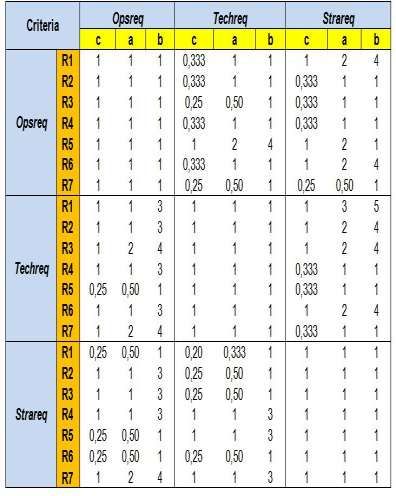
From the initial matrix of decision makers
(R1, R2, R3, R4, R5, R6, R7) it is translated
into linguistic variables.
The assessment of the level of
importance between the main criteria using
Figure 8. Inconsistency Value the Fuzzy AHP method can be seen in Table
5. Below:
Table 4. Assessment of the Level of Interest among Main Criteria by 7 Respondents
using the Fuzzy AHP Method
4.1.4 Geometric Mean b=
The next step is to recap all the results of Below is a table of the results of calculating
the respondent's assessment and calculate the the geometric mean for the main criteria related
geometric mean of the lower limit value (c); to the objective:
middle value (a); and the upper limit value (b).
Table 5. Pairwise Comparison Matrix for Main
Here is the formula used to calculate the
geometric mean:
c=
ɑ=
614.1.5 Benefit Cost Ratio (BCR) Analysis specifications (0.171) and supporting facilities /
systems (0.152); Strareq Criteria Sub-criteria
The purpose of using BCR analysis in
Historical consideration (0.225), completeness of
this study is to provide alternative results in data
safety equipment (0.169), AIP technology
processing, in addition to those produced by the
development (0.165), Detterence effect (0.121),
Fuzzy AHP method. Thus, researchers used a
Results & Process ToT (0.112), Speed of
combination of Fuzzy AHP and BCR methods in Compliance with MEF (0.109) and the effect of
carrying out data processing. After obtaining the the sustainability of the national industry (0.099 ).
submarine alternative priority, then selecting the The sub-criteria for the variation of ability on the
best alternative by considering the cost of each Opsreq criterion, the geographic and climatic
alternative to be selected, then carried out the adaptation sub-criteria on the Techreqcriterion
calculation of BCR. and the historical consideration sub-criteria on
From the BCR calculation for submarine the Strareq criterion each rank 1 for the selection
selection, assuming a year-round operation (360 of submarine alternatives. When viewed from the
days) with a total operating time of 100 days, the weighting results above, to accommodate the
base price for Solar Industry Area I is IDR other criteria, it can be seen that the selection of
10,337.69 (period 1-14 October 2020) at an submarines is expected to take into account the
exchange rate. dollar bill IDR 14,158.30. variation of submarine capabilities, geographical
With the alternative priority that has and climate adaptation as well as historical
been previously obtained, we can calculate the considerations.
value of the BCR, because this priority is an
element of Benefit that can be combined with the 4.2.2 Selected Submarine Alternatives
Cost element. Based on Sensitivity Analysis.
Based on the calculation of BCR, it is From the results of data processing using
known that the Y-Class has a BCR value of the Fuzzy AHP method, then a sensitivity
1.512232936 (profitable). While other submarine analysis was carried out, the results showed that
options are not profitable because the after changing the weight of the sub-criteria (by
comparison results of B / Cmastery, and variations in submarine criteria for the perfection of existing
capabilities; research.
2) Technical Requirements c. BCR analysis can be further developed by
(Techreq) with sub- criteria: calculating the Life Cycle Cost (LCC) of each
technical specifications, alternative submarine, so that the analysis results
maintenance and ILS, cutting edge are more perfect.
of technology, adaptation to
Indonesia's geography & climate ACKNOWLEDGEMENT
and supporting facilities / systems; The authors greatly acknowledge the
3) Strategic Requirements support from Naval Technology College, STTAL
(Strareq) with sub-criteria: The Surabaya Indonesia for providing the necessary
development of AIP technology, resources to carry out this research work. The
completeness of safety equipment, authors are also grateful to the anonymous
the effect of the sustainability of the reviewers and journal editorial board for their
national industry, historical many insightful comments, which have
considerations, speed of MEF significantly improved this article.
fulfilment, deterrence effect and the
results & process of ToT. REFERENCES
b. In determining the alternative Alshenqeeti, (2014). Interviewing as a Data
priority for submarine selection in this study Collection Method: A Critical Review.
using the Fuzzy Analytical Hierarchy
English Linguistic Research, Vol. 3 (1).
Process (Fuzzy AHP) method and Benefit
Cost Ratio (BCR) analysis. 39 Ciptomulyono, U., and Henry (2000).
Model Fuzzy goal programming untuk
c. Based on data processing with penetapan pembobotan prioritas dalam
Fuzzy AHP, the selected alternative with
metode analisis hirarki (AHP). Jurnal
the highest weight is Y-Class with a value
of 0.398 and based on BCR analysis, Y- IPTEK, Hal 19-29.
Class is also selected because based on
the results of data processing, it has the Andi Prastowo. (2011). Metode Penelitian
highest BCR value of 1.512232936, Kualitatif dalam Persepektif Rancangan
meaning that it is the most profitable if you Penelitian. Jogjakarta: Ar-Ruzz Media.
choose the submarine as the Indonesian
Navy Main defence system. Thus, it can be Ciptomulyono, U., & Henry. (2000). Model Fuzzy
used as a reference for the leadership of goal programming untuk penetapan
the Indonesian Navy in determining policies pembobotanprioritas dalam metode
for selecting priority types of submarines as analisis hirarki proses (AHP). Jurnal
defence for archipelagic warfare. IPTEK, 19-29
Creswell, J.W., & Brown, M.L. (1992). How
5.2 Suggestions
chairperson enchance faculty research:
Based on the data processing
A grounded theory study. The Review of
process and the conclusions from the
Higher Education, vol.16, 41-62.
research results, there are several things
that make suggestions related to this
Fenton, & C.L. Wang. (2006). Evaluating Attack
research:
Helicopters by AHP Based on
a. The submarine type priority, Linguistic Variable Weight, European
namely the Y-Class made by the C-country, Journal of Operational Research,
which has been analyzed, can be used as vol.116, 423-435.
material for consideration and input to the
Fitria, L. (2006). The Design of DecisionSupport
top leadership for the selection of the next
System to Choose the Transportation
submarine type as the Indonesian Navy's
Service Using Fuzzy AHP (Case Study:
Main defense system.
PT. X). Surabaya, Indonesia: Teknik
b. In addition to using the Fuzzy AHP Industri ITS.
method and BCR analysis, other research
can also be carried out using different Hamed, K. (2015). Optimum Mining Method
methods, or can be combined with other Selection Using Fuzzy AHP-Qapiliq Salt
methods, such as Fuzzy ANP and BOCR Mine, Iran. Journal of Mining Science
analysis and the addition of main and sub-
63and Technology, Elsevier, vol. 25(2), Irrigation Project. Agricultural Water
225-230. Management 121, 113-123.
Haryanto (2018). Model Strategi dan Alokasi Mulyono, S. (1996). Penyelesaian Masalah
Sumber Daya TNI Angkatan Laut dalam dengan menggunakan Metode AHP.
Menghadapi Peperangan Kepulauan, Jakarta: Lembaga Penerbit Fakultas
Surabaya: STTAL. Ekonomi Universitas Indonesia.
Hutchinson, R. (2001). Submarines war beneath Indradewi (2008).Penilaian Resiko Lingkungan
the waves from 1776 to the present day. Dengan FAHP Pada Manajemen Resiko
New York:Harper Collins Publisher. Lingkungan Lumpur Berbahan
Berbahaya Dan Beracun (B3) dari IPAL,
Jackson, R. (2000). Submarines of the world. ITS, Surabaya.
London: Brown books.
Padma, T. (2011), A Fuzzy Analytic Hierarchy
Kemenhan. (2012). UU RI Nomor 16 tentang Processing Deision Support System
Industri Pertahanan. Jakarta: to Analyze Occupational Menace
Kementerian Pertahanan Republik Forecasting The Spawning of Shoulder
Indonesia. and Neck Pain,India.
Koarmatim. (2018). Kajian Pemilihan Jenis Paksoy, T. (2012). Organization Strategy
Kapal Selam Diesel Elektrik Dihadapkan Development in Distribution Channel
dengan Rencana Pembangunan Management Using Fuzzy AHP And
Kekuatan TNI AL dan Kemandirian Hierarchy Fuzzy TOPSIS, Turki.
Industri Pertahanan Nasional.Surabaya:
Komando Armada RI Kawasan Timur. Peraturan Kasal No per Kasal/39/V/2009
Tanggal 26 Mei 2009 Tentang
Kuo, R.J. (2001). A Decision Support System for Kebijakan Pembangunan TNI AL
Selection Convenience Store Location Menuju Kekuatan Pokok Minimum Atau
Through Integration of Fuzzy AHP And MEF.
Artificial Neural Network.Computers in
Industry, vol. 47 (2), 199-214. Saaty, Thomas L. (1971-2015). The
Analytical Hierarchy Process (AHP),
Kusumadewi. (2010). Metode Yang Dapat Planning, Priority Setting, Wharton
Digunakan Untuk Mengolah Data Input School.
Menjadi Output Dalam Bentuk Informasi
Yang Baik. Yogyakarta: Graha Ilmu. Subroto (1983). United Nations Convention on
The Law of The Sea (UNCLOS).
Majalah Angkasa. (2005). Kapal Selam: The Sugiartoyo, N. (2016). Pemilihan sistem senjata
Silent Warrior, edisi XIII. Jakarta:PT rudal anti kapal permukaan dengan
Gramedia. pendekatan kombinasi Fuzzy AHP dan
Electre ll pada kapal cepat rudal TNI AL,
Mabesal. (1987). Buku Petunjuk Tempur Surabaya: STTAL.
Peperangan Kapal Selam. Jakarta:
Markas Besar TNI Angkatan Laut. Sugiyono (2009). Metode Penelitian
Kuantitatif, Kualitatif dan \R&D,
Mabesal (2004). Strategi Pertahanan Laut Bandung: Alfabeta
Nusantara. Cilangkap: Markas Besar
TNI Angkatan Laut. TNI-AL. (2005). Pembangunan Kekuatan TNI
AL sampai dengan
Menko-Maritim. (2018). Data Rujukan Kelautan 2024.Jakarta: TNI AL.
RI. Jakarta: Kementrian Koordinator
Maritim TNI-AL. (2018). Kebijakan Perencanaan TNI AL.
Jakarta: TNI AL.
Mikhailov &T svetinov. (2004). Evaluation of
service using a fuzzy analytic hierarchy TNI-AL (2018). Doktrin TNI AL Eka Sasana Jaya.
process, App. Soft comp. vol.5, 23-33. Jakarta: TNI AL.
Montazar, Aliasghar (2013). A Fuzzy AHP for Undang-Undang RI Nomor: 3 Tahun 2002 Pasal
Performance Assessment of 3 Ayat (2), tentang Pertahanan
64Negara yaitu bahwa Pertahanan
negara disusun dengan memperhatikan
kondisi geografis Indonesia sebagai
negara kepulauan.
Undang-Undang RI Nomor: 34 Tahun 2004 Pasal
7 Ayat (1), tentang Tugas Pokok
TNI.
Vahidniaa (2008). Fuzzy Analytical
Hierarchy Process in GIS
Application, Journal of The
International Archives of the
Photogrammetry Remote Sensing and
Spatial Information Sciences Faculty of
Geodesy and Geomatics Eng. K.N.Toosi
University of Technology (37),
593-596.
Wang, J. (2014). Safety Assessment of
shipping Routes in The South China
Sea Based on The Fuzzy Analytic
Hierarchy Process, China.
Wijnmalen, D. (2007). Analysis of benefits,
opportunities, costs, and risks
(BOCR) with the AHP–ANP: A
critical validation, Belanda.
Wiyono, W. (2015). Penentuan prioritas lokasi
Fasharkan dengan
metode Fuzzy Analytical
Hierarchy Process, Surabaya: STTAL.
Yulianto (2015). Analisa pemilihan pangkalan
TNI AL dalam rangka penanganan tindak
pidana perompakan dan pembajakan
dengan metode Fuzzy AHP, Topsis
dan GIS, Surabaya: STTAL
65You can also read


