PROCEEDINGS OF SPIE Front Matter: Volume 10163
←
→
Page content transcription
If your browser does not render page correctly, please read the page content below
PROCEEDINGS OF SPIE
       SPIEDigitalLibrary.org/conference-proceedings-of-spie

                   Front Matter: Volume 10163

                                  , "Front Matter: Volume 10163," Proc. SPIE 10163, Electroactive Polymer
                                  Actuators and Devices (EAPAD) 2017, 1016301 (11 May 2017); doi:
                                  10.1117/12.2280225

                                  Event: SPIE Smart Structures and Materials + Nondestructive Evaluation and
                                  Health Monitoring, 2017, Portland, Oregon, United States

Downloaded From: https://www.spiedigitallibrary.org/conference-proceedings-of-spie on 19 Nov 2021 Terms of Use: https://www.spiedigitallibrary.org/terms-of-use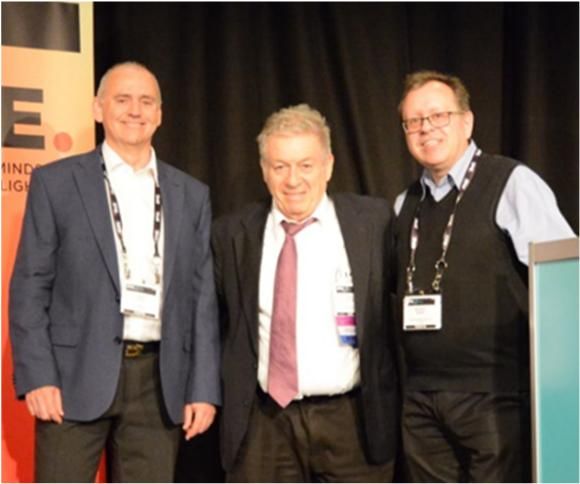
PROCEEDINGS OF SPIE

                   Electroactive Polymer Actuators
                   and Devices (EAPAD) 2017

                   Yoseph Bar-Cohen
                   Editor

                   26–29 March 2017
                   Portland, Oregon, United States

                   Sponsored by
                   SPIE

                   Co-sponsored by
                   OZ Optics, Ltd. (United States)
                   Polytec, Inc. (United States)
                   Fiberguide Industries (United States)
                   Frontiers Media (Switzerland)

                   Cooperating Organization
                   Jet Propulsion Laboratory (United States)

                   Published by
                   SPIE

                                                                                                                                  Volume 10163

                                                                Proceedings of SPIE 0277-786X, V. 10163
                               SPIE is an international society advancing an interdisciplinary approach to the science and application of light.

                                 Electroactive Polymer Actuators and Devices (EAPAD) 2017, edited by Yoseph Bar-Cohen, Proc. of SPIE
                                       Vol. 10163, 1016301 · © 2017 SPIE · CCC code: 0277-786X/17/$18 · doi: 10.1117/12.2280225

                                                                       Proc. of SPIE Vol. 10163 1016301-1
Downloaded From: https://www.spiedigitallibrary.org/conference-proceedings-of-spie on 19 Nov 2021
Terms of Use: https://www.spiedigitallibrary.org/terms-of-use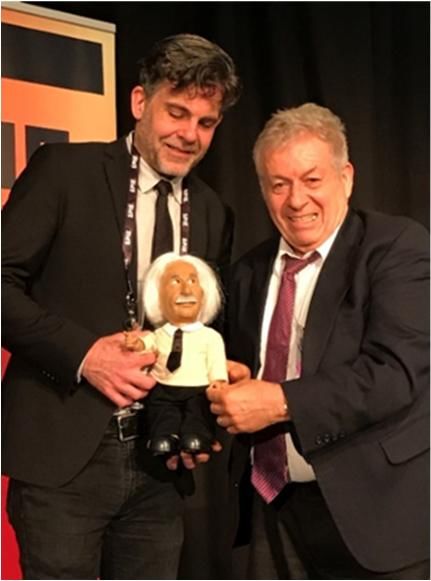
The papers in this volume were part of the technical conference cited on the cover and title
page. Papers were selected and subject to review by the editors and conference program
committee. Some conference presentations may not be available for publication. Additional
papers and presentation recordings may be available online in the SPIE Digital Library at
SPIEDigitalLibrary.org.
The papers reflect the work and thoughts of the authors and are published herein as submitted.
The publisher is not responsible for the validity of the information or for any outcomes resulting from
reliance thereon.
Please use the following format to cite material from these proceedings:
Author(s), "Title of Paper," in Electroactive Polymer Actuators and Devices (EAPAD) 2017, edited
by Yoseph Bar-Cohen, Proceedings of SPIE Vol. 10163 (SPIE, Bellingham, WA, 2017) Seven-digit
Article CID Number.
ISSN: 0277-786X
ISSN: 1996-756X (electronic)
ISBN: 9781510608115
ISBN: 9781510608122 (electronic)
Published by
SPIE
P.O. Box 10, Bellingham, Washington 98227-0010 USA
Telephone +1 360 676 3290 (Pacific Time)· Fax +1 360 647 1445
SPIE.org
Copyright © 2017, Society of Photo-Optical Instrumentation Engineers.
Copying of material in this book for internal or personal use, or for the internal or personal use of
specific clients, beyond the fair use provisions granted by the U.S. Copyright Law is authorized by
SPIE subject to payment of copying fees. The Transactional Reporting Service base fee for this
volume is $18.00 per article (or portion thereof), which should be paid directly to the Copyright
Clearance Center (CCC), 222 Rosewood Drive, Danvers, MA 01923. Payment may also be made
electronically through CCC Online at copyright.com. Other copying for republication, resale,
advertising or promotion, or any form of systematic or multiple reproduction of any material in this
book is prohibited except with permission in writing from the publisher. The CCC fee code is
0277-786X/17/$18.00.
Printed in the United States of America.
Publication of record for individual papers is online in the SPIE Digital Library.
SPIEDigitalLibrary.org
Paper Numbering: Proceedings of SPIE follow an e-First publication model. A unique citation
identifier (CID) number is assigned to each article at the time of publication. Utilization of CIDs
allows articles to be fully citable as soon as they are published online, and connects the same
identifier to all online and print versions of the publication. SPIE uses a seven-digit CID article
numbering system structured as follows:
The first five digits correspond to the SPIE volume number.
The last two digits indicate publication order within the volume using a Base 36 numbering
system employing both numerals and letters. These two-number sets start with 00, 01, 02, 03, 04,
05, 06, 07, 08, 09, 0A, 0B … 0Z, followed by 10-1Z, 20-2Z, etc. The CID Number appears on each
page of the manuscript.
Proc. of SPIE Vol. 10163 1016301-2
Downloaded From: https://www.spiedigitallibrary.org/conference-proceedings-of-spie on 19 Nov 2021
Terms of Use: https://www.spiedigitallibrary.org/terms-of-use
Contents

                                  ix     Authors

                                 xiii    Conference Committee

                                xvii     Introduction

                                xxi      Appendix: The 2017 EAP-in-Action Program

                      SESSION 1          EAP AS EMERGING ACTUATORS

                        10163 03         Electroactive polymers for healthcare and biomedical applications (Keynote Paper)
                                         [10163-1]

                      SESSION 2          SENSORS USING EAP MATERIALS

                        10163 06         Distributed sensing: multiple capacitive stretch sensors on a single channel [10163-4]

                        10163 07         Monitoring diver kinematics with dielectric elastomer sensors [10163-5]

                        10163 08         Dual sensing-actuation artificial muscle based on polypyrrole-carbon nanotube
                                         composite [10163-6]

                        10163 09         Operation tools with dielectric elastomer pressure sensors [10163-7]

                      SESSION 3          DESIGN METHODS OF PRODUCING EAP MECHANISMS

                       10163 0C          Integrated sensing and actuation of dielectric elastomer actuator [10163-10]

                      SESSION 4          PERFORMANCE CHARACTERIZATION OF VARIOUS EAP MATERIALS

                       10163 0D          Properties of polypyrrole polyvinilsulfate films for dual actuator sensing systems [10163-11]

                        10163 0H         A mathematical model for an integrated self priming dielectric elastomer generator
                                         [10163-15]

                      SESSION 5          ARTIFICIAL MUSCLE FOR SOFT ROBOTICS

                         10163 0I        Fused filament 3D printing of ionic polymer-metal composites for soft robotics
                                         (Invited Paper) [10163-16]

                                                                                                                                         iii

                                                                       Proc. of SPIE Vol. 10163 1016301-3
Downloaded From: https://www.spiedigitallibrary.org/conference-proceedings-of-spie on 19 Nov 2021
Terms of Use: https://www.spiedigitallibrary.org/terms-of-use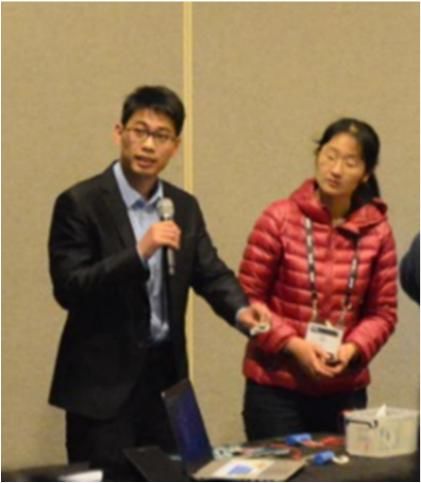
10163 0L         A model framework for actuation and sensing of ionic polymer-metal composites:
                                         prospective on frequency and shear response through simulation tools [10163-20]

                       10163 0M          A theoretical framework for the study of compression sensing in ionic polymer metal
                                         composites [10163-21]

                     SESSION 6A          EAP ACTUATORS

                       10163 0O          DEMES rotary joint: theories and applications [10163-22]

                        10163 0P         Dielectric elastomer actuator for the measurement of cell traction forces with sub-cellular
                                         resolution [10163-23]

                       10163 0Q          Dielectric elastomer actuator with variable stiffness based on interlaminar electrostatic
                                         chucking [10163-24]

                        10163 0S         A torsional artificial muscle from twisted nitinol microwire [10163-26]

                     SESSION 6B          EAP BASED ON DIELECTRIC ELASTOMERS I

                        10163 0T         Chemically pre-strained dielectric elastomers finite element analysis [10163-27]

                       10163 0W          Super stretchable soft actuator made of twisted and coiled spandex fiber [10163-30]

                        10163 0X         Development of a fatigue testing setup for dielectric elastomer membrane actuators
                                         [10163-31]

                     SESSION 7A          3D PRINTING AS A FABRICATION METHOD

                        10163 0Y         Permanent magnets as biasing mechanism for improving the performance of circular
                                         dielectric elastomer out-of-plane actuators [10163-97]

                        10163 0Z         3D printing PLA and silicone elastomer structures with sugar solution support material
                                         [10163-33]

                        10163 10         Ras Labs-CASIS-ISS NL experiment for synthetic muscle returned to Earth: resistance to
                                         ionizing radiation [10163-118]

                        10163 11         Inkjet printing of carbon black electrodes for dielectric elastomer actuators [10163-35]

                     SESSION 7B          IONIC EAP MATERIALS

                        10163 12         Design of ultra-thin high frequency trilayer conducting polymer micro-actuators for tactile
                                         feedback interfaces [10163-36]

                iv

                                                                       Proc. of SPIE Vol. 10163 1016301-4
Downloaded From: https://www.spiedigitallibrary.org/conference-proceedings-of-spie on 19 Nov 2021
Terms of Use: https://www.spiedigitallibrary.org/terms-of-use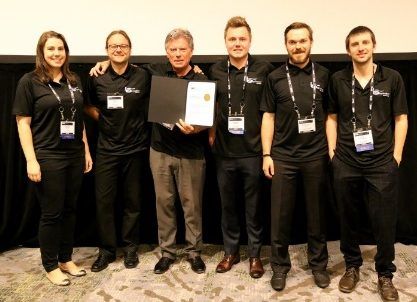
10163 13         Temperature and humidity dependence of ionic electroactive polymer actuators
                                         [10163-102]

                    SESSION 8A           ANALYSIS AND MODELING EAP ACTUATORS PERFORMANCE

                        10163 16         Rate dependent constitutive behavior of dielectric elastomers and applications in legged
                                         robotics (Invited Paper) [10163-40]

                        10163 17         Modeling and simulation of a chemically stimulated hydrogel bilayer bending actuator
                                         [10163-41]

                        10163 18         Modeling and experimentally characterizing ionic buoyancy engines [10163-42]

                       10163 1A          Numerical analysis of helical dielectric elastomer actuator [10163-44]

                       10163 1C          Frequency-domain trade-offs for dielectric elastomer generators [10163-46]

                     SESSION 8B          EAP MATERIALS FABRICATION METHODS AND PROCESSES I

                        10163 1E         Electrospraying and ultraviolet light curing of nanometer-thin polydimethylsiloxane
                                         membranes for low-voltage dielectric elastomer transducers [10163-48]

                        10163 1F         Leakage current, self-clearing and actuation efficiency of nanometer-thin, low-voltage
                                         dielectric elastomer transducers tailored by thermal evaporation [10163-49]

                         10163 1I        Optimization study for fabrication of micro-scale stacked dielectric elastomer actuators
                                         [10163-52]

                        10163 1K         Microfabricated PEDOT trilayer actuators: synthesis, characterization, and modeling
                                         [10163-54]

                        10163 1L         Proposal of a peristaltic micropump using dielectric elastomer actuators fabricated by
                                         MEMS technology [10163-98]

                    SESSION 9A           APPLICATIONS OF EAP ACTUATORS TO ROBOTIC MECHANISMS I

                       10163 1N          Entirely soft dielectric elastomer robots [10163-56]

                       10163 1O          Fluid electrodes for submersible robotics based on dielectric elastomer actuators
                                         (1st Place SPIE Best Student Paper) [10163-57]

                     SESSION 9B          APPLICATIONS OF EAP ACTUATORS TO VARIOUS MECHANISMS II

                        10163 1U         Design and motion control of bioinspired humanoid robot head from servo motors toward
                                         artificial muscles [10163-63]

                                                                                                                                    v

                                                                       Proc. of SPIE Vol. 10163 1016301-5
Downloaded From: https://www.spiedigitallibrary.org/conference-proceedings-of-spie on 19 Nov 2021
Terms of Use: https://www.spiedigitallibrary.org/terms-of-use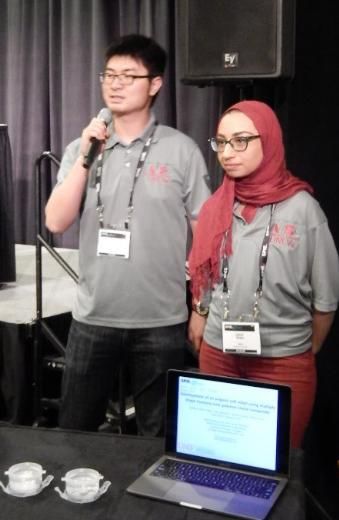
SESSION 10A         APPLICATIONS OF EAP ACTUATORS TO VARIOUS MECHANISMS III

                       10163 1W          Energy analysis of a DEAP based cylindrical actuator coupled with a radial negative
                                         stiffness spring [10163-65]

                        10163 1X         Development of a soft untethered robot using artificial muscle actuators [10163-66]

                        10163 1Y         Electrically tunable window based on microwrinkled ZnO/Ag thin film [10163-67]

                        10163 1Z         Strong dielectric-elastomer grippers with tension arch flexures [10163-68]

                     SESSION 10B         APPLICATIONS OF EAP ACTUATORS TO VARIOUS MECHANISMS IV

                        10163 20         Development of elastomeric flight muscles for flapping wing micro air vehicles
                                         (Invited Paper) [10163-69]

                        10163 21         Hydrogels for engineering: normalization of swelling due to arbitrary stimulus [10163-71]

                        10163 22         Exploring dielectric elastomers as actuators for hand tremor suppression [10163-70]

                     SESSION 11A         USE OF EAP IN THE FORM OF FIBERS AND TEXTILE

                        10163 25         A novel sheet actuator using plasticized PVC gel and flexible electrodes [10163-74]

                        10163 26         Mechanical stretch influence on lifetime of dielectric elastomer films [10163-75]

                        10163 27         Development of novel textile and yarn actuators using plasticized PVC gel [10163-76]

                     SESSION 11B         EAP BASED ON DIELECTRIC ELASTOMERS II

                        10163 28         Electrical breakdown phenomena of dielectric elastomers (Invited Paper) [10163-77]

                        10163 29         Viscoelastic performance of dielectric elastomer subject to different voltage stimulation
                                         [10163-78]

                       10163 2A          Continuum vibration analysis of dielectric elastomer membranes [10163-79]

                        10163 2B         Electrical breakdown detection system for dielectric elastomer actuators [10163-80]

                     SESSION 12A         APPLICATIONS OF EAP ACTUATORS TO VARIOUS MECHANISMS V

                       10163 2C          New approach to improve the energy density of hybrid electret-dielectric elastomer
                                         generators [10163-81]

                       10163 2D          A dielectric elastomer actuator-based tactile display for multiple fingertip interaction with
                                         virtual soft bodies [10163-82]

                vi

                                                                       Proc. of SPIE Vol. 10163 1016301-6
Downloaded From: https://www.spiedigitallibrary.org/conference-proceedings-of-spie on 19 Nov 2021
Terms of Use: https://www.spiedigitallibrary.org/terms-of-use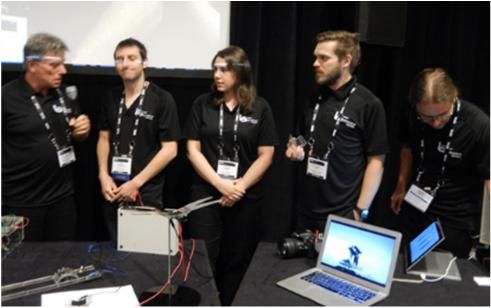
10163 2G          Surface texture change on-demand and microfluidic devices based on thickness mode
                                         actuation of dielectric elastomer actuators (DEAs) [10163-85]

                        10163 2H         Rubbery computing [10163-86]

                         10163 2I        Effect of porosity of the electrodes on ionic electroactive polymer actuators [10163-101]

                   SESSION 12B           EAP MATERIALS FABRICATION METHODS AND PROCESSES II

                        10163 2K         Stackable configurations of artificial muscle modules that is continuously-tunable by
                                         voltage (Invited Paper) [10163-88]

                        10163 2L         Micro-fabrication of a novel linear actuator [10163-89]

                       10163 2M          Effect of electrical terminals made of copper to the ionic electroactive polymer actuators
                                         [10163-90]

                       10163 2N          Fabrication of multilayered conductive polymer structures via selective visible light
                                         photopolymerization [10163-91]

                       10163 2O          Design and fabrication of conductive polyaniline transducers via computer controlled
                                         direct ink writing [10163-92]

                        10163 2P         Adhesion enhancement methods for a roll-to-sheet fabrication process of DE
                                         stack-transducers and their influences on the electric properties [10163-93]

                                         POSTER SESSION

                       10163 2Q          Fabrication of dielectric elastomer stack transducers (DEST) by liquid deposition modeling
                                         [10163-94]

                        10163 2R         Boundary-condition analysis for physics-based modeling of ionic-polymer metal
                                         composite electroactive polymers [10163-95]

                        10163 2T         Study on simplification of a multi-physical model of IPMC sensor generating voltage as
                                         sensing signal [10163-99]

                        10163 2U         Experimental verification of displacement control on integrated ionic polymer-metal
                                         composite actuators with stochastic on/off controller [10163-100]

                       10163 2V          Position control of twisted and coiled polymer actuator using a controlled fan for cooling
                                         [10163-103]

                       10163 2W          Elastic actuation for legged locomotion [10163-104]

                        10163 31         Energy harvesting by dielectric elastomer generator and self-priming circuit: verification by
                                         radio transmission [10163-110]

                        10163 32         Micromixer based on dielectric stack actuators for medical applications [10163-112]

                                                                                                                                      vii

                                                                       Proc. of SPIE Vol. 10163 1016301-7
Downloaded From: https://www.spiedigitallibrary.org/conference-proceedings-of-spie on 19 Nov 2021
Terms of Use: https://www.spiedigitallibrary.org/terms-of-use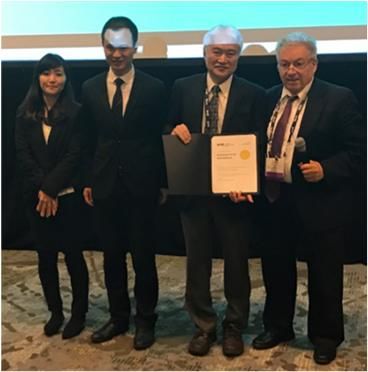
10163 35         Effects of ionic liquids on the performance of IPMC [10163-115]

                        10163 38         Experience-based learning on determining the frictional coefficients of thermoset polymers
                                         incorporated with silicon carbide whiskers and chopped carbon fibers at different
                                         temperatures [10163-119]

                        10163 39         Experience-based training of students on concretes reinforced by recycled carbon fibers
                                         [10163-120]

                viii

                                                                       Proc. of SPIE Vol. 10163 1016301-8
Downloaded From: https://www.spiedigitallibrary.org/conference-proceedings-of-spie on 19 Nov 2021
Terms of Use: https://www.spiedigitallibrary.org/terms-of-use
Authors

                              Numbers in the index correspond to the last two digits of the seven-digit citation identifier (CID) article
                              numbering system used in Proceedings of SPIE. The first five digits reflect the volume number. Base 36
                              numbering is employed for the last two digits and indicates the order of articles within the volume.
                              Numbers start with 00, 01, 02, 03, 04, 05, 06, 07, 08, 09, 0A, 0B...0Z, followed by 10-1Z, 20-2Z, etc.

                              Aabloo, Alvo, 13, 2I, 2M                                        Ehrlich, Johannes, 09
                              Ahmed, Anansa S., 1Z                                            Eom, S. I., 1L
                              Akle, Barbar J., 18                                             Fang, Houfei, 2L
                              Alamir, Mohammed, 38                                            Förster-Zügel, Florentine, 2Q, 32
                              Albers, Leila N., 10                                            Frediani, Gabriele, 2D
                              Almubarak, Yara, 1U                                             Froio, Danielle, 10
                              Alzahrani, Naif, 38, 39                                         Fuerst, Tyler, 10
                              Anderson, Iain A., 06, 07, 0H, 1N, 2H                           Furuse, A., 27
                              Ankit, Ankit, 2G                                                Gallucci, Sergio, 10
                              Arakawa, Takeshi, 2V                                            Gao, Wei, 16
                              Asai, K., 1L                                                    Gaza, Ramona, 10
                              Asaka, Kinji, 2T, 2V                                            Gentile, Charles, 10
                              Ascione, George, 10                                             Ghilardi, Michele, 2B
                              Asmatulu, Eylem, 39                                             Goldberg, Nathaniel, 1O
                              Asmatulu, Ramazan, 38                                           Grondel, Sébastien, 1K
                              Asundi, Anand, 1Y                                               Hablani, Surbhi, 10
                              Bardella, Lorenzo, 0M                                           Hamidi, Armita, 0Z
                              Bass, Patrick S., 2R                                            Hao, Zhaogang, 0O
                              Bauer, Siegfried G., 03                                         Harrison, Edward, 38
                              Blocher, Whitney, 10                                            Hashimoto, Minoru, 25, 27
                              Bochmann, Helge, 2P                                             Heng, Kim-Rui, 1Z
                              Böse, Holger, 09                                                Henke, E.-F. Markus, 0H, 1N, 2H
                              Boys, Hugh, 2D                                                  Hijazi, Ahmad, 18
                              Busfield, James J. C., 2B, 2D                                   Hill, M., 0X
                              Cai, Shengqiang, 1O                                             Hitchner, Robert, 10
                              Cao, Chongjing, 2W                                              Hoffman, Dan, 10
                              Cao, Jiawei, 1X                                                 Holness, F. Benjamin, 2O
                              Carpi, Federico, 2B, 2D                                         Homer, Martin, 1C
                              Carrico, James D., 0I                                           Hou, Yangqing, 2L
                              Cattan, Eric, 1K                                                Huang, Bo, 0O
                              Cha, Youngsu, 0M                                                Hunter, Ian W., 0S
                              Chavanne, Jonathan, 1W                                          Hussaini, M. Yousuff, 16
                              Chen, Hualing, 29                                               Iannarelli, A., 26
                              Chen, Zheng, 0C                                                 Ikegame, Toru, 31
                              Cheng, Zhongyang, 2R                                            Illenberger, Patrin K., 0H
                              Chin, Yao-Wei, 20                                               Imamura, Hiroya, 0Q
                              Cho, Kyeong Ho, 0W                                              Ito, Takamasa, 31
                              Choi, Hyouk Ryeol, 0W                                           Jain, Shrenik, 0Z
                              Christianson, Caleb, 1O                                         Jean-Mistral, Claire, 2C
                              Civet, Yoan, 1W                                                 Jiang, Shuidong, 2L
                              Clark, Jonathan, 16                                             Johanson, Urmas, 2I, 2M
                              Conn, Andrew, 2W                                                Jung, Hosang, 0W
                              Corbaci, Mert, 1I                                               Kadooka, Kevin, 0Q
                              Corl, Dylan, 10                                                 Kamamichi, Norihiro, 2U
                              Cosgun, Cumhur, 39                                              Kauffman, Jeffrey L., 22
                              Cullen, Andrew T., 2N                                           Kelley, Christopher R., 22
                              Cylinder, David, 10                                             Kim, Daewon, 1A
                              Ebrahimi Takalloo, Saeedeh, 12                                  Kim, J.-W., 1L
                              Ehrenhofer, Adrian, 21                                          Kim, Kwang J., 0L

                                                                                                                                            ix

                                                                       Proc. of SPIE Vol. 10163 1016301-9
Downloaded From: https://www.spiedigitallibrary.org/conference-proceedings-of-spie on 19 Nov 2021
Terms of Use: https://www.spiedigitallibrary.org/terms-of-use
Kim, Min Jung, 35 Pascual, Victor H., 08, 0D
Kim, Youngeun, 0W Patlolla, Vamsidhar R., 39
Kimura, Keishiro, 2U Perriard, Yves, 1W
Klug, Florian, 2Q, 32 Plesse, Cédric, 1K
Koh, Soo Jin Adrian, 2K Poirier, Catherine, 10
Kojima, Hiroki, 31 Porfiri, Maurizio, 0M
Koo, Ja Choon, 0W Poslad, Stefan, 2D
Kovacs, Gabor, 1E Poulin, Alexandre, 0P
Krutz, Gary, 0T Price, Aaron D., 2N, 2O
La, Thanh-Giang, 20 Prillaman, Daniel L., 10
Lagomarsini, Clara, 2C Punning, Andres, 13, 2I, 2M
Lamkin-Kennard, Kathleen, 1I Qin, Lei, 1X
Lau, Gih-Keong, 1Y, 1Z, 20 Rasmussen, Lenore, 10
Leang, Kam K., 0I Ratto, Jo Ann, 10
Lee, Heow Pueh, 1X Rizzello, G., 0X, 0Y, 2A
Li, Bo, 29 Rodella, Andrea, 0M
Li, Mingyu, 0O Rodriguez, Simone, 10
Li, Yi, 25 Rosset, Samuel, 0P, 11
Liffland, Stephanie, 10 Rossiter, Jonathan, 1C
Liu, Lei, 29 Schlaak, Helmut F., 2Q, 32
Liu, Lei, 2L Schlatter, Samuel, 11
Loew, P., 0Y Schumacher, J., 08, 0D
Lörcher, Samuel, 1F Seelecke, S., 0X, 0Y, 2A
Maas, Jürgen, 2P Seifi, Hasti, 12
Madawala, Udaya K., 0H Shea, Herbert, 0P, 11
Madden, John D. W., 12, 1K Shen, Qi, 0L
Mark, Patrick S., 10 Sheng, Junjie, 29
Mashayekhi, Somayeh, 16 Shrestha, Milan, 1Y, 1Z
Masuya, Ken, 2V Siketanc, Matej, 1E
Mateiu, Ramona V., 28 Sinkler, Charles, 10
Mathew, Anup Teejo, 2K Skov, Anne L., 28
Mathews, Nripan, 2G Slipher, Geoffrey A., 2H
Meixler, Lewis D., 10 Smith, Michael, 0P
Menegus, Michael J., 10 Sobczyk, Martin, 17
Miles, Paul, 16 Solano-Arana, Susana, 2Q, 32
Mirvakili, Seyed M., 0S Song, Min Geun, 0W
Miyata, K., 1L Soyer, Caroline, 1K
Monfray, Stephane, 2C Stalbaum, Tyler, 0L
Moon, Hyungpil, 0W Stewart, Frank, 0T
Mößinger, Holger, 2Q, 32 Sun, Lining, 0O
Moy, Leon, 10 Sylvestre, Alain, 2C
Müller, Bert, 1E, 1F Tadesse, Yonas, 0Z, 1U
Müller, Dominik, 09 Tahara, Kenji, 2V
Nah, Changwoon, 35 Tairych, Andreas, 06
Nair, Saurabh, 1A Takagi, Kentaro, 2T, 2V, 31
Nakshatharan, S. Sunjai, 13, 2I, 2M Takeda, Jun, 2T, 2V
Nalbach, S., 2A Taya, Minoru, 0Q
Nam, Jae-Do, 0W Taylor, James, 10
Nasser, Jalal, 18 Thellen, Christopher T., 10
Newell, Brittany, 0T Tolley, Michael T., 1O
Nguyen, Anh Chien, 2G Töpper, Tino, 1E, 1F
Nguyen, Ngoc Tan, 1K Valenza, Logan, 10
Niasar, M. Ghaffarian, 26 Vidal, Frédéric, 1K
Nodarse, Robert, 10 Vo Tran, Vy Khanh, 2K
Oates, William, 16 Volpini, Valentina, 0M
Osmani, Bekim, 1E, 1F von Heckel, Benedikt, 2P
Otero, Toribio F., 08, 0D Walker, Christopher R., 07
Park, Jang Ho, 1A Wallmersperger, Thomas, 17, 21
Park, Sang Woo, 35 Walter, Wayne, 1I
Pascal, Kevin, 0T Wang, Shu, 0O
x
Proc. of SPIE Vol. 10163 1016301-10
Downloaded From: https://www.spiedigitallibrary.org/conference-proceedings-of-spie on 19 Nov 2021
Terms of Use: https://www.spiedigitallibrary.org/terms-of-useWilson, Katherine E., 0H, 1N, 2H
Won, Joohye, 35
Yang, Sang Yul, 0W
Ye, Zhihang, 0C
Yoshida, K., 1L
Yoshikawa, Hitoshi, 31
Yu, Liyun, 28
Zanini, Plinio, 1C
Zeineddine, Hatim F., 39
Zhang, Lin, 2R
Zhang, Yuqing, 29
Zhao, Jianwen, 0O
Zhu, Jian, 1X
Zhu, Zicai, 2T
Zollinger, Alicia, 0P
xi
Proc. of SPIE Vol. 10163 1016301-11
Downloaded From: https://www.spiedigitallibrary.org/conference-proceedings-of-spie on 19 Nov 2021
Terms of Use: https://www.spiedigitallibrary.org/terms-of-useProc. of SPIE Vol. 10163 1016301-12 Downloaded From: https://www.spiedigitallibrary.org/conference-proceedings-of-spie on 19 Nov 2021 Terms of Use: https://www.spiedigitallibrary.org/terms-of-use
Conference Committee

                               Symposium Chairs
                                                Jayanth N. Kudva, NextGen Aeronautics, Inc. (United States)
                                                Theodoros E. Matikas, University of Ioannina (Greece)

                              Symposium Co-chairs
                                                Tribikram Kundu, The University of Arizona (United States)
                                                Gregory W. Reich, Air Force Research Laboratory (United States)

                               Conference Chair
                                                Yoseph Bar-Cohen, Jet Propulsion Laboratory (United States)

                               Conference Co-chair
                                                Jonathan M. Rossiter, University of Bristol (United Kingdom)

                               Conference Program Committee
                                                Barbar J. Akle, Lebanese American University (Lebanon)
                                                Iain A. Anderson, The University of Auckland (New Zealand)
                                                Tunku Ishak Al-Irsyad, University Teknologi MARA (Malaysia)
                                                Kinji Asaka, National Institute of Advanced Industrial Science and
                                                  Technology (Japan)
                                                Pavol Bauer, Technische Universiteit Delft (Netherlands)
                                                Siegfried G. Bauer, Johannes Kepler Universität Linz (Austria)
                                                Ray H. Baughman, The University of Texas at Dallas (United States)
                                                Václav Bouda, Czech Technical University in Prague (Czech Republic)
                                                Federico Carpi, Università degli Studi di Firenze (Italy)
                                                Suresh Chandra, Institute of Technology, Banaras Hindu University (India)
                                                Hyouk Ryeol Choi, Sungkyunkwan University (Korea, Republic of)
                                                Gal deBotton, Ben-Gurion University of the Negev (Israel)
                                                Toribio Fernández Otero, Universidad Politécnica de Cartagena (Spain)
                                                Yahya A. Ismail, A'Shargiyah University (Oman)
                                                Edwin W. H. Jager, Linköping Universitet (Sweden)
                                                Giedrius Janusas, Kaunas University of Technology (Lithuania)
                                                Kwang Jin Kim, University of Nevada, Las Vegas (United States)
                                                Gabor M. Kovacs, EMPA (Switzerland)
                                                Maarja Kruusmaa, University of Tartu (Estonia)
                                                Jinsong Leng, Harbin Institute of Technology (China)
                                                John D. W. Madden, The University of British Columbia (Canada)
                                                Qibing Pei, University of California, Los Angeles (United States)
                                                Thelge Chaminda Peiris, MAS Innovation Ltd. (Sri Lanka)
                                                Valentin Radu, Omicron Plus S.R.L. (Romania)

                                                                                                                            xiii

                                                                       Proc. of SPIE Vol. 10163 1016301-13
Downloaded From: https://www.spiedigitallibrary.org/conference-proceedings-of-spie on 19 Nov 2021
Terms of Use: https://www.spiedigitallibrary.org/terms-of-use
Mehdi Razzaghi-Kashani, Tarbiat Modares University
(Iran, Islamic Republic of)
Anuvat Sirivat, Chulalongkorn University (Thailand)
Anne Ladegaard Skov, Technical University of Denmark (Denmark)
Ji Su, NASA Langley Research Center (United States)
Minoru Taya, University of Washington (United States)
I-Hsiang Tseng, Feng Chia University (Taiwan)
Rocco Vertechy, Università degli Studi di Bologna (Italy)
Frédéric Vidal, Université de Cergy-Pontoise (France)
Gordon G. Wallace, University of Wollongong (Australia)
Thomas Wallmersperger, Technische Universität Dresden (Germany)
Qiming M. Zhang, The Pennsylvania State University (United States)
Jian Zhu, National University of Singapore (Singapore)
Pawel Zylka, Wroclaw University of Technology (Poland)
Session Chairs
1 EAP as Emerging Actuators
Yoseph Bar-Cohen, Jet Propulsion Laboratory (United States)
Jonathan M. Rossiter, University of Bristol (United Kingdom)
2 Sensors Using EAP Materials
Siegfried G. Bauer, Johannes Kepler Universität Linz (Austria)
Kwang Jin Kim, University of Nevada, Las Vegas (United States)
3 Design Methods of Producing EAP Mechanisms
Anne Ladegaard Skov, Technical University of Denmark (Denmark)
Adrian Koh, National University of Singapore (Singapore)
4 Performance Characterization of Various EAP Materials
Geoff Spinks, University of Wollongong (Australia)
Stoyan Smoukov, University of Cambridge (United Kingdom)
5 Artificial Muscle for Soft Robotics
Kwang Jin Kim, University of Nevada, Las Vegas (United States)
Maurizio Porfiri, NYU Tandon School of Engineering (United States)
6A EAP Actuators
Gabor M. Kovacs, EMPA (Switzerland)
Christoph Keplinger, University of Colorado Boulder (United States)
6B EAP Based on Dielectric Elastomers I
Richard J. Spontak, North Carolina State University (United States)
Barbar J. Akle, Lebanese American University (Lebanon)
7A 3D Printing as a Fabrication Method
William S. Oates, Florida State University (United States)
Richard J. Spontak, North Carolina State University (United States)
xiv
Proc. of SPIE Vol. 10163 1016301-14
Downloaded From: https://www.spiedigitallibrary.org/conference-proceedings-of-spie on 19 Nov 2021
Terms of Use: https://www.spiedigitallibrary.org/terms-of-use7B Ionic EAP Materials
Iain A. Anderson, The University of Auckland (New Zealand)
Samuel Rosset, École Polytechnique Fédérale de Lausanne (Switzerland)
8A Analysis and Modeling EAP Actuators Performance
John D. W. Madden, The University of British Columbia (Canada)
Gih-Keong Lau, Nanyang Technological University (Singapore)
8B EAP Materials Fabrication Methods and Processes I
Qibing Pei, University of California, Los Angeles (United States)
Geoffrey M. Spinks, University of Wollongong (Australia)
9A Applications of EAP Actuators to Robotic Mechanisms I
Lenore Rasmussen, Ras Laboratories, LLC (United States)
Jonathan M. Rossiter, University of Bristol (United Kingdom)
9B Applications of EAP Actuators to Various Mechanisms II
Bert Müller, University of Basel (Switzerland)
Gih-Keong Lau, Nanyang Technological University (Singapore)
10A Applications of EAP Actuators to Various Mechanisms III
Holger Böse, Fraunhofer-Institut für Silicatforschung ISC (Germany)
E.-F. Markus Henke, The University of Auckland (New Zealand)
10B Applications of EAP Actuators to Various Mechanisms IV
Liwu Liu, Harbin Institute of Technology (China)
Jian Zhu, National University of Singapore (Singapore)
11A Use of EAP in the Form of Fibers and Textile
Dan Armstrong, North Carolina State University (United States)
Richard J. Spontak, North Carolina State University (United States)
11B EAP Based on Dielectric Elastomers II
Rocco Vertechy, Università degli Studi di Bologna (Italy)
Kam K. Leang, The University of Utah (United States)
12A Applications of EAP Actuators to Various Mechanisms V
Jinsong Leng, Harbin Institute of Technology (China)
Seyed Mohammad Mirvakili, Massachusetts Institute of Technology
(United States)
12B EAP Materials Fabrication Methods and Processes II
Jonathan M. Rossiter, University of Bristol (United Kingdom)
Seon Jeong Kim, Hanyang University (Korea, Republic of)
xv
Proc. of SPIE Vol. 10163 1016301-15
Downloaded From: https://www.spiedigitallibrary.org/conference-proceedings-of-spie on 19 Nov 2021
Terms of Use: https://www.spiedigitallibrary.org/terms-of-useProc. of SPIE Vol. 10163 1016301-16 Downloaded From: https://www.spiedigitallibrary.org/conference-proceedings-of-spie on 19 Nov 2021 Terms of Use: https://www.spiedigitallibrary.org/terms-of-use
Introduction

                              The SPIE Electroactive Polymers Actuators and Devices
                              (EAPAD) conference remains the leading international
                              forum for presenting the latest progress and
                              information     exchange       among     the    attendees
                              regarding the advances, capabilities, challenges and
                              potential future directions. The conference this year
                              was chaired by Yoseph Bar-Cohen, Jet Propulsion
                              Laborotary/California Institute of Technology (United
                              States), and co-chaired by Jonathan M. Rossiter,
                              University of Bristol (United Kingdom). Hani E. Naguib, a
                              notable award recipient within the Smart Structures
                              symposium, University of Toronto, Canada (Figure 1)                            Figure 1: Hani E. Naguib (on
                              received the 2017 SPIE Fellow Award for his                                    the left) receiving the 2017 SPIE
                                                                                                             Fellow Award from Chris Lynch,
                              contributions to multifunctional materials development                         University of California, Los
                              and characterization including EAP materials.                                  Angeles.

                              Photos from the conference were posted at the SPIE website:
                              http://spie.org/about-spie/press-room/spie-smart-structures/nondestructive-
                              evaluation-2017-news-and-photos

                                                                  The conference included 122 presentations and was well
                                                                  attended by internationally leading experts in the field
                                                                  including members of academia, industry, and
                                                                  government agencies from the United States and
                                                                  overseas. This year, two plenary speakers made EAP-
                                                                  related presentations at the symposium. David Hanson
                                                                  (Figure 2), Hanson Robotics, presented “Electroactive
                                                                  polymers for healthcare and biomedical applications”.
                                                                  His presentation included a demonstration of his robot,
                                                                  Sophia, conversing with him and making facial
                                                                  expressions. Hanson pointed out that bio-inspired

                               Figure 2: David Hanson and          intelligent robots are coming of age in both research
                               Yoseph Bar-Cohen next to            and industry, and are propelling market growth for robots
                               a toy robot Prof. Einstein          and AI.

                              However, conventional motors limit the capability of bio-inspired robotics. EAP
                              actuators and sensors could improve the simplicity, compliance, physical scaling,
                              and offer bio-inspired advantages in robotic locomotion, grasping, manipulation,
                              and social expressions. For EAP actuators to realize their transformative potential,
                              further innovations are needed. The actuators must be robust, fast, powerful,
                              manufacturable, and affordable. In his presentation, Hanson reviewed the

                                                                                                                                                 xvii

                                                                       Proc. of SPIE Vol. 10163 1016301-17
Downloaded From: https://www.spiedigitallibrary.org/conference-proceedings-of-spie on 19 Nov 2021
Terms of Use: https://www.spiedigitallibrary.org/terms-of-use
progress, opportunities, and challenges in his latest work with social robots and
EAP actuators, and he proposed a roadmap for EAP actuators in bio-inspired
intelligent robotics.
In addition, Chiara Daraio, California Institute of Technology (United States),
presented a plenary presentation entitled “Plant nanobionic materials for
thermally active, soft, artificial skins”. In her paper, she described bionic materials
as a class that aims to preserve, enhance, and exploit properties of living systems
for engineering purposes. In most cases, however, creating synthetic materials
that reproduces or surpasses the performance of natural materials has been
elusive. In her lab, Daraio fabricated synthetic materials that combine carbon
nanoparticles in a matrix of plant cells to create new temperature sensors with
record-breaking responsivity. She had extracted the active molecule, pectin
(responsible for the temperature sensitivity in plants), to create ultra-sensitive,
flexible membranes that can map temperature changes from a distance. These
materials augment properties of synthetic skins for robotics and prosthesis, and
can find applications in consumer electronics or NDE.
In the EAPAD conference, the keynote speaker
was Siegfried G. Bauer (Figure 3), Johannes Kepler
Universität, Linz (Austria) with a paper titled
“Electroactive polymers for healthcare and
biomedical applications”. In his paper, he noted
that electroactivity has been noticed in biological
substances; including proteins, polynucleotides
and enzymes. In addition, piezo- and pyro-
electricity were found in wool, hair, wood, bone
and tendon. He stated that there is still a strong
Figure 3: From left to right – Gabor debate about the physiological importance of
Kovach, Yoseph Bar-Cohen, and electroactive effects in biological materials, but it
Siegfried G. Bauer
is interesting that electroactive phenomena are
widespread in natural materials. According to Bauer with the currently available
science and technology, we are at the verge of witnessing the demonstration of
truly complex bionic systems and the future of EAP materials remains bright.
Overall, the presented papers reported the significant progress made in each of
the topics of the EAP field infrastructure. The topics included: theoretical
modeling and analysis of EAP mechanisms; improved EAP materials, processes,
fabrication (including 3D printing) and characterization techniques; emerging
EAP actuators (including ionic, conducting, shape memory polymers, CNT and
dielectric EAP); applications of EAP materials including power generation and
energy harvesting, robotics, haptic, tactile, and other sensors. Of significant
interest, Gabor M. Kovacs, EMPA (Switzerland), (Figure 3) presented a paper
entitled “From research to production” in which he described his company efforts
to create a commercial EAP actuator at mass production scale and the related
issues.
xviii
Proc. of SPIE Vol. 10163 1016301-18
Downloaded From: https://www.spiedigitallibrary.org/conference-proceedings-of-spie on 19 Nov 2021
Terms of Use: https://www.spiedigitallibrary.org/terms-of-useThe efforts described in the presented papers show significant improvements in
understanding the electromechanical principles towards better methods of
dealing with the challenges to the materials applications. Researchers continue
to develop analytical tools and theoretical models to describe the electro-
chemical and mechanical processes, nonlinear behavior as well as
methodologies of design and control of the activated materials. EAP with
improved response were described including dielectric elastomer, IPMC,
conducting polymers, gel EAP, carbon nanotubes, and other types. Specifically,
there seems to be a significant trend towards using dielectric elastomers as
practical EAP actuators. The invited papers in the 2017 EAPAC Conference were
as follows:
Gabor M. Kovacs, EMPA (Switzerland), “From research to production”
[10163-2];
John D. W. Madden, Yuta Dobashi, Mirza S. Sarwar, Eden C. Preston, Justin
K. M. Wyss, The Univeristy of British Columbia (Canada); Vincent Woehling,
Tran-Minh-Giao Nguyen, Cédric Plesse, Frédéric Vidal, Université de
Cergy-Pontoise (France); Sina Naficy, Geoffrey M. Spinks, University of
Wollongong (Australia), “Proximity and touch sensing using deformable
ionic conductors” [10163-3];
Stoyan Smoukov, University of Cambridge (United Kingdom), “Bottom-up
approaches to multi-functional materials and artificial morphogenesis”
[10163-8];
James D. Carrico, Kam K. Leang, The University of Utah (United States),
“Fused filament 3D printing of ionic polymer-metal composites for soft
robotics” [10163-16];
William S. Oates, Paul Miles, Wei Gao, Jonathan Clark, Somayeh
Mashayekhi, Mohammad Y. Hussaini, Florida State University (United
States), “Rate dependent constitutive behavior of dielectric elastomers
and applications in legged robotics” [10163-40];
Christoph Keplinger, University of Colorado Boulder (United States),
“Reliable, robust, electrically powered soft actuators that self-heal from
mechanical and electrical damage” [10163-55];
Seon Jeong Kim, Shi Hyeong Kim, Hanyang University (Korea, Republic of);
Ray H. Baughman, The University of Texas at Dallas (United States),
“Artificial muscles for electrical energy harvesting” [10163-60];
Gih-Keong Lau, Yao-Wei Chin, Nanyang Technological University
(Singapore); Thanh-Giang Lau, Nanyang Technological University
xix
Proc. of SPIE Vol. 10163 1016301-19
Downloaded From: https://www.spiedigitallibrary.org/conference-proceedings-of-spie on 19 Nov 2021
Terms of Use: https://www.spiedigitallibrary.org/terms-of-use(Singapore), “Development of elastomeric flight muscles for flapping wing
micro air” [10163-69];
Mohammad Vatankhah-Varnosfaderani, William F. M. Daniel, Alexandr P.
Zhushma, Qiaoxi Li, Benjamin J. Morgan, The University of North Carolina at
Chapel Hill (United States); Krzysztof Matyjaszewski, Carnegie Mellon
University (United States); Daniel P. Armstrong, North Carolina State
University (United States); Andrey V. Dobrynin, The University of Akron
(United States); Sergei S. Sheyko, The University of North Carolina at
Chapel Hill (United States); Richard J. Spontak, North Carolina State
University (United States), “Bottlebrush elastomers: a promising molecular
engineering route to tunable, prestrain-free dielectric elastomers” [10163-
72];
Ramona Mateiu, Liyun Yu, Anne L. Skov, Technical University of Denmark
(Denmark), “Electrical breakdown phenomena of dielectric elastomers”
[10163-77];
Vy Khanh Vo Tran, Anup Teejo Mathew, Adrian Koh, National University of
Singapore (Singapore), “Stackable configurations of artificial muscle
modules that is continuously-tunable by voltage” [10163-88];
The EAP-in-Action Session included 13 demonstrations with presenters from China,
Germany, Japan, New Zealand, Singapore, Switzerland, and the United States.
The session was opened by Dr. Hanson’s robot Sophia, who welcomed the
attendees of the session and gave general introductory words. Then, Dr. Hanson
presented the new toy robot, Prof. Einstein, and demonstrated its capabilities
(Figure 2). This year SPIE started giving awards for the best EAP-in-Action
Demonstrations (see Appendix for the details).
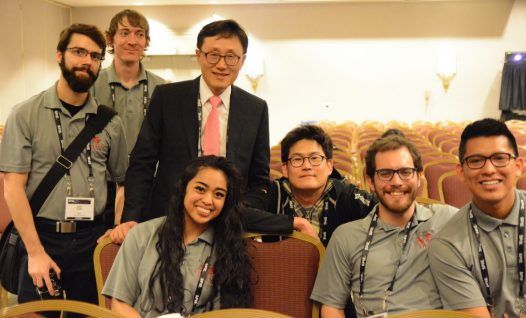
A notable accomplishment of the students who participated and
made a presentation at the EAPAD conference was winning the
Best Student Paper Award. The winner this year, Caleb Christianson,
University of California, San Diego, (Figure 4) with his paper titled
“Fluid electrodes for submersible robotics based on dielectric
elastomer actuators” [10163-57].
In closing, I would like to extend a special thanks to all the
conference attendees, paper presenters, session chairs, EAP-in-
Action Demo presenters, and the members of the EAPAD program Figure 4: Caleb
organization committee. In addition, special thanks are extended Christianson,
University of
to the SPIE staff that helped making this conference a great California, San
success. Diego, the
winner of the
Best Student
Paper Award
xx
Proc. of SPIE Vol. 10163 1016301-20
Downloaded From: https://www.spiedigitallibrary.org/conference-proceedings-of-spie on 19 Nov 2021
Terms of Use: https://www.spiedigitallibrary.org/terms-of-useAppendix: the 2017 EAP-in-Action program
The 2017 EAP-in-Action session highlighted some of the latest
capabilities and applications of Electroactive Polymer (EAP)
materials where the attendees have been shown demonstrations
of these materials in action. In addition, the attendees were
given an opportunity to interact directly with the presenters as
well as have been given “hands-on” experience with the
presented technology. The first Human/EAP-Robot Armwrestling
Contest was held in 2005 during this session.
Figure 5:
This year, the session has been opened by Dr. Hanson’s robot,
Hanson’s robot,
Sophia, greets
Sophia (Figure 5), who welcomed the attendees of the session
the attendees of
and gave general introductory words. Then, he presented the
the EAP-in-Action
Session. new toy robot, Prof. Einstein, and demonstrated its capabilities
(Figure 2). This participation of a humanlike robot gave great
excitement to the participants with the feeling of the “future is here”.
As part of the session, Gabor Kovacs presented his
company’s new contractile multilayered stack EAP actuator
that they are developing towards mass production (Figure
6).
The Session included 13 demonstrations with presenters from
China, Germany, Japan, New Zealand, Singapore,
Switzerland, and the United States. The presenters consisted
of professors and their students as well as engineers from
various companies. This year, the session ran as a
Figure 6: Gabor Kovach
competition, and the top three presentations were presenting his
selected by six judges. The winners were as follows: company’s new
contractile multilayered
stack EAP actuator.
First Place: Multilayered PVC gel artificial muscle - Minoru
Hashimoto, Yi Li, Aya Suzuki, Hanako Niwa, Rina Yokotsuka,
Shinshu University, Japan (Figure 7, left)
xxi
Proc. of SPIE Vol. 10163 1016301-21
Downloaded From: https://www.spiedigitallibrary.org/conference-proceedings-of-spie on 19 Nov 2021
Terms of Use: https://www.spiedigitallibrary.org/terms-of-useSecond Place: DEA-driven vibratory feeder - Steffen Hau, Mathias
Hoffmann, Stefan Seelecke, Saarland Universität, Germany
(Figure 8, right)
a
Third Place: "Multilocation sensing on one
input/output and the EAP zoo", Markus Henke,
Patrin Illenberger, Andreas Tairych, Chris Walker,
Katie Wilson, and Iain Anderson, Biomimetics Lab,
Auckland Bioengineering Institute, Auckland, New
Zealand (Figure 9, left).
The ranking evaluation criteria of the demonstration were:
1. Originality/creativity
2. Use of EAP to drive the demo
3. Performance of the demo
4. Potential impact
The judges for the 2017 competition were:
• Siegfried Bauer, Johannes Kepler Universität Linz (Austria)
• David Hanson, Hanson Robotics LLC (United States)
• Gabor Kovacs, EMPA (Switzerland)
• John D Madden, The University of British Columbia (Canada)
• Qibing Pei, University of California, Los Angeles (United States)
• Jonathan Rossiter, University of Bristol (United Kingdom)
Presentations were scored as followed: 4 Excellent; 3 Good; 2 Fair; 1 Reasonable;
0 No Show
The demonstrations in 2017 included innovative devices and potential new
products that are driven by EAP and were as follows (listed by the country of the
leading presenters):
China
(Figure 10) Jing Dai, Bangyuan Liu, Feiyu Chen, Sukai Wang, Zhiqiang Fu, Tiefeng
Li, Soft Matter Research Center of Zhejiang University, China, “Applications of
smart polymers”
xxii
Proc. of SPIE Vol. 10163 1016301-22
Downloaded From: https://www.spiedigitallibrary.org/conference-proceedings-of-spie on 19 Nov 2021
Terms of Use: https://www.spiedigitallibrary.org/terms-of-useThis demonstration showed Soft robotics and smart
structures that are made of multiple soft active materials,
and can be fabricated by 3D printing method. Driven by
dielectric elastomer, the robot shows excellent
performances in large actuation and fast response. Using
a common compact power and control electronics,
various configurations of soft robot can be designed as
actuated modules. Smart structures made of
temperature active tough hydrogel will also demonstrate
as actuators of bio-medical applications. The operation
Figure 10: The team from principles may guide the further design of soft robots for
Zhejiang University various applications.
demonstrating their EAP
actuated soft robotic
mechanism.
(Figure 11) Liwu Liu, Jinrong Li, Fengfeng Li, Xiongfei Lv,
Jinsong Leng, Harbin Institute of Technology, China,
“Applications of smart deformable polymers”
This demonstration will show smart polymers in action
taking advantage of their being light weight, fast
response, and large deformation. These advantages
make them attractive for applications in smart bionics,
aerospace, biomedicine and other fields. The
demonstration will include the applications of EAP,
shape memory polymer (SMP) and pneumatic artificial Figure 11: Hui Gao, Fanlong
Chen (speaker), Liwu Liu (from
muscle (PAM), such as soft robot, soft continuum left to right) (Harbin Institute of
manipulator, smart release device, adaptive eyewear Technology), presenting the
frame and other deformable structures. demo “Applications of smart
deformable polymers”
Germany
(Figure 12) Steffen Hau, Mathias Hoffmann, and Stefan
Seelecke, Saarland Universität, Germany, “DEA Driven Vibratory
Feeder”
Vibratory feeders are widely used in part handling technology
for transport, aligning and/or feeding parts to a certain process.
Currently they are driven by electro-magnetic actuators and
Figure 12: Steffen unbalance motors, which do not allow arbitrary vibration
Hau, Saarland
profiles or changes of amplitude/frequency during operation.
Univ. (Germany),
presenting the DEA Dielectric elastomer actuator (DEA) show potential to
Driven Vibratory overcome these drawbacks. A fully functional DEA driven
Feeder demo. vibratory feeder transporting small goods will be demonstrated,
showing DEAs potential in this new field of application. This demo received the
Runner-Up Best Student Paper Award.
xxiii
Proc. of SPIE Vol. 10163 1016301-23
Downloaded From: https://www.spiedigitallibrary.org/conference-proceedings-of-spie on 19 Nov 2021
Terms of Use: https://www.spiedigitallibrary.org/terms-of-useJapan
(Figure 13) Minoru Hashimoto, Yi Li, Aya Suzuki, Hanako Niwa,
Rina Yokotsuka, Shinshu University, Hashimoto-Tsukahara
Laboratory, Nagano, Japan, “Multilayered PVC Gel Artificial
Muscle”
Multilayered contraction type PVC gel actuator was
developed using stainless mesh electrodes having many Figure 13: The
positive characteristics. This include being soft and lightweight, Multilayered PVC Gel
Artificial Muscle
with stable actuation in air and with high output. It is activated being presented
by applying voltage of 400V, and the displacement of 60- (from Left to Right)
layer artificial muscles is ~3.0mm, with contraction strain of by Rina Yokotsuka,
~10%, and the maximum output force is ~50kPa. The response Minoru Hashimoto,
and Yi Li.
rate is 9Hz, and the current is about 0.45mA. This demo
received the Best EAP-in-Action Award.
(Figure 14) Tempuu Siva, Teruo Toyoda, and Fujio Mine,
Haloworld Inc., Fukushima, Japan, “Biomimetic robot system
for plumbing tests”
A tubular inchworm robot mechanism that is driven by
electroactive polymer and air pressure will be presented.
This robot will be equipped with a camera to allow testing
the plumbing of the decommissioned Fukushima Daiichi
Nuclear Power Plant. The robot is capable of traversing thru
Figure 14: Tempuu Siva
(on the right) and Teruo the many elbow sections along the more than several
Toyoda (on the left), hundred meter plumbing. The use of the EAP actuation
Haloworld Inc., mechanism allows for smooth operation thru the curvatures
presenting their along the plumbing path.
Biomimetic robot
system
New Zealand
(Figure 15) Patrin Illenberger, Katie Wilson, Andreas
Tairych, Chris Walker, Antoni Harbuz and Iain Anderson,
Biomimetics Laboratory, Auckland Bioengineering
Institute, Auckland, New Zealand “Multilocation sensing Figure 15: Iain Anderson
on one input/output and EAP zoo” presenting the Auckland
The Biomimetics Lab presented: Bioengineering Institute’s
1. The multisensor shirt that can measure stretch at Multilocation sensing on one
input/output and EAP zoo. From
several locations from one input/output. left to right: Iain Anderson, Patrin
2. The Electroactive polymer zoo: we present the latest Illenberger, Katie Wilson, Markus
self-regulating crawling caterpillars and wing Henke, Andreas Tairych, and
flapping dragonflies fabricated from printed polymer Chris Walker.
and electrode. No need for electronics!
This demo received the Third Place Best EAP-in-Action Award.
xxiv
Proc. of SPIE Vol. 10163 1016301-24
Downloaded From: https://www.spiedigitallibrary.org/conference-proceedings-of-spie on 19 Nov 2021
Terms of Use: https://www.spiedigitallibrary.org/terms-of-use(Figure 16) Mark Williamson StretchSense Ltd., Auckland, New
Zealand, “New EAP products”
What’s new in wearable electroactive polymer sensing and energy
harvesting. This included soft sensors with soft electronics.
Figure 16
Singapore
(Figure 17) Jiawei Cao, Lei Qin and Jian Zhu, National
University of Singapore, Singapore, “Soft untethered
robots”
The soft untethered robot mainly consists of a deformable
robotic body and two paper-based feet. Based on the ,11fi '
optimal mechanical design, the robot is capable of Figure 17: The team from
achieving autonomous movements. National University of
Singapore, Singapore,
demonstrating their soft
(Figure 18) Anansa S. Ahmed and Gih- untethered robots.
Keong Lau School of Mechanical and
Aerospace Engineering, Nanyang Technological University,
Singapore, “Dielectric elastomer grippers using tensioned arch
flexures”
The followings are going to be demonstrated
1. Versatile DEA grippers with enhanced tip angle
deflection and blocked force due to tension arch flexure
Figure 18: The structure.
Nanyang 2. Grippers capable of grasping and lifting a variety of
Technological
objects including highly deformable materials without damage.
University,
Singapore, team
presenting their Milan Shrestha, Anansa Ahmed, Anand Asundi, Gih-Keong Lau,
electrically tuning Nanyang Technological University, Singapore, “Electrically
transparency
tuning transparency by wrinkling of ZnO/Ag thin film”
This demonstration unit consists of transparency tunable device. It works based on
wrinkling and unfolding a ZnO/Ag-coated elastomer substrate using a dielectric
elastomer actuator (DEA). Initially, the membrane is at wrinkled state and the
device is opaque. An object placed underneath the membrane will not be
visible. When the DEA device is electrically activated, the wrinkles are flattened
turning the device to a transparent membrane and the object placed behind
xxv
Proc. of SPIE Vol. 10163 1016301-25
Downloaded From: https://www.spiedigitallibrary.org/conference-proceedings-of-spie on 19 Nov 2021
Terms of Use: https://www.spiedigitallibrary.org/terms-of-usethe device becomes clearly visible. Reversible tuning between the two states can
be obtained electrically for a large number of cycles.
Switzerland
(Figure 19) Samuel Rosset and Samuel Schlatter, EFPL,
Switzerland “PetaPicoVoltron: an open-source portable high-
voltage supply”
A portable high voltage power supply (HVPS) has been
demonstrated that is specifically designed to drive DEAs. Its
output DC voltages is up to 5kV with a resolution of 0.1% of full
scale, and can generate square signals from 1mHz to 1kHz
with a slew rate faster than 15V/µs. It has a user friendly GUI
enabling easy interaction with the HVPS, and using LabView Figure 19: The EFPL,
library makes it simple to integrate the power supply with Switzerland,
presenting their
other instruments. The circuit layout and the software have
PetaPicoVoltron
been released as an open-source project, for anyone to use demo
and improve.
United States
(Figure 20) Qi Shen, Sarah Trabia, Tyler Stalbaum, Taeseon Hwang, Robert Hunt,
Zakai Olsen, and Kwang Kim, University of Nevada, Las Vegas “Development of
an origami soft robot using multiple shape memory ionic polymer-metal
composite”
The multiple-shape-memory
ionic polymer-metal
composite (MSM-IPMC)
actuator is used to
demonstrate complex 3D
deformation. The MSM-IPMC
has two characteristics,
which are the electro-
mechanical actuation
effect and the thermal- Figure 10: The team Univ. of Nevada, Las Vegas, under the lead
mechanical shape memory of Kwang Kim (right) and their origami soft robot using multiple
effect. The bending, shape memory ionic polymer-metal composite (left).
twisting, and oscillating motions of the actuator could be controlled
simultaneously or separately by means of thermal-mechanical and electro-
mechanical transactions. Using the MSM-IPMC, a soft biomimetic robot was
developed that has origami structure. The multiple shape memory effect enables
the robot to change its shape and in return enables the robot to move forward in
water. This work may bring inspiration for designing new soft robotic systems with
the MSM-IPMC actuators
xxvi
Proc. of SPIE Vol. 10163 1016301-26
Downloaded From: https://www.spiedigitallibrary.org/conference-proceedings-of-spie on 19 Nov 2021
Terms of Use: https://www.spiedigitallibrary.org/terms-of-use(Figure 21) Lenore Rasmussen, Ras Laboratories, “Synthetic
V il
Muscle”
The operation of the latest Synthetic Muscle based actuators
was demonstrated. These are EAP based actuators that
contract and expand, attenuate impact, and sense pressure. In
addition, prosthetic liner prototype with self-adjusting EAP
based pads and sensing robotic gripper was shown.
Figure 11: Lenore Rasmussen, Ras Labs,
demonstrating her latest Synthetic Muscle Yoseph Bar-Cohen
based actuator, with sensing EAP pads
retrofitted to a standard EMI robotic gripper.
xxvii
Proc. of SPIE Vol. 10163 1016301-27
Downloaded From: https://www.spiedigitallibrary.org/conference-proceedings-of-spie on 19 Nov 2021
Terms of Use: https://www.spiedigitallibrary.org/terms-of-useProc. of SPIE Vol. 10163 1016301-28 Downloaded From: https://www.spiedigitallibrary.org/conference-proceedings-of-spie on 19 Nov 2021 Terms of Use: https://www.spiedigitallibrary.org/terms-of-use
You can also read


