Process Guidance Note 6/46(11) Statutory guidance for dry cleaning - Revised: June 2014
←
→
Page content transcription
If your browser does not render page correctly, please read the page content below
www.gov.uk/defra

Process Guidance Note 6/46(11)
Statutory guidance for dry cleaning
Revised: June 2014
© Crown copyright 2013
You may re-use this information (not including logos) free of charge in any format or
medium, under the terms of the Open Government Licence. To view this licence, visit
www.nationalarchives.gov.uk/doc/open-government-licence/ or write to the Information
Policy Team, The National Archives, Kew, London TW9 4DU, or e-mail:
psi@nationalarchives.gsi.gov.uk
This document/publication is also available on our website at:
http://www.defra.gov.uk/environment/quality/industrial/las-regulations/guidance/
Any enquiries regarding this document/publication should be sent to us at:
Atmosphere and Local Environment
Defra
Area 5F
Ergon House
Horseferry Road
London
SW1P 2AL
Email: Control.Pollution@defra.gsi.gov.uk
Defra would like to acknowledge the work of the
Environment Agency’s Local Authority Unit in the
drafting of this guidance note.
Revision of the guidance
      The electronic version of this publication is updated from time to time with new or
      amended guidance. Table 0.1 is an index to the latest changes (minor amendments
      are generally not listed).

                         Table 0.1 - Revision of the guidance
   Date of     Section/ paragraph                        Nature of change
   change      where change can be          - what paragraphs have been inserted,
                      found                          deleted or amended
                                            - what subject matter is covered by the
                                                            change
  June       Appendix 5                   Correction - Removal of annual requirement to
  2014                                    send details of staff training and maintenance at
                                          paragraph 3 as BAT conditions do not apply to
                                          cleaners using hydrocarbon or siloxane.
  June       SE Box 1                     Addition of colour coding to clarify requirements
  2013
  June       Table 7.1                    Addition of colour coding to clarify requirements
  2013
  09 March   Table 1                      Tables altered to identify the change of waste
  2011       Table 2                      solvent content.

             Appendix 3 (renumbered as    Additional text added to enhance calculation
             Appendix 4 in 2013)          sheet.
  March      throughout                   Replacement throughout the solvent PG notes of
  2013                                    ‘Solvent Emissions Directive’ with ‘industrial
                                          emissions Directive’ or ‘the Directive’, as
                                          appropriate;
             throughout                   Replacement of the abbreviation ‘SED’ with
                                          ‘solvent emission’, ‘SE’ or ‘solvent emission
                                          activity(ies)’, as appropriate, e.g. SED box will
                                          become SE box
             Para 1.13                    For England only, new paragraph – dry cleaning
                                          using hydrocarbon or siloxane is not subject to
                                          best available techniques
             Table 3.1                    Links to new regulations updated
             Table 5.1                    Error correction – deletion of % from residue
                                          solvent factors
             Appendix 4                   To the annual inventory form, was added ‘date
                                          submitted ____’

PG6/46(11)                                                                                    i
Appendix 5 Added for England only - outline permit for dry
cleaning using hydrocarbon solvents or
siloxanes, but no perchloroethylene
PG6/46(11) iiContents Revision of the guidance ................................................................................................... i 1. Introduction ................................................................................................................. 1 Legal basis .................................................................................................................... 1 Who is the guidance for? ............................................................................................... 2 Updating the guidance................................................................................................... 3 Consultation .................................................................................................................. 3 Policy and procedures ................................................................................................... 3 EU industrial emissions Directive .................................................................................. 3 England – dry cleaners to which Chapter V of the Directive is applied but not BAT ...... 4 2. Timetable for compliance and reviews ...................................................................... 5 Existing activities ........................................................................................................... 5 Permit reviews ............................................................................................................... 5 3. Activity description ..................................................................................................... 6 Regulations ................................................................................................................... 6 Activity ........................................................................................................................... 6 4. Emission limits, monitoring and other provisions ................................................. 15 Compliance with total emission limit value .................................................................. 15 Solvent content of residues ......................................................................................... 16 Calculation of compliance ............................................................................................ 17 5. Summary of changes ................................................................................................ 18 6. Further information ................................................................................................... 19 Definitions.................................................................................................................... 19 Health and safety......................................................................................................... 19 Training ....................................................................................................................... 20 Appendix 1: industrial emissions Directive ................................................................... 22 Appendix 2: Outline application form ............................................................................ 23 Appendix 3: Outline Permit ............................................................................................. 29 Appendix 4: Solvent and product cleaned inventory ................................................... 35 Appendix 5: Outline Permit, for England only, for dry cleaning with siloxane or hydrocarbon solvents ..................................................................................................... 38 List of Tables Table 0.1 - Revision of the guidance .................................................................................... i Table 3.1 - Regulations listing dry cleaning activities ........................................................... 6 Table 5.1 - Summary of changes ....................................................................................... 18 Table 7.1 - Classification of hazardous materials .............................................................. 21 List of Figures Figure 3.1 - Potential VOC release points from a typical dry cleaning machine ................. 12 Figure 3.2 - Schematic of a typical dry cleaning machine .................................................. 12 Figure 3.3 - By pass wash for typical dry cleaning operation ............................................. 13 Figure 3.4 - Filter Wash for typical dry cleaning operation ................................................. 13 Figure 3.5 - Distillation cycle for a typical dry cleaning operation ....................................... 14 Figure 3.6 - Drying cycle for a typical dry cleaning operation............................................. 14 Figure 4.1 - Solvent management plan inputs and outputs ................................................ 17 PG6/46(11) iii
1. Introduction

      Legal basis
1.1   This note applies to the whole of the UK. It is issued by the Secretary of State, the
      Welsh Government, the Scottish Government and the Department of the
      Environment in Northern Ireland (DoE NI) to give guidance on the conditions
      appropriate for the control of emissions into the air from the dry cleaning sector. It
      is published only in electronic form and can be found on the Defra website. It
      supersedes PG 6/46(04) and NIPG 6/46.

1.2   This guidance document is compliant with the Code of Practice on Guidance on
      Regulation page 6 of which contains the "golden rules of good guidance". If you feel
      this guidance breaches the code or you notice any inaccuracies within the
      guidance, please contact us.

1.3   This is one of a series of statutory notes giving guidance on the Best Available
      Techniques (BAT). The notes are all aimed at providing a strong framework for
      consistent and transparent regulation of installations regulated under the statutory
      Local Air Pollution Prevention and Control (LAPPC) regime in England and Wales,
      Scotland and Northern Ireland. The note will be treated as one of the material
      considerations when determining any appeals against a decision made under this
      legislation. In certain cases in England, the appropriate conditions for solvent
      emissions activities differ from BAT, see paragraph 1.13. Further guidance on the
      meaning of BAT can be found for England and Wales (in chapter 12 of the General
      Guidance Manual), Scotland, and Northern Ireland, (in chapter 9).

1.4   In general terms, what are BAT for one installation in a sector are likely to be BAT
      for a comparable installation. Consistency is important where circumstances are the
      same. However, in each case it is, in practice, for regulators (subject to appeal) to
      decide what are BAT for each individual installation, taking into account variable
      factors such as the configuration, size and other individual characteristics of the
      installation, as well as the locality (e.g. proximity to particularly sensitive receptors).

1.5   The note also, where appropriate, gives details of any mandatory requirements
      affecting air emissions which are in force at the time of publication, such as those
      contained in Regulations or in Directions from the Government. In the case of this
      note, at the time of publication the mandatory requirements are those contained in
      the EU industrial emissions Directive. The Regulations referenced in paragraph 1.3
      put the Directive requirements into UK law.

PG6/46(11)                                                                                    1
1.6 Most dry cleaning plant will have essentially the same characteristics and it is
expected that the outline application form and permit in Appendices 2 and 3 will
normally be used in order to simplify for businesses the process of applying for a
permit and to simplify for regulators the process of issuing a permit. The outline
permit comprises conditions 1- 25 which are likely to be needed in all cases, and
then additional conditions 26 -35 to cater for three additional circumstances:
new and substantially changed installations (although substantial changes are
likely to be rare);
cases where dry cleaning solvents are stored on-site in tanks (bulk storage);
the very unlikely event that a dry cleaner uses substances or preparations
containing or comprising hazard statements H340, H350, H350i, H360D or
H360F (similar risk phrases classifications in the industrial emissions Directive
continue until June 2015. Until then both classifications apply. (See section 6))
Dry cleaner suppliers should be able to advise if this is the case.
Who is the guidance for?
1.7 This guidance is for:
Regulators
local authorities in England and Wales, who must have regard to this statutory
guidance when determining applications for permits and reviewing extant
permits;
the Scottish Environment Protection Agency (SEPA) in Scotland, and district
councils or the Northern Ireland Environment Agency (NIEA), in Northern
Ireland for whom this is statutory guidance;
Operators who are best advised also to have regard to it when making applications
and in the subsequent operation of their installation;
Members of the public who may be interested to know what the Government
considers, in accordance with the legislation, amounts to appropriate conditions for
controlling air emissions for the generality of installations in this particular industry
sector.
PG6/46(11) 2Updating the guidance
1.8 The guidance is based on the state of knowledge and understanding, at the time of
writing, of what constitute BAT for this sector. The note may be amended from time
to time to keep up with developments in BAT, including improvements in
techniques, changes to the economic parameters, and new understanding of
environmental impacts and risks. The updated version will replace the previous
version on the Defra website and will include an index to the amendments.
1.9 Reasonable steps will be taken to keep the guidance up-to-date to ensure that
those who need to know about changes to the guidance are informed of any
published revisions. However, because there can be rapid changes to matters
referred to in the guidance – for example to legislation – it should not be assumed
that the most recent version of this note reflects the very latest legal requirements;
these requirements apply.
Consultation
1.10 This note has been produced in consultation with relevant trade bodies,
representatives of regulators including members of the Industrial Pollution Liaison
Committee and other potentially-interested organisations.
Policy and procedures
1.11 General guidance explaining LAPPC and setting out the policy and procedures is
contained in separate documents for England and Wales, Scotland and Northern
Ireland.
EU industrial emissions Directive
1.12 The activities covered by this note are solvent emission activities (SE) under the
industrial emissions Directive. To be a solvent emission activity, it must:
be a dry cleaning activity listed as a solvent emission activity in the LAPPC
Regulations (see Table 3.1).
The industrial emissions Directive chapter V is primarily concerned with emissions
to air, but contains implied controls on discharges to water and land. This Note
delivers the latter objective via the inherent controls of the solvent management
plan that restricts losses via water and land, Specific controls on these discharges
are delivered by other legislation that is not considered further in this Note.
PG6/46(11) 3In order to reduce VOC emissions from installations covered by this Note, the
compliance objective being used is detailed in Section 4.
The industrial emissions Directive chapter V gives limited discretion to Member
States to adopt different measures if the Directive requirements are demonstrated
not to be technically and economically feasible. Any such alternative measures
would need to be clearly justified and approved by the regulator. The operator must
demonstrate to the satisfaction of the regulator that the best available technique is
being used and that there are no significant risks to human health or the
environment. Before the derogation is permitted for solvent emission activities, the
regulator must notify Defra and give full justification of each case where Directive
requirements are not applied.
This note includes an outline permit in Appendix 3. The use of this permit will satisfy
the mandatory requirements of the industrial emissions Directive for dry cleaning.
England – dry cleaners to which Chapter V of the
Directive is applied but not BAT
1.13 In England, dry cleaners using hydrocarbon solvents or siloxane are not subject to
BAT other than in the very specific circumstances covered by Article 59(2) and (3)
of the industrial emissions Directive. These are drycleaners who do not also carry
on an activity listed in Part B of Regulations (see Table 3.1).
For these installations:
SE box 1 applies, to achieve this and compliance with the Directive, the outline
permit in Appendix 5 should be used instead of the perchloroethylene permit in
Appendix 3.
the application form in Appendix 2 can be used, omitting questions B4, B6 and
B7
the rest of the requirements in Sections 3 and 4 do not apply
BAT do not apply; any mention of BAT in the guidance should be read simply
as the requirements of the industrial emissions Directive.
PG6/46(11) 42. Timetable for compliance and reviews
Existing activities
2.1 This note contains all the provisions from previous editions which have not been
removed. Some have been amended. For installations in operation at the date this
note is published, the regulator should have already issued or varied the permit
having regard to the previous editions. If they have not done so, this should now be
done.
2.2 There are only two changes since the 2004 edition of this note which are likely to
require existing permits to need varying. They both relate to the calculation of the
solvent content of the still bottoms (see paragraph 4.2). There is a new factor of
0.35 for ecological filter rake out, and the factor for plumbed pump-out systems has
been reduced from 0.6 to 0.5. In both cases, variations should be made as soon as
reasonably practicable.
2.3 An additional change will eventually be needed, in England only, for plant using
hydrocarbon solvents, or siloxanes, but not using perchloroethylene. Until such a
permit is varied, the existing permit must be enforced as if it was already altered to
Appendix 5 or its equivalent.
2.4 For new activities, the permit should have regard to the full standards of this
guidance from the first day of operation.
2.5 For substantially changed activities, the permit should normally have regard to the
full standards of this guidance with respect to the parts of the activity that have been
substantially changed and any part of the activity affected by the change, from the
first day of operation.
Permit reviews
2.6 Under LAPPC, the legislation requires permits to be reviewed periodically but does
not specify a frequency. It is considered for this sector that a frequency of once
every eight years ought normally to be sufficient for the purposes of the appropriate
Regulations. Further guidance on permit reviews is contained in the appropriate
Guidance Manual for England and Wales, Scotland, Practical guide section 10 and
Northern Ireland Part B Guidance page 9, Northern Ireland Part C Guidance
chapter 17. Regulators should use any opportunities to determine the variations to
permits necessitated by paragraph 2.2 above in conjunction with these reviews.
2.7 Conditions should also be reviewed where complaint is attributable to the operation
of the process and is, in the opinion of the regulator, justified.
PG6/46(11) 53. Activity description
Regulations
3.1 This note applies to LAPPC installations for the dry cleaning sector. The activities
for regulation are listed in Table 3.1.
Table 3.1 - Regulations listing dry cleaning activities
LAPPC England and Wales Scotland Northern
Ireland
EPR reference PPC PPC reference
reference
Solvent emission Reg 2 EPR as amended in Schedule 2 n/a
activity 2013
refers to
industrial emissions
Directive Annex VII Parts 1
and 2
Part C solvent n/a n/a Schedule 1
emission activity section 7 Part C
The links are to the original version of the Regulations. A consolidated version is not
available on www.legislation.gov.uk
For England and Wales, an unofficial consolidated version is available but read the
first page of that document in order to understand its status and content.
3.2 This note applies to LAPPC installations at which dry cleaning operations are
carried out. The few mobile dry cleaning plants present in the UK are not subject to
regulation as the industrial emissions Directive definition of “installation” just covers
stationary technical units.
Activity
3.3 This note refers to any dry cleaning using organic solvents in particular:
perchloroethylene (PER), hydrocarbon solvent (HCS) and siloxane. The use of
carbon dioxide in dry cleaning is not covered by this note.
In the rest of this section only “process” should be understood to describe the
various stages involved in the dry cleaning operations. It does not necessarily have
the same meaning as elsewhere in this note.
PG6/46(11) 63.4 In the context of this note the activity comprises the whole process from receipt of
raw materials, via processing, to dispatch of finished products, including the
treating, handling and storage of all materials and wastes relating to the process.
3.5 The vast majority of machines within the UK are PER machines, although both HCS
and siloxane machines are used in some installations. HCS machines use
flammable solvents. As such they have specific controls and interlocks placed on
them to prevent possible ignition of the solvent. The majority of the PER machines
operating within the UK are the refrigerated closed circuit type, though the closed
circuit carbon adsorption type are becoming more common. A small number of open
circuit machines may still be in operation in existing installations. However, this type
of machine do not comply with the 31 October 2007 compliance requirements.
When a machine is changed, or substantially upgraded, the operator should notify
the regulator of this change.
3.6 Products to be dry cleaned are received at the installation; ticketed, checked for
foreign objects (coins etc.), and loose items (buttons), then sorted by colour (lights
and darks) and material (woollen blankets, suits etc.). Sorting is with the intention of
producing the optimum load weight to minimise solvent consumption. Components
of the load should have similar drying times. Unfortunately operators offering a
quick turn round service may achieve this by cleaning part loads. As the solvent
consumption per load is fairly constant this will lead to higher solvent consumption
per kg cleaned, with possible non compliance.
3.7 Before or after sorting of the products for cleaning, stains which may require
additional assistance for removal are treated with spot cleaning solutions. Most of
these solutions are supplied by specialist suppliers to the industry and the amount
of organic solvent is usually very low. Where dry cleaning installations still make up
their own spot cleaning or soap solutions containing dry cleaning solvent the use of
such solutions should be discouraged as not only is the VOC contained within them
released to environment, but the use may not be recorded and storage conditions
are normally inadequate.
3.8 Before loading into the machine the load must be weighed, (in kilograms), to
optimise the loading of the machine and to ensure that the machine is not over
loaded. Overloading and under loading of the machine will increase solvent
consumption.
3.9 Most modern machines have set programmes for different types of cleaning cycles.
Cleaning materials using the appropriate programme will reduce the solvent
consumption.
PG6/46(11) 73.10 The materials to be cleaned are taken to the machine and the door of the machine
is then opened and the materials loaded in. Care is required to ensure that door
seal is not damaged in anyway during the loading operation. The door of the
machine is then closed and not opened again until the machine cycle has finished.
3.11 Once the cleaning and drying cycle is completed the materials are removed from
the machine. A very strong solvent odour associated with the load indicates that the
solvent recovery process may not have been optimised. This may be due to a
number of reasons: poor loading of the machine (over loading or inadequate sorting
of materials to be cleaned); use of the wrong programme for the particular load,
leading to poor solvent recovery as a result of insufficient drying time, poor
maintenance, or a possible fault within the machine.
3.12 During the drying cycle of the machine, water which was present in the garments
cleaned and within the atmosphere of the dry cleaning machine is condensed out
within the water separator. This water is likely to contain small quantities of the dry
cleaning solvent. Secondary treatment of this water is normally required, after which
careful disposal of the final water stream will be needed. In some cases approval for
this disposal will require agreement from the local sewage undertaker.
3.13 Dirt from clothes cleaned has to be removed from the dry cleaning solvent. This is
done by draining the dirty solvent from the wash drum to a still, where distillation
takes place, the solvent is then condensed and returned to the clean solvent tank.
The clean solvent is used to rinse the clothes being cleaned and this solvent is
passed through a filter before returning to the clean solvent tank. Two types of filter
are in use, being a powder filter or an “ecological” filter. The latter spins to remove
the dirt, (and associated solvent), from the filter surface.
3.14 In both cases the material removed from the filters is also sent to the still for solvent
recovery. After a number of distillation operations the build up of residues in the still
must be removed. On powder systems this is done by distilling to near dryness the
contents of the still. Once cooled the residues are then raked out. Residues from
“ecological” filters may either be pumped out, via an integral pump on the machine,
or, as with powder systems, raked out manually. On pumpable systems the residue
is distilled until the remaining product can just be pumped, the residues then being
transferred into a sealed holding container. Whichever method is used the residues,
with any remaining solvent, are removed by a licensed waste contractor.
Daily, weekly and other checks
3.15 Manufacturers of machines supply operating and maintenance manuals for their
machines in order to optimise the machine performance. Good practice and
common requirements in these manufacturers’ manuals are checks daily, weekly
and at other intervals in the areas listed below. (The following describes typical
checks found in machine manufacturers’ manuals).
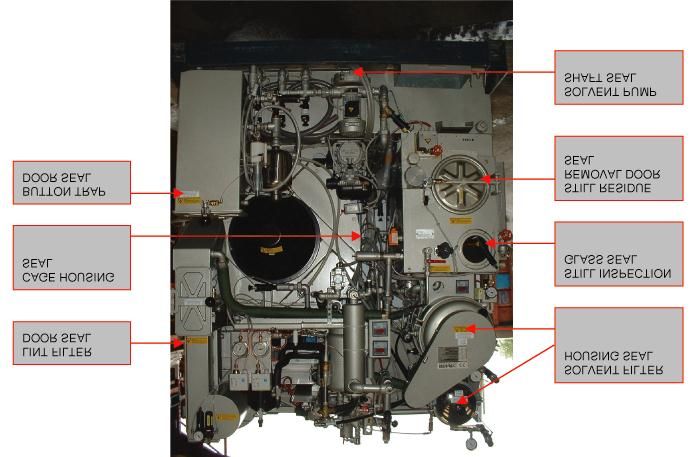
PG6/46(11) 8Daily leak tests from areas such as:
cage door gasket;
button trap lid;
air duct inspection hatch;
filter seals;
lint filter;
main bearing seal;
vapour line;
fan housing inspection hatch;
heating coil battery;
solvent valves;
recovery head;
cooling coil battery;
still doors;
solvent tank sight glasses;
solvent pipe flanges.
Vapour leaks are best detected during the early stages of the drying cycle.
Weekly checks of common components:
all drying and still temperature control settings;
draining line on the drum;
for by-passing of the lint filter, which may lead to blocking of the drying circuit;
button trap is functioning correctly and debris cannot pass the trap;
PG6/46(11) 9Common parts on machines which may need replacement or cleaning include:
door seals: wipe clean all door seals daily and replace annually;
button trap (manual): clean sieve twice daily and after lint loads;
lint filter (manual): clean twice daily;
water separator: drain and clean every two weeks; drain excess water daily;
solvent pump: check for leaks after repair or maintenance;
filters: drain spent cartridges in the machine overnight; check for leaks after
replacement;
still: empty at least once per week, or at manufacturers recommended time
interval;
recovery condensers: clean accessible condenser fins on air cooled
refrigeration systems on a six/twelve monthly basis.
Self service machines
3.16 Only PER self service machines are found in the UK. Un-manned coin operated
machines are unlikely to comply with the requirements of the Directive.
Self service machines will only comply if all of the below are in place in addition to
all the other relevant provisions of this note:
the manufacture of the machine can guarantee that under all load conditions
the compliance requirements of this note will be met;
the machine has some method of measuring the weight of the garments etc,
loaded into the machine;
a method of measuring the PER concentration in the cage at the end of each
cleaning cycle;
a continuous method of detecting leakage of solvent whilst the machine is
unattended is provided.
PG6/46(11) 103.17 The industrial emissions Directive requires that dry cleaning installations are
operated in such a manner that no more than 20 grams of solvent per kilogram of
product cleaned and dried shall be emitted as measured on an annual basis. The
20 grams includes all organic solvents used within the installation e.g. dry cleaning
solvent and spot cleaning solutions. The regulator will be required to check
compliance with this directive requirement using the return submitted by the
operator to demonstrate compliance. Other information may be used by the
regulator to audit the returns from the operator for example:
turnover of the installation;
customer/ticket counts;
solvent purchased reconciliation;
cycle counts.
PG6/46(11) 11Figure 3.1 - Potential VOC release points from a typical dry cleaning machine
Figure 3.2 - Schematic of a typical dry cleaning machine
PG6/46(11) 12Figure 3.3 - By pass wash for typical dry cleaning operation Figure 3.4 - Filter Wash for typical dry cleaning operation PG6/46(11) 13
Figure 3.5 - Distillation cycle for a typical dry cleaning operation

Figure 3.6 - Drying cycle for a typical dry cleaning operation

PG6/46(11)                                                             14
4. Emission limits, monitoring and other
provisions
4.1 Emissions of the substances listed in SE Box 1 below should be controlled.
SE BOX 1 – VOC emissions
Total Emission Limit Equivalent to Monitoring
Monitoring of solvent
20 grams of solvent released For PER - 80 kilograms of input
per kilogram of product product cleaned and dried per
cleaned and dried per litre emitted Monitoring of solvent
installation losses
For Hydrocarbons - 48.5 Monitoring of mass of
kilograms of product cleaned garments, etc, cleaned
and dried per litre emitted
By weekly recording
For Siloxane - 48.5 kilograms and annual mass
of product cleaned and dried balance to
per litre emitted demonstrate
compliance
Compliance with total emission limit value
4.2 To determine compliance with the requirements of SE Box 1 above requires records
to be kept of the following:-
The weight of each load of clothes cleaned. This should be recorded on a
weekly basis in kilograms.
Solvent added to the machine.
Figure 4.1 shows the solvent mass balance across a typical dry cleaning machine.
For compliance purposes the important material streams are solvent input (I1), and
solvent remaining in collected waste, (O8). Solvent losses in the separated water
(O5) are negligible and can be ignored. Allowance must be made for the spot
cleaning solvents used (O4) as these are lost to atmosphere as fugitive emissions.
O4 is calculated on an annual basis only.
I1 is determined by recording the amount of solvent used during the reporting period
to top up the machine solvent storage tanks. Where a mixture of solvents are used,
(including PER), then the amount of each individual solvent used will be required.
PG6/46(11) 15Solvent sent for recovery (O8) that is contained in the residue from the solvent
distillation still is recorded on a monthly basis. However, this material stream may
be stored for many months and an allowance may have to be made if waste
collection is made just before or just after the annual accounting date.
Example sheets that could be used for recording the above information are in
Appendix 4 of this Note.
For a new or re-installed machine, additional solvent may be used if the solvent tank
is filled following installation. This solvent can normally be ignored for mass balance
purposes as it is presumed it remains within the machine throughout its operating
life. However it will be good practice to check the monthly level of solvent in the
base tanks and, when refilling, to top up to a known level or mark. Only if the
machine fails to comply with the required emission limits should a check be made to
ensure excess solvent has not been lost/removed from the storage tanks.
Solvent content of residues
4.3 The solvent content of the still bottoms is determined by the nature of the filtration
and distillation processes within the machine. (See section 3 for a description of
these operations).
For older machines with a powder filter, the used powder is dropped to the solvent
recovery still where the majority of the solvent is recovered. The remaining residue
is emptied from the still by removing a plate on the back of the machine and “raking”
the residue out. This is stored in a drum until full when it is taken away by a licensed
waste contractor.
More modern machines use an “ecological” filter without a solid filter medium and
therefore the still residue may be removed either by pumping it out via a plumbed
system to the residue container, or raked out as described previously. Different
solvent contents are assumed for the three circumstances, being:-
0.15 for powder filter rake out;
0.35 for ecological filter rake out and
0.5 for plumbed pump out systems.
0.35 should also be used for
residues from decolourant filter cartridges where the solvent is only recovered
by draining the unit to the still;
residues from those machines, normally using siloxane, where the solvent is
only filtered to remove solids, with no distillation taking place.
PG6/46(11) 16Calculation of compliance
4.4 The compliance performance of the machine is calculated from the total weight of
clothes cleaned during the year and the solvent usage, including that used for spot
cleaning. For compliance when the weight of products cleaned and dried in
kilograms is divided by the annual solvent use the result should be equal to or
greater than the figures for the appropriate solvent(s) in column 2 of SE Box 1.
Figure 4.1 - Solvent management plan inputs and outputs
PG6/46(11) 175. Summary of changes
The main changes to this note, with the reasons for the change, are summarised in
Table 5.1. Minor changes that will not impact on the permit conditions e.g. slight
alterations to the Process Description have not been recorded.
Table 5.1 - Summary of changes
Section/ Change Reason Comment
paragraph/row
Emission limits, monitoring and other provisions
4.3 Higher waste solvent The old Permits should
content allowances of be varied as
allowance reduced to 0.5. 0.15 for rake-out necessary for
New 0.35 waste solvent and 0.6 for pump allowances to
content allowance for out did not fully take effect as
ecological filter machines reflect the solvent soon as
content and reasonably
range of wastes practicable
produced.
PG6/46(11) 186. Further information
Definitions
A change that can be considered as a “Substantial change” is discussed/defined in
the relevant Guidance Manual for England and Wales, Scotland and Northern
Ireland.
Health and safety
Operators of installations must protect people at work as well as the environment:
requirements of a permit should not put at risk the health, safety or welfare of
people at work or those who may be harmed by the work activity;
equally, the permit must not contain conditions whose only purpose is to
secure the health of people at work. That is the job of the health and safety
enforcing authorities.
Where emission limits quoted in this guidance conflict with health and safety limits,
the tighter limit should prevail because:
emission limits under the relevant environmental legislation relate to the
concentration of pollutant released into the air from prescribed activities;
exposure limits under health and safety legislation relate to the concentration
of pollutant in the air breathed by workers;
these limits may differ since they are set according to different criteria. It will
normally be quite appropriate to have different standards for the same
pollutant, but in some cases they may be in conflict (for example, where air
discharged from a process is breathed by workers). In such cases, the tighter
limit should be applied to prevent a relaxation of control.
PG6/46(11) 19Training
The following organisations can offer training on PPC and dry cleaning.
The Guild of Cleaners and Launderers offer a competence-based certificate on
"Handling Dry Cleaning Solvents Safely" following a 75-minute exam. Its aim is to
qualify dry cleaners and regulators in the requirements of SED, but also includes
understanding and optimisation of the dry cleaning operation. (Tel 0161 483 4655
www.gcl.org.uk )
EHRC (Environmental Health Resource Centre Ltd) are providers of bespoke
small group and one-to-one training sessions for regulators involved in permitting
and regulating dry cleaners, including theory and practice at a dry cleaner of your
choice (www.ehrc.org.uk)
Martin Cranfield Associates can provide courses around the country on inspecting
dry cleaning installations. The course has been designed in association with
Parrisianne Ltd, who are approved trainers to the Guild of Cleaners and
Launderers. www.cranfieldassociates.co.uk/
SATRA, based in Kettering, runs a Solvent Emissions Directive practical 1 day
course for regulators and cleaners. Their premises include working dry cleaning
equipment. (www.satra.co.uk )
(It should be noted that SLEAT, (Society of Laundry Engineers and Allied Trades),
has issued a Code of Practice that indicates when a machine has been designed to
meet the Directive standards. This should be made available by the operator to the
regulator if requested).
PG6/46(11) 20Table 7.1 - Classification of hazardous materials
The industrial emissions Directive Halogenated VOC is the
catches materials which, because of their trigger for the Directive in
VOC content, are designated with the this column
phrases/statements in these columns
Risk Phrases class 1 ‘known to’ class 2 ‘treat as’ class 3 ‘cause concern’
Hazard category 1a category 1b category 2
statements
categories known from human presumed from suspected human
They are NOT evidence animal evidence carcinogens
exact equivalents
H340, H350, H350i, H360D or H360F H341
H351
Carcinogens R45 R45 R40
May cause cancer May cause cancer Limited evidence of a
carcinogenic effect
H350 H350
H351
May cause cancer May cause cancer
Suspected of causing
cancer
Mutagens R46 R46 R68
May cause heritable May cause heritable possible risk of irreversible
genetic damage genetic damage effects
H340 H340 H341
May cause genetic May cause genetic Suspected of causing
defects defects genetic defects
Carcinogen by R49 R49 R40
inhalation
May cause cancer May cause cancer by Limited evidence of a
by inhalation inhalation carcinogenic effect
H350i H350i H351
May cause cancer May cause cancer by Suspected of causing
by inhalation inhalation cancer
Toxic to R60 R60 Outside the Directive - R62
reproduction and R63 for the suspected
May impair fertility - May impair fertility - R phrases say “possible risk
and R61 and R61 to”.
May cause harm to May cause harm to
the unborn child the unborn child
H360D or H360F H360D or H360F
May damage fertility May damage fertility
or the unborn child or the unborn child
PG6/46(11) 21Appendix 1: industrial emissions Directive
The industrial emissions Directive 2010/75 recasts 7 Directives including the solvent
emissions Directive, which is minimally changed.
In the industrial emissions Directive, Chapters I and V, and Annex VII, Parts 1 to 8
are most directly related to the solvent emissions Directive and this guidance note.
The Directive chapters are:
Chapter I - common provisions
Chapter II - provisions for activities listed in Annex I
Chapter III - special provisions for combustion plants
Chapter IV - special provisions for waste incineration plants and waste co-
incineration plants
Chapter V - special provisions for installations and activities using organic solvents
Chapter VI - special provisions for installations producing titanium dioxide
Chapter VII - committee, transitional and final provisions
In the Directive, the Parts of Annex VII are:
Part 1 - activities
Part 2 - thresholds and emission limit values
Part 3 - emission limit values for installations of the vehicle coating industry
Part 4 - emission limit values relating to volatile organic compounds with specific
risk phrases
Part 5 - reduction scheme
Part 6 - emission monitoring
Part 7 - solvent management plan
Part 8 - assessment of compliance with emission limit values in waste gases
PG6/46(11) 22Appendix 2: Outline application form
Application for a permit for dry cleaner
Local Authority Pollution Prevention and Control
Pollution Prevention and Control Act, 1999
The Environment (Northern Ireland) Order 2002
The Pollution Prevention and Control Regulations (Industrial Emissions) (Northern Ireland) 2012
Environmental Permitting (England and Wales) Regulations 2010
Introduction
When to use this form
Use this form if you are applying for a permit to a regulator to operate a dry cleaning installation as
defined in the appropriate legislation of the UK region in which the installation is sited.
The appropriate fee must be enclosed with the application to enable it to be processed further.
When complete send the form and fee and any additional information to:
[Insert local authority address]
If you need help and advice
We have made the application form as straightforward as possible, but please get in touch with us at
the local authority address given above if you need any advice on how to set out the information we
need.
For the purposes of Section C of the form, a relevant offence is any conviction for an offence relating
to the environment or environmental regulation.
For Local Authority use
Application reference: Officer reference: Date received:
PG6/46(11) 23LAPPC application form - to be completed by the operator
A The basics
A1 Name and address of the premises
Postcode: Telephone:
A2 Ordinance survey national grid reference (8 characters)
(for example, SJ 123 456...there are a number of internet mapping sites which will convert
a post code to a grid refrences.)
A3 Details of any existing environmental permit or consent
(for waste operations, include planning permission for the site, plus established use
certificates, a certificate of lawful existing use, or evidence why the General Permitted
Development Order applies.)
A3 Do you have an existing permit for a dry cleaning installation
Yes No
PG6/46(11) 24A4 The applicant – please provide the full name of company or corporate body or the
name of the sole trader or the names of the partners
Name:
Trading name, if different:
Registered office address:
Principal office address, if different:
A4 Any holding company?
Is the operator a subsidiary of a holding company within the meaning of section 1159 of the
Companies Act 2006? If “yes” please fill in details of the ultimate holding company.
Yes No
Name:
Trading name, if different:
Registered office address:
Principal office address, if different:
Company registration number:
PG6/46(11) 25B The installation
B1 A plan of the premises must be attached showing the location of:
(a) the premises
(b) where the dry cleaning machine(s) will be installed
(c) where the dry cleaning solvents will be stored
(d) where the dry cleaning residue will be stored
(e) any drains within the installation and in the immediate area of the installation which may be
affected as a result of any potential Volatile Organic Compound (VOC) release from the dry
cleaning operations
B2 A description of the location and methods of storage of (a) or (b) must be
supplied:
(a) dry cleaning solvents
(b) dry cleaning residue
B3 Make, model name and number, serial number, load capacity, date of installation
and type of dry cleaning solvent used, plus method of removal of residue from
the machine.
B4 Provide details, including a schedule, of checking and maintenance procedures
for each machine. This should include the machine manufacturers’
recommended operating procedures, checking and maintenance requirements
and any other additional procedures undertaken by the operator. (This should be
submitted in a form of a list of the activities carried out and their frequencies, for additional
guidance see Section 3, paragraph 3.14)
B5 Provide details of any other activities carried out within the dry cleaning
installation which involve the use of organic solvents in particular spot clean
solutions, water-proofing solutions and any other solvents or solvent borne
preparations
B6 Provide details on the training and relevant qualifications regarding operating
and maintaining the dry cleaning machine in accordance with this guidance.
B7 Provide details on the training and relevant qualifications regarding operating
and maintaining the dry cleaning machine in accordance with this guidance.
B8 Specify how the product will be weighed and recorded weekly and annually,
including details of scales.
B9 Provide details how the mass or volume of solvent used will be determined and
recorded weekly and annually (due to the low use, spot cleaning solvents need
only be determined annually).
PG6/46(11) 26C Fees and Charges
C1 For details of how to calculate the application fee please consult the appropriate
charging scheme via the Defra web site, (England & Wales), the SEPA web site,
(Scotland) or the DOENI web site, (Northern Ireland). Your application cannot be
processed unless the application fee is correct and enclosed.
Please state the amount enclosed as an application fee for this installation.
£................................
Cheques should be made payable to:
We will confirm receipt of this fee when we write to you acknowledging your application.
Please give any company purchase order number or other reference you wish to be
used in relation to this fee.
C2 Annual charges
If we grant you a permit, you will be required to pay an annual subsistence charge.
If you don’t pay, your permit can be revoked and you will not be able to operate your
installation.
Please provide details of the address you wish invoices to be sent to and details of
someone we may contact about fees and charges.
Postcode: Telephone:
C6 Commercial confidentiality
Is there any information in the application that you wish to justify being kept from the
public register on the grounds of commercial confidentiality?
If ‘Yes’, please provide full justification, considering the definition of commercial
confidentiality within the Regulations (See the appropriate general guidance manual).
PG6/46(11) 27C7 Data Protection Declaration
The information you give will be used by the regulator to process your application. It will
be placed on the relevant public register and used to monitor compliance with the permit
conditions. We may also use and/or disclose any of the information you give us in order
to:
consult with the public, public bodies and other organisations,
carry out statistical analysis, research and development on environmental issues,
provide public register information to enquirers,
investigate possible breaches of environmental law and take any resulting action,
prevent breaches of environmental law,
assess customer service satisfaction and improve our service.
We may pass on the information to agents/ representatives who we ask to do any of
these things on our behalf.
It is an offence under the relevant regulations, for the purpose of obtaining a permit (for
yourself or anyone else) to:
make a false statement which you know to be false or misleading in a material
particular,
recklessly make a statement which is false or misleading in a material particular.
If you make a false statement we may prosecute you, and if you are convicted, you are
liable to a fine or imprisonment (or both).
C8 Declaration
Signature of current applicant(s)*
I / We certify that the information in this application is correct. I / We apply for a permit in
respect of the particulars described in this application (including supporting
documentation) I / We have supplied.
Please note that each individual applicant must sign the declaration themselves, even if
an agent is acting on their behalf.
For the application from:
Premises name:______________________________________________________
Signature:___________________________________________________________
Name:______________________________________________________________
Position:____________________________________________________________
Date:___________________________
Signature:___________________________________________________________
Name:______________________________________________________________
Position:____________________________________________________________
Date:___________________________
* Where more than one person is defined as the applicant, all should sign. Where a
company or other body corporate - an authorised person should sign and provide
evidence of authority from the board of the company or body corporate.
PG6/46(11) 28Appendix 3: Outline Permit [ ] COUNCIL POLLUTION PREVENTION AND CONTROL ACT 1999 Environmental Permitting (England and Wales) Regulations 2013 Permit ref. no: Installation Details (i) Name and address of operation: + (if appropriate) registered number and office of company. (ii) Address of permitted installation: [outlined on attached plan; + include location of dry cleaning machine(s), The above named company is permitted to operate a dry cleaning installation containing the dry cleaning machine(s) [insert details from application], subject to compliance with the following conditions: PG6/46(11) 29
Residual BAT condition
The best available techniques shall be used to prevent, or where that is not practicable, reduce
emissions from the installation in relation to any aspect of the operation of the activity which is not
specifically regulated by any condition of this permit.

Conditions

1.   Operations must be carried out in such a manner that no more than 20 grams of solvent per
     kilogram of product cleaned and dried shall be emitted as measured and reported annually.
     The 20 grams includes all organic solvents used within the installation e.g. dry cleaning
     solvent, water-proofing solutions and spot cleaning solutions.

2.   A weekly inventory of solvent usage, product cleaned and solvent waste sent for recovery or
     disposal shall be maintained and held on site for inspection by the regulator for at least 12
     months. Further, the operator should retain records of solvent purchased for at least 12
     months.

Note: The solvent management balance sheet for dry cleaning installations in Appendix 4 can be
used to demonstrate compliance with conditions (1) and (2) (above).

3.   On a date stipulated by the local authority regulator a copy of the following shall be sent to the
     Council at the frequency given below:

     Information to be sent to the Council               Frequency at which information
                                                                should be sent
     (i) the monthly inventory sheets for the        Once a quarter
     previous quarter or

     (ii) with the written agreement of the          Once a year
     Council**
     the record of regular maintenance during        Once a year
     the previous 12 months, referred to in
     condition 4, once a year on [date]
     a list of staff nominated and trained, in          Once a year
     accordance with conditions (6) and (7)
     ** it is expected that local authorities will specify quarterly submission of data initially
     unless they are satisfied from the inventory data already received that condition (1) is
     being consistently met and, having regard to operator competence, that it is likely to be
     met in future. Where quarterly submission is initially required, the operator may at any
     time ask the authority to agree an annual submission. Agreement by the regulator should
     be notified in writing, such a request being judged on the same criteria.

4.   The operator, (or a suitably qualified engineer), shall implement the schedule of procedures,
     checks and maintenance requirements to each dry cleaning machine as listed in B1.5 of the
     permit application dated [date].

5.   The regulator shall be advised in writing 14 days prior to any proposed significant alteration to
     the operation, or modification of the installation which may have an effect on emissions of
     VOC from the installation, in particular changes to the matters listed in condition (4).

6.   All operating staff shall know where the operating manual for each dry cleaning machine can
     be found and have ready access to it.

PG6/46(11)                                                                                           30
7. All operating staff shall be trained in the operation of each dry cleaning machine and the
control and use of dry cleaning solvents. The training received shall be recorded.
8. The machine shall be installed and operated in accordance with supplier recommendations, so
as to minimise the release of VOC to air, land and water.
9. In the case of abnormal emissions, malfunction or breakdown leading to abnormal emissions
the operator shall:
investigate immediately and undertake corrective action; adjust the activity to minimise
those emissions; and
adjust the activity to minimise those emissions; and
promptly record the events and actions taken.
In this condition abnormal emission will include any detectable solvent smell other than in
the area of the dry cleaning machine.
10. In cases of non-compliance causing immediate danger to human health, or threatens to cause
an immediate significant adverse effect upon the environment, operation of the activity shall be
suspended; and the regulator within 24 hours.
11. Dry cleaning machines shall be operated as full as the type of materials to be cleaned will
allow. (for instance, full loads for light non delicates materials such as suits. Delicates and
heavy materials, such as, wedding dresses and blankets may need to be cleaned in part
loads).
12. Where cleaning solvents containing VOC are not received in bulk they shall be stored:
in the containers they were supplied in with the lid securely fastened at all times other
than when in use; and
within spillage collectors, of suitable size, made of impervious and corrosion-proof
materials; and
away from sources of heat and bright light; and
with access restricted to only appropriately trained staff, and
the lids of the containers shall only be removed when the container is next to the cleaning
machine ready for filling. Cleaning solvents shall be obtained in containers of a size which
allows the entire container to be emptied into the machine at each topping up. Once
emptied the lid of the container shall be replaced securely.
(Note: from a health and safety point of view: a well ventilated area should be used).
13. Spot cleaning with organic solvents or organic solvent borne preparations shall only be carried
out if no other method of treating a particular stain on the material to be cleaned is available.
14. The dry cleaning machine loading door shall be kept closed when not in use.
(Note - Where an extract fan is fitted to maintain a negative pressure within the machine during
unloading, the exhaust from this fan should be directed to a carbon adsorption filter prior to
discharge to atmosphere).
PG6/46(11) 3115. The dry cleaning machine loading door shall be closed before the start-up of the machine, and
kept closed at all times through the drying and cleaning cycle.
All machines installed after 19 May 2005 shall have interlocks to prevent start-up of the
machine until the loading door is closed and to prevent opening of the loading door until
the machine cycle has finished and the cage has stopped rotating.
All machines installed after 19 May 2005 shall have interlocks to automatically shut down
the machine under any of the following conditions: cooling water shortage, failure of the
cooling ability of the still condenser, failure of the cooling ability of the refrigeration system
or failure in the machine heating system resulting in the inability to dry the load.
16. The still, button trap and lint filter doors shall be closed before the start-up of the machine and
kept closed at all times through the drying and cleaning cycle.
All machines installed after 19 May 2005 shall have interlocks to automatically shut down
the machine if the still, button trap and lint filter doors are not properly closed.
17. The still shall have a thermostatic control device or equivalent with which to set a maximum
temperature, in accordance with manufacturers' recommendations for the solvent used. (In
those cases where several machines are supplied by a steam supply, where the operator can
demonstrate that the maximum temperature can be controlled via the steam pressure
controller, then this should be accepted by the local authority).
18. All new, and substantially refurbished machines, shall have a spillage tray with a volume
greater than 110% of the volume of the largest single tank within the machine.
(Explanatory note that is not part of the permit conditions - This does not remove the need to
comply with Health & Safety recommendations relating to the fitting of spill trays to existing
machines.)
19. All machines installed after 19 May 2005 shall have a secondary water separator to minimise
potential solvent losses. Where this is not an integral part of the machine then the operator
should select and install a method that will achieve an equivalent degree of separation. [Where
this is followed by a an activated carbon unit then the operator will need to demonstrate
adequate procedures are in place to detect when the unit requires disposal via an acceptable
route].
20. Prior to disposal, containers contaminated with solvent shall be stored with the lids securely
fastened to minimise emissions from residues during storage prior to disposal, and labelled so
that all that handle them are aware of their contents.
(Note - Empty containers should, where possible, be returned to the supplier.)
21. Solvent contaminated waste, for example still residues, shall be stored:
in suitable sealed containers with the lid securely fastened at all times other than when in
use; and
on a suitable impervious floor; and
away from any drains which may become contaminated with residues as a result of
spillage,
away from sources of heat and bright light; and
with access restricted to only appropriately trained staff.
(Note 1 - From a health and safety point of view: a well ventilated area should be used.)
PG6/46(11) 32You can also read


