PULMONARY & NASAL DELIVERY - P06 P33 - Nemera
←
→
Page content transcription
If your browser does not render page correctly, please read the page content below
P06                              P33                           P62
                                 WAITING WITH BATED               ADDRESSING SYSTEMIC           DO SOFT-MIST INHALERS HOLD
                                 BREATH – WHAT’S IN STORE         DELIVERY WITH A               THE KEY TO FASTER INHALATION
                                 FOR 2022 AND BEYOND?             UNIT-DOSE NASAL SPRAY         DRUG DEVELOPMENT?

                           PULMONARY &
                           NASAL DELIVERY
APRIL 11TH 2022 • ISSUE NO 131

                                                 ®
Helping our clients connect with the future

—
—
—
—
—
—
Contents
ONdrugDelivery Issue No 131, April 11th, 2022 Waiting with Bated Breath – What’s in Store for 2022 and Beyond?
PULMONARY & NASAL DELIVERY 06 -09 Rob Udale, Principal Engineer, Inhalation Lead; and
Heather Jameson, Senior Engineer
springboard
This edition is one in the ONdrugDelivery series
Invitation to Participate in Standardisation of
of publications. Each issue focuses on a specific
topic within the field of drug delivery, and is 12 - 15 Particle Measurements for Pharmaceuticals
Caterina Minelli, Science Area Leader
National Physical Laboratory
supported by industry leaders in that field.
Interview
EDITORIAL CALENDAR
Apr/May Drug Delivery & Environmental Sustainability
2022
18 - 21 Jon Lenn, Chief Scientific Officer; and
Jon Volmer, Senior Director of Research Biology & Innovation
MedPharm
May Injectable Drug Delivery: Nose-to-Brain Drug Administration and a Novel Approach with an Old Familiar
Formulations & Devices Marie-Christine Klein, Head of Development & Regulatory Affairs; and
Jun
Jul
Connecting Drug Delivery
Novel Oral Delivery Systems
22 - 26 Andreas Bilstein, General Manager
URSATEC
Rouven Kraus, Head of Sales
Aug Industrialising Drug Delivery Aero Pump
Sep Wearable Injectors
Breaching the Blood-Brain-Barrier with Particle-Based Nasal Delivery Systems
Oct Prefilled Syringes & Injection Devices
Oct/Nov Drug Delivery & Environmental Sustainability 27 - 30 Tom French, Delivery Device Project Manager
3P innovation
Nov Pulmonary & Nasal Drug Delivery
Addressing Systemic Delivery with a Unit-Dose Nasal Spray
Dec Connecting Drug Delivery
Jan 2023 Skin Drug Delivery: 33 - 36 Audrey Chandra, Category Project Manager; and
Raphaële Audibert, Global Category Manager, Ear, Nose and Throat
Nemera
Dermal, Transdermal & Microneedles
Feb Prefilled Syringes & Injection Devices Nasal Delivery System Expands Public and Patient Access
Mar Ophthalmic Drug Delivery to Naloxone to Mitigate the Opioid Overdose Epidemic
Apr Pulmonary & Nasal Drug Delivery 38 - 40 Todd D Pizitz, Co-Founder; and
Donald R Mealing, Co-Founder
EDITORIAL: CounterACT
Guy Furness, Proprietor & Publisher Nanotechnology: a Next-Generation Tool for Pulmonary and Nasal Delivery
E: guy.furness@ondrugdelivery.com 41 - 43 Frédérique Bordes-Picard, Vice-President of Business Development, Europe
Nanoform
CREATIVE DESIGN:
Personalised Aerosol Loading and Management (PALM):
Simon Smith, Creative Director (Freelance) a Hand-Held Device for Aerosol Drug Delivery
E: simon.smith@ondrugdelivery.com Jason Brenker, Research Fellow; and
44 - 48
Tuncay Alan, Senior Lecturer
SUBSCRIPTIONS: Monash University
Audrey Furness (subscriptions@ondrugdelivery.com) Tuncay Alan, Senior Lecturer
Print + Digital subscription: £99/year + postage. Macquarie University
Digital Only subscription: free. Woolcock Institute of Medical Research
Investigating the Propellant Pathways Leading to a Sustainable Future for MDIs
ADVERTISING:
Chris Baron, Director of Business Development, Pulmonary Category
Guy Furness (guy.furness@ondrugdelivery.com)
ONdrugDelivery is published by
49 - 52 Aptar Pharma
Jag Shur, Vice-President, Science & Technology
Nanopharma
Frederick Furness Publishing Ltd
The Candlemakers, West Street, Lewes
East Sussex, BN7 2NZ, United Kingdom 55 - 56 Technology Showcase: Testing Solutions for pMDI Drug Development
Proveris Scientific
T: +44 1273 47 28 28 Evolution of Nebulisation for Drug Delivery to the Lungs
Registered in England: Company No 8348388 58 - 60 Daniel Lock, Specialist, Pharmaceutical Development
Vectura
ISSN 2049-145X print / ISSN 2049-1468 pdf
Do Soft Mist Inhalers Hold the Key to Faster Inhalation Drug Development?
62 - 65 Wilbur de Kruijf, General Manager and Chief Technology Officer; and
Bernhard Müllinger, General Manager and Chief Operations Officer
Resyca
Using Quality by Design to Optimise the Combination Product Journey
Justin Lacombe, Chief Scientific Officer
ONdrugDelivery Magazine is printed sustainably by Newman Thomson Ltd,
West Sussex, UK, using Forestry Stewardship Council® certified recycled paper,
vegetable-based inks, biodegradable laminates and carbon balanced materials
66 - 69 Experic
Julie Suman, President, Scientific Affairs
offset via the World Land Trust™ following ISO140001 processes.
Next Breath
Copyright © 2022 Frederick Furness Publishing Ltd Manufacturing DPIs: an Engineering Perspective
71 - 74 Pietro Pirera, Product Manager, Capsule Fillers
IMA Active
Capsules for Dry Powder Inhalation – a Complete Product
Anita Solanki, Lead – White Papers, Formulation R&D (Pharma & Nutra);
The ONdrugDelivery logo is a registered trademark of
Frederick Furness Publishing Ltd.
76 - 80 Jnanadeva Bhat, Vice-President and Head of R&D (Pharma & Nutra); and
Justin Kalafat, Head of International Scientific Business Development (Pharma & Nutra)
ACG Capsules
The views and opinions expressed in this issue are those of the authors.
Due care has been used in producing this publication, but the publisher Collaboration Aims to Accelerate Development Process in DPI Formulation
makes no claim that it is free of error. Nor does the publisher accept
liability for the consequences of any decision or action taken (or not
taken) as a result of any information contained in this publication.
81 - 83 Harry Peters, Senior Product Application Specialist (Inhalation)
DFE Pharma
A TRUSTED PARTNER FOR MATERIAL
SOLUTIONS IN MEDICAL DEVICES
                        Over 150 million patients rely on medical devices manufactured
                        with Celanese materials to improve their quality of life every day.
                        Trust our 40 years of clinical history in medical devices and engage our team for:
                                       One-on-one guidance on material options during device design to meet
                                       evolving performance requirements

                                       Regulatory and quality management* to support clinical trials and
                                       sustain long-term device sales

                                       Tooling optimization and process validation assistance for high-volume
                                       manufacturing

                        * included in the Celanese Medical Technology service package

                                                                                        Celanese®, registered C-ball design and all other
Discover how our team and our materials can enable your medical device development      trademarks identified herein with ®, TM, SM,
                                                                                        unless otherwise noted, are trademarks
                                                                                        of Celanese or its affiliates.
Contacts:        healthcare.celanese.com                healthcare@celanese.com         Copyright © 2022 Celanese or its affiliates.
                                                                                        All rights reserved.
Expert View

WAITING WITH BATED BREATH
– WHAT’S IN STORE FOR 2022?
Here, Rob Udale, Principal Engineer, Inhalation Lead, and Heather Jameson, Senior
Engineer, both of Springboard, discuss the exciting developments taking place in the
design of inhalation devices and share their predictions for the top five inhalation
trends to watch as 2022 unfolds, and beyond.

SUSTAINABILITY AND GREENER
LIFECYCLE MANAGEMENT
                                                    “In addition to reducing
November 2021 saw the largest climate                   the carbon footprint
change conference of its type to date,               of individual inhalation
COP26, bringing a new wave of eco-
                                                    devices, medical device
awareness that has permeated almost
every industry. Medical engineering is no                companies are also
exception, and we are seeing early signs            increasingly committed
of a revolution in the sustainability and
                                                  to finding carbon-neutral
reusability of inhalation devices.
   Over the last half-century, many drug           manufacturing solutions
delivery devices have been designed with        and assessing the impact of
disposability in mind. Disposability has its
                                                their devices’ full lifecycles.”
advantages:

•	High-volume        manufacture     brings
   efficiencies of scale
•	Single-use, disposable devices can have
   fewer use steps and can be easier to use
•	It can be easier to guarantee user safety
   with a disposable device.

    But if we look back to some of the
first inhalation devices from the late 20th                                                     Rob Udale
century, such as Boehringer Ingelheim’s                                                         Principal Engineer, Inhalation Lead
Aerohaler or GlaxoSmithKline’s Diskhaler,                                                       T: +44 1223 856446
                                                                                                E: rob.udale@springboard.pro
we find a very different story. Those early
devices were reusable with a loadable
primary pack.
    Now, in 2022, we are beginning to see
a move “back to the future” and a return
to those reusable devices (Figure 1). The
driving forces for this move include:

•	Patients and other stakeholders becoming
   more sensitive to the environmental
                                                                                                Heather Jameson
   impact of fully disposable devices, in                                                       Senior Engineer
   particular that from plastic waste.                                                          T: +44 1223 607467
•	The current generation of devices                                                            E:
                                                                                                   heather.jameson@springboard.pro
   tending to be more complicated and
   costly than the previous generation.                                                         Springboard Pro Ltd
   For example, pressurised metered dose                                                        St. John’s Innovation Centre
   inhalers (pMDIs) are now more likely                                                         Cowley Road
                                                Figure 1: The new reusable version              Cambridge
   to have a dose counter or a breath
                                                of Boehringer Ingelheim’s Respimat®             CB4 0WS
   actuation mechanism. The economics           has a 71% smaller carbon footprint              United Kingdom
   of fully disposable devices sets an upper    after six months of use compared
   limit on their cost.                         with its disposable counterpart.                www.springboard.pro

6                                    www.ondrugdelivery.com                            Copyright © 2022 Frederick Furness Publishing Ltd
Expert View

•	The “connectivity” aspect of many new            SOFT MIST INHALERS
   devices. The electronics and batteries that
   are typically involved lend themselves           With Spiriva, a successful drug for the
   to reusable modules.                             treatment of chronic obstructive pulmonary
•	Potential future changes in reimbursement        disease (COPD), beginning to come off-
   structures to incentivise reuse.                 patent across the globe, several companies
                                                    have designs for generic alternatives in the
   In addition to reducing the carbon               pipeline, from Merxin (King’s Lynn,
footprint     of   individual    inhalation         UK) to Softhale (Diepenbeek, Belgium),
devices, medical device companies are               and we should expect other novel soft mist
also increasingly committed to finding              device platforms to follow (Figure 2). These
carbon-neutral manufacturing solutions              companies will be looking to capitalise on
and assessing the impact of their devices’          the established properties that make soft
full lifecycles. It was fantastic to hear           mist designs so attractive, such as:
announcements at COP26 that FTSE100
companies, including AstraZeneca and                •
                                                      Their aerosolised and propellant-free
GSK, are now committed to eliminating                 drug solutions are expelled in a slow jet,
their contribution to climate change                  which reduces undesired oropharyngeal
by 2050.1                                             deposition.
   This reinforces messaging earlier in             •
                                                      This slower jet velocity makes it much
2021 when both AstraZeneca and Chiesi                 easier to perform the sequence successfully
announced a commitment to develop                     between actuation and inhalation.
pMDIs with near-zero global warming                 •
                                                      The aerosol fine droplet fraction from
potential.2,3 One way that manufacturers              Respimat, a very successful soft mist
are planning to achieve this is by                    inhaler, is reported to be approximately
recapturing some of the embodied energy               double that of a pMDI, meaning half
within the waste materials; Chiesi launched           the dose with a Respimat can achieve
an inhaler recycling scheme in February               the same therapeutic outcome as the full
2021 that covers any inhaler from any                 dose administered by a pMDI.5
manufacturer, which could reduce the waste
caused by the 73 million inhalers prescribed            We could expect to see soft mist inhaler
each year in the UK4 – change is afoot!             designs with new developments to the drug
   Highlighting this industry trend,                storage container that allow them to contain
Springboard has been working on                     more doses and potentially to deliver ethanol-
several projects that aim to reduce the             based formulations, such as corticosteroids.
environmental impact of inhalation devices,         It is likely that new designs will also seek
frequently following methods defined in             to minimise the need for overfilling, thereby
the ISO 14000 standard on environmental             reducing costs, especially for higher value
management. In line with this, lifecycle            drugs such as biologics – the third trend.
assessments should be undertaken and
updated throughout the device development           BIOLOGICS AND LARGER DOSES
process to ensure that devices meet the
requirements of both the end-user and               Biologics for inhalation is another area
wider stakeholders. We should expect to see         to watch for in 2022 – continued growth
more devices that:                                  and recent advancements in biologics and
                                                    biosimilars6 across industries (including
•
  Are either reusable or have reusable              parenteral drug delivery) are likely to filter
  subassemblies.                                    through to the design and development of
•
  Have reduced embodied energy due to
  the smart use of biopolymers and recycled
  plastics or the selection of materials
  and manufacturing methods that have                      “Over the last decade,
  reduced environmental impacts.
                                                         there has been a socio-
•
  Are designed with device end-of-life in
  mind, including active management of                     medical trend towards
  their waste streams – recover, reclaim              reduced dosing frequency
  and reuse are core imperatives here.
                                                         to minimise intrusion of
                                                                                                     Figure 2: Soft mist inhalers are likely
   This is a trend that we very much hope to        therapies into patients’ lives.”                 to become a staple of the inhalation
see continued in 2022.                                                                               market alongside DPIs and pMDIs.

Copyright © 2022 Frederick Furness Publishing Ltd                                    www.ondrugdelivery.com                                    7
Expert View

                                                                                                     NASAL INHALATION
          “Smart devices have been heralded as a major trend
                                                                                                     The final trend to watch for in 2022 is
           for the future for at least the last decade, and many                                     nasal inhalation, a delivery method
         will be wondering whether 2022 will be the year that                                        with huge growth potential (Figure 3).
                                                                                                     The market was valued at US$7.8 billion
                      finally brings their widespread adoption.”
                                                                                                     (£5.7 billion) in 2018 and is predicted
                                                                                                     to reach close to $12 billion by the end
                                                                                                     of 2025.9 Nasal inhalation systems offer
inhaled drugs and their delivery devices.        •	How to manage the device strategy – as a         several attractive benefits:
An example of this is seen in the continued         connected add-on or upgrade, or as a fully
interest in technologies that offer non-            integrated device from the ground up.            •	A less-invasive drug delivery method
parenteral insulin delivery solutions.           •	How to mitigate cybersecurity risks and             that is preferable to injections. Factors
   Additionally, over the last decade, there        navigate a regulatory landscape that is             include ease of learning and use, device
has been a socio-medical trend towards              currently struggling to keep up with the            portability, safety and comfort.10
reduced dosing frequency to minimise                rapid pace of development.                       •	Ability to deliver drugs across the
intrusion of therapies into patients’ lives.                                                            blood-brain barrier.
In recent years, a focus on delivering larger       However, there are encouraging signs             •	Faster absorption than is possible with
dose volumes has gone some way towards           that these hurdles are being overcome. An              enteral solutions.
addressing this unmet need. Of course,           example of this is Teva’s CareTRx inhaler           •	Better molecule survival rates than oral
solutions with reduced dosing frequency          sensor, which is already being tested in the           delivery forms.
require a correspondingly greater focus on       UK NHS.8 Medical device manufacturers               •	Best inhalation delivery method for larger
patient adherence, including technology          are realising the need for high-quality                molecule solutions, including biologics.
that assists users through reminders and         input data, gathered in a way that does
data tracking. Therefore, alongside the          not burden the end-user. Devices and their             There is active research towards
drive towards these larger doses, we will        apps need to fit into patients’ lifestyles,         developing drugs that can bypass the blood-
continue to see the trend towards smart          match their needs and have a prosumer               brain barrier to aid in treating conditions
inhalation devices.                              experience in line with the world of                such as schizophrenia and epilepsy. Nasal
   Inhalation may become the delivery            consumer electronics.                               inhalation offers a powerful solution;
method of choice to address these                   Additionally, we may see a greater focus         consequently, there has been recent interest
advancements in 2022 and beyond. Of the          on device training incorporated within              in harnessing this delivery system to provide
inhalation platforms, dry powder inhalers        the user experience to tackle the issues of         enhanced delivery of established molecules,
(DPIs) and nasal delivery systems are well       incorrect technique on the user’s part, either      such as ketamine and cannabinoids, which
suited to large-molecule delivery, so expect     external to device usage, such as through a         will likely have a faster route to market
exciting growth in this area.                    connected app, or as an integrated feature.         than novel chemicals.

CONNECTED HEALTH

Smart devices have been heralded as a
major trend for the future for at least the
last decade, and many will be wondering
whether 2022 will be the year that finally
brings their widespread adoption. Generally,
the old adage holds true: “In the field of
medical technology, evolution rather than
revolution often wins out.”
    The drive towards reusable devices and
the increased interest in delivering larger
molecules with reduced dosing frequency
may be the impetus needed finally to
help establish smart inhalation devices.
This progress will be incremental, as there
are still significant challenges within device
design:

• How to demonstrate value to the payer.
•
  How to tackle the issue of data
  collection and patient trust when very
  few consumers believe companies handle
  their data responsibly.7                       Figure 3: Nasal drug delivery is set to be an area with huge potential for growth.

8                                     www.ondrugdelivery.com                                      Copyright © 2022 Frederick Furness Publishing Ltd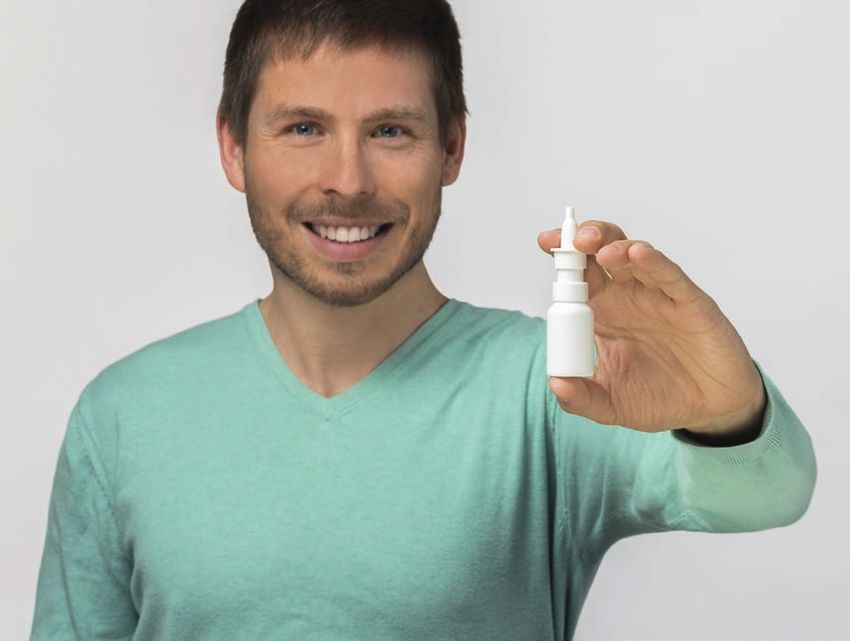
Expert View

                                                        To some degree, nasal inhalation does                Negative Across the Entire Value
                                                    lag behind other inhalation devices in the               Chain by 2030”. AstraZeneca press
     “Nasal drug delivery is a
                                                    incorporation of dose counters, locks and                release, Jan 2020.
     highly versatile method                        connected elements. We may therefore                3.	“Chiesi Group Calls for
   of administration for both                       see more nasal delivery devices with these               #ActionOverWords in the Fight
                                                    features incorporated in the future.                     Against Climate Change”.
   local and systemic drugs,
                                                                                                             Chiesi press release, May 2021.
        for emergency doses                         FINAL REMARKS                                       4.	Robinson J, “Chiesi Launches Postal
         and managing long-                                                                                  Asthma Inhaler Recycling Scheme”.
                                                    This article has outlined five key inhalation            Pharm J, Feb 2021.
      term conditions, and in
                                                    trends to watch in 2022. Some perennial             5.   Kunkel G et al, “Respimat (a New
       preventative vaccines.”                      themes emerge – connectivity, efficacy,                   Soft Mist Inhaler) Delivering Fenoterol
                                                    safety, cost-efficiency and ease of use.                  Plus Ipratropium Bromide Provides
                                                    There are also, however, themes that are                  Equivalent Bronchodilation at Half
   One particularly pertinent use of nasal          products of the rapid changes the world has               the Cumulative Dose Compared with
inhalation systems is that of vaccine               undergone over the last few years; primarily              a Conventional Metered Dose Inhaler
delivery. Covid-19 has led to significant           a renewed interest in alternative vaccine                 in Asthmatic Patients”. Respiration,
investment in the global vaccines market,           delivery methods and a commitment to                      2000, Vol 63(7), pp 306–314.
and this can be expected to continue                sustainability and greener products that are        6.	“Biologics Market - Growth,
as co-operative international efforts               hopefully here to stay.                                  Trends, COVID-19 Impact,
to vaccinate developing countries get                                                                        And Forecasts (2022–2027)”.
underway. Nasal inhalation of vaccines              ABOUT THE COMPANY                                        Mordor Intelligence, 2021.
has several key advantages – needle-phobia                                                              7.	“Data Privacy: What the Consumer
affects 3.5%–10% of the UK population11             Springboard specialises in developing                    Really Thinks”. Data & Marketing
and may drive vaccine hesitancy, and nasal          devices from concept to manufacture for                  Association, Feb 2018.
vaccines are able to instigate mucosal              regulated markets. The company is expert at         8.	“Test Beds Programme – Information
immunity directly at the site of infection.12       creating innovative yet robust designs and               to Support the Launch of Wave 2”.
   Another important benefit lies within            solving difficult technical problems quickly.            NHS England, Mar 2018.
the “rescue treatment” setting. Numerous            Springboard does not have internal projects so      9.	 “Global Inhalation and Nasal Sprays
medical conditions call for swift drug              it is as fast and cost effective as possible, and        Generic Drugs Market Insights, Forecast
administration and rapid onset. Using a             the intellectual property belongs to its clients.        to 2028”. QYResearch, Jan 2022.
nasal spray that provides a rapid onset is an                                                           10.	Beckman S, “Patients Prefer
ideal solution that can be used by anyone;          REFERENCES                                               Epinephrine Nasal Spray Over
examples can already be seen in emergency-                                                                   Auto-Injector”. Healio, Nov 2019.
use medications, such as naloxone for               1.	“COP26 Sees UK Businesses Lead                  11.	“Injection Phobia”. Anxiety UK
opioid overdose.                                        the World in Climate Change                          web page, accessed Mar 2022.
   Finally, advancements in nasal inhalation            Commitments”. UK Government                     12.	An X et al, “Single-dose Intranasal
have exciting implications for biologics                press release, Nov 2021.                             Vaccination Elicits Systemic and
research. Successful nasal delivery of              2.	“AstraZeneca’s ‘Ambition Zero                        Mucosal Immunity Against
peptides has already been demonstrated                  Carbon’ Strategy to Eliminate                        SARS-CoV-2”. iScience, 2021,
for the treatment of conditions such as                 Emissions by 2025 and be Carbon                      Vol 24(9), Article 013037.
osteoporosis, haemophilia and vitamin
B12 deficiency. However, larger molecules
continue to present a challenge to nasal
inhalation methods due to the limited
                                                      ABOUT THE AUTHORS
permeability of the nasal mucosa, and                 Rob Udale is a Principal Engineer at Springboard, where he leads engineering and
further research will be required to develop          scientific teams developing new medical devices, including surgical tools, injectors and
a solution.                                           inhalers. He has been the named inventor on multiple patents and is a Chartered Engineer.
   Nasal drug delivery is a highly versatile          He read Engineering at Cambridge University (UK), where he developed his background
method of administration for both local               in both fluids and mechanics at the prestigious Whittle Laboratory. In developing devices,
and systemic drugs, for emergency doses               Mr Udale seeks to balance technical, user and commercial requirements to produce
and managing long-term conditions, and                simple and robust solutions.
in preventative vaccines. Key to this is
the flexibility of the device to the drug’s           Heather Jameson is a Senior Engineer at Springboard, taking a leading role in planning and
formulation (its suitability for water-               executing both design and test projects and has worked on the design and development
based or hydroalcoholic formulations,                 of several drug delivery devices. She read Engineering at Cambridge University (UK),
suspensions, emulsions and powders) and               before completing a PhD in Fluid Mechanics at the distinguished Whittle Laboratory.
the fact that the nasal devices tend to be            She continues to play an active part in university relations in addition to her public
convenient, discreet, easy to use and easy            speaking engagements on STEM and outreach.
to carry.

Copyright © 2022 Frederick Furness Publishing Ltd                                      www.ondrugdelivery.com                                      9
14 & 15 September 2022 | Geneva, Switzerland

The new event at the heart of European pharma
dedicated to innovative packaging, drug delivery systems,
CDMO/CMO and filling & assembling processes

Register to attend today
connectinpharma.com

Founding partners
Your partner for
integrated platform
offerings
Recipharm offers a fully integrated, combination product service
for developing and manufacturing inhalation drug products and
devices to the global pharmaceutical market.

We have expertise in pressurised Metered Dose Inhalers (pMDIs),
Soft Mist Inhalers (SMIs), Dry Powder Inhalers (DPIs) unit dose and
multi dose nasal sprays.

Discover how Recipharm can take your inhalation product from
concept to commercial. Speak to us today.

recipharm.com
Expert View

INVITATION TO PARTICIPATE
IN STANDARDISATION OF PARTICLE
MEASUREMENTS FOR PHARMACEUTICALS
In this article, Caterina Minelli, PhD, Science Area Leader at the National Physical
Laboratory, discusses the importance of co-operation between metrology institutes
and the pharmaceutical industry in the pursuit of improving analytical techniques and
standards for the characterisation of particle attributes in drug development.

Innovation in the field of analytical
technology and the standards for measuring
                                                      “The pace of innovation
particle attributes is a continual process,
driven in large part by the importance                      and the increasing
of particles in the development and               complexity of particle-based
manufacture of pharmaceutical formulations.
                                                   products pose a substantial
Characterisation of particles is central to
ensuring the efficacy of many medicinal                   regulatory challenge
products, including dry powder inhalers,                 and ensuring that the
APIs, excipients within solid oral dosages,
                                                  measurement infrastructure
micro-particulates and both oil and solid
phases in topical formulations. Advanced                 remains relevant and
therapies that use liposomal and lipid                       comprehensive is
nanoparticles, along with other nano
                                                       essential to enable new
preparations, are vital to treatments including
anticancer therapeutics, vaccines and vectors         medicine development.”
for gene delivery applications. Particle
characterisation is integral to understanding
the performance and implementation of             of a product, with many more attributes
quality control for medicines.                    typically being measured in the development
   The pace of innovation and the increasing      phase than in manufacturing control.
complexity of particle-based products pose           The type and specifications of analytical
a     substantial    regulatory      challenge    instruments employed also changes across
and ensuring that the measurement                 the different stages of a product’s lifecycle.
infrastructure remains relevant and               During development, a detailed mechanistic
comprehensive is essential to enable new          understanding of a drug’s mode of action or
medicine development. It is not surprising,       the performance of a formulation requires
then, that the measurement technology             state-of-the-art measurement capabilities
serving the pharmaceutical industry is            and expertise, which may be available
continuously evolving, and that standard          in-house but is often accessed through
bodies, regulators and national metrology         specialist outsourcing partnerships. As a
institutes are proactive in developing the        product progresses towards larger volume
underpinning measurement infrastructure.          manufacturing, the number of measured
The collaboration of such institutions with       attributes is reduced, while the quality
the pharmaceutical industry is essential for      infrastructure typically relies on analytical
defining and prioritising measurement needs.      instrumentation that is available at the                  Dr Caterina Minelli
                                                  production site. Sensitivity, precision and               Science Area Leader
MEASURING CRITICAL ATTRIBUTES                     accuracy requirements for the analytical                  T: +44 20 8943 6689
                                                  instrumentation change in accordance with                 E: caterina.minelli@npl.co.uk
There are many different characteristics, or      the product phase.
attributes, of particles that can be measured.       There is a wide variety of particle types              National Physical Laboratory
However, it is not always clear which of          used in therapeutic formulations and                      Hampton Road
these attributes are critical to pharmaceutical   their constituent materials and no single                 Teddington
                                                                                                            TW11 0LW
product performance. Furthermore, the             analytical technique addresses all types of
                                                                                                            United Kingdom
selection of which attributes should be           particles. Particle measurements during
measured may change during the lifecycle          the product lifecycle may include physical                www.npl.co.uk

12                                     www.ondrugdelivery.com                                      Copyright © 2022 Frederick Furness Publishing Ltd
Expert View
and chemical characteristics, including super-resolution methods. Among label-free methods,
drug loading, release profile some types of Raman spectroscopy and mass spectrometry enable
“Knowledge of the
and particle fate in animal the location and quantification of the product ingredients within
models, to mention just a changes that particles biological cells and tissues or a medical device. Raman-based and
few. Measurement methods undergo with time fluorescence-based microscopies are also suited to in vitro imaging
are best used in concert to where, for example, the migration of active ingredients following
and when exposed to
provide complementary their release may be observed and measured.
pieces of information that, different environments
like the pieces of a jigsaw, can enable a BUILDING CONFIDENCE IN MEASUREMENTS
may be combined to enable
better mechanistic
measurement experts to A robust measurement infrastructure for pharmaceutical product
build a complete picture of a understanding of their development and manufacturing ensures that particle attributes
product. To reap the benefits mode of action.” can be compared over time and at different production sites with
of this synergistic approach, confidence. This is essential for evaluating product consistency across
effort should be invested into different batches and changes due to ageing, as well as informing the
ensuring that both sample preparation and measurement approaches decisions that will direct product improvements and diversification.
are consistent across techniques to enable comparability. Documentary standards and reference materials underpin
It is important to consider that particles are dynamic systems and the confident use of analytical technology. Such standards are
that their attributes may change with time or with the environment typically either expert reports or prescriptive protocols describing
that they are exposed to. For this reason, particle formulation terminology, practice for sample preparation and measurement,
measurements must be taken with the particles in both their pristine and relevant aspects of data analysis. Importantly, documentary
state and in either simulated or real biological environments over standards contain knowledge about the potential sources of errors
time. Knowledge of the changes that particles undergo with time in a measurement and enable the description of particle attributes
and when exposed to different environments can enable a better in terms of values with associated uncertainties. Published standards
mechanistic understanding of their mode of action. In a similar are periodically updated to enable them to keep pace with
way, it is useful to measure particles while exposing them to varying innovations in measurement technology.
temperature and humidity levels in order to inform understanding of Standards result from significant expertise developed by
potential changes to the product during storage and ageing. Both of measurement laboratories and instrument manufacturers, generally
these examples involve significant complexity from a measurement over a number of years, and are cowritten and internationally
technology point of view. reviewed by measurement experts. Technical committees (TCs)
One aspect of this complexity is the challenge of measuring relevant to particle metrology include the International Organisation
particles in matrices, including those of a biological nature. The ability for Standardisation (ISO) TC 229 – Nanotechnologies and TC 24 –
to measure particle products in complex matrices requires that either: Particle Characterisation; ASTM International E55 – Manufacture
of Pharmaceutical and Biopharmaceutical Products and E56 –
• The particles are separated from the matrix prior to measurement Nanotechnology; the European Committee for Standardisation
• The analytical method can distinguish between the particle and (CEN) TC 352 – Nanotechnologies; and the British Standards
the matrix. Institution (BSI) LBI/37 – Particle Characterisation Including Sieving.
Pharmacopoeias also contain practice and reference databases useful
To address the first, significant effort is invested in developing to particle analysis. The interactions across these technical committees
preparative protocols and technologies that minimise changes to are vital and it is not unusual for one expert to sit on many related
particle attributes during separation. These protocols tend to be committees, but harmonisation of standards could be improved
designed on a bespoke basis for each product and matrix combination through more effective co-operation between bodies.
and the time needed for their development and validation should not Lists of published documentary standards are typically available
be underestimated. on the websites of the standards bodies where they are available
Methods that can distinguish the particles from the matrix include for purchase or through open access models. The standards body
both imaging and spectroscopy. Among the available imaging websites also often list the documentary standards currently under
methods, optical and electron microscopies are widespread but development; relevant examples include a document to define
are best coupled with chemical strategies to identify the products liposome-related terminology (ISO/AWI TS 4958), a guide to
within the matrices. For example, fluorescence dyes conjugated with measuring nanoparticle agglomeration and aggregation (CEN/
the molecules of interest afford multiplexed fluorescence imaging, TC 352) and a guide to characterising the encapsulation, extraction
and analysis of mRNA in lipid nanoparticles (ASTM WK75607).
To prepare for the development of a documentary standard,
it is usual to complete one or more inter-laboratory studies or
“A robust measurement infrastructure for
round-robin comparisons. Depending on the type of study and the
pharmaceutical product development nature of the organisations involved, the primary focus of the study
and manufacturing ensures that particle may alter. For example, participation in the highest level of inter-
laboratory comparisons organised by the International Bureau of
attributes can be compared over time and at
Weights and Measures (BIPM) is restricted to designated national
different production sites with confidence.” measurement institutes (NMIs) and the focus is on the accuracy and
reproducibility of the measurement.
Copyright © 2022 Frederick Furness Publishing Ltd www.ondrugdelivery.com 13Expert View Figure 1: Outcome of the VAMAS TWA 34 Project 10 inter-laboratory comparison on the measurement of the number concentration of colloidal gold by centrifugal liquid sedimentation (CLS), UV-visible spectroscopy, particle tracking analysis (PTA) and single particle inductively coupled plasma mass spectrometry (spICPMS). The pie chart shows the background of the laboratories enrolled to the study. The pie chart shows the background of the laboratories participating in the study. Organisations such as the Versailles Project on Advanced methodological requirements. The outcomes from this study are Materials and Standards (VAMAS) encourage wider participation currently being incorporated into a draft ISO technical report from industry, academia and research laboratories with a primary (ISO/DTR 24672) scheduled for publication in late 2022. Through focus on comparability in measurement results and on testing this ISO document, best practice for particle number concentration of sample preparation and measurement protocols prior to measurement will be available to the entire community. standardisation. The outcomes of BIPM studies are used to enable An important aspect of a VAMAS study is that the publication the participating institutes to generate approved calibration and of its datasets, combined with the commercial availability of the measurement capabilities (CMCs) and to state the attributes of test materials, offers a straightforward route for laboratories to certified reference materials (CRMs) with a clear uncertainty benchmark and demonstrate the performance of their measurement statement in both cases. Both CMCs and CRMs are the highest point capability. Confidence in measurement capability enables faster of reference for evaluating measurement outcome. development and more robust quality frameworks and product Inter-laboratory comparisons open to a broader community regulatory submissions. For this reason, there is a need to extend of participants, such as those run under VAMAS, are required inter-laboratory comparisons to a broader selection of particles that to establish and disseminate best practice, underpin and test mimic the attributes of real particle-based products more closely, documentary standards, and benchmark participating laboratories’ and which are dispersed or distributed in relevant matrices. measurement capability. For example, Figure 1 shows the outcome of a large VAMAS interlaboratory study organised by the National INVITATION TO COLLABORATE Physical Laboratory (NPL) on measuring the number concentration of colloidal gold.1 The study provided objective data to compare ISO/DTR 24672 is just one of the many efforts that the particle practice and performance associated with five independent methods metrology community is engaged in with the intention of continuing and to cross-validate independent measurement approaches, to develop a robust measurement framework to underpin product which is important for regulatory purposes. development, manufacturing and regulatory approval. There is a The study clearly highlighted that some methods have very small need to maintain such frameworks’ relevance and fitness for purpose. between-lab variability, suggesting them as methods of choice for This is a significant challenge considering the fast pace of innovation quality control purposes. However, where accuracy is required in pharmaceutical products and the fact that documentary standards and for other types of particles, the choice may be different. are usually developed over several years. Not all methods are suitable for all materials and particle size ranges; There is a need to grow the channels of communications some materials may become unstable upon dilution or samples between the pharmaceutical industry, the metrology community and may be expensive and limited in volume, which imposes different regulators to inform the discussion on product innovation and 14 www.ondrugdelivery.com Copyright © 2022 Frederick Furness Publishing Ltd
Expert View

                                                                          Stronger collaboration between NMIs, industry, governments
                                                                       and regulators will accelerate the pace of innovation and the
      “There is a need to grow the channels
                                                                       commercialisation of particle-based products, from paediatric
           of communications between the                               medicines to new vaccines. Initiatives such as inter-laboratory studies
     pharmaceutical industry, the metrology                            are an excellent vehicle for collaboration. There is a need for the
                                                                       industry and measurement development scientists to engage at early
    community and regulators to inform the
                                                                       stages of product development to identify challenges, understand
      discussion on product innovation and                             the complexities involved and start developing the next generation
                     standardisation needs.”                           of analytics capable of tackling such obstacles to innovation. There
                                                                       are some excellent examples of funding schemes made available
                                                                       by governments around the world to foster this co-operation, but
standardisation needs. For example, particle-based products            more strategic routes to embed the work of NMIs within industrial
are increasing in complexity, becoming more structured and             innovation must be opened. Finally, the pharmaceutical industry and
sophisticated in the way they deliver their therapeutic cargo          regulators play a critical role in determining measurement priorities,
while improving their safety profile. Efforts to develop a robust      directing the metrology community to develop methods, standards
metrology framework in biology are underway but are relatively         and reference materials that can accelerate the delivery of improved
new, with more work needed to fully standardise measurement            therapeutics and ultimately bring improved outcomes to patients.
methods supporting in vitro and in vivo testing.2 Finally, the step
change promised by the digitisation of the industry requires robust    ABOUT THE COMPANY
documentary standards that establish a common vocabulary and
enable the implementation of findable, accessible, interoperable and   The National Physical Laboratory (NPL) is the UK’s national
reusable (FAIR) data principles.                                       metrology institute, developing and maintaining the national primary
                                                                       measurement standards. It is a public corporation owned by the UK
                                                                       Department of Business, Energy and Industrial Strategy and is part

  ABOUT THE AUTHOR                                                     of the National Measurement System, which provides the UK with
                                                                       a national measurement infrastructure. NPL undertakes excellent
  Caterina Minelli, PhD, leads the UK National Physical                science and engineering to deliver extraordinary impact for the UK
  Laboratory’s research into the development of the metrology          and provide the measurement capability that underpins the UK’s
  underpinning the industrial exploitation of particle systems, with   prosperity and quality of life. From accelerating new antibiotics
  a focus on development and manufacturing of pharmaceuticals          and more effective cancer treatments to developing unhackable
  and nanomedicines. She acts as a UK expert in a number               quantum communications and superfast 5G, NPL expertise is crucial
  of standard technical committees, including the ISO TC229            in researching, developing and testing new products and processes.
  (Nanotechnologies), ISO TC24/SC4 (Particle Characterisation)
  and ASTM E56.08 (Nano-enabled Materials). Dr Minelli                 REFERENCES
  developed her professional career working for private and
  national laboratories across the globe. She complements her          1.	Minelli C et al “Versailles Project on Advanced Materials and
  research experience through insightful secondments, including            Standards (VAMAS) Interlaboratory Study on Measuring the
  within the former UK Department of Business, Innovation and              Number Concentration of Colloidal Gold Nanoparticles”.
  Skills to work on the development of the Government Science              Nanoscale, Mar 2022, epub.
  and Innovation Strategy.                                             2.  Sené M, Gilmore I, Janssen JT, “Metrology is Key to Reproducing
                                                                            Results”. Nature, Jul 2017, Vol 547(7664), pp 397–399.

     UNPARALLELED
     TIGHT TOPIC FOCUS
     EVERY ISSUE FOR MORE
     THAN 130 ISSUES
     www.ondrugdelivery.com/subscribe

Copyright © 2022 Frederick Furness Publishing Ltd                             www.ondrugdelivery.com                                       15
Interview
INTERVIEW “If you design a nasal
delivery system properly,
you can hit the olfactory
In this exclusive interview, Jon Lenn and Jon Volmer, both of MedPharm, talked
with Guy Furness, Publisher of ONdrugDelivery, about the importance of nasal bulb, which can result in
modelling, focusing on MedPharm’s own nasal cavity modelling technology, rapid delivery of the drug
MedCast, its unique characteristics and benefits and the value it brings to the
directly to the CNS.”
company’s offering for nasally delivered products.
Q To start with, can you give us a
broad overview of what advantages
the nasal route offers for drug delivery?
JON LENN, PHD
CHIEF SCIENTIFIC JV Nasal delivery is rapid, relatively
painless and easy for the patient
to administer, especially compared with
OFFICER injections. From a delivery perspective,
the nose is highly vascularised, especially
around the turbinate regions, so the
nasal route is very attractive for systemic
Jon Lenn, Chief Scientific Officer, MedPharm, has direct responsibility for
delivery. There’s also a moist surface for
the company’s global scientific operations. Since joining in 2015, he has
the formulation to cling to, so the drug can
led MedPharm’s development of cutting-edge performance models for
easily diffuse across the barrier and then get
assessing the penetration and activity of clients’ products targeted towards
into the systemic circulation.
key biochemical pathways. He has played a critical role in MedPharm’s growth,
That’s only the beginning, however.
as well as the development and success of the US facility.
One of the more exciting aspects of nasal
delivery is that it can access the central
Dr Lenn has more than 15 years’ experience in developing dermatological
nervous system (CNS). If you design a nasal
projects with Connetics, which was acquired by Stiefel, itself subsequently
delivery system properly, you can hit the
acquired by GSK, and has been directly involved with the development and
olfactory bulb, which can result in rapid
approval of eight products. He received his PhD on the topical delivery of
delivery of the drug directly to the CNS.
macromolecules from the University of Reading, UK.
So nasal delivery gives you a way to get
drugs into the CNS that you simply can’t get
any other way.
JON VOLMER, PHD Thinking about practical applications,
nasal delivery is well-suited for emergency
SENIOR DIRECTOR OF medications, such as delivering naloxone to
counteract opioid overdoses. You can use a
RESEARCH BIOLOGY & nasal spray on someone who’s unconscious;
INNOVATION OFFICER you just spray the device in their nose
while they’re breathing and the medication
will take effect. Of course, the rapidity
Jon Volmer joined MedPharm in 2016 to generate new technologies, of nasal delivery is also a huge advantage
systems and biological models and expand MedPharm’s capabilities for in emergency situations; when a crisis
serving the needs of current clients, as well as to expand the company into occurs, you want the medication to kick
new areas of expertise. He has more than 15 years’ experience developing in as quickly as possible – nasal delivery is
a variety of biological models and technological lab support equipment perfect for that.
in fields including immunology, microbiology, pulmonary disease and It’s also one of the few alternatives
mechanical modelling. to injection for getting a large molecule
into systemic circulation. Nasal delivery
Dr Volmer received his PhD on the biochemical basis of inflammatory won’t work for all large molecules but it’s
remodelling in the lung from the University of Texas Graduate School of certainly viable for much larger molecules
Biomedical Sciences (TX, US). than, for example, topical administration
via the skin. You can even get some proteins
across the nasal epithelium.
Of course, there’s also interest in the
nasal route from a vaccine perspective.
With vaccines, you’ve got all the advantages
18 www.ondrugdelivery.com Copyright © 2022 Frederick Furness Publishing LtdInterview
I’ve outlined already – speed, little pain,
systemic delivery and so on – coupled with
the fact that the nose is often a primary
route of infection for the diseases you’re
vaccinating against, which is a major plus.
Nasal vaccination is definitely a trend I
think we’re going to see a lot more of.
JL To expand on that from the
formulation side, nasal delivery
has the advantage of not having to deal
with a cornified barrier, instead you
have active and passive transport that,
in practice, simplifies the formulation
approach. Compared with the skin, the
obstacles you need to overcome to deliver
a drug successfully via the nasal cavity
are significantly less challenging. You do
have to deal with mucociliary clearance,
but that’s much easier to deal with than
the protective barrier, or stratum corneum, Figure 1: Digital render and summary of the MedCast model.
of the skin.
the turbinates, which iswhere you typically combination. This variety of available
Q Let’s discuss modelling. Briefly,
why is it useful to model the nasal
cavity when developing drugs for nasal
target delivery to get a drug into the
systemic circulation. However, getting a
drug through the nasal cavity to reach the
materials gives us the ability to make sure
that whatever material we’re using to make
the MedCast in a specific instance will
administration? olfactory bulb takes a specialised device. be able to bind the drug, hold onto it
There’s also the inverse, where you’re and then release it for analysis without
JL When you’re looking at a drug-
device combination product,
you can examine and test the geometry
targeting systemic delivery but need to make
sure that the drug doesn’t hit the olfactory
bulb at all – drugs where you do not want
modifying the device geometry.
In terms of function, we can use a
controlled airflow system in conjunction
and characteristics of the spray and the it going to the CNS. These two scenarios with the MedCast so that it models
formulation as it comes out of the device. are where physical modelling is especially inhalation, exhalation or held breath,
However, if that’s all the information important because it offers that knowledge depending on how the nasal delivery device
you have, then you have to make some and increased awareness of exactly where is intended to work. Then we administer the
assumptions on where it is going to go the drug is being deposited in the nose. drug into the model and the drug distributes
when you spray it inside the nasal cavity. through it as it would in a patient’s nasal
As such, you’re somewhat limited if you’re
trying to deliver the formulation to a
very specific location or if you want good
Q Getting into the specifics, can you give
our readers some detail on MedCast,
MedPharm’s own nasal cavity model?
cavity. We can then disassemble the
MedCast and quantify the drug deposition
in the regions of interest.
data on how much drug is really being There are other nasal models similar
deposited at the target site.
That’s where physical modelling comes
in. Conceptually, what we have done is
JV We started with CT scans of
people’s heads and applied
specialised modelling software to build
to MedCast but, generally, they divide the
nose by geographic region – for example,
upper, middle and lower. In contrast,
create a physical 3D model where you can digital 3D models, which we use as the MedCast divides into functional regions,
insert a device, spray the formulation and basis of MedCast (Figure 1). We can then which we identify based on anatomical cues
then break apart the main components of use 3D printing to make models out of from the specific CT scans that we use.
the cavity, extract the drug and quantify various materials, which allows us to look This matters because it is the functional
how much drug has been deposited in at which materials are best suited for the region that determines whether you’re
the different compartments, as well as chemistry of a specific drug-formulation going to get local, systemic or CNS delivery,
potentially what may have gone into the
lung. Therefore, modelling the nasal cavity
allows formulators and device designers to
“With MedCast, we can take the model apart into the
access additional information that enhances
their ability to optimise their product. specific functional regions for a specific modelled nose and
then extract the deposited drug from each to see a relative
JV Modelling is particularly helpful
for formulations that are trying
to hit the olfactory bulb. If you’re targeting
ratio of drug in each functional region, which is what you
really want to know from a drug delivery standpoint.”
systemic delivery, it’s relatively easy to hit
Copyright © 2022 Frederick Furness Publishing Ltd www.ondrugdelivery.com 19Interview
focus on really developing expertise that
wouldn’t be possible if we diluted our
“Then you have further variation within each patient
attention across more delivery routes. To
group and, with MedCast, we’re aiming to get a clarify, we define topical administration as
representative sample across those differences.” delivering a compound locally to a tissue,
and then transdermal delivery is interfacing
with epithelium, aiming to deliver the drug
or if the formulation is going to go down into the systemic absorption. With these
into the lung. With MedCast, we can take
the model apart into the specific functional
regions for a specific modelled nose and
Q How does MedCast sit within
MedPharm’s operations as a CDMO?
definitions, we’re somewhat agnostic when
it comes to the epithelia in question – it can
be the skin, the nose, the eyes or any other
then extract the deposited drug from each
to see a relative ratio of drug in each
functional region, which is what you
JL As a CDMO, we’re able to put
an additional level of rigour
into development, analysis and increasing
easily accessible mucosal epithelium.
This focus strongly influences how we
approach everything, from formulation
really want to know from a drug delivery throughput that wouldn’t necessarily be design to the biology itself. It also means
standpoint. The ability to design MedCasts possible if innovation and modelling weren’t that we’re able to develop very specific
based on a cross-section of the population built into our processes. With MedPharm, models for the routes of administration
further reduces the risk once the device hits a partner can come to us and we can help we excel in. Going back to MedCast as
a real human population. them get their API into a device and start an example, we also have a reconstructed
This plays a large part in why we’re testing it, and MedCast is a key part of model of the nasal epithelium built from
using individual CT scans – MedCast is that – it’s all in-house, which allows us to primary human nasal epithelial cells
not just one model, it’s multiple models, optimise our development programmes and that helps to get a clearer picture of the
all from different patient categories. For really get the most out of them. biology. Coupled with practical data on
example, men and women are going to deposition during delivery in the MedCast,
be different, children and adults are going
to be different. Then you have further
variation within each patient group
JV MedCast is useful in multiple
ways for drug development. First
off, you can use it right at the start of
we can help optimise that formulation and
really de-risk a development project before
it gets into the clinic. So, these are all
and, with MedCast, we’re aiming to development to determine whether or not a preclinical and non-clinical assays that we
get a representative sample across those formulation is suitable for nasal delivery in highly recommend to make sure that you
differences. So, depending on how detailed the first place – you don’t want to get to the have the best formulation and device prior
you want to be, we can use multiple stage where your formulation is in a nasal to undertaking expensive clinical trials.
different models based on the target delivery device only to realise that it’s the
patient demographic for a given drug. wrong delivery route. Then, when you get
a formulation that is suitable, MedCast is
“MedPharm has the
JL An interesting note from the
design process is that we’ve
found that the model works best when we
ideal for refining and optimising the device
so that it delivers the formulation where you
want in the quantity you want.
advantage that we are able
to do all of this in-house.
make the front part of the nose out of a
By performing a broad
pliable material. With the early prototypes,
we quickly realised that, if you made the
nostrils too hard, the model wouldn’t accept
Q To round things out, let’s discuss
MedPharm’s operations more
broadly. Can you give us an overview
sweep of development
tasks co-ordinated
a device properly. Once we started making of where MedPharm sits within the
under one umbrella, you
the front out of more pliable material, drug delivery sphere and what your core
we were able to play around a little bit competencies are? reduce the risk of losing
with the orientation of a device if needed. information while it’s
The end result being that you have the
added advantage where, while not perfectly
realistic, MedCast is close to what the front
JL At a very high level, MedPharm’s
core expertise is topical and
transdermal. We’ve put all our effort into
being transferred from
one group to another.”
part of your nose would feel like. that specific niche so that we’re able to
NOW
* using Forestry Stewardship Council® certified recycled
paper, vegetable-based inks, biodegradable laminates and
carbon balanced materials offset via the World Land Trust™
SUSTAINABLY following ISO140001 processes.
PRINTED*
20 www.ondrugdelivery.com Copyright © 2022 Frederick Furness Publishing LtdYou can also read


