REF 2021 Code of Practice - Research Excellence Framework
←
→
Page content transcription
If your browser does not render page correctly, please read the page content below
REF 2021
Code of Practice
Part 1: Introduction
1. The University’s mission is to be a distinctive ‘teaching intensive and research informed’
university that puts student experience and education first, supported by the quality of our
staff, our facilities and our links to employment sectors. Our world-leading research is
supported by our strong links to industry as we seek to enhance the quantity, quality and
usefulness of our research, focusing its application on improving practice, shaping change,
informing public policy and solving problems. Consequently, the University’s policy is to
present the very best of the research conducted by our staff in the Research Excellence
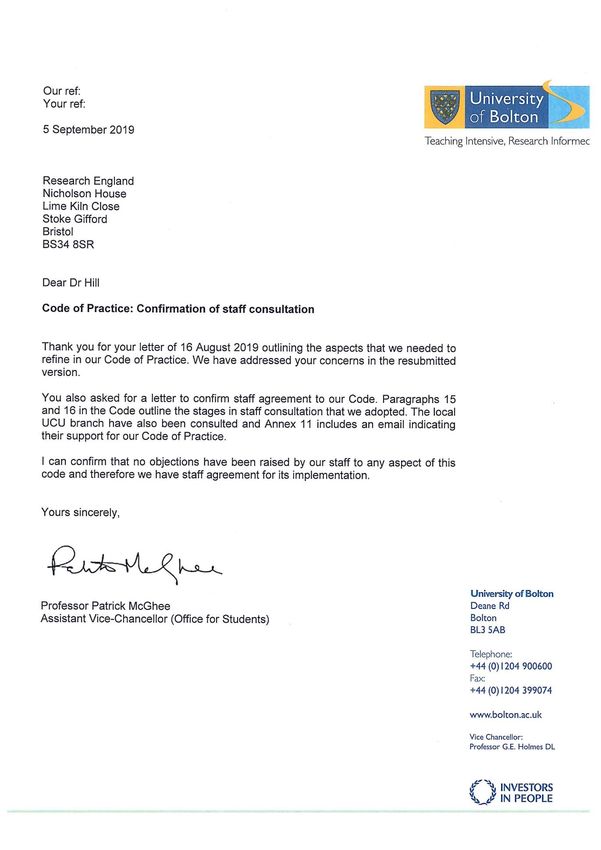
Framework in 2021. The University strives to ensure that there are no obstacles for staff
based on lack of awareness, oversight, preconception or prejudice.
2. As a truly diverse institution, the University of Bolton is committed to promoting equality in
all its activities and aims to provide a work, learning, research and teaching environment
free from discrimination and unfair treatment. The University has an Equality and Diversity
Committee, chaired by a member of the University Executive Board, reporting to the
Executive and Board of Governors on human resource development and equality and
diversity matters. The Board of Governors and the Senate receive a report on equality and
diversity matters annually.
3. This Code of Practice addresses the four underpinning principles of the Research
Excellence Framework as follows;
Transparency: the processes for identifying staff who will be submitted and selecting
outputs for inclusion in the submissions are transparent.
Consistency: the University policies in relation to the processes covered by this Code
of Practice are consistently implemented across the University, with key policies such
as that for appeals being longstanding University policies.
Accountability: responsibilities are clearly defined and the individuals and committees
involved in REF decision making are identified clearly.
Inclusivity: the University policies and processes are driven by a commitment to an
inclusive environment for all staff.
4. Since REF 2014 the University requires all staff to undertake mandatory online training as
follows;
a. Equality and Diversity Awareness ( two course are available; one is for all staff and the
other is specific to those in management roles)
b. The Bribery Act
c. PREVENT duty
d. GDPR
5. During 2018 the University also piloted online training for ‘unconscious bias’ for those in
management roles and has subsequently made this a requirement for all staff who are
members of REF committees.
6. The University is committed to equality of opportunity, the pursuit of diversity amongst its
staff and student population and a supportive environment for all members of our
L:\Research And Graduate School\28. REF2021\Code_Of_Practice\Cop_REF_2021_Oct_2019_Revised_Clean.Docx
1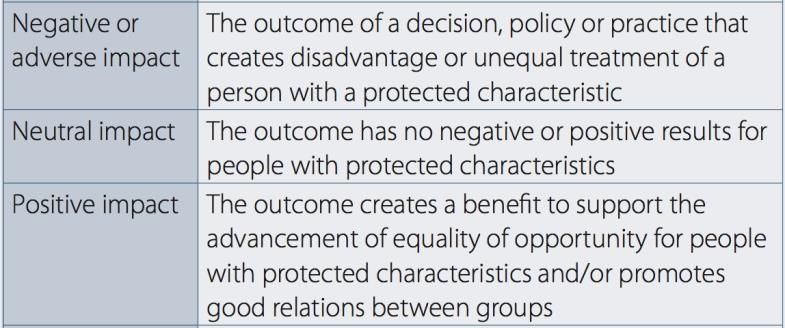
community. It expects that all staff and students alike will contribute to and actively support
   the University in working towards:

    a. the elimination of discrimination, harassment, victimisation and any other conduct that
       is prohibited under the Equality Act 2010
    b. the advancement of equality of opportunity and the fostering of good relations between
       persons who share a relevant protected characteristic and persons who do not share
       it

7. Protected characteristics under the Equality Act 2010 are age, disability, sex, gender
   reassignment, pregnancy, maternity, race (which includes colour, nationality and ethnic or
   national origins), sexual orientation, religion or belief, or because someone is married or
   in a civil partnership.

8. Under the Fixed-term employee and Part time workers Regulations, fixed term employee
   and part time workers have the right not to be treated less favourably than a comparable
   employee who works on an open contract or full time.

9. Accordingly, the University wishes to ensure that all staff have the opportunity to present
   their research to be considered for inclusion in a submission for Research Excellence
   Framework (REF) 2021 subject to them fulfilling the appropriate criteria. No member of
   staff will be excluded or less favourably treated due to any protected characteristic. In
   order to ensure compliance, the University will use its ‘Equality Check’ process to conduct
   equality impact assessments of this code.

10. This policy has been reviewed in response to and in accordance with the Equality Act 2010
    and the Code will apply to all those involved in the University’s submission for REF 2021.

11. Implementation of this Code will include:

    a.   Publicising the policy throughout the University of Bolton.
    b.   Publishing on the Research pages of the University web site.
    c.   Publishing on the Diversity pages of the University web site.
    d.   Providing specialist training for selection panels to raise awareness on equality and
         diversity issues relating to submissions.

Development of process(es)

12. The formal deliberative processes associated with the development of the REF
    Submission have been led through the REF Outputs Sub-panel and its parent committee,
    the REF Strategy Group. The membership of both committees is representative of all
    academic areas of the University, including representation from HR, IST and the
    timetabling/workload support area. The members of these committees will be encouraged
    to cascade, and feedback, information to/from the relevant Faculties so that dissemination
    of information has been as broad as possible.

13. In order to facilitate the work of the REF committees a REF Staff database was
    commissioned from the IS&T team within the University. This system extracted data from
    existing University systems for HR and from publicly available data related to our staff
    within the ORCiD system. In this way, multiple data sources were avoided and the REF
    committees worked with data that was already held on Category A staff within the
    University. The REF Staff database allows for modelling of UoA submissions and for
    capturing REF specific information such as the 200 word text to show a 0.2 – 0.29 fte staff
    member’s substantive connection with a UoA. This formed part of the strategy of openness

 L:\Research And Graduate School\28. REF2021\Code_Of_Practice\Cop_REF_2021_Oct_2019_Revised_Clean.Docx
 2
with staff about data collection and manipulation for REF purposes, as well as helping to
ensure an inclusive approach.
14. Additionally, matters of significance will be agenda items on the Research and Knowledge
Exchange Committee (particularly around research impact case studies and open access)
with whom the REF Strategy Group will consult. Matters such as ORCiD and open access
will also be discussed with the Board of Studies for Research Degrees as part of a process
of engaging a wider community in the deliberations. This has been helpful in providing
several ‘critical friends’ during the development of our REF processes, policies and
systems, whilst also providing a wider audience for REF developments. During the
calendar year 2018 the Executive Dean – R&GS and the AVC (OfS) undertook meetings
with individual academic groups based on likely units of assessment in order to brief them
on the requirements of REF and to allow them chance to enter into dialogue about their
own subject in a focused meeting.
Consultation
15. Staff have been consulted throughout the development of the Code leading to a high level
of confidence with regard to staff agreement to the processes defined in relation to
significant responsibility for research (SRR). Additional local consultation also took place
when Faculty representatives from the relevant committees reported to their
Faculty/School Boards and when the Executive Dean – R&GS was invited to School
research meetings. Specific consultation events were;
a. Senate meeting on 25 February 2019 and circulation of a further draft to members
on 26 March 2019 for comment
b. REF Outputs sub-panel meetings of 27 February 2019, 13 March 2019 and 10
April 2019.
c. Research and Knowledge Exchange Committee on 14 March 2019
d. All staff email requesting feedback on a draft which was issued on 16 April 2019
with responses requested by 3 May 2019
This level of consultation activity was appropriate for the size of the University and scale of
its research.
16. The University and College Union (UCU) branch Chair was consulted initially at regular
periods and there was a Union Liaison meeting convened by HR on 6 March 2019.
Subsequently the UCU Branch Chair was sent further drafts on 17 April 2019 and 13 May
2019 with a request for feedback. This was circulated to the circa. 120 members of UCU
(which represents 355 of the Category A eligible staff) for comments. The response from
the UCU Branch Chair confirming the consultation and their support for this Code is shown
in Annex 11. Additionally, a letter from the University confirming that staff consultation has
occurred, and yielded staff consent to the Code, is also included in Annex 11.
17. Ultimately, the Executive Board approves all policies related to REF and the actual REF
submission having been endorsed by the REF Strategy Group.
18. The University REF internal timeline for developing the final version of this Code is shown
in Annex 1.
Part 2: identifying staff with significant responsibility for research (SRR)
L:\Research And Graduate School\28. REF2021\Code_Of_Practice\Cop_REF_2021_Oct_2019_Revised_Clean.Docx
3Policies and procedures
19. There are three criteria in establishing whether or not a current member of Category A
staff has significant responsibility for research (SRR) and these are detailed in paragraph
141 of the Guidance on Submissions (GOS). In summary they are;
a. Explicit time and resources are made available: paragraphs 21-23 explain the
process used to determine this aspect
b. The staff member acts as an independent researcher: detailed in Part 3 of this Code
within paragraphs 44 and 45
c. It is an expectation of the job role: paragraph 25 expands on this point
Staff who meet the criteria specified in a), b) and c) will be deemed to have significant
responsibility for research (SRR) and will therefore be eligible to be Category A Submitted
for REF purposes.
20. There will be no variation across submitted UoAs in terms of determining SRR because
the University’s employment practices are consistent across all subject areas.
Explicit time and resources
21. The University’s existing workload allocation system (WLA) is the well-established
method by which dedicated research time is planned and allocated to academic staff.
The process of allocating time will be used to inform discussions with staff during the
annual Performance Review process where allocations are balanced across teaching
and research. These allocations may vary across individual staff but the process is
transparent and takes account of research projects/grants, outputs and personal
circumstances. The WLA will be used inform our approach to the identification of staff
who make a significant contribution to research.
22. The University will use the existing workload allocation system (WLA) to review the time
allocated to research activities in AY 2019-20. Staff for whom an allowance of hours has
been entered in the supplemental activity ‘Research Type I/Type II’ or ‘Research Active’
fields will be deemed to have met this criterion.
23. A Category A staff member who does not have hours allocated would not be deemed to
have had explicit time and resources available that is consistent with being research
active. In this case, the staff member would not be submitted.
Expectation of the job role
24. The HR Business Partner responsible for REF and attached to the REF Outputs sub-
panel has confirmed that all academic (that is ‘teaching and research’) and ‘research
only’ contracts contain detailed reference to a requirement to engage in research activity.
Staff, committees and training
25. A diagram of the main University committees is shown in Annex 2 together with the
terms of reference and membership for the key consultative and decision making
committees directly involved in the REF preparations;
Senate
REF Strategy Group
L:\Research And Graduate School\28. REF2021\Code_Of_Practice\Cop_REF_2021_Oct_2019_Revised_Clean.Docx
4 REF Outputs Sub-panel
Research & Knowledge Exchange Committee (RKEC)
26. The memberships of the committees referred to below are designed to provide a balance
of representation from appropriate areas of the University and to ensure those with the
relevant specialist knowledge of the committee’s work are included. This is evident from
the role descriptions given in Annex 2.
27. The deliberative and decision-making relationships between the key committees directly
involved in the REF submission are summarized in Figure 1. Ultimately, it will be the
Executive Board that approves the Code of Practice and the REF submission itself.
Figure 1 Committee relationships
28. The Assistant Vice Chancellor (Office for Students) convenes and chairs the REF
Strategy Group consisting of the Executive Dean – R&GS (or nominee), School research
coordinators, HR Business Partner (responsible for academic processes including
REF/TEF/ECR) and the REF administrator (whose substantive role is Senior
Administrator in the R&GS). The minutes of these meetings are presented to the next
meeting of Senate. The REF Strategy Group is the committee that coordinates all REF
related task and processes on behalf of Senate and makes the recommendation on the
final shape of the REF submission including the Code of Practice.
Responsibilities of Senate
29. Senate is the University’s most senior committee in relation to academic matters. It has
overall responsibility for the University’s qualifications, the oversight of academic quality,
standards and information and for the quality framework. It directly approves changes to
the academic regulations for taught and research programmes of study. More detailed
functions are largely delegated to its sub committees: Education Committee alongside
the Research and Knowledge Exchange Committee.
Responsibilities of REF Strategy Group
30. This Group will receive the recommendations on the REF submission from the REF
Outputs Sub-panel and then endorse the final form of REF submission for onward
L:\Research And Graduate School\28. REF2021\Code_Of_Practice\Cop_REF_2021_Oct_2019_Revised_Clean.Docx
5passage to the Executive Board. This Group is responsible to the Executive Board for
the initiation, ongoing management and integrity of the process of preparing the research
submissions, which the University will return in REF 2021, and advised of the
deliberations of the REF Outputs sub-panel in relation to submitted staff, outputs and the
Code of Practice. Where a UoA covers more than one Faculty/Centre research area, the
REF Strategy Group will determine which Faculty/Centre Research acts as “host”.
31. The Strategy Group will invite Faculties or Research Centres whose submissions show
equality profiles markedly different from the University’s profile either to revise the
submission or to produce commentary that explains the apparent discrepancy.
32. The Strategy Group will make recommendations to the Executive Board with regard to
the REF submission.
Responsibilities of the REF Outputs Sub-panel
33. The Executive Dean – R&GS (or nominee) chairs this meeting, which comprises four
Faculty REF coordinators, HR Business Partner (responsible for academic processes
including REF/TEF/ECR) and the REF administrator (whose substantive role is Senior
Administrator in the R&GS). The minutes of these meetings are presented to the next
meeting of the REF Strategy Group.
34. This sub-panel will undertake the detailed work on outputs and staff to be submitted in
order that it can make a proposal on the REF submission to the REF Strategy Group.
Responsibilities of the Research & Knowledge Exchange Committee
35. The Committee is advisory to Senate on the development of the Strategic Plan in relation
to research, knowledge exchange/transfer, and industry engagement and for developing
policies and initiatives concerning the maintenance, growth and enhancement of related
activities and the University’s research activity (including scholarship, knowledge transfer
and the creation and exploitation of new knowledge) within the overall context of the
current Strategic Plan. The Committee’s remit will include the development of business
opportunities and the creation and exploitation of new knowledge within the overall
context of the Strategic Plan.
Responsibilities of Faculties/Research Centres
36. Faculties/Research Centres will convene such meetings as are necessary to undertake
work on the outputs and staff to be submitted at a local level as required by the REF
Outputs Sub-panel. Outcomes will be reported to relevant School Boards and the REF
Outputs Sub-panel.
37. An online training package was implemented in November 2018 for unconscious bias
training for all staff in managerial/supervisory roles and those directly involved in any
REF related committees. The University has also implemented mandatory equality and
diversity training, which must be completed by all employees of the University. This
ensures that all employees of the University have a good understanding of all equality
and diversity matters and are able to act appropriately if they encounter an instance of
bullying, harassment, victimisation or discrimination.
Appeals
38. Appeals will be possible for each stage of the REF process and will be eligible on the
following grounds;
L:\Research And Graduate School\28. REF2021\Code_Of_Practice\Cop_REF_2021_Oct_2019_Revised_Clean.Docx
6 Inappropriate exclusion from the Category A submitted list due to not meeting the
criteria related to ‘significant responsibility for research’ (SRR)
Inappropriate rejection of personal circumstances, but only if a personal
circumstances form was submitted within the prescribed timeline
39. It should be noted that in line with the REF guidelines there is no ground for appeal
relating to the selection of outputs for a UoA submission.
40. Individual staff will have access to the University’s existing Grievance Process (as shown
in Annex 3) in order to make an appeal. This is a tried and tested process that has
existed for many years and has the full support of the recognized trade unions (UCU and
UNISON) meaning that the University has full confidence in the fairness and
transparency of the process making it highly appropriate for use in this Code where such
attributes are a key feature. The procedure makes it clear that the process should be
undertaken without ‘unreasonable delay’ and usually within 15 days of receiving an
appeal. Appeals under this Code of Practice are unlikely to be more complex than typical
and so the University envisages concluding such appeals in a speedy manner. The final
internal deadlines for personal circumstances forms and decisions on SRR have been
set such that it allows March through to June as a period when staff will know the
outcomes and can lodge appeals.
41. The HR Business Partner (responsible for academic processes including REF/TEF/ECR)
will notify the REF Outputs sub-panel only of the outcome of an appeal so that the sub-
panel can revise its recommendations to the REF Strategy Group.
Equality impact assessment
42. The University’s existing ‘Equality Check’ process (Annex 4) will be used to conduct
equality impact assessments of this Code. The completed Equality Checks are included
in Annex 5. The Equality Check process will not be used to directly identify staff because
the mechanisms outlined in this Code will be used. However, the Equality Check will be
used to provide a reflection on the Code and to identify any changes that may be
necessary to ensure that the Code is fair in its treatment of staff as well as ensuring
compliance with legal obligations regarding equality and diversity. This Code has been
constructed with equality and diversity at its core throughout its development.
Part 3: Determining research independence.
Policies and procedures
43. Where the University HR system shows a member of staff to be on a ‘teaching and
research contract (ACEMPFUN = 3) then they will be deemed to be an independent
researcher. In the context of the University of Bolton all such staff are permitted to
undertake research activities in line with the types of indicators specified in paragraph
132 of the GOS. The University uses a pool of academic variable hours tutors (VHT) but
these colleagues are on a teaching only contract (ACEMPFUN = 1) and are therefore out
of scope for REF.
44. Those staff who are on a ‘research only’ contract (ACEMPFUN = 2 in the University HR
system) may not automatically be assumed to be independent researchers. The Chair of
the REF Outputs Sub-panel will write to the staff members on such contracts and ask
them to produce a short statement evidencing their independence with reference to
paragraphs 128 to 133 in the GOS. The statements will be considered by the REF
Outputs Sub-panel who will decide whether the staff member is compliant with this
L:\Research And Graduate School\28. REF2021\Code_Of_Practice\Cop_REF_2021_Oct_2019_Revised_Clean.Docx
7criterion. The individual staff member will be notified by email normally within 5 working
days of the meeting. The minutes of the REF Outputs Sub-panel will provide the audit
trail in relation to decisions taken.
Staff, committees and training
45. The committee structure outlined in Part 2 also applies here.
46. The REF Outputs Sub-panel will undertake the detailed work in this aspect and make
recommendations to the REF Strategy Group who will make the final recommendations
to Senate.
Appeals
47. The appeals process detailed in Part 2 of this Code of Practice will apply.
Equality impact assessment
48. The University’s existing ‘Equality Check’ process (Annex 4) will be used to conduct
equality impact assessments of this Code as described in Part 2.
Part 4: Selection of outputs
Policies and procedures
49. For all staff who are deemed to be Category A ‘submitted’ (by virtue of meeting the
criteria detailed in Part 2 and Part 3) a request will be made for each staff member to
complete an Outputs Form (Annex 6) detailing their 5 best outputs based on their own
assessment together with a rationale to explain these choices. The REF Outputs sub-
panel will use this information to recommend to the REF Strategy Group a profile of
outputs that meet the criteria of;
a minimum of 1 output per Category A fte
a maximum of 5 outputs per individual and;
overall, 2.5 outputs x number of Category A staff in the UoA
50. Once the final size of the Category A eligible group is determined, the REF Outputs sub-
panel will select outputs that best represent the excellent research undertaken in that
UoA with regard to those indicated on the REF Outputs form (Annex 6) for each eligible
staff member.
51. The aim will be to provide a coherent set of outputs for the UoA. In undertaking this work,
the REF Outputs sub-panel will take into account the permitted criteria for reductions in
outputs as detailed in paragraphs 58-68. Staff will be able to request a reduction by
using the Individual Staff Circumstances Disclosure form in Annex 8 following the
process described in paragraphs 71-74. The REF Outputs sub-panel will use the
information returned to determine the appropriate reductions in the UoA output pools as
defined in Tables 1 and 2 of this Code so that an appropriate UoA submission can be
constructed.
52. The outputs of former staff will be allocated to relevant UoAs by the REF Outputs sub-
panel who will take advice from the relevant Faculty representative on that committee.
L:\Research And Graduate School\28. REF2021\Code_Of_Practice\Cop_REF_2021_Oct_2019_Revised_Clean.Docx
8The GOS guidelines (paragraphs 211 to 216) will be applied to determine eligibility and
the University will include the outputs from former staff who were made compulsorily
redundant if their outputs fit with a submitted UoA. Outputs from current staff will be
prioritised over those from former staff where all other selection criteria are deemed
equal.
53. Outputs will be selected in order to best represent the breadth and diversity of research
undertaken in the UoA.
54. Where the REF Outputs sub-panel are unclear in their deliberations then they may
request a meeting with the current staff member to gain better understanding of why they
have proposed the particular outputs on the form.
Small Units of Assessment
55. The GOS permits an exception for submission for UoAs where the combined fte of staff
employed with significant responsibility for research in the unit is lower than 5 and where
the research focus of these staff
falls within the scope of one UoA exclusively;
is clearly academically distinct from other submitting units in the institution and;
the environment for supporting research and enabling impact of each proposed
submitted unit is clearly separate and distinct from other UoAs in the University
56. The REF Strategy Group will consider whether to request an exemption for certain UoAs
if:
The research is in the scope of a UoA in which the institution has not previously
submitted, and has not been an area of investment and growth for the institution; or
a previous REF submission has been made to the UoA, but there has
been a change in the staff profile in the research area.
Criteria for Reduction in Outputs (from GOS)
57. Submitting units may be returned with fewer than 2.5 outputs per fte without penalty in
the assessment, where one or more of the following circumstances significantly
constrained the ability of submitted staff to produce outputs or to work productively
throughout the assessment period:
Qualifying as an early career researcher.
Absence from work due to secondments or career breaks.
Qualifying periods of family-related leave.
Circumstances equivalent to absence, that require a judgement about the appropriate
reduction in outputs, which are:
i. Disability: defined in Annex 7 (extracted from REF2018/03).
ii. Ill health, injury, or mental health conditions.
iii. Constraints relating to pregnancy, maternity, paternity, adoption or childcare that
fall outside of – or justify the reduction of further outputs in addition to – the
allowances made below.
iv. Other caring responsibilities (such as caring for an elderly or disabled family
member).
v. Gender reassignment.
vi. Other circumstances relating to the protected characteristics listed in Annex 7 or
relating to activities protected by employment legislation.
L:\Research And Graduate School\28. REF2021\Code_Of_Practice\Cop_REF_2021_Oct_2019_Revised_Clean.Docx
958. The reduction applied to the total output pool will be a sum of the reductions arising from
individual staff in the unit with applicable circumstances, which have constrained their
ability to work productively during the assessment period.
59. Reductions arising from the circumstances of individual staff should be determined
according to the tables and guidance below, up to a reduction of 1.5 outputs per staff
member affected.
a. The sum of the reductions should include those arising from the circumstances of
staff for whom a request is being made to remove the minimum of one requirement,
up to 1.5 outputs. A further reduction of one will be applied if the request to remove
the minimum of one requirement is agreed by REF.
b. Rounding to the nearest whole number will be applied to the sum of reductions to
give a whole number of outputs for reduction.
c. The applied reduction must not reduce the output pool below the unit’s required
minimum of one per Category A submitted staff member (except for any staff for
which a reduction to the minimum of one is sought).
60. In applying defined reductions, or making a judgement on circumstances equivalent to
absence, the University may take account of where an individual’s circumstances are
ongoing at the point of making the request.
Early career researchers
61. ECRs are defined as members of staff who meet the definition of Category A eligible on
the census date, and who started their careers as independent researchers on or after 1
August 2016. For the purposes of the REF, an individual is deemed to have started their
career as an independent researcher from the point at which:
a. they held a contract of employment of 0.2 FTE or greater, which included a primary
employment function of undertaking ‘research’ or ‘teaching and research’, with any
HEI or other organisation, whether in the UK or overseas, and
b. they first met the definition of an independent researcher.
62. Table 1 sets out the permitted reduction in outputs without penalty in the assessment for
ECRs who meet this definition.
Table 1 Early career researchers: permitted reduction in outputs
Date at which the individual first met the REF definition Output pool may be
of an ECR: reduced by up to:
On or before 31 July 2016 0
Between 1 August 2016 and 31 July 2017 inclusive 0.5
Between 1 August 2017 and 31 July 2018 inclusive 1
On or after 1 August 2018 1.5
Absence from work due to secondments or career breaks
63. Table 2 sets out the permitted reduction in outputs without penalty in the assessment for
absence from work due to secondments or career breaks outside of the HE sector, and
in which the individual did not undertake academic research (the allowances are based
L:\Research And Graduate School\28. REF2021\Code_Of_Practice\Cop_REF_2021_Oct_2019_Revised_Clean.Docx
10on the length of absence or time away from working in HE. They are defined in terms of
total months absent from work);
Table 2 Secondments or career breaks: permitted reduction in outputs
Total months absent between 1 January 2014 and 31 July Output pool may be
2020 due to a staff member’s secondment or career break: reduced by up to:
Fewer than 12 calendar months 0
At least 12 calendar months but less than 28 0.5
At least 28 calendar months but less than 46 1
46 calendar months or more 1.5
Qualifying periods of family-related leave
64. The total output pool may be reduced by 0.5 for each discrete period of:
a. Statutory maternity leave or statutory adoption leave taken substantially during the
period 1 January 2014 to 31 July 2020, regardless of the length of the leave.
b. Additional paternity or adoption leave, or shared parental leave lasting for four
months or more, taken substantially during the period 1 January 2014 to 31 July
2020.
65. While the above reduction of outputs due to additional paternity or adoption leave is
subject to a minimum period of four months, shorter periods of such leave could be taken
into account as follows:
a. By applying a reduction in outputs where there are additional circumstances, for
example where the period of leave had an impact in combination with other factors
such as ongoing childcare responsibilities.
b. By combining the number of months for shorter periods of such leave in combination
with other circumstances, according to Table 2.
c. Any period of maternity, adoption, paternity or shared parental leave that qualifies for
the reduction of an output under the provisions above may in individual cases be
associated with prolonged constraints on work that justify more than the defined
reduction set out. In such cases, the circumstances should be explained in the
disclosure form (Annex 8).
Combining circumstances
66. Where individuals have had a combination of circumstances that have a defined
reduction in outputs, these may be accumulated up to a maximum reduction of 1.5
outputs. For each circumstance, the relevant reduction should be applied and added
together to calculate the total maximum reduction.
67. Where Table 1 allowances is combined with Table 2, the period of time since 1 January
2014 up until the individual met the definition of an ECR will be calculated in months, and
Table 2 will be applied. When combining circumstances, only one circumstance can be
taken into account for any period of time during which they took place simultaneously.
68. Staff may disclose circumstances that do not lead to a reduction in either individual
outputs or those of a UoA and yet these may be circumstances of which the University
L:\Research And Graduate School\28. REF2021\Code_Of_Practice\Cop_REF_2021_Oct_2019_Revised_Clean.Docx
11has been unaware prior to this process. The University does not have formal
expectations of the numbers of research outputs or research funding bids that an
individual should meet and so this is not an issue that would cause undue stress for an
individual. However, the University prides itself on taking a caring approach to its staff
and would seek to support a colleague to the best of its ability. The confidential nature of
the disclosure process would mean that the HR Business Partner would intervene
directly to establish what support could be offered at a University level, and would seek
approval for engaging the relevant line manager in any support mechanism.
Staff, committees and training
69. The committee structure outlined in Part 2 also applies here.
70. The REF Outputs Sub-panel will undertake the detailed work in this aspect and make
recommendations to the REF Strategy Group who will make the final recommendations
to Senate.
Disclosure of circumstances
71. Each staff member who is Category A ‘eligible’ will be invited to submit a personal
circumstances declaration form (Annex 8) voluntarily. This form should be returned by
email to HR@bolton.ac.uk. The University gives an undertaking that any disclosure will
be treated confidentially and in line with REF requirements. All REF related personal
data will be destroyed in 2022 and all such data will be managed in compliance with the
University’s Staff Data Privacy Notice (Annex 10).
72. Due to the complex nature of such personal circumstances and the links with output
reductions, it may be necessary for the HR Business Partner (responsible for academic
processes including REF/TEF/ECR) to discuss the case with the Chair of the REF
Outputs sub-panel in order to ascertain what, if any, reduction can be sought from UKRI.
The individual staff member will be notified by email normally within 5 working days of a
decision being made and would be able to appeal at that stage.
73. The outcomes would be reported in anonymized form to the next full meeting of the REF
Outputs sub-panel. Any reductions would be reflected in the relevant entries within the
University’s REF Staff Database.
74. Colleagues wishing to use this process will be asked to note the declarations on the form
itself concerning the sharing of their data, particularly with respect to anonymity if their
data has to be passed to UKRI.
Appeals Process
75. The appeals process detailed in Part 2 of this Code of Practice will apply.
Equality impact assessment
76. The University’s existing ‘Equality Check’ process (Annex 4) will be used to conduct
equality impact assessments of this Code as described in Part 2. The completed
Equality Checks are included in Annex 5. The Equality Check process will not be used to
directly identify staff because the mechanisms outlined in this Code will be used.
However, the Equality Check will be used to provide a reflection on the Code and to
identify any changes that may be necessary to ensure that the Code is fair in its
treatment of staff as well as ensuring compliance with legal obligations regarding
equality and diversity.
L:\Research And Graduate School\28. REF2021\Code_Of_Practice\Cop_REF_2021_Oct_2019_Revised_Clean.Docx
12Data Collection Statements
77. Annex 9 contains statements from UKRI regarding the use of personal data collected
during the REF 2021 process. There are separate statements for ‘staff’ and ‘non-staff’ in
order that the different stakeholders in REF 2021 have clarity with respect to their data.
The University’s Staff Data Privacy notice is given in Annex 10 for completeness.
L:\Research And Graduate School\28. REF2021\Code_Of_Practice\Cop_REF_2021_Oct_2019_Revised_Clean.Docx
13Annex 1
REF Code of Practice Internal timeline
2019 W/c Activity
February 11 13: draft to BoSRD
18 20: draft to Outputs sub-panel
25 25: draft to Senate
March 4 6: draft discussed with UCU & UNISON (University liaison committee)
13: draft to Outputs sub-panel
11
14: draft to RKEC
18 Collate all responses received and compile final draft
25 Circulate final draft to RKEC, BoSRD, Senate (responses by 29
March)
April 1 Undertake equality check
8 10: CoP final draft to Outputs sub-panel
15 Consult: publish CoP to R&GS web pages and send via all staff email
17: Consult: UCU Branch Secretary on final version (email)
22
29 3 May: responses from all-staff consultation
May 6 8: CoP endorsed by BoSRD
13 13: version 4 after staff consultation sent to UCU for comment
20
27 30: CoP endorsed by RKEC and circulated to Senate
June 3 3: final sign-off by Executive Board (Chair sign off)
5: final approval to submit from AVC (OfS)
7 midday: Submit to REF
July CoP final version published to R&GS web pages and all staff email
August 5
12 16: REF notifies UoB of CoP outcome
19 19: REF approved CoP published - R&GS web & all-staff email
26
September 2
9
16 20: Resubmission of CoP if required [AVC(OfS) chair’s action]
23
October
November 4 8: REF approves CoP or requires further resubmission
11 11: REF approved CoP published - R&GS web & all-staff email
15: Resubmission of CoP if required [AVC(OfS) chair’s action]
18
25 29: Final REF approval of CoP
December 2: REF approved CoP published - R&GS web & all-staff email
L:\Research And Graduate School\28. REF2021\Code_Of_Practice\Cop_REF_2021_Oct_2019_Revised_Clean.Docx
14Annex 2
Senate and its sub-committees and REF committee reporting lines 2019
Senate
Executive
Board
Education Committee Honorary Awards Research & Knowledge REF Strategy
Committee Exchange Committee Group
(RKEC)
External Examiner
Nominations Sub-
Research REF Outputs
committee (EENSC)
Ethics Sub- Sub-panel
committee
Validation/University (UREC)
Standing Panel
Partnerships Panel
School Boards
Board of Studies for
Research Degrees
(BoSRD)
Programmes
Committee
L:\Research And Graduate School\28. REF2021\Code_Of_Practice\Cop_REF_2021_Oct_2019_Revised_Clean.Docx
15Senate
The Senate has delegated its authority to the following committees:
Assessment Boards
On behalf of Senate, Assessment Boards determine the results of assessments, student
progression and the classification of awards. Senate receives regular reports on student
progression and achievement and approves the regulations, which are used to define the
conduct of Assessment Boards and the rules governing progression and attainment.
Honorary Awards sub-committee
The Honorary Awards sub-committee has delegated authority to identify and approach
candidates for the award of honorary degrees.
Education Committee
The Education Committee has delegated authority to review and approve processes for the
implementation of policies related to the University’s Learning, Teaching and Assessment
Strategy, the Student Experience Strategy and the Employability, Enterprise and
Apprenticeships Strategy. The Education Committee also oversees the arrangements for
assuring academic quality and standards on University programmes of study in both an on
and off campus context.
Research and Knowledge Exchange
On behalf of Senate, to implement the Strategic Plan as it relates to research, knowledge
exchange and industrial engagement, including the approval, review and oversight of the
implementation of any related policies and procedures. To oversee the submission of bids for
research and/or knowledge exchange funding.
Terms of Reference
i. To determine the University’s academic aims and objectives and to promote effective
student learning, teaching, scholarship and research.
ii. To advise the President & Vice Chancellor and Board of Governors on the
development of the University’s academic activities and the resources needed to
support these activities.
iii. To approve a framework of principles and regulations to be complied with by all of the
University’s programmes of study and programmes of supervised research, including
University programmes offered in collaboration with external organisations.
iv. To determine conditions and procedures for the granting and conferment of Degrees,
Diplomas, Certificates, other academic awards, prizes and distinctions by the
University, including honorary academic awards and titles.
v. To be responsible for academic standards, academic quality audit, the validation and
review of programmes of study and programmes of supervised research, subject to
the requirements of external bodies.
vi. To maintain oversight of the arrangements for ensuring that students have the
opportunity to express their opinions on their overall experience and to ensure that
students are well-prepared for employment in fields related to their degrees.
vii. To establish policies and procedures on matters relating to the admission of students,
student retention, teaching, curriculum content, assessment and examination of the
academic performance of students, subject to the requirements of the University’s
authority and that of any external bodies.
viii. To appoint and, if necessary, to remove internal and external examiners or, where
appropriate, recommend the appointment of examiners to external validating bodies.
L:\Research And Graduate School\28. REF2021\Code_Of_Practice\Cop_REF_2021_Oct_2019_Revised_Clean.Docx
16ix. To determine procedures whereby students may appeal against decisions made by
an Assessment Board.
x. To determine procedures for the expulsion of students for academic reasons, after
having consulted with the Board of Governors.
xi. To advise on such other matters as the President & Vice Chancellor or Board of
Governors may refer to Senate.
Membership
Under the Articles of Government, Senate should have no more than thirty members,
selected under arrangements approved by the Board of Governors. The President &
Vice Chancellor shall be Chairperson and in the event of the membership being at any time
below thirty, the proportion of staff holding designated management posts should not be less
than half. The membership of Senate shall be as follows:
• Chair – President & Vice Chancellor
• Fifteen holders of designated management posts (to include Pro-Vice Chancellor
(Academic) (Deputy Chair), Deans of Faculty, Heads of Schools /Institutes; others to be
designated managers with cross institutional responsibilities) (nominated by the
President & Vice Chancellor)
• Five members of the permanent academic teaching staff (no more than two from an
individual School) (elected by and from the permanent academic teaching staff)
• Five members of the Professoriate
• Two student representatives
• Two other permanent non-teaching staff (nominated by the Vice Chancellor).
L:\Research And Graduate School\28. REF2021\Code_Of_Practice\Cop_REF_2021_Oct_2019_Revised_Clean.Docx
17Research and Knowledge Exchange Committee
Terms of Reference
i. To engage with the research landscape across the higher education sector and its funding
bodies, partners and users, to inform research policy and planning within the University.
ii. To identify opportunities for knowledge exchange and industry engagement with research
and the wider University, including opportunities for student internships and placements,
and to identify potential sources of funding, and research partners from the UK, EU and
overseas, so as to inform policy and planning within the University.
iii. To formulate and implement University research strategies and associated policies
according to the commitments made in the Strategic Plan and to ensure that appropriate
staff development is made available to support these activities.
iv. To formulate and implement University knowledge exchange and employer engagement
policies, strategies and implementation plans according to the commitments made in the
Strategic Plan.
v. To identify opportunities by which the University is able to achieve its knowledge exchange
and industry engagement-related goals and to measure progress against these goals,
including:
a. the development of products and services leading to knowledge exchange and
industrial engagement outcomes;
b. the development of mechanisms to support and deliver high added value
consultancy and knowledge exchange;
c. the creation, exploitation and dissemination of innovative approaches to industry
engagement;
d. the development of mechanisms to assist in new knowledge creation and
transfer.
vi. To advise the Vice Chancellor on the appropriate strategic utilisation and distribution of the
Funding Council third stream income in support of research and employer engagement
(such as the HEIF grant and any successful SDF application) and, on behalf of Senate, to
monitor and report back on the outcomes achieved.
vii. To advise the Vice Chancellor on the appropriate distribution of the Funding Council
research grant (including any special funds for research) and on the level and distribution
of internal funding for research.
viii. To consider annual reports from Schools and research teams and relevant central services
relating to the achievement of University and local research plans and to report to Senate
accordingly.
ix. To receive progress reports from Schools, research centres and institutes on their
acquisition and use of external project funding in support of innovation and employer
engagement and on their achievement of the funded outcomes.
x. To advise as required by Senate on the configuration and content of any returns and
statements on research and on knowledge exchange and industry engagement made to
external bodies.
xi. To disseminate good practice in the preparation of bids for external funding.
Membership
• Chair – Member of the Professoriate
• Assistant Vice Chancellor, Office for Students
• Pro Vice Chancellor, Academic
• A member from each School, nominated by the Head of School.
L:\Research And Graduate School\28. REF2021\Code_Of_Practice\Cop_REF_2021_Oct_2019_Revised_Clean.Docx
18• Six co-options as agreed with the Chair of the Committee, representative of the research
and enterprise activity of the University
• Up to three external representative from relevant industries to be nominated by the
Heads of Schools
Invited to attend:
• Research and Innovation Administrator (Secretary)
L:\Research And Graduate School\28. REF2021\Code_Of_Practice\Cop_REF_2021_Oct_2019_Revised_Clean.Docx
19REF2021 Strategy Group
Terms of Reference
1. The overall goal of the group is to achieve the best possible outcome for the University of
Bolton in the next Research Excellence Framework assessment.
2. To develop an overall strategy and set of objectives consistent with that overall goal.
3. To locate the goal, strategy and objectives within the context of the University’s Strategic
Plan 2015-2020 including in particular the commitment to become a ‘Teaching Intensive,
Research Informed’ institution (‘TIRI’).
4. To make final recommendations on which Units of Assessment and which individuals
should be submitted to REF2021.
5. To ensure that the University supports good practice in relation to diversity, inclusion
transparency and equal opportunities’ in the process and final judgements relevant to the
REF2021.
6. To ensure that he University reviews options on submission at an early stage.
7. To ensure the University has appropriate systems in place to capture, manage, audit and
submit appropriate information in relation to individual researchers, financial transactions,
research students and other data relevant to the final submission.
8. To ensure that the process of preparing for the REF2021 submission does itself contribute
to the quality of research, the culture of academic critical enquiry and innovation across the
institution.
9. To liaise with Schools, Committees and officers relevant to the goal of the Group.
10. To champion the importance of the REF for the reputation of the University to students,
partners and other stakeholders as appropriate.
11. To contribute as appropriate to national consultations on the overall character, focus and
operations of the REF2021.
The Group is advisory to the Assistant Vice Chancellor (Office for Students)
Membership:
AVC (OfS), Chair
Senior Policy & Practice Advisor – Standards & Enhancement
Professor - Psychology
Executive Dean Research & Graduate School
Impact Case Study Lead (Reader in CiF)
Research Coordinator - IoM
Professor – Fire Research
Professor - OfCD
Professor - Engineering
Research Coordinator – Sports Science
Research Coordinator - Health
Professor - Arts
Emeritus Professor - Philosophy
R&GS Coordinator
HR Business Partner (responsible for academic processes including REF/TEF/ECR)
Senior Administrator R&GS, Steering Group Officer
L:\Research And Graduate School\28. REF2021\Code_Of_Practice\Cop_REF_2021_Oct_2019_Revised_Clean.Docx
20REF2021 Outputs Sub-panel
Terms of Reference
1. To make preliminary recommendations to the Assistant Vice Chancellor (OfS) and the
REF2021 Steering panel regarding which Units of Assessment and which outputs should
be submitted to REF2021.
2. To ensure that the University supports good practice in relation to diversity, inclusion
transparency and equal opportunities’ in the process and final judgements relevant to the
REF2021 through the development of an appropriate REF-compliant Code of Practice.
3. To ensure that the University reviews options on submission at an early stage.
4. To ensure the University has appropriate systems in place to capture, manage, audit and
submit appropriate information in relation to individual researchers and their outputs.
5. To liaise with Schools, Committees and officers relevant to the goal of the Subpanel as
appropriate.
6. To advise the main panel and the AVC on the implications of emerging policies and
protocols in relation the final submission.
7. The Subpanel reports to the main REF2021 Strategy Group.
Membership:
Executive Dean Research & Graduate School (Chair)
Senior Policy & Practice Advisor (Deputy Chair)
HR Business Partner (responsible for academic processes including REF/TEF/ECR)
Research Co-ordinator (Professional Studies)
Research Co-ordinator (Engineering & Creative Tech)
Research Co-ordinator (Arts)
Research Co-ordinator (Health)
R&GS Coordinator
Impact Case Study Lead
SDM (Workload Allocation Tool)
Head of IS&T
Secretary – Senior Administrator R&GS
Director of HR Services – corresponding member
AVC (OfS) – Corresponding member
The Sub Panel will normally meet on a monthly basis
L:\Research And Graduate School\28. REF2021\Code_Of_Practice\Cop_REF_2021_Oct_2019_Revised_Clean.Docx
21Annex 3
THE UNIVERSITY OF BOLTON
THE INDIVIDUAL GRIEVANCE PROCEDURE
1. Introduction
The University of Bolton is committed to the promotion of equality, diversity and a supportive
environment for all members of our community. Our commitment to equality and diversity means
that this procedure has been screened in relation to the use of plain English, the promotion of the
positive duty in relation to race, gender and disability and avoidance of discrimination.
The University wishes to establish a culture of professionalism, respect and a positive working
environment for its entire staff. It recognises that from time to time circumstances may arise where
employees could have concerns about, for example, their work, working conditions and working
relationships with colleagues. In such cases an employee may wish to bring the issue(s) to the
attention of the University in the form of a grievance.
Any employee who has a grievance relating to his or her employment should have access to an
effective means of dealing with the grievance in order to prevent problems from escalating where
this can be avoided. This procedure:
(i) sets out a framework where grievances can be dealt with effectively;
(ii) seeks to achieve solutions initially through informal methods before recourse to formal
processes where this is appropriate, and is concerned to achieve a resolution of employee
grievances;
(iii) sets out the general steps that will be followed by the University and is non-contractual.
The University reserves the right to vary any stage in this procedure as it deems necessary in order
to comply with any current legal obligations and best practice.
2. Scope
This procedure applies to all staff within the University other than the Vice Chancellor, Deputy Vice
Chancellor or the University Secretary and Clerk to the Governors who are designated as senior
post holders and to whom a separate procedure shall apply in respect of any grievance raised by a
senior post holder.
In circumstances where two or more employees assert a common grievance the issue should be
progressed in accordance with the principles and procedures set out in this procedure.
This procedure should be followed where an employee has a grievance arising from their
employment, except where the matter constitutes an appeal against a disciplinary decision, or
relates to a disciplinary decision, which should be taken up in accordance with the disciplinary
procedures, or where the University has specifically applicable procedures such as in relation to
grading or remuneration or public interest disclosure.
It is anticipated that the majority of problems can be resolved at an early stage by informal
discussion, ideally at the time when they arise. However, if the matter cannot be resolved
informally, it may then pass to formal stages.
3. The Procedure
L:\Research And Graduate School\28. REF2021\Code_Of_Practice\Cop_REF_2021_Oct_2019_Revised_Clean.Docx
223.1 Informal Procedure
Employees are encouraged to resolve any grievances which arise in the workplace as quickly as
possible through informal means, including through mediation.
Most grievances can be resolved quickly and informally through discussion by the employee with
the person concerned. If the employee feels unable to speak to the person concerned he/she
should speak to his/her line manager. If the employee feels unable to speak to his/her line
manager, for example, because the complaint concerns the line manager, the employee should
speak informally to a more senior manager or the Personnel Manager. If this does not resolve the
problem the formal procedure set out at 3.2 below should be followed.
3.1.1 Mediation
Mediation is a completely voluntary and confidential process, which involves an independent,
impartial person helping to reach a solution that is acceptable. The mediator can talk to all parties
separately or together and will not make judgements or determine outcomes – he/she will ask
questions that will help to uncover underlying problems, assist the parties to understand the issues
and help them to clarify the options for resolving their conflict/issue. Mediation aims to restore and
maintain the employment relationship and its focus is on working together to go forward, not
determining who was right or wrong in the past.
The University and/or the employee may suggest mediation as a potential way forward in
appropriate cases. If an employee wishes to have his/her issue resolved through mediation they
should contact the University’s Personnel Manager, however, the University may decide that given
the circumstances of a particular case that mediation is not an appropriate means of resolving the
grievance. In these circumstances, the grievance will be progressed through the informal/formal
procedure (as appropriate). Where mediation is considered an appropriate mechanism for resolving
a particular grievance, an individual will be selected from an approved list of mediators held by the
Personnel Manager to mediate on the grievance.
3.1.2 Failure to resolve a grievance informally
Only if the informal methods fail to resolve the issue or it is not considered appropriate to seek
resolution by informal means should the employee use the formal procedure set out at paragraph
3.2 below.
3.2 Formal Procedure
3.2.1 Stage 1 of the Formal Procedure
When an employee considers that he/she has exhausted the possibility of resolving a grievance by
informal means or in the circumstances it is deemed inappropriate to attempt to resolve the
grievance by informal means, then the formal procedure should be implemented as outlined below.
A member of the Personnel Team will be in attendance at any meeting held under the formal
procedure.
3.2.1.1 The grievance must be set out in writing (which can be done using the University’s
Grievance Form accompanying this procedure (see appendix A)) stating the nature of the
grievance, any relevant dates/times and where appropriate witnesses, what, if any,
informal methods have been used to resolve the situation and what the employee’s
desired outcome / remedy is.
L:\Research And Graduate School\28. REF2021\Code_Of_Practice\Cop_REF_2021_Oct_2019_Revised_Clean.Docx
23You can also read


