Relapsing Fortum buying into Uniper makes it one of Europe's most polluting power companies - Europe Beyond Coal
←
→
Page content transcription
If your browser does not render page correctly, please read the page content below
Relapsing
Fortum buying into Uniper
makes it one of Europe’s
most polluting power
companies

                                    March 2019
    Relapsing - Fortum buying into Uniper makes it one of Europe’s most polluting power companies   1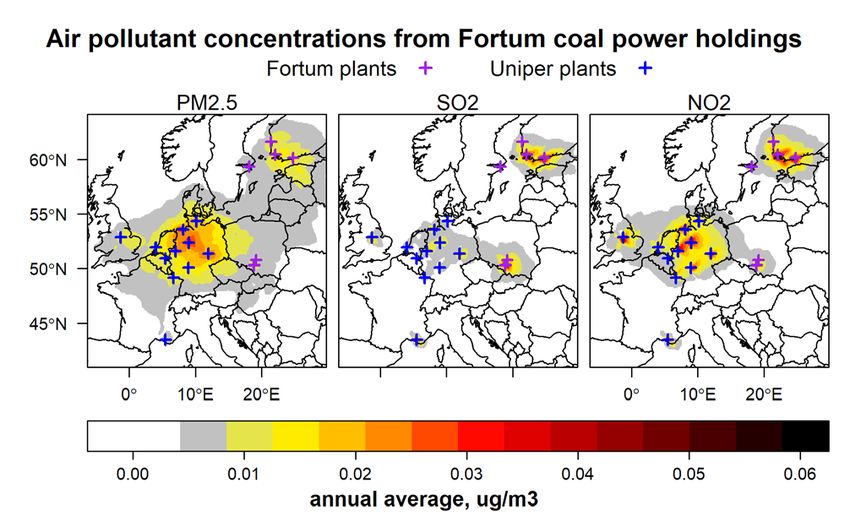
About this briefing
This briefing is an initiative of the Europe Beyond Coal campaign.

It builds on the findings and methodology published in the report ‘Last Gasp: the coal companies making
Europe sick', November 2018, by the Europe Beyond Coal campaign, under the responsibility of Climate
Action Network Europe.

The individuals who contributed to it include:
Greenpeace Nordic: Rosa Gierens (atmospheric modelling), Lauri Myllyvirta (lead author and Head of
Greenpeace Air Pollution Unit, health impact analysis)
Europe Beyond Coal: Kaarina Kolle (lead author), Greg McNevin (producer)

The health impact methodology used in the ‘Last Gasp’ report is guided by recommendations from the
World Health Organization Europe’s ‘Health risks of air pollution in Europe’ (HRAPIE) project on health
impact assessments for air pollution. It includes atmospheric modelling with the European Monitoring
and Evaluation Programme Meteorological Synthesizing Centre - West (EMEP MSC-W) computer model,
which is also used by the European Environment Agency for European Commission assessments of
health impacts from air pollution in Europe. They are based on publicly available, relevant data known
of by the authors; this data may not be exhaustive and there may exist further or updated information
they were not aware of at the time of writing. This briefing does not attempt to quantify actual health
occurrences nor their actual costs.

Published 26 March 2019.

For enquiries, please contact:
Lauri Myllyvirta - lauri.myllyvirta@greenpeace.org
or
Kaarina Kolle - kkolle@wwf.eu

 2     Relapsing - Fortum buying into Uniper makes it one of Europe’s most polluting power companies

Contents
Executive Summary                                                                             4

Introduction                                                                                  6

Fortum and Uniper                                                                             7

Health Impacts                                                                                10

Conclusions                                                                                   15

Annex                                                                                         16

          Relapsing - Fortum buying into Uniper makes it one of Europe’s most polluting power companies   3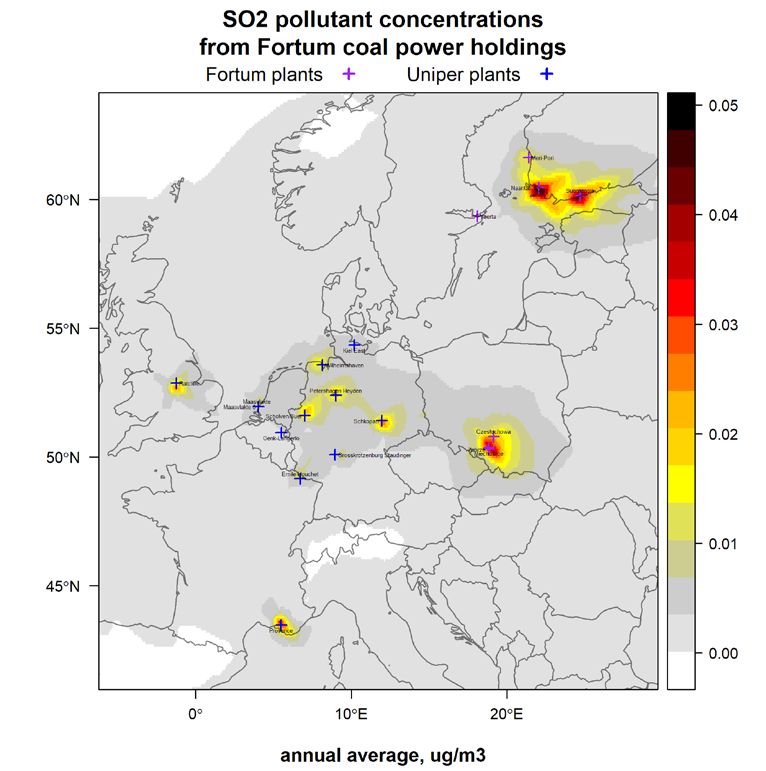
Executive Summary
Finnish state-owned power generator Fortum has become one of Europe’s 10 worst polluting power
companies through its acquisition of the coal-fired assets of Uniper, based on health impact modeling by
the Greenpeace Global Air Pollution Unit.

This report finds that Fortum, through its new near majority ownership of Uniper, is taking on responsibility
for coal plants that caused an estimated 316 premature deaths and EUR340 million in health costs in
2016 alone. Since the latest available data is from 2016, before Fortum had invested in Uniper, Fortum’s
new responsibility can only be calculated from then.

This modelling shows that through its newly increase stake in Uniper, Fortum will be taking on responsibility
for a modelled 131 new cases of chronic bronchitis, and 5,418 asthma symptom days in children annually,
and the mentioned 316 premature deaths. This leads to an estimated 5,419 hospital admissions and 229
lost working days. The calculations are adjusted to Fortum’s most recently announced ownership of
Uniper (49.9% 1 ).

When the pollution caused by Uniper is accounted towards Fortum’s own emissions, it becomes one
of the most polluting companies in Europe. This is hardly surprising as Germany, Uniper’s home base, is
struggling to break its addiction to coal on a fast enough trajectory. Furthermore, while Fortum’s business
strategy is rooted in clean energy solutions, the company still has several polluting coal assets of its own
that have adverse health impacts also in Finland and beyond. With these results, Fortum becomes the
ninth most polluting power company within the ‘toxic ten’ coal polluters identified in the report 2 Last Gasp.

   Table 1           2016 Modelled health impacts of Fortum, including the company’s share in Uniper-owned coal plants

                                                    Fortum through
            Effect              Fortum Plants                                 Total         95% confidence interval 3               Unit
                                                        Uniper

      Premature deaths                 56                 260                 316                    (196 - 432)              cases per year

      Chronic bronchitis                                                                                                      new cases per
                                       24                 107                 131                    (46 - 204)
        (adults only)                                                                                                             year

   Hospital admissions                871                4548                 5419                (1,037 - 9,774)             cases per year

                                                                                                                              worker-years
      Lost working days                43                 186                 229                    (205-258)
                                                                                                                                per year

      Asthma attacks in
                                      871                4548                 5418                (1,159 - 9,786)             cases per year
          children

      Health costs, high               65                 271                 336                   (119 - 525)                    MEUR

1 Fortum Oyj CEO Pekka Lundmark on Q4 2018 Results - Earnings Call Transcript, February 2019.
  Access at - https://seekingalpha.com/article/4237593-fortum-oyj-fojcf-ceo-pekka-lundmark-q4-2018-results-earnings-call-transcript
2 Last Gasp - The coal companies making Europe sick, 2018.
  Access at - https://beyond-coal.eu/wp-content/uploads/2018/11/Last-Gasp-2018.pdf
3 It gives an estimated range of values which is likely to include an unknown population parameter, the estimated range being calculated from a
  given set of sample data

  4       Relapsing - Fortum buying into Uniper makes it one of Europe’s most polluting power companies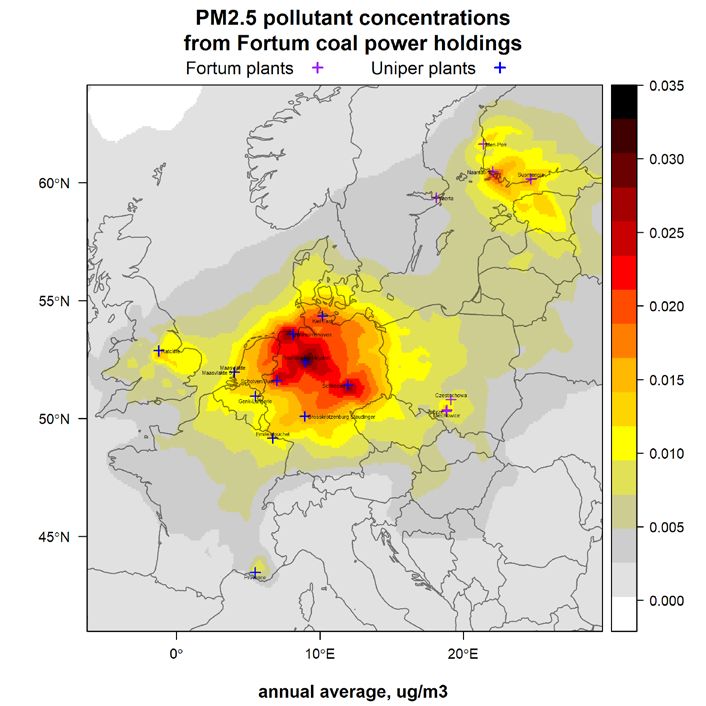
The largest number of premature deaths associated with Fortum/Uniper’s emissions occur in Germany,
with 120 deaths per year, followed by the UK, France and Poland. The largest contributions to PM2.5
pollution take place around power plants in Rheinland and Northern Germany, while the largest
contribution to NO2 pollution is on the Finnish coast around the Naantali power plant.

The study makes recommendations for Fortum/Uniper, the Finnish government and the financial
institutions associated with these companies

Fortum must:
• Publish a clearly articulated and detailed roadmap for the gradual closure (not sale) of existing coal plants
  of both companies, ending at the latest in 2030 - despite the phase-out date of 2038 set by the German
  Coal Commission.
• Not sell its coal plants but rather take responsibility for closing them, and closure dates should be
  announced to plan for a just transition.
• Force Uniper to put an immediate end to capital expenditure into Datteln 4 and any form of lifetime
  extension for existing coal plants. Datteln should not be allowed to operate - as has been recommended
  by the German Coal Commission.4

The Finnish government must:
• Immediately update the Finnish Government’s Resolution on State-Ownership Policy to align business
  plans and practices with the goal of limiting global warming to 1.5°C (covering scopes 1-3) - with an
  explicit clause to discourage selling of high-carbon assets instead of closing them.

Fortum's shareholder must:
• Robustly engage with Fortum and Uniper through their ownership of the company and ensure the
  companies genuinely contribute towards compliance with the Paris Climate Agreement aim of
  temperature rises not exceeding 1.5°C.

4 Abschlussbericht: Kommission “Wachstum, Strukturwandel und Beschäftigung”, January 2019
  https://www.handelsblatt.com/downloads/23912864/3/190126_abschlussbericht_kommission-wachstum-strukturwandel-und-
  beschaeftigung_beschluss.pdf?ticket=ST-408630-uk0N3XmWfR0126mz1ZFH-ap1

                      Relapsing - Fortum buying into Uniper makes it one of Europe’s most polluting power companies   5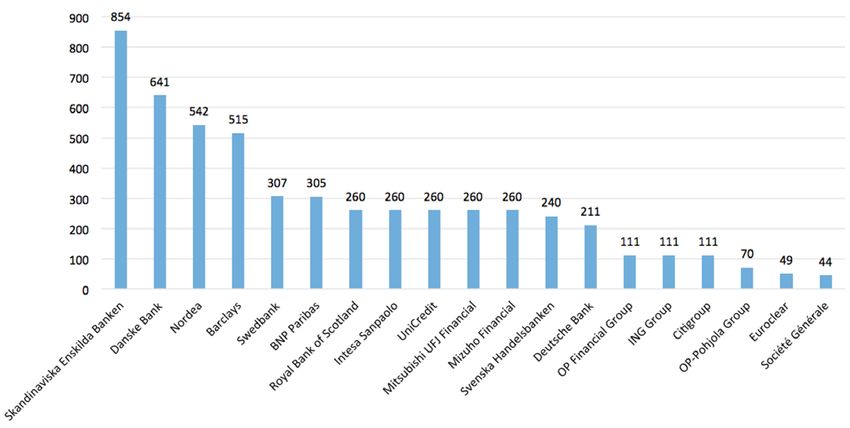
Coal has proven to be a precarious fuel to be

Introduction
                                                                 associated with. Air pollution from coal-fired
                                                                 power plants is linked with a plethora of ailments
                                                                 undermining public health. Toxic pollutants from
                                                                 the burning of coal such as sulphur oxides (SOx),
                                                                 nitrogen oxides (NOx), and particulate matter (PM)
                                                                 have detrimental effects on public health.

                                                                 Alongside with the human health impacts, we
                                                                 are fortunately witnessing collapse of hard coal
                                                                 plants’ profitability. With many coal companies
                                                                 hemorrhaging due to regulations and competition
                                                                 from cheaper fuels cutting into their profit margins
                                                                 the situation has led to coal and carbon prices
                                                                 rising faster than the cost of electricity. There is
                                                                 a growing consensus amongst leading financial
                                                                 institutions globally that the world is moving
                                                                 towards a low carbon economy, and that as a
                                                                 result, coal power assets will be stranded, and
                                                                 constitute growing financial and reputational risks.
                                                                 The diminishing social licence of coal to operate
                                                                 is underpinned by the climate science, which calls
                                                                 for closures in Europe for 2030. This timeline has
                                                                 been put forward by the International Energy
                                                                 Agency and is increasingly demanded by coalitions
                                                                 of responsible investors 5 - including the Finnish
                                                                 Pension Fund Elo.

                                                                 However, while it is clear that coal is inevitably on
                                                                 its way out, any delay in the phase-out is not only
                                                                 a disaster for the climate but any lingering is also
                                                                 putting the health of Europeans at risk. For these
                                                                 reasons, it is time for Fortum, the Finnish state and
                                                                 the financial institutions to take responsibility for
                                                                 the coal assets and close them by 2030 or earlier.

                                                             5 Investors push power companies to end coal use by 2030.
                                                               The Financial Times (December 2018),
                                                               Access at - https://www.ft.com/content/1c65952e-03a4-11e9-99df-6183d3002ee1

   6   Relapsing - Fortum buying into Uniper makes it one of Europe’s most polluting power companies
Fortum and Uniper
Company overview
The state-owned Fortum is the largest single owner of the German
company Uniper (currently at 49.9%). As from 30 June 2018, Fortum
has consolidated Uniper as an associated company. The two companies’
strategies differ significantly: Uniper’s business model largely revolves
around fossil-based energy. Fortum’s company strategy, on the other
hand, is mostly based on a low-carbon energy system. However,
despite this, Fortum still has an operational coal fleet of its own.
Both Fortum and Uniper are still operating coal plants. Uniper’s coal
plants in the UK, Netherlands and France account for around half of
the pollution impacts; national government coal phase-out plans mean
these plants will eventually retire. Uniper’s coal plants are scattered
throughout Western Germany. Even in the aftermath of the Coal
Commission’s announcement, Uniper has not yet announced any plans
to close any of them.
Fortum’s coal plants are located in Russia 6, Poland, Sweden and
Finland 7. The Finnish plants will eventually be closed due to the Finnish
coal ban. However, the future of most of the plants remains unclear.
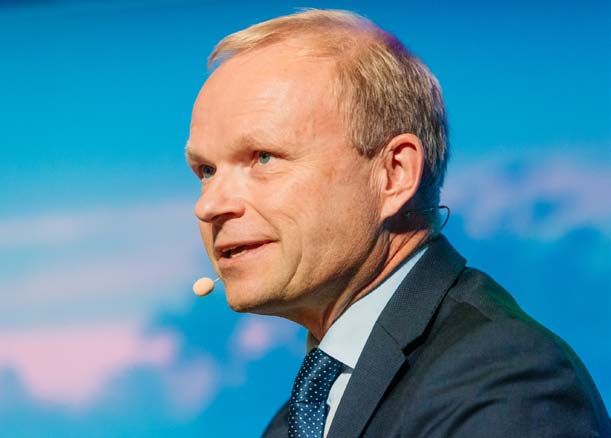
The CEO of Fortum, Pekka
Lundmark. Under his
leadership Fortum has
acquired 49.9 % of Uniper’s
© Arno Mikkor / Fortum
shares
6 Emissions from the Russian power plants not modelled in this study
7 Read more about the plant-by-plant composition here: https://beyond-coal.eu/wp-content/uploads/2018/12/EBC_Fortum_Uniper_briefing_
paper.pdf
Relapsing - Fortum buying into Uniper makes it one of Europe’s most polluting power companies 7Fortum’s largest shareholders must shoulder their responsibility: the Finnish government and the financial institutions Investments in coal carry real financial risks for banks, insurers and investors. Furthermore, it is the fiduciary duty of any investor - including the Finnish state - to serve the best interest of its beneficiaries. Ultimately, that means the ordinary Finnish people. Fortum is a listed company with the Finnish government being the largest owner with 50.76% share. As a consequence, the company has to abide by the Finnish Government’s Resolution on State-Ownership Policy that states: in its decision-making, a company must take into account the economic factors and the social and environmental impacts of its activities. Besides the state, the largest shareholders of Fortum are primarily the large Finnish pension funds. Furthermore, many financial institutions are also Fortum’s creditors through underwriting and loans. The detailed data of the financial ties to Fortum are detailed in Annex 1. Additionally, a large number of shares is owned by The Social Insurance Institution (Kela) - a government agency in charge of several health- related functions in Finland. Several Finnish financial institutions are also members of the Climate Action 100+ Initiative 8 that involves over 320 investors collectively representing $33 trillion in assets. The coalition’s purpose is to pressure high-emitting companies to change. Fortum 9 has been listed as one of the focus companies by the initiative. Therefore, the onus is on the financial institutions to publicly intervene and engage with the company. Those Finnish investors, banks and insurers who are part of the initiative must now step up and assertively demand the coal plant closures. The financial institutions are also change agents: the responsible investors play a pivotal role in shaping the company behaviour through engagement and reallocation of capital. This can in turn can positively influence decisions on how utilities are run and whether the management steers the company in the right direction. 8 http://www.climateaction100.org/ 9 ibid. 8 Relapsing - Fortum buying into Uniper makes it one of Europe’s most polluting power companies
Since 2016...
While Europe as a whole has been reducing coal-fired power
generation, Uniper continues to expand its capacity with Datteln 4
planned to be completed in 2020 - these health impacts are therefore
not modelled. Uniper has retired several older plants.

Some of Fortum’s domestically operated coal plants have moved 308
MW of Meri-Pori as peak load to reserve capacity for the period 1 July
2017 - 30 June 2020 10. However, the Zabrze II plant was added to
grid in Poland in 2018 11.

Uniper has started the disposal of its coal plants in France and initiated
the talks with the Czech utility EPH 12. The privately owned EPH is
come to be known for scooping up unwanted plants from big power
companies that are switching to other forms of generation.

26 January 2019, the German Coal Commission released the long
awaited coal phase out proposal which suggests to close by 2022
12.5 GW of coal power plants and coal-fired power generation by
2038 with an option to end it by 2035. The German government has
now started a process of putting a phase out into law, building on
the coal commission outcomes. This has profound impacts on the
utilities operating coal power plants in Germany. At the initial phase of
the phase-out RWE and Uniper have the most at stake, which makes
the detailed closure plans increasingly material to disclose. Most
importantly, if the German government follows the Commission’s
recommendations, Datteln 4 will become a clear example of a stranded
asset.

In February 2019, the Finnish Parliament approved a ban on coal-
fired power and heating generation to enter into force in May 2029.
This means that if Fortum will not endorse the same deadline for its
operational fleet, it is out of step with the timeline set by its largest
shareholder - the Finnish government.

Therefore, through its 49.9% ownership of Uniper, Fortum has a
central role to play.

10 Access at - https://www.energiavirasto.fi/web/energy-authority/-/he-energy-authority-is-purchasing-729-mw-as-reserve-capacity
11 Our power plants: Zabrze CHP plant Access at: https://www.fortum.com/about-us/our-company/our-energy-production/our-power-plants/
   zabrze-chp-plant
12 Uniper’s website, December 2018. Access at https://www.uniper.energy/news/uniper-and-eph-enter-into-exclusive-negotiations-for-the-
   sale-of-unipers-activities-in-france/

                        Relapsing - Fortum buying into Uniper makes it one of Europe’s most polluting power companies              9
Health Impacts
Methodology
Detailed atmospheric modeling on the impacts of Fortum and Uniper
emissions on air quality across Europe was carried out using the
EMEP MSC-W atmospheric chemical-transport model, developed
by European meteorological institutes under the Convention on
Transboundary Air Pollution (CLRTAP). The MSC-W is an advanced
chemical-transport model that simulates air quality across Europe
using spatial data on emissions from all different sectors and sources,
along with three-dimensional time series data on meteorological
variables such as wind speed and direction, temperature, humidity
and precipitation, and land use, topographical and other relevant
geophysical data. The model is developed continuously and validated
yearly by comparing predicted total pollution levels and pollution
composition to measurements at dozens of ground stations . All used
datasets and meteorological data are for the year 2013.
The emission data for the studied coal-fired power plants was obtained
from the E-PRTR database which is based on emission reports by
national authorities.
Assessment of health impacts follows the recommendations of WHO
for health impact assessment of air pollution given in the HRAPIE
project, as implemented in Huscher, Myllyvirta & Gierens (2017)13.
For each health effect modelled, data on air pollutant concentrations
derived from the atmospheric modeling is combined with a high-
resolution gridded population dataset, information on current
incidence of the health issue (e.g. death rate, number of asthma
attacks) in each country, and concentration-response relationships
derived from epidemiological studies, to obtain the number of cases
of the health impact that can be attributed to Fortum’s emissions.
13 Huscher, Myllyvirta, Gierens 2017: Modellbasiertes Health Impact Assessment zu grenzüberschreitenden Auswirkungen von
Luftschadstoffemissionen europäischer Kohlekraftwerke. Umweltmedizin - Hygiene - Arbeitsmedizin Band 22, Nr. 2 (2017)
https://www.ecomed-umweltmedizin.de/leseproben/self/umweltmedizin--hygiene--arbeitsmedizin-band-22-nr-2-2017-.pdf
10 Relapsing - Fortum buying into Uniper makes it one of Europe’s most polluting power companiesFindings Table 2 2016 Modelled premature deaths by country
Air pollution from Fortum/Uniper
coal power plants travels hundreds
95% confidence
of kilometers, affecting air quality Country Total
interval
in health not only in countries
where they are located but also in
Germany 122 (77-195)
neighboring countries. The largest
public health impact in 2016 took United Kingdom 36 (23-61)
place in Germany, United Kingdom,
France and Poland, due to both France 24 (15-37)
relatively large air quality impact and Poland 24 (15-37)
large populations exposed.
Netherlands 19 (12-31)
Russia 14 (9-20)
Belgium 10 (7-16)
Ukraine 8 (5-11)
Czech Republic 7 (5-11)
Finland 6 (4-10)
Others 45 (28-65)
Total 316 (199-494)
Relapsing - Fortum buying into Uniper makes it one of Europe’s most polluting power companies 1112 Relapsing - Fortum buying into Uniper makes it one of Europe’s most polluting power companies
How do these pollutants impact human
lives?
Ambient air pollution is the largest environmental health risk in the
world and in Europe, reducing average global life expectancy by almost
two years. PM2.5, ozone and NO2 are the pollutants responsible for
the largest impact on public health.

The World Health Organization (WHO) says that no level of air pollution
can be considered ‘safe’ 14 and the link between air pollution and
respiratory and cardiovascular diseases is well-established 15. Breathing
in particulate matter, even at low levels, can lead to physiological changes
in the body that damage health. The biggest impact of particulate
matter on health is from long-term exposure, which increases the risk
of premature death, particularly from conditions affecting the heart
and blood vessels. However, poor air quality is also linked to chronic
and acute respiratory diseases, which significantly degrade quality of
life, such as bronchitis and the aggravation of asthma.

Scientists continue to identify new ways that air pollution can harm our
health, for example, there is increasing evidence linking air pollution
to dementia 16 [5] and new evidence has shown that particles of air
pollution travel through pregnant women’s lungs and lodge in their
placentas, harming babies before they are born 17.

Around 80% of premature deaths associated with the emissions
from coal-fired power plants in Europe were caused by exposure to
PM2.5 18. Coal plants contribute substantially to the formation of
PM2.5 via their emissions of sulphur dioxide (SO2) and nitrous oxides
(NOx), which react with ammonia to form PM2.5 in the atmosphere;
but also, less so, via direct emissions into the air. Coal power plants
were responsible for 26% of all SO2 emissions and 8% of all NOx
emissions across Europe in 2016 19.

14 See page 1 of: http://www.euro.who.int/__data/assets/pdf_file/0004/193108/REVIHAAP-Final-technical-report-final-version.pdf
15 WHO/Europe. Review of evidence on health aspects of air pollution – REVIHAAP Project. http://www.euro.who.int/en/health-topics/
   environment-and-health/air-quality/publications/2013/review-of-evidence-on-health-aspects-of-air-pollution-revihaap-project-final-
   technical-report
   Royal College of Physicians - Every breath we take: the lifelong impact of air pollution.
   https://www.rcplondon.ac.uk/projects/outputs/every-breath-we-take-lifelong-impact-air-pollution
   The European Respiratory Society/The European Lung Foundation. The European Lung White Book.
   https://www.erswhitebook.org/chapters/outdoor-environment/
16 https://blogs.bmj.com/bmjopen/2018/09/18/air-pollution-may-be-linked-to-heightened-dementia-risk/
17 https://www.theguardian.com/environment/2018/sep/16/air-pollution-particles-found-in-mothers-placentas
18 Moore C et al 2018: Last Gasp – The coal companies making Europe sick. Europe Beyond Coal, Sandbag, EEB, Greenpeace and CAN Europe.
19 The coal plants had emissions of 617,000t SO2 and 612,000t NOx, compared to economy-wide emissions of 2.4Mt and 7.6Mt respectively,
   according to EUROSTAT (all 2016 figures).

                        Relapsing - Fortum buying into Uniper makes it one of Europe’s most polluting power companies                   13
How coal emissions Effects from Exposure
to PM2.5 on the body
affect Human Health
Brain
Stroke, impaired cognitive
function and brain
development
Pollutants transform into secondary Heart
Heart disease,
particulate matter (PM2.5), heart attack
and impact the air we breathe Lungs
Breathing problems,
asthma, chronic lung
Pancreas disease, lung cancer
Diabetes
Fetus
Premature delivery,
low birth weight,
low sperm quality
14 Relapsing - Fortum buying into Uniper makes it one of Europe’s most polluting power companiesFortum must:
Conclusions
• Publish a clearly articulated and detailed roadmap
for the gradual closure (not sale) of existing coal
plants of both companies, ending at the latest in
2030 - despite the phase-out date of 2038 set
by the German Coal Commission.
• Not sell its coal plants but rather take respon-
sibility for closing them, and closure dates should
be announced to plan for a just transition.
Fortum, the Finnish government • Force Uniper to put an immediate end to capital
expenditure into Datteln 4 and any form of
and those financial institutions lifetime extension for existing coal plants.
Datteln should not be allowed to operate - as
associated with Fortum, now have has been recommended by the German Coal
Commission.20
a chance to do the right thing.
The Finnish government must:
• Immediately update the Finnish Government’s
Resolution on State-Ownership Policy to align
business plans and practices with the goal of
limiting global warming to 1.5°C (covering scopes
1-3) - with an explicit clause to discourage selling
of high-carbon assets instead of closing them.
Fortum's shareholder must:
• Robustly engage with Fortum and Uniper through
their ownership of the company and ensure
the companies genuinely contribute towards
compliance with the Paris Climate Agreement
aim of temperature rises not exceeding 1.5°C.
20 Abschlussbericht: Kommission “Wachstum, Strukturwandel und
Beschäftigung”, January 2019 https://www.handelsblatt.com/down-
loads/23912864/3/190126_abschlussbericht_kommission-wachs-
tum-strukturwandel-und-beschaeftigung_beschluss.pdf?ticket=-
ST-408630-uk0N3XmWfR0126mz1ZFH-ap1
Relapsing - Fortum buying into Uniper makes it one of Europe’s most polluting power companies 15ANNEX
Annex 1 - Fortum’s largest creditors and investors
Fortum’s creditors 2016 - 2018, in millions EUR (loans and underwriting)
Source: Thomson EIKON (2019, February), Loans; Thomson EIKON (2019, February),
Share Issuances; Thomson EIKON (2019, February), Bond Issuances; Bloomberg (2019,
February), Loan Search; Bloomberg (2019, February), Aggregated Debt.
16 Relapsing - Fortum buying into Uniper makes it one of Europe’s most polluting power companiesFortum’s investors top 30 (the Finnish state omitted), in millions EUR
(bonds and shareholding)
Source: Thomson EIKON (2019, February), EMAXX; Thomson EIKON (2019, February),
Shareholdings; Thomson EIKON (2019, February), Bond Issuances; Bloomberg (2019,
February), Aggregated Debt.
Disclaimer
This publication and related materials are not intended to provide and do not constitute financial or investment advice.
Europe Beyond Coal - campaign or the organizations that have contributed to the development of this briefing make no
representation regarding the advisability or suitability of investing in or divesting any particular company, investment fund
or other vehicle or of using the services of any particular entity, pension provider or other service provider for the provision
of investment services. A decision to invest in or to divest should not be made in reliance on any of the statements set forth
in this publication. Whilst every effort has been made to ensure the information in this publication is correct, we cannot
guarantee its accuracy and Europe Beyond Coal - campaign or the organizations that have contributed to the development
of this briefing shall not be liable for any claims or losses of any nature in connection with information contained in this
document, including (but not limited to) lost profits or punitive or consequential damages or claims in negligence.
Relapsing - Fortum buying into Uniper makes it one of Europe’s most polluting power companies 17You can also read


