Requests, Efforts and
 Accomplishments
←
→
Page content transcription
If your browser does not render page correctly, please read the page content below
Requests, Efforts and Accomplishments
The 2020 Legislative Session was unlike any other.

Following a long interim session focused on tax reform, there was still much to
accomplish. We worked and coordinated with you throughout the summer and during
our weekly legislative policy committee meetings throughout the legislative session to
coordinate efforts.

We want to thank you for your hard work this year as we all worked together unlike
ever before. When you joined us at the capitol to advocate for your public office, you
demonstrated your commitment to uphold your public office in the highest regard.
Again, we thank you for that ongoing effort.

The pages that follow are legislative priorities that together we turned into victories.
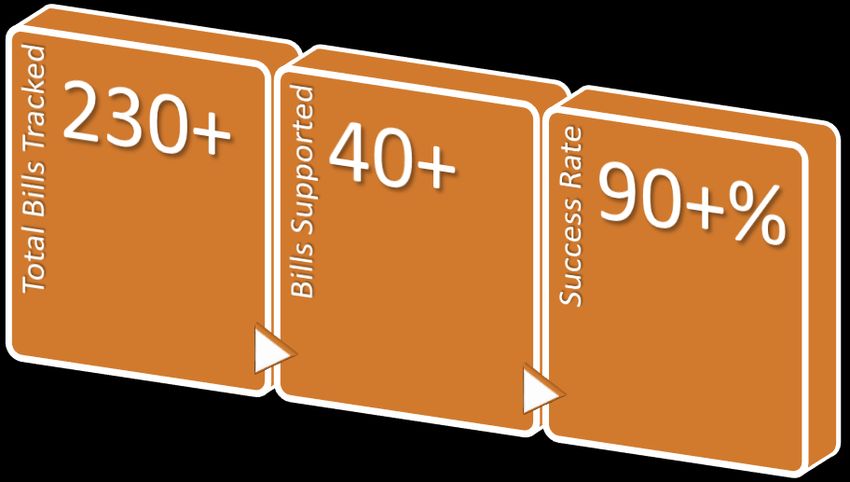
These are the highlights of our combined efforts. Overall, we tracked 257 bills and
began using a bill tracking software to help streamline the process.

The other bills tracked not mentioned in this recap can be found on our website.
Bills relating to the topic are linked in the bottom left-hand corner.

Thank you for your commitment to good government and a wonderful legislative
session.

Sincerely,

Your UAC Team

                                                                                           2
2020 Legislative Priorities
and Successes
1. Tax Reform - Repeal and Legislation to Remove Education Earmark
2. Change in County Form of Government Recodification
3. Fix the Educational Exemption to Property Tax
4. Floating the Certified Tax Rate - Multicounty Assessing Levy
5. Funding – Increase the Daily Rate for Jails
6. Funding – Computer Assisted Mass Appraisal System
7. Funding - Reinstate Medicaid Funding Cuts ($3.9M)
8. Funding - Rewrite of GOED Incentive Tools for Counties
9. Tier II Retirement Issues - Protect County Budgets
10. Funding - County TRT Flexibility Issues
11. Personal Use of Public Property Modifications
12. Funding - EMS Services Stabilization and New Funding
12 for 12 3Tax Reform
Following months of Tax Reform and Equalization Task
Force meetings, SB 2001 passed during a special
session but was repealed during the 2020 General
Session. Any major changes to tax policy in the state
will come as gradual changes during upcoming
legislative sessions, or there will need to be another
round of task force meetings to change Utah’s tax
structure in an all-encompassing bill.
UAC worked tirelessly to ensure local government
revenue sources were maintained, which we did
successfully. We anticipate the effort around tax
reform will continue, but in all conversations, our
revenue capabilities are maintained. The focus is
primarily aimed at loosening restrictions around the
use of income tax (Education Fund).
SB 2001 Tax Restructuring Revisions (Hillyard)
HB 357 Public Education Funding Stabilization (Spendlove)
4County Form of Government
Recodification
• Promote the Commission as the default form (Rural Counties)
• Streamline the process for a change in form
• Ensure the process is controlled by the County on any proposed change
• Clarity around roles of the “study committee” and the elected officials during deliberation
This bill was a priority during interim as we
determined how language should be modified
to clarify the change of form of government
process. This bill also identifies the alternative
forms of government counties can choose
from should they choose this process.
The flowchart (left) shows the new
form for changing county form of
government. (Click the chart to view)
HB 61 Amendments to County Form of
Government (Wilde)
5Educational and Charitable
Exemptions for Property Tax
• This bill came as a result of a lawsuit from Cache County
• This bill ensures that the Cache County interpretation of the law is maintained
• Provides consistency of interpretation for counties and taxpayers
UAC staff worked closely with several
representatives from the assessors, auditors,
attorneys, and the Utah Taxpayers Association
in drafting this language.
The bill defines educational and charitable purposes
in a clear manner based on case law. These
clarifications remove ambiguity from the statute so
those who do not meet the definition of an
educational purpose pay their fair share in property
taxes.
HB 47 Property Tax Amendments (Eliason)
6Multicounty Assessing
and Collecting Tool
This was a proactive piece of legislation that was initiated by UAC to ensure
adequate funding for the computer assisted mass appraisal system. This is the tool
counties use to effectively value property for the purposes of establishing property
tax rates. By establishing a set funding rate for the tool, we have guaranteed
adequate resources for the full development of this critical county tool.
New multicounty assessing
and collecting levy tax rate
.000012
Stabilizes rate for 5 years
— funding MCAT
SB 141 (Hemmert) – Multicounty
Assessing and Collecting Levy
Amendments
7Jail Funding
Jail funding is a continued priority for our counties and for UAC. Work on jail
contracting, reimbursement and programming will continue to be a focus.
While this year’s allocation was not a significant increase, we have been very
successful over the last several years to increase the rate substantially. We
will be back at it again in 2020 and 2021.
Jail Contracting and Reimbursement
$82.93
Actual County Daily Incarceration Rate
This year, our Joint Jails Committee wanted to study the true cost of
running a jail. UAC staff worked with county auditors and sheriffs’ offices to
collect this information.
Jail funding is an ongoing topic as the new state prison nears completion.
Counties will continue to play a vital role in housing & rehabilitating inmates.
SB 236 Jail Contracting and Reimbursement Amendments (Anderegg)
HB 3 Appropriations Adjustments (Last)
8Medicaid
During the 2019 effort to expand Medicaid, the fiscal analyst,
anticipating cost savings, and thus cut local Medicaid budgets by
3.9M to account for the “savings”. When full-expansion was
delayed, so were the savings. With that loss of savings, we found
ourselves in a $3.9M hole. UAC successfully reinstated the $3.9M
that was originally cut.
Reinstatement of $3.9 Million from
funding cuts.
This money goes to Behavioral Health
Mental Health Services.
$398,800 was appropriated to
Washington County in order
to restore funding to the Washington
County Court Support Services
program.
SB 2002 One-Time Appropriation for Behavioral Health (Christensen)
9Rewrite of GOED Incentive
Tools for Counties
Appropriations for:
Continuation of Rural Online Initiative - $880k
Opportunity Zones Development - $150k ongoing
Inland Port - $1.5 Million
This is the second consecutive session UAC has worked on this
legislation. The bill creates the Rural County Grant Program for
3rd – 6th class counties and requires each county seeking to
participate in the grant program to create a County Economic
Development Advisory Board. It creates two pools of ongoing
funding, pool A which is $5 million distributed evenly per rural
county (up to $200,000 annually) and pool B which is another $5
million distributed through a competitive grant program. The County
Advisory Board vets and proposes projects to their county
commission/council then forwards the proposals to the Governor’s
Rural Partnership Board who then approves the grant.
The $10 million used to fund these grants was drawn from the
former USTAR program. SB 95 sunsets the BEAR, Rural Fast
Track, and Enterprise Zone tax credits.
UAC supported changes to the Inland Port, which include enhancements of satellite
locations and the benefits this would provide to rural Utah.
SB 95 Economic Development Amendments
HB 347 Inland Port Modifications 10HB98
Personal Use of Public
Property
With huge concerns from members, UAC proactively redrafted
2019 legislation for the 2020 session, redefining what is
considered an “allowable use”, giving counties flexibility and
removing many of the felony provisions for unintentional
violations of this section of code.
Removing draconian language and
allowing for de minimus or incidental use
of public property by a public servant.
Previous de minimus use was all
felonious.
Intentional misuse, damage, or theft of
public property remains a crime and can
be a Class B Misdemeanor for damages
or theft of less than $500, all the way to a
Second-Degree Felony if the damage or
theft of property is over $5,000.
HB 98 Offenses Against the Administration of Government Amendments (Hall)
11Tier II Retirement for
Public Safety
Always a balancing act, this bill give counties the flexibility to
grant increased benefits, but it is at the county’s discretion.
We successfully found a middle ground to grant additional
benefits while also leaving it up to the counties to decide.
The Tier II Retirement bills adjust retirement
benefit accumulation. Retirees are now
eligible to earn additional service credits in
cases of reemployment.
The line-of-duty death benefit is expanded
to allow for potentially larger death benefit
allowances based on years of service and
salary, rather than just a percentage of final
monthly salary.
SB 56 Public Safety and Firefighter Tier II Retirement Enhancements (Harper)
HB 22 Utah Retirement Systems Amendments (Hall)
12Transient Room Tax
As counties grapple with funding infrastructure to support our
tourism economies, we sought to rebalance the split between
marketing/promotion and infrastructure development. This bill
changed the split between those two activities to help ensure we
have resources to accommodate our visitors.
Transient Room Tax change
Lowers the TRT tourism marketing funding
percentage from 45 to 37 percent and
allows for revenue in addition to the base
to be used for a number of expenses,
which now includes Emergency Medical
Services in 4th–6th class counties.
This was proactive legislation of UAC that was successfully
passed for our tourism-based communities.
HB 280 Transient Room Tax Revisions
13Transportation Funding
Rural Road funding will be a priority for the
2021 Session.
Funding for rural roads was initially
in SB 2001 or the Tax Reform bill.
We anticipate $5 Million or more for
rural roads.
14EMS Funding
EMS Funding in our rural areas has become a critical issue for many, as our ability
to rely on volunteers dwindles, and the lack of resources grows, it has become
imperative to have a robust EMS funding pool for these communities.
As a top priority, UAC was successful in restructuring and funding a new EMS
Grant program.
HB 389 Creates a grant program for
3rd–6th class counties to fund their
EMS programs.
Up to $100,000 for vehicle
purchasing.
$3,000,000 As part of our efforts, we want to
make EMS an essential service. This
designation is crucial when receiving
future funding.
HB 389 Emergency Medical Services Amendments (Owens)
15Revenue Recovery
Brought to us by several UAC members, UAC pursued state authorization to
participate in the NACO Revenue Recovery Program. With the leadership of
our counties and Sen. Okerlund (former county commissioner) we
successfully passed legislation allowing UAC to operate its own revenue
recovery program for Utah communities.
This bill enables counties to contract with
UAC as a clearinghouse to collect on debts
from fees and other debts owed to the
county by offsetting a debtor’s income tax
refund/overpayment.
UAC staff is working with NACo to
implement a system through which counties
can search for debtors and collect lost
revenue — all while not going to collections
or affecting a debtor’s credit.
This new system will be known as UTRECS
—the Utah Tax Refund Exchange and
Compliance System.
SB 234 – Government Debt Collection
Amendments (Okerlund)
1617
You can also read


