Research and Education Connectivity - Unlocking the Intellectual Potential of Africa based Researchers - Africa Education Summit
←
→
Page content transcription
If your browser does not render page correctly, please read the page content below
Africa Education Summit

Research and Education Connectivity -
Unlocking the Intellectual Potential of
      Africa based Researchers

    F F Tusubira - ceo@ubuntunet.net
           www.ubuntunet.net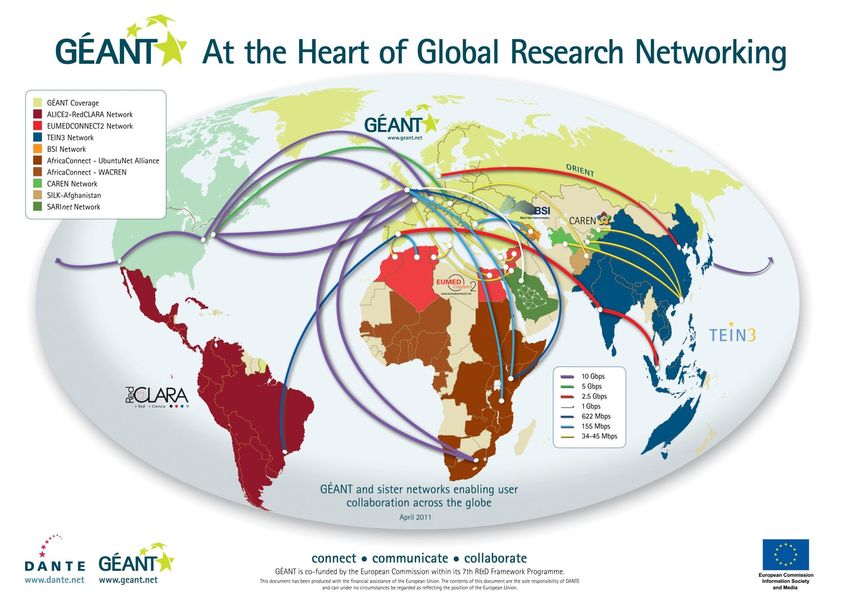
Contents
• Headlines
• Our thesis
• About the Alliance..
• NRENs need for broadband, and vice versa..
• African Governments can unlock the
  potential…
• A new Initiative - AfricaConnect
Some Headlines..
• In 2008, African Universities in the
  UbuntuNet membership region were
  spending more than $1.2million per month
  on less than 700Mbps – this would be
  60GBps elsewhere
• Total bandwidth to the same members is now
  about 12Gbps and growing (10Gbps to South
  Africa) within the same total cost envelope
• The challenge is not lack funds – it is cost!
Our thesis..
• “Improved and affordable connectivity will
  enable African researchers to produce
  proportionate intellectual output and
  generate a proportionate amount of
  intellectual property goods”
• Our objective: to end the intellectual isolation
  of academics and researchers in Africa
• Creation of a connected environment will
  attract researchers to Africa
From Ubuntu to UbuntuNet Alliance..
• Ubuntu or Obuntu: - “I am because we are”
• …Ubuntu is not just a philosophy – it is a way of life
  that defines the relationship of the individual to the
  community and vice versa …
• … It recognises that individual good arises out of the
  community good and vice versa…
• …It is about the responsibility of caring for the general
  welfare, supporting others.
• Ubuntu means “the essence of humanity”; Umuntu
  means “a human being”
• Hence UbuntuNet Alliance – an organisation owned by
  the National Research and Education Networks in
  Eastern and Southern Africa
National Research and Education Networks
• Serve data communication needs of higher institutions
  of learning, and sometimes lower levels;
• Two layers: the infrastructure layer; and the human
  layer where content sharing and collaboration occur;
• Enable shared applications like e-learning platforms;
  management information systems; i-labs; video-
  conference platforms; grid-computing; etc
• Enable collaboration in teaching, research, and
  administration;
• Enable advanced applications, and access to high
  capacity on demand that the private sector cannot
  handle;
Our Programme: Consolidating Research and
    Education Networking in Africa - CORENA
• Overall goal : Enable an environment… African
  Education and Research Institutions can exploit
  their full potential.. contributing to national and
  international human development…increasing
  contribution to, and share in intellectual property
  output… effective collaboration.
• Principle Objective: Integration of African
  institutions into the global research and
  education community through provision of intra-
  African connectivity and enabling access to
  sufficient and affordable bandwidth.
Our Role…. • Create awareness and stimulate/support growth of NRENs • Create a human network of experience and expertise for mutual support and benefit • Engage and enable content networks • Engage policymakers and regulators to create conducive environments • Engage external expertise (other RENs) and development partners • Roll out and operate regional infrastructure
Our Stakeholders……
Our Backbone Vision….
African NRENs Need Broadband to…
• Eliminate the intellectual isolation that sees researchers
  cut off from their peers and diverted to purely money
  making ventures…
• Enable access to online resources that would improve
  the effectiveness and efficiency of research and learning,
  and therefore address the huge Intellectual Property
  deficit in African countries;
• Create research synergy through regional and
  international content/research networks;
• Create intellectual havens that could reverse the flow of
  the brain drain;
• Reach out to schools at all levels, libraries, hospitals...
Broadband needs African NRENs to..
• Stimulate demand by ensuring that people
  entering the job-market at all levels are internet
  ready and thirsty for connectivity;
• Drive the cutting edge of research and
  applications that will lead to advanced industrial
  parks associated with academic and research
  institutions;
• Create an environment that will develop the
  human resource with the capacity to assure the
  availability and security of broadband ICT
  resources as Africa transforms
Some Major Opportunities
• Growing investment in higher education
• More competitive access = cheaper bandwidth:
  – More private sector and utility fiber on the market
  – Public investment into national fiber backbones
  – SEACOM, TEAMS, EASSy, WACS, ..
• Increasing intra/extra research linkages among
  African and non-African universities
• Prices down typically to 20% or less of typical
  2009 cost of $3000per Mbps per month: releases
  money already in budgets to REN activities
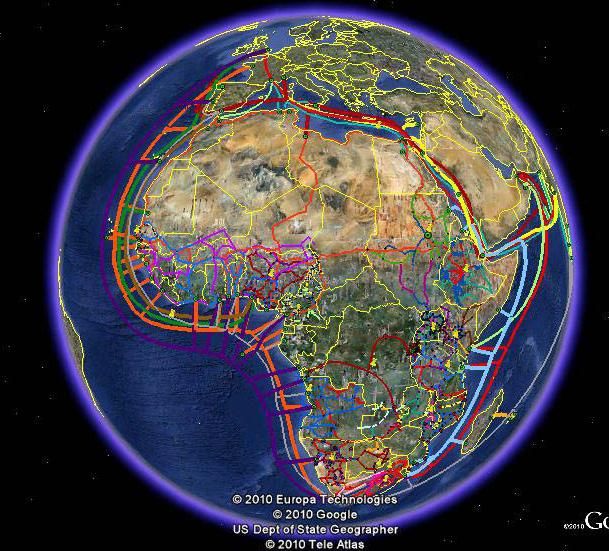
www.ubuntunet.net/fibre-map
                         Fibre to and Within Africa
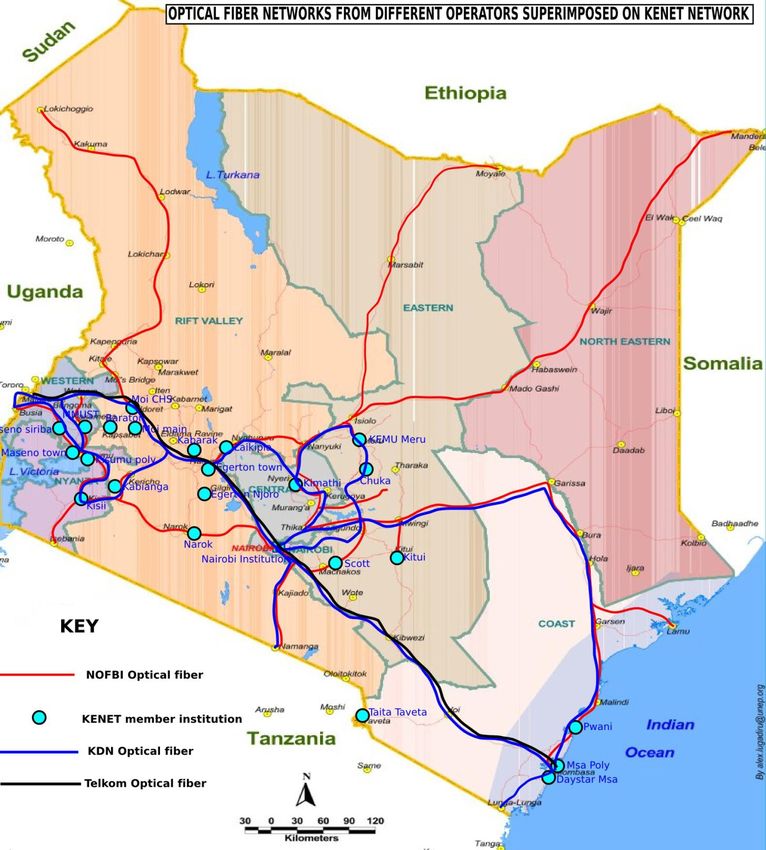
Kenya Fibre Rollout
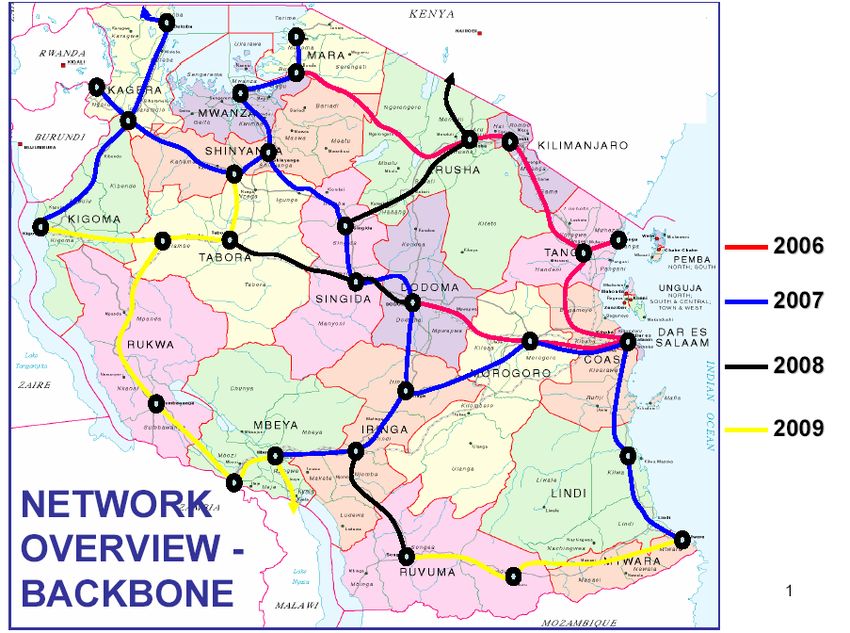
Tanzania National Information Communication
and Technology Broadband Backbone (NICTBB)
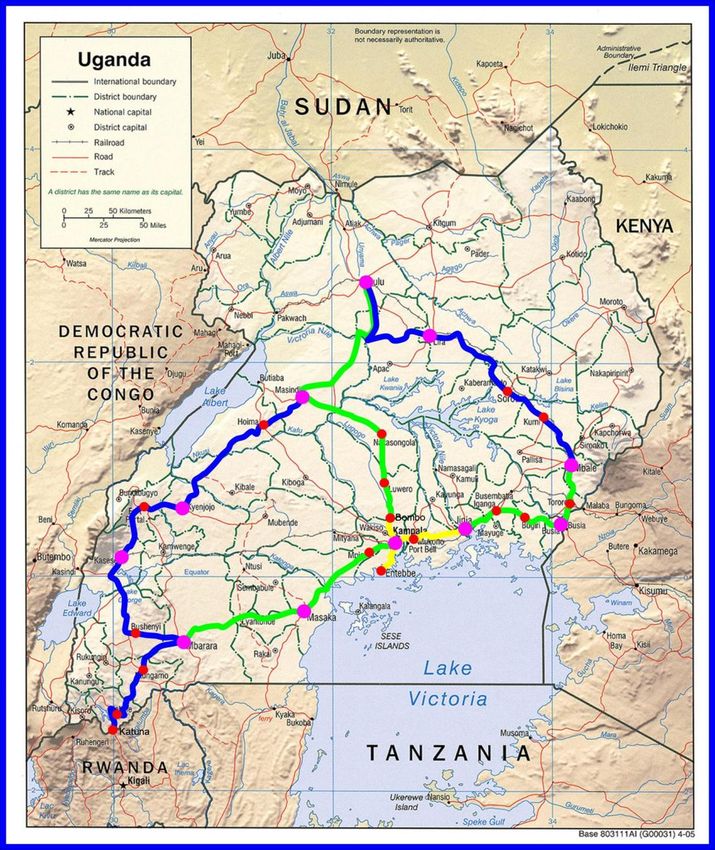
Uganda National Fibre Backbone
  (Operators’ fiber not shown)
Challenges we are addressing
• Technical and Managerial Capacity a cross-
  cutting challenge
• NRENs still financially under-resourced (all
  inherently rich because of huge direct
  bandwidth spends)
• Continuing individual efforts at national level in
  some cases fragments the business case
• Working across 23 countries: differences in
  policy, law, regulation create the challenge of
  enabling cross-border and transit traffic
• Still – not enough fibre; prices too high
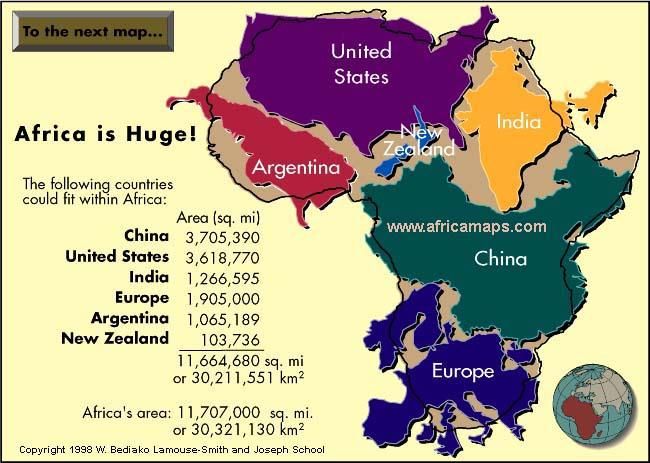
The challenge of Africa’s size if often forgotten…
Alliance Membership Status
13 Full member countries   NREN Growth in Africa

                            UbuntuNet
                             Alliance
                           (5 years old)
What is Happening among NRENs? (1) • Sudan: International connectivity (155Mbps) and staff costs supported by government; • Ethiopia: Extensive national backbone connecting universities via fiber and international connectivity (all government) • Somalia: Universities setting up an NREN; support from Sweden • Kenya: $20m from government for connecting institutions; capacity on national backbone; 760 Mbps International Bandwidth
What is Happening among NRENs? (2)
• Uganda: Dark fiber pair on national backbone;
  USAID funded equipment ordered to light
  backbone and first batch delivered; Also working
  with IEEAF through a PPP arrangement for
  external connectivity;
• DRC: Planning to connect through WACS in
  Kinshasha;
• Rwanda: Gigabit capacity on national fiber;
  150Mbps International Bandwidth. Procedural
  holdups in activating capacity.
What is Happening among NRENs? (3)
• Tanzania: Extensive national fiber, also
  connecting to borders; 150Mbps external
  connectivity to Alliance router;
• Zambia: NUFFIC intervention of €2.25m to
  support NREN infra. and capacity development.
• Malawi: Still fighting the challenges of limited
  connectivity and high cost with only 12Mbps.
• Mozambique: benefitting from WB funding
  through government for local and international
  connectivity; project commencing.
What is Happening among NRENs? (4)
• Namibia: Low cost capacity on Telecom operated
  national backbone; working with TENET,
• South Africa: 10Gb government funded R&E
  Backbone and 10Gb International bandwidth
• UbuntuNet Alliance has worked with DANTE, the
  contractor for AfricaConnect (regional network),
  to develop all pre-contract documentation
• UbuntuNet Alliance working to bring content
  networks to the center
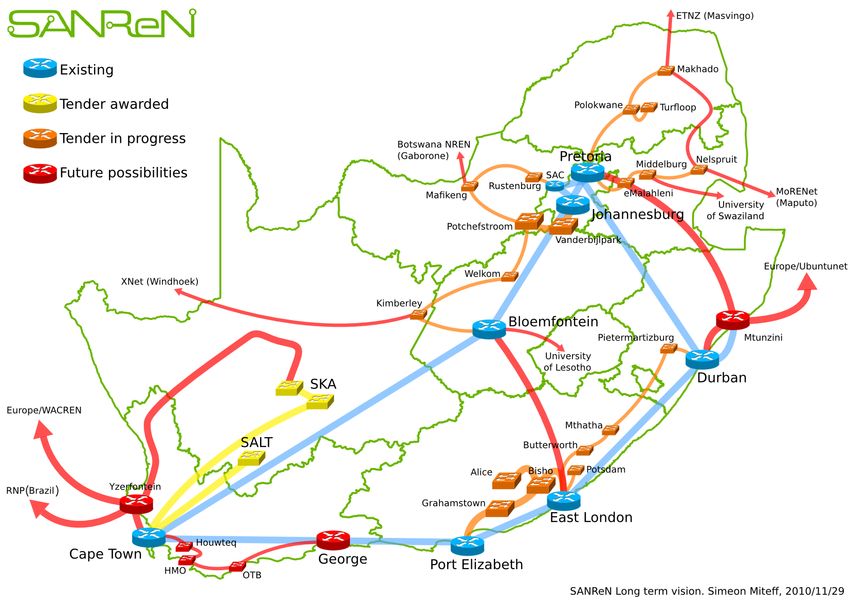
Global Reach from Three Year Ago....
20Gbps; inc. a         …..To now: Current Operations
10Gbps POP link
     Internet
                Géant

                                                 TERNET
                                 760 Mbps
                  UbuntuNet,
                   London
                                             KENET
 10Gbps

                                               Swaziland

  TENET/           UbuntuNet,
  SANReN                                        Botswana
                  Johannesburg
                                   Lesotho

   Namibia                                    MoRENet
Connecting to the World through GÉANT
AfricaConnect
www.africaconnect.eu
Overview
• 4 year project divided into Planning/
  Procurement Phase and Operational Phase
  – Planning and Procurement (up to 12 months)
  – Operational Phase (months 13-48)
• Budget of 14.8 M Euro (80% EUC, 20% from
  AfricaConnect beneficiary partners: NRENs need
  support of their governments to raise this)
• Location is within the Ubuntunet Alliance
  member countries; extends to WACREN for
  capacity building activities
Phase A: Planning and Procurement
 • Procurement of the network connectivity
   network equipment;
 • Design of a cost-effective technical solution
   for the network based on offers received;
 • Development of Cost-sharing model;
 • Confirmation of service requirements and
   subscriptions with UbuntuNet Alliance
 • Contract awards to suppliers;
 • Start of development of a sustainability plan
Phase B: Operational Phase (1)
• Network Operations: Implement and test
  network prior to operational service; set up
  Network management and operations (in-house);
• User support: Support to collaborative user
  communities and the uptake of the use of ICT
  applications by the research and education
  community.
• Promotion: of the use of the network to the end-
  users and to the international stakeholder
  community
Phase B: Operational Phase (2)
• Training and support activities, including
  capacity building for the consolidation of the
  NRENs and training local staff in the
  effective engineering, management and
  operation of the network.
• Increasing political dialogue to raise the
  political and financial support necessary for
  a successful and sustainable network,
  including expansion to cover more countries
AfricaConnect Progress Todate
• Feasibility study showed the Alliance Region
  Ready to benefit; main beneficiary
• Contract between DG AidCO and DANTE
  signed during IST-Africa 2011 (11 – 13 May,
  Gaborone) (The UbuntuNet Alliance is an
  implementing partner)
• DANTE and UbuntuNet Alliance have agreed
  all detailed work plans and the budget
• Implementation has started – ready to connect
  NRENs will get priority
Governments can Unlock Broadband Access
         for NRENs in Africa...
• Ensure regulatory environments that permit NRENs to
  own or get access to broadband infrastructure at
  globally competitive prices;
• Removing the cross-border barriers: African NRENs
  are exchanging traffic outside Africa!
• Provide capacity (preferably dark fibre) on the national
  fibre backbones that have rolled out;
• Governments to support the growth of NRENs while
  leaving them to operate independently;
• How? A high level forum of Ministers of ICT and
  regulators to agree and implement these positions;
• NRENs will then do the rest.
The Future is Bright!
• “We know that we have it in ourselves as
Africans, to change all this [the challenges
we face]. We must assert our will to do so.
We must say there is no obstacle big enough
to stop us from bringing about an African
renaissance.”
– Nelson Mandela
• Appreciation: IDRC; PHEA; FRENIA; OSISA;
EUC
• Thank youYou can also read


