Retail investor trading during COVID-19 volatility - May 2020 - ASIC
←
→
Page content transcription
If your browser does not render page correctly, please read the page content below
Retail investor trading during
COVID-19 volatility

May 2020
Retail investor trading during COVID-19 volatility

Contents

              Summary ....................................................................................................................... 3
              A      Changes in retail investor trading activity in securities markets ................... 4
                     Changes in turnover and market share .................................................................. 4
                     Trading by new and dormant accounts .................................................................. 4
                     Trading frequency and day trading ........................................................................ 5
                     Exchange traded products ..................................................................................... 6
                     Changes in order characteristics ............................................................................ 6
              B      Potential retail investor harm in securities markets......................................... 9
                     Poor market timing ................................................................................................. 9
                     Trading in complex and high-risk products .......................................................... 10
              C      Contracts for difference and market volatility ................................................ 13
                     Large spike in CFD trading activity ...................................................................... 13
                     Leverage and volatility magnify risk ..................................................................... 13
                     Retail client losses trading CFDs during 16–22 March 2020 ............................... 14
                     CFD losses may exceed initial investment amount ............................................. 14
                     Overnight funding costs may erode initial investment amount ............................ 14

© Australian Securities and Investments Commission May 2020                                                                                Page 2
Retail investor trading during COVID-19 volatility
Summary
This paper outlines some early observations by ASIC staff on trading in securities and
contracts for difference (CFDs) during the volatility caused by the COVID-19 pandemic
(COVID-19 volatility).
It was produced to inform our work in managing the impact of the COVID-19 pandemic
and is published to raise awareness and provide detail on recent retail investor trading
activity and issues of concern.
The paper highlights a range of potential retail investor harms. It is divided into three
parts:
(a) Section A sets out the changes we observed in retail trading activity in securities
markets;
(b) Section B sets out the potential retail investor harm in securities markets; and
(c) Section C discusses CFDs and market volatility.
Examples in this paper are purely for illustration; they are not exhaustive and are not
intended to impose or imply particular rules or requirements.
Time periods covered in this paper
The securities market analysis in Sections A and B is derived from ASIC’s exchange
market surveillance data, using trading through retail brokers. We use this as a proxy for
retail investor activity, but we note that not all trading through these brokers is ‘retail’
within the context of the Corporations Act 2001 (Corporations Act). The ‘focus period’ is
from 24 February 2020 (the first trading day after the market peak) to 3 April 2020, and
the ‘benchmark period’ used for comparison is the six months prior (22 August 2019 to
21 February 2020).
The CFD analysis in Section C is based on over-the-counter (OTC) derivatives trade
repository data and separate data provided by a sample of 12 Australian licensed CFD
providers for the seven days from 16 to 22 March 2020.
© Australian Securities and Investments Commission May 2020 Page 3Retail investor trading during COVID-19 volatility
A Changes in retail investor trading activity in
securities markets
Changes in turnover and market share
The average daily securities market turnover by retail brokers increased from $1.6 billion
in the benchmark period to $3.3 billion in the focus period. Retail trading as a proportion
of total trading increased marginally, from 10.62% to 11.88%, when benchmarked
against the backdrop of total average daily securities market turnover—which increased
from $15 billion to $28 billion (counting both sides of each trade, consistent with retail
numbers).
Retail brokers were net buyers of securities over the focus period, buying $53.4 billion
and selling $48.4 billion.
Trading by new and dormant accounts
There has been a sharp increase in the daily number of unique client identifiers (indicative
of new client accounts) associated with retail brokers that are appearing for the first time
in ASIC’s trade surveillance data. An average of 4,675 new identifiers appeared per day
in the focus period. This made up a total of 140,241 identifiers we had previously not
observed. In the benchmark period, we observed 1,369 new identifiers per day and an
average of 34,502 new identifiers appearing in a period of the same length. See Figure 1
for the increase in activity by new and dormant accounts during the focus period.
The rate of creation of new accounts (as indicated by their identifiers) is roughly
3.4 times higher during the focus period (compared to the benchmark period). In the
focus period, new accounts represented 21.36% of all active accounts. New account made
up 3.65% of all active accounts in the benchmark period.
© Australian Securities and Investments Commission May 2020 Page 4Retail investor trading during COVID-19 volatility
Figure 1: Increase in new accounts and dormant accounts re-entering the market
10,000
9,000 Start of
focus
8,000
period
7,000
6,000
5,000
4,000
3,000
2,000
1,000
-
New client identifiers Returning client identifiers
A large number of ‘dormant’ client identifiers from retail brokers, which had not traded
during the preceding six months, started trading again in the focus period. A total of
142,022 ‘dormant’ retail broker client identifiers did not trade during the benchmark
period, but recommenced trading during the focus period. In the focus period, these
dormant identifiers accounted for 21.63% of all active accounts.
Trading frequency and day trading
Retail investors have been trading more frequently. For client identifiers that were active
during the focus and benchmark periods, there has been a substantial decline in the
average time between trades by the same investor in a particular stock. On average, this
was 4.5 days in the benchmark period and one day in the focus period.
This may indicate either investors building up positions more frequently over time or
attempting to profit from buying and selling around short-term price movements. For
trading in any stock, the average time between trades by the same investor has decreased
from 2.5 days to less than one day: see Figure 2.
© Australian Securities and Investments Commission May 2020 Page 5Retail investor trading during COVID-19 volatility
Figure 2: Retail investor trading activity and frequency
4.5
2.5
1 0.9
Average days between trades of Average days between trades of
same stock any stock
Benchmark period (22 August 2019 to 21 February 2020)
Focus period (24 February to 3 April 2020)
Exchange traded products
The average daily turnover in exchange traded products (ETPs), like exchange traded
funds (ETFs) and managed funds, has increased from $703 million in the benchmark
period to $1.88 billion in the focus period (counting both sides of each trade, consistent
with retail numbers). In relative terms, this is an increase of 159%, which compares with
the increase in turnover of 86% across the broader securities market.
However, the proportion of turnover in ETPs that retail brokers were a party to increased
marginally—from 58% in the benchmark period to 61% in the focus period. A significant
proportion of the non-retail activity in these products is typically conducted by market-
makers as opposed to institutional investors.
Changes in order characteristics
Increases in new retail trading have also seen changes in order characteristics, including
the use of orders that remain open until cancelled (i.e. ‘good til cancelled’ or GTC).
GTC orders provide the benefit of order queue priority and the possibility of orders away
from current market prices being hit if there are overnight price moves. But they are
exposed to significant price swings in response to overnight international news and
market performance, and may expose retail investors to unexpected losses.
© Australian Securities and Investments Commission May 2020 Page 6Retail investor trading during COVID-19 volatility
Figure 3: Number of GTC orders submitted by clients of retail brokers
70,000 Start of
focus
60,000 period
50,000
40,000
30,000
20,000
10,000
-
Retail GTC orders
In the period from 1 January to 1 April 2020, usage of GTC orders by clients of retail
brokers increased dramatically: see Figure 3. These clients were also responsible for the
vast majority of GTC orders.
Figure 4 shows the number of accumulated GTC orders that did not execute intraday, and
hence were restated at the beginning of the next trading day. As volatility and retail
trading increased, initially the accumulated restatements dipped even as the use of
GTC orders increased. This could be because many GTC limit orders far away from
current market prices were able execute intraday due to extreme volatility. As volatility
tempered recently, we started to see a build-up of GTC orders that were not hit intraday,
and hence were restated at the start of the next trading day.
© Australian Securities and Investments Commission May 2020 Page 7Retail investor trading during COVID-19 volatility
Figure 4: Number of GTC orders restated for clients of retail brokers
150,000
140,000
Start of
130,000 focus
period
120,000
110,000
100,000
90,000
80,000
70,000
60,000
50,000
GTC restatements retail
© Australian Securities and Investments Commission May 2020 Page 8Retail investor trading during COVID-19 volatility
B Potential retail investor harm in securities
markets
Poor market timing
The average retail investor was not proficient at predicting short-term market movements
over the focus period.
Figure 5 compares the daily net buying or selling activity across all retail investors with
the change in price over the next day for the shares that they traded. For more than
two thirds of the days on which retail investors were net buyers, their share prices
declined over the next day. For more than half of the days on which retail investors were
net sellers, their share prices increased over the next day. If all retail investors held their
positions for only one day, total losses would have amounted to over $230 million.
While markets generally recover over the long run and tend to grow with economic
fundamentals, short-term trading and poor market timing can be a major risk for investors
in volatile markets. Therefore, retail investors should be wary of trying to ‘play the
market’ for short-term price movements by day trading.
Figure 5: Net buying and selling activity and next day percentage price change—Focus period
(24 February to 3 April 2020)
800 16%
600 12%
400 8%
200 4%
$ millions
0 0%
-200 -4%
-400 -8%
-600 -12%
24/02/2020
25/02/2020
26/02/2020
27/02/2020
28/02/2020
02/03/2020
03/03/2020
04/03/2020
05/03/2020
06/03/2020
09/03/2020
10/03/2020
11/03/2020
12/03/2020
13/03/2020
16/03/2020
17/03/2020
18/03/2020
19/03/2020
20/03/2020
23/03/2020
24/03/2020
25/03/2020
26/03/2020
27/03/2020
30/03/2020
31/03/2020
01/04/2020
02/04/2020
03/04/2020
Net buying or selling (LHS) Next day price change (RHS)
© Australian Securities and Investments Commission May 2020 Page 9Retail investor trading during COVID-19 volatility
Trading in complex and high-risk products
Geared ETPs
Over the focus period, there has been a significant increase in trading activity in ETPs
that have geared exposures in the same or opposite direction to market movements.
Gearing magnifies the risk of these ETPs, by increasing profits from favourable market
movements but also increasing losses from unfavourable market movements.
Additionally, geared ETPs are complex because they are actively managed to periodically
reset the level of gearing, to ensure that it remains within a specified range after large
market movements.
Geared ETPs should not be traded by investors who do not have appetite for this risk or
understand the complexity. We saw trading volumes for one geared ETP increase by
16 times the normal volume to become the second most traded ETP. Retail investors were
on at least one side of 75% of turnover in this fund during the focus period.
Oil-related securities
The global oversupply and storage issues with oil are impacting Australian financial
products that are heavily invested in by retail investors. ETPs and other unlisted managed
investment schemes that are exposed to oil futures have seen significant price volatility in
response to unprecedented negative oil futures prices. Some saw prices decline over 80%
between 24 February and 22 April. It highlights a risk for funds that have exposure to
physically delivered commodities, where many investors in the futures contract have no
intention of taking physical delivery of the oil.
Listed investment companies and listed investment trusts
Low interest rates and the search for yield have led to increased risk taking by investors
in the fixed income space in recent times. Even before the COVID-19 volatility, we saw
an increasing trend of high-yield issuances and retail investor interest in listed investment
companies and listed investment trusts. The constituent underlying securities can fall
outside the investment-grade credit ratings and bear significant risks in periods of
economic stress. We saw the price of some fall by 50% during the focus period.
Overall, we have also seen an increasing proportion of listed investment companies and
listed investment trusts trading at greater discounts to their net tangible assets: see
Figure 6. This trend pre-dates the COVID-19 pandemic.
© Australian Securities and Investments Commission May 2020 Page 10-70%
-60%
-50%
-40%
-30%
-20%
-10%
0%
10%
20%
30%
BEL, -58.9%
AU P, -56.7%
M M J, -56.6%
SVS, -46.2%
CD3, -42.5%
CD2, -36.6%
OEQ, -36.0%
TGF, -28.6%
NGE, -28.1%
BAF, -27.0%
AI B, -26.2%
BTI , -25.8%
CDM , -23.9%
ECP, -23.1%
FGG, -22.7%
OZG, -22.5%
NSC, -21.3%
GFL, -21.0%
CVF, -20.7%
TOP, -20.5%
LRT, -20.5%
TEK , -20.3%
PGF, -19.6%
PI A, -19.4%
APL, -19.2%
LSF, -19.1%
EAI , -18.9%
LSX, -18.4%
PAF, -18.0%
SEC, -17.8%
FPP, -17.7%
© Australian Securities and Investments Commission May 2020
M EC, -17.5%
ALF, -17.1%
W QG, -17.1%
K AT, -16.6%
W IC, -16.0%
VG8, -15.7%
W GB, -15.7%
CI N, -15.6%
PM C, -15.4%
NAC, -14.6%
ALI , -14.5%
TGG, -14.3%
SNC, -14.1%
RYD, -14.0%
FOR, -13.7%
FSI , -13.5%
FPC, -13.2%
M A1, -13.2%
PAI , -12.9%
NCC, -12.7%
FGX, -12.7%
EGI , -11.8%
M FF, -11.3%
VG1, -10.6%
CLF, -10.6%
CI E, -10.4%
K K C, -10.3%
GVF, -10.0%
W LE, -10.0%
RF1, -9.7%
QVE, -8.7%
M HH, -8.4%
PE1, -8.4%
ACQ, -8.2%
AM H, -8.0%
PI C, -7.9%
I BC, -7.4%
HM 1, -7.2%
AEG, -7.1%
Source: Based on data from ASX. See the original figure in ASX Monthly Investment Products Report March 2020 (PDF 2.23 MB).
AYF, -5.9%
M GG, -5.8%
M LT, -5.4%
EGD, -5.2%
PCI , -5.1%
AU I , -4.4%
AI Q, -4.3%
Figure 6: Distribution of premiums and discounts of listed investment companies as at 28 February 2020
BK I , -3.8%
8EC, -3.6%
CD1, -3.1%
W HF, -3.1%
EAF, -2.9%
DU I , -2.9%
M I R, -2.5%
EGF, -1.7%
GCI , -1.2%
AGM , -0.5%
NBI , -0.5%
M XT, -0.5%
QRI , 0.0%
M OT, 0.0%
CAM , 0.0%
EFF, 0.0%
AFI , 0.2%
ABW , 1.3%
W MI, 1.5%
ARG, 1.5%
PGG, 1.5%
DJW , 1.6%
W AA, 2.5%
GC1, 2.6%
ZER, 3.4%
PL8, 3.8%
OPH, 8.1%
W AM , 18.9%
W AX, 24.0%
8I H, 24.7%
Page 11
Retail investor trading during COVID-19 volatilityRetail investor trading during COVID-19 volatility
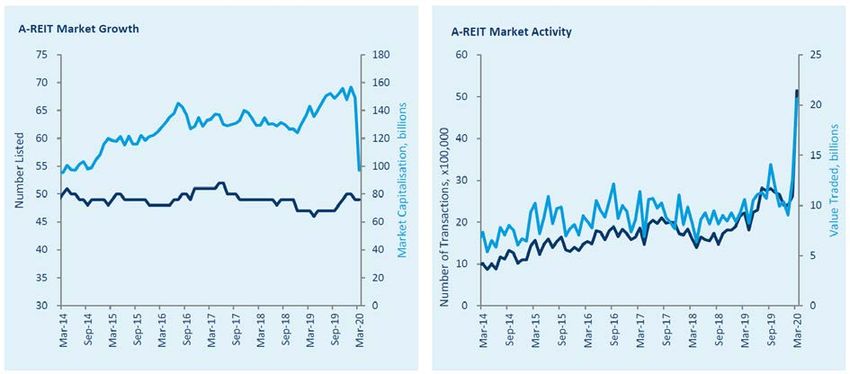
Australian real estate investment trusts
The impacts of the COVID-19 pandemic have been keenly felt by tenants and real estate
investors. Discounts and suspensions of rental payments may indirectly impact Australian
real estate investment trusts (A-REITs). We are seeing a sharp fall in A-REITs prices and
total market capitalisation, while trading volumes in these products has increased: see
Figure 7.
Figure 7: A-REITs market size versus market activity
Source: ASX Monthly Investment Products Report March 2020 (PDF 2.23 MB).
© Australian Securities and Investments Commission May 2020 Page 12Retail investor trading during COVID-19 volatility
C Contracts for difference and market volatility
Large spike in CFD trading activity
ASIC OTC derivatives trade repository data indicates a significant increase in trading
activity during the peak of COVID-19 volatility: see Figure 8.
Figure 8: CFD messages per week: Total messages reported to the Depository Trust and
Clearing Corporation (DTCC)
Leverage and volatility magnify risk
Compared with unleveraged investment in securities like shares and ETFs, CFD leverage
magnifies investment exposure and sensitivity to market volatility. For example, on a
$1,000 initial investment in shares, a 5% fall in a share price results in a $50 loss. For a
$1,000 investment in a CFD over shares with a leverage ratio of 20:1 (i.e. providing
$20,000 exposure), the loss is $1,000—100% of the initial investment amount.
We commonly see CFD leverage ratios of up to 200:1 for CFDs over securities market
indices, and up to 500:1 for CFDs over currency pairs. This means that, for example, at a
leverage ratio of 500:1 a retail client with an initial investment of $1,000 may open a
CFD position with exposure of $500,000. Between 16–20 March 2020, the Australian–
US dollar fix rate (WM/Reuters) fell 5.2%, the equivalent of 26 times the minimum initial
margin for a currency CFD with 500:1 leverage (a $26,000 fall in the example).
We have observed some CFD issuers reducing the maximum leverage that they offer on
CFDs during this period of significant market volatility.
© Australian Securities and Investments Commission May 2020 Page 13Retail investor trading during COVID-19 volatility
Retail client losses trading CFDs during 16–22 March 2020
In the week 16–22 March 2020, based on a sample of 12 Australian licensed CFD
providers, retail client losses were just over $428 million gross (or $234 million net). The
12 providers account for around 84% market share, so the aggregate retail client losses
across the industry for this single week may be higher.
CFD losses may exceed initial investment amount
In fast-moving markets, prices can gap and losses can exceed the initial investment. Many
retail client accounts went into negative balance in the week commencing 16 March.
5,448 retail client accounts of the 12 providers in the sample (or 2% of their retail client
accounts that traded during that week) went into negative balance to the value of
over -$4 million in aggregate. That is, they lost their initial investment and owed a further
$4 million to the CFD providers. Some of the providers absorbed the losses themselves.
Overnight funding costs may erode initial investment amount
Overnight funding costs can increase significantly during times of volatility and can
quickly erode a retail client’s initial investment, even before accounting for price
movements. For example, we have seen very significant increases in the cost of holding
oil CFDs overnight (up to 220% per annum). For a hypothetical $100,000 exposure to oil
CFDs ($1,000 initial investment at 100:1 leverage), overnight funding costs of 220% per
annum would amount to around $600 per night—around 60% of the initial investment in
fees alone in one night.
© Australian Securities and Investments Commission May 2020 Page 14You can also read


