Return to Hockey Framework - Revised July 27, 2020 - Huron-Bruce Minor Hockey
←
→
Page content transcription
If your browser does not render page correctly, please read the page content below
Return to
  Hockey
Framework
   Revised July 27, 2020
SECTION 1

Purpose
The Ontario Hockey Federation has worked in conjunction with Hockey Canada, the National Sport Organization
(NSO) for hockey, and the Ontario Government as one of its recognized Provincial Sport Organizations (PSO) to
ensure that in every phase of our return the safety of our Players, Coaches, Officials, Administrators and volun-
teers are at the center of our plan and decision making. This plan focuses on making the return to hockey fluid
while enhancing the experience. This document is used for the purposes of the Ontario Hockey Federation
only and does not make assertion to hockey programming that falls outside of its jurisdiction.

                                                                                                                    2
SECTION 2
Disclaimer
The information in this document is not intended or implied to be a substitute for professional medical advice,
diagnosis, or treatment. The Ontario Hockey Federation and its Members make no representation and assume
no responsibility in respect of their information concerning COVID-19 as the circumstances are constantly
changing, and any information on COVID-19 should be obtained from your Public Health Authority.
3SECTION 3
Framework for
Return to Hockey
The impacts of the COVID-19 outbreak have been felt across Ontario, by families, workers, businesses, and commu-
nities. Our hockey family has also felt the impacts of this.
COVID-19 has created a unique situation for every person, business, and government body to deal with. Sport for
our youth and adults alike closed on March 12, 2020 with no identified return. While the situation is still evolving,
the OHF continues to work with its partners to prepare for a return to programming with the necessary measures in
response to COVID-19.
Our plan to return recognizes that although hockey was shut down with us all playing 5 on 5 traditional hockey our
return to traditional hockey will be by way of a planned phased in approach. The Ontario Hockey Federation has de-
veloped a phased approach to return with programming.
Phase 1 - Protect and Support
The OHF’s primary focus in Phase 1 was the reintroduction of the sport of hockey for the health
and well-being of stakeholders in the game, their families, and the greater community following the
cancellation of the 2019-2020 hockey season.
During this phase, the OHF developed the standards of operations and certification protocols by in-
dividuals that provide hockey programming, as well unique and innovative strategies to bring hockey
into the lives of our stakeholders and participants, in a safe – distanced manner.
Phase 2 - Restart, Protect and Support
The OHF will be implementing a careful, stage-by-stage approach to reintroducing hockey activities
across our provincial jurisdictions. The safety of all participants and stakeholders will continue to be
the priority, while balancing the needs of individuals within the game. This staged approach does not
have a specific time frame, but will evolve further to guidelines of the public health authorities, the
provincial government, and our governing body, Hockey Canada. At any point during the progression,
we may need to pause or return to a previous stage in order to protect and support our participants
and the public.
4Stage 1 - Individual In-Person Training and Group Virtual Training
In-Person Training
Instructional Training – Individual athlete training on or off ice sanctioned by the OHF up to 10 participants
or less if determined by Public Health Unit or the facility. All programming must be in compliance with the
Ontario Government Emergency Order and OHF policies.
• OHF Members may conduct programming with the use of an instructor who meets the qualifications
under the OHF Hockey Canada Licensed Skill Development Program Policy.
• Minor Hockey Associations may conduct, with the approval of their Member instructional, training for
players registered with their MHA during the 2019-2020 season, where such training is conducted by a
registered coach with the MHA during the 2019-2020 season.
• In process and fully licensed Hockey Canada Licensed Development Specialists who are in compliance
with the OHF Hockey Canada Licensed Skill Development Program Policy may conduct training.
• If utilizing a private skills instructor, MHAs will need to validate that the skills instructor qualifies under
the OHF Hockey Canada Licensed Skill Development Program Policy.
• Junior hockey teams may conduct programming with the approval of their Member for players that they
have registered for the 2020-2021 season or any players that are on their protected list. If utilizing a pri-
vate skills instructor will need to validate that the sills instructor qualifies under the OHF Hockey Canada
Licensed Skill Development Program Policy.
Virtual Training
Sport Science – sleep, nutrition, fitness, training, dance, flexibility, yoga, mental training and mental health.
• Such programming that is being offered will be done with approval of the OHF or Member for the pur-
pose of sanctioning and insurance.
Professional Development
Training of stakeholders online, in groups and one on one or small groups in compliance with the Ontario
Government Emergency Order and OHF policies
• OHF Hockey Canada Licensed Skill Development Program
• Gender Identity and Expression
• Hockey Canada Safety Program/Hockey Trainers Certification Program
• Officials On-Line Recertification
• Respect-In-Sport
Stage 2 - Group Development Programming
In-Person Training
Instructional Training – Individual athlete training on or off ice sanctioned by the OHF up to 15 participants
or less if determined by Public Health Unit or the facility. All programming must be in compliance with the
5Ontario Government Emergency Order and OHF policies.
• OHF Members may conduct programming with the use of an instructor who meets the qualifications
under the OHF Hockey Canada Licensed Skill Development Program Policy.
• Minor Hockey Associations may conduct, with the approval of their Member, instructional training for
players registered with their MHA during the 2019-2020 season, where such training is conducted by a
registered coach with the MHA during the 2019-2020 season.
• In process and fully licensed Hockey Canada Licensed Development Specialists who are in compliance
with the OHF Hockey Canada Licensed Skill Development Program Policy may conduct training.
• If utilizing a private skills instructor, MHAs will need to validate that the skills instructor qualifies under
the OHF Hockey Canada Licensed Skill Development Program Policy.
• Junior hockey teams may conduct programming with the approval of their Member for players that they
have registered for the 2020-2021 season or any players that are on their protected list. If utilizing a
private skills instructor, they will need to validate that the sills instructor qualifies under the OHF Hockey
Canada Licensed Skill Development Program Policy.
Virtual Training
Sport Science – sleep, nutrition, fitness, training, dance, gymnastics, yoga, mental training, and mental
health.
• Such programming that is being offered will be done with approval of the OHF or Member for the pur-
pose of sanctioning and insurance
Professional Development
Training of stakeholders on-line in groups and one-on-one or small groups in compliance with the Ontario
Government Emergency Order and OHF policies.
• OHF Hockey Canada Licensed Skill Development Program
• Gender Identity and Expression
• Hockey Canada Safety Program/Hockey Trainers Certification Program
• Officials On-Line Recertification
• Respect-In-Sport
Stage 3 - Non-Traditional Programming
Associations will operate their programming in accordance with the framework of the OHF Return to Hockey
Stage, as well as the rules established by their Member, the local Public Health Unit and the facilities. In all
stages the Hockey Canada Safety Protocols will be followed. Further information on the other Stage 3 levels will
be released in the near future.
Stage 3a - Return to Ice Continued July 28 to August 31
Member Approved Programming in Geographic Area that is in Ontario Government Stage 3
6Programming is based on Stage 1 and 2 requirements. Association programming is for participants registered
with the Association for 2019-2020.
Individual and Group Training
• Maximum of 25 participants on the ice, including instructors, or a lower number if determined by Ontario
Government, local Public Health Unit, the facility or Member.
• Every aspect of facility use must adhere to facility policies and physical distancing on and off the ice.
Stage 4 - Traditional Hockey
This stage will involve the introduction of traditional hockey (5 on 5). Any such introduction will be in compliance
with the Ontario Government Emergency Order and OHF policies.
Phase 3 - Recover, Protect, and Support
Stage 1 - Registration Numbers
Implementation of a collective recruitment initiative in conjunction with the Ministry of Heritage,
Sport, Tourism, Culture, and Industries, and Hockey Canada to bring participants back to hockey to
pre-COVID-19 numbers for the 2021-2022 season.
Stage 2 - Internal Events
Planned approach to operating and hosting of tournaments across the OHF with teams from
Ontario.
Stage 3 - Integration Outside of the Province
Identifying National and International hosting opportunities for events and tournaments.
7SECTION 4
Facilities
Public and Private facilities that are providing training to hockey need to ensure that they maintain their own
insurance on their facility and are in compliance with the Ministry of Labour Protocols and those protocols
specific to the Ontario Government Emergency Order.
All hockey programming providers that are sanctioned by the Provincial Sport Organizations in Ontario will:
• be listed on the OHF website and will be able to present a Hockey Canada Insurance Certificate and Certifi-
cate of Validation.
• be required to complete a tracking document of participation use and an ice surface by ice surface training
attendance form; and
• be required to have a COVID-19 Contact Person.
Facilities are directed to utilize the information provided by the Ontario Recreation Facilities Association (ORFA)
as an industry standard material: ORFA Reentering and Reopening.
Ontario Ice Sports Harmonized Ice Sports Facility Procedures
Facility Entrance - No Dressing Rooms - Come Dressed – Entrance to Arena is based on facility plan and all
sport groups collectively are required to have a meeting with the facility based on the following agenda.
• Parking Lot Entrance
• Entrance Doors
• Entrance Process
• Entrance Time
• Changing of equipment location process
• Dropping off Minor participants – Parents/Attendance – number of attendees permitted to support and
watch
• Conduct of Parents in the stands (i.e. food and beverage maintaining facility cleanliness)
• Items allowed in the facility (bags, food, and beverage)
Facility Entrance - Dressing Rooms - Come Dressed – Entrance to Arena is based on facility plan and all
sport groups collectively are required to have a meeting with the facility based on the following agenda.
• Parking Lot Entrance
• Entrance Doors
• Entrance Process
• Entrance Time
• Changing of equipment location process
• Dropping off Minor participants – Parents/Attendance – number of attendees permitted to support and
8watch
• Conduct of Parents in the stands (i.e. food and beverage maintaining facility cleanliness)
• Items allowed in the facility (bags, food, and beverage)
Facility Entrance - Dressing Rooms - Option to Change at Facility – Entrance to Arena is based on facility
plan and all sport groups collectively are required to have a meeting with the facility based on the following
agenda.
• Parking Lot Entrance
• Entrance Doors
• Entrance Process
• Entrance Time
• Changing of equipment location process
• Dropping off Minor participants – Parents/Attendance – number of attendees permitted to support and
watch
• Conduct of Parents in the stands (i.e. food and beverage maintaining facility cleanliness)
• Items allowed in the facility (bags, food, and beverage)
•
Other Facility Specific Issues
• Tenant Dressing Room Requirements must be dealt with in a meeting with facility to determine con-
tractual agreements on responsibilities
• Elite hockey rental requirements (i.e. longer break if require warmups)
• Look to plan for longer Ice-times rental
• Warming up within the facility
Reporting of incidents of injury or COVID-19 to facility personnel
• Until a standardized form is approved with all facilities the form that is provided by the facility will be
the required form.
Equipment Storage
• Each rink will have to determine private storage requirements and if applicable should be part of your
meeting agendas.
9SECTION 5
Certification of
Validation and Insurance
The following validation process will be put in place to ensure that each group or individual operating meets
OHF standards that focuses on athlete safety.
This certificate is issued to Junior Teams, Minor Hockey Associations and Hockey Canada Licensed Develop-
ment Specialists under the jurisdiction of the Ontario Hockey Federation. The approved bearer of this certificate
is compliant with both the OHF Return to Hockey Framework and the Hockey Canada Safety Guidelines.
Facilities will be able to verify OHF programming based on the Certificate of Validation and Certificate of Insur-
ance.
Certification of Insurance: Each organization will be required to have a valid Certificate of Insurance present
with them for any hockey activities.
Certification of Validation: As a certified organization, you will be required to have a Certificate of Validation in-
dicating that you have completed the training provided by the OHF. The certificate will be presented to you on
your meeting all the requirements set out in the OHF Return to Hockey Framework.
10SECTION 6
Chief Medical Officer
Mandate:
The Chief Medical Officer Ontario Hockey is responsible for providing the Provincial Sport Organizations
(being the Ontario Hockey Federation (OHF), Hockey Eastern Ontario (HEO), Hockey Northwestern Ontario
(HNO) and Ontario Women’s Hockey Association (OWHA) hereinafter referred to as the PSOs), Boards and
staff with medical advice and comprehension regarding decisions and the impact of those decisions due to
COVID-19 and the direction from the Ontario Government and Public Health Authorities.
Key Duties:
• Act as the medical consultant for the PSOs to respect of COVID-19 with the mandate to abide by the On-
tario Government and Public Health.
• Act as the medical consultant for the individual PSOs in respect of COVID-19 if the Ontario Government
opens regionally.
• Maintain professional status and be in good standing with their respective licensing College.
• Be the medical spokesperson for the PSOs.
• Advise the PSOs on risk management issues especially with respect to medical issues.
• Advise the PSOs on research projects and issues especially with respect to medical issues.
• Advise the PSOs on event sanctioning.
• Act as a consultant for international tournaments held in the PSOs jurisdiction.
• Act as a liaison with the Hockey Canada Chief Medical Officer concerning medical issues.
• Such additional duties as may be delegated to the Chief Medical Officer Ontario Hockey by the PSOs from
time to time
Authority:
The Chief Medical Officer Ontario Hockey, will exercise their authority as set out by any Hockey Canada or
PSO regulation or in accordance with this job description.
Appointment:
For the role of Chief Medical Officer Ontario Hockey there will be a short canvasing period of the PSO’s
Boards and OHF Members Boards for potential candidates. Based on the potential candidates the Chief
Medical Officer Ontario Hockey shall be appointed by the PSOs Chairs of the Board, in consultation with
the CEO/EDs, for a one-year term that is renewable. The Chief Medical Officer Ontario Hockey has no
voting rights.
Meetings:
The Chief Medical Officer Ontario Hockey will attend meetings in person and via conference call, via invita-
tion from any of the PSO’s Chair of the Boards. PSO’s members must obtain the approval of their respec-
tive PSO Chair of the Board before making any such invitations.
Resources:
The Chief Medical Officer Ontario Hockey will receive the necessary resources from the PSOs, to the
11extent approved in the annual budget, to fulfill his or her mandate. They will also receive the necessary adminis-
trative support from the PSOs office.
Reporting:
The Chief Medical Officer Ontario Hockey will report to the PSO’s Board as required and to the CEO/ED.
Requirements:
The Chief Medical Officer Ontario Hockey will be licensed to practice as a Physician in the Province of Ontario.
Experience as a Sport Medicine Physician and membership in CASEM will be considered an asset.
Renumeration:
The Chief Medical Officer Ontario Hockey is a volunteer role with no remuneration except for expenses related
to the attendance of meetings for the purpose of this role and other expenses as determined by the PSOs.
Insurance Coverage:
The Chief Medical Officer Ontario Hockey will fall within the Hockey Canada Insurance program including the
Directors and Officers Insurance for the activities of the Chief Medical Officer Ontario Hockey related to this
specific role.
Regional Chief Medical Officer
If it is determined that we require Regional Chief Medical Officers to support implementation as we continue to pro-
ceed through the Return to Hockey Framework, they will be appointed at that time.
12SECTION 7
Stakeholder Requirements
The following chart outlines the requirements that individuals in different leadership positions must have in order
to train, support and/or coach registered hockey players in the OHF.
Team On-Ice Skills On-Ice
Coach Trainer Manager Volunteer Instructor Official
CAC Training/
Certification
OHF Hockey Canada
Licensed Skill Development
Program
Trainers Program
HCOP
Rowan’s Law
Gender Identity and
Expression
VSS/CRC
Respect in Sport-
Activity Leader
13SECTION 8
Hockey Canada Safety
Guidelines
• Hygiene - Safety Protocols
• Positive Covid-19 Test in Hockey Environment
• Return to Hockey Procedures
14SECTION 9
Appendix A
Ontario Government Resources
• Ontario Provincial Government COVID-19
• Ontario Emergency Orders
• A Framework for Reopening our Province
• Ontario Law and Safety
Hockey Canada Resources
• Hockey Canada’s Safety Guidelines.
OHF Resources
• OHF Screening Policy
• OHF Code of Conduct
• Recreation Facility Dressing Room Policy
• Gender Identity Training
• OHF Confidentiality Statement
• OHF Confidentiality Implementation Manual
• OHF Dressing Room Policy
• OHF Dressing Room Implementation
• Respect in Sport
• OHF Harassment, Abuse & Bullying Policy
• Dressing Room Supervision Policy
• OHF Concussion Code of Conduct
• Rowans Law Resources Ages 10 and under
• Rowans Law Resources Ages 11 - 14
• Rowans Law Resources Ages 15 and up
• Hockey Canada Concussion Card
• OHF Social Media Policy
• OHF Helmet Policy
• OHF Coach Policy
• OHF Game Officials Code of Conduct
• OHF Players Code of Conduct
• OHF Team Officials Code of Conduct
• OHF Volunteers Code of Conduct
• OHF Policy on Body Checking in Tournaments
• OHF Unsanctioned League Policy
• OHF Sports School Policy
• OHF Tobacco Policy
• OHF Billeting Policy
15SECTION 10
Appendix B
OHF Hockey Canada Licensed Skill Development Program
The Ontario Hockey Federation, in conjunction with Hockey Canada, the Ontario Provincial Sport Organizations
(Hockey Eastern Ontario, Hockey Northern Ontario and the Ontario Women’s Hockey Association), and its
Members developed the OHF Hockey Canada Licensed Skill Development Program.
Hockey Canada Licensed Development Specialists are qualified, skilled and capable of running the highest qual-
ity programs on the ice for Minor Hockey Associations (MHAs), Female Hockey Associations (FHAs) Coaches
and Players. The certification process equips skills coaches to deliver approved curriculums as set out by Hock-
ey Canada Development, Men’s High Performance and Female High Performance and ensures all participants
engaging in private skill development are covered by Hockey Canada insurance.
On completion of the certification process coaches will be considered a Hockey Canada Licensed Develop-
ment Specialist, which includes:
• Hockey Canada Certified Skills Instructor
• Hockey Canada Certified Goaltender Instructor
• Hockey Canada Subject Matter Expert/Skating Specific Instructor
Once certified, Hockey Canada Licensed Development Specialists can then operate both individual and group
skill development sessions, Hockey School / Day Camp (if not hockey only additional insurance rider may be
required) and/or Coach Mentoring Sessions provided for sanctioned hockey associations.
How to Become Certified
1. Please apply online by using the following links specific to your area of interest:
o Skill Instructor
o Goaltender Instructor
2. The OHF will then work with applicants to ensure they receive the following prerequisite training:
o Vulnerable Sector Screening (VSS) or Criminal Record Check (CRC)
o Respect in Sport – Activity Leader Course
o Gender Identity and Expression Course
o Rowan’s Law Concussion Awareness and Acknowledgment Form
o Hockey Canada Licensed Skill Development Program In-Process License Agreement
3. Following the completion of the Prerequisite Training, candidates will be provided with details to the online
training course.
o The first initial training sessions being offered by the OHF will start the week of June 22, 2020
and will include: Skills Analysis / Teaching Skills, Skating, Puck Control, Developing Defencemen, and
Shooting and Scoring.
4. Post-Seminar Tasks will be issued following the completion of the online course.
5. Complete In-Person Training Weekend, which will consist of in-class and on-ice sessions.
166. Complete a Field Evaluation.
The fee for the OHF Hockey Canada Licensed Skill Development Program is $1500.00 + applicable taxes.
How to Become Licensed
1. Must have been certified as a Hockey Canada Certified Skills Instructor, Hockey Canada Certified Goalten-
der Instructor or a Hockey Canada Subject Matter Expert/Skating Specific Instructor.
2. The OHF will then work with applicants to ensure they receive the following prerequisite training:
o Vulnerable Sector Screening (VSS) or Criminal Record Check (CRC)
o Respect in Sport – Activity Leader Course
o Gender Identity and Expression Course
o Rowan’s Law Concussion Awareness and Acknowledgment Form
o Hockey Canada Licensed Skill Development Program License Agreement
The annual licensee fee for Hockey Canada Licensed Development Specialist is $1500.00 + applicable taxes.
Benefits of Becoming Certified through the Hockey Canada Licensed Skills
Development Program
o Full Hockey Canada / Member Insurance coverage
o Endorsement through the OHF and its Members
o Opportunity to attend National / Member training and certification
o Opportunity to deliver Hockey Canada and Member approved programming
o Opportunity for Professional Development webinars throughout the hockey season.
o Hockey Canada/ Member promotion on website under certified / licensed programs to MHA’s / Parents
/ Players
o Opportunity to be Skills Instructors at Member / Hockey Canada High Performance programs
o Opportunities to attend Hockey Canada / Member Professional Development Workshops
o Ability to market themselves to MHA’s / Coaches / Players in conjunction with Members and Hockey
Canada
o Use of specific certified / licensed logo
17SECTION 11
Appendix C
Stage Two Explained
The following provides and overview of the relevant literature within the OHF Return to Hockey Framework
that outlines how different stakeholders may return to the ice under the umbrella of the OHF.
Stage Two - Group Development Programming
In-Person Training
Instructional Training – individual and small group training on ice or off ice sanctioned by the OHF in compliance
with the Ontario Government Emergency Order and OHF policies.
• OHF Members may conduct programming with the use of an instructor who meets the qualifications un-
der the OHF Hockey Canada Licensed Skill Development Program Policy.
What it means: During Stage 2 of the OHF Return to Hockey Framework OHF Members (ALLIANCE,
GTHL, NOHA, OHA, OHL, OMHA, OWHA) may operate programming subject to the following condi-
tions:
• Participants must be registered within their jurisdiction. Jurisdiction is defined in OHF Article 4.2; and
• The lead on-ice instructor must be a Hockey Canada Licensed Development Specialist.
• Minor Hockey Associations may conduct, with the approval of their Member, instructional training for play-
ers registered with their MHA during the 2019-2020 season, where such training is conducted by a regis-
tered coach with the MHA during the 2019-2020 season.
What it means: During Stage 2 of the OHF Return to Hockey Framework Minor Hockey Associations
may conduct programming with the approval of their Member (ALLIANCE, GTHL, NOHA, OMHA,
OWHA) subject to the following conditions:
• Instructional training only, no competition; and
• Players must have been registered with your MHA during the 2019-20 season; and
• All coaches delivering programming must have been registered with the same MHA, in 2019-20,
that they are now delivering programming.
For clarity: Minor Hockey Associations must gain the approval of the Member prior to operating any
programming. More information on gaining approval from the Member can be found below. Note that
programming is based on MHA and not on Team, this means players from different age groups can be on
the ice at the same time.
Coaches delivering programming on behalf of an MHA do not require the Hockey Canada Licensed Skill
Development Program training to deliver programming. The certification that made them eligible to coach
during the 2019-20 season will allow them to deliver programming on behalf of that MHA.
The above criteria have implications and limitations on both players and coaches who have made the
18decision to switch MHA’s for the upcoming 2020-21 season:
• A player that has decided to switch organizations, without having a Residential Transfer duly ap-
proved subject to OHF Regulations, between the 2019-20 and the 2020-21 season may not partici-
pate in programming operated by the new MHA.
• A player that has moved and their Residential Transfer duly approved subject to OHF Regulations
must contact the applicable Member (ALLIANCE, GTHL, NOHA, OMHA) within the new jurisdiction
for approval. The Member (ALLIANCE, GTHL, NOHA, OMHA) will determine if that player is eligible
to be on the ice. If the player is eligible to multiple MHA’s, subject to OHF or Member Regulations,
the Member will determine which MHA the player is eligible to participate with during Stage Two of
the OHF Return to Hockey Framework.
• A coach that has switched organizations between the 2019-20 and 2020-21 seasons is not eligible
to deliver programming.
•Private skills instructors may conduct training of individuals once the lead skills instructor on the ice has
qualified as a Hockey Canada Licensed Development Specialist or as compliant with the OHF Hockey Canada
Licensed Skill Development Program Policy.
What it means: During Stage 2 of the OHF Return to Hockey Framework an individual may deliver pro-
gramming outside of the MHA, FHA, or Junior Hockey setting only as a Hockey Canada Licensed Devel-
opment Specialist and be in compliance with the OHF Hockey Canada Licensed Development Program
Policy.
• If utilizing a private skills instructor, MHAs will need to validate that the skills instructor qualifies under the
OHF Hockey Canada Licensed Skill Development Program Policy.
What it means: During Stage 2 of the OHF Return to Hockey Framework a Hockey Canada Licensed
Development Specialist may deliver programming within an MHA, FHA, or Junior Hockey setting if
contracted to do so by that MHA, FHA or Junior Hockey team and must be in compliance with the OHF
Hockey Canada Licensed Development Program Policy.
• Junior hockey Teams may conduct programming with the approval of their Member for players that they
have registered for the 2020-2021 season or any players that are on their protected list. If utilizing a private
skills instructor, they will need to validate that the sills instructor qualifies under the OHF Hockey Canada
Licensed Skill Development Program Policy.
What it means: During Stage 2 of the OHF Return to Hockey Framework Junior hockey teams may
conduct programming with the approval of their Member (NOHA, OHA or OHL) subject to the following
player conditions:
• Instructional training only, no competition; and
• Players must be registered with that Junior hockey team for the 2020-21 season OR players must
be on that Junior hockey team’s protected list ;
During Stage 2 of the OHF Return to Hockey Framework Junior hockey teams may conduct program-
ming with the approval of their Member (NOHA, OHA or OHL) subject to the following coach/instructor
conditions:
• Junior hockey teams may utilize coaches currently registered to their team; OR
• Junior hockey teams may utilize a Hockey Canada Licensed Development Specialist that is in com-
19pliance with the OHF Hockey Canada Licensed Development Program Policy.
How do Minor Hockey Associations Gain Approval to Deliver Programming with one of their
2019-20 Coaches?
A Minor Hockey Association may gain approval to deliver programming led by one of their 2019-20 coaches
subject to the following procedure:
1. MHA makes application to the appropriate Member (ALLIANCE, GTHL, NOHA, OHA, OHL, OMHA,
OWHA) clearly identifying participants and coaches. The Member will validate all participants and coaches are
eligible to participate.
2. The Member will issue the following documentation as approval:
a. Certificate of Insurance: Each organization will be required to have a valid Certificate of Insurance pres-
ent with them for any hockey activities.
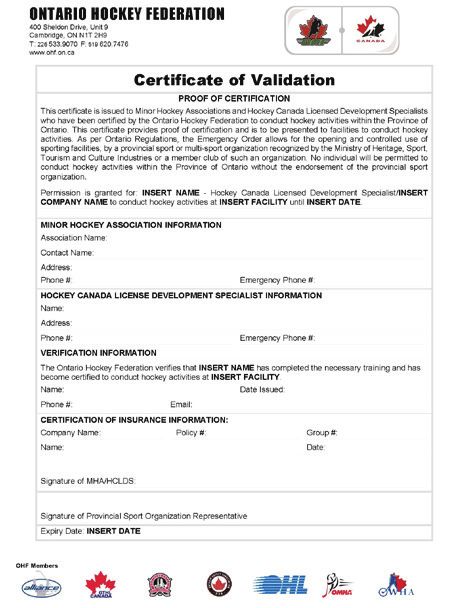
b. Certificate of Validation: This certificate is issued to Minor Hockey Associations and Hockey Canada
Skills Instructors who have been certified by the Ontario Hockey Federation to conduct hockey activities.
This certificate provides proof of certification and is to be presented to facilities to conduct hockey activi-
ties.
3. Upon receipt of the Certificate of Insurance and Certificate of Validation the Minor Hockey Association
must share the documentation with all coaches in their program that will be delivering programming during
Stage Two. It is the coach’s responsibility to maintain these documents and present it immediately upon
request at a facility during scheduled programming.
How do Minor Hockey Associations Gain Approval to Deliver Programming with Hockey Cana-
da Licensed Development Specialists?
A Minor Hockey Association may gain approval to deliver programming led by a Hockey Canada Licensed De-
velopment Specialist subject to the following procedure:
1. MHA makes application to the appropriate Member (ALLIANCE, GTHL, NOHA, OHA, OHL, OMHA,
OWHA) clearly identifying participants and the Hockey Canada Licensed Development Specialist. The Mem-
ber will validate all participants and the Hockey Canada Licensed Development Specialist are eligible to
participate.
2. The Member will issue the following documentation to the MHA:
a. Certificate of Insurance: Each organization will be required to have a valid Certificate of Insurance pres-
ent with them for any hockey activities.
3. The Member will ensure the specified Hockey Canada Licensed Development Specialist is compliant with
the OHF Hockey Canada Licensed Skill Development Program Policy by ensuring their Certificate of Valida-
20tion is current.
a. Certificate of Validation: This certificate is issued to Minor Hockey Associations and Hockey Canada
Skills Instructors who have been certified by the Ontario Hockey Federation to conduct hockey activities.
This certificate provides proof of certification and is to be presented to facilities to conduct hockey activi-
ties.
4. Upon receipt of the Certificate of Insurance the Minor Hockey Association must share the documentation
with the HCLDS. It is the HCLDS’ responsibility to maintain the Certificate of Insurance and their Certificate
of Validation and present it immediately upon request at a facility during scheduled programming.
How do Hockey Canada Licensed Development Specialists Gain Approval to Deliver Program-
ming?
A Hockey Canada Licensed Development Specialist (HCLDS) gain approval to deliver programming subject to
the following procedure:
1. Duly signed (by OHF and HCLDS) one of the following agreements:
a. Hockey Canada Licensed Skill Development Program In Process License Agreement; OR
b. Hockey Canada Licensed Skill Development Program License Agreement
2. The OHF will issue the following documentation as approval:
a. Certificate of Insurance: Each HCLDS will be required to have a valid Certificate of Insurance present
with them for any hockey activities.
b. Certificate of Validation: This certificate is issued to Minor Hockey Associations and Hockey Canada
Skills Instructors who have been certified by the Ontario Hockey Federation to conduct hockey activities.
This certificate provides proof of certification and is to be presented to facilities to conduct hockey activi-
ties.
3. It is the responsibility of the HCLDS to be able to provide immediately, upon request by a facility or munici-
pality, both the Certificate of Insurance and Certificate of Validation of the HCLDS. A HCLDS that is unable to
present both documents upon request may be unable to deliver programming as scheduled.
For more information on the Hockey Canada Licensed Skill Development Program and to register – click here.
Additional Documents for Reference
Session Participation and Health Screening Tracking
Health Screening Questionnaire
21You can also read


