Risk Assessment Covid-19 Corporate Generic Template - Premises / Building related
←
→
Page content transcription
If your browser does not render page correctly, please read the page content below
Risk Assessment Covid-19
Corporate Generic Template – Premises / Building related
This example risk assessment template is not exhaustive and should be used a guide by Duty Holders / Principal Occupiers / Nominated Building Manager to support COVID-
19 risk management controls for each building you have responsibility for (as set out withing the Building Duty Holder List) to support safe occupation of the premises.

Note: This assessment is specific to the safe management of the premises / building and will support safe services to be delivered by controlling premises/building related
COVID-19 Risks. This assessment is required in addition to the Covid-19 Risk Assessments which are required to be completed for operational service areas.

You must ensure robust arrangements are in place to control the risks if adopting any part of this assessment for the buildings which you have nominated responsibility. It is
important this assessment and proposed action is consulted with your team. In addition, please ensure that this assessment is made available to service managers,
employees or their representatives on request. There may be a need to revise arrangements to meet a particular service or individual need. This would be based on a
discussion with the relevant service manger of the employee. Please record and highlight your additional risk control measures / adaptations you have made for your
individual buildings

Step 1: Identify the hazards. Step 2: Decide who might be harmed and how. Step 3: Evaluate the risks and decide on precautions. Step 4: Record your findings and
implement them. Step 5: Review your assessment periodically and where there have been significant changes or any learning from accidents / incidents or work-related ill
health. Risks should be reduced to as low as reasonably practicable.

When managing hazards and risks, the Hierarchy of Controls must be applied (working top down):

    •   Elimination
        The hazard, task or activity is physically removed or abandoned (e.g. avoiding contact with anyone with symptoms)
    •   Substitution
        Replace a material or process with a less hazardous one
    •   Engineering Controls
        Isolate staff, contractors, visitors, public from the hazard (demarcation, physical barriers)
    •   Administrative Controls
        Identify and implement procedures to maximise safe working (management of social distancing, hygiene protocols)
    •   Personal Protective Equipment (PPE)
        Only to be considered if measures above would be ineffective to control risks.

PPE Guidance: There are very few workplaces where additional PPE is required to protect from the risks of coronavirus. The main controls to protect people are through
social distancing, good hygiene (frequent cleaning and handwashing), ventilation, working in fixed teams or partnering, and not through the use of PPE. Supplies of PPE,
including face masks, should continue to be reserved for those who need PPE to protect against workplace risks, such as people exposed to dust and fume hazards as well
as healthcare workers.
If you have any COVID-19 PPE requirements, please discuss this with the Health and Safety team during the review of your Risk Assessment. Appendix 1 contains a PPE
template and a process for you to order PPE and building related items should they be needed.
Important note:
This risk assessment must be read and worked through in conjunction with current Government guidelines applicable to Working Safely During Coronavirus (COVID-19) and
other relevant industry specific guidance to include:
Covid-19 guidance for the safe use of council buildings
https://www.gov.uk/guidance/working-safely-during-coronavirus-covid-19
You must follow the councils Buildings COVID-19 Risk Assessment Process for approval of your Risk Assessment, which can be found here. Once your COVID-19 Risk
Assessment has been approved, it is your responsibility to review the Risk Assessment monthly or before if there is a significant change.
Managing the risks to employees in the clinically extremely vulnerable “shielded”/ clinically vulnerable groups or other vulnerable people will normally considered as part the
operational services’ COVID-19 risk assessments. Building Duty Holders / Principal Occupiers will need to consider making reasonable adjustments for employees (if
contacted by an individual’s manager), or service users who may be of increased risk of contracting COVID-19. This may include additional support to access and/or leave the
building safely e.g. if they have mobility or hearing or sight impairments etc, or to access soap dispensers and toilet facilities.
How to use:
There are mandatory fields (in black text) that are required to stay in your risk assessment. There are also fields that may or may not apply to your buildings (in grey text).
These grey sections may apply now or may apply in the future then the grey sections would have to be reviewed for possible inclusion at that time. Each greyed out point
must be fully considered and where applicable to your building, this would be demonstrated by turning the grey text into black text. It is expected that all relevant
suggested controls have been fully implemented where they apply to your work activity / service area. If a control is not relevant and does not apply, please leave it in place
as grey text.
Do not just copy this example, as that may not satisfy the law and may not protect your employees and visitors. You must think about specific hazards and controls relevant to
your buildings. At the bottom of most sections of the Risk Assessment, there is space under the heading ‘Please add any additional specific arrangements applicable to your
building’ for you to add items which are specific to your buildings.
Please ‘save as’ a copy of this template and apply it to your building. Refer back to the main template when carrying out any reviews of your risk assessment to ensure you
have considered any changes to COVID-19 related legislation and guidance.
To support managers prior to the development and completion of COVID-19 Risk Assessments, a COVID-19 Risk Assessment skills session should be
undertaken. To book yourself on Please click here.
Version 1.0
2Risk Assessment Covid-19
Premises / Building Park Active age centre Key Resultant Risk Rating
Please tick
Duty Holder / Principal Social Distancing to minimise High
Occupier potential spread of COVID-19
Site responsible manager Relationship Manager
Assessor(s) including Service Manager Hygiene protocols to minimise Medium
employee representative Relationship Manager potential spread of COVID-19
Date of assessment 03 August 2020 Additional considerations to Low (normal)
Nominated responsible 03 September 2020 manage and control risk
person monthly review
date
Risk rating to be applied following implementation of control measures. Select a risk rating to reflect the overall risk once control measures are in place. You are aiming to
ensure that the risk is as low as reasonably practicable (ALARP)
What further Actions Action
What are the Who may be harmed and Date
What are you already doing? action is by by
hazards? how? (risk) Completed
necessary? whom? when?
1. Staff, contractors, service
Minimising the users, visitors, public,
risk of
coronavirus The council is making every reasonable effort to enable working
Possible transmission of the from home as a first option. Where working from home is not
transmission
virus from person to person possible, the council will make every reasonable effort to comply
and into the wider with the social distancing guidelines set out by the government
community. (2m, or 1m with risk mitigation where 2m is not viable)
People can catch the virus
from others who are infected If staff choose to wear face coverings at work, this position is
in the following ways: supported by the council. Face coverings are not classed as
• the virus moves from PPE. They are not manufactured to a standard and don’t provide
person-to-person in a proven level of protection for work risks such as dust and
droplets from the nose or spray in an industrial context. It is important to use face
mouth spread when a coverings properly and wash your hands before putting them on
person with the virus and taking them off. Instructions on wearing a face covering and
coughs or exhales making your own can be found here
• the virus can survive for up
to 72 hours out of the body
Version 1.0
3What further Actions Action
What are the Who may be harmed and Date
What are you already doing? action is by by
hazards? how? (risk) Completed
necessary? whom? when?
on surfaces which people In case of an outbreak (please see definitions below), contact
Covid-19 have coughed on, etc the local Public health team and PHE London Coronavirus
Outbreaks on • people can pick up the virus Response Cell (LCRC) as below: (For all settings)
site by breathing in the droplets
or by touching Contact Local PH team
contaminated surfaces and
then touching their eyes, They will
nose or mouth • Respond to your enquiries
• Exposure to the virus may • Give advice if there are suspected coronavirus cases (i.e.
result in mild or moderate before test result back)
symptoms (e.g. coughing, • Gives ongoing support to settings managing outbreaks
fever or change to your
sense of smell or taste) or Contact PHE (LCRC) on 0300 303 0450
more severe symptoms
include pneumonia in both They will
lungs which can lead to • Give initial advice when there is a person with confirmed
death coronavirus in a high-risk setting
• Want organisations to notify them of all confirmed (test
positive) cases in high risk local settings (Notifications to be
made via LCRC@phe.gov.ukWhat further Actions Action
What are the Who may be harmed and Date
What are you already doing? action is by by
hazards? how? (risk) Completed
necessary? whom? when?
Where settings are observing guidance on COVID-19: infection
prevention and control (IPC) , which will reduce risk of
transmission, closure of the whole setting will not generally be
necessary.
Outbreak definition as follows. COVID-19 Cluster and Outbreak
Definitions.
Cluster definition:
Two or more confirmed cases of COVID-19 employees in a
building within 14 days
OR
Increase in the background rate of absence due to suspected or
confirmed cases of COVID-19 (does not include absence rate due
to individuals shielding or self-isolating as contacts of cases).
Outbreak definition:
Two or more confirmed cases of COVID-19 among employees
who are direct close contacts, proximity contacts or in the same
cohort/team in the building within 14 days.
*a cohort might be a team or a group within the setting who sit
and work together. This definition aims to distinguish between
transmission occurring in the community verses transmission
occurring within the setting.
2. Staff, contractors, service This guidance applies to buildings that provides an on-site
users, visitors, public, service and to any events that take place on its premises.
Contacting
Tracing (Risk - As set out in section By maintaining records of staff, customers and visitors for 21
1) days, and sharing these with NHS Test and Trace where
requested, you can help identify people who may have been
The opening up of the exposed to the virus. Containing outbreaks early is crucial to
economy following the reduce the spread of COVID-19, protect the NHS and social
COVID-19 outbreak is being care sector, and save lives.
Version 1.0
5What further Actions Action
What are the Who may be harmed and Date
What are you already doing? action is by by
hazards? how? (risk) Completed
necessary? whom? when?
supported by NHS Test and
Trace. You should assist this Recording both arrival and departure times (or estimated
service by keeping a departure times) will help reduce the number of customers or
temporary record of your staff needing to be contacted by NHS Test and Trace. It is
visitors and or customers for recognised by the government, however, that recording
21 days, in a way that is departure times will not always be practicable. Set up an Excel
manageable for your spreadsheet to
business, and assist NHS The following information should be collected by the building capture information 15/082
Test and Trace with requests manager, where possible: required for track 020
for that data if needed. This and trace
could help contain clusters or purposes. Informati
Customers/Visitors
outbreaks. on to be deleted
after 21 days.
o customers and visitors (if unknown by the service i.e. not a
registered contact or service user where these details
would already be available)
o the name of the customer or visitor. If there is more than
one person, then you can record the name of the ‘lead
member’ of the group and the number of people in the
group
o a contact phone number for each customer or visitor, or for
the lead member of a group of people
o date of visit, arrival time and, where possible, departure
time
o if a customer will interact with only one member of staff, the
name of the assigned staff member should be recorded
alongside the name of the customer
Staff
Display LBBD
A record of staff who were ‘on site ‘would normally be available Protocol NHS
via standard operational practices, systems and protocols. Contact Tracing 15/08/
and Privacy Notice 2020
Information required by NHS track and Trace would consist of Test and Trace at
reception
o the names of staff who work at the premises
o a contact phone number for each member of staff
Version 1.0
6What further Actions Action
What are the Who may be harmed and Date
What are you already doing? action is by by
hazards? how? (risk) Completed
necessary? whom? when?
o the dates and times that staff are at work
Note: This information can be collated via staff rota’s and
additionally by contacting the council’s security team for access
control records.
o No additional data should be collected for this purpose.
o Data to be held securely and destroyed after 21 days.
To access Privacy Notice to be displayed at reception areas
and the protocol to be followed please click here Email staff
/partners regarding 15.08.
Although this is voluntary, please encourage customers and trace system and 20
visitors to share their details in order to support NHS Test and discus at team
Trace and advise them that this information will only be used meetings and 121s
where necessary to help stop the spread of COVID-19.
If a customer or visitor informs you that they do not want their
details shared for the purposes of NHS Test and Trace, they can
choose to opt out, and if they do so you should not share their
information used for booking purposes with NHS Test and
Trace.
The accuracy of the information provided will be the
responsibility of the individual who provides it. You do not have
to verify an individual’s identity for NHS Test and Trace
purposes.
• Confirmation that (where applicable) contact trace system in
place, staff informed of protocol to be followed.
Please add any additional specific arrangements applicable to
your building.
Version 1.0
7What further Actions Action
What are the Who may be harmed and Date
What are you already doing? action is by by
hazards? how? (risk) Completed
necessary? whom? when?
3. Staff, contractors, service
Pre-visit users, visitors, public,
Communication (Risk - As set out in section
strategy 1)
(communication Protocol in place and includes:
to Customers/ • Working safely during coronavirus COVID-19 offices-and- Ensure that regular Weekl
contractors/ contact-centres communication is y
visitors etc) • Communication arrangements in place to ensure both staff maintained with all
and visitors who feel unwell stay at home and do not attend staff, partners,
the premises. service providers
• Encouraging visits via remote connection/working where this and public with an
is an option. emphasis on
• Contractors provide assurance that they are operating a providing guidance
COVID-19 Secure service on changes to
• Informing visitors that they should be prepared to remove opening hours,
face coverings if asked to do so by police officers and staff access to services,
for the purposes of identification. work practices and
• Provision of guidance on social distancing and hygiene to review all
people on arrival, for example, signage or visual aids and information weekly
before arrival, for example, by phone, on the website or by
email. Consider the particular needs of those with protected
characteristics, such as those who are hearing or visually
impaired.
• Agreed arrangements for council services reoccupation with
service managers – (number of staff proposed to be present
at any one time and agreed to ensure safe occupancy levels
/ welfare arrangements)
• Sanitisation / social distancing protocols to be observed
when onsite
• Limiting visitor times to a specific time window and restricting
access to required visitors only.
• Determine if schedules for essential services and contractor
visits can be revised to reduce interaction and overlap
between people, for example, carrying out services at night.
• Staff /Customers / contractors advised to follow guidance
below:
COVID-19: guidance for households with possible coronavirus
infection guidance
Version 1.0
8What further Actions Action
What are the Who may be harmed and Date
What are you already doing? action is by by
hazards? how? (risk) Completed
necessary? whom? when?
• Increased frequency of surface cleaning arrangements in
place
• Increased frequency of handwashing/sanitiser to maintain
personal hygiene.
• Contents of risk assessment shared with staff and
contractors
Please add any additional specific arrangements applicable to
your building.
4. Staff, contractors, service
Reoccupation of users, visitors, public,
operational • Visual inspection of the work area that you are going to
buildings - areas Due to some or all parts of occupy/ responsible for premises to identify and remedy
which have not the premises not being used health and safety hazards, particularly in any areas that may
been in use / full for a period of time, have been non-occupied due to lockdown
use during inspection and testing of • Building services maintained in accordance with the LBBD
lockdown period building services and safety ‘Duty Holder Support Pack’ including:
devices to ensure they are in • Maintenance checks of plant and equipment undertaken –
full working order is required. including kitchen equipment.
• Fire alarms and systems checked and operational including:
o Fire alarm panel status green
o Fire call points operational
o Emergency lighting operational
o Firefighting measures e.g. fire extinguishers, blankets all
present and maintained
• Gas systems maintained
• Water flushing of little used outlets undertaken to minimise
risk of legionella and checks/maintenance undertaken/up to
date on hot and cold-water systems (and pools) in
accordance with Legionella water risk assessment. Every tap
(hot and cold) should be run for minimum of 2 minutes in all
Version 1.0
9What further Actions Action
What are the Who may be harmed and Date
What are you already doing? action is by by
hazards? how? (risk) Completed
necessary? whom? when?
areas of the premises which have not been used during Annual PAT testing 29.08.
lockdown period requested. Ensure 20
• Electrical equipment and systems maintained takes place
• Electrical gate systems maintained
• Lifts and lifting equipment/hoists maintained
• Ventilation / air conditioning / extraction systems maintained
if using a central ventilation system that removes and
circulates airs to different rooms, it is recommended that you
turn of re-circulation and use a fresh air supply
• Asbestos management arrangements in place
• Boiler room plant inspected / maintained
• Identify and remedy possible vermin infestations
Confirmation that safe arrangement are in place with any shared
landlord/ Duty Holders of a premises must be confirmed.
Building checks have been carried out on a weekly basis during
lockdown. Pest control have been carrying out checks and
asbestos check has been done.
Please add any additional specific arrangements applicable to
your service / work setting.
5. Staff, contractors, service
On entry to users, visitors, public,
buildings
(Risk - As set out in section Measures taken to control COVID-19 are accessible to all staff
1) and visitors including people with disabilities. E.g. hand washing Sanitiser stations to
/ sanitiser stations are accessible to wheelchair users, notices be set up and
are read to visually impaired people where identified or upon ensure they are 15/08/
request. accessible 2020
Use simple, clear messaging to explain guidelines using images
and clear language, with consideration of groups for which
English may not be their first language and those with protected Put up posters and 15/08/
characteristics such as visual impairments. messages using 2020
clear messaging
Version 1.0
10What further Actions Action
What are the Who may be harmed and Date
What are you already doing? action is by by
hazards? how? (risk) Completed
necessary? whom? when?
Notices for display can be found under ‘Resources’.
https://lbbd.sharepoint.com/sites/IntTp/HR/Pages/Risk-
Assessment---COVID-19-.aspx
(Managers are responsible for ensuring safety information is
explained and understood to their relevant team members where
a need is identified)
Notice to be 15/08/
• Notices displayed advising visitors should not enter the displayed on the 2020
building if they have symptoms of COVID-19 front door advising
• Informing visitors that they should be prepared to remove visitors not to enter
face coverings if asked to do so by police officers and staff if they have Covid
for the purposes of identification. Symptoms
• Pictorial social distancing notices displayed at all entry points Social distancing 15/08/
to the building (including disabled access entry points) posters to be 2020
• 2-meter demarcation on building entry approaches reviewed
• Staggered start times
• Controlled entry to building / Limiting the number of visitors
at any one time.
• Supervising of entry to building to follow social distancing
guidelines
• Established host responsibilities relating to COVID-19 and
providing any necessary training for people who act as hosts
for visitors.
• Revised entry and exit routes for staff, visitors and
contractors to minimise contact with other people. Entrance
via main door and exit via hall fire escape
• Provision of additional parking or facilities such as bike racks
to help people walk, run, or cycle to work where possible. Create and display
• Members of Public required to wear face covering prior to signage advising 15/08/
entry to building as from 8.8.2020. public of change in 2020
policy and ensure
• Notice to be displayed
information is
• Non-compliance reasonable steps to be taken to encourage
shared with all staff
compliance (clear signage to be displayed)
especially external
Version 1.0
11What further Actions Action
What are the Who may be harmed and Date
What are you already doing? action is by by
hazards? how? (risk) Completed
necessary? whom? when?
Requirement for face coverings guidance, including exemptions Partners and
in link below Service Providers
https://www.gov.uk/government/publications/face-coverings- as well as Security
when-to-wear-one-and-how-to-make-your-own/face-coverings- Contractors.
when-to-wear-one-and-how-to-make-your-own Update violence &
aggression RA and
circulate to all staff
and ensure
Security are
familiar with
incident escalation
procedure
• Hand sanitiser stations located at entry points to the building Set up hand 15/08/
• Hand washing / sanitisation stations (ideally soap and water sanitiser stations 2020
to minimises possible adverse dermatological effects) at
point of entry to building. All people entering the building Display signs
must sanitise hands prior to entry. (20 seconds minimum asking visitors to
recommended) sanitise hands on 15/08/
• Enhance cleaning frequency of regular touched items entry at reception 2020
including handles on doors, rails, dispensers and water
coolers Pre-order PPE so
• Maintaining use of security access devices, such as keypads always in stock
or passes, and adjusting processes at entry/exit points to
reduce risk of transmission. For example, cleaning pass
readers regularly and asking staff to hold their passes next to
pass readers rather than touching them.
Please add any additional specific arrangements applicable to
your building.
Version 1.0
12What further Actions Action
What are the Who may be harmed and Date
What are you already doing? action is by by
hazards? how? (risk) Completed
necessary? whom? when?
6. Staff, contractors, service
Reception areas users, visitors, public,
(Risk - As set out in section • Telephone appointments/emails to office where possible to
1) minimise face to face contact
• Screens fitted to reception area desks
• Workstation set up to allow social distancing of staff
• Notices displayed advising visitors should not enter the
building if they have symptoms of COVID-19
Consider the need 15/09/
• Demarcation to maintain safe distancing 2 metre floor for demarcation 2020
markings, including for possible queues when services start
• spacing of desks, back
• Activity / interactions with customers kept as short as 15/08/
possible Notices to be 2020
• Pictorial social distancing notices displayed at all entry points reviewed and
to the building (including disabled access entry points) checked
• 2-meter demarcation on building entry approaches
• One-way flow system at entry and exit points.
• Controlled / staggered entry to building
• Additional entrances available to minimise congestion at
peak times
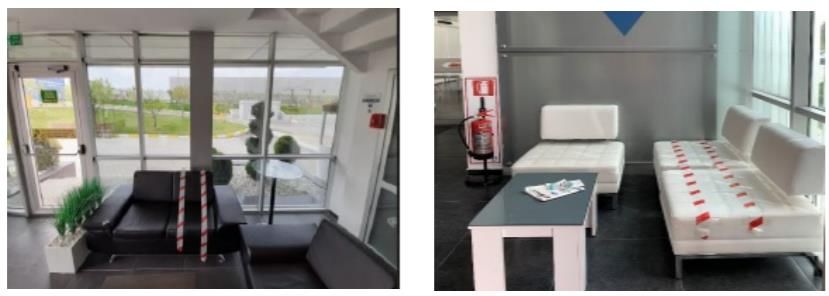
• Seating areas revised to ensure 2m social distancing
• Supervising of entry to building to follow social
distancing guidelines
Display signs 15/08/
• Provision of hand washing stations (ideally soap and water at asking visitors to 2020
point of entry to building. If not practicable hand sanitiser to sanitise hands on
be used (next bullet point) entry at reception
• Provision of hand sanitiser stations located at entry / exit
points to the building
• Notice displayed to sanitise hands
• Increased natural ventilation where practicable
Version 1.0
13What further Actions Action
What are the Who may be harmed and Date
What are you already doing? action is by by
hazards? how? (risk) Completed
necessary? whom? when?
• Enhance cleaning frequency of regularly touched items Pre-order PPE so 15/08/
including handles on doors, rails, dispensers, and water always in stock 2020
coolers, IT equipment, pens, telephones
• Sharing of items discouraged for example avoiding sharing
pens, documents, and other objects.
• Shared items to be wiped/sanitised prior to next use
• Catch it, bin it, kill it posters displayed
• Staff provided with guidance on hygiene protocols to
eliminate cross-infection risks.
• Staff to use PPE (gloves) when handling deliveries.
• Items to be sanitised via antibacterial wipes/spray prior to
delivery to staff
• Staff cleaning would be in line with:
• Working-safely-during-covid-19/offices-and-contact-centres
offices
• Provision of closed top bins available for disposal of face
coverings and other PPE which may be worn. Face Notice to be added
coverings are not recyclable at present and should not be to bins advising this 15/08/
placed in recycle bins. Further guidance can be found here is where to dispose 2020
• https://www.gov.uk/guidance/coronavirus-covid-19- of face masks and
disposing-of-waste PPE
Please add any additional specific arrangements applicable to
your building.
7. Staff, contractors, service
Lifts users, visitors, public,
• Buildings procedure in place for control of access/egress and
(Risk - As set out in section use of lifts Advise partners
1) • Working patterns amended, reducing the number of people using building by 15/08/
on site and the numbers needing to use a lift at any one time. sharing risk 2020
• Staggered entry / exit times assessment
• Demarcation to allow social distancing on access/egress Display sign to 15/08/
avoid lift and only 2020
Version 1.0
14What further Actions Action
What are the Who may be harmed and Date
What are you already doing? action is by by
hazards? how? (risk) Completed
necessary? whom? when?
• Notice displayed to avoid lift use where possible - people one person at a
who are able are encouraged to use the stairs. time
• Reduced maximum occupancy - disabled people given
priority.
• Single person travel, if the risk assessment identifies that
only one person at a time can use the lift.
• Where it is identified in the risk assessment that a lift can
carry more than one person, passengers using lift must face
the sides of the lift car with their backs towards other
passengers.
• Demarcation in lifts in line with guidance/working-safely-
during-coronavirus-covid-19/offices-and-contact-
centres#offices-3-2
Example images – if risk assessment identifies single travel is
not possible / practical
• Increased hygiene protocols introduced, to include regular
cleaning and sanitation of lift controls and the passenger car 15/08/
and placing hand sanitiser near lift controls/push buttons with Sanitiser and sign 2020
signs encouraging staff to use it. placed near lift
• Hand Sanitiser stations located by lift call points
• Catch it, bin it, kill it posters displayed
Please add any additional specific arrangements applicable to
your building.
Version 1.0
15What further Actions Action
What are the Who may be harmed and Date
What are you already doing? action is by by
hazards? how? (risk) Completed
necessary? whom? when?
8. Staff, contractors, service
Stairs users, visitors, public,
(Risk - As set out in section • Managing use of high traffic areas to maintain social Display sign to give 15/08/
1) distancing. For example, asking staff and visitors to walk on way to people 2020
the left, to give priority to those ascending stairs, or indicating ascending stairs
‘passing points’ where the walkway is widest.
• Demarcation to maintain 2-meter safe distancing in place
• Signs to instruct people to ‘stay left’ (direction of travel)
displayed
• Pictorial social distancing notices displayed in stairwells on
each level
Display signs to be
• Staggered start times. put up/ 15/08/
• Catch it, Bin it, kill it notices displayed 2020
• Hand sanitiser stations located at entry points to the building Hand sanitiser to 15/08/
• Enhance cleaning frequency of regular touched items be located at entry 2020
including handles on doors, rails, access controls point
• Windows open to increase natural ventilation where
practicable
Please add any additional specific arrangements applicable to
your building.
9. Staff, contractors, service
Corridors users, visitors, public,
(Risk - As set out in section • Managing use of high traffic areas to maintain social
1) distancing. For example, asking staff and visitors to walk on
the left, to give priority to those ascending stairs, or indicating
‘passing points’ where the walkway is widest.
• Demarcation to maintain 2-meter safe distancing in place
Version 1.0
16What further Actions Action
What are the Who may be harmed and Date
What are you already doing? action is by by
hazards? how? (risk) Completed
necessary? whom? when?
• Pictorial social distancing notices displayed Notices to be
• Signs to instruct people to ‘stay left’ (direction of travel) reviewed and 15/08/
displayed checked 2020
• Staggered start times
• Pinch points in corridors and stairs, consider:
o Allowing only essential trips within buildings/ sites, to
maintain social distancing as much as possible. By
limiting the number of staff moving around you are
also reducing the number of people in high traffic
areas including corridors and stairs.
o If possible, arrange one-way systems with arrows on
the floor to prevent crossing in narrow spaces and
ensure all staff know to make space for each other.
• Non fire doors / security propped open to minimise surface
contact
• Low use of building as partners using the site for services
and will have their own risk assessments in place
Hand sanitiser to
• Hand sanitiser stations located in corridors be placed in 15/08/
• Enhance cleaning frequency of regular touched items corridor 2020
including handles on doors, rails, access control buttons
• Catch it, bin it, kill it posters displayed
• Windows open to increase natural ventilation where
practicable
Please add any additional specific arrangements applicable to
your building.
Version 1.0
17What further Actions Action
What are the Who may be harmed and Date
What are you already doing? action is by by
hazards? how? (risk) Completed
necessary? whom? when?
10. Staff, contractors, service
Communal users, visitors, public,
Areas
(Risk - As set out in section • Working collaboratively with landlords and other tenants in
N/A for Park 1) multi-tenant sites/buildings to ensure consistency across
centre common areas, for example, receptions, staircases (where
applicable)
• Demarcation to maintain 2-meter safe distancing in place
• Pictorial social distancing notices displayed
• Staggered break times
• Additional space created by using other parts of the
building that have been freed up by remote working.
• Reconfiguring seating and tables to maintain spacing and
reduce face-to-face interactions.
• Staggering break times to reduce pressure on the staff
break rooms or places to eat and ensuring social distancing
is maintained in staff break rooms.
• Encouraging staff to remain on-site and, when not possible,
maintaining social distancing while off-site.
• Encouraging storage of personal items and clothing in
personal storage spaces, for example, lockers and during
shifts.
• Using safe outside areas for breaks.
Common areas and appropriate signage to restrict access when
social distancing is not possible / practical
Example within working safely during- ovid-19 offices and contact centres
Version 1.0
18What further Actions Action
What are the Who may be harmed and Date
What are you already doing? action is by by
hazards? how? (risk) Completed
necessary? whom? when?
• Hand sanitiser stations located in corridors
• Enhance cleaning frequency of regular touched items
including handles on doors, rails, tables etc
• Windows open to increase natural ventilation where
practicable
• Catch it, Bin it, kill it notices displayed
• Non fire / security doors propped open to minimise
touching of surfaces
• Provision of closed top bins available for disposal of face
coverings and other PPE which may be worn. Face
coverings are not recyclable at present and should not be
placed in recycle bins. Further guidance can be found here
https://www.gov.uk/guidance/coronavirus-covid-19-disposing-of-
waste
Please add any additional specific arrangements applicable to
your building.
11. Staff, contractors, service
General office users, visitors, public,
space /
Workstations / (Risk - As set out in section • Assessment undertaken to determine social distanced Signs displayed 15/08/
desks 1) capacity outside rooms of 2020
Version 1.0
19What further Actions Action
What are the Who may be harmed and Date
What are you already doing? action is by by
hazards? how? (risk) Completed
necessary? whom? when?
• Demarcation to maintain 2-meter safe distancing in place maximum people in
• Reconfiguring seating and desks to maintain spacing room.
avoiding people working face-to-face – instead, work side-
by-side or back-to-back Downstairs
• Pictorial social distancing notices displayed reception office -2
• Only where it is not possible to move workstations / create people.
distancing 2 metres apart:
o Assigning one person per work area Upstairs large office
o Reducing the number of people in the work area so -4
that 2m distancing can be achieved avoiding people
working face-to-face – instead, work side-by-side or Upstairs small
back-to-back office -1
• Use of screens to create a physical barrier between people
where 2m cannot be achieved Downstairs
• You should also limit the amount of contact between different reception office -2
workers by assigning and keeping people in shift teams
(sometimes known as a cohort). This means that the same
people work within the same team, on the same shift.
• Telephone appointments/emails to office where possible to
minimise face to face contact
• Meetings where possible via Skype / Teams
• Workstations assigned to an individual and not shared. If
they need to be shared, they should be shared by the
smallest possible number of people and cleaned prior to next
use
• Staggering break times to reduce pressure on the staff break
rooms or places to eat and ensuring social distancing is
maintained in staff break rooms.
• Encouraging storage of personal items and clothing in
personal storage spaces, for example, lockers and during
shifts.
• Using safe outside areas for breaks.
Example within working safely during- ovid-19 offices and contact centres
Version 1.0
20What further Actions Action
What are the Who may be harmed and Date
What are you already doing? action is by by
hazards? how? (risk) Completed
necessary? whom? when?
• Increased cleaning frequency of hard surfaces and regularly
touched items including handles on doors, rails, dispensers,
and water coolers/ emptying of bins
• in line with COVID-19: cleaning of non-healthcare settings
guidance
• Additional day time cleaning arrangements put in place
• Provision of hand washing stations (ideally soap and water at
point of entry to building. If not practicable hand sanitiser to
be used (next bullet point)
• Provision of hand sanitiser stations located at entry / exit
points to the building
• Notice displayed to sanitise hands
• Increased natural ventilation where prcticable Pre-order PPE so On-
• Staff provided with antibacterial wipes to clean IT equipment, always in stock going
telephones prior to use
• Items to be sanitised before sharing (including PCs) / re-use
Remove crockery
by another person
and cutlery from ongoin
• Staff to use own cups / for drinks
kitchen and inform g
• Sharing of items discouraged for example avoiding sharing
staff/partners to use
pens, documents, and other objects.
their own
• Shared items to be wiped/sanitised prior to next use
• Catch it, bin it, kill it posters displayed
Version 1.0
21What further Actions Action
What are the Who may be harmed and Date
What are you already doing? action is by by
hazards? how? (risk) Completed
necessary? whom? when?
• Adequate tissues are available to clear up spills and to catch Order 4 closed top
sneezes in line with Catch it / Bin it / Kill lit advice bins
• Provision of closed top bins available for disposal of face
coverings and other PPE which may be worn. Face
coverings are not recyclable at present and should not be
placed in recycle bins. Further guidance can be found here
https://www.gov.uk/guidance/coronavirus-covid-19-disposing-of-
waste
Please add any additional specific arrangements applicable to
your building.
12 Staff, contractors, service
Multi-Functional users, visitors, public,
Devices
(Risk - As set out in section • Demarcation around user space / queuing lines
1)
• Wipes available to wipe down touch screen before and after Keep wipes near 15/08/
use. MFD with sign 2020
• Increased cleaning frequency of device in line with enhanced asking people to
frequency of regular touched items in the building clean
• Less people in the centre so less use of MFD
13. Staff, visitors, contactors,
Kitchens public, resident or building
occupants • Determine food / drink / refreshments provision for the site/
location i.e. bringing in own food only, use of on-site Downstairs Kitchen
(Risk - As set out in section provision, supply of drinks, use of appliances, if applicable. will not be used and
1) if hirers use they
will have own risk
assessment in
place
• Demarcation to maintain 2-meter safe distancing in place 15/08/
• Pictorial social distancing notices displayed 2020
Version 1.0
22What further Actions Action
What are the Who may be harmed and Date
What are you already doing? action is by by
hazards? how? (risk) Completed
necessary? whom? when?
• Additional space created by using other parts of the building Posters to be
that have been freed up by remote working. reviewed and
• Reconfigured seating and tables to maintain spacing and displayed
reduce face-to-face interactions
Example within working safely during- ovid-19 offices and contact centres
• Hand washing /hand sanitising facilities available
Pre-order PPE so On-
• Enhanced cleaning frequency of hard surfaces and regular
always in stock going
touched items including handles on doors, rails, appliances,
water dispensers
• Provision of anti-bacterial spray / wipes for Items to be Remove crockery
sanitised before use by another person and cutlery from 07.08.
• Staff to use own cups for drinks kitchen and inform 20
• Provision of communal cutlery, crockery and glassware staff/partners to use
removed their own
• Hand washing poster displayed
• Catch it, kill it, Bin it poster displayed
• Windows open to increase natural ventilation where
practicable All posters to be 15/08/
• Staff encouraged to bring their own food. reviewed 2020
• Staggering break times to reduce pressure on the staff break
rooms or places to eat and ensuring social distancing is
maintained in staff break rooms
Version 1.0
23What further Actions Action
What are the Who may be harmed and Date
What are you already doing? action is by by
hazards? how? (risk) Completed
necessary? whom? when?
Please add any additional specific arrangements applicable to
your building.
14. Staff, visitors, contactors,
Toilets public, resident or building
occupants
Using signs and posters to build awareness of good
(Risk - As set out in section handwashing technique, the need to increase handwashing
1) frequency and to avoid touching your face, and to cough or
sneeze into a tissue which is binned safely, or into your arm if a
tissue is not available.
Tempreature of wash hand basin hot water mixertaps regulated
to ensure tolerable/comfortable tempreature for use.
Posters to be 15/08/
• Pictorial social distancing notices displayed added 2020
• Notice to includes information to queue outside not inside
the toilets.
• Social distancing marking in areas where queues normally
form
• In larger WC facilites (i.e. with no small corrdors) removial
of access to every other urinal or hand basin through use of
tape or signage or other mechanism.
• Smaller/confined WC areas (i.e. where narrow corridor Display notice
entry or pinch points are present) limited entry approach saying only one 15/08/
system, one in, one out) utilising accessible locking device person in toilet and 20200
on main door). queue outside
Version 1.0
24What further Actions Action
What are the Who may be harmed and Date
What are you already doing? action is by by
hazards? how? (risk) Completed
necessary? whom? when?
• Hand Sanitiser provided at entry point to toiletes Hand sanitiser to 15/08/
• Provision of handwashing basins be provided 2020
• Enhanced cleaning frequency of hard surfaces and
regular touched items including handles doors, rails, taps
etc
• Daily checks for replenishing soap for handwashing
• Visible cleaning schedule displayed and kept up to date
• Disposable towels / hand dryers provided.
• Frequent collection of paper towels and other waste.
• No re-useable towels
• Provision of anti-bacterial spray / wipes / gel for Items to
be sanitised before use by another person
• Hand washing poster displayed
• Catch it, Bin it, kill it posters displayed
• Windows open to increase natural ventilation where
practicable
• Non fire doors propped open to increase natural
ventilation where practicable
Please add any additional specific arrangements applicable to
your building.
15. Staff, visitors, contactors,
Meeting Rooms public, resident or building
and hall occupants • Using remote working tools to avoid in-person meetings.
• Only necessary participants should physically attend Signs displayed 31.07.
(Risk - As set out in section meetings and should maintain social distancing (2m) outside rooms of 20
1) • Avoiding transmission during meetings, for example maximum people in
avoiding sharing pens, documents, and other objects. room
• For areas where necessary face to face meetings take
place, using floor signage and reduced seating capacity to
help people maintain social distancing. As more people
• Staff at community food club wear visors and residents return to work
come to collect food on an appointment only basis and do information will be On-
not enter the building sent out to wider going
teams about
• Restrict the number of persons able to attend the offices/
maximum
consider booking system / site to maintain social distancing
occupancy of each
area and booking
Version 1.0
25What further Actions Action
What are the Who may be harmed and Date
What are you already doing? action is by by
hazards? how? (risk) Completed
necessary? whom? when?
guidelines – Signage is being displayed showing the requirements if
maximum occupancy of each office/room and pod. necessary.
• Reducing the number of people each person has contact
with by using ‘fixed teams or partnering’ (so each person
works with only a few others).
Ensure that we Ongoi
have up to date ng
• Provision or hand sanitiser / antibacterial wipes in meeting guidance is on
rooms. display and is
• Holding meetings in well-ventilated rooms whenever regularly checked
possible. against PHE
• Enhanced cleaning frequency of hard surfaces and regular guidance Ongoi
touched items including handles on doors / tables / IT ng
• Air conditioning considered in next section Pre-order PPE so
always in stock
Please add any additional specific arrangements applicable to
your building.
16. Staff, contractors, service
Air Conditioning users, visitors, public,
systems – no air • Ventilation / air conditioning / extraction systems maintained.
conditioning (Risk - As set out in section • If using a central ventilation system that removes and
system in the 1) circulates airs to different rooms, it is recommended that you
building. turn of re-circulation and use a fresh air supply
• HSE guidance on use of air conditioning systems followed
https://www.hse.gov.uk/coronavirus/equipment-and-
machinery/air-conditioning-and-ventilation
Please add any additional specific arrangements applicable to
your building.
17. Staff, contractors, service
Use of fans users, visitors, public,
Version 1.0
26What further Actions Action
What are the Who may be harmed and Date
What are you already doing? action is by by
hazards? how? (risk) Completed
necessary? whom? when?
(Risk - As set out in section Circulation of outside air can be considered to prevent pockets
1) of stagnant air in occupied spaces. You can do this by using
ceiling fans or desk fans for example, provided good ventilation
is maintained. The risk of transmission through the use of ceiling
and desk fans is extremely low. Source HSE
https://www.hse.gov.uk/coronavirus/equipment-and-
machinery/air-conditioning-and-ventilation.htm
Please add any additional specific arrangements applicable to
your building.
18. Staff, contractors, service
Changing rooms users, visitors, public,
and showers • Regulated use of locker rooms, changing areas and
(Risk - As set out in section other facility areas to reduce concurrent usage.
No changing 1)
rooms or
showers.
• Where shower and changing facilities are required,
setting clear use and cleaning guidance for showers,
lockers and changing rooms to ensure they are kept
clean and clear of personal items and social distancing
is achieved as much as possible.
Please add any additional specific arrangements applicable to
your building.
19. Staff, contractors, service
Post room / users, visitors, public,
deliveries
(Risk - As set out in section • Restriction of non-business deliveries, e.g. personal
Handling goods, 1) deliveries to staff
merchandise • Revised pick-up and drop-off collection points, procedures,
and other signage and markings.
materials, and Pre-order PPE so Ongoi
• Cleaning procedures for goods, merchandise and other and
onsite vehicles always in stock. ng
materials entering the site.
• Increased handwashing frequencies for staff handling goods
Version 1.0
27What further Actions Action
What are the Who may be harmed and Date
What are you already doing? action is by by
hazards? how? (risk) Completed
necessary? whom? when?
• handwashing facilities for staff handling goods and
merchandise and provision of hand sanitiser where this is not Staff working from 15/08/
practical. centre to be 2020
• Considering methods to reduce frequency of deliveries, for informed about
example by ordering larger quantities less often. protocols for
• Staff wear disposable gloves to handle deliveries handling deliveries
• Cleaning procedures for goods and merchandise entering
the site.
Please add any additional specific arrangements applicable to
your building.
20. Staff, contractors, service Cafes inside of council buildings are permitted to open but
Buildings with users, visitors, public, should take account of the guidance below in order to reopen
Cafes these functions safely when permitted:
(Risk - As set out in section
Not applicable 1) • COVID-19: Guidance for the safe use of multi-purpose
for this community facilities
building
Please add any additional specific arrangements applicable to
your building.
21. Staff, contractors, service
Someone users, visitors, public,
becomes unwell Protocol developed in line with Government Guidance to
(Risk - As set out in section include:
1)
• First-aid procedure and arrangements in place. Discuss in team On-
• If anyone becomes unwell with a new, continuous cough or a meetings and 121s going
high temperature loss of taste / smell across the service,
they must be sent home and advised to follow the COVID-
19: guidance for households with possible coronavirus Check first-aider 15/08/
infection guidance. always on site 2020
• If a person is awaiting collection, they should be moved, if
possible, to a room where they can be isolated behind a
closed door. Ideally, a window should be opened for
Version 1.0
28What further Actions Action
What are the Who may be harmed and Date
What are you already doing? action is by by
hazards? how? (risk) Completed
necessary? whom? when?
ventilation. If it is not possible to isolate them, move them to
an area which is at least 2 metres away from other people.
• If they need to go to the bathroom while waiting to be
collected, they should use a separate bathroom if possible.
The bathroom should be cleaned and disinfected using
standard cleaning products before being used by anyone
else.
• In an emergency, call 999 if they are seriously ill or injured or
their life is at risk. Do not visit the GP, pharmacy, urgent care
centre or a hospital.
• If a member of staff has helped someone who was unwell
with a new, continuous cough, a high temperature, loss of
taste or smell they do not need to go home unless they
develop symptoms themselves (and in which case, a test is
available) or the person subsequently tests positive (Close
contact generally refers to being within 2 metres for more
than 15 minutes).
• If you have been in close contact with someone who is being
tested for COVID-19, but they do not yet have a test result:
Current advice states that at this stage, you do not need to
self-isolate. You should take extra care in practising social
distancing and good hand and respiratory hygiene. Contacts
of people who have tested positive for COVID-19 infection
who need to self-isolate will be notified accordingly by the
NHS Test and Trace service. If you have not been notified,
this means you do not need to self-isolate.
• They should wash their hands thoroughly for 20 seconds
after any contact with someone who is unwell. Cleaning the
affected area with normal household disinfectant after
someone with symptoms has left will reduce the risk of
passing the infection on to other people. See COVID-19:
cleaning of non-healthcare settings guidance
• Staff cleaning would be in line with:
https://www.gov.uk/guidance/working-safely-during-
coronavirus-covid-19/offices-and-contact-centres#offices-5-2
Version 1.0
29What further Actions Action
What are the Who may be harmed and Date
What are you already doing? action is by by
hazards? how? (risk) Completed
necessary? whom? when?
To dispose of waste from people with symptoms of coronavirus,
such as disposable cleaning cloths, tissues, and PPE:
• put it in a plastic rubbish bag and tie it when full
• place the plastic bag in a second bin bag and tie it
• put it in a suitable and secure place marked for storage for
72 hours
• Waste to be stored safely and securely.
Please add any additional specific arrangements applicable to
your building.
22. Staff, contractors, visitors,
Park Centre Fire customers, public.
drills / • Upon discovery of an actual fire or other emergency,
Emergency immediate evacuation of the building in a safe and controlled
Smoke inhalation, exposure
situations manner will be essential. Evacuation is the priority, in this
to heat
circumstance social distancing may need to be relaxed to
enable quicker evacuation.
• Fire risk assessment and Emergency Evacuation Plans
revised for site to take into account possible COVID-19 Ensure fire warden 15/08/
restrictions and areas which may not be in use and changes always on site 2020
of use to the building.
• Personal Emergency Evacuation Plans (PEEPS) in place
and revised where necessary
• Adequate numbers of trained staff to safely evacuate all
personnel on the premises
• Demarcation of safe distancing in place at assembly points in
Ensure fire warden
line with social distancing guidelines (2 meters) where
follows social 15/08/
reasonably practicable (planned drills only). If not practicable
distancing protocols 2020
nominated person to monitor social distancing.
in case of an
evacuation
Version 1.0
30What further Actions Action
What are the Who may be harmed and Date
What are you already doing? action is by by
hazards? how? (risk) Completed
necessary? whom? when?
• Fire drill arrangements to be confirmed with landlord/ duty
holder/ occupant (where premises are shared)
• Ensure emergency evacuation routes out of the building are
not compromised including fire doors and final exit doors.
On return to building, occupants to sanitise hands/follow hygiene
protocols on re-entry
Please add any additional specific arrangements applicable to
your service / work setting.
23. Staff, contractors, visitors,
First Aid customers, public. • Adequate first aid provision in line with the services/ First aid box 15/08/
buildings first aid needs assessment. contents to be 2020
(Risk - as set out in section • First Aid Boxes kit requires additional supply of Disposable checked
Gloves, Disposable Aprons, Eye Protection Goggles/Face and replenished
1)
shield, Fluid Resistant Surgical Facemask, within new
• First aid boxes content checked, including for vehicles (fleet guidelines.
vehicles)
• Where closer contact may be necessary to administer first Ensure that first 15/08/
aid, wear appropriate PPE to protect First Aider and aiders have been 2020
casualty. This would include disposable gloves, disposable given the updated
apron and fluid resistant surgical facemask. Eye protection is advice
also required if the casualty is coughing, spitting, or vomiting
• For resuscitation - only deliver CPR by chest compressions
and use a defibrillator (if available) DON’T do rescue
breaths.
Pre-order PPE so 15/08/
• PPE / Handwashing protocols to be followed
always in stock. 2020
• Management and staff must read and follow manufactures
instructions on how to use PPE correctly. Guidance on PPE
and the correct fitting of face masks can be found here.
Contact the health and safety team if it is suspected that a staff
member at work has been diagnosed as having COVID-19
attributed to an occupational exposure to coronavirus.
Version 1.0
31You can also read


