Running or crossing? Children's expression of voluntary motion in English, German, and French
←
→
Page content transcription
If your browser does not render page correctly, please read the page content below
Journal of Child Language (2021), 1–24
        doi:10.1017/S0305000921000271

        ARTICLE

        Running or crossing? Children’s expression of
        voluntary motion in English, German, and French
        Henriëtte HENDRIKS1, Maya HICKMANN2†, and Carla PASTORINO-CAMPOS1
        1
         University of Cambridge, UK and 2CNRS & University Paris 8, France
        Corresponding author: E-mail: hpjmh2@cam.ac.uk

        (Received 20 February 2019; revised 11 December 2020; accepted 6 March 2021)

            Abstract
            Much research has focused on the expression of voluntary motion (Slobin, 2004; Talmy,
            2000). The present study contributes to this body of research by comparing how children
            (three to ten years) and adults narrated short, animated cartoons in English and German
            (SATELLITE-FRAMED languages) vs. French (VERB-FRAMED). The cartoons showed agents
            displacing themselves in variable Manners along different Paths (Path saliency and
            variance were specifically manipulated in four item types). Results show an increase
            with age across languages in how much information participants expressed. However,
            at all ages, more motion information was encoded in English and German than in
            French. Furthermore, language-specific features impacted the content and its
            organization within utterances in discourse, showing more variation within and across
            Path types in French than in the satellite-framed languages, resulting in later
            achievement of adult-like descriptions in this language. The discussion highlights the
            joint impact of cognitive and typological features on language development.

        Keywords: voluntary motion expression; typology of spatial language; child language development

        Introduction
        Imagine a scene where a girl crosses a street on rollerskates. Lexicalizing this information
        (Talmy, 1985) presents a classical linearization problem (Levelt, 1981): the event
        encompasses two simultaneous sub-events (crossing and rollerskating), and one is not
        obviously more important than the other. It is up to the speaker to decide whether and
        how to prioritize the sub-events, e.g., by mentioning only one or by ordering them. And
        although most languages allow speakers to linearize the information as they see fit, such
        orders are likely to have discourse implications, given that each language type has a
        preferred way of lexicalizing information. The present study explores this issue further by
        comparing how children (three to ten years) and adults express voluntary motion across
        three languages: English, German, and French. The aim is to determine the extent to
        which the development of motion expression is influenced by language-specific features
        and Path types (across, up, down) in addition to general cognitive factors.
            †
                Author passed away during the writing of this article.
        © The Author(s), 2021. Published by Cambridge University Press. This is an Open Access article, distributed under the
        terms of the Creative Commons Attribution licence (http://creativecommons.org/licenses/by/4.0), which permits
        unrestricted re- use, distribution and reproduction, provided the original article is properly cited.

Downloaded from https://www.cambridge.org/core. IP address: 46.4.80.155, on 22 May 2021 at 01:56:38, subject to the
Cambridge Core terms of use, available at https://www.cambridge.org/core/terms. https://doi.org/10.1017/S0305000921000271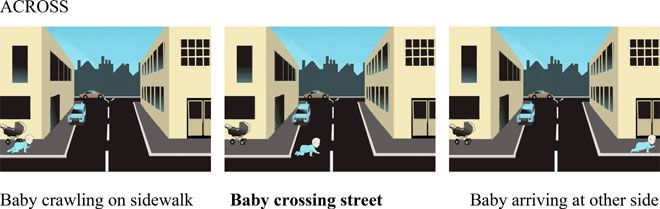
2       Henriëtte Hendriks et al.

             We first summarize language-specific means available for motion expression in the
          three languages, and indicate how this determines adult speakers’ preferred expression
          and children’s acquisition. We then present results from our cross-linguistic study
          examining participants’ elicited productions. The discussion highlights the role of
          three main factors explaining the results: general cognitive factors, accounting for
          common developmental progressions across languages; language-specific factors,
          accounting for differences across and within language types; and the influence of
          Path types that may or may not result in further variation of motion expression,
          thereby potentially complicating the acquisition task for the child.

          Motion across languages: typological features
          According to Talmy (2000), voluntary motion involves an entity (i.e., the Figure, e.g.,
          girl) moving with respect to another entity (i.e., the Ground, e.g., street), along a Path
          (i.e., across) and (optionally) a co-event, the Manner in which motion is carried out
          (e.g., rollerskating). A further possible co-event, Cause (the boy kicked the ball), was
          also identified by Talmy but is irrelevant for this study.
              Talmy (1985, 2000, 2012) identified several language types, including SATELLITE and
          VERB-FRAMED languages (hereafter S- AND V-LANGUAGES), which provide different
          lexicalization patterns for motion expression. S-languages (e.g., Germanic languages)
          typically express Manner in the main verb and Path in satellites such as particles
          (examples 1–2). In contrast, V-languages (e.g., Romance languages) lexicalize Path in
          the main verb and downplay Manner, either expressing it in the periphery or
          ignoring it altogether (example (3)).

              (1) The wallaby skipped [M] across [P] Sidney Harbor Bridge.
              (2) Eine Ameise krabbelte [M] aus [P] dem Ameisenhügel.
                  ‘An ant crawled out of the ant heap.’
              (3) Gertrud Ederle a traversé [P] la Manche (à la nage [M]).
                  ‘Gertrud Ederle crossed the English Channel (swimming).’
          This typological difference applies particularly to events that denote a
          ‘boundary-crossing’ (Aske, 1989; Özçalişkan, 2015; Slobin & Hoiting, 1994), i.e., a
          motion event involving a change of state (cf. examples (4) to (6)). It does not hold
          for motion events that lack a change of state, either because they take place within a
          general location (he is walking in the room) or because the intended goal of
          an event is not reached (he runs towards the school) (cf. Aske, 1989). In these cases,
          S- and V-languages (e.g., English (7) and French (8)) can both use Manner verbs.

              (4) The old man strolled [M] across [P] the road.
              (5) Das Mädchen ist über [P] die Strasse gehüpft [M].
                  ‘The girl skipped across the street.’
              (6) Le chat a traversé [P] la route en marchant lentement [M].
                  ‘The cat crossed the road by walking slowly.’
              (7) A seal was swimming [M] in the estuary [Loc].
              (8) Le pingouin glisse [M] sur la neige [Loc].
                  ‘The penguin is sliding on the snow.’

             Although these structures correspond to typical lexicalization patterns, they are not
          obligatory. In all languages, it is possible to use other means of expression depending on
Downloaded from https://www.cambridge.org/core. IP address: 46.4.80.155, on 22 May 2021 at 01:56:38, subject to the Cambridge Core terms
of use, available at https://www.cambridge.org/core/terms. https://doi.org/10.1017/S0305000921000271
Journal of Child Language                3

        factors such as the relative importance of Manner information in the discourse
        situation. For example, English (9) shows the lexicalization pattern that is most
        typical of S-languages, while (10) deviates from this pattern, lexicalizing Path in the
        verb and expressing Manner in the periphery. Similarly, French (11) shows the
        pattern most typical of V-languages, while (12) shows a different one (Manner verb
        with prepositional phrase expressing Path). However, the fact that the expression of
        boundary crossings ideally is differentiated from other motion events in French may
        well lead to more varied expressions overall in this language than in English and
        German.

             (9) The cat ran [M] away [P].
             (10) The cat left [P] with a leap [M].
             (11) Le chat est parti [P] (en courant [M]).
                  ‘The cat left (running).’
             (12) Le chat a couru [M] jusqu’en haut de l’arbre [P].
                  ‘The cat ran all the way to the top of the tree.’

        Influence of typology on adults’ preferred expression
        Slobin (1996, 2003) argues that when speakers want to lexicalize scenes such as those
        described in examples (1) to (12) above, they need to be aware of the linguistic devices
        that are available in their language. They can then prepare their conceptualization of
        the event to make it fit with said devices. Slobin (1996) calls this requirement to fit the
        conceptualization with the language spoken ‘thinking for speaking’.
            The last decades have witnessed multiple studies assessing the extent to which
        motion expression is indeed influenced by specific properties of the speakers’
        language (cf. Allen, Özyürek, Kita, Brown, Furman & Ishizuka, 2007; Berman &
        Slobin, 1994; Filipović, 2007; Hickmann, 2003; Hickmann, Taranne & Bonnet, 2009b;
        and Özçalişkan & Slobin, 1999, 2003). Most of these studies compared the
        lexicalization of motion in verb- versus satellite-framed languages, to measure inter-
        and intra-typological differences. All of them have found robust differences in
        lexicalization patterns across S- and V-languages: as expected, Path is mostly
        expressed by the verb in V-languages and by satellites in S-languages (Berman &
        Slobin, 1994; Filipović, 2007; Hickmann et al., 2009b; Özçalişkan & Slobin, 1999,
        2003); Manner is more frequently expressed in S-languages in more compact
        structures than in V-languages (Allen et al., 2007); and more information overall is
        expressed in S- than in V-languages (Hickmann et al., 2009b).
            However, further in-depth research has also brought to light differences within
        typological groups: Harr (2012) indicates that the lexicalization of motion
        information in German is more typical of S-languages than in English: German
        speakers are more systematic in how they distribute information (M in the verb, P in
        other devices), and their utterances encode more information than those of their
        English counterparts.
            Given these systematic differences within and across typological groups, one
        wonders when and how children learn these specific features of motion
        expression in their language. The next question asked therefore is: how early does
        children’s motion expression within and across clauses become adult-like and
        language-specific? The following section discusses some of the existing studies
        addressing this question.

Downloaded from https://www.cambridge.org/core. IP address: 46.4.80.155, on 22 May 2021 at 01:56:38, subject to the Cambridge Core terms
of use, available at https://www.cambridge.org/core/terms. https://doi.org/10.1017/S0305000921000271
4 Henriëtte Hendriks et al.
Motion expression across child languages
Many studies have focused on the development of motion expression in children (Allen
et al., 2007; Bowerman, 1996; Bowerman & Choi, 2001; Choi, 2011; Bunger, Trueswell
& Papafragou, 2012; Choi & Bowerman, 1991; Harr, 2012; Hickmann & Hendriks,
2010; Hickmann, Hendriks & Champaud, 2009a; Hickmann et al., 2009b; Ji,
Hendriks & Hickmann, 2011; Maguire, Hirsch-Pasek, Golinkoff, Imai, Haryu,
Vanegas, Okada, Pulverman & Sanchez-Davis, 2010; Naigles, Eisenberg, Kako,
Highter & McGraw, 1998; Özçalişkan & Slobin, 1999; Papafragou, Massey &
Gleitman, 2002; Slobin, 1996, 2004). They have shown two main results. First,
children observe cross-linguistic differences that follow from typological language
properties. From very early on (around age three), children’s motion descriptions
differ across languages and resemble those of adults in their language more than
those of same-aged children in other languages. Thus, from early on children’s
motion descriptions rely on the different structures available in the languages
acquired. Children learning S-languages express both Manner (in the verb) and Path
(in satellites) in compact one-clause structures (e.g., English run across). In contrast,
children learning V-languages may use Path verbs (e.g., French monter ‘to ascend’,
traverser ‘to cross’) whilst expressing Manner less frequently if at all (e.g., traverser
[en courant] ‘to cross [by running]’), or use Manner verbs whilst giving less
information about Path in the same clause.
Second, in all languages examined, children express more motion components
with increasing age. Thus, young children are more likely to encode either Manner
or Path, but not both (cf. Bunger et al., 2012). Notwithstanding a general increase
of Manner+Path responses with age, such utterances remain significantly more
frequent in S- than in V-languages. It has been proposed that this may be because
in the latter type languages speakers may need to rely on subordinate structures as
a way to add Manner to the periphery of Path verbs (e.g., monter/descendre en
courant ‘to ascend/descend by running’) (cf. Allen et al., 2007; Hickmann et al.,
2009b; Özçalişkan, 2015). In other words, the combination of Path and Manner in
V-languages cannot always be expressed in one clause, which might cause an
additional hurdle for young children. Existing studies have examined children at
different ages, but all agree that acquisition is likely to evolve well into primary
school years.
Few of the above studies, to our knowledge, have looked at the possible influence of
the described Path types on variation within and across languages1. Hickmann,
Hendriks, Harr and Bonnet (2018), however, showed that Path types can have such
an influence: they found that combining multiple types of semantic information
might be more challenging when referring to boundary-crossing events (across, into)
than when referring to events expressing vertical motion (up, down) and relate this
result to the fact that boundary-crossing involves a CATEGORICAL change of location,
more difficult to express than vertical motion which involves a GRADUAL change of
location.
The present study aims to shed further light on these issues, examining lexicalization
patterns in the expression of voluntary motion, using the same elicitation procedure in
seven age groups (three to ten years and adults) from three languages (English, German,
French). Special attention is given to the diversity of motion expressions across different
item types, with the items chosen to differ in Path saliency, and the availability or lack
1
Allen et al. (2007) controlled for Manner type (inherent or not) but did not oppose different Path types.
Downloaded from https://www.cambridge.org/core. IP address: 46.4.80.155, on 22 May 2021 at 01:56:38, subject to the Cambridge Core terms
of use, available at https://www.cambridge.org/core/terms. https://doi.org/10.1017/S0305000921000271Journal of Child Language 5
of a categorical boundary. To our knowledge, this is the largest and most complete study
based on elicitation materials specifically designed for the expression of voluntary
motion.
Aims and hypotheses
The aim of the present study is to determine the extent to which the development of
motion expression is influenced by general cognitive factors on the one hand and
language-specific factors and the specific information to be expressed on the other. If
general cognitive factors were more influential, one would expect younger children to
look more similar to each other than older children, who should look more like the
adult speakers of their languages. If, however, language specific influences are
stronger, children should at any point look more like the adult speakers of their
language. Finally, if specific items are shown to influence expression, then this could
create variability within as well as across languages.
A first set of analyses concerns (INFORMATION) LOCUS, which refers to the part of the
sentence where Path and other types of information are encoded (main verb vs. other
devices). Note that, in contrast to Talmy’s strict definition of satellites, our coding
included all devices other than the main verb. This allowed us to take into account
the full diversity of additional expressions of both Manner (with a bike, en marchant
‘walking’, la patineuse ‘the skater’, or sur les pattes arrières ‘on hindlegs’), and Path
(von einer Seite zum anderen ‘from one side to the other’). The second analysis
examines response DENSITY (the number of different semantic components expressing
the motion event).
We tested a number of hypotheses, partly based on previous findings as discussed
above. The hypotheses have guided the statistical analyses we present below.
Following on from the statistical analyses, we then attempted to explain how or why
we find the attested phenomena by adding more detailed qualitative analyses.
First, given the fact that Path is the framing event for all motion events (there
cannot be motion without Path), we expected Path expressions to be frequent and
little impacted by item type or language-specific factors. Second, we expected that
French speakers (V-language) should express Path in the verb, while speakers of
English and German (S-languages) should express Path in other devices. Third, we
expected children to show language-specific differences from early on, whilst also
continuing to become more like the native speakers with age. We used
qualitative analyses to look at the specific ages at which this change towards entirely
adult-like expression occurs, and if ages are similar across languages. Fourth, more
motion components should be expressed with increasing age in all languages. Note
however that, for the latter hypothesis, an interaction between age and language is
predicted, such that participants should produce more components in English and
German than in French, particularly among young children. Finally, item type was
expected to interact with the above factors (language, age) such that it should impact
the type and number of expressed components both in adult speakers as well as in
child data. In particular, and given the information provided in the items, we are
expecting CONTROL items to be least dense as only Manner is salient in these
items. We are furthermore expecting UP/DOWN items to be most dense (cf. Hickmann
et al., 2018), but again, the effect might differ depending on languages and age. Note
finally that we hypothesize that an attested variety across item types in the adult data
may introduce a level of noise making the acquisition task for the child more complex.
Downloaded from https://www.cambridge.org/core. IP address: 46.4.80.155, on 22 May 2021 at 01:56:38, subject to the Cambridge Core terms
of use, available at https://www.cambridge.org/core/terms. https://doi.org/10.1017/S03050009210002716 Henriëtte Hendriks et al.
Methodology
Participants
A total of 468 monolingual participants took part in the study (156 per language). They
belonged to seven age groups of approximately three, four, five, six, eight, ten years, and
adults (cf. Table 1). Each age group comprised 24 participants except for the groups of
three-year-olds (12 children per group).2 Children were tested in schools in the UK,
France and Germany. Adults were university students in those countries.
Stimuli
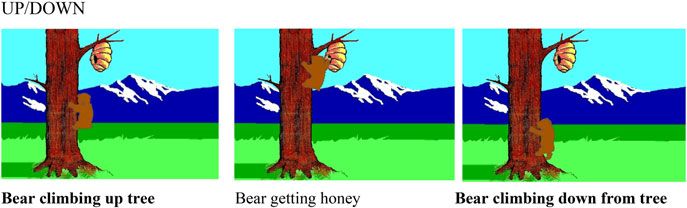
Stimuli were animated cartoons (8–10 seconds) showing a Figure, animal or human,
voluntarily performing a displacement. They represented four types of events: six
showed vertical motion (first UP, then DOWN), six boundary crossing (ACROSS), and
twelve only Manner against a grey background (CONTROL).
Test items (UP, DOWN, ACROSS) included three parts: a beginning (scene setting), a
middle part including the targeted information (TARGET motion event), and an
ending (Figure leaving scene). The target motion events were carefully controlled for
and provided a clear Path (as in the item names) combined with typical Manners
(crawling, climbing for animals, walking, cycling for humans). To make the cartoons
more varied and interesting, the beginning and end parts were less controlled for.
Analyses therefore focus on target motion events only. Appendix 1 summarizes all
items and highlights (in bold) the targeted events. Appendix 2 illustrates one UP and
DOWN item, an ACROSS item and a CONTROL item.
Contrary to many previous studies, this study included a set of 12 CONTROL items.
CONTROL items showed the same Figures as those in test items, but all background
entities were removed, thereby maximizing Manner and minimizing Path saliency
(cf. Appendix 2 mouse tiptoeing). The only potential Path information in these items
consisted of forward motion against a blank screen. These items allowed to ensure
that children knew the relevant Manner expressions in case they had not mentioned
them in their descriptions of target events. They further provided interesting
comparative material, as participants were free to construe a Path or to simply focus
on the Manner of motion.3
Procedure
Participants were tested individually. All participants saw all stimuli and were assigned
one of six random orders of item presentation (but equally distributed across genders).
Test items were always shown before control items.4 After each item, participants were
asked to narrate what had happened for someone who had not seen the cartoons.
2
The smaller sample at three years was due to difficulties in finding enough children in England and
Germany where few children go to school at three. It was decided to test smaller samples of 3-year-olds
but in similar experimental situations, rather than to increase numbers but in different situations (e.g.,
home).
3
We would like to thank one of our reviewers for pointing out that the fact that no information attracts
attention to Path in these items may well allow them to elicit the most natural encoding of motion events.
4
Previous results (Hickmann et al., 2009b) showed that the order in which test and control items were
presented affected some results, e.g., when control items were shown first, participants focused more on
Manner in French and more on Manner+Path in English.
Downloaded from https://www.cambridge.org/core. IP address: 46.4.80.155, on 22 May 2021 at 01:56:38, subject to the Cambridge Core terms
of use, available at https://www.cambridge.org/core/terms. https://doi.org/10.1017/S0305000921000271of use, available at https://www.cambridge.org/core/terms. https://doi.org/10.1017/S0305000921000271
Downloaded from https://www.cambridge.org/core. IP address: 46.4.80.155, on 22 May 2021 at 01:56:38, subject to the Cambridge Core terms
Table 1. Participants in the study
age 3 age 4 age 5 age 6 age 8 age 10 Adults
English mean 3;3 3;11 5;0 6;1 8;1 10;0 n.a.
range 2;11-3;6 3;6-4;5 4;6-5;5 5;10-6;5 7;6-8;9 9;6-10;6 n.a.
gender 7f/5m 12f/12m 12f/12m 12f/12m 12f/12m 12f/12m 12f/12m
N 12 24 24 24 24 24 24
German mean 3;5 4;5 5;5 6;1 8;6 10;7 n.a.
range 3;0-3;8 3;8-4;11 5;0-6;2 5;8-6;6 7;10-9;3 10;0-11;4 n.a.
gender 6f/6m 13f/11m 12f/12m 12f/12m 12f/12m 12f/12m 13f/11m
N 12 24 24 24 24 24 24
Journal of Child Language
French mean 3;2 4;5 5;3 6;4 8;6 10;3 n.a.
range 2;11-3;10 3;10-4;10 4;11-5;10 5;9-6;9 7;9-8;9 9;2-11;8 n.a.
gender 7f/5m 12f/12m 12f/12m 12f/12m 11f/13m 14f/10m 12f/12m
N 12 24 24 24 24 24 24
78 Henriëtte Hendriks et al.
Young children (three to five) were presented with a blindfolded doll and asked to tell
her what happened. Older children and adults were instructed to address a fictitious
naïve interlocutor.
All sessions started with a training item (a frog jumping into a pond). During this
item, the experimenter helped participants focus on different motion components
(“Okay, so what did the frog do?”). Hereafter, the experimenter did not intervene.
The entire session was audio-recorded, transcribed and coded.
Coding
All data were coded at the clausal level. A clause was defined as the expression of a proposition
minimally containing a verb, including inflected forms, infinitives and gerundives.
The analyses focus on the part of the response that described the target event
(hereafter ‘target responses’). Responses could involve a sentence containing a single
clause (90% of all responses analyzed) as in (13), or several clauses with
subordination (14), coordination (15) or juxtaposition (16). In cases of single clause
and subordinated responses (13 and 14) the whole response was automatically
selected as target response. However, when responses contained coordinated or
juxtaposed clauses (8% of all clauses), only one was selected as the ‘main target
response’ and others were coded as ‘potential target responses’. Selection in these
cases was based on two criteria. Semantic richness was the main criterion: if one
clause contained more motion components than the other, it was considered the
target response. Thus, skating was identified as the target response in (16) because it
expresses Manner, whereas going on snow expresses neither Path nor Manner. When
clauses were equally rich (15), priority was given to Path expression, as the most
crucial defining feature of motion (cf. Talmy, 2000). As a result, the clause et qui
traverse une rue ‘and who crosses a street’ was identified as the target.
(13) [He] slid [M] across [P] the frozen river. (Eng-10yrs)
(14) [Une femme blonde] pédale à vélo [M] pour traverser [P] une voie ferrée.
(Fren-Adult)
‘A blond woman is peddling a bike to cross a railroad track.’
(15) Alors c’est un bébé qui marche à quatre pattes [M] et qui traverse [P] une rue.
(Fren-10yrs)
‘So, it’s a baby that walks on all fours and that crosses a street.’
(16) He’s skating [M]. He’s going on some snow [Loc]. (Eng-03yrs)
Each resulting target response was coded for number and type of motion
components, and how they were encoded within the clause. For this purpose, two
loci were identified: ‘verb’ (main verb) and ‘other devices’ (any other linguistic
items). For density coding, only semantic information from distinct categories was
considered (several expressions of Path counted as density = 1, but one expression of
Manner and one of Path counted as density = 2). In voluntary motion expressions,
the maximum possible density therefore is 2.5
5
One reviewer pointed out that the term density seems somewhat cumbersome, as the maximum
information to be expressed in voluntary motion is Path+Manner. Although this is indeed the case for
voluntary motion, caused motion events potentially express more semantic information (cf. Hickmann
et al., 2018). As we ran a study on voluntary and caused motion within the same population, we decided
to use the same terminology and measures for ease of comparison across studies.
Downloaded from https://www.cambridge.org/core. IP address: 46.4.80.155, on 22 May 2021 at 01:56:38, subject to the Cambridge Core terms
of use, available at https://www.cambridge.org/core/terms. https://doi.org/10.1017/S0305000921000271Journal of Child Language 9
Analyses
For our quantitative analyses, two linear mixed-effects models were fitted, utilizing
mean Path expression (analysis 1), and mean response density (analysis 2) as the
dependent variables. All analyses included language (English, German and French),
age (three, four, five, six, eight, ten and adults), item type (ACROSS, UP, DOWN,
CONTROL) and gender (Male vs. Female) as fixed effects, as well as interactions
between language, age and item type. Results showed no effects of gender nor any
interaction between this factor and other factors, so gender is ignored in subsequent
analyses.
Locus (verb vs. other) and interactions between locus and all other fixed effects
(excluding gender) were additionally introduced as fixed effects in analysis 1, to be
able to address the questions of interest. A random-effects structure was specified to
account for the hierarchical nature of the data and to control for non-systematic
variation. For all models fitted, random intercepts for participants, language and age
were included. Planned contrasts were specified in those instances when more than
two factors were compared (cf. Appendix 3). The analyses were conducted in R
version 3.4.3 (R Core Team, 2017) using the nmle package (Pinheiro, Bates, Debroy,
Sarkar & R Core Team, 2018).
For our qualitative analyses, the actual participant responses were surveyed by an
expert to identify both the trends in the behaviour of the participants with regards to
the research questions, and specific examples of the phenomena identified.
Results
Expression of Path and Information Locus
Our first analysis first of all indicated an effect of Language showing that French overall
Path expression was significantly lower than in English and German (b = 0.21, t(445) =
68.72, p < .001), whereas no difference was found between German and English. An
overall age effect was also observed showing significant differences in all age
contrasts and indicating a steady overall increase of Path expression with age across
all three languages (cf. Table 2). Finally, an overall effect of item type occurred: in all
languages and age groups, CONTROL items showed significantly fewer Path expressions
than test items (b = −0.09, t(3106) = −36.54, p10 Henriëtte Hendriks et al.
Table 2. Age effect (contrasts) in Mean Path analysis
Value Std. Error DF t-value p-value
3- vs 4-yrs −0.15 0.01 445 −10.58Journal of Child Language 11
both groups of children ended up looking close to adult-like. German children,
interestingly, started out by providing Paths to their CONTROL item descriptions, but
then increasingly provided only Manner (19), thus looking least like the German
adults at age ten.
(17) Là c’est une petite fille qui fait du patin. (Fren-08yrs)
‘There it’s a little girl who is ice-skating.’
(18) The boy skidded across the lake. (Eng-08yrs)
(19) Das Eichhörnchen hüpft oder springt. (Ger-10yrs)
‘The little squirrel hops or jumps.’
For the ACROSS items the French and English children showed an increase in Path
expression most clearly at earlier ages (cf. examples 20 and 21 for a French
four-year-old and an adult, respectively), whereas German children seemed close to
adult-like from age three. English children reached that stage around age six and
French children did not quite reach it at age ten. Finally, Path expression in vertical
items was adult-like at all ages in German, reached adult-like expression at three
years for UP and 6 years for DOWN expressions in English and failed to reach
adult-like expression in French. Thus, French children overall indeed seem to achieve
adult-like expression later than the children acquiring S-languages.
(20) Y [: il y] a une fille sur le vélo [M] et puis elle a roulé [M] sur les rails [Loc] du
train. (Fren-04yrs)
There’s a girl on a bicycle and then she has rolled on the train tracks.
(21) alors y a une dame en vélo [M] qui suit la route [P] et qui traverse une voie
ferrée [P]. (Fren-Adult)
So there’s a lady on a bike who follows the road and who crosses the railroad
tracks.
Figure 2 illustrates our analysis with the added factor locus. The analysis showed a
main effect of locus, indicating that average Path expression was significantly lower in
verbs than in other devices (b = 0.31, t(3106) = −52.57, p < .001). Interactions also
occurred. A two-way interaction between locus and language was observed:
contrasting French with the S-languages (b = −0.41, t(3106) = −99.37, p < .001),
French, as expected, mainly expresses Path in the verb, whereas English and German
mainly express Path in other devices. The contrast between English and German was
also significant (b = −0.02 t(3106) = −3.18, p .0015), indicating a more systematic
expression of Path in other devices in German as compared to English. Finally, a
three-way interaction between locus, age and language was significant for all age
contrasts (p-values were all under the .05 significance threshold), except for eight to
ten-year olds. This interaction results from an increase of Path scores that is more
prominent in other devices than in verbs, and although this is true for all three
languages, it is less visible in German, more pronounced and more gradual in
English, and only happens between 10 years and adult age in French.
Notwithstanding the above results showing clear V- versus S-framed tendencies,
qualitative analyses at the same time indicated that French speakers used more varied
constructions than S-language speakers. Thus, whereas English and German adults
used very similar structures to express both Manner (in verb) and Path (in other
devices) across the four item types (cf. English examples 22–25 from one single
Downloaded from https://www.cambridge.org/core. IP address: 46.4.80.155, on 22 May 2021 at 01:56:38, subject to the Cambridge Core terms
of use, available at https://www.cambridge.org/core/terms. https://doi.org/10.1017/S030500092100027112 Henriëtte Hendriks et al.
Figure 2. Mean Path responses in verb vs. other devices (G = German, E = English, F = French).6
adult, for CONTROL, ACROSS, UP and DOWN items respectively), French adults may use a
diverse array of structures across and also within item types, as in French examples
26–29 from a single adult (26: CONTROL; 27–29: ACROSS). This diversity, which is most
pronounced in the adult data for ACROSS items may result in some further noise in
the input that may well have led French children to reach adult-like lexicalizations
later than German and English children or not at all.
(22) A cat bounces [M] across [P] from left to right (Eng-Adult)
(23) There’s also a baby crawling [M] across [P] (Eng-Adult)
(24) A squirrel […] climbs [M] up [P] a tree (Eng-Adult)
(25) And then climbs [M] back down [P] (Eng-Adult)
(26) Là un ours qui marche [M] (Fren-Adult)
There a bear who walks
(27) un homme qui traverse [P] une route de gauche à droite [P] en courant [M]
(Fren-Adult)
A man who crosses a road from left to right while running
(28) Une femme qui pédale à vélo [M] donc pour traverser [P] des rails
(Fren-Adult)
A woman who peddles on a bike in order to cross the railroad tracks
(29) il glisse [M] jusqu’à l’autre rive [P] (Fren-Adult)
He slides all the way to the other bank
Mean response density
To assess the influence of language, age and item type on mean utterance density, we
ran a second linear mixed-effects model. Results show an effect of language indicating
that density in French was significantly lower than in the S-languages (b = 0.13, t(445)
6
Error bars represent the standard error of mean
Downloaded from https://www.cambridge.org/core. IP address: 46.4.80.155, on 22 May 2021 at 01:56:38, subject to the Cambridge Core terms
of use, available at https://www.cambridge.org/core/terms. https://doi.org/10.1017/S0305000921000271Journal of Child Language 13
= 22.60, p < .001) and density in English was also significantly lower than in German (b
= 0.04, t(445) = 3.65, p = < .001). An effect of age was also observed (cf. Table 3),
indicating a steady overall increase of density with age.
However, as shown in Figure 3, language and age also interacted significantly.
Although density increases in all three languages, the developmental path before the
age of eight looks distinctly different for English children (steeper developmental
curve) compared to French and German children. From eight years onwards, the
developmental path is similar across all ages.
As shown in Figure 4, an effect of item type was also observed, such that responses to
CONTROL items, as expected, were significantly less dense than test items (b = −0.06, t
(1329) = −16.62, p < .001); in addition, DOWN items elicited significantly less dense
responses than UP items (b = 0.09, t(1329) = 10.49, p < .001). Differences between
ACROSS and vertical items were not significant. These results must be qualified
because of a significant interaction between item type and language that is best
described as follows: differences between French and the S-languages (b = −0.02, t
(1329) = −8.80, p < .001) occurred because difference in density across the four items
was large in French (DOWN and CONTROL items < ACROSS and UP items) whereas
German and English participants seemed to mainly differentiate CONTROL items from
all others (b = −0.04, t(1329) = −8.75, p14 Henriëtte Hendriks et al.
Table 3. Age effect (contrasts) in Density analysis
Value Std. Error DF t-value p-value
3- vs 4-yrs −0.27 0.03 445 −10.32Journal of Child Language 15
Figure 4. Interaction between age, language and item type affecting mean response density
Table 4. Age effect (contrasts) in Architecture analysis
Value Std. Error DF t-value p-value
3- vs 4-yrs 0.04 0.01 445 3.26 .0012
4- vs 5-yrs 0.05 0.01 445 4.1716 Henriëtte Hendriks et al.
Common developmental progressions across languages
All three languages showed similar developmental progressions. As predicted, from three
years on, response density increased gradually in all three languages, i.e., children
expressed more motion information with increasing age (Manner plus Path rather than
just Manner or Path). Presumably, these common developmental progressions result
from increasing cognitive capacities underlying this task. We know that by the age of
three (our starter age) children already have a good understanding of space, e.g., they
notice changes in Path or Manner as early as 9 months (Pulverman, Song, Pruden,
Golinkoff & Hirsch-Pasek, 2013) and can categorize events based on Path and Manner
as early as 15 months (Pruden, Hirsch-Pasek & Golinkoff, 2008) (cf. Allen et al., 2007
for a similar discussion). However, even if children are shown to attend to different
parts of an event with similar timing as adults (as measured by eye-tracking) they are
shown not to necessarily express the same information in a linguistic task (Bunger
et al., 2012). They continue to develop their understanding and expression of motion
until well into their late primary school years (Newcombe, Uttal & Sauter, 2013). And
even if children may understand basic spatial configurations early, that knowledge does
not necessarily translate directly into linguistic expression given the variation that is
observed within and across languages which may or may not match these
configurations. Furthermore, this type of linguistic task requires that children hold in
memory several aspects of motion information simultaneously, a capacity that
continues to improve until a later age or even until adulthood (Cowan, 2014; Delage &
Frauenfelder, 2019; Gathercole, 1999; Nys, Gyselinck & Hickmann, 2016). Finally,
research (Hickmann, 2003) shows that it takes children some time (not before seven
years) to learn to organize discourse, which is essential in this task to decide what
motion information needs expressing based on the saliency of the presented
information and on the shared knowledge (or lack thereof) between speaker and
hearer. The more general developmental trajectory is therefore likely related to a
variety of causes, including the development of working memory and the child’s
acquisition of the production of cohesive and coherent discourse.
Language-specific patterns within and across language types
Notwithstanding this common progression, responses differed across languages both
within and across typological groups. First, as predicted, English and German
(S-languages) clearly differed from French (V-language), in that they expressed Path
almost solely in devices other than the verb. This was true at all ages and Path
expression in this locus became even more frequent with age. French (V-language)
on the contrary showed highly frequent Path expression in the verb from the earlier
ages onwards. However, in this language the contrast between loci reduced with age,
as increasingly more Path expressions occurred outside of the verb, resulting in some
more elaborate marking (different aspects) of Path information in this language or
the gradual marking of Path and Manner. Overall, though, these findings support
our locus hypothesis (Path in verb in French, in satellite in English and German).
As also predicted, considerable differences were found in response density, which
was highest in German, slightly lower in English (S-languages) and lowest in French
(V-language) at all ages including among adults.
Our findings correspond to previous results relying on Talmy’s typology, and
previous studies in child language acquisition (Allen et al., 2007; Berman & Slobin,
Downloaded from https://www.cambridge.org/core. IP address: 46.4.80.155, on 22 May 2021 at 01:56:38, subject to the Cambridge Core terms
of use, available at https://www.cambridge.org/core/terms. https://doi.org/10.1017/S0305000921000271Journal of Child Language 17
1994; Özçalişkan & Slobin, 1999, 2003): all these studies show the same division of
labor between verbs and other devices in V- versus S-languages as our study. And
they also provide evidence for the more frequent encoding of multiple types of
information in S-languages as compared to V-languages (Allen et al., 2007 for
English versus Turkish and Japanese; Özçalişkan & Slobin, 1999 for English versus
Spanish and Turkish; Hickmann et al., 2009b for English versus French).
The current study, however, also observed some unexpected differences within the
S-languages, i.e., German children produced adult-like responses earlier than English
children. Presumably, this result is due to the different linguistic means available in
German as compared to English, particularly for the expression of Path, i.e., case
markings, particles, and double Path markings in prepositions and particles, as in
example (32). As a result, these multiple markers8 reinforce Path information and
may speed up the acquisition of such markers by German children (cf. similar
arguments in Harr, 2012 and Slobin, Bowerman, Brown, Eisenbeiss & Narasimhan,
2011).
(32) Dann steigt [P+M] er auf [P] die Palme rauf [P]. (Ger-10yrs)
Lit. Then climbs.up he on the palm tree upwards.
‘Then he climbs up on the palm tree.’
More importantly, previous studies lacked a careful control of different event (item)
types, which were introduced in this study, thus allowing for further insights into
language-specific differences. Remember that we introduced a CONTROL item that
specifically downplayed Path salience and that a clear boundary-crossing event
(ACROSS) was contrasted with vertical items, which imply a more gradual change of
state (UP and DOWN). As predicted, responses varied with the type of item described.
In all three languages, density was highest with the vertical item UP and lowest with
the CONTROL items. ACROSS items showed most progression in density across ages in
all three languages. DOWN events showed lower density than UP events, presumably
because they were systematically presented right after and in the same cartoon as the
UP events, leading speakers to delete Manner information already available in the
discourse context. As mentioned in the introduction, a previous study on caused
motion (Hickmann et al., 2018) already proposed that gradual changes of location
(vertical motion, e.g., UP) might be easier to express and perhaps to conceptualize
than categorical changes of location (boundary crossing). This could explain why
ACROSS items in all languages lag at early ages. The fact that CONTROL items receive
little expression of Path can be explained because of the low Path salience.
However, although this trend was true for all three languages, careful and qualitative
analyses of these items further indicated that French adult speakers distinguish more
clearly between these item types in terms of Path expression, locus and density than
S-language speakers. CONTROL items, even by French adults are quite likely to be
reported including Manner information only, whereas DOWN information is reported
with almost exclusively Path information.
Our qualitative analyses furthermore showed that whereas English and German
adults tend to use very similar lexicalization patterns across all four item types,
French adults may vary their lexicalization across but also within item types. As a
8
Recall that multiple markers of the same type (i.e., multiple Path markers) are only counted once in the
density analysis.
Downloaded from https://www.cambridge.org/core. IP address: 46.4.80.155, on 22 May 2021 at 01:56:38, subject to the Cambridge Core terms
of use, available at https://www.cambridge.org/core/terms. https://doi.org/10.1017/S030500092100027118 Henriëtte Hendriks et al.
result, the French input will overall be more varied and subtly differentiated than the
S-language input, potentially creating some additional acquisition challenges for
French children compared to the S-language learning children. And indeed, although
children at three years seem to look more like the native speaking adults of their
language than like other three year old children, French children seem to take longer
to express the motion information comparable to the French adults, often not
looking adult-like even at the age of ten. The variation in the treatment of different
items is particularly clear in our density results, where French three-year-olds already
show a distinction between the different item types whereas English and German
children seem to provide similar density levels across the various items (CONTROL
items excluded). The lack of adult-like expression in French is best seen in the mean
Path analysis, where a considerable gap between Path expression in ten-year-olds and
adults still exist in this language (most clearly for the vertical items).
Implications for language and cognitive development
Although our data show a clear developmental progression in terms of density in all
three languages, making it likely that language acquisition is partly guided by similar
underlying cognitive processes, clear differences between S- and V-languages were
also found. First, as previously mentioned, French native speakers (adults and
children) show most variation in their choices of lexicalization when describing
motion events and seem most sensitive to the event types they describe. As a result,
even French adults do not systematically express Path in the verb. This is mainly
influenced by the perceived saliency of Manner and Path in the item types described.
Thus, in the CONTROL items, that downplayed Path saliency and hence foregrounded
the Manner of the action, French speakers chose a Manner verb and ignored Path
information. This finding seems to contrast with those reported by Allen et al.
(2007) and Özçalişkan and Slobin (2003) for Turkish, which show a very clear
preference for the expression of Path in the verb and Manner (when expressed) in
other devices. We proposed that the alternative structures in French as exemplified
in (26–29 above) increased the variety in the input, leading to the diverse patterns of
Path expression observed in French at all ages.
We further proposed that this variety in the treatment of individual items may also
impact the progression in density. Note that it is certainly not the case that French
native speakers cannot produce dense motion responses. In fact, they do so
frequently (especially among ten-year-olds and adults), as in the striking example
produced by an adult in (33). Second, when looking beyond the domain of voluntary
motion, research has shown that French at times encodes denser information than
English: when expressing caused motion for example, French adult native speakers’
expressions are as dense as those of English and German speakers. In such cases the
French adults show a large variety of different expressions including many
constructions including subordination, allowing them to express multiple types of
information, resulting in a mean response density of three. Example (34) from
Hickmann et al. (2018) shows an even denser response expressing five pieces of
motion information.
(33) Alors une chenille […] qui traverse l’écran de droite à gauche et heu, donc
traverse en glissant mais en faisant avec son corps un geste d’accordéon,
c’est à dire se plie en deux pour avancer. (Fren-Adult)
Downloaded from https://www.cambridge.org/core. IP address: 46.4.80.155, on 22 May 2021 at 01:56:38, subject to the Cambridge Core terms
of use, available at https://www.cambridge.org/core/terms. https://doi.org/10.1017/S0305000921000271Journal of Child Language 19
‘So, a caterpillar that crosses the screen from right to left and ehm, so crosses
the screen by sliding but making the movement of an accordion with its body,
in other words (it) folds itself in two in order to go forward.’
(34) Popi grimpe [Agent M+P] sur la dune, en poussant [Cause+Manner of
Causing motion] devant lui la bouée qui tourne [Object M] dans le sens
inverse des aiguilles d’une montre. (Fren-Adult)
‘Hoppy climbs up on the sand dune, pushing in front of him the swimming
ring that turns in counter-clockwise direction.’
In sum, although French speakers typically express Path in the verb and do not
necessarily express Manner, the present findings have unveiled a much richer set of
patterns in this language than in the other languages. Whereas Talmy’s description for
S-languages holds for most motion event types, the description for V-languages holds
only for boundary crossing events, and variation occurs depending on the salience of
both Manner and Path in this language. These varied patterns in the input to the
child seem to lead to a later acquisition, thereby delaying adult-like lexicalization and
dense expression of motion. However, they also reveal a great sensitivity to the
properties of motion events across the different scenarios presented. This finding
supports Croft, Barðdal, Hollmann, Sotirova and Taoka, (2010) and Hendriks and
Hickmann (2015) who argue that in addition to classifying whole languages as S- or
V-framed, one should also look at expression preferences related to individual motion
events. It also supports the idea that linguistic typology might be better represented as
a continuum, rather than a dichotomy (cf. Ibarretxe-Antuñano, 2009; Slobin, 2006).
This further supports the view that language acquisition is not only guided by general
cognitive developmental principles, but also by the language-specific features of the
languages to be acquired.
Implications and future research directions
Future research pursuing these questions should expand the experimental design
presented here in at least two ways. First, it should include more languages,
particularly more V-languages to explore further intra-type variation in these
languages. For example, results reported in the literature for Turkic languages
(V-language) differ from those for French, showing that such languages present a
more typically verb-framed pattern and less overall variation of expression than French
(cf. Hickmann et al., 2009b for French; Allen et al., 2007, and Özçalişkan & Slobin,
1999 for Turkish; Tusun, 2018 for Uyghur). Second, to further understand the
influence of typology on motion expression, it is necessary to look at a variety of
motion events, including not only voluntary motion, but also caused motion and
placement events. The present study shows that speakers of the same language do not
behave in similar ways across different event types, a result which may further enrich
our understanding of motion description and further inform motion event typologies.
Conclusion
The aim of this study was to determine the extent to which the acquisition of voluntary
motion expression is determined by general cognitive and/or language-specific factors.
The findings are in line with those of previous studies on the typological status of
English and German as S-languages, and French as a V-language, but also call for a
Downloaded from https://www.cambridge.org/core. IP address: 46.4.80.155, on 22 May 2021 at 01:56:38, subject to the Cambridge Core terms
of use, available at https://www.cambridge.org/core/terms. https://doi.org/10.1017/S030500092100027120 Henriëtte Hendriks et al.
detailed study of more varied motion events and their individual expression in those
and other languages (cf. also Croft et al., 2010; Hendriks & Hickmann, 2015).
French in particular seems to vary the patterns of motion description, a finding that
is mostly related to the types of events described. Elaborating studies on motion
expression by including a variety of motion events should allow a better
understanding of the underlying reasons for speakers’ choices of Path and/or
Manner focus.
From a developmental point of view, the data show general progressions in the
acquisition of motion expression in all three languages, suggesting the influence of
general (and perhaps universal) cognitive determinants. However, robust differences
across and within typological language groups at all ages also indicate that
language-specific features influence the development of spatial language. To better
understand these two forces and timing of their impact, future research must
examine production in more diverse languages and tasks.
Acknowledgements. The research reported in this paper is part of a French-German research project
entitled ‘LANGACROSS’ and was financially supported by the French (ANR) and German (DFG) national
funding agencies for research. The German data were collected by Anne-Katharina Harr as part of her
doctoral thesis. We thank all the participating schools, pupils and students in the UK, France and Germany
for their cooperation. The second author of this paper, Maya Hickmann, passed away during the writing
up of the article. She will be much missed by friends and colleagues, not least by the first author. Finally,
we thank two anonymous reviewers and the editor for their helpful comments.
References
Allen, S., Özyürek, A., Kita, S., Brown, A., Furman, R., & Ishizuka, T. (2007). Language-specific and
universal influences in children’s syntactic packaging of Manner and Path: a comparison of English,
Japanese, and Turkish. Cognition 102, 1, 16–48.
Aske, J. (1989). Path predicates in English and Spanish: A closer look. In K. Hall, M. Meacham &
R. Shapiro (eds.), Proceedings of the 15th annual meeting of the Berkeley Linguistics Society, 1–14.
Berman, R. A., & Slobin, D. I. (eds.) (1994). Different ways of relating events in narrative: a crosslinguistic
developmental study. Hillsdale, NJ: Lawrence Erlbaum.
Bowerman, M. (1996). The origins of children’s spatial semantic categories: Cognitive vs. linguistic
determinants. In J. J. Gumperz & S. C. Levinson (eds.), Rethinking linguistic relativity (pp. 145–76).
Cambridge: Cambridge University Press.
Bowerman, M., & Choi, S. (2001). Shaping meanings for language: universal and language-specific in the
acquisition of spatial semantic categories. In M. Bowerman & S. C. Levinson (eds.), Language acquisition
and conceptual development (pp. 475–511). Cambridge: Cambridge University Press.
Bunger, A., Trueswell, J., & Papafragou, A. (2012). The relation between event apprehension and
utterance formulation in children: evidence from linguistic omissions. Cognition 122, 135–149.
Choi, S. (2011). Language-specificity of motion event expressions in young Korean children. Language,
Interaction and Acquisition (LIA) 2, 1, 157–84.
Choi, S., & Bowerman, M. (1991). Learning to express motion events in English and Korean: The influence
of language-specific lexicalization patterns. Cognition, 41, 83–121.
Cowan, N. (2014). Short-term and working memory in childhood. In P.J. Bauer and R. Fivush (eds.), The
Wiley handbook on the development of children’s memory (pp. 202–229). John Wiley Publishers.
Croft, W., Barðdal, J., Hollmann, W., Sotirova, V., & Taoka, C. (2010). Revising Talmy’s typological
classification of complex event constructions. In Boas, H.C. (ed.), Contrastive studies in construction
grammar (pp. 201–235). Amsterdam: John Benjamins.
Delage, A., & Frauenfelder, U. (2019). Syntax and Working Memory in typically-developing children.
Language, Interaction and Acquisition, 10,2, 141–176.
Filipović, L. (2007). Language as a witness: Insights from cognitive linguistics. International Journal of
Speech, Language and the Law, 14,2, 245–267.
Downloaded from https://www.cambridge.org/core. IP address: 46.4.80.155, on 22 May 2021 at 01:56:38, subject to the Cambridge Core terms
of use, available at https://www.cambridge.org/core/terms. https://doi.org/10.1017/S0305000921000271Journal of Child Language 21
Gathercole, S. E. (1999). Cognitive approaches to the development of short-term memory. Trends in
Cognitive Sciences, 3(11), 410–419. doi:10.1016/S1364-6613(99)01388-1
Harr, A.-K. (2012). The impact of language-specific factors in first language acquisition: The expression of
motion in French and German. Series: Studies on Language Acquisition. Berlin: Mouton de Gruyter.
Hendriks, H., & Hickmann, M. (2015). Finding one’s Path into another language: On the expression of
boundary crossing by English learners of French. Modern Language Journal, 99, Supplement, 14–31.
Hickmann, M. (2003). Children’s discourse: person, space and time across languages. Cambridge:
Cambridge University Press.
Hickmann, M., Hendriks, H., & Champaud, C. (2009a). Typological constraints on motion in French and
English child language. In J. Guo, E. Lieven, S. Ervin-Tripp, N. Budwig, K. Nakamura & Ş. Özçalışkan
(Eds.), Crosslinguistic approaches to the psychology of language: Research in the tradition of Dan Isaac
Slobin (pp. 209–24). New York: Psychology Press.
Hickmann, M., Taranne, P., & Bonnet, P. (2009b). Motion in first language acquisition: Manner and Path
in French and English child language. Journal of Child Language, 36, 705–41.
Hickmann, M., & Hendriks, H. (2010). Typological constraints on the acquisition of spatial language in
French and English. In H. Hendriks, M. Hickmann & K. Lindner (eds.), Space, language, and cognition:
developmental perspectives. Special issue of Cognitive Linguistics, 21, 189–215. doi:10.1515/
COGL.2010.007.
Hickmann, M., Hendriks, H., Harr, A.K., & Bonnet, P. (2018). Caused motion across child languages: A
comparison of English, German and French. Journal of Child Language, 45(6), 1247–1274.
Ibarretxe-Antuñano, I. (2009). Path salience in motion events. In J. Guo, E. Lieven, N. Budwig,
Ervin-Tripp, K. Nakamura & Ş. Özčalışkan (eds.), Crosslinguistic approaches to the psychology of
language: Research in the tradition of Dan Isaac Slobin (pp. 403–414). New York: Psychology Press.
Ji, Y., Hendriks, H., & Hickmann, M. (2011). Children’s expression of voluntary motion events in English
and Chinese. Journal of Foreign Languages, 34(4), 2–20.
Levelt, W. J. M. (1981). The speaker’s linearization problem. Philosophical Transactions of the Royal Society,
295, 305–315.
Maguire, M., Hirsch-Pasek, K., Golinkoff, R., Imai, M., Haryu, E., Vanegas, S., Okada, H., Pulverman, R.,
& Sanchez-Davis, B. (2010). A developmental shift from similar to language-specific strategies in verb
acquisition: a comparison of English, Spanish, and Japanese. Cognition, 114, 299–319.
Naigles, L. R., Eisenberg, A. R., Kako, E. T., Highter, M., & McGraw, N. (1998). Speaking of motion:
Verb use in English and Spanish. Language and Cognitive Processes, 13, 521–49.
Newcombe, N. S., Uttal, D.H., & Sauter, M. (2013). Spatial development. In P. Zelazo (ed.), Oxford handbook
of developmental psychology, Vol. 1: Body and mind (pp. 564–590). New York: Oxford University Press
Nys, M., Gyselinck, V., & Hickmann, M. (2016). The role of visuo-spatial abilities and working memory in
the development of children’s spatial representation of a virtual route. European Workshop on Imagery
and Cognition (EWIC), Paris-Descartes, 6–8 June. http://ewic2016.parisdescartes.fr/
Özçalişkan, S. (2015). Ways of crossing a spatial boundary in typologically distinct languages. Applied
Psycholinguistics, 36, 485–508.
Özçalişkan, S., & Slobin, D. I. (1999). Learning how to search for the frog: Expression of Manner of
motion in English, Spanish and Turkish. In A. Greenhill et al. (eds.), BUCLD 23 Proceedings (pp.
541–552). Sommerville, MA: Cascadilla Press.
Özçalişkan, S., & Slobin, D. I. (2003). Codability effects on the expression of Manner of motion in Turkish
and English. In A. Sumru-Özsoy, D. Akar, M. Nakipoglu-Demiralp, E. Erguvanli-Taylan & A. Aksu-Koç
(Eds.), Studies in Turkish linguistics, (pp. 259–270). Istanbul: Boğažici University Press.
Papafragou, A., Massey, C., & Gleitman, L. (2002). Shake, rattle, ’n’ roll: the representation of motion in
language and cognition. Cognition, 84,2, 189-219.
Pinheiro, J., Bates, D., Debroy, S., Sarkar, D., & R Core Team (2018). Nmle: Linear and Nonlinear Mixed
Effects Models. R package version 3.1-131.1, URL:https://CRAN.R-project.org/package=nmle.
Pruden, S., Hirsch-Pasek, K., & Golinkoff, R. (2008). Current events: how infants parse the world and
events for language. In T. Shipley & J. Zacks (eds.), Understanding events: from perception to action
(pp. 160–192). Oxford: Oxford University Press.
Pulverman, R., Song, L., Pruden, S., Golinkoff, R., & Hirsch-Pasek, K. (2013). Preverbal infants’
attention to Manner and Path: Foundations for learning relational terms. Child Development, 84, 1,
241–252.
Downloaded from https://www.cambridge.org/core. IP address: 46.4.80.155, on 22 May 2021 at 01:56:38, subject to the Cambridge Core terms
of use, available at https://www.cambridge.org/core/terms. https://doi.org/10.1017/S0305000921000271You can also read


