Savings and Credit CHAPTER 6: Managing Income, Expenses, Headquarters Marine ...
←
→
Page content transcription
If your browser does not render page correctly, please read the page content below
CHAPTER 6:             Managing Income, Expenses,
                       Savings and Credit
                                          INTRODUCTION

                                          Managing Income, Expenses, Savings and Credit is a
                                          90-minute program designed to provide Marines and
                                          their families with an understanding of the
                                          importance of managing all areas of personal
                                          finance. Within this chapter, learners will be
                                          provided with education enabling them to recognize
                                          and understand common financial terms, develop
                                          personal financial goals and a monthly budget, avoid
                                          excessive debt, and establish and maintain good
                                          credit.

LEARNING OBJECTIVES

Upon completion of this course, learners should be able to:
   • List at least two benefits of managing personal finances.
   • Develop one short-term or one long-term financial goal.
   • Name the three levels of the financial planning pyramid.
   • Differentiate between gross, net, and take-home pay income.
   • Identify the four primary areas in a monthly budget.
   • Complete a budget/spending plan.
   • Create a positive cash flow.
   • Discuss the purpose of taxes.
   • Discuss the correct procedure for disposing of financial documents.
   • Name two types of financial management tools.
   • Identify resources to assist in managing finances.

                                              1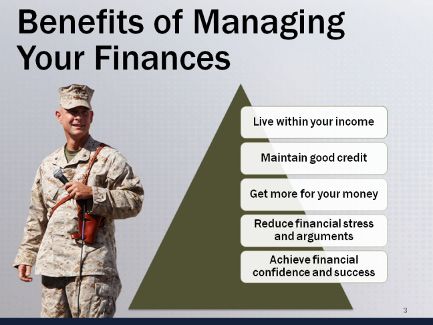
REFERENCES

Barnes, R. (2011, January). Top 5 Budgeting Questions Answered. Retrieved from
    http://www.investopedia.com/articles/pf/07/budget-qs.asp.
Garman, E.T., & Forgue, R.E. (2010). Personal Finance, 10th edition. Boston, MA: Houghton
   Mifflin Co.
Investopedia ULC. (2011). Investopedia. Retrieved from http://www.investopedia.com/.
The Kiplinger Washington Editors Inc. (2008). Kiplinger’s Practical Guide to Your Money:
    Keep More of it, Make it Grow, Enjoy it, Protect it, Pass it on, 4th edition. New York, N.Y.:
    Kaplan Publishing.
Mapping Your Future Inc. (2011). Start Budgeting. Retrieved from
   http://www.mappingyourfuture.org/money/budget.htm.
U.S. Department of Defense. (2004). Instruction 1342.27: Personal Financial Management for
    Service Members. Washington, D.C.
U.S. Department of Defense. (2008) Instruction 1344.9: Indebtedness of Military Personnel.
    Washington, D.C.
U.S. Department of the Navy. Commander, Navy Installations Command. (2005). Command
    Financial Specialist Training Manual 15608D. Washington, D.C.
U.S. Department of the Navy. Office of the Secretary of the Navy. (2007). SECNAV Instruction
    1740.4: Department of the Navy Personal Financial Management (PFM) Education,
    Training, and Counseling Program. Washington, D.C.
U.S. Marine Corps, Marine and Family Programs Division. (2011). Marine Corps Community
    Services Training Documents: Million Dollar Sailor. Retrieved from http://www.usmc-
    mccs.org/finance/mdsdoc.cfm?sid=ml&smid=4&ssmid=3.

      2   Managing Income, Expenses, Savings and Credit
PREPARATION AND PROCEDURES

Activities:

•   “Setting S.M.A.R.T. Goals”: An activity in which learners practice developing a short-term
    or long-term S.M.A.R.T. financial goal.

Additional Handouts:

    •   “Creative Savings Strategies”

    •   “Debt-to-Income Ratio”

    •   “Financial Planning Pyramid”

    •   “Financial Planning Worksheet”

    •   “Financial Planning Worksheet Checklist”

    •   “Monthly Spending Record”

    •   “Session Evaluation”

Materials:

    •   Managing Income, Expenses, Savings and Credit PowerPoint slides

    •   Pens, pencils, markers, and paper

    •   Chart paper or a whiteboard

    •   Electronic Financial Planning Worksheet

    •   Computer for all participants, if available

                                        Managing Income, Expenses, Savings and Credit   3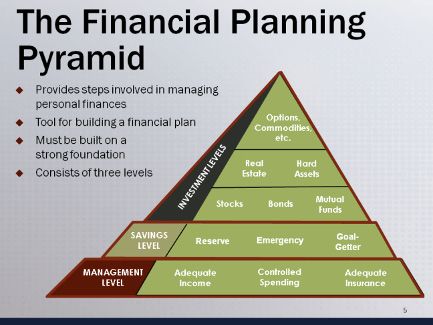
Registration:

Registration ensures that you have an adequate number of materials on hand and that guest
speakers are prepared if they have handouts or giveaways for their audience. Program registrants
should be contacted by phone or e-mail two to three days before the program to verify
participation. Sign-in is advised to track attendance.

Target Audience:

The target audience is Marines and their family members with a basic to intermediate knowledge
of personal financial management.

      4   Managing Income, Expenses, Savings and Credit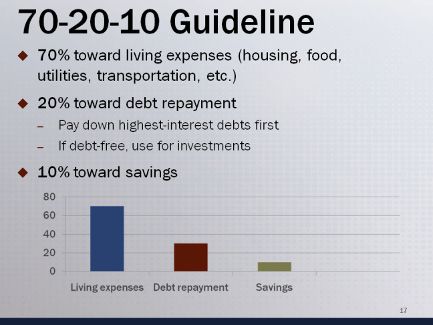
KEY TERMS

  • Checking account: An account held at a financial institution that an individual
    uses to deposit funds and make withdrawals.
  • Discretionary income: The amount of money left over after all deductions and
    automatic payments or allotments are taken from net income.
  • Federal Insurance Contributions Act (FICA): An act that mandates an employer
    withholds a set percentage of an employee’s salary each pay period as a tax. FICA also
    requires that the employer match the employee’s amount and contribute the money to a
    government account known as the Social Security Trust Fund. This fund provides
    retirement income, as well as disability insurance, Medicare, and benefits for survivors.
  • Gross income: The actual, total amount of money that an individual makes each
    month or year before any taxes, withholdings or allotments are removed.
  • Leave and Earnings Statement (LES): Monthly statement of pay based on two
    pay periods. This statement provides the Marine with all of their monthly and
    year-to-date income, as well as entitlements, deductions and allotments, and
    taxes.
  • Net income: Gross income minus income taxes, withholdings and allotments
    (dental, TSP, SDP, life insurance, TRICARE etc).
  • Net worth: The total picture of an individual’s financial status at a given time
    based upon their assets minus their liabilities (debts). Net worth is often used by
    banks to determine an individual’s ability to repay a loan.
  • Reconciliation of bank statements: A form that allows individuals to compare their
    personal bank account records to the bank’s records on their account balance, to reveal
    any discrepancies.
  • Savings account: A deposit account held at a financial institution (bank, credit
    union, etc.), that allows principal security and a modest interest rate.
  • S.M.A.R.T. goals: Goals that are specific, measurable, attainable, realistic, and
    trackable and time sensitive.
  • Spending plan: A written budget that allows an individual to achieve financial
    goals through proper management of money from paychecks and other sources
    of income. This plan allots specific amounts of money for particular uses. It is
    more commonly referred to as a “budget.”

                                   Managing Income, Expenses, Savings and Credit          5
QUALITY ASSURANCE PROCEDURES

To assure accurate and current information as well as a quality presentation:

   •   Headquarters (HQ) and installation PFMs will review the curriculum annually or when
       there have been consequential changes to content regarding laws, regulations or military
       programs that could have a significant impact on Marines and their families. HQ will
       then update the curriculum.

   •   Distribute session evaluations to participants at the end of each workshop. Results should
       be tabulated and retained to measure the effectiveness of information provided at the
       session, in the program content, and of the delivery of the presentation.

       6   Managing Income, Expenses, Savings and Credit
CONTENT OUTLINE (90 MINUTES TOTAL)

   1. Welcome and Chapter Overview (5 minutes)
   2. Benefits of Managing Your Finances (10 minutes)
      a. S.M.A.R.T Goals
   3. Financial Planning Pyramid (10 minutes)
      a. Management Level
      b. Savings Level
      c. Investment Level
   4. Budgeting Basics (30 minutes)
      a. Net Worth
      b. Monthly Budget
      c. Income
      d. Savings
      e. Living Expenses
      f. Tracking Expenses
      g. Indebtedness
      h. 70-20-10 Guideline
      i. Debt-to-Income Ratio
      j. Creating a Positive Cash Flow
   5. Understanding Taxes (10 minutes)
      a. Withholding Taxes
      b. Payroll Taxes
   6. Record Keeping (15 minutes)
      a. Statements
      b. Checks and Debit Cards
      c. Insurance Documents
      d. Other Considerations
      e. Records Disposal
   7. Resources and Summary (5 minutes)

                                    Managing Income, Expenses, Savings and Credit   7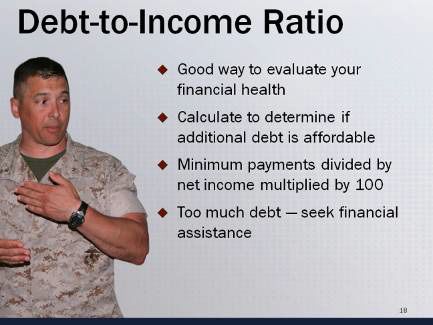
SLIDE 1: INTRODUCTION                SECTION BACKGROUND INFORMATION
                                     Managing your income, expenses, savings and credit is
                                     one of the most important things that you can do for
                                     yourself and your family. Your financial health and that of
                                     your family’s will depend on how well you understand
                                     your financial picture and how well you continue to grow
                                     and manage your finances throughout your life.
                                     There are basic ideas and terms that are a necessary part of
                                     managing your personal finances. Once you understand
                                     some of these core concepts, you will be able to make
SLIDE 2: OVERVIEW
                                     sound decisions regarding the way you budget your
                                     money.
                                     Do you have a household or personal monthly budget at
                                     the present time? If not, you may be thinking to yourself,
                                     “I know how much I make each month and I know how to
                                     spend my paychecks. That is all that matters.”
                                     However, good financial management includes not only
                                     spending and saving but good record keeping as well!
                                     In today’s session, we will discuss many topics that will
INSTRUCTOR NOTES:
                                     assist you in managing all aspects of your personal
1. Introduce yourself and have the
                                     finances. These include:
   participants introduce
   themselves.                       •   Benefits of Managing Your Finances
2. Introduce the topics to be
                                     •   Financial Planning Pyramid
   covered in this session.
                                     •   Budgeting Basics
                                     •   Understanding Taxes
                                     •   Record Keeping
                                     •   Financial Management Tools
                                     •   Resources

      8   Managing Income, Expenses, Savings and Credit
SLIDE 3: BENEFITS OF MANAGING          SECTION BACKGROUND INFORMATION
YOUR FINANCES                          Consider the following questions:
                                       •    Do you live within your income?
                                       •    Do you know whether your credit is good or bad?
                                       •   Have you ever felt financial stress?
                                       •   Would you like to achieve financial confidence?
                                       Being able to effectively manage your finances is an
                                       important skill. It calls for self-discipline and the setting of
                                       goals, if one desires to do it successfully.
INSTRUCTOR NOTES:
                                       Although it does require some work to do it well, there are
Use the information in the column
                                       benefits that will change the way you think when it comes
to the right to guide your
                                       to your money.
discussion.
                                       Live within your income: A good budget will guide your
                                       spending and help you live within your income. Putting
                                       everything down in black and white, and planning and
                                       tracking your spending, enables you to account for every
                                       penny you earn. As a result, you and your family are able
                                       to stay in line with your short- and long-term financial
                                       goals.
                                       Maintain good credit: Establishing and maintaining good
                                       credit is both a good goal worth setting and an important
                                       benefit in good financial management. The first step in
                                       having good credit is to pay your bills on time. An
                                       effective, written budget provides the foundation for a
                                       great credit report. And since the ultimate goal of any
                                       spending plan is to help you build wealth, not debt, as
                                       your assets grow and your debt is kept to a minimum, your
                                       credit report looks better and better.
                                       Get more for your money: Managing your finances
                                       through a budget is the single best way to help find
                                       “leaks” in your spending. By tracking your income and
                                       expenses, you may find money you did not know you
                                       had. You could find that you have been spending money
                                       on things that you do not really need or value. Many
                                       people even find that there is money “lost” … meaning
                                       they do not know where some of their money goes. You

                                    Managing Income, Expenses, Savings and Credit          9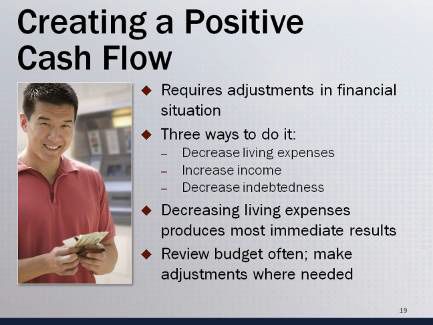
should be able to account for 100 percent of your money
                                     and ensure it is going only where you want it to go. Good
                                     financial management in some ways can be as easy as
                                     knowing what is coming in and how it is going out to
                                     reach your financial goals.
                                     Reduce financial stress and arguments: Planning
                                     income and expenses, writing down goals, and working
                                     together with your spouse will greatly reduce financial
                                     stress and arguments. Money is a top reason many
                                     Marines experience stress on the job. It is also one of the
                                     top things couples fight about. Much of this can be
                                     avoided by planning your spending, and creating a written
                                     budget.
                                     Achieve financial confidence and success: Imagine how
                                     it would feel to have just achieved an important financial
                                     goal in your life – perhaps it was to buy a house, to
                                     finance a child’s education, or to retire early. Imagine how
                                     it would feel to save for that important goal and to achieve
                                     it. Imagine what it would feel like to be fully in control of
                                     your money, with no/low debt, adequate savings, an
                                     investment plan in place and not living paycheck to
                                     paycheck. Learning financial management skills is not the
                                     key to all happiness, but it will certainly open the door to a
                                     sense of financial confidence. This can motivate you to
                                     take the necessary steps to create wealth in the future.
SLIDE 4: S.M.A.R.T. GOALS            SECTION BACKGROUND INFORMATION
                                     Successful people have financial goals!
                                     They take control of their money, distribute percentages of
                                     their income to specific uses and commit to them in
                                     writing. Goal setting is an important part of financial
                                     management It forces you to decide what you want to
                                     accomplish with your money and clearly defines the steps
                                     you need to take to get there. A well-written financial goal
                                     is a S.M.A.R.T. goal.
INSTRUCTOR NOTES:
1. Use the information in the
   column to the right to guide
   your discussion.
     10   Managing Income, Expenses, Savings and Credit
2. After the discussion, conduct S.M.A.R.T. goals are effective because they are:
the activity described below. • Specific
• Measurable
Learner Activity: Setting
S.M.A.R.T. Goals. • Attainable
• Realistic
Purpose: To allow learners the
opportunity to practice developing • Timely (has start and stop dates)
a short-term or long-term In the financial world, being fiscally S.M.A.R.T will ensure
S.M.A.R.T. financial goal. that your short- and long-term goals are met with success!
Time: 5 minutes Let’s take a closer look at each part of this acronym:
Materials: Pencils and paper. Specific: When setting up financial goals, you must make
them specific. Goals should be straightforward and
Procedure: Provide each learner emphasize what you want to happen. You cannot just say,
with a pencil and blank sheet of “Hey! I want to be rich one day!” Does being rich mean
paper. Explain to the participants that you will have $1 million by age 40? Or does it mean
that you are going to have them having a retirement account that allows you to have your
take a moment to practice writing current standard of living without having to work? Be
their own financial goal. Instruct specific such as: Pay off car loan in 12 months! Specifics
each participant to write down one help us to focus our efforts and clearly define what we are
financial goal that they would like going to do. Specific is the what, why, and how of the
to achieve. It can be short-term, S.M.A.R.T. model.
(achieved within the next five
years), or long-term (would take Measurable: If you cannot measure your goal, you
more than five years to achieve). cannot manage it. Establish concrete criteria for measuring
Point out that they should also progress toward the attainment of each goal you set. When
ensure their goal follows the you measure your progress, you stay on track, reach your
S.M.A.R.T. model. After a few target dates, and experience the exhilaration of
minutes, ask for volunteers to read achievement that spurs you on to continued effort required
their goals. Tactfully tweak to reach your goal. To determine if your goal is
participant goals to ensure they measurable, ask questions such as: How much? How
follow the S.M.A.R.T. model. many? How will I know when it is accomplished? If your
Congratulate all participants for goal is to pay off your car loan in 12 months you can
putting their goals in writing. easily track your progress on this.
Discussion: Reiterate the Attainable: Good financial goals are ones that you can
importance of making financial achieve. For goals you set which are too far out of your
goals specific, measurable, reach, you probably will not commit to doing. Although
attainable, realistic, and timely to you may start out with the best of intentions, your
ensure success. subconscious will keep reminding you that your goal is
beyond your means and will stop you from giving it your
best.
Managing Income, Expenses, Savings and Credit 11Realistic: In this case, realistic means within your
capabilities. It means a financial goal that is within your
availability of resources, knowledge and time. It means
that the learning curve is not a vertical slope; it may push
your skills and knowledge to reach it, but it should not
break you. Be sure to set goals that you can attain with
some effort and set the bar high enough for a satisfying
achievement! You may decide to start paying off the
smallest debt first which gives you a feeling of
accomplishment and then move that extra funding to the
next piece of debt -- whether it is the next smallest or the
one with the highest interest rate. PowerPay.org is a great
Internet resource with tools to help you develop a
personalized debt elimination plan.
Timely: Set a timeframe for the goal: next week, in three
months, by retirement, etc. Putting an end point on your
goal gives you a clear target to work toward. If you do not
set a time limit, the commitment is too vague. It tends not
to happen because you feel you can start at any time.
Without a time limit, there is no urgency to start taking
action now.
Here is an example of a S.M.A.R.T. goal:
“I will buy a house within the next five years.”
To achieve this goal, I will:
• Get a copy of my credit report within 30 days.
• Pay off my car loan one year early by making double
payments each month.
• Double my current savings to equal $500 per month
to be able to have $30,000 for closing costs, down
payment and other expenses.
Thorough, accurate and effective spending plans are
developed with the ultimate goal of building wealth, not
debt. Start the process of managing your finances by
envisioning what you would like to achieve with your
money and then writing your goals down in black and
white using the S.M.A.R.T. process.
12 Managing Income, Expenses, Savings and CreditSLIDE 5: FINANCIAL PLANNING SECTION BACKGROUND INFORMATION
PYRAMID Once you set your goals, the next phase in managing your
finances is having an understanding of what is needed to
build financial success.
The Financial Planning Pyramid gives us a visual picture
of the steps that are involved in successfully managing our
personal finances. It is also a widely accepted, simple tool
for building your financial plan.
The pyramid illustrates how developing a financial plan
proceeds in an orderly fashion (like building blocks) and
INSTRUCTOR NOTES: that it must be built on a strong foundation.
1. Use the information in the There are basically three levels to the pyramid:
column to the right to guide Management, Savings, and Investment.
your discussion. Investing is an advanced financial tool that you will want
2. Distribute the “Financial to learn about after you have your “building blocks” in
Planning Pyramid” handout to place and you understand their importance.
participants.
SLIDE 6: MANAGEMENT LEVEL SECTION BACKGROUND INFORMATION
“Management” is a word we hear every day. There are
retail managers, project managers, business managers and
financial managers, to name a few. Anytime we take
control of a situation, entity or job, we are managers.
Taking control and responsibility for your personal
finances is the first step toward financial success.
The management level includes the most basic elements of
planning and is the first step in building wealth. This level
includes:
INSTRUCTOR NOTES:
Use the information in the column • Adequate income: Using all of the pays, allowances
to the right to guide your and benefits offered by your employer.
discussion.
• Controlled spending: Using some type of a written
plan.
• Adequate insurance: Using appropriate insurance to
protect against financial loss.
The management level is also the rock-solid foundation of
the other two more advanced steps; therefore, the most
important step in the pyramid.
Managing Income, Expenses, Savings and Credit 13SLIDE 7: SAVINGS LEVEL SECTION BACKGROUND INFORMATION
The second level of the pyramid is the savings level. This
level includes:
• Emergency fund: An emergency fund is for
unexpected emergency expenses such as emergency
leave, auto repairs, or things like sick pets. It is
recommended that an emergency fund consist of one
to three months of your net pay.
• Reserve fund: A reserve fund is for expenses that do
INSTRUCTOR NOTES: not occur monthly, such as car insurance, school
Use the information in the column tuition, birthdays and anniversaries, and holiday
to the right to guide your shopping.
discussion.
• Goal-getter fund: The goal-getter fund is for your
short-term goals or for financial goals for which the
money is needed in the next five years or less. Money
is kept in liquid accounts such as savings accounts,
money market savings accounts, or short-term CDs,
where it is easily accessed. In this fund, you will make
an initial installment plan, and add to it weekly or
monthly during a certain period of time to achieve
your specific goals. Many banks offer goal-getter
funds which foster good financial management and
responsibility.
Note that these three funds do not necessarily have to be
three separate accounts, but they need to be accounted for
separately.
14 Managing Income, Expenses, Savings and CreditSLIDE 8: INVESTMENT LEVEL SECTION BACKGROUND INFORMATION
The remaining level of the Financial Planning Pyramid is
the investment level. This level includes all of the tools
that can be used in an effective investment plan. It
involves the acquisition of stocks, bonds, mutual funds,
real estate, hard assets, options, and commodities, to name
a few.
Investing is different from savings – more gain is
involved, but so is more risk. Investing is for long-term
financial goals; financial goals for which the money is
INSTRUCTOR NOTES:
needed in more than five years. Do not invest money you
Use the information in the column
may need in the short term. The most important thing to
to the right to guide your
remember at this level is to diversify your investments.
discussion.
Before investing though, it is critical to first give attention
to the management and savings levels of the Financial
Planning Pyramid. Once you have established your
spending and savings plans, then move into the investment
arena.
Since these are advanced investment steps, it is
recommended you educate yourself first and seek
professional financial assistance from your Command
Financial Specialist (CFS) or Marine Corps Community
Services (MCCS) Personal Financial Management (PFM)
Specialist.
SLIDE 9: BUDGETING BASICS SECTION BACKGROUND INFORMATION
Marines and their families can benefit tremendously when
they understand the basics of developing a
budget/spending plan.
What is a budget?
A budget is a written method of measuring and managing
the money that comes in and goes out of your pocket.
Another common name for a budget is a spending plan.
Learn the basics first: Before creating a budget, though,
INSTRUCTOR NOTES: it is important to have a clear understanding of all of the
1. Discuss the points on the slide basic elements that go into it.
using the information in the
column to the right.
Managing Income, Expenses, Savings and Credit 152. Distribute the “Financial Benefits of learning the basics: Once you learn the basics
Planning Worksheet Checklist” of budgeting, you will be able to easily streamline and
handout to the participants. review your own individual budget, evaluate and make
3. After the discussion, conduct changes to it where needed, and easily find you can stick
the activity described below. to your budget to reach your financial goals.
4. If a computer lab is available It is important to remember that budgeting is a lifelong
where all participants will have process. To be effective at managing your finances
access to a computer, ensure requires that you make it a priority for you and your
the electronic version of the family.
Financial Planning Worksheet
(FPW) is on each The FPW is one of the best ways to keep an eye on your
computer. The instructor may expenses. It is one of the most convenient and simple tools
choose to modify the lesson to of financial management and personal financial planning,
accommodate participant enabling you to plan, execute, and review income and
interaction with each tabbed expenses. Think about it like this, once you know how
section being discussed on the much money you have coming in every month, and what
electronic FPW. you are spending every month, you will be able to make
5. If computers are not available decisions about what you need versus what you want. You
for all participants, distribute will also be informed and prepared to make good financial
the “Financial Planning decisions that will impact you and your family. You will
Worksheet” handout to the have a visual picture of your financial situation -- and this
participants. Show them the information is power!
electronic version of the FPW Although a brief walk-through will be conducted to
on the computer you are using familiarize you with the contents of the FPW, Marines will
to give the presentation. Advise need to invest some time on their own or with one-on-one
participants how they can get coaching with a PFM Specialist after the training to
this electronic version to use on thoroughly complete the worksheet. Once completed, the
their own. FPW will aid you in developing your own individual
Learner Activity: Financial spending plan.
Planning Worksheet. Gather financial information: One of the first things you
Purpose: A walk-through activity must do before developing a spending plan is gather some
to familiarize learners with the important financial information. The “Financial Planning
FPW and help them understand Worksheet Checklist” handout will provide you with a
how to apply personal financial good idea of what is needed to complete the worksheet.
information. This includes:
Time: 15-20 minutes. • Current Leave and Earnings Statement (LES). This
can be obtained through myPay at
Procedure: Provide each learner
http://mypay.dfas.mil.
with the “Financial Planning
Worksheet”. Walk through each • Any other sources of income.
16 Managing Income, Expenses, Savings and Creditsection of the worksheet using the • A list of current living expenses, such as housing costs,
information provided in the column food, entertainment, personal care, travel, etc.
to the right that corresponds with
• All current bank statements, including a current
Slides 9 through 16.
mortgage statement if you own a home.
Most participants will not have the
necessary items available during • All current investment and retirement account
the training. However, they should statements.
be encouraged to fill out the It is also important to have copies of your monthly bills,
worksheet using as much (or know what monthly payments are and total balances
information as they know and due). Some examples may include:
complete the FPW on their own.
• Utility and electric bills.
• Phone bills (home and/or cell.)
• Internet, cable, and/or satellite bills.
• Insurance payments.
• Any outstanding debts including personal loans, car
loans, credit card statements, student loans, etc.
• Other debts owed.
It is very important to ensure you have all of your financial
information so that you have an accurate picture of your
cash flow.
It is vital that you record this information, either on the
worksheet provided or in a spreadsheet of your choice.
SLIDE 10: NET WORTH SECTION BACKGROUND INFORMATION
The first place to start on the FPW is at the “Statement of
Net Worth.” In this section, you will calculate your total
net worth. Although it may sound complicated, calculating
net worth is simply what you own minus what you owe.
Your net worth can be a useful tool to measure your
financial progress from year to year. Your net worth is
essentially a grand total of all of your assets (what you
own) minus your liabilities (what you owe). Having this
INSTRUCTOR NOTES: information allows you to be in control of your financial
Use the information in the column situation. It will reduce the possibility of being surprised
to the right to guide your by unexpected expenses and will enable you to develop
discussion. your financial plan with confidence.
Managing Income, Expenses, Savings and Credit 17List your assets: On the worksheet, you will list the value
of everything you own under the “assets” column on the
left. Where property is concerned, do not forget that you
must actually own the property; therefore, exclude leases
or rental information here.
Examples of assets include:
• Personal assets (jewelry, automobiles, household
items).
• Home and real estate (including undeveloped land).
• Cash, as well as money in checking or savings
accounts.
• Retirement plans of all kinds (pension, 401(k), etc),
• Investments (stocks, bonds, mutual funds, CDs,
annuities).
• Cash value of life insurance policies.
• Livestock.
• Farmland/crops.
List amounts of liabilities: Next, you will list individual
amounts of everything you owe under the “liabilities”
column on the right. You will want to remember to include
Navy-Marine Corps Relief Society loans, and student or
car loans, as these are debts which must be repaid.
Examples of liabilities include:
• Loans or leases (Navy-Marine Corps Relief Society,
signature, student, consolidation, auto).
• Credit card debts.
• Advance/overpayments (something you must pay
back).
• Mortgages for second homes or rental properties.
• Other balances due (time shares, layaway payments,
etc.)
18 Managing Income, Expenses, Savings and CreditTotal both balances and subtract liabilities from assets:
The next step is to total both the assets and liabilities
columns, and record these numbers at the bottom of the
page. Finally, subtract what you owe (liabilities) from
what you own (assets). This is your net worth.
To have a positive net worth (which is what we all want),
your assets (what you own) should be more than your
liabilities (what you owe). If that is not the case, you
should see a CFS, PFM Specialist or call Military
OneSource (both are found in the reference section of this
presentation) for assistance in developing a plan to
decrease your debt as soon as possible.
Ideally, you should have a positive net worth. However for
many people just starting out, it is common to be negative.
It is important that you accurately estimate the value of
what you own (items in the assets column). To find the
value of savings bonds, go to www.savingsbond.gov. If
you do not know your home’s value, you can get an
estimate of its value at www.homegain.com. To find your
car’s value check www.kbb.com or www.nadaguides.com.
Since your net worth is a measure of your wealth, it is a
number you should track on a regular basis, preferably
year to year. This is important to ensure you are building
wealth, not debt. Using sound financial principles in the
way you manage your money will ensure that each year
your net worth increases and that you are indeed moving
in the direction of building wealth.
SLIDE 11: MONTHLY BUDGET SECTION BACKGROUND INFORMATION
A monthly budget is the first step in managing your
personal finances! Though many Marines may be familiar
with the term, most do not understand exactly what goes
into developing one.
There are four primary elements in developing a budget:
• Income
• Savings
• Expenses
• Indebtedness
Managing Income, Expenses, Savings and Credit 19INSTRUCTOR NOTES: To ensure your budget is effective and works for YOU,
Use the information in the column remember these important points:
to the right to guide your
• A budget should be easy to understand: A budget,
discussion.
in its simplest form, is a list of money in and money
out. It should not be any more complex than it needs
to be for your situation.
• Involve everyone who spends the money in the
budgeting process: A budget is a reflection of your
family’s needs, wants, values and goals: The monthly
budget is YOUR budget. It should reflect the way you
actually spend your money. Anyone who spends the
money should be involved in the budgeting process.
For example, if you are married, your spouse should
be included.
• A monthly budget is based on current income and
expenses: If you do not know what your current
income and expenses are, you will need to find out.
Most of the information you will need to develop it
can be obtained from a Leave and Earnings Statement
(LES), credit card and bank statements, receipts, bill
statements, etc. Listing expenses may take a little
more effort, especially if the individual putting the
plan together does not spend all of the money in the
family. Again, include everyone who spends the
money in the budgeting process. If you need to, track
spending for a pay period or two to get accurate
numbers. When your income changes, such as a pay
raise or a pay grade increase, you will want to sit
down and decide where that extra money would be
best utilized. Paying down high interest debt is
always a top priority once you have saved for an
emergency savings account. If you have already
accomplished these, then consider applying the
increase towards savings, investments, college
education, or a special fund such as vacation or
holiday.
20 Managing Income, Expenses, Savings and CreditSLIDE 12: INCOME SECTION BACKGROUND INFORMATION
Every budget begins with income, which is your deposit
into your budget. There are income terms used for
different combinations of pays and deductions:
• Gross income: Gross income is your total pay and
allowances; it is everything you earn before any
federal or state taxes and deductions are removed from
the amount.
• Net income: Net income is the amount of money you
INSTRUCTOR NOTES:
receive after all taxes, withholdings and allotments are
Use the information in the column
taken from your gross income. More information on
to the right to guide your
the types of taxes deducted will be discussed later on
discussion.
in the chapter.
• Take-home pay: Another term for net income is take-
home. This is the amount that ends up in your account
each pay day. On a Marine’s LES it will be “regular
pay”. Typically, this money will be used to pay for
your living expenses.
As previously mentioned, your LES is a great resource to
use when developing your budget. Your LES can help you
determine the amount of your gross and net income. It will
show you exactly where your money from your monthly
pay has been dispersed. Your LES will also list the amount
of taxes (both state and federal) you have paid, as well as
any other deductions or automatic allotments you may
have set up.
Funds that might be deducted from your pay can include:
• Taxes
• Servicemembers’ Group Life Insurance (SGLI)
• Family Servicemembers’ Group Life Insurance
(FSGLI)
• Thrift Savings Plan (TSP)
• Dental
• Advance Pay
• Overpayments
Managing Income, Expenses, Savings and Credit 21Allotments might include:
• Rent or mortgage payments
• Car payments
• Contributions to organizations like Navy-Marine
Corps Relief Society (NMCRS)
• Child support payments
There are two important categories on the “Income”
section of the FPW:
• Cash flow statement: The cash flow statement is the
“Actual” column, which tells you where your money is
coming from and where it is being spent. It is basically
a tracker for your money. If you already use Quicken,
mint.com, or another cash flow tool, it is the same
concept.
• Spending plan: The column called “Projected” is also
known as a spending plan. A spending plan is similar
to a cash flow statement. However, instead of tracking
what money goes in and out, this section allows you to
plan for what money will come in and what will go
out.
List your income: To simplify things, it is best to begin
filling out the cash flow statement first. This step involves
calculating all of your income sources (under the “Actual”
column), on the “Monthly Income” of the FPW. Marines
should include all current pays and income sources,
including the income from a spouse. Next, calculate
monthly net income. Remember, this should be written in
the “Actual” column since you will only be working with
what you currently earn. If desired, this number can then
be divided in half to see what is received each pay period.
22 Managing Income, Expenses, Savings and CreditSLIDE 13: SAVINGS SECTION BACKGROUND INFORMATION
The next element to include in developing your monthly
budget is the amount you put toward savings. This amount
should be considered an expense, because it is something
that you should “spend” money on.
Calculate your expenses: List all of your current
expenses, starting with your savings expenses on the page
titled “Monthly Saving & Investing.” Under the “Actual”
column, calculate the amount you save every paycheck.
Be sure to include any saving “expenses” for investments,
INSTRUCTOR NOTES: TSP, etc. After that, total the “Actual” amount of your
1. Use the information in the savings expenses.
column to the right to guide
Here are some ways to help you prioritize saving and
your discussion.
2. Distribute the “Creative investing:
Savings Strategies” handout to Pay yourself first: When it comes to spending, the
participants. primary “golden rule” in budgeting is to pay yourself 10
3. More detailed information percent of your income first.
about saving and investing can That’s right! List all your fixed expenses such as mortgage
be obtained in both the “Basic or rent, water and electric bill, cable, car payment, etc.
and Intermediate Saving and Then take 10 percent of your income, and put it into a
Investing” workshops. savings account BEFORE you start paying on your listed
expenses.
Many Marines might say, “How am I supposed to pay my
bills if I pay myself 10 percent of each pay check?” You
may find that you cannot dine out as often or that you
must limit yourself to only one movie per month! These
types of expense cuts will involve evaluating basic needs
vs. wants. However, this practice allows you to pay
yourself first.
An easy way to pay yourself first is to have your
contribution to your savings taken directly from your
paycheck. You can do this for the Thrift Savings Plan
(TSP) and civilian retirement plans such as a 401(k),
403(b), Savings Incentive Match Plan for Employees
(SIMPLE) IRA. Not only are you saving but an
immediate benefit of these accounts is that contributions
made to them are deducted from your paycheck before
income taxes are calculated, so your taxable pay is
reduced today.
Managing Income, Expenses, Savings and Credit 23SLIDE 14: LIVING EXPENSES SECTION BACKGROUND INFORMATION
Living expenses are your basic day-to-day needs that help
you maintain your standard of living. The living expense
portion of your budget takes up the majority of your
income.
Calculate living expenses: Under “Living Expenses,” you
will calculate the dollar amounts of all of your monthly
“Actual” expenses. If it is helpful to split up your expenses
according to pay periods instead of months, record all of
your expenses in both “Actual” columns. Otherwise, you
INSTRUCTOR NOTES:
may record all of your monthly expenses in one “Actual”
Use the information in the column
column.
to the right to guide your
discussion. Living expenses can include:
• Housing (rent or mortgage)
• Utilities (electricity, cable, water, sewer, trash)
• Food (groceries, dining out)
• Transportation costs (car repair, gas, etc.)
• Entertainment (movies, concerts, sporting events, etc.)
• Child care
• Clothing
• Medical expenses
• Phone (home and/or cell)
• Internet
Some of these living expenses are fixed, such as rent and
insurance. Others will vary from month to month, such as
entertainment, food, and clothing. Living expenses are the
most flexible area of any budget, as they are determined
by your standard of living. You can control variable
expenses and adjust the amounts you spend in these
categories to have more to use somewhere else.
It is important point out that categories listed in this area
are not only housing and utilities but entertainment and
child care, medical expenses, etc.
24 Managing Income, Expenses, Savings and CreditAccording to financial experts, Americans lose 10 percent
to 30 percent of their income from this area. This is
sometimes called the “latte factor.” Consider for a moment
what your own latte factor might be. Home repair, clothes,
nails, toys or clothes for kids, etc. are all examples of the
latte factor.
If you know you spend money on an item but do not know
how much, you may need to track your spending for one
or two pay periods.
SLIDE 15: TRACKING EXPENSES SECTION BACKGROUND INFORMATION
How do you spend the money from your paycheck
each month?
Most people who are building their first budget cannot
account for 10 percent of their income – they simply do
not know where their money goes.
There are a lot of ways to track expenses.
“Monthly Spending Record” handout: This form allows
you to record and track the money you spend. Be sure to
INSTRUCTOR NOTES: include everything: $1 for a soda, $4 for cookies sold by
1. Use the information in the your neighbor’s child, $5 you lend to a co-worker, and all
column to the right to guide the living expenses we discussed earlier such as home
your discussion. utilities, etc. You can also try keeping receipts from every
2. Distribute the “Monthly purchase you make and transfer the amounts at the end of
Spending Record” handout to each day onto the handout.
participants. After you have written everything down for two weeks,
group your expenditures into categories similar to those
listed in the “Living Expenses” section of the FPW and
enter the amounts spent in the appropriate categories.
Another suggestion to categorize your expenditures is by
using your banking statement.
Another way to keep track of income and expenses is with
some sort of a ledger or log. Categories can be set up to
work for your particular situation. For example, if you are
setting up a logbook for paying your bills, you might have
“Company Name,” “Date Due,” “Amount Paid,” “Date
Paid,” and “Received” as your categories. A ledger can be
set up with debits and credits. This type of method is
usually very detailed.
Managing Income, Expenses, Savings and Credit 25Online forms: There are various forms online that will
allow you to manage your income and expenses. Some
programs allow you to create a form for your records,
while other programs already have the templates built into
them. Software programs such as Quicken, QuickBooks,
etc., allow you to simply plug your numbers directly into
their templates. These programs can be purchased to keep
track of your budgeting and bill paying, and they are
generally easy to use and self-explanatory.
Excel spreadsheets: Spreadsheets can make record
keeping a breeze if you are familiar with how to set one
up. Excel allows for columns to be constructed that will
automatically add or subtract, multiply, divide, create
percentages and track changes both positive and negative.
Once the initial work to set the spreadsheets up is done, the
recording becomes swift and easy.
Envelope system: This is a basic system that uses cash
and envelopes. Spending categories are divided up into
envelopes, and a set amount of cash is added for a set
amount of time. This method helps to control spending
because you are physically able to see the amount of
money that has been spent and the amount of money left.
It also cuts down on the use of credit because all that is
spent is the “cash in the envelope.”
Free online programs: There are numerous free online
programs that can assist you with your income and
expense management. Here are a few of the more common
ones:
• Mint.com
• Budgettracker.com
• Quicken.intuit.com
As with any on-line financial program, evaluate them
carefully and understand that hackers aim for companies
that will give them the most information. Therefore, if a
website has all your financial data in one location there is
always the risk of a hacker obtaining a lot more
information on you through one event/one financial site.
26 Managing Income, Expenses, Savings and CreditTracking your finances is a very important process that
needs to be maintained throughout your life. Even when
you are debt free you do not want to lose track of your
spending or your savings could suffer and debt may re-
appear.
For Marine’s and their families, the important thing to
remember is that there are a few basic financial
management tools that are important: (1) monthly income
and expenses record, (2) the monthly budget, and (3) the
statement of net worth (balance sheet).
SLIDE 16: INDEBTEDNESS SECTION BACKGROUND INFORMATION
The last element included in a budget is the indebtedness
section. In the section titled “Debt” of the FPW is where
you list all of your outstanding debts along with the
minimum payment required for each and the annual
percentage rate (APR) charged. Include:
• Credit cards (bank, department store, gas, etc.)
• Car loans
INSTRUCTOR NOTES: • Personal loans
Use the information in the column • Consolidation loans
to the right to guide your
discussion. • Student loans
• Advanced payments
• Overpayments
• Indebtedness to NMCRS, Navy Exchange, family and
friends.
DO NOT include your mortgage. For our purposes, your
mortgage is a living expense. DO include any rental
property you have that is not your primary residence.
When you total your minimum monthly debt payments,
copy the amount on the appropriate line at the bottom of
the worksheet.
Determine surplus or deficit: With the numbers you
input at the bottom of the page, you can determine whether
you have a surplus (money left over) or a deficit (a
negative amount) at the end of the month.
Managing Income, Expenses, Savings and Credit 27Calculate your cash flow: Calculate your monthly cash
flow or “Actual” expenses. This is done by subtracting
your monthly expenses from your monthly income that we
calculated on “Monthly Income” of the FPW.
Income minus living expenses determines what you have
left to pay debts. This number minus debt payments is
what you have at the end of the month (this is also
considered lost money or money that is unaccounted for,
otherwise it would already be listed somewhere on the
budget worksheet). This final information can also be used
to calculate what percentage of your net income goes to
expenses, to indebtedness, and to savings.
Projection totals: After you have filled in the projected
amounts of your spending plan, total them. Then take the
estimated amount of expenses (including savings from
“Monthly Saving & Investing” on the FPW) and the total
amount of debt and subtract this number from your
estimated amount of income. You should have a positive
number. If not, in the future you will need to cut expenses
and debt or find ways to increase your monthly income.
Your goal should be to become debt-free. Consider these
actions to help you achieve this goal:
Use a power payment plan: After budgeting to get a
positive cash flow, ensure that minimum payments are
made on all monthly bills and then apply all remaining
available funds to whichever debt has the smallest balance.
When the smallest balance is paid off, apply the money
used for that payment to the next bill on your list and keep
the others the same. Again, when that bill is paid off, apply
all the money used for the payment to the next bill on your
list. In this manner, you will “power pay” down your debt.
Your PFM or CFS can help evaluate this method and
possibly offer other solutions and methods.
Talk to your creditors: Stay in contact with your
creditors; let them know if there is a problem. Once you
have determined how much you can pay to a creditor,
approach them with a plan. Be careful about promising
more than you can deliver.
28 Managing Income, Expenses, Savings and CreditChange your behavior: Spend time thinking about how
you got into debt to begin with. … Are you living beyond
your means? Are you satisfying all your wants and
sacrificing all your needs? Are you an emotional spender
or an impulse shopper? Should you not use credit at all?
Becoming and staying debt-free is achievable with a bit of
effort and self-discipline. The careful examination of
spending coupled with a power payment plan can get you
to that debt-free status. Once debt-free, there are several
practical alternatives to using credit and acquiring debt,
including planning your spending carefully and purposeful
saving for specific events, wants and needs.
Here are some ideas that people with a debt free attitude
use to manage their thoughts:
• Live by this powerful rule: if you can't afford it, don't
buy it.
• Know the difference between a “need” vs. a “want.”
• Save up for big purchases.
• Pay off existing debt.
• Change your attitude. Don’t think of it as going
without. Realize that you are empowering yourself to
have what you really want tomorrow.
• Find out if anyone you know lives by this philosophy
and get examples and advice from them. Seek out a
friend or family member whose money management
allows them to live debt free.
• Instant gratification is what gets people into trouble
with debt. Patience and persistence is what gets you
out.
Managing Income, Expenses, Savings and Credit 29SLIDE 17: 70-20-10 GUIDELINE SECTION BACKGROUND INFORMATION
According to many financial experts, the ideal distribution
of your net income should follow the 70-20-10 guideline:
70: 70 percent of your budget should be used for living
expenses. This includes housing, food, utilities and
transportation.
20: 20 percent of your budget should be allocated toward
debt repayment. You can begin by paying down the
highest-interest debts first or if you are a person that needs
INSTRUCTOR NOTES: to see immediate results for encouragement you may
Use the information in the column decide to pay off the smallest debt first and then roll the
to the right to guide your extra payment to the next smallest debt or to the highest
discussion. interest debt. If you do not have any debt, use that final 20
percent for savings and investments.
10: The last 10 percent of your budget should be used for
savings. If you like, as an option you can split this amount
in half, with 5 percent set aside for building up an
emergency fund and the remaining 5 percent going toward
an interest-bearing savings account or CDs, IRAs, etc.
Percentages will vary by the lifestyle of each household,
but these guidelines still prove effective in helping build
wealth and keeping debt to a reasonable level.
Don’t worry if you do not know how to do this! You can
always consult your CFS, MCCS PFM Specialist,
accountant or financial advisor to make sure you are
choosing what is best for you and your family’s financial
situation.
30 Managing Income, Expenses, Savings and CreditSLIDE 18: DEBT-TO-INCOME SECTION BACKGROUND INFORMATION
RATIO Monitoring your debt-to-income ratio is a good way to get
a quick check of your financial health. In the 70-20-10
guidelines, the “20” is the debt-to-income ratio. Calculate
your debt-to-income ratio as a means of measuring
whether or not additional credit is affordable.
• First determine your net monthly income by
identifying everything you make in one month.
• Then total all monthly payments which includes loan
and credit card balances. Remember not to include
INSTRUCTOR NOTES: mortgage payments as housing is a fundamental need
1. Use the information in the and therefore is not included in the Debt-to-Income
column to the right to guide ratio.
your discussion.
2. Distribute the “Debt-to-Income • Divide the monthly debt payments by the total net
Ratio” handout to participants monthly income to determine your debt-to-income
and tell them they can mark ratio.
items they may need to review • Minimum payments divided by net income multiplied
or do, now or in the future. This by 100 is your ratio.
handout can serve as a guide
This written formula is included on your “Debt-to-Income
when determining if additional
Ratio” handout. Once you calculate your debt-to-income
credit is affordable.
ratio, check the credit use guidelines to determine if
additional credit is affordable.
Credit use guidelines:
• Less than 15 percent — Use with caution.
• 15-20 percent — Fully extended. Start seeking
financial coaching to be proactive.
• 21-30 percent — Overextended. Strongly suggest
seeking financial coaching.
• Greater than 30 percent — Seek financial coaching.
It is important to point out that large families sometimes
find a debt-to-income ratio of as little as 16 percent
difficult and therefore refrain from taking on further debt.
Managing Income, Expenses, Savings and Credit 31The use of credit has evolved from a luxury to almost a
necessity if proper planning and budgeting for the future
hasn’t been done to prepare for layoffs and other
unexpected financial situations. It all depends on how you
use it. Credit cards are often used for wants and needs that
were not planned for in advance. This, along with impulse
spending, gets many people into the overextended debt
range. If you find yourself with too much debt, there are
resources available to assist you. These resources will be
discussed at the end of this program.
SLIDE 19: CREATING A POSITIVE SECTION BACKGROUND INFORMATION
CASH FLOW If you are accounting for all your money there should be
no surplus or deficit in your monthly budget. If there is a
surplus, put it away into savings or use it to pay off debts.
If there is a deficit, double check all your numbers and
math to ensure there are no mistakes.
If, after checking your numbers, you still find you have a
deficit, you will need to make some adjustments in your
financial situation to create a more positive cash flow.
There are three ways you can do this:
INSTRUCTOR NOTES: • Decrease living expenses
Use the information in the column
• Increase income
to the right to guide your
discussion. • Decrease indebtedness
Decreasing living expenses produces the most immediate
results. A well-managed budget that decreases living
expenses can see results within days.
Ways to decrease living expenses:
• Cut back to basic cable.
• Research packages deals for cable, Internet and cell
phone vs. individual plans to see which is the better
option.
• Eliminate telephone land line if you have a cell
phone.
• Check books out from library rather than buying.
• Use public transportation or carpool rather than drive.
32 Managing Income, Expenses, Savings and Credit• Turn off lights when not in a room and set your
thermostat to an energy saving temperature when you
are away at work, on vacation or not using that level
of the house.
• Ask for military and other discounts.
• Send e-mail rather than calling if it will save money.
• Trade child care duty or meal duties with another
couple.
• Cook at home and pack your lunch.
• Shop at thrift stores.
Ways to increase income:
• Spouse gets a job.
• Active-duty Marine gets a part-time civilian job.
• Review and change tax filing status and exemptions.
• Enroll in any federal or state programs you may
qualify for such as Women, Infants and Children
(WIC) or Supplemental Security Income (SSI).
• Consign items that you no longer use at consignment
stores, on craigslist, eBay or similar methods.
Ways to decrease indebtedness:
• Learn the difference between a need and a want.
• Seek assistance from CFS or MCCS PFM Specialists.
• Pay off debts.
• Stop using credit cards.
• Pay down debt using a power pay plan.
• Shop for the lowest interest rates. Make sure you look
at total cost depending on interest rate and other pay
off terms (length, etc).
• Consider consolidating loans or talk to your creditors
about a payment plan.
After you have decided what changes and improvements
to make, go back and recalculate your surplus or deficit.
Do not forget: Your budget is a working document, so it is
important to review your monthly budget often and make
adjustments where needed.
Managing Income, Expenses, Savings and Credit 33SLIDE 20: UNDERSTANDING SECTION BACKGROUND INFORMATION
TAXES Taxes are an important part of your financial picture.
Because they directly affect your income, it is necessary to
have a good understanding of their purpose. Although
there are many different types of taxes, this section will
only discuss those that are associated with your income.
Defining what tax is:
• Tax is an amount of money either withheld or paid
to local and federal governments.
• Taxes can be imposed (but not limited to) property,
INSTRUCTOR NOTES:
sales, imports, payroll, estates and gifts, and some
1. Use the information in the
fees.
column to the right to guide
your discussion. • Taxes help pay for many things in our country and
2. If needed, refer to the Key in your home state. They pay for roads and
Terms section for more highways, federal and state parks, police and fire
information on FICA. departments and wars, just to name a few things.
Withholding taxes: Your withholding taxes are deducted
from each pay period (based on your number of
dependents) for local and federal governments. This
amount is used to offset the total amount of tax owed to
these entities for the end of a calendar year. When taxes
are filed, the Marine may find that he or she either owes
additional tax to either government, or that one or both
governments may owe the Marine a refund. This is why,
when you file a tax return, you will either write a check to
them or they will write you a check or deposit it
electronically.
Payroll taxes: Money paid by the Marine and their
employer to cover items such as Federal Insurance
Contribution Act (FICA), which is comprised of Social
Security and Medicare. The total FICA payroll tax is 15.3
percent, of which the employee and employer each pay
7.65 percent (employees pay 5.65 percent in 2011.) Of
each portion, 6.2 percent (employees pay 4.20 percent in
2011) goes to Social Security — also known as the Old
Age Survivors and Disability Insurance (OASDI). The
remaining 1.45 percent is allocated to Medicare Hospital
34 Managing Income, Expenses, Savings and CreditYou can also read


