School Funding 2021-22 Consultation - Bournemouth, Christchurch and Poole - BCP Council
←
→
Page content transcription
If your browser does not render page correctly, please read the page content below
Bournemouth, Christchurch & Poole School Funding Consultation 2021-22

Bournemouth, Christchurch and Poole

School Funding 2021-22
Consultation
Monday 23rd November 2020

Consultation closes 23:59, Monday 14th December, 2020.

Please respond to the consultation using the link below:

https://wh1.snapsurveys.com/s.asp?k=160612910253

                                      1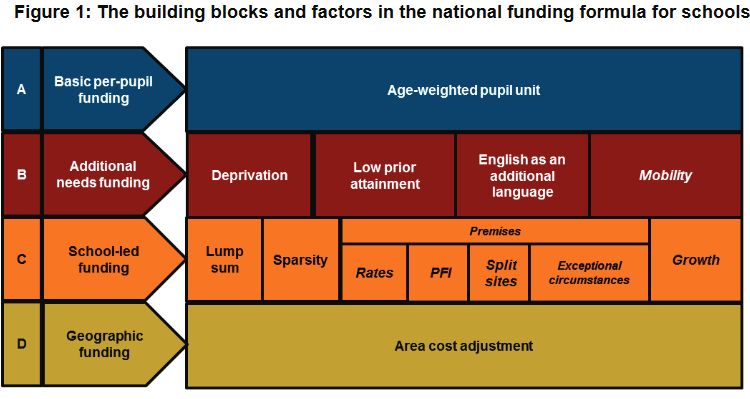
Bournemouth, Christchurch & Poole School Funding Consultation 2021-22

                                   CONTENTS

1. Introduction

2. School Funding for BCP 2020-21

3. Mainstream Schools National Formula (Option 1)

4. Development of Local BCP Formula

5. The High Needs Block

6. Transfer of Mainstream Funding to High Needs (Option 2)

7. Formula Affordability – Impact of Final Data

8. Financial Summary of Formula Options

9. Growth Fund

10. Central Schools Services Block – Services for all Schools

11. Centrally retained element for maintained schools only

12. Next Steps

Appendix 1        National Funding Formula 202-21
Appendix 2        National Formula 2020-21 applied to BCP Schools
Appendix 3        Schools Level Impact of Transfer Options
Appendix 4        Funding for LA Services for Maintained Schools
Appendix 5        LA Statutory Functions for Schools
Appendix 6        BCP High Needs spend forecast 2020-21
Appendix 7        2019-20 BCP growth fund policy, and proposed 2020-21 policy
Appendix 8        Summary of Consultation Questions
Appendix 9        Glossary of Terms

                                          2
Bournemouth, Christchurch & Poole School Funding Consultation 2021-22
1. Introduction
This consultation concerns DSG funding allocations for the financial year 2021-22 only. It
contains the detail of the DfE national school funding system throughout the DSG and
options for implementing locally by the Bournemouth, Christchurch and Poole (BCP)
authority.
The DSG is allocated to the LA through four separate funding blocks to support expenditure
on early years, mainstream schools, pupils with high needs and central school services. The
national arrangements for the financial year 2021-22 are similar to last year, but with some
differences.
There is a separate consultation underway with the sector, including where there are nursery
classes in mainstream schools, for early years funding that will run alongside this
mainstream schools consultation.
This document, therefore, considers only the national changes and local proposals for the
remaining three DSG funding blocks. Section 2 provides a summary of forecast funding
levels for BCP.
1.1. Schools National Funding Formula (NFF) 2021-22
The most significant decision for BCP Council and the Schools Forum is how the
mainstream schools NFF will be implemented to take into account the growing level of
funding needed to support pupils with high needs. The BCP formula set for 2021-22 will be
effective for maintained schools from April 2021 and for academies from September 2021.
It remains the Government’s aspiration to fund all mainstream schools in the same way and
the factors and methods within the NFF schools formula are expected to prevail now for
some years. Unit values will continue to change over time and there is likely to be some
evolution and refinement to reflect changing government policy.
The updated 2021-22 NFF for mainstream schools is described in Section 3. The starting
point before any other options are considered is to look at the impact of the 2021-22 NFF
calculated for each school. This is considered in Section 4 as Option 1. The school level
allocations through the local formula differ from those announced by the government through
the NFF predominantly as a result of the NFF protecting schools against 2020-21 NFF
baselines, whilst application through the local formula protects schools against their actual
2020-21 local allocations.
It is important to note in considering Option 1 that the NFF uses data from the October 2019
school census (lagged) to provide the total funding to the LA but the local formula must use
the equivalent data at October 2020. Data movements could therefore prevent this option
being fully affordable. A method to adjust the formula when final data is received from the
Education Skills Funding Agency (ESFA) is considered towards the end of this document in
Section 7.
Other options need to be considered should it be agreed that a level of the NFF should be
transferred to support pupils with high needs from central budgets rather than be allocated
directly to mainstream schools through the local formula.
3Bournemouth, Christchurch & Poole School Funding Consultation 2021-22
1.2. High Needs Budget Pressures
High needs budgets include funding for special schools, alternative provision and pupils with
high needs in mainstream schools and further education (FE) colleges. It is clear that the
growth in demand for Education Health and Care Plans (EHCPs) and the trend of pupils
permanently excluded from schools is unaffordable within the high needs funding allocation
from the DfE for 2021-22. Details of the national and local picture are provided in Section 5.
The Schools Forum received a report in October considering the high needs budgets across
BCP. The link to the report is included in Section 5.
Policies and tools have been developed and action plans are in place within the LA working
in partnership with schools to address high needs cost pressures. However, it must be
recognised that potential solutions to reduce costs significantly are for the medium and
longer term, and will require more pupils with an EHCP or currently excluded remaining in a
mainstream setting. Work is on-going to create additional places in mainstream units and
specials school and to manage demand.
1.3. Funding Transfer to High Needs 2021-22
Schools Forum has an important consultation role with oversight of all DSG budgets and will
need to decide if a level of mainstream school funding is to be transferred to support the
growth in pupils with SEND or excluded from mainstream schools. The decision can be
made for 2021-22 only with a fresh decision needed next year for 2022-23 if that remains an
option.
A funding transfer can be agreed by the Schools Forum of up to 0.5% of Schools Block
funding. A higher level would require the approval of the Secretary of State. The alternative
to a funding transfer of restricting expenditure to the level of funding is not possible given the
statutory framework of support required to be in place for pupils with high needs and the
continued growth in demand. With the growing number of pupils needing provision, there
continues to be pressure on the fixed cost of commissioned places, the level of top up
funding and the affordability of other services supporting pupils, including those in
mainstream schools.
How the NFF could be adjusted to support varying levels of transfer is considered in Section
6. The development of these proposals for consultation has been supported by the Schools
Forum (SF) but it is important to note that no decision has been made. The transfer levels
modelled provide no indication of what that level might be (if at all). The financial impact on
categories of schools under all options is shown in Section 8 at summary level with the detail
for individual schools in Appendix 3. Final decisions on the local formula for BCP will be
made at the Council meeting on 23 February 2021, after taking into account the views of
schools and decisions made by the Schools Forum.
During December 2020 the ESFA will provide the October 2020 mainstream school data to
enable final mainstream budgets to be calculated and overall affordability of planned unit
values to be assessed.
1.4. Growth Fund
As in previous years, the SF is to agree the level of the Growth Fund and how it is to be
allocated to schools with basic need growth. Proposals will be considered by the Schools
Forum in January 2021. Changes were made to the operation of the growth fund for the
current year (2020/21) to provide only a proportion of funding if the commissioned place
remained unfilled. This change was requested by schools forum last year when it became
4Bournemouth, Christchurch & Poole School Funding Consultation 2021-22
clear that a significant proportion of commissioned new places remained unfilled as pupils
had gone to other schools. There are no proposals for further changes in 2021/22.
This is covered in more detail in Section 9 of this consultation.
1.5. Central Schools Services Block
Central schools services include LA support to all schools for a range of services, charges
from the DfE over which locally there is no control (copyright licenses) and other statutory
services supporting individual pupils or the schools funding system as a whole. The proposal
to the SF will be that the budget overall is to be set at the level of funding received. The
allocation to individual LA central budgets will be considered and agreed by the SF in
January 2021..
This is covered in more detail in section 10 of this consultation.
1.6. Next Steps
During the Covid pandemic it is not possible to arrange physical consultation event. Instead,
we will be hosting an MS Teams virtual event on
• Thu 3rd December 2020, 13:30-15:00
Following the release of this consultation document an invite to this meeting shall be emailed
out – to book a place at this event please accept this invite. If you have any questions
relating to this event or the consultation more generally please contact:
Jack Cutler, Interim Schools and Early Years Funding and Sufficiency Manager
jack.cutler@bcpcouncil.gov.uk.
To respond to the consultation please complete the response form linked to here:
https://wh1.snapsurveys.com/s.asp?k=160612910253
The SF on 14th January 2021 will make its recommendation to the LA on the mainstream
school’s formula and make decisions regarding the other budgets included in the
consultation. At the same meeting final budget decisions will be made concerning any
transfer of mainstream school funding to support high needs budgets. The Council meeting
on 23rd February 2021 is scheduled to consider the outcome of this consultation with all
schools and the recommendations of the Schools Forum. The mainstream schools’ formula
for 2021-22 will be agreed at this meeting.
The unit values in the proposed formula will be tested for affordability following receipt of the
October 2020 school census data from the ESFA in December 2020, with any final
adjustments made according to an agreed method.
All final mainstream school budgets and the level and detail of the Growth Fund are to be
provided to the ESFA by the 21st January 2021.
1.7. Budget Timetable
Consultation Issued 23rd November 2020
Consultation Event Thu 3rd December 2020
Consultation Closes Monday 14th December 2020
5Bournemouth, Christchurch & Poole School Funding Consultation 2021-22
SF updated on final formula (updated data 14th January 2021
applied), recommendations and decisions
Mainstream school budgets sent to ESFA 21st January 2021
Council agree local formula 23rd February 2021
This document has been distributed to all Headteachers and Chairs of Governors in
mainstream, special and alternative provision across BCP.
2. Schools and Early Years Funding 2021-22
2.1. DSG Summary
A summary of the indicative funding provided by the DfE for 2021-22, is detailed in Table 1
below:
Table 1: DSG Draft Settlement 2021-22
Forecast Forecast Annual
%
Funding Block 2020-21 2021-22 Change
£000’s £000’s £000’s
Early Years
2 year olds Entitlement 2,391 2,391 0 -
3 year olds Entitlement 18,408 18,408 0 -
Pupil Premium 78 78 0 -
Disability Access Fund (DAF) 118 118 0 -
Total Early Years* 20,995 20,995 0 -
Schools Block
Primary (PUF** = £4,273) 108,304 118,339 10,035 9.3%
Secondary (SUF** = £5,635) 97,330 105,164 7,834 8.0%
Teachers Pay & Pension Grants*** 10,025 0 -10,025 -100%
Total NFF & other grants 215,659 223,503 7,844 3.6%
Premises 1,659 1,679 20 1.2%
Growth* 1,858 1,858 0 -
Total Schools 219,176 227,040 7,864 3.6%
Central School Services
NFF 1,746 1,702 -44 -2.52%
Commitments 291 233 -58 -20%
Total Central School Services 2,037 1,935 -102 -5.0%
High Needs
NFF 42,969 47,275 4,306 10%
Teachers Pay & Pension Grants** 769 0 -769 -100%
Total High Needs 43,738 47,275 3,537 8.1%
Total DSG Funding (plus Pay & pension grants) 285,946 297,245 11,299 4.0%
* Provisional allocations for the Early Years Block and Growth were not included with the July
information so are included at 2020-21 levels.
** Primary Unit of Funding (PUF) and Secondary Unit of Funding (SUF) have been multiplied by October
19 census numbers to provide a provisional allocation.
6Bournemouth, Christchurch & Poole School Funding Consultation 2021-22
*** Teachers Pay and pension grants have been included for comparison as included in the NFF
baseline in calculating the 2021-22 funding.
Some elements of funding are now fixed but final funding for BCP will be updated to reflect
the October 20 school census, final growth fund allocation, high needs place return, and
January 2021 census to account for change in the cross-border flow of high needs pupils.
The allocation of the DSG for 2021-22 includes some elements of historic funding according
to the local budgets in either 2017-18 (high needs and central services) or 2020-21 (amounts
outside the NFF in the schools’ block, and minimum funding guarantee protection). The reset
of the high needs and schools block baselines in 2017-18 means that funding transfers
between schools and high needs up to 2017-18 are now locked into the high needs historic
protection arrangements with funding restored to schools through the NFF from 2018-19.
The schools block allocation now includes the teachers’ pay and pension grants that were
previously funded through separate grants. This has been delivered through an increase to
Basic Entitlement rates and Minimum per Pupil Funding Levels of £180 and £265 per
primary and secondary pupil respectively. The per pupil 2020-21 baselines have also been
uplifted accordingly to continue this funding to school on the Minimum Funding Guarantee.
2.2. Schools Block Funding for Mainstream Schools
The Schools Block comprises 3 funding elements:
i. Schools National Formula (NFF) with separate primary and secondary per pupil
funding levels. The NFF has been applied to the 2020-21 data for each school, the
outcome being amalgamated and divided by pupil numbers to derive the primary and
secondary unit funding levels to the LA.
ii. Local formula elements outside of the national formula. This is provided at the
historic (now 2020-21) budgeted level. This includes business rates (funded at cost to all
schools) and exceptional premises factor (joint use agreements for 2 schools, split site
factor for 2 schools).
iii. Growth Fund allocations for basic need pupil growth. In 2020-21 the DfE changed
the previous historic allocation basis to one using demographic data. This continues for
2021-22, with final allocations being notified in December.
Table 1 above summarises the detail of BCP Schools Block Funding for 2021-22. In this
table 2020-21 and 2021-22 funding totals for the NFF both use 2020-21 pupil numbers and
data from the October 2019 census. The October 2020 census pupil numbers will be applied
to the above funding rates (SUF’s and PUF’s) to calculate final funding.
3. Mainstream Schools National Formula
3.1. Summary of Formula
The NFF was set as a formula to apply from 2018-19 onwards, with the first 2 years being a
transition period to the NFF, with capping on gains for formula schools for national
affordability. Such transition was complete for 2020-21, with capping removed and funding
values increased for all formula elements.
Figure 1 below shows the formula elements that constitute the NFF. The associated factors
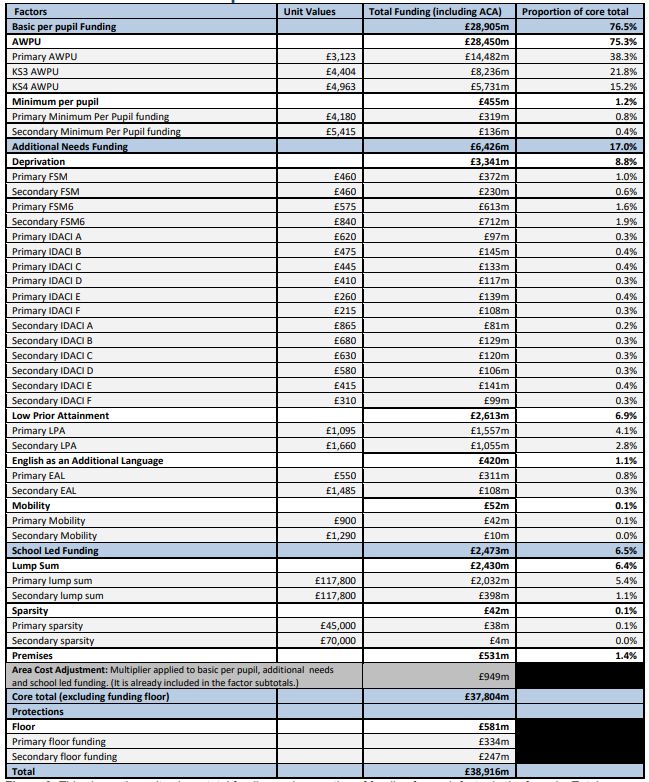
and unit funding rates for 2021-22 are provided for reference in Appendix 1. In addition to
7Bournemouth, Christchurch & Poole School Funding Consultation 2021-22
these factors, the formula includes protection arrangements for individual schools to provide
a minimum increase per pupil (against the 2020-21 NFF baseline), and an absolute
minimum per pupil funding level, considering the age range of the schools.
Note that the area cost adjustment in Figure 1 is not relevant for BCP as a low-cost area.
The PFI factor is also not relevant.
3.2. National Implementation of the Schools NFF 2020-21
The 2021-22 announcements from the DfE in July 2020 included the national context of how
LAs had responded to the continuation of the mainstream school NFF in 2020-21 (total of
151 LAs). Summary of the national progress, with BCP as a comparator is as follows:
• Across all LA’s, 90.41% of funding was allocated through pupil-led factors,
compared with 90.52% in 2019-20, and 90.57% in 2018-19. BCP was 91.8%, above
the national average due to the efficiency of our school organisation (relatively few
schools for the number of pupils keeping the total lump sum allocation lower than
average). This is also reflected in our NFF allocation.
• 52 LAs mirrored the NFF Primary lump sum rate (including BCP), and 54 for the
secondary lump sum (including BCP). This is an increase in the primary phase (from
48) but a slight decrease in the secondary phase (from 55) from 2019-20.
• 124 (82%) set Minimum Funding Guarantee (MFG) at least +1.0%. 105 (70%) set a
threshold of 1.84% mirroring the MFG protection in the NFF (includes BCP).
• The MFG was a mandatory factor, as were the minimum per pupil funding rates. 2
LA’s applied to use a higher per-pupil rate for primary pupils and one for KS3 and 4
pupils. Only 123 authorities actually allocated funding through this factor, since all
schools in the other 28 local authorities were already receiving over the minimum
level through the other funding factors. Only 31 authorities allocated more than 1%
of their funding through this factor, including BCP, which allocated over 2.3% due to
the characteristics of the pupils in our schools.
• The national Primary to Secondary funding ratio was 1:1.298 , compared with
1:1.350 in BCP, which was slightly higher than national due to our local school
8Bournemouth, Christchurch & Poole School Funding Consultation 2021-22
organisation leading to more key stage 4 pupils relative to key stage 3 than is
typical, thereby increasing the average secondary per pupil funding level.
3.3. Summary of NFF Changes 2021-22
The estimated 3.6% NFF growth shown in Table 1 is the net impact of:
• An increase to the Primary and Secondary minimum per pupil funding levels (MPPFLs)
of £250 (6.4%) and £150 (2.8%) respectively, where additional funding is provided to a
school when for all other formula elements, the outcome of the NFF is below nationally
set 2021-22 phase levels.
• A 3% increase to all formula rates with the exception of current free school meals that
has a 2% increase in line with inflation projections.
• A minimum funding guarantee (MFG) of 2% set against 2020-21 NFF funding levels for
schools where additional funding is provided when the outcome of the NFF is below the
schools’ historic funding level. This is compared with a 1.84% uplift in 2020-21. Note that
there is still discretion in the level of the MFG in the local formula.
3.4. Detail of NFF for 2021-22
The level of funding through the NFF for individual schools is used to derive the Primary and
Secondary unit values for the BCP allocation.
National Formula allocations by factor for 2021-22 compared with the local formula for 2020-
21 are shown below in Table 2, based on the 2020-21 local formula pupil base (the 2019
October census plus funded pupil growth).
Table 2: Impact by factor of the National Formula for 2021-22
BCP National Growth /
Formula Formula (Reduction)
Formula Factors
£000’s £000’s
2020-21 2021-22
£000’s %
Primary Basic Entitlement 78,219 86,662 8,442 10.8%
Secondary Basic Entitlement 77,790 86,206 8,415 10.8%
Deprivation Primary 7,560 7,763 202 2.7%
Deprivation Secondary 6,663 6,857 195 2.9%
Low Prior Attainment Primary 8,072 8,294 223 2.8%
Low Prior Attainment Secondary 5,967 6,152 185 3.1%
EAL Primary 1,346 1,383 38 2.8%
EAL Secondary 519 535 16 3.1%
Primary Mobility 260 268 7 2.9%
Secondary Mobility 121 125 4 3.2%
Looked After Children 0 0 0
Lump Sum 10,182 10,484 303 3.0%
Sparsity 56 58 2 3.6%
Floor Factor Primary (MPPFL) 2,463 5,054 2,590 105.1%
Floor Factor Secondary (MPPFL) 2,175 2,213 38 1.7%
MFG 1,359 1,030 -330 -24.3%
9Bournemouth, Christchurch & Poole School Funding Consultation 2021-22
Total Local/ National Formula 202,752 224,762 22,009 10.9%
Total Premises Factors 1,679 1,679 0 0.0%
Teacher Pay and Pension Grant 10,025 0 -10,025 -100.0%
Total Formula, Premises, Grants 214,456 226,440 11,985 5.6%
Total Primary Phase 98,643 104,474 5,831 5.9%
Total Secondary Phase 95,666 100,471 4,805 5.0%
Table 2 above shows how the NFF for 2021-22 compares with the distributed BCP total in
2020-21. This difference therefore includes surplus NFF allocated to BCP after required
growth and the NFF formula had been applied to the October 2019 census data for all
schools. A proportion of this surplus was transferred to the High needs Block (0.5% of the
Schools Block allocation), whilst the remainder stayed unallocated within the DSG.
The higher MPPFLs in 2021-22 apply to potentially 43 primary schools, 1 middle school and
6 secondary schools with more schools in 2021/22 drawn into this group from the primary
phase as the MPPFL increase is greater than for other formula factors.
The DfE have signalled that the NFF is still a work in progress. The current structure is
expected to remain unchanged in the use of factors and data but with a formulaic approach
continuing to be developed for 2022-23 for factors currently funded outside the NFF; namely
the premises factors including split sites and business rates. It is possible for 2021-22 to
replicate almost all aspects of the National Funding methodology in the local formula for
individual schools. The local formula will, however, retain the MFG. This continues to restrict
per pupil funding changes in 2021-22 compared with the 2020-21 local formula allocations
rather than referencing the 2020-21 NFF. Depending on the specific circumstances, these
funding adjustments may not be covered by the NFF to the LA.
4. Development of a Local BCP Formula
4.1. Principles and Options
The underlying principle in considering options is to adopt in the first instance the NFF
methodology in full. There is no guarantee that the current formula elements will remain
unchanged for 2022-23 but the main formula should remain relatively stable for a period of
time.
The main options for consultation are whether to adopt the NFF in all aspects as affordable
(option 1) or to make adjustments to the NFF to accommodate a transfer to support pupils
with high needs (option 2).
Whilst the sparsity factor only affects 1 school, this is planned to continue in BCP as
calculated by the NFF.
All proposals have been drawn up using data from 2020-21 to set unit values. This is to
enable a direct comparison to be made with the current unit values and formula allocations
across schools. This means that unit values may need to be updated should there be a
significant change in the pupil data for 2021-22 when released by the ESFA in December.
We have become aware, for example, that pupils entitled to free school meals have
increased significantly since the October 2019 data used in the calculation of the 2021-22
10Bournemouth, Christchurch & Poole School Funding Consultation 2021-22
primary and secondary per pupil funding levels being used by the ESFA in the December
2020 settlement for the LA. Proposals therefore include how the formula should be updated
in considering overall affordability later in the process in Section 7.
The overall financial impact for individual schools will change from that estimated in this
document when the data is updated in December 2020, particularly where there is a change
in pupil numbers, and schools should bear this in mind when estimating final funding for
2021-22.
4.2. Comparison BCP 2020-21 and NFF 2021-22
The local formula includes the NFF funded factors and those related to business rates
(funded at cost) and any specific premises-related factors that have been agreed with the
ESFA individually for a small number of schools.
Table 3 below compares each BCP local formula for 2020-21 with the NFF 2021-22 (option
1).
Table 3: Comparison of Local Formula 2020-21 and BCP NFF 2021-22
(a) Factors within the NFF
Factor BCP formula 2020-21 Option 1 NFF 2021-22
Rate Description Rate Description
Basic Entitlement -
3,037* £3,123
Primary
NFF NFF
Basic Entitlement - KS3 £4,283* KS3 £4,404
Secondaries KS4 £ 4,826* KS4 £4,963
£450 FSM £460 FSM
£560 Primary £575 Primary
Deprivation - FSM
FSMe6 NFF FSMe6 NFF
data
£815 Secondary £840 Secondary
FSMe6 FSMe6
Deprivation** - Range £210 to
NFF Range £215 to £680 NFF
IDACI bands £625
Prior Attainment
£1,065 NFF £1,095 NFF
Primary
Prior Attainment
£1,610 NFF £1,660 NFF
Secondary
NFF (Not NFF (Not
LAC £0 £0
used) used)
EAL Primary £535 NFF £550 NFF
EAL Secondary £1,440 NFF £1,485 NFF
Lump Sum Primary £114,400 NFF £117,800 NFF
Lump Sum
£114,400 NFF £117,800 NFF
Secondary
Sparsity NFF NFF
£875 Primary £900 Primary NFF -
Mobility NFF
£1,250 Secondary £1,290 Secondary formulaic
11Bournemouth, Christchurch & Poole School Funding Consultation 2021-22
Primary £3,930* Primary £4,180
Minimum per pupil
KS3 £5,065* KS3 £5,215
funding levels NFF NFF
KS4 £5,565* KS4 5,715
(MPPFL)
Secondary £5,265* Secondary £5,265*
Capping & Scaling None NFF None NFF
Minimum increase
+1.84% NFF +2.00% NFF
per pupil (MFG)
* Baseline rates for 2020-21 have been adjusted to include teacher pay and pension grants
** Upper range shown is IDACI band E as band F is not relevant across BCP.
(b) Factors and mechanisms outside the NFF
Factor BCP formula 2020-21 Option 1 NFF 2021-22
Business Rates At Cost At Cost
£101,017 £101,017
Exceptional Premises
(2 Schools) (2 Schools)
Split sites £230,288 (2 schools) £230,288 (2 schools)
It is proposed the same treatment is adopted for formula elements not included within the
NFF regardless of which option is taken forward.
The NFF applied locally to BCP schools is provided at a school level comparison against
2020-21 funding in Appendix 2.
4.3. Exceptional Premises (Joint use Agreements) and Split Site Factors
Exceptional premises and split sites factors are funded by the ESFA at historic levels outside
the NFF for 2 schools (split site) and 2 different schools (joint use). Their use has previously
been agreed by the ESFA based on evidence provided of additional costs of operating over
a split site or from the provision of joint use with the community of sports facilities. No other
schools across the new area meet the criteria used in establishing these factors so it is
proposed that the allocations continue without change.
4.4. Mobility
The measure counts pupils who entered a school during the previous 3 academic years but
did not start in September (this excludes reception pupils starting in January). A 6%
threshold is applied, and funding allocated based on the proportion of pupils above the
threshold (for example, a school with 9% mobility will attract mobility funding for 3% of
pupils).
4.5. MFG – budget change per pupil compared with 2020/21
The MFG is important as it provides funding stability between years. It must be set between
plus 0.5% and plus 2.0% per pupil (compared with plus 0.5% and plus 1.84% last year). It is
also to apply to top up funding rates for special schools and alternative provision (although
total funding change considers both place and top-up funding) but this MFG can be set at a
different level from that used in the mainstream formula. However, it must be set at least
0%, the same as last year.
12Bournemouth, Christchurch & Poole School Funding Consultation 2021-22
Funding changes for mainstream schools in 2021-22 will be due to differences between the
NFF formula values as well as data changes from the October 2020 census. A lower MFG
can be used to ensure funding is more aligned to the current school data, as well as
facilitating faster progress to achieve school funding consistency across BCP. It also
reduces the risk that an individual school’s allocation might exceed that provided through the
NFF. It is important to note that MFG in the NFF protects against the NFF LA allocations,
while MFG in the local formula protects against 2020/21 BCP formula school allocations,
which were slightly different.
If there is to be no transfer to High Needs then it is proposed that the MFG factor is set at
plus 2.00%, in line with the NFF rate.
Where the operation of the MFG would give rise to an unreasonably high level of protection
a request can be made to the ESFA to use an alternative calculation. A fresh disapplication
request must be made each year, and this is considered in the next section.
4.6. Disapplication Requests to ESFA - applicable for all options
4.6.1. Process
Disapplication from aspects of the School Finance Regulations can be made where there is
evidence that a school budget would be set unfairly. Due to the ESFA deadlines of 20th
November and 16th January 2021 (for amendments), disapplication requests to adjust the
formula have been submitted for approval. This is to ensure a decision can be received in
time to meet the DfE timetable for the completion of the school budgets submission.
The potential formula adjustments below, if agreed by the ESFA, will not be implemented
until a recommendation from the Schools Forum has been taken into account.
4.6.2. Disapplication to adjust the MFG calculation for all through schools adding
primary year groups
It is proposed to vary the calculation of the MFG for two all-through schools (St Peters RC
School and Avonbourne Girls Academy) that are growing in the primary phase, should these
schools receive additional funding through the MFG. The protection method needs to be
weighted to reflect the lower funding levels of primary pupils. If this adjustment is not made
then these growing schools could trigger MFG protection at a higher rate simply as a result
of having more primary pupils, rather than due to a change in the characteristics of pupils at
the school.
The disapplication request reduces the 2020-21 budget baseline used in the national MFG
calculation method. An adjustment of this type is expected by the DfE with a template
provided for their approval.
The calculation is formulaic based on pupil numbers by Key Stage in both 2019-20 and
2020-21 to derive the adjusted 2020-21 baseline for the MFG. The DfE has approved a
disapplication request of this nature from both BCP and legacy Bournemouth LAs in
previous years.
13Bournemouth, Christchurch & Poole School Funding Consultation 2021-22
QUESTION 1a:
Do you agree with the disapplication request to adjust the MFG baseline for all-through schools
adding primary year groups represents a fair adjustment to the local formula?
☐ Yes
☐ No
☐ Unsure
If no, what do you consider an appropriate adjustment and why?
4.6.3. Disapplication to set the MPPFLs below NFF
The NFF MPPFLs are mandatory for use in the local formula and are not to be set below the
NFF values and any disapplication would be agreed by the DfE only if these were
unaffordable. this disapplication request would allow BCP the flexibility to set MPPFLs below
the NFF levels to allow schools on the MPPFL to contribute to any transfer to the High
Needs Block should this be necessary.
QUESTION 1b:
Do you agree with the disapplication request to set the MPPFLs below NFF for all schools
protected through these levels, should this be necessary to allow all schools to contribute to any
transfer to the High Needs Block (HNB), represents a fair adjustment to the local formula?
☐ Yes
☐ No
☐ Unsure
If no, could you propose an approach that would allow MPPFL schools to contribute towards any
transfer to the HNB, should this be necessary?
5. The High Needs Block (HNB)
5.1. Overview
The HNB primarily supports individual pupils, either through additional funding within
mainstream, special school funding or funding to specialist providers. It also includes the
funding for those unable to attend school due to exclusion or medical needs.
14Bournemouth, Christchurch & Poole School Funding Consultation 2021-22
HNB pressures are now recognised as a national issue linked to several drivers, including
government policy changes. The introduction of a new Code of Practice for Special
Educational Needs and Disabilities (SEND) from age 0 to 25 (previously age 0 to 19) has
seen an increase in pupils requiring EHCPs, and across the country there is becoming ever
increasing reliance on I/NMSS provision as a result of sufficiency pressures within special
schools and increasing complexity of need.
Figure 2: National Picture of Growing Numbers of children and Young people with
Statements or EHC plans
Figure 3: National Picture of High Needs Placements
15Bournemouth, Christchurch & Poole School Funding Consultation 2021-22
Figure 4: National Picture by type of need
5.2. Context for BCP
Pupils with SEND in mainstream schools are supported by a combination of the school
delegated budget (Schools Block funding) and top up funding (SEN packages) and outreach
services funded from the HNB.
In the Schools NFF the largest impact on overall funding (and costs) is in most cases from
changing numbers on roll. In contrast, the cost of the growing numbers of children in the high
needs budget is far greater than the additional funding for BCP with a funding gap of
£11.8million in-year for 2021-22 originally identified in the 2020-21 funding consultation
unless planned initiatives were successful. Due to significant ongoing work, this projected
funding gap has now been reduced by almost £7million to £4.9million without any transfer
from the school’s block, reducing to a gap of £3.9million assuming a 0.5% transfer into the
high needs block in 2021-22.
Based on the total funding announced by the government last year for schools over the
three years from 2020-21 to 2022-23 BCP funding in the High Needs block is expected to
grow at similar levels each year (approximately 8% per annum) with a provisional increase
announced of 8.1% (£3.54m) in 2021-22 as shown in table 1 above.
16Bournemouth, Christchurch & Poole School Funding Consultation 2021-22
This increase reflects the growing demand nationally as demonstrated in figures 2, 3 and 4
above. Locally, budget pressures mirror the national picture from the main budget drivers
due to the:
• High level of permanent exclusion for younger children (particularly in year 9) in
recent years, with this trend continuing in academic year 2019-20. Early signs are
that strategies introduced last year are starting to work but the impact of Covid 19 on
pupil attendance at school in the summer term will be obscuring recent trends.
• Increasing numbers of pupils with EHCPs.
• Increasing complexity of needs inflating the average cost of an EHCP.
• Local specialist provision becoming full, with greater use of higher cost Independent
and Non-Maintained Special School (INMSS), and Bespoke. BCP will have created
over 240 places since Sep 2019 by Sep 2021 and the average cost per EHCP
placement is seen to be reducing partly as a result of this.
5.3. BCP Budget Position 2020-21
The DSG budget for BCP in 2020-21 was set with a funding gap of £5m, which is currently
forecast to be almost achieved Action plans are in place to dampen funding demands, but
further budget growth will be needed with current trends continuing in 2021-22.
5.4. Budget Progress 2021-22
The October Schools Forum report linked to here
https://democracy.bcpcouncil.gov.uk/documents/s20631/Item%207%20-
%20HNB%20financial%20strategy%20report%20FINALv3.pdf
contains information on the DSG budget position and the financial strategy underpinning
bringing this budget out of a deficit position. Such strategy includes support for the high
needs block from the schools block via an annual transfer of 0.5%.
The factors responsible for the budget shortfall remain the same as those included within
this consultation last year, although significant work has been undertaken to reduce these
pressures.
The BCP budget for high needs has been high compared nationally over many years and
this reflected the pattern of provision rather than providing for a greater proportion of pupils
with SEND; however, the prevalence of EHCPs in the school population in BCP last year
exceeded that of national. LA historic expenditure is protected in the National High Needs
Formula through a funding floor mechanism in a similar way to MFG for mainstream school
funding. Funding increase to the High Needs Block has been provided through an uplift to
this funding floor for 2021-22.
The draft budget in Appendix 6 includes an increase in places and top up funding for pupils
with an EHCP in mainstream school bases and the FE College, as well as within maintained
and academy special schools
Included within post school budgets, there is significant further growth for the cost of post 19
EHCPs, as the changes in the 2014 SEND Code of practice are still impacting. Parental
expectations have continued to grow over time and particularly for education up to age 25. It
17Bournemouth, Christchurch & Poole School Funding Consultation 2021-22
should be noted that plans for individuals can be determined through a legislative process
and this can direct a more costly placement through the SEND Tribunal system.
The budget for 2021-22 is based on a reduction in permanent exclusion placements as a
result of the BCP on-going preventing exclusions strategy, for which an objective is to
reduce the number of permanent exclusions from BCP schools.
5.4.1. Consideration of Options
A large proportion of the high needs budget is supporting individual pupil placements in
specialist provision and as such the areas to reduce the budget are, therefore, limited.
To maintain the current level of services for mainstream schools and individual pupils within
the HNB a transfer of funding will be necessary from mainstream schools. The outcomes
from the reviews may identify some solutions to reduce costs but these are likely to be for
the longer term.
A transfer of funding to high needs budgets would reduce the amount of funding available for
the mainstream formula. In preparation for this decision, the next section considers how
funding could be found from the NFF for varying levels of transfer when this is established.
6. Transfer of Mainstream Funding to High Needs (Option 2)
6.1. DSG Regulations
It is possible to transfer funding from mainstream schools to support expenditure in other
funding blocks. This requires the agreement of the SF. A transfer can be made of up to 0.5%
of mainstream school funding. A transfer above this level requires the approval of the
Secretary of State. Any decision is for 2021-22 only and will be needed at the January SF
meeting so that work can progress to finalise the mainstream school formula.
6.2. Summary of Approach
The final outcome in 2020-21 was that the NFF was fully affordable for all schools after a
0.5% transfer was made to high needs. This may not be possible in 2021-22 as the number
of pupils eligible for FMS have increased since last year and a surplus may not be available
from the growth fund allocation which has not yet been announced. Schools forum members
have mixed views about how any adjustments should be made to the NFF. Some members
feel that all schools should contribute to a transfer if one is agreed, with others not
supporting any reduction in the minimum per pupil funding levels (MPPFL) within the local
formula
6.3. Principles
It is proposed that all schools should see reduced funding compared with their potential NFF
allocations as equitably as possible, as allowed within the financial regulations, or where a
disapplication of regulations is supported through this consultation and agreed by the
secretary of state.
A further consideration is that all schools need to support activity to reduce the demands on
the high needs budgets so that less of the NFF funding is used to support individual pupils
through the high needs budget in future years.
18Bournemouth, Christchurch & Poole School Funding Consultation 2021-22
6.4. Levers to Adjust Funding
Less than half of all schools across BCP in 2021/22 would potentially receive NFF
allocations according to the funding factors only. Other schools have formula allocations
uplifted through MPPFLs or MFG, so adjusting the formula factors only would not provide a
contribution from all schools.
Schools have been categorised by the potential levers to adjust funding and these are
summarised below:
LEVER 1. Funding Protection – MFG rate to use. Level of the MFG between + 0.5%
and plus 2%
LEVER 2. Reduce a formula unit value. A sensible value to adjust would be the
phase appropriate Basic Entitlement rate.
LEVER 3. Reduce the MPPFL for each phase. This requires a disapplication request
There would be some compound effect from using a combination of levers. The illustrations
of funding levels released through each lever in this document assume they are applied in
the order shown in the above paragraph. This is in line with the approach taken locally for
2020-21.
The paragraphs below illustrate how funding can be released from the NFF through
adjusting each lever. The adjustments considered below are considered in isolation of any
other levers; applying levers simultaneously results in compound effects.
6.5. Lever 1 – Reducing MFG from the NFF
The impact of varying MFG from 2% NFF is shown in Table 4. Setting the MFG at its lowest
level of plus 0.5% releases the maximum possible of £290k. Setting the MFG at plus 0.5%
allows schools that would see reduced funding compared with 2020/21 and potentially also
under the NFF stay closer to their funding allocations determined according to their most
recent data.
Table 4 – impact of variable Minimum Funding Guarantee
MFG Funding released from 2020-21 % Pupils
NFF Schools impacted
Block
1.5% £91,462 0.04% 3,810
1.0% £182,923 0.08% 3,810
0.5% £262,085 0.12% 3,810
6.6. Lever 2 - Scaling back Basic Entitlement
This lever can be used as an alternative to release funding from formula schools, as per
Table 5. The maximum funding released under this approach would be to scale back funding
through the formula at any level by varying amounts, and all formula schools are on MFG,
(illustrated using MFG at 2.0%).
19Bournemouth, Christchurch & Poole School Funding Consultation 2021-22
Table 5 – impact of scaling back Basic Entitlement factor values. MFG at 1.84%
Basic Entitlement % of Funding released from 2020-21 NFF % Pupils
NFF Schools impacted
Block
99.5% £ 307,820 0.14% 25,449
99.0% £ 543,939 0.24% 25,449
98.5% £586,214 0.26% 25,449
MAX £640,884 0.28% 25,449
6.7. Lever 3 – Reducing MPPFL below the NFF (requires a disapplication of
regulations)
A disapplication request is required to set MPPFLs below NFF). Following a successful
disapplication, MPPFLs could be set at a level that the DfE would allow. Table 6 shows the
illustrative impact of reducing MPPFLs by varying amounts (a disapplication to reduce rates
below these levels is not expected to be proposed and so is not modelled below).
Table 6 – impact of variable MPPFL rates
MPPFLs Funding released from 2020- % Pupils
21 NFF Schools impacted
Block
NFF 2021-22 - £15 £380,772 0.17% 17,153
NFF 2021-22 - £30 £752,055 0.33% 17,153
NFF 2021-22 - £50 £ 1,212,541 0.53% 17,153
6.8. Maximum release from NFF (with / without disapplication of regulations)
An indication of the maximum funding to be released from NFF from MFG, Formula and
MPPL schools, in that order, is provided in Table 7. The effects of the various formula
changes are compounded in this table.
Table 7: Illustrative extremes for transfer to High Needs considerations
All schools All schools
All schools
on MFG on MFG
Description MFG @0.5% on MFG
@2.0% or @0.5% or
@0.5%
MPPFL MPPFL
MFG 0.5% 2.00% 0.5% 0.5%
Basic Entitlement 100% Max released Max released Max released
2020-21
MPPFLs NFF NFF NFF formula +
0.5%
% Transfer 0.12% 0.28% 0.81% 3.13%
Maximum funding that
could be released from 262 641 1,848 7,106
NFF formula £’000s
Disapplication Yes – to vary
No No No
required? MPPFL
20Bournemouth, Christchurch & Poole School Funding Consultation 2021-22
6.10 Varying Levels of Funding Transfer
Table 8: Transfer Options – Proposals to Release Funding from the NFF
Transfer
MPPFLs
Formula Changes Basic
changed
(implemented in this MFG Entitlement all
against 2021-
order) phases %
22 NFF £
2021-22 NFF +2.00% 0 100.0%
(a) 0.5% only MFG &
Formula schools +1.00% No change 98.3%
contribute
(b) 0.5% all schools
+1.40% -20 99.3%
contribute
Table 9: Comparison of Option Unit Values / Mechanisms for 2021/22
Factor Option 1 Option 2 Option 2
NFF a 0.5% MFG b 0.5% all schools
and Formula
Basic Entitlement Primary £3,123.00 £3,069.91 £3,101.14
Basic Entitlement KS3 £4,404.00 £4,329.13 £4,373.17
Basic Entitlement KS4 £4,963.00 £4,878.63 £4,928.26
Minimum per Pupil Funding £4,1800 £4,1800 £4,160
Level Primary
Minimum per Pupil Funding £5,215 £5,215 £5,195
Level KS3
Minimum per Pupil Funding £5,715 £5,715 £5,695
Level KS4
Gains Cap None None None
MFG 2.00% 1.00% 1.4%
21Bournemouth, Christchurch & Poole School Funding Consultation 2021-22
QUESTION 2a:
Do you agree with the principle that if a funding transfer takes place all schools should make a
contribution through a lower budget allocation than would otherwise have been the case?
☐ Yes
☐ No
☐ Unsure
If no, please suggest an alternative
QUESTION 2b:
If you agree that all schools should make a contribution, do you agree with the approach
outlined in Table 8 and Table 9 for varying levels of transfer?
☐ Yes
☐ No
☐ Unsure
If no, what do you consider an appropriate adjustment and why?
QUESTION 3:
Do you agree that the basic entitlement is the most appropriate formula factor to adjust?
☐ Yes
☐ No
☐ Unsure
If no, which unit values should be different from those proposed and why?
22Bournemouth, Christchurch & Poole School Funding Consultation 2021-22
7. Formula affordability
Final school budgets will be calculated following receipt of the October 2020 census data
from the DfE in December and application of the agreed local formula. Affordability of
planned unit values and other formula elements will need to be assessed again at that time.
Should the proxy data for additional needs reduce (increase) between Oct 19 to Oct 20
censuses, the SUFs and PUFs based on Oct 19 proxy data will allocate more (less) funding
to the Schools Block than required to distribute locally through NFF. There is an indication
that the prevalence of free school meals across the area may have increased by
approximately 20% compared with last year’s prevalence, which is likely to impact
affordability.
These final formula adjustments could involve:
i. In the case of a funding shortfall:
• Introducing a gains cap
• Applying lower MFG protection (if greater protection than 0.5% is initially planned)
• Reduction in formula unit values.
• Reducing the MPPFLs (subject to the disapplication required being approved).
• A combination of the above.
ii. In the case of a funding surplus:
• Applying greater MFG protection (if a level less than +2.00%) is initially planned).
• Increase a factor unit value for any set below the NFF.
• Increasing the level of the MPPFL
• A combination of the above.
• Include any surplus within any funding transfer to the High Needs Block.
• Offset the historic deficit
7.1.1. Proposal
It is proposed to manage any shortfall in funding by adjusting the values of the Basic
Entitlement factor for each phase by the same proportion. Any surplus in funding is added to
the High Needs Block transfer as far as permitted.
QUESTION 4a
Do you agree that to manage any funding shortfall or excess the unit values of the Basic
Entitlement for each phase should be adjusted by the same proportion?
☐ Yes
☐ No
☐ Unsure
If No please explain your choice and suggest an alternative method.
23Bournemouth, Christchurch & Poole School Funding Consultation 2021-22
The resourcing for the High Needs budget is set out in Appendix 6. The vast majority of this
spend is on place and top-up funding within early years providers, mainstream and special
schools, AP placements for both hospital education and exclusions, and non-maintained and
independent special schools
QUESTION 5
The High Needs budget shown in Appendix 6 includes an illustrative 0.5% transfer from the
school block, limiting the growth in the deficit in 2021/22 to an estimated £3.9 million. Do you
support some level of transfer while the strategy adopted is being implemented recognising that
schools have a part to play in limiting costs and it takes time to create new places and manage
change?
☐ Yes
☐ No
☐ Unsure
please provide further comments here
8. Financial Summary of Formula Options
8.1. Funding Impact of Proposals for Individual Schools
A summary of the impact for schools of Option 1 and Option 2 (only MFG and Formula (a),
and all schools (b) contribute) provided in Table 10 below:
Table 10: Summary Final Formula Positions (based on 2020-21 data)
Number of schools NFF
Option1 Option 2a Option 2b
Transfer Level 0% 0.50% 0.50%
MFG 10 11 10
MPPFL 50 56 51
Fully formula funded 29 22 28
Total Schools 89 89 89
Appendix 3 provides the indicative impact of the proposals for each school for each transfer
level within Option 2. The estimated budgets use the data applicable to the 2020-21 local
formula. This removes the impact of changing pupil numbers and pupil data and enables a
direct comparison to be made with 2020-21 funding levels.
8.2. High Needs Financial Strategy for 2021-22
This is a continuation of the financial strategy set out in the 2020-21 consultation, which is
beginning to show positive results.
24Bournemouth, Christchurch & Poole School Funding Consultation 2021-22
QUESTION 6
Considering Appendix 6, do you have any suggestions on any area(s) where spend on high needs
pupils can be reduced without breaching statutory requirements?
☐ Yes
☐ No
☐ Unsure
If yes, please provide details of this/ these
QUESTION 7
Up to what level of transfer from the Schools Block would you support? (please provide a tick
against the level you agree). Please provide any rationale behind your decision.
☐ No Transfer
☐ Up to 0.5% (Schools Forum level of approval without need for further
consideration by the Secretary of State.)
☐ Up to 1.0% (Schools to contribute 25% towards the forecast 2021-22 in year
high-needs funding gap)
☐ Up to 1.5% (Schools to contribute 50% towards the forecast 2021-22 in year
high-needs funding gap)
☐ Other
Please provide any rationale behind your decision.
QUESTION 8
Do you agree that should funding remain with schools rather than be transferred to the HN
block for 2021-22, and there is no clear evidence the High Needs funding gap is closing as a
result, the LA should consider a greater transfer to HN in 2022-23, and that you would support
such a transfer?
☐ Yes, as long as no reduction in NFF is needed
☐ Yes, even if the NFF needs to be reduced
☐ No
☐ Unsure
If No, please provide further details
25Bournemouth, Christchurch & Poole School Funding Consultation 2021-22
9. Growth Fund
9.1. Proposed policy for 2021-22
The local authority is required to produce criteria through which growth funding is allocated,
that must be agreed by the Schools Forum. Growth funding can be allocated for the following:
• support growth in pre-16 pupil numbers to meet basic need
• support additional classes needed to meet the infant class size regulation
Since 2019-20, funding to cover mainstream pupil growth is allocated to the LA using a
formulaic method based on lagged growth data. The amount allocated in 2020-21 was
£1.858m. The allocation for 2020-21 has not yet been confirmed.
Growth funding is provided to schools under local optional and national statutory
arrangements. It is statutory to provide growth through the all funding formula factors for new
and growing schools, where the school is either new or has changes its age range and does
not yet have all year groups open. There is a new free school opening with 150 places in year
7 in September 2021. The cost to BCP of implicit growth from this is expected to be
approximately £503,000.
It is proposed to use the existing 2020-21 policy for the local optional Growth Funding for
2021-22 (explicit growth where we have discretion).
This policy funds each new place added at the relevant key stage Basic Entitlement for the
period September to March, for both permanent and temporary growth. Where the growth
does not materialise according to the following October census, that place is only funded at
30% of the above. New and growing schools in line with the definition in 9.3 will receive start
up and diseconomy of scale funding from the Growth Fund in-line with that previously provided
by the DfE to new Free Schools, along with the resources funding also provided to such free
schools.
Whilst there is no requirement to set a growth fund, there is an expectation that a growth fund
is established to support at the least, in some way, pupil growth requested by the LA to meet
basic need. Further, there is a requirement that the growth fund allocates start up and
diseconomy of scale funding to new local Free Schools delivered through the presumption
route. It would also be disingenuous to stop paying, or significantly reduce the payments, for
existing growth that is working its way through the school.
9.2. Indicative financial cost of funding growth
The total estimated growth fund cost annually is as below. Note the growth fund allocation
has already been agreed for 2020-21. If Livingstone Academy does not open with 150 year
7 places for Sep 2021, a contingency should be added to the 2021-22 growth fund that
would cost up to an additional £385k. Should Livingstone Academy open for Sep 2021 with
150 year 7 places, this will cost approximately £503,000 through implicit growth.
Table 11: Summary of explicit growth fund under proposed policy
2020-21 2020-21 2021-22 2022-23 2023-24
Budget Forecast Forecast Forecast Forecast
Total 499,671 496,871 279,676 421,316 421,316
26Bournemouth, Christchurch & Poole School Funding Consultation 2021-22
Further details of the proposed policy are set out in Appendix 7, with a more detailed
breakdown of forecast spend.
QUESTION 9
Do you support the growth fund proposal as set out in section 9?
☐ Yes
☐ No
Please provide your reasons/ provide further details for your choice below:
10. Central Schools Services Block
10.1. Funding and Draft Budget 2021-22
It is proposed to allocate the central services block funding to the LA for the related
services. A national formula was introduced for 2018-19 to determine LA allocations for on-
going central service for all schools. It is largely based on pupil numbers but with an
allowance to reflect relative levels of deprivation across LAs. There is a protection
arrangement in places with BCP higher levels of historic spend being protected with a
maximum reduction of 2.5% per year.
Other funding in this block is for historic commitments at cost which is scheduled to
decrease by 20% each year unless an application to the DfE is successful in retaining
enough funding to cover prudential borrowing repayments and early retirement
commitments. This application was successful last year and as nothing has changed it is
hoped it will be again for 2020-21. Services for maintained schools only are not included in
the Central Schools Services Block as described in section 3. Central School Services are
statutory duties of the LA but the allocation to budgets is decided by Schools Forum. The
draft budget for these services is as follows.
Table 12: Central School Services 2021-22
2020-21 Change 2021-22
Central School Services
£000’s £000’s £000’s
School admissions and access arrangements 423 0 423
Licences purchased by DfE 235 17 252
Servicing Schools Forum 18 0 18
Ex ESG services all schools 1,007 0 1,007
Commitments - premature retirements (ex
20 -2 18
DCC)
Commitments - ASD Base / other 275 0 275
Funding secured post budget in 2020-21* 59 -59 0
Total Expenditure 2,037 -44 1,993
27Bournemouth, Christchurch & Poole School Funding Consultation 2021-22
* Included in total for 2021/22 (assuming application will be successful again)
10.2. School Admissions and Servicing of the Schools Forum
Any further reduction would require schools to consider how individually they manage the
Schools Admissions Forum or school admissions process in the absence of coordinated
arrangements.
The Schools Forum Budget supports the cost of the meeting itself and attendance of early
years voluntary and private sector members at sub-group meetings.
10.3. DfE Licenses
The list of licences negotiated on behalf of all schools by the DfE is to be included in the
budget 2020-21 consultation. However, the LA has no influence over which licenses are
included or the level of the DfE change on the DSG.
The list of licenses included in the charge is the same as last year as follows:
Christian Copyright Licensing International (CCLI)
Copyright Licensing Agency (CLA)
Education Recording Agency ERA)
Filmbank Distributers Ltd (For the PVSL)
Mechanical Copyright Protection Society (MCPS)
Motion Picture Licensing Company (MPLC)
Newspaper Licensing Agency (NLA)
Performing Rights Society (PRS)
Phonographic Performance Limited (PPL)
Schools Printed Music Licence (SPML
10.4. Ex ESG Services
These services are LA statutory duties on behalf of all schools, including academies and
special schools. The proposed budget allocations have been increased as noted above. The
list of these services is included in Appendix 5 alongside the different duties for maintained
schools only for clarity. Steve to provide latest numbers.
Table 13: Ex ESG Services 2021-22
Ex ESG Services 2020-21 Change 2021-22
£000’s £000’s £000’s
Statutory and Regulatory Duties 445 0 445
Education Welfare 414 0 414
Asset Management 148 0 148
Total Ex ESG services all schools 1007 0 1007
If this level of funding is not allocated to support the LA costs, then the consequences could
be that:
• Activity supporting the Children and Young People’s Partnership Board would need
to be reduced.
• Support for pupils with poor school attendance could be reduced.
• Support to schools with basic need capital projects would reduce.
28You can also read


