School of Computing Undergraduate Programmes 2020/2021 - Professor JAIN, Sanjay Vice Dean, Undergraduate Studies
←
→
Page content transcription
If your browser does not render page correctly, please read the page content below

School of Computing
Undergraduate Programmes
        2020/2021
          Professor JAIN, Sanjay
    Vice Dean, Undergraduate Studies

                                       1
Outline
• Degree Requirements
• Module Registration via MogReg@EduRec
  Platform
• Academic Challenge and Academic Advice
• Useful Information
• Teaching in Semester 1

                                           2
Degree Programmes
Undergraduate Programmes:
 B.Comp. (Honours) in Information Security   InfoSec
 B.Comp. (Honours) in Computer Science         CS
 B.Comp. (Honours) in Information Systems      IS
 B.Eng. (Honours) in Computer Engineering     CEG
 B.Sc. (Honours) in Business Analytics        BZA

                                                       3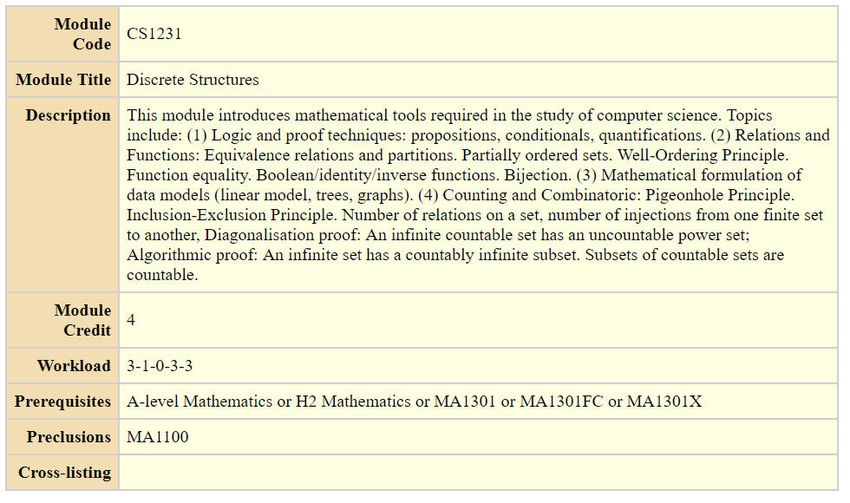
Co‐operative Programmes
• Business Analytics
• Information Security

More details will be shared at the Programme briefing via
zoom webinar sessions conducted by the Departments in
the afternoon on 13 July 2020 2.30 pm.
Please apply with SoC UG Office (email:
comajy@nus.edu.sg) by 20 July 2020 5.00 pm using the
prescribed application form as these students are
required to follow the recommended study schedule
throughout their candidature.
                                                        4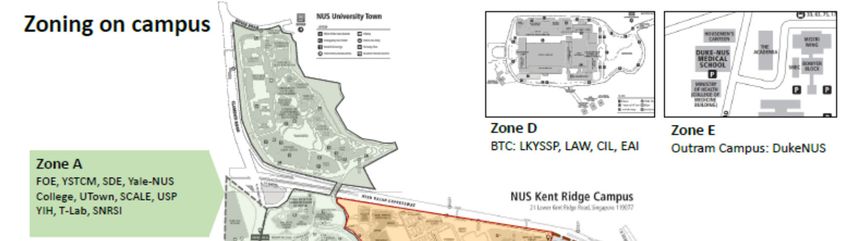
About this Course Briefing ‐ I
This course briefing is meant for students
pursuing the Bachelor of Computing and
Bachelor of Science in Business Analytics
degrees.
Course briefing for Bachelor of Engineering in
Computer Engineering will be delivered by the
CEG Joint Academic Committee from both
Faculty of Engineering and School of Computing.
5
About this Course Briefing ‐ II
This course briefing touches on general
information relevant to studying in the School
of Computing
It will not cover detailed information about
individual programmes.
Please attend the Programme Briefing via
zoom webinar session conducted by the
Departments on 13 July 2020 at 2.30 pm to find
out more information
6
Module ‐ I

               Workload of a module
                4MC = ~ 10 hrs/wk
“Weight” of a module:
               5MC = ~ 12.5 hrs/wk
     The “MC”
   Lectures‐Tutorials‐Lab‐Field work‐Preparation
                    Must pass these modules before taking CS3235.
                      Usually good idea to do level 1000 in Year 1,
                        level 2000 in Year 2 for pre‐req purposes

                                                                      7
Module ‐ II

Must not have taken
 MA1100 before

                             8
Modes of Module Taking
                                              Grade   Grade
1. Taking with Grade                                  Point
   – Obtain a letter grade at the end of       A+     5.00
     the course:                               A      5.00
                                               A‐     4.50
      A+, A, A‐, B+, B, B‐, C+, C, D+, D, F
                                               B+     4.00
                                               B      3.50
   – Included in the calculation of your       B‐     3.00
     performance                               C+     2.50
                                               C      2.00
                                               D+     1.50
                                               D      1.00
                                                F     0.00

                                                              9
Modes of Module Taking
1. Taking with Grade
2. Taking CS/CU modules
  –   Pass/fail (completed satisfactorily/completed unsatisfactorily)
  –   Not an option with student
3. Taking the S/U Option
  – Enhanced Grade Free Scheme (see:
    https://myportal.nus.edu.sg/studentportal/academics/ug/su‐
    homepage.html)
  – Encourage students to try modules outside their fields of study
  – Option to choose with student

                                                                    10
Enhanced Grade‐Free
Scheme ‐ I
• Grade free scheme to encourage students to try
modules outside their fields of study
– Obtain either a Satisfactory (S) or an Unsatisfactory (U)
record
– Not included in the calculation of your performance
– Three day window to decide on S/U after release of
results
– Irrevocable!!
11Enhanced Grade‐Free
Scheme ‐ II
• S/U Option is limited to
– level 1000 modules, and
– level 2000 modules without NUS modules as pre‐requisites
– level 2000 Communication and Ideas & Exposition modules
offered by CELC and UTown
– Language modules at all levels offered by FASS’ Centre for
Language Studies and Yale‐NUS College
• Cannot exercise this option on modules:
– a. dropped with a “F” grade during the semester
– b. in which a student has been found to plagiarize
– c. in which a revised grade had been prescribed by the Board
of Discipline
12Enhanced Grade‐Free
Scheme ‐ III
• Available for incoming undergraduates admitted from AY2018‐19 onwards.
• May exercise the S/U option for up to 32 MCs in the first two regular
semesters; if this is not fully utilised, the remaining S/U option may still be
exercised in subsequent semesters, for up to max of 12 MCs.
• Variations on the limit of S/U options that can be exercised may apply for
specific groups of students, such as the following:
i. Students without prior university experience but are granted 20 or more
Advanced Placement Credits (APCs) at the point of admission to NUS may
exercise the S/U option for up to 20 MCs in the first two regular semesters; if
this is not fully utilised, the remaining S/U option may still be exercised in
subsequent semesters, for up to max of 12 MCs.
ii. Students with some prior university experience (which are being recognised
towards the NUS degree) may exercise the S/U option for up to 12 MCs
anytime during their candidature, including the first two regular semesters.
iii. Students with a prior university degree are not eligible for the grade‐free
scheme.
13Continuation Requirement
Third Semester
First Semester Second Semester
Onwards
Probation if CAP < 2.00
Advisory for students for current semester;
found to be performing
All students progress
poorly despite the grade‐ Dismissal if CAP < 2.00
free scheme for two consecutive
semesters
14Grade, Grade Points
and S/U Option
Grade Grade Point S/U Options
A+ 5.00
A 5.00
A‐ 4.50
B+ 4.00
Satisfactory (S)
B 3.50
B‐ 3.00
C+ 2.50
C 2.00
D+ 1.50
D 1.00 Unsatisfactory (U)
F 0.00
Note: A candidate who has obtained a D or higher
grade cannot repeat the module.
15Cumulative Average Point (CAP)
CAP = sum (module grade point × modular credits)
sum (modular credits)
rounded up to 2 decimal places
• Note:
To graduate, a student MUST obtain a
CAP of at least 2.00
16CAP and SAP calculations
(Example)
Module Module Name Grade MC Grade Points
Code Point
CS1101S PROGRAMMING A 4 5 20
METHODOLOGY
CS1231 DISCRETE STRUCTURES B- 4 3 12
ES1103 ENGLISH FOR ACADEMIC B- 4 3 12
PURPOSES
MA1521 CALCULUS FOR COMPUTING B 4 3.5 14
IS2101 BUSINESS & TECHNICAL D+ 4 1.5 6
COMMUNICATION
GER1000 QUANTITATIVE REASONING S 4 null null
Total 20 64
CAP = 64/20 = 3.2
SAP (Semester Average Point) = 64/20 = 3.20
17Degree Structure
University Level Requirements (ULR)
Common for all programmes in NUS
unless in University Town College Programme or
University Scholars Programme
Programme Requirement
Programme Essentials
Essentials specific to the programme
Programme Electives
If you fail an elective, you may retake or read
another elective
Unrestricted Electives (UE)
18General Education/
University Level Requirement
• Students are to read 5 modules – one from
each pillar.
• Students are strongly encouraged to
complete the GE modules within the first 2
years of their candidature.
19General Education/ULR
• Modules that lay the foundation for important
life skills
• Five pillars
GEH – Human cultures
GEQ – Asking questions
GER – Quantitative Reasoning
GES – Singapore Studies
GET – Thinking and Expression
20• Do one GE module from each pillar
• UTown Programme students replace the ULR
curricular space meant for 4 GE pillars
(besides Quantitative Reasoning pillar) by
other requirements.
• GER1000 is a graduation requirement for 2020
cohort for ULR for UTown residential
programme students.
21USP Modules and GE Mapping
Applicable to 2020 Cohort
GE Pillar Fulfilled by the Following
USP Module Designations/Codes
Thinking and Expression UWC, UAR, ULT, UPI, USE, UHB, UCV, UQF
Human Cultures ULS, UNL, UPC, UQR, UBM, UIT
Asking Questions (Q module) USS, USR, USP
Singapore Studies Singapore Studies
(http://www.usp.nus.edu.sg/curriculum/ac
ad‐structure/fulfilling‐singapore‐
studies.html)
GE Pillar To be read by all NUS students
Quantitative Reasoning GER1000
(QR module)
22Exceptions, Exemptions,
Exclusions
• University Scholars Prog (USP) & UTown College Prog (UTCP)
Required to read QR module
The rest of the GE requirements are fulfilled by USP/UTCP modules.
Can use UWC module to replace either CS2101 or IS2101
• Ridge View Residential College
Allowed to read GEQ1917 in fulfilment of the Asking Questions pillar
Allowed to read ES1601 in fulfilment of CS2101 or IS2101.
• All students who are required to read GER100 and/or GEQ1000 will be preallocated*
the modules by the Office of Senior Deputy President and Provost (SDPPVO)
Hall Freshmen will attend their tutorials at their Halls:
(a) GER1000 in Year 1 Sem 1;
(b) GEQ1000 in Year 1 Sem 2
* Diversity by track will apply for tutorial group allocation.
23ULR: QR and Q modules
• Students are pre‐allocated the Quantitative
Reasoning (QR) module GER1000 or Asking Question
(Q) module GEQ1000 in either first or second
semester of their first year of study in random by the
Office of the Senior Deputy President & Provost
(SDPPVO) unless otherwise specified for their degree
requirements.
24QR and Q modules: Pre‐Allocation
Guidelines for SoC
The Office of the Senior Deputy President & Provost (SDPPVO) will preallocate the
modules below:
YEAR 1 YEAR 2
Major
Sem 1 Sem 2 Sem 1 Sem 2
GER GEQ GER GEQ GER GEQ GER GEQ
USP X
Business Analytics X O O O
Information Security X O O O
Non‐
O O O O O O
Other Hall
Majors (CS,
IS)
Hall X X
Legend
X : the module will be pre‐allocated in the Semester indicated.
25
O : the module will be pre‐allocated on a random basis over the Semesters indicated.Useful Links & Contacts for
QR and Q modules
GER GEQ
Appeals/Inquiries Submit Appeals/Inquiries in ModReg@EduRec
Enquiries QRadmin@nus.edu.sg AskQ@nus.edu.sg
Tutorial Registration Ballot for a tutorial slot at Select Tutorials : Round 1 and
schedule Round 2.
Tutorial Balloting info https://wiki.nus.edu.sg/pages/viewpage.action?pageId=
194740263
26• ULR
• Programme Requirements
• Unrestricted Electives
– Modules from SoC/other Faculties to make up
total modular credit requirement
27Programme/Major
Requirements
Programme Essentials
– Core Modules/Computer Science Foundations/ …
– Must pass all of them with letter grades (unless with
permitted S/U option)
– Include at least two to three programming modules
depending on programme of study
– CS1010/CS1010J/CS1010S/CS1101S Programming Methodology
– CS2030 Programming Methodology II and CS2040 Data Structures and
Algorithms (for IS and BZA), CS2030S/CS2040S (for CS)
– CS2040C Data Structures and Algorithms (for InfoSec)
Programme Electives
– Each programme has its own list of elective modules
– Allow you to choose modules from a basket 28Degree Requirements ‐ I
Pass at least 160 MCs (approx. 40 modules) comprising:
University Level Requirements – pass 20 MCs
Programme Requirements
Fulfil Programme Essentials, Programme Electives
Unrestricted Electives
CAP must be at least 2.00.
29Degree Requirements ‐ II
No more than 60 MCs at level‐1000.
Residency requirement: must Complete MCs at NUS,
where is :
50% of required MCs for degree requirement must be at NUS
These MCs must be earned from NUS modules with assigned grades,
or modules with an ‘S’ or ‘CS’ grade.
30Degree Requirements ‐ III
Polytechnic Graduates:
Advanced Placement Credits:
20 MCs from Unrestrictive Electives
(not included in computation of 60‐MC limit of level‐1000
modules)
Up to 20 MCs from programme requirement
31Other Requirements ‐ I
Normal Candidature for our undergraduate programmes:
4 Years
Maximum Candidature for 4‐year Programme:
5 Years
Maximum Candidature for Double‐degree Programme:
6 Years
32Other Requirements ‐ II
Number of MCs to read every semester:
at least 18 MCs
Completed the programme in the 8th semester or earlier, but
want to do either an additional Regular semester or Special Term
to pull up your CAP?
Possible with permission from UG Office
Must take at least 18 MCs
Must take only level‐3000 or above modules
Max permissible workload for 1st semester of study (no
waiver allowed)
No more than 23 MCs ( for Single degree students with or without
minor/second major)
No more than 27 MCs ( for students who are enrolled in USP or, DDP, CDP)
33Honours Classification
Honours Classification CAP
Honours (Highest Distinction) 4.5 – 5
Honours (Distinction) 4.0 – 4.49
Honours (Merit) 3.5 – 3.99
Honours 3.0 – 3.49
Pass 2.0 – 2.99
Fail Below 2.0
34Mind Twister I
Adam is into his final semester. His CAP is
3.35, and his total MC accumulated is 142.
He intends to take 20MC of modules in this
semester. What should be his average A+ 5
grade for the final semester in order to get A 5
a CAP of 3.50? (Assuming no S/U options.) A- 4.5
(142x3.35 + 20 x G) / 162 ≥ 3.50 B+ 4
B 3.5
G ≥ (162x3.50 – 142x3.35)/20
= 4.57 B- 3
C+ 2.5
Examples:
C 2
4 A- (4.5) and 1 A (5.0) G = 23/5 = 4.6
2 B+ (4.0), and 3 A (5.0) G = 23/5 = 4.6 D+ 1.5
D 1
1 B (3.5), 1 B+ (4.0), and … No Way!! F 0
35Mind Twister II
Zack’s CAP is 1.49, and his total MC accumulated A+ 5
is 40. He intends to take 20MC of modules in the A 5
coming semester to achieve a CAP of at least 2.0. A- 4.5
What should be his average grade for the coming B+ 4
semester in order to achieve that? (Assuming no B 3.5
S/U options.) B- 3
C+ 2.5
≥ (60x2.0 – 40x1.49)/20 = 3.02
C 2
Examples: D+ 1.5
4 B- (3.0) and 1 B (3.5) 15.5/5 = 3.1 D 1
2 C+ (2.5), 1 B- (3.0), 1 B (3.5), 1 B+ (4.0) F 0
15.5/5 = 3.1
36Academic Warning,
Probation and Dismissal
To continue in a programme, a student must
not have:
– CAP below 2.00 for two consecutive semesters A+ 5
A 5
Student receiving academic probation must A- 4.5
B+ 4
receive counselling from academic advisors.
B 3.5
B- 3
To restore to good standing before C+ 2.5
reaching the state of dismissal: C 2
Bring CAP to the level of 2.00 in the D+ 1.5
following semester D 1
F 0
37Can I drop a module after
securing it?
Add new modules By end of week 1
Drop modules without
By end of week 2
grade penalty
Drop modules with “W” Week 3, Day 1 to last day
grade of recess week
Drop modules with “F”
Week 7, Day 1 onwards
grade
38What do Employers look for
…
www.comp.nus.edu.sg/~sanjay/Google.mp4
39Activities in SoC
• University education consists of more than
just attending classes
• Develop a network of life‐long friends
• Explore and find out what you are
passionate about
40Activities in SoC
• SoC/NUS offers
o Internships for work experience
o Entrepreneurship programme
o Design‐Your‐Own‐Module (DYOM)
http://www.nus.edu.sg/registrar/education‐at‐nus/undergraduate‐
education/design‐your‐own‐module.html
o Open source and volunteer work
o Leadership programme
o Student clubs and activities
o Student exchange programme
o Research experience
o Competitions
o Teaching experience
41Internships
Advanced Technology Attachment Programme (ATAP)
Industry Internship Programme (IIP)
• Course credit for 6 month internship
Student Internship Programme (SIP)
• Course credit for 3 month summer internship
Students also go on overseas internship
(see Project Intern at the end of this briefing)
• Google
• Facebook
• Microsoft Compulsory internship. Details during afternoon briefing.
• …
42What do Employers look
for …
Project Intern
How you too, can land an internship with Google,
Microsoft, Facebook and the like.
http://ymichael.github.io/projectintern
43What do Employers look
for …
www.comp.nus.edu.sg/~sanjay/KPMG.mp4
44Oversea Experience
Student Exchange
• University of British Columbia
• University of California
• University of Melbourne
• University of Illinois, Urbana‐
Champaign
• Technische Universitat Wien
• University of Copenhagen
• Tsinghua University
• Ecole Superieure D' Electricite
• University of Stuttgart
• Tokyo Institute of Technology
• Korea Advanced Inst of Sci &
Tech
• University of Stockholm
• King's College London
45Entrepreneurship
Shanghai Stockholm New York
(China) (Sweden) Israel
(USA)
Singapore Beijing Shenzhen
(China) (China)
Munich Lausanne SE Asia
Toronto
Courses on Digital Entrepreneurship
• CP2201 Journey of the Innovators
• IS3251 Principles of Technology Entrepreneurship
VaSCo (Validating Startup Concept)
Up to $10,000 to develop idea
46Open Source and Volunteer
Work (CP3107 and CP3110)
Build systems for volunteer organisations and gain course credit
Get paid by Google for doing Google Summer of Code and Computing
open source work and gain for Voluntary Welfare Organisations can
course credit be mapped to 3‐month internship (SIP).
47Independent Software
Development Project (Orbital)
• Every SoC student should have
the confidence to
– propose their own project
– learn what is necessary to do the
project
– deliver what was promised
• For 1st year students
– Over the long vacation (May—
July 2020)
– Work in pairs
– Basic project – web app in Python
• Option to propose more advanced
project
– 4 MCs independent work (graded
as CS/CU basis under CP2106)
48Student Club/Interest Groups
NUS Computing Club
… and others
49Outline
• Degree Requirements
• Module Registration via EduRec@EduRec
Platform
• Academic Challenge and Academic Advice
• Useful Information
• Teaching in Semester 1
50How to Get the modules
you want?
Module Registration via EduRec (aka Education Records
System) Platform
employs a rules‐driven priority‐based engine to allocate modules to
students based on Curricular needs; Seniority in the programme;
and Module preferences
Details at: http://www.nus.edu.sg/ModReg/
Navigation
myEduRec > Academics > Module Registration
Priority Score of module(s)
Am x Bm x Cm
User Guide
http://www.nus.edu.sg/registrar/info/modreg/ModR
eg‐Student‐User‐Guide.pdf 51Priority Score of module(s)
= Am x Bm x Cm
Programme Requirements Category (in descending order of
points) – Am
UTown/USP modules
Major core and Major Specialisation modules
Major modules
Second Major Specialisation modules
Faculty Requirement modules
Second Major modules
Restricted/Direct Minor modules
Unrestricted Elective / General Education modules
52Priority Score of module(s)
= Am x Bm x Cm
Students’ Seniority (in descending order of points) – Bm
Year 4/GLB Year 3/Graduating Year 3
Year 3
Year 2/E‐Scholars Programme Year 1
Year 1
53Priority Score of module(s) =
Am x Bm x Cm
Rank Preference of Modules (in descending order in descending order of
points) – Cm
Rank 1
Rank 2
Rank 3
Rank 4
Rank 5
Rank 6
Rank 7
Rank 8
54TIE‐BREAKERS
Tie‐breakers (in descending order of consideration)
Students who have not attained minimum workload
Student’s home faculty is module host faculty
Remnant CORS points (applicable for AY2019/2020 only)
Module feedback points
Random balloting
55Outline
• Degree Requirements
• Module Registration via EduRec@EduRec
Platform
• Academic Challenge and Academic Advice
• Useful Information
56Academic Challenge: Double
and Concurrent Degrees
CS/IS with Business BZA with Business CS with
Admin/Accountancy Admin Maths/Applied Maths
IS with Masters in
CS/IS with Masters in
IS/BZA with Engineering and Tech
Management with
Economics Innovation
NUS Business School
Management in CMU
Self designed DDP
French Grandes
with another NUS
Ecoles
Faculty
57Undergraduate Research
www.comp.nus.edu.sg/~sanjay/SandCanvas.mp4
Undergraduate Research
Opportunity Programme
(UROP)
Chris Chua
Summer research attachment with
MIT, Imperial College, King’s College
Brown University, Tsinghua
58Academic Challenge: University Scholars Programme Breadth and Interdisciplinary Studies Students in the Scholars Programme must read and pass: ‐ 3 compulsory foundation‐tier modules worth 12 MCs ‐ 8 Inquiry‐tier modules worth 32 MCs ‐ 1 reflection‐tier module worth 4 MCs Which includes GER1000 module worth 4 MCs FOUNDATION‐TIER Writing and Critical Thinking Quantitative Reasoning Foundation University Scholars Seminar INQUIRY‐TIER Humanities and Social Sciences Sciences & Technologies REFLECTION‐TIER Senior Seminar 59
Academic Challenge: Double‐Major
               Programmes, Minor Programmes

• Double‐major Programmes
•    Double major in Management
•    Double major in Statistics
•    Double major from many faculties

• Minor Programmes offered by other faculties
•    Math, Statistics, Economics, Management, …

                                                  60
Academic Advisors
• Questions you may have:
– Should I do a DDP, USP, FDDP, CDP, SEP, specialisation, minor, second
major, etc.?
– I want to be an entrepreneur. How do I go about it?
– What courses should I do to help prepare for a career as a software
engineer, consultant, etc.?
– I am interested in research. How do I go about getting research
experience?
– Should I do a PhD?
– I am struggling academically. How should I study? What courses
should I select next semester?
• Talk to an academic advisor!
– http://www.comp.nus.edu.sg/undergraduates/useful_advisors.html
61Faculty Mentor
You can talk to an academic advisor any time you
need academic advice
Perhaps you want to have a closer mentorship
relationship with
Someone who has started a company and can advise you
about entrepreneurship?
Someone who teaches or does research in a particular
area so that you can get advice about the area?
Someone who interacts actively with mentees in his or
her group using the social media?
Senior students with the same mentor who can also act
as peer mentors?
All freshmen will be assigned a mentor.
Your mentor will contact you to meet you online.
62Career Advisor
• Venue: COM1 01‐23
• Some questions you may have for
the Career Advisor:
– How to I plan for my career?
– How do I write a good CV?
– How do I prepare for my interview?
– How do I network with people during my internship?
– What are the resources I can use to get a job?
– I failed to secure an internship this semester. What did I do
wrong? How can I do better next semester?
63Advice on Passing a Module
Perform consistently in Continual
assessment (CA) and examination.
Assignments
CA Tutorial Attendance
Mid-term Tests/Quizzes
If you miss your examination due to medical reason, make sure you ask
the doctor to fill up the Form for Application for Special Consideration,
and submit the form online via via EduRec. Login to EduRec and navigate
to My Homepage > Academics > Examinations > Access Special
Consideration > Make Submission for Current Semester..
64Form for Application for Special
Consideration
65Academic Problems
• Every year, around 5% of freshmen face
academic problems
– CAP below 2.00 (C average)
– Have to see an academic advisor
• You don’t want to be one of them.
• What got them into academic difficulties?
66Why they did badly … and
what they did to improve …
• No real difficulties, I just didn't study. I was lazy and just wanted to
enjoy university life.
• I started studying and taking interest in programming.
• I am not trying to blow my own trumpet, however, the first time I did
it, I didn't do any work at all. That is to say, I didn't attend lectures,
tutorials recitation nothing of sorts. So if I may say so, the prime
reason for coming down in the particular course was rather a complete
negligence on my part …… Especially when I had come directly after A
levels this sudden influx was a bit hard to grasp, inspite of being
warned that uni would be like this. =)
• Stuck to the basics, attend lectures, tutorials and recitations more than
I did the first time. Started the labs earlier …….
67Why they did badly … and
what they did to improve …
• Firstly, I had difficulty understanding programming as a whole
since I had no background in computing when I first took CS1010.
Therefore, learning C Programming is almost the same as learning
a new language.
• Secondly, I didn't really know how to apply basic algorithms to
solve problems (labs).
• I attempted all tutorial questions and clarified my doubts during
tutorials.
• I exchanged ideas on how to solve problems and weigh their
complexity or efficiency with my tutorial mates.
• Increase my self‐confidence, really.
68Why they did badly … and
what they did to improve …
• Complacency and adaptability. CS1010 is a module that I took in the
first semester. Besides adapting to a brand new school, I also need to
juggle between the new social life and a completely different (from JC)
way to study a module. I think the main problem is not sure how to go
about studying this module, no computing background, unsure how to
go about asking question and that the nature of the module has a very
huge snowballing effect once you lag at the very beginning of the
course.
• Practice, be consistent and keep asking questions (both to yourself and
the lecturer), keep the programs that you practise, realised your
mistake, remember them and keep going on.
69Advice for Grade‐Free
modules
• Reduce stress of transition to university
• Observed issues
– Take too many difficult modules
– Too relaxed at till mid‐semester, then too late to
catch up
• Learn your basics well – you will continue to
need it
70If you think you may
struggle …
1. Try not to overload yourself. Generally, doing more than 5
modules a semester is not a good idea for struggling students.
2. Try to work consistently through the semester, rather than
cramming at the end. In particular, try to ensure that you do all
the tutorial exercises.
3. Work in a group if possible. Students who study in a group tend
to do better.
4. Other than compulsory modules, try to pick modules that suit
your strengths.
5. Do some research on the modules before signing up for them.
You can drop a module with ‘W’ grade before the end of the
recess week if you think that you cannot cope. Min
71
workload per semester must be maintained.Module and Workload
Waivers
• Waiver of Module Prerequisite Chains
Appeals must be provided with strong justifications
- Submit Appeals/Inquiries in ModReg
CS Dept appeal procedure for CS and IFS coded modules at:
https://dochub.comp.nus.edu.sg/soc_wiki/ug_wiki/course_planning/notes_o
n_cs_pre-requisite_waiver
Appeal procedure for BT and IS coded modules: email A/P Tan Chuan Hoo
at tancho@comp.nus.edu.sg
• Waiver of class/exam time-table clashes:
Not supported by the School
• Workload per semester: At least 18 modular credits (MCs)
• Workload increase for freshmen:
Will not be supported for first semester of study
Do not file any such request/appeal via ModReg@EduRec
72Outline
• Degree Requirements
• Module Registration via ModReg@EduRec
Platform
• Academic Challenge and Academic Advice
• Useful Information
• Teaching in Semester 1
73SoC Office of
Undergraduate Studies
• Vice Dean: Prof JAIN, Sanjay
• Assistant Deans: Assoc Prof CHAN Chee Yong
Assoc Prof KAN Min‐Yen
Assoc Prof SETIONO, Rudy
Assoc Prof Aaron TAN
• Deputy Director: Ms TOH Mui Kiat
• Associate Director: Ms Pamela LIM
• Manager: Mr LOW Mun Bak
• Manager: Ms Diana WONG
• Executive Ms Ang Jia Ying
Ms Ivy Ng
Office of Undergraduate Studies is located at:
COM1 Level 2 Room 19
Email: socug@comp.nus.edu.sg 74SoC Office of Student Life
• Vice Dean: Assoc Prof Gary TAN
• Assistant Dean: Assoc Prof WADHWA, Bimlesh
• Assistant Dean: Dr TAN Wee Kek
• Manager: Ms Adele CHIEW
• Asst Manager: Ms Nur Arifah
SoC Student Life Office is located at COM1, Level 2 Room 19
Contact details:
SoCFamily@comp.nus.edu.sg
Student Life team aims to foster student success by providing students with access to
broader experiences that would provide them with a balanced university life both
within and beyond the classroom.
Details at: http://www.comp.nus.edu.sg/studentlife/
75SoC Office of Industry
Relations
• Vice Dean: Assoc Prof NG Teck Khim
• Assistant Dean: Assoc Prof HUANG Zhiyong
• Assistant Dean: Dr Anand Mohan RAMCHAND
• Associate Director: Ms Jane LIM
• Executives: Mr John Elijah TAN & Ms Vel TAN
SoC Office of Industry Relations is located within Dean’s Office at COM1, Level
3 Room 27. It liaises with companies to provide internship opportunities
(https://www.comp.nus.edu.sg/studentlife/intern/) and organises career
fairs for our undergraduates and graduates.
Contact details:
internship@comp.nus.edu.sg
76Useful Information
NUS Bulletin http://www.nus.edu.sg/registrar/nusbulletin/ has all the
information about rules and regulations governing your degree.
SoC undergraduate page http://www.comp.nus.edu.sg/cug/ has
information relevant to SoC undergraduates. Please choose the
requirement for your own cohort.
UG Wiki https://wiki.nus.edu.sg/display/SUW/SoC+UG+WIKI has
informal information that is useful to SoC undergraduates .
You will be informed on how to participate in ATAP, SIP, and NOC at the
appropriate periods. In addition, ad hoc job postings can be found at
https://share.nus.edu.sg/soc/Lists/Jobs/AllItems.aspx (you may subscribe
using to the list). Similarly, you may want to subscribe to industry related
announcements at
https://share.nus.edu.sg/soc/Lists/Industry%20related%20announcements
/AllItems.aspx .
77Useful Information
ModRegWebsite: http://www.nus.edu.sg/ModReg/index.html
NUSMods: Students can now search and view the module and timetable
information from NUSMods. Information on pre-requisites and preclusions of a
module, whether they have S/U option, lab-based, independent-study modules or
SkillsFuture funded can be found.
Course Briefing Slides to be deposited:
http://www.comp.nus.edu.sg/programmes/ug/freshmen/
Computer Accounts
NUSNET account
• Given out during registration
• Email address: exxxx@u.nus.edu
• SoC UNIX account
• Email address: socrocks@comp.nus.edu.sg
Enquiries: SOCUG@comp.nus.edu.sg 78Outline
• Degree Requirements
• Module Registration via ModReg@EduRec
Platform
• Academic Challenge and Academic Advice
• Useful Information
• Teaching in Semester 1
79SoC: Current Plans
• As situation is evolving, we may need to change plans
• For example: Singapore speeded up start of phase 2.
If situation improves later in the semester, then we
may allow for more F2F classes.
• Our main aim is to ensure safety for all, along with
giving quality education subject to constraints
80Teaching in Sem 1
Some Basic Principles for restarting NUS
• Safety
• Containment in case of spread
• Maintain quality of education
81Safety
• Students must declare their temperature online twice daily (both am and pm) via uNivUS app for
daily healthy declaration and NUSafe entry. Temperature declaration must be made first before
coming to campus
• More information of declaration systems/NUS/MOH circulars on COVID‐19 measures/information
can be found at https://emergency.nus.edu.sg/
• Students should come to campus only if they have classes on the day
• Not too many students in a class ( 50 will be via e‐learning.
• Safe distancing (2m distance between students)
• All the rooms are marked to indicate where students can sit given the safe distancing constraint
• If you have any COVID symptoms, do not come to class, go to University Health Centre (UHC) or a
qualified medical doctor
82Campus Zoning for
Containment of COVID‐19
• NUS divided into 5 zones
• 3 zones in the main campus
• School of Computing is in Zone C
• Business School, FASS also in Zone C
• UHC is zoneless (all students can go to UHC)
83Campus Zoning for
Containment of COVID‐19
84Campus Zoning for
Containment of COVID‐19
• School of Computing (SoC) students are in Zone C.
• Besides F2F classes in SoC, you can also attend any F2F
classes in Business school and FASS.
• You are not allowed to cross to other zones (other than the
zone your hall of residence resides) to attend F2F classes.
For examples, F2F classes in Science and Engineering.
• You can eat in Zone C canteen only.
• The zone you are in is based on your home faculty resides.
85F2F and e‐learning • Lectures/Tutorials/Labs/recitations which are of
Assessments and Exams
•   100 % CA for some modules
•   Current plan: for modules which have final exam, it will be e‐exam
•   To maintain integrity of the e‐exams, students need to follow honour code
    and the protocols as laid down by the University and the lecturers.
•   Strict action will be taken against those who violate the honour code and
    exam protocols.
•   Students should read and familiarize themselves with the code of conduct
    document from NUS
•   Please read E‐Exam SOP for Students via mySoC ‐> Academic
     link: https://mysoc.nus.edu.sg/academic/e‐exam‐sop‐for‐students/ using NUSnet account

                                                                                             87
Meeting Etiquette for Webinar Sessions (both
faculty and dept briefings) on 13 July 2020
• Please check your audio settings.
• Your microphone is muted with video switched off by default upon joining
the webinar session.
• You may post your questions via the webinar during the Q&A segment.
The most “voted” ones will be answered first.
• This session will be recorded. If you choose to participate in this webinar,
you are presumed to have given your consent of your video/audio text
comments in these recordings and the recordings will be shared.
88Thank you!
Q&A
89You can also read


