Secure Administration - Australian Cyber Security Centre
←
→
Page content transcription
If your browser does not render page correctly, please read the page content below

Secure Administration
JANUARY 2019
Introduction
Privileged access allows administrators to perform their duties such as establishing and making changes to key servers,
networking devices, user workstations and user accounts. Privileged access or credentials are often seen as the ‘keys to
the kingdom’ as they allow the bearers to have access and control over many different assets within a network.
Privileged access is often a key goal of an adversary. They can use privileged access to:
propagate malware to multiple workstations and servers
add new user accounts, including privileged accounts
bypass security controls for applications, databases and file servers
implement configuration changes to make future access easier.
Given the scale and complexity of enterprise networks, it is reasonable to assume that at least one standard user
account and workstation within an organisation's internet-connected network could be compromised by an adversary.
As administrator accounts often have unrestricted access to critical resources, this document focuses on protecting
sensitive accounts and resources from an adversary who has gained a presence on a network.
This document is designed to complement and expand upon the guidance contained within the Australian
Government Information Security Manual (ISM).
Secure administration and the cloud
The primary intent of this document is to secure the administration of traditional corporate network assets such as
domain controllers and application servers as well as the infrastructure used for the administration of these assets.
Administration of cloud based infrastructure, systems and applications brings different challenges and may require a
different approach. As such, not all security controls within this document may be directly applicable to the
administration of cloud assets and may require assessment and adjustment before being applied to infrastructure
used for cloud administration.
Throughout the document, the security controls will contain guidance on applying the recommendation within a
cloud environment.
Rationale for implementing secure administration
The goals of an adversary, whatever they may be, are far easier to achieve when privileged access on a network or
system has been attained. Assuming an adversary has not been able to achieve their goals with the access granted by
their initial foothold, gaining privileged access to a network or system may be an extremely high priority. This is for a
number of reasons:
1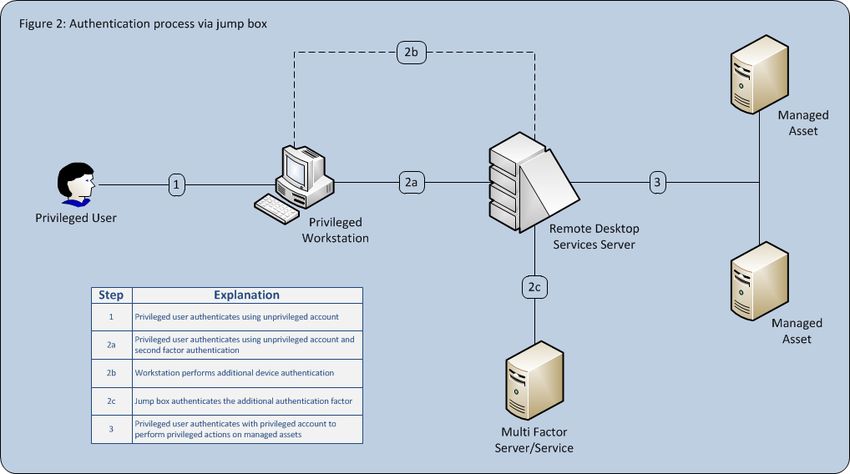
Wider malware propagation. Privileged accounts, especially built-in Administrator accounts and groups such as
Domain Administrators, have privileged access to a wide range of systems. If an adversary compromises such an
account, they can more easily propagate malware to multiple workstations and servers. This increases the chance
of accessing the information they want while also making it harder to remediate the cyber intrusion.
More intrusive access. Privileged access will also provide an adversary greater access to systems. For example,
privileged access allows an adversary to utilise more advanced tools and techniques, such as credential theft, in
order to move laterally within a network.
Access to sensitive data stores. Privileged access may allow an adversary direct access to a sensitive data store,
such as a database, without having to access the data store through regular means where illegitimate access may
be audited and detected.
Insight into detection and remediation activities. If an adversary has sufficient access, they may gain insight into
any detection and remediation activities being performed. This may enable the adversary to avoid complete
detection, or hamper the effectiveness of mitigation activities. This may necessitate the creation of secure
administration assets prior to any significant remediation work proceeding.
Organisations which implement secure administration strategies can increase their resilience to a successful cyber
intrusion by preventing or greatly delaying an adversary from gaining access to privileged accounts and credentials.
Furthermore, any incident response and remediation work will be more effective and agile.
Lessons from an incident response team
The Australian Cyber Security Centre’s (ACSC’s) incident response team has responded to compromises of
government networks. In the majority of compromises, an adversary had managed to acquire significant privileged
access, such as Domain Administrator access, which allowed them to more efficiently steal, modify and damage
data; move laterally within the network to gain access to additional resources and remaining undiscovered on the
network for longer.
A well-known cyber incident where privileged accounts were compromised and used to further the goals of the
adversary is the 2014 compromise of Sony Pictures Entertainment. A large amount of data, including intellectual
property that directly affected the company’s operations, was exfiltrated. In addition, sensitive emails were
publically disclosed that severely damaged the company’s reputation. Finally, malware was installed on workstations
that wiped hard drives which resulted in the loss of a large amount of corporate information.
While also being a critical security control, the implementation, or lack of, a secure administration environment can
make a significant difference to the effectiveness of investigation and remediation activities carried out by incident
responders in response to a cyber incident. This is particularly the case when the incident responders know that the
adversary already has privileged access, or suspects that it is highly possible due to a poor network security posture.
When confronted with a significant network compromise, one of the common remediation activities an incident
response team will recommend is to establish a secure administration environment. Because of this, resources which
would otherwise be focused on remediation activities may be spent on establishing a secure administration
environment. This can lead to a delay in the full remediation of a network, increasing the consequences associated
with a compromise, as the adversary has more time to propagate within the network resulting in the theft of
sensitive information.
Elements of secure administration
The table below provides an outline of the key security controls which underpin secure administration within an
organisation. Each security control is expanded upon in greater detail in later sections of this document.
2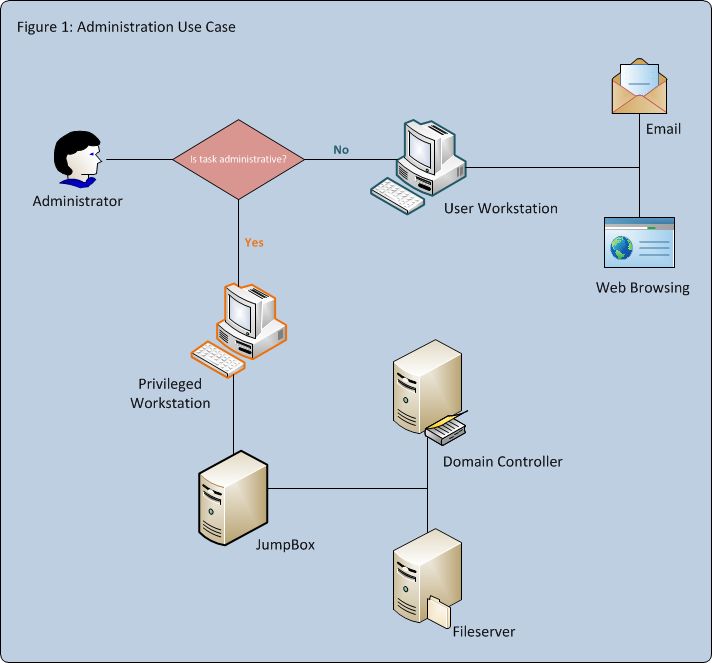
While implementing each security control in isolation would provide some benefit (some more than others), these
controls are most effective when implemented as a package. If the entire package of security controls cannot be
implemented in one step, the preferred order of implementation is to start at the top of the table and work down.
Most of the security controls below can be achieved using a combination of standard tools in modern operating
systems and logical changes to an organisation and their corporate network.
Element Description
Privileged access Controlling access to privileged accounts is a fundamental security control that will protect
control privileged accounts from misuse. The access control methodology will encompass the concepts
of ‘least privilege’ and ‘need to have’ as well as processes and procedures for managing service
accounts and staff movements.
Multi-factor Implementing additional factors of authentication beyond usernames and passphrases, such as
authentication physical tokens or smartcards, can help protect critical assets. If an adversary were to
compromise credentials for privileged accounts, as all administrative actions would first need to
go through some form of multi-factor authentication, the consequences can be greatly reduced.
Privileged The use of a known secure environment for administrative tasks can result in a lesser risk of the
workstations network being compromised due to the implementation of additional security controls.
Logging and Automated generation, collection and analysis of security and administrative related events
auditing from workstations, servers, network devices and jump boxes will enable detection of
compromises and attempted compromises. This will enable organisations to respond more
quickly, reducing the implications of a compromise.
Network Segmenting a network into logical zones such as differing security domains, and further
segmentation segregating these logical networks by restricting the types of data that flow from one zone to
and segregation another, restricts lateral movement. This will prevent an adversary from gaining access to
additional resources.
Jump boxes A jump box is a hardened remote access server, commonly utilising Microsoft’s Remote Desktop
Services or Secure Shell (SSH) software. It acts as a stepping point for administrators accessing
critical systems with all administrative actions performed via a jump box.
Privileged access control
Privileged accounts are often targeted by an adversary due to their access across the breadth of an organisation’s
network and systems. Restricting the use of built-in administrator groups and accounts and delegating privileged
permissions in accordance with the principles of least privilege is an effective way to reduce the impact and spread of
an adversary’s access during a cyber intrusion.
To assist in restricting the use of privileged accounts, the following procedural and technical security controls should be
implemented:
Ensure that unique identifiable accounts are linked to individual users and they are authenticated every time
privileged access is granted on a system. This will ensure accountability and attribution of all actions.
Restrict access for privileged accounts by issuing administrators a standard user account in addition to separate
privileged and unprivileged administrator accounts for administrative purposes. Separate user and administrator
3accounts will provide a logical separation of administrative and user tasks while the use of privileged and
unprivileged administrator accounts will provide another layer of abstraction to further protect privileged account
credentials. The unprivileged administrator account is used to control remote access to a jump box and corporate
workstations and servers while all actual administration tasks are performed with the privileged administrator
account using ‘runas’, ‘sudo’ and remote administration management tools.
Privileged administrator accounts should not be used to run ongoing tasks on a system, including with ‘runas’ or
by escalating privileges via Windows User Account Control. It is possible to extract passphrase hashes of processes
running with UAC and ‘runas’; however, the hashes are cleared following process termination. In cases where
services or applications require additional privileges indefinitely or over a long period of time, specific service
accounts with the minimum required permissions should be used instead.
Enforcing role-based delegation of privileges for privileged administrator accounts will reduce the exposure of an
account in the event of compromise by an adversary. As functional levels have progressed for Microsoft Active
Directory, built-in administrator groups have been provided with the goal of encouraging administrative role-
based delegation. While these groups provide a useful starting point, it is likely further customisation will be
required based on any organisational structures in place.
Enforcing strong passphrase management for privileged and unprivileged administrator accounts will reduce the
risk of passphrase guessing and brute-force attacks against administrator accounts.
Disabling local administrator accounts will reduce the risks associated with credential theft.
Enforcing the use of Microsoft Window’s Secure Desktop for entry of all privileged account credentials where
possible. This will prevent key loggers from capturing credentials when administrators use their unprivileged
administrator account to elevate to their privileged administrator account to perform an administrative action.
This setting can be set in Group Policy (User Account Control: Switch to the secure desktop when prompting for
elevation).
On recent Microsoft Windows releases, consider utilising the Protected Users group for privileged accounts if
supported by the environment. This will enforce strong authentication protocols and Kerberos settings.
Do not allow service accounts to be members of any built-in administrator groups. This will reduce the risks
associated with credential theft. Where possible, managed service accounts should be used with delegation of
specific privileges as required.
Pass-the-Hash attacks
Pass-the-Hash (PtH) is a very common and effective method an adversary may use to move laterally within an
organisation’s network with their ultimate goal being to gain access to sensitive information and resources.
One common technique to perform a PtH attack is for an adversary to expose the authentication credentials of user
accounts that have been previously authenticated on a compromised workstation. These credentials are then passed
directly around the network. The credentials are usually hashed passwords, although there may be cases where
plaintext passwords or single sign on and multi-factor tokens are stolen.
Environments where local administrator accounts share the same password throughout the environment and where
domain and enterprise administrator accounts are used for regular workstation support are particularly susceptible
to this attack.
By following the previous security controls for privileged access control, leveraging PtH attacks become far more
difficult. In particular, the separation of privileged and unprivileged administrator accounts and the use of remote
administration management tools from a jump box reduce the number of privileged administrator account hashes
being stored on workstations and servers.
4Role-based delegation of administrative privileges further strengthens the security posture of an organisation by
reducing the implications of PtH attacks as much as possible by minimising the exposure of networks even in the
event of a privileged account hash being compromised.
Other security controls throughout this document further mitigate PtH attacks and should be employed where
possible.
Considerations when administering a cloud environment
There are no specific issues to be considered when applying the above guidance to a cloud environment.
Multi-factor authentication
By implementing an additional authentication factor, such as a hardware authentication token, the consequences
associated with the theft of passphrases can be greatly reduced. When implementing multi-factor authentication (MFA)
in a secure administration context, the primary consideration is where MFA takes place. The three possible locations
are the privileged workstation, the jump box or the target asset. The following table outlines the advantages and
disadvantages associated with the three different locations.
Privileged Workstation Jump Box Target Asset
Advantages Advantages Advantages
Ease of integration with MFA Ease of integration with MFA MFA process occurs on the target
product. product. asset at time of privileged action.
MFA can also cover workstation MFA only needs to be deployed to
login. a centralised location.
Disadvantages Disadvantages Disadvantages
Greater risk of workstation and MFA process not performed on Varied target assets on different
authentication compromise, the target asset. platforms must support
particularly if dedicated privileged MFA process may not be integration with MFA.
workstations are not used. performed temporally close to Multiple deployment locations.
Multiple deployment locations the privileged action.
MFA process not performed on
the target asset.
MFA process may not be
performed temporally close to
the privileged action.
NOT RECOMMENDED1 RECOMMENDED RECOMMENDED
1
It must be noted that this recommendation is in the context of establishing a secure administration environment.
Implementing multi-factor authentication on the workstation for general users is still recommended as a mitigation
strategy as per the Strategies to Mitigate Cyber Security Incidents.
5Considerations when administering a cloud environment
The key decision when implementing MFA for the administration of a cloud-based service is determining where to
implement the MFA: within an organisation’s local network, within the cloud service or both.
If implementing MFA within the cloud service, the following issues should be considered:
Many cloud service providers offer a MFA service which can be used to enhance the authentication process when
accessing cloud assets, such as accessing an administrator web console or protecting an application programming
interface (API).
Organisations may establish their own dedicated MFA server within a virtual private cloud to enhance the
authentication process to the various cloud servers hosted within the virtual private cloud.
An existing local MFA server may also provide coverage of cloud assets.
An MFA process could be enforced for local jump boxes which are then used to access cloud services. This
provides little benefit if these cloud services can be administered by hosts other than the jump boxes.
If a virtual private cloud is accessed via a virtual private network (VPN), the existing local MFA server could extend
its coverage to include the cloud-based assets.
Privileged workstations
A key goal of an adversary is to compromise the workstation of an administrator or a user with privileged access to one
or more systems. This compromise can occur due to common intrusion methods such as phishing emails, drive-by
downloads or through lateral movement by an adversary who already has a presence within the network.
Once the adversary has access to a privileged workstation, the adversary can perform some form of credential theft
(e.g. keylogging, hash dumping) to gain access to additional privileged account credentials. Therefore, it is essential to
reduce the likelihood that a workstation used for administration purposes will be compromised. This can be achieved
through the use of dedicated and hardened privileged workstations.
Dedicated privileged workstations
Privileged users utilising a low-privilege user account for high risk activities such as email or web browsing reduces the
risk of privileged account credentials being compromised. However, if a user was to elevate their privileges (e.g. to a
local administrator or SYSTEM account) after being compromised by an adversary their privileged administrator
account credentials could be at risk.
Providing a physically separate workstation that is used exclusively to carry out privileged activities (a privileged
workstation) will greatly reduce the risk of privileged administrator accounts being compromised.
Privileged workstations should not have internet or email access. Additionally, the workstations should be logically
separated from other zones within the network, and only allowed to communicate with assets which require
management (ideally through jump boxes), or infrastructure required for the proper management of workstations and
servers such as internally managed patching servers. Communication between this dedicated privileged workstation
and with less trusted zones, such as regular user workstations, should be prevented.
Figure 1, on the following page, shows the different use cases for a dedicated privileged workstation and a regular user
workstation.
6The use of virtualisation to achieve dedicated workstations
The use of virtualisation does not yield the same security benefit as using a dedicated physically separate workstation.
However, a risk-based approach may determine that utilising a virtualisation solution is sufficient.
Care should be taken to ensure separation of physical and virtual machines to prevent leakage across the virtualisation
boundary. For example, drag and drop integration, clipboard integration and shared folders should all be disabled
where possible when using a virtualised solution.
The configuration of virtualised desktops can take many forms. The following table is ranked from most secure to least
secure and encompasses the most likely approaches.
7Configuration Advantages Disadvantages Notes
Remotely virtualised Separation of the Relatively difficult to A thin client will be
privileged and user workstations managed by use. Possibly more required to allow access to
workstations (preferred) the hypervisor and expensive as a thin client the virtualised desktops.
possibly physical will also be required. The privileged workstation
hardware. Improved Availability in the event should be non-persistent.
control over workstation. of service outage.
No physical access to
workstations so security
controls can’t be
circumvented.
Physical privileged Relatively hard to escape Privileged workstation The user workstation
workstation and virtualised from the virtualised user must be persistent. should be remotely
user workstation workstation back to the virtualised in order to
privileged workstation. prevent console access to
the virtual machine.
Physical user workstation Logical separation of the The workstation can be The privileged workstation
and virtualised privileged workstations. Privileged used to pivot into the should be remotely
workstation (not preferred) workstation can be non- privileged workstation virtualised in order to
persistent. leveraging Pass-the- prevent console access to
Hash, key logging or the virtual machine.
saved passphrase
functionality.
Hardening privileged workstations
Regardless of whether dedicated privileged workstations are employed, workstations that are used by privileged users
should be subject to additional security controls. At a minimum, the following procedural and technical security
controls should be implemented for privileged workstations:
Ensure administrators log in with an unprivileged administrator account.
Implement host-based firewall rules restricting both inbound and outbound traffic to only traffic required to
perform administration functions. For example, restrict outbound remote access services (e.g. Remote Desktop
Services (RDP), PowerShell Remoting and Secure Shell (SSH)) to only the jump box.
Implement a strict removable storage policy. This will prevent malware from using storage devices to bypass
other separation controls in place.
Implement full disk encryption to protect the integrity of workstations as well as the confidentiality of any
sensitive information.
By implementing these security controls, in conjunction with the network architecture controls mentioned below, an
organisation can reduce the ability of an adversary to target and compromise privileged workstations.
8Considerations when administering a cloud environment
One of the key security controls for privileged workstations is enforcing a lack of internet connectivity. When
administering an internet-based cloud environment, such as public cloud services, this recommendation may require
some changes depending on the secure administration environment in place.
It is desirable that no internet connectivity be provided for privileged workstations. However, for the purposes of
managing cloud resources exceptions can be made:
A local jump server used solely for administering cloud-based assets could be used. This jump box would have
internet connectivity, but be restricted to only accessing the domains or IP addresses required for accessing the
necessary cloud services and other critical services such as patch servers.
The cloud-based environment could be configured to only accept administration traffic from an organisation’s
public IP address range to prevent unauthorised access.
A dedicated physical link may provide additional security for management connections to cloud services.
In cases where a jump box is not feasible and privileged workstations must connect directly to cloud-based
infrastructure, restrict workstations to only access the domains or IP addresses required for accessing the
necessary cloud services.
If the only cloud service being administered is a private virtual network2 accessed via a VPN, then an organisation
should determine whether internet connectivity restrictions should apply. The use of a local jump server is still
recommended.
Logging and auditing
Log collection and analysis for the purposes of auditing is a core element of an organisation’s defence of their networks.
A comprehensive log collection and audit plan is a key method of detecting when security and administrative events of
significance occur, allowing for detection of cyber intrusions and determining appropriate incident response activities.
When implementing a secure administration approach using a jump box, logging and auditing becomes easier as all
administrative access should pass through the jump box. While the jump box is the most obvious target for logging and
auditing activities, logging and associated activities should still be performed within the secure administration
environment and servers to ensure that all key events are subjected to appropriate auditing.
All log events should be captured and stored in a centralised, backed-up location. Centralisation of event logs can allow
easier log collation and correlation which aids the identification of suspicious events or anomalies. In addition, care
should be taken to ensure time synchronisation across the environment (and by extension the logs) in order to allow
for proper log analysis.
Considerations when administering a cloud environment
Cloud services may create their own logging events and files which may be accessed by an organisation for auditing
purposes. Some cloud providers may even offer a logging cloud service which allows aggregation and storage of all
activity and events across multiple cloud services.
If possible, all logs should be retrieved and incorporated into a centralised logging environment so a comprehensive
picture of administrative events can be developed.
Management logs for cloud services should be regularly audited.
2
For example: Amazon’s Virtual Private Cloud or Microsoft Azure’s Virtual Network.
9Network segmentation and segregation
Designing a network architecture based on security zones is an extremely effective method of restricting an adversary’s
ability to move laterally within a network and gain access to administrative resources.
Security controls for network segmentation and segregation in relation to a secure administration environment are:
Create zones to logically separate different security domains. Examples of different zones may be user
workstation zone, privileged workstation zone and asset zone.
Restrict traffic flows between the zones. Especially for more sensitive security domains such as the privileged
workstation zone and the asset zone, as well as sensitive management traffic types such as RDP and SSH.
Management traffic should only flow between jump boxes and managed assets. When jump boxes are
implemented the only assets which should be able to administer managed assets are the jump boxes.
Some examples of traffic restrictions that should be put in place are outlined in the table below. By default, traffic
between zones should be denied. These examples are designed around an implementation which utilises jump boxes.
Permitted Traffic
Source Destination Traffic Type
Privileged workstation Jump box Management traffic
(e.g. RDP, SSH)
Jump box Managed assets Management traffic
(e.g. RDP, SSH)
User workstation Managed assets Business traffic
(e.g. web, mail, business applications, application portals, Active
Directory)
Blocked Traffic
Source Destination Traffic Type Explanation
User workstation Managed assets Management traffic User workstations should not be
(e.g. RDP, SSH) performing administration activities.
User workstation Jump box Any traffic type User workstations should not interact
with IT administration assets.
User workstation Privileged workstation Any traffic type User workstations should not interact
with IT administration assets.
Privileged workstation Managed assets Any traffic type Privileged actions should be performed
via the jump box.
10Considerations when administering a cloud environment
The security controls listed above can be applied to administering an Infrastructure as a Service (IaaS)-based network,
particularly if a virtual private cloud is also implemented.
Depending on the functionality of a Software as a Service (SaaS) or Platform as a Service (PaaS) offering, it may be
impossible or impractical to implement some of the security controls listed above. For example, organisations may be
limited to whitelisting certain IP addresses which a cloud asset can be administered from.
Jump boxes
A jump box can enhance a secure administration environment by providing three main benefits:
Single point of origin for administration connections. A jump box, or specific jump box zone, provides a single
point of origin for administration connections, such as RDP or SSH, destined for critical assets. This can help
reduce administrative overhead and technical complexity, thereby reducing the chance of configuration mistakes.
Easier detection of anomalous or suspicious behaviour. If a jump box and administration zone have been
configured it can be easier to identify anomalous behaviour. For example, regular users and workstations should
not be administering critical servers and applications. As such, attempted RDP connections originating from a user
workstation zone destined for an asset zone or jump box would be suspicious.
Enables an effective and easier deployment of multi-factor authentication. With all administrative actions now
performed via a jump box, it can be easier to deploy multi-factor authentication by centralising it at the jump box.
Without a jump box it may be more difficult to ensure that all assets can support the multi-factor implementation
used by an organisation.
The configuration of a jump box is critical to realising the benefits listed above. Minor configuration mistakes can lead
to a jump box becoming a security liability as it has wide ranging access across the breadth of an organisation’s systems
and is likely to be targeted.
In addition to application whitelisting, patching operating systems and applications, restricting administrative privileges,
and other general hardening practices, the following procedural and technical security controls should be implemented
for a jump box:
Implement strong device or computer authentication in addition to user authentication to ensure only trusted
workstations are able to connect to the jump box. For example, the issuance of computer certificates to
administrative workstations and the jump box combined with IP Security (IPSec) policy settings allowing remote
network access to the jump box by only workstations with trusted certificates.
Prevent direct internet access to and from the jump box.
Only allow access to the jump box from the secure administration environment. Block traffic from all other
sources to help protect the jump box from an adversary who already has a presence on the network.
Prevent privileged accounts from logging on to the jump box remotely. Administrators should connect to the jump
box with an unprivileged administrator account and then elevate their privileges as required.
Perform thorough auditing with automated analysis of all activities carried out on the jump box including logins,
logouts, program execution, outbound connections and failed login attempts.
Implement a host-based intrusion prevention and detection system (HIPS/HIDS) to identify and prevent malicious
and suspicious activities.
Investigate system crashes, unusual activity and unusual network traffic as a priority to determine if they are
indicators of compromise.
11Figure 2 below demonstrates the process flow of administration utilising a jump box.
Considerations when administering a cloud environment
Jump boxes can be implemented in a variety of ways when administering a cloud environment. The key consideration
will be the type of cloud service being administered.
Software as a Service. As a cloud-based jump box is likely not possible with a SaaS offering, a local cloud-specific
jump box can be used. Such a jump box should only be used for administering cloud services and not local assets
since it will likely have to be able to connect to the Internet.
Platform as a Service. PaaS will have a similar approach as SaaS since organisations will likely be unable to
establish a cloud-based jump box.
Infrastructure as a Service. In addition to the local jump box approach outlined for SaaS and PaaS offerings, a
cloud-based jump box approach could be used for IaaS services. In this scenario a cloud server is used as a
dedicated jump box. Administrators would first connect to the cloud-based jump box, and then use it to
administer other cloud-based servers.
Further information
The Australian Government Information Security Manual (ISM) assists in the protection of information that is
processed, stored or communicated by organisations’ systems. This publication can be found at
https://www.acsc.gov.au/infosec/ism/.
The Strategies to Mitigate Cyber Security Incidents complements the advice in the ISM. The complete list of
mitigation strategies and supporting publications can be found at
https://www.acsc.gov.au/infosec/mitigationstrategies.htm.
12If your network is based on Microsoft Windows and Active Directory, the following two Microsoft documents contain
advice relevant to many parts of this publication:
Mitigating Pass-The-Hash (PtH) Attacks and Other Credential Theft, Version 1 and 2 at
https://www.microsoft.com/en-au/download/details.aspx?id=36036
Best Practices for Securing Active Directory at https://docs.microsoft.com/en-au/windows-server/identity/ad-
ds/plan/security-best-practices/best-practices-for-securing-active-directory.
For further advice related to cloud computing, see the Cloud Computing Security for Tenants publication at
https://www.acsc.gov.au/publications/protect/Cloud_Computing_Security_for_Tenants.pdf.
For further advice on implementing network segmentation and segregation, see the Implementing Network
Segmentation and Segregation publication at
https://www.acsc.gov.au/publications/protect/Network_Segmentation_Segregation.pdf.
For further advice on the benefits of multi-factor authentication and implementation considerations, see the
Implementing Multi-Factor Authentication publication at
https://www.acsc.gov.au/publications/protect/Multi_Factor_Authentication.pdf.
For further advice on the Protected Users group (applicable to Windows 8.1 and Windows Server 2012 R2 onwards),
see Protected Users Security Group article at https://docs.microsoft.com/en-au/previous-versions/windows/it-
pro/windows-server-2012-R2-and-2012/dn466518(v=ws.11).
For further advice on Managed Service Accounts (applicable to Windows 7 and Windows Server 2008 R2 onwards), see
the Managed Service Accounts article at https://docs.microsoft.com/en-au/previous-versions/windows/it-
pro/windows-server-2008-R2-and-2008/ff641731(v=ws.10).
Contact details
Organisations or individuals with questions regarding this advice can contact the ACSC by emailing
asd.assist@defence.gov.au or calling 1300 CYBER1 (1300 292 371).
13You can also read


