Wales Patient Access Scheme: Process Guidance - July 2012 (Updated September 2014)
←
→
Page content transcription
If your browser does not render page correctly, please read the page content below
Wales Patient
Access Scheme:
Process Guidance

July 2012
(Updated September 2014)
This guidance document has been prepared by the Patient Access Scheme Wales
Group, with support from the All Wales Therapeutics and Toxicology Centre (AWTTC),
and has subsequently been endorsed by the All Wales Medicines Strategy Group
(AWMSG).

Please direct any queries to AWTTC:

All Wales Therapeutics and Toxicology Centre
University Hospital Llandough
Penlan Road
Llandough
Vale of Glamorgan
CF64 2XX

awttc@wales.nhs.uk
029 2071 6900

This document should be cited as:
All Wales Medicines Strategy Group, Wales Patient Access Scheme: Process
Guidance. September 2014.
Wales Patient Access Scheme: Process Guidance

ABBREVIATIONS

ABPI         Association of the British Pharmaceutical Industry
AWDCC        All Wales Drug Contracting Committee
AWMSG        All Wales Medicines Strategy Group
AWTTC        All Wales Therapeutics and Toxicology Centre
FAR          Final Appraisal Report
HTA          Health Technology Assessment
NICE         National Institute for Health and Care Excellence
PAS          Patient Access Scheme
PASLU        Patient Access Scheme Liaison Unit
PASWG        Patient Access Scheme Wales Group
PPRS         Pharmaceutical Price Regulation Scheme
WPAS         Wales Patient Access Scheme

ACKNOWLEDGEMENTS

The All Wales Medicines Strategy Group would like to acknowledge the Welsh
Government, the Therapeutic Development Assessment Partnership Group and the
Patient Access Scheme Liaison Unit at the National Institute for Health and Care
Excellence for their assistance in developing the process described herein.

                                                                       Page 1 of 32
All Wales Medicines Strategy Group

CONTENTS

1.0 INTRODUCTION .................................................................................................... 3
2.0 MEMBERSHIP OF PASWG ................................................................................... 4
3.0 PROCESS FOR CONSIDERATION OF A WPAS .................................................. 4
APPENDIX 1. INFORMATION REQUIRED FOR A WPAS SUBMISSION ..................11
APPENDIX 2. SUBMISSION FORM FOR A SIMPLE WPAS ......................................12
   1.0 INTRODUCTION ...............................................................................................13
   2.0 INSTRUCTIONS FOR MANUFACTURERS AND SPONSORS .........................13
   3.0 DETAILS OF THE WPAS ..................................................................................14
   4.0 OPERATION OF THE SCHEME........................................................................16
   5.0 ADMINISTRATIVE COST OF THE SCHEME ....................................................16
   6.0 BENEFITS OF THE SCHEME ...........................................................................17
   7.0 GOVERNANCE .................................................................................................17
   Appendix A: Key principles for the implementation of WPAS ...................................19
APPENDIX 3. SUBMISSION FORM FOR A COMPLEX WPAS ..................................20
   1.0 INTRODUCTION ...............................................................................................21
   2.0 INSTRUCTIONS FOR MANUFACTURERS AND SPONSORS .........................21
   3.0 DETAILS OF THE WPAS ..................................................................................22
   4.0 OPERATION OF THE SCHEME........................................................................24
   5.0 ADMINISTRATIVE COST OF THE SCHEME ....................................................25
   6.0 BENEFITS OF THE SCHEME ...........................................................................28
   7.0 GOVERNANCE .................................................................................................28
   Appendix A: Key principles for the implementation of WPAS ...................................30
   Appendix B: Relevant documents and forms ...........................................................30
   Appendix C: Details of outcome-based schemes .....................................................31
APPENDIX 4. AWMSG DELAYED APPRAISAL STATEMENT DUE TO A WPAS
SUBMISSION..............................................................................................................32

Page 2 of 32
Wales Patient Access Scheme: Process Guidance

1.0 INTRODUCTION

1.1 Background
A proposal to establish a Patient Access Scheme Wales Group (PASWG) was
supported by the All Wales Medicines Strategy Group (AWMSG) at their meeting on 13
July 2011. The remit of PASWG is to consider the feasibility, workability and
acceptability of Patient Access Schemes (PAS) within NHS Wales and to provide
advice to Welsh Government. A pilot for considering PAS within NHS Wales was
subsequently undertaken and completed in November 2011.

The All Wales Therapeutics and Toxicology Centre (AWTTC) worked with the
Association of the British Pharmaceutical Industry (ABPI) Wales in developing a
process for considering Wales Patient Access Schemes (WPAS) based on the key
principles described in the 2009 Pharmaceutical Price Regulation Scheme (PPRS)1
and updated in the 2014 PPRS2.

It should be noted that the National Institute for Health and Care Excellence (NICE)
Patient Access Scheme Liaison Unit (PASLU) also uses the principles outlined in the
PPRS. AWTTC acknowledges the support of PASLU in developing the pilot within NHS
Wales. Following consultation, the terminology for a PAS within Wales has been
agreed as Wales Patient Access Scheme or WPAS.

1.2 Process
This document describes the process, including expected timescales, that PASWG
follows when advising whether implementation of a proposed WPAS is feasible within
NHS Wales. Manufacturers (or sponsors of the technology) need to complete the
“WPAS submission form”, which requests specific information that PASWG needs in
order to provide this advice. WPAS proposals are referred by the Welsh Government to
PASWG, which provides advice on the feasibility of implementing the WPAS in NHS
Wales.

The implementation of a WPAS aims to improve the cost-effectiveness of a certain
medicine, which, subject to a positive Health Technology Assessment (HTA), allows
AWMSG to recommend the use of a new medicine within NHS Wales that may not
have been considered cost-effective without such a scheme.

Key principles for the implementation of a WPAS
The key principles considered by PASWG for the implementation of a WPAS are based
on those used by PASLU at NICE, which are outlined in the PPRS. These provisions
have been revised in line with the existing appraisal process in Wales and the PPRS2
2014 agreement:
    • Arrangements must respect the role of AWMSG in providing Welsh
       Government and NHS Wales with an independent assessment and appraisal of
       the evidence on a technology.
    • A WPAS should be submitted by manufacturers to AWTTC prior to submission
       of a Form B or C. AWTTC will record receipt and pass the details of the scheme
       to Welsh Government who will forward to PASWG.
    • The full costs to NHS Wales of any such arrangement should be included in the
       costs submitted for consideration.
    • Schemes should be clinically and financially robust, plausible, appropriate and
       auditable.
    • Any scheme should be operationally manageable for NHS Wales without
       unduly complex monitoring, disproportionate additional costs or bureaucracy.
       Any burden to NHS Wales should be proportionate to the benefits of the
       scheme for the NHS and patients. The exact duration of any agreement and the
       circumstances in which it might be terminated should be clear to all parties from
       the outset.

                                                                         Page 3 of 32
All Wales Medicines Strategy Group
• It is important that any cumulative administrative burden of such schemes
remains manageable for all parties involved in their operation, including front-
line NHS staff. It is reasonable for the Welsh Government to take this issue into
account when considering the viability of individual schemes.
• Schemes should be consistent with existing financial flows in NHS Wales.
• NHS Wales must be consulted on schemes by the applicant company, in
particular where these involve additional data collection beyond that associated
with the conventional purchase of medicines e.g. in relation to patient numbers,
or the monitoring and recording of a patient’s condition over and above that for
the normal management of a patient.
2.0 MEMBERSHIP OF PASWG
Membership of PASWG will comprise experts from clinical, pharmacy, NHS finance,
NHS contracting/procurement, lay and pharmaceutical industry backgrounds. All
PASWG members:
• must agree to be bound by the terms and conditions of a signed confidentiality
agreement;
• must agree to their name and affiliation appearing in PASWG advice;
• should have knowledge and/or experience relevant to the assessment of PAS;
• must be familiar with the AWMSG appraisal process;
• must declare any conflicts of interest.
PASWG will consist of:
• Chair/deputy
• Chief pharmacist/deputy
• Medical director/deputy
• Senior finance manager/deputy
• Representative of AWTTC
• Representative of the All Wales Drug Contracting Committee (AWDCC)/deputy
• Representative of ABPI Wales/deputy
• Representative of PASLU
• Lay member
PASWG reserves the right to invite a clinical specialist or specialist pharmacist to
attend each meeting in a non-voting capacity to set the clinical context.
3.0 PROCESS FOR CONSIDERATION OF A WPAS
The process outlined below has been developed following discussion with PASLU, the
AWMSG Steering Committee, the Therapeutic Development Assessment Partnership
Group and AWMSG, and was informed by the pilot conducted in 2011.
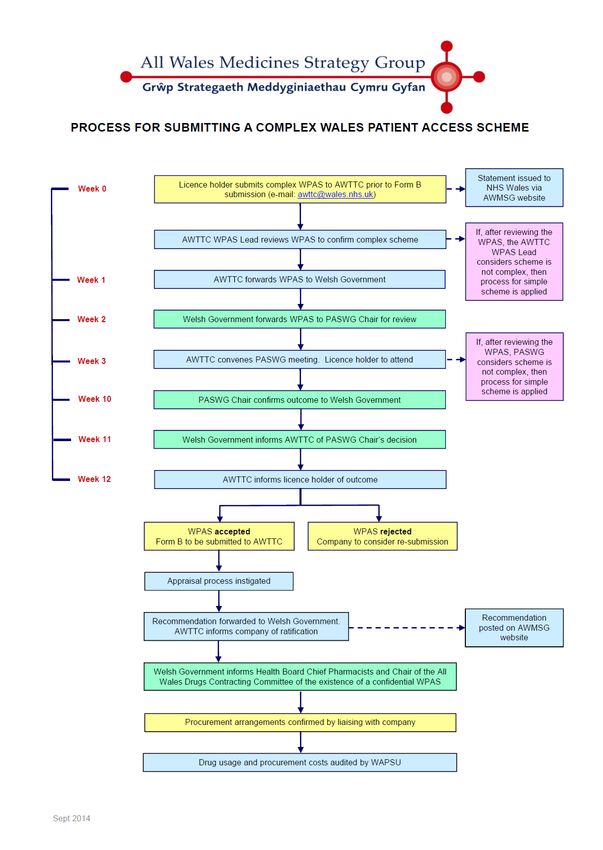
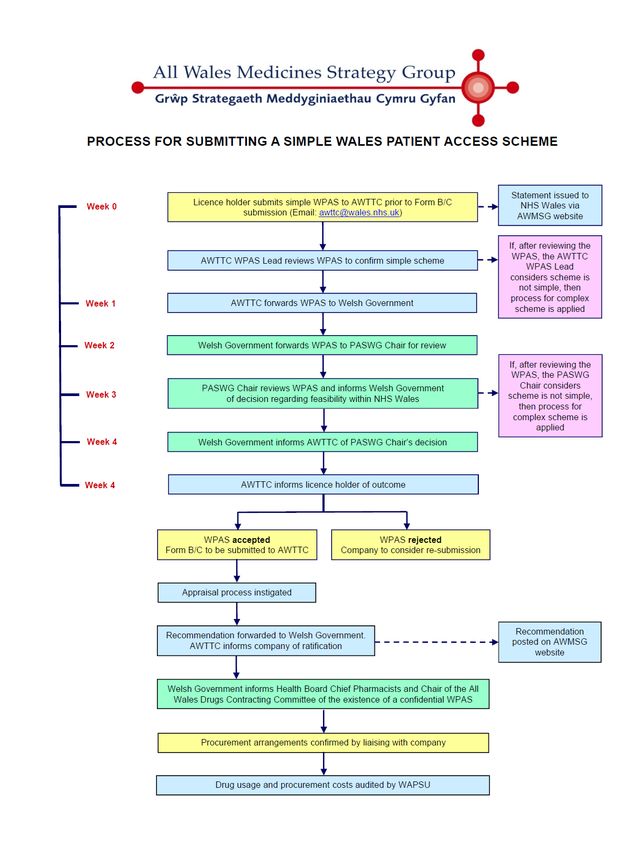
It should be noted that the time required for processing a WPAS may vary depending
on the complexity of the submitted scheme (the estimated timelines for assessment of
simple and complex schemes are shown in Figures 1 and 2).
A PAS that has been previously approved by the Department of Health will be
accepted as part of the HTA process in Wales if the medicine is subsequently
submitted to AWMSG for appraisal for another indication. This only applies to simple
discount schemes where the PAS is already included within a NICE Final Appraisal
Determination. Verification of the details of the scheme would be required prior to the
commencement of the appraisal by AWMSG and before production of the AWMSG
Secretariat Assessment Report.
Page 4 of 32Wales Patient Access Scheme: Process Guidance
Submitting the WPAS
1. Appendix 1 provides a list of the information required from the manufacturer
within their submission. The manufacturer must submit a WPAS proposal using
the PASWG submission form (see Appendices 2 and 3), which is based on the
PASLU template and PPRS criteria.
2. Manufacturers should indicate on Form A whether they wish to submit a simple
or complex WPAS. If a medicine meets the criteria for a limited submission a
simple WPAS should be submitted ahead of Form C. A complex WPAS
requires a full HTA submission and should be made prior to the submission of
Form B. A WPAS proposal should be submitted electronically by the
manufacturer to AWTTC (awttc@wales.nhs.uk).
3. In the event that the appraisal process is delayed longer than three months post
marketing authorisation and pending consideration of a WPAS, a Delayed
Appraisal Statement will be issued via the AWMSG website (see Appendix 4).
This will confirm that the holder of the marketing authorisation has submitted a
WPAS and notes that the process of appraisal for [generic name (Trade name)]
for the treatment of [abbreviated indication] has been delayed until further
notice pending consideration of the feasibility of the WPAS scheme in NHS
Wales.
4. A simple WPAS proposal should apply to all licensed indications of the product
under consideration. A proposed complex or outcome-based WPAS proposal
may be specific to a single indication (see points 5 and 6 below).
5. It is NHS Wales policy to offer patients the opportunity to receive treatment
closer to their homes. This includes the ability to collect medication from
community pharmacies where it is considered safe and practical to do so.
Therefore, all applicants should consider whether it is reasonable to include
details as to how the WPAS may work in primary care.
6. Any WPAS that applies to primary care should be submitted as a complex
scheme.
7. According to process timelines, all documentation should be received from the
manufacturer eight weeks before the PASWG meeting (see Figures 1 and 2 for
estimated timelines).
8. For time-limited WPAS proposals, with a fixed expiry date, arrangements post-
termination will be taken into account.
Processing the WPAS
9. AWTTC will review the WPAS proposal and provide a dossier including all
relevant information (manufacturer’s submission and clarification
requests/responses) to Welsh Government who will forward to the PASWG
Chair.
10. A request for further clarification or evidence, if necessary, will be forwarded to
the manufacturer within ten working days of receiving the proposal, and the
manufacturer will have a maximum of five working days to respond (see Figures
1 and 2 for estimated timelines).
11. AWTTC will be the main contact for the manufacturer submitting the WPAS.
Page 5 of 32All Wales Medicines Strategy Group
12. All information will be handled in accordance with the principles and
requirements of legal frameworks such as the Data Protection Act 1998 and the
Freedom of Information Act 2000. WPAS details will be treated as confidential
in nature, and both AWMSG and AWTTC understand that manufacturers may
suffer commercial and other harm if information relating to a WPAS were to be
made publicly available. Therefore, if the information referred to herein is
subject to a Freedom of Information Act Request (if the requestor is defined as
a Public Authority in Part 1 Section 3(1) of the Freedom of Information Act
2000) or other request to share the data, then appropriate measures will be
undertaken to engage and consult with such persons in order to determine
whether or not an exemption applies to the information requested, or in order to
reach a view on whether the obligations in Section 1 of the Act arise in relation
to that information. All parties involved in the WPAS process will be subject to a
confidentiality agreement.
13. Any documentation provided to PASWG in support of a scheme must be in line
with copyright legislation. The manufacturer must ensure that they have
copyright clearance if a submission contains full journal articles. Copyright-
controlled material may not be provided via the internet. Journal articles in
electronic format will only be accepted if they are submitted on a CD-ROM.
Journal articles will be passed on to PASWG members in the format they are
received. The manufacturer is required to sign a statement declaring that all
relevant information in support of a proposed scheme has been submitted to
PASWG.
14. The remit of PASWG will be to consider the WPAS dossier provided by AWTTC
(as the PASWG secretariat) and to formulate advice for the Welsh Government
regarding the feasibility and implementation of a proposed scheme.
15. The WPAS dossier will include the manufacturer’s submission and, if relevant,
clarification requests and responses.
PASWG meeting
16. A PASWG meeting may not be required if, in the opinion of the Chair, the
proposal can be considered as a simple discount scheme. Under these
circumstances, the scheme may be considered by the PASWG Chair.
17. The manufacturer will be given the opportunity to be available, in person or over
the telephone, at the PASWG meeting.
18. The PASWG meeting is held in private and all information and discussions are
considered “commercial in confidence”. PASWG decisions will normally be
made based on a majority vote, and voting details will be noted in the meeting
minutes.
19. The decision of PASWG will be relayed by the Chair to Welsh Government.
20. Welsh Government will direct AWTTC on the use of a proposed WPAS after
considering PASWG advice. AWTTC will inform the manufacturer of this
decision.
Page 6 of 32Wales Patient Access Scheme: Process Guidance
Appraisal process subsequent to WPAS consideration
21. Depending on the outcome of the PASWG assessment, the manufacturer may
subsequently:
• incorporate the WPAS into their appraisal submission;
• resubmit a revised WPAS to AWTTC;
• decide not to progress to appraisal, which is likely to mean that the
medicine will not be funded for routine use within NHS Wales;
• decide to progress to appraisal without incorporating the WPAS into
their appraisal submission.
22. The recommendation of the New Medicines Group to AWMSG in relation to
cost-effectiveness of the proposed WPAS will be captured in the Preliminary
Appraisal Recommendation.
23. Appraisal by AWMSG will continue to be held in private in the short term until
there is confidence that sensitive information relating to such schemes will not
be disclosed at the public appraisal meeting.
Post appraisal process
24. Where AWMSG has recommended that, based on the existence of an
approved PAS, a medicine should be available within NHS Wales, the Final
Appraisal Recommendation (FAR) will disclose the existence of a WPAS. The
inclusion of WPAS details in any publicly available document will be subject to
the extent of confidentiality requested by the manufacturer.
25. Health boards and the Chair of the AWDCC will be informed by Welsh
Government of the existence of the WPAS associated with a recommended
medicine. Health boards will be advised to contact the manufacturer directly for
procurement arrangements. To ensure consistency and to ensure that the
WPAS is applied, health boards should contact the AWDCC Chair as a central
point for confirmation of the agreed scheme, if required.
26. For a simple WPAS, if a company wishes to amend the level of discount
applicable to an operational WPAS, they must put a request in writing to the
PASWG secretariat (awttc@wales.nhs.uk), which Welsh Government will
consider.
27. AWMSG advice, with or without a WPAS, will be superseded by that of a NICE
recommendation, should they subsequently issue final advice for the same
technology.
28. AWMSG FARs will be reviewed three years after publication. At this stage, any
WPAS associated with a recommendation will also be subject to review.
Page 7 of 32All Wales Medicines Strategy Group
Figure 1. Simple PAS assessment process for Wales
Page 8 of 32Wales Patient Access Scheme: Process Guidance
Figure 2. Complex PAS assessment process for Wales
Page 9 of 32All Wales Medicines Strategy Group
REFERENCES
1 Department of Health, Association of the British Pharmaceutical Industry. The
Pharmaceutical Price Regulation Scheme 2009. 2008. Available at:
http://webarchive.nationalarchives.gov.uk/20130107105354/http://www.dh.gov.uk/p
rod_consum_dh/groups/dh_digitalassets/documents/digitalasset/dh_098498.pdf.
Accessed Apr 2014.
2 Department of Health, Association of the British Pharmaceutical Industry.
Pharmaceutical Price Regulation Scheme 2014. 2013. Available at:
https://www.gov.uk/government/uploads/system/uploads/attachment_data/file/2825
23/Pharmaceutical_Price_Regulation.pdf. Accessed Apr 2014.
Page 10 of 32Wales Patient Access Scheme: Process Guidance
APPENDIX 1. INFORMATION REQUIRED FOR A WALES PATIENT ACCESS
SCHEME SUBMISSION
As part of a Wales Patient Access Scheme (WPAS) submission, the manufacturer will
need to specify:
• the purpose and type of proposed scheme, based on Pharmaceutical Price
Regulation Scheme classification;
• for simple schemes: whether the discount will be variable to maintain a constant
purchase price over time (if the list price fluctuates; termed “fixed purchase
price scheme”), or whether the discount will be fixed and the WPAS price will
fluctuate with variations in list price. Details of the list price and level of discount
should be included;
• for outcome-based schemes, the manufacturer will need to provide details
regarding the collection of relevant outcome details;
• the patient population, and any subgroups, to which the scheme applies;
• selection criteria for subgroupings;
• additional tests and monitoring associated with the proposed scheme;
• how they have addressed any equity or equality issues related to the scheme;
• how they have addressed patient confidentiality and data protection;
• if commercial implications have been considered;
• the duration of the scheme and circumstances for termination;
• the impact of the scheme on the choice of other available treatments;
• the entire administrative process and expected net cost (including additional
treatment-related costs) of the scheme to NHS Wales;
• the grounds for their proposed scheme format should other simpler schemes for
a similar technology be available;
• if the technology has other indications not covered by the scheme;
• the proportion of patients expected to meet the scheme inclusion criteria and
the anticipated number of patients that will be treated during years 1, 2 and 3
post-AWMSG appraisal (assuming a positive recommendation);
• the clinical benefits of the scheme;
• a financial and organisational flow diagram showing operation of the scheme;
• operational details of the scheme in different settings (e.g. homecare, primary
care);
• if relevant to the scheme, the process of claiming rebates;
• whether the scheme has been previously assessed by the Patient Access
Scheme Wales Group or the Patient Access Scheme Liaison Unit.
Manufacturers will need to supply all relevant documentation relating to the
implementation of a scheme, e.g.:
• Scheme agreement forms
• Patient registration forms
• Pharmacy claim forms/rebate forms
• Guides for pharmacists and physicians
• Patient information documents
• Declaration
• Other relevant information
For outcome-based schemes, the manufacturer will need to provide details regarding
the assessment, collection and costs of any new evidence that supports the scheme.
These details may include:
• the design and patient population of the new study;
• outcomes to be collected, and expected duration of data collection;
• an outline of the statistical analyses required and the expected results;
• planning of evidence synthesis or data pooling, and expected results from this
type of analysis.
Page 11 of 32All Wales Medicines Strategy Group
APPENDIX 2. SUBMISSION FORM FOR A SIMPLE WALES PATIENT ACCESS
SCHEME
Submission Form for a
Simple Wales Patient Access Scheme
PATIENT ACCESS SCHEME WALES GROUP
September 2014
Page 12 of 32Wales Patient Access Scheme: Process Guidance
1.0 INTRODUCTION
The 2009 Pharmaceutical Price Regulation Scheme (PPRS)1 was a non-contractual
scheme between the Department of Health and the Association of the British
Pharmaceutical Industry. The purpose of the 2009 PPRS was to ensure that safe and
cost-effective medicines are available on reasonable terms to the NHS in Wales and
England. One of the features of the 2009 PPRS was the improvement of patient access
to medicines at prices that better reflect their value, through Patient Access Schemes
(PAS). The 2014 PPRS2 became effective from January 2014, and included updated
guidance on the use of PAS in the NHS.
A PAS is an arrangement that may be used on an exceptional basis for the acquisition
of a medicine for the NHS in Wales and England. A PAS proposes a discount, rebate
or other variation from the list price of a medicine that may be linked to the number,
type or response of patients, and/or the collection of new evidence (outcomes). These
schemes should aim to improve the cost-effectiveness of a medicine and therefore
allow the All Wales Medicines Strategy Group (AWMSG) to recommend treatments
that it might otherwise have found not to be cost-effective. More information on the
framework for PAS is provided in the 2014 PPRS2.
Wales Patient Access Schemes (WPAS) are proposed by a pharmaceutical company
and agreed with the Welsh Government, with input from the Patient Access Scheme
Wales Group (PASWG) within the AWMSG Health Technology Assessment (HTA)
process.
2.0 INSTRUCTIONS FOR MANUFACTURERS AND SPONSORS
This document is the simple WPAS submission form for PASWG, which is based on
the National Institute for Health and Care Excellence (NICE) Patient Access Scheme
Liaison Unit (PASLU) proposal template. This form should be read in conjunction with
the ‘Wales Patient Access Scheme: Process Guidance’ document. If manufacturers
and sponsors wish PASWG to consider a scheme, they should use this form to submit
information (evidence) for assessing the feasibility of implementing the scheme in
Wales. All schemes involving primary care will be considered complex. WPAS
proposals should be submitted to the All Wales Therapeutics and Toxicology Centre
(AWTTC) at: awttc@wales.nhs.uk.
The submission form contains the information PASWG requires to assess the
proposed WPAS using the principles set out in the 2014 PPRS (see Appendix A), and
explains the way in which information should be presented. Manufacturers and
sponsors are requested to include all information that is necessary to assess the
feasibility of implementing a scheme, including evidence not directly related to the
PPRS principles. If applicants are unable to follow this format, they must state the
reasons clearly. Applicants should insert ‘N/A’ against sections that they do not
consider relevant to the proposed scheme, and provide justification and/or reasons for
this response.
The evidence provided in a proposal should only focus on the NHS in Wales. PASWG
will consider the proposed scheme and produce final advice to the Welsh Government
on the feasibility of implementing the scheme in NHS Wales. The incorporation of each
scheme in the AWMSG HTA process is subject to approval from the Welsh
Government.
For information regarding confidentiality, and how AWMSG will handle information
relating to a WPAS proposal, please see the document ‘Wales Patient Access
Scheme: Process Guidance’.
Page 13 of 32All Wales Medicines Strategy Group
To qualify as a simple WPAS the applicant must answer YES to all of the following
questions and sign below.
The proposed WPAS offers a discount or price reduction: Insert YES here
From the list price, applied for all supplies of the product applicable to all current
1.
and future indications (within the duration of the WPAS).
2. Which applies to the original invoice, or the indicated price for the product.
Which requires no additional administration to receive the price offered;
3. ‘additional’ means over and above the administration required for procuring the
drug without a PAS (a single contract is allowed).
4. Which will remain in place until or after AWMSG appraisal review (3 years).
Signed*:
Name:
Position:
On behalf of:
Date:
*Please include a scanned signature.
3.0 DETAILS OF THE WPAS
3.1 Please give full contact details for the people responsible for the proposed scheme.
Please state if the applicant is the manufacturer or sponsor. Where the applicant is the
sponsor, please state the relationship with the manufacturer (e.g. UK distributor).
Applicant details:
Organisation name:
Address line 1:
Address line 2:
Address line 3:
Address line 4:
Address line 5:
Postcode:
Manufacturer or sponsor?
Sponsor’s relationship to manufacturer
including details of the manufacturer:
Primary contact – the individual responsible for the application
Name:
E-mail:
Tel:
Secondary contact
Name:
E-mail:
Tel:
Page 14 of 32Wales Patient Access Scheme: Process Guidance
Other contact
Name:
E-mail:
Tel:
3.2 Please give the name of the technology and the indication for which the proposed
scheme applies.
Medicine name*
Indication for which the
proposed scheme applies:
*Please detail all names that apply and include all trade names.
3.3 Does the technology have any licensed indications that are not covered by the
proposed scheme? Where applicable, describe how the NHS and the company will
identify the specific patient population treated for the different indications.
3.4 Are any additional licensed indications anticipated in the next 3 years? If yes, what
are the expected dates of the licence extensions?
3.5 Does the scheme require any additional forms, registration or other administrative
process to claim the discount? If so, a complex scheme submission form may be
required.
3.6 Is the technology with the proposed WPAS anticipated to be prescribed in primary,
and/or secondary care? A complex scheme submission will be required if primary care
prescribing is anticipated.
3.7 Will the technology be available through homecare arrangements? If yes, will the
technology be available through homecare only?
3.8 What is the current list price of the technology excluding VAT?
Page 15 of 32All Wales Medicines Strategy Group 4.0 OPERATION OF THE SCHEME Operational manageability: schemes should be clinically robust, clinically plausible, appropriate and auditable. 4.1 Please describe the type of scheme and how it will operate. State whether the discount will be variable to maintain a constant purchase price over time (if the list price fluctuates), or whether the discount will be fixed, and the WPAS price will fluctuate with variations in the list price. 4.2 Have all of the commercial implications been considered during the development of the proposed scheme, e.g., has Competition Law been adhered to? 4.3 Please provide details of the duration of the proposed scheme and confirm that the scheme will be in place until AWMSG appraisal review (three years after advice is published) and subject to Welsh Government agreement. 4.4 Please outline the circumstances under which the scheme might be terminated by the company. 4.5 Please confirm the notice period that will be provided to NHS Wales prior to termination of the scheme and/or the end of the period of operation (NB: this is usually six months). 5.0 ADMINISTRATIVE COST OF THE SCHEME The full costs to the NHS of any WPAS should be included in the costs considered by AWMSG. 5.1 Please describe the financial flow of the scheme. 5.2 Are other schemes currently available for patients with the disease for which this scheme applies? If so, please provide details. Page 16 of 32
Wales Patient Access Scheme: Process Guidance

6.0 BENEFITS OF THE SCHEME

Proportionate burden: any burden for the NHS should be proportionate to the
benefits of the scheme for the NHS and patients.
6.1 To what extent does the scheme enable NHS Wales to address a currently unmet
clinical need? Please provide details of the current clinical care the population would
otherwise receive. Please include clinical and non-clinical details if available.

6.2 Please indicate the estimated number of patients who will be treated with the
technology over years 1 to 3.

                                            Year 1          Year 2           Year 3
Number of patients covered by current
indication (Incident + prevalent cases)
Number eligible for treatment with this
technology

Expected uptake (%)

Number of patients treated

7.0 GOVERNANCE

NHS financial flows: schemes should be consistent with existing financial flows
in NHS Wales.
7.1 Please provide a flow diagram that clearly shows how the scheme will operate. All
planned flows of funds must be clearly demonstrated.

7.2 Please state who the scheme agreement is between (e.g. between the
manufacturer and the hospital trust or health board). Please provide copies of any
relevant documents.

7.3 Please describe any impact that the scheme may have on the choice of treatment
available in NHS Wales and/or the delivery of treatment for an individual patient.
Schemes should not incentivise the use of treatments that may not be the safest or
most suitable for an individual patient.

                                                                        Page 17 of 32
All Wales Medicines Strategy Group 7.4 Has any consultation with NHS Wales already been undertaken for the proposed scheme? (The NHS in Wales must be consulted on WPAS.) If so, what was the response and was the scheme amended to reflect the response? 7.5 Please state whether the Department of Health has received the same scheme outlined within this document. DECLARATION I confirm that all relevant data pertinent to the scheme have been disclosed to AWMSG. Signed*: Name: Position: Date: *Please insert scanned signature and submit to AWTTC at: awttc@wales.nhs.uk Page 18 of 32
Wales Patient Access Scheme: Process Guidance

Appendix A: Key principles for the implementation of WPAS
The key principles for the implementation of PAS in Wales are based on those used by
PASLU, which are outlined in the PPRS. These provisions have been revised in line
with the existing appraisal process in Wales and the PPRS 2014 agreement:
    • Arrangements must respect the role of AWMSG in providing the Welsh
        Government and NHS Wales with an independent assessment and appraisal of
        the evidence on a technology.
    • A WPAS should be submitted by manufacturers to AWTTC prior to submission
        of a Form B/C. AWTTC will record receipt and pass the details of the scheme to
        Welsh Government who will forward to PASWG.
    • The full costs to NHS Wales of any such arrangement should be included in the
        costs submitted for consideration.
    • Schemes should be clinically and financially robust and plausible, appropriate
        and auditable.
    • Any scheme should be operationally manageable for NHS Wales without
        unduly complex monitoring, disproportionate additional costs and bureaucracy.
        Any burden to NHS Wales should be proportionate to the benefits of the
        scheme for the NHS and patients. The exact duration of any agreement and the
        circumstances in which it might be terminated should be clear to all parties at
        the outset.
    • It is important that any cumulative administrative burden of such schemes
        remains manageable for all parties involved in their operation, including front-
        line NHS staff. It is reasonable for the Welsh Government to take this issue into
        account when considering the viability of individual schemes.
    • Schemes should be consistent with existing financial flows in NHS Wales.
    • NHS Wales must be consulted on schemes by the applicant company, in
        particular where these involve additional data collection beyond that associated
        with the conventional purchase of medicines e.g. in relation to patient numbers,
        or the monitoring and recording of a patient’s condition over and above that for
        the normal management of a patient.

                                                                         Page 19 of 32
All Wales Medicines Strategy Group
APPENDIX 3. SUBMISSION FORM FOR A COMPLEX WALES PATIENT ACCESS
SCHEME
Submission Form for a
Complex Wales Patient Access Scheme
PATIENT ACCESS SCHEME WALES GROUP
September 2014
Page 20 of 32Wales Patient Access Scheme: Process Guidance
1.0 INTRODUCTION
The 2009 Pharmaceutical Price Regulation Scheme (PPRS)1 is a non-contractual
scheme between the Department of Health and the Association of the British
Pharmaceutical Industry. The purpose of the 2009 PPRS is to ensure that safe and
cost-effective medicines are available on reasonable terms to the NHS in Wales and
England. One of the features of the 2009 PPRS was the improvement of patient access
to medicines at prices that better reflect their value, through Patient Access Schemes
(PAS). The 2014 PPRS2 became effective from January 2014, and included updated
guidance on the use of PAS in the NHS.
A PAS is an arrangement that may be used on an exceptional basis for the acquisition
of medicines for the NHS in Wales and England. A PAS proposes a discount, rebate or
other variation from the list price of a medicine that may be linked to the number, type
or response of patients, and/or the collection of new evidence (outcomes). These
schemes should aim to improve the cost-effectiveness of a medicine and therefore
allow the All Wales Medicines Strategy Group (AWMSG) to recommend treatments
that it might otherwise have found not to be cost-effective. More information on the
framework for PAS is provided in the 2014 PPRS2.
Wales Patient Access Schemes (WPAS) are proposed by a pharmaceutical company
and agreed with the Welsh Government, with input from the Patient Access Scheme
Wales Group (PASWG) within the AWMSG Health Technology Assessment (HTA)
process.
2.0 INSTRUCTIONS FOR MANUFACTURERS AND SPONSORS
This document is the complex WPAS submission form for PASWG, which is based on
the National Institute for Health and Care Excellence (NICE) Patient Access Scheme
Liaison Unit (PASLU) proposal template. This form should be read in conjunction with
the ‘Wales Patient Access Scheme: Process Guidance’ document. If manufacturers
and sponsors wish PASWG to consider a scheme, they should use this form to submit
information (evidence) for assessing the feasibility of implementing the scheme in
Wales. It is likely that all schemes involving primary care and homecare will be
considered complex. A simplified submission form is also available for simple discount
schemes applicable to secondary care only. WPAS proposals should be submitted to
the All Wales Therapeutics and Toxicology Centre (AWTTC) at: awttc@wales.nhs.uk.
The submission form contains the information PASWG requires to assess the
proposed WPAS using the principles set out in the 2014 PPRS (see Appendix A), and
explains the way in which information should be presented. Manufacturers and
sponsors are requested to include all information that is necessary to assess the
feasibility of implementing a scheme, including evidence not directly related to the
PPRS principles. If applicants are unable to follow this format, they must state the
reasons clearly. Applicants should insert ‘N/A’ against sections that they do not
consider relevant to the proposed scheme, and provide justification and/or reasons for
this response.
The evidence provided in a proposal should only focus on the NHS in Wales. PASWG
will consider the proposed scheme and produce final advice to the Welsh Government
on the feasibility of implementing the scheme in NHS Wales. The incorporation of each
scheme in the AWMSG HTA process is subject to approval from Welsh Government.
For information regarding confidentiality, and how AWMSG will handle information
relating to a WPAS proposal, please see the document ‘Wales Patient Access
Scheme: Process Guidance’.
Page 21 of 32All Wales Medicines Strategy Group 3.0 DETAILS OF THE WPAS 3.1 Please give full contact details for the people responsible for the proposed scheme. Please state if the applicant is the manufacturer or sponsor. Where the applicant is the sponsor, please state the relationship with the manufacturer (e.g. UK distributor). Applicant details: Organisation name: Address line 1: Address line 2: Address line 3: Address line 4: Address line 5: Postcode: Manufacturer or sponsor? Sponsor’s relationship to manufacturer including details of the manufacturer: Primary contact – the individual responsible for the application Name: E-mail: Tel: Secondary contact Name: E-mail: Tel: Other contact Name: E-mail: Tel: 3.2 Please give the name of the technology and the indication for which the proposed scheme applies. Medicine name* Indication for which the proposed scheme applies: *Please detail all names that apply and include all trade names. 3.3 Does the technology have any licensed indications that are not covered by the proposed scheme? Where applicable, describe how the NHS and the company will identify the specific patient population treated for the different indications. 3.4 Are any additional licensed indications anticipated in the next 3 years? If yes, what are the expected dates of the licence extensions? Page 22 of 32
Wales Patient Access Scheme: Process Guidance

3.5 Is the technology with the proposed WPAS anticipated to be prescribed in primary,
and/or secondary care?

3.6 Will the technology be available through homecare arrangements? If yes, will the
technology be available through homecare only?

3.7 What is the current list price of the technology excluding VAT?

3.8 Please outline the rationale for developing the scheme.

3.9 If available, please provide a list of any forms, guides and other paperwork relevant
to the scheme, including those addressing:
    • formal agreements
    • patient registration
    • pharmacy claim/rebate
    • guides for pharmacists and physicians
    • patient information documents

Please include copies of all documents in an appendix to your application as outlined in
Appendix B.

3.10 Please describe the type of scheme, as defined by the PPRS. If this is an
outcome-based scheme, please provide relevant outcome collection details for the
scheme, including those listed in Appendix C.

                                                                         Page 23 of 32
All Wales Medicines Strategy Group
4.0 OPERATION OF THE SCHEME
Operational manageability: schemes should be clinically robust, clinically
plausible, appropriate and monitorable.
4.1 Please provide specific details of the patient population to which the scheme
applies. Does the scheme apply to the whole population for which the technology is
licensed or only to a specific subgroup (e.g., type of tumour, location of tumour)? If so:
• How is the subgroup defined?
• If certain criteria have been used to select patients, please explain why these
criteria been chosen.
• How are the criteria measured and why have these measures been chosen?
4.2 Please provide details of when the scheme will apply to the population specified in
section 4.1. Is the scheme dependent on certain criteria, e.g., degree of response,
response by a certain time point, number of injections? If so:
• Please explain why the criteria have been chosen.
• How are the criteria to be measured and why have these measures been
chosen?
4.3 Does the scheme require any additional tests, interventions or appointments with
healthcare professionals compared with current treatment? If so, please provide details
of all additional healthcare support that might be required.
4.4 Are there any equity or equalities issues relating to the scheme, taking into account
current legislation? If so, how have these been addressed?
4.5 Have data protection laws been adhered to during the development of the scheme?
Please take into account any patient information that is collected.
4.6 Please describe the procedures that are in place to ensure that patient
confidentiality and data protection requirements are met.
Page 24 of 32Wales Patient Access Scheme: Process Guidance
4.7 Have all of the commercial implications been considered during the development of
the proposed scheme e.g., have competition laws been adhered to?
4.8 Please provide details of the duration of the proposed scheme and confirm that the
scheme will be in place until AWMSG review (three years after advice is published) and
subject to Welsh Government agreement.
4.9 Please outline the circumstances under which the scheme might be terminated by
the company.
4.10 Please confirm the notice period that will be provided to NHS Wales prior to
termination of the scheme and/or the end of the period of operation (NB: this is usually
six months).
5.0 ADMINISTRATIVE COST OF THE SCHEME
The full costs to the NHS of any WPAS should be included in the costs
considered by AWMSG.
5.1 Please provide details of how the scheme will need to be administered by
clinicians. Please specify whether any additional information will need to be collected,
explaining when this will be done and by whom. Please be specific about how the
manufacturer or sponsor is involved in that process, to what extent and at what stages.
This is to enable us to build a clear picture of the entire administrative process from
start to finish.
Page 25 of 32All Wales Medicines Strategy Group
5.2 Please provide details of the expected cost of the scheme in NHS Wales. List any
costs associated with the implementation and operation of the scheme (e.g., additional
staff, time for stock management and/or rebate calculations). A suggested format is
presented in Table 1. Please provide the reference source for all costs.
Table 1. Annual costs associated with the implementation and operation of the scheme
Calculation of cost Reference source
Stock management
Administration of claim forms
Staff training
Other costs
Total implementation/operation costs
5.3 Please provide details of any additional treatment-related costs incurred by
implementing the scheme. A suggested format is presented in Table 2. Please provide
the reference source for all costs.
Table 2. Additional treatment-related costs per patient incurred by implementing the
scheme
Calculation of cost Reference source
Interventions
Monitoring tests
Diagnostic tests
Appointments
Other costs
Total treatment-related costs
5.4 Please explain in detail the financial aspects of the proposed scheme, e.g.:
• How will cost information be calculated?
• How will rebates be calculated and paid?
5.5 Please describe the financial flow of the scheme, e.g., what is the procedure for
issuing discounts and rebates under the scheme? Which organisation will be
responsible for issuing any rebates?
5.6 Please describe any mechanisms included in the scheme that will minimise the
likelihood that NHS Wales might not request/claim a discount/rebate.
Page 26 of 32Wales Patient Access Scheme: Process Guidance
Administratively simple: any scheme should be operationally manageable for
NHS Wales without unduly complex monitoring, disproportionate additional
costs and bureaucracy.
5.7 Are other simpler schemes for the technology available and if so were they
considered for this technology? If so, why have you chosen to propose the scheme in
this format?
5.8 Is it necessary to gather patient data to implement the scheme? If so, how will this
be gathered, collated and analysed, and by whom? For what purpose(s) will the data
collection be used?
5.9 Is data collection for the scheme in line with the current methods of data collection
for this patient population? If not, please explain how the data collection differs from
usual practice, e.g., if the scheme applies after a certain number of injections have
been given, and whether these data would be collected routinely if there were no
scheme.
5.10 Please define the responsibilities of the following in implementing and monitoring
the scheme:
• manufacturer or sponsor
• NHS trust or health board
• other relevant parties
Effect on the cumulative burden: it is important that the cumulative
administrative burden of such schemes remains manageable for all parties
involved in their operation, including front-line NHS staff.
5.11 Are other schemes currently available for the population for which this scheme
applies? If so, please provide details.
Page 27 of 32All Wales Medicines Strategy Group
6.0 BENEFITS OF THE SCHEME
Proportionate burden: any burden for the NHS should be proportionate to the
benefits of the scheme for the NHS and patients.
6.1 What proportion of the patient population (specified in 4.1) is expected to meet the
scheme criteria (specified in 4.2)? Please include evidence to support this view.
6.2 To what extent does the scheme enable NHS Wales to address a currently unmet
clinical need? Please provide details of the current clinical care the population would
otherwise receive.
6.3 Please indicate the estimated number of patients who will be treated with the
technology over years 1 to 3.
Year 1 Year 2 Year 3
Number of patients covered by current indication
(Incident + prevalent cases)
Number eligible for treatment with this
technology
Expected uptake (%)
Number of patients treated
7.0 GOVERNANCE
NHS financial flows: schemes should be consistent with existing financial flows
in NHS Wales.
7.1 Please provide a flow diagram that clearly shows how the scheme will operate. All
planned flows of funds must be clearly demonstrated (please ensure consistency with
responses to 5.2 to 5.4).
7.2 Please state who the scheme agreement is between (e.g. between the
manufacturer and the hospital trust or health board). Please provide copies of any
relevant documents.
7.3 If the scheme offers rebates, can the payer claim these in the form of cash
payments, credit or free stock? Please provide full details.
Page 28 of 32Wales Patient Access Scheme: Process Guidance
7.4 Please describe any impact that the scheme may have on the choice of treatment
available in NHS Wales and/or the delivery of treatment for an individual patient.
Schemes should not incentivise the use of treatments that may not be the safest or
most suitable for an individual patient.
7.5 If patient care is likely to be given in more than one setting, please detail how the
scheme will operate in each situation e.g. include details of any homecare or other
similar arrangements.
7.6 Has any consultation with NHS Wales already been undertaken for the proposed
scheme? (The NHS in Wales must be consulted on WPAS.) If so, what was the
response and was the scheme amended to reflect the response?
7.7 Please state whether the Department of Health has received the same scheme
outlined within this document.
DECLARATION
I confirm that all relevant data pertinent to the scheme have been disclosed to
AWMSG.
Signed*:
Name:
Position:
Date:
*Please insert scanned signature and submit to AWTTC at: awttc@wales.nhs.uk.
Page 29 of 32All Wales Medicines Strategy Group
Appendix A: Key principles for the implementation of WPAS
The key principles for the implementation of WPAS are based on those used by
PASLU, which are outlined in the PPRS. These provisions have been revised in line
with the existing appraisal process in Wales and the PPRS 2014 agreement:
• Arrangements must respect the role of AWMSG in providing the Welsh
Government and NHS Wales with an independent assessment and appraisal of
the evidence on a technology.
• A WPAS should be submitted by manufacturers to AWTTC prior to submission
of a Form B/C. AWTTC will record receipt and pass the details of the scheme to
Welsh Government who will forward to PASWG.
• The full costs to NHS Wales of any such arrangement should be included in the
costs submitted for consideration.
• Schemes should be clinically and financially robust and plausible, appropriate
and auditable.
• Any scheme should be operationally manageable for NHS Wales without
unduly complex monitoring, disproportionate additional costs and bureaucracy.
Any burden to NHS Wales should be proportionate to the benefits of the
scheme for the NHS and patients. The exact duration of any agreement and the
circumstances in which it might be terminated should be clear to all parties at
the outset.
• It is important that any cumulative administrative burden of such schemes
remains manageable for all parties involved in their operation, including front-
line NHS staff. It is reasonable for the Welsh Government to take this issue into
account when considering the viability of individual schemes.
• Schemes should be consistent with existing financial flows in NHS Wales.
• NHS Wales must be consulted on schemes by the applicant company, in
particular where these involve additional data collection beyond that associated
with the conventional purchase of medicines e.g. in relation to patient numbers,
or the monitoring and recording of a patient’s condition over and above that for
the normal management of a patient.
Appendix B: Relevant documents and forms
If available please provide appropriate information supporting the scheme. This should
include:
• scheme agreement forms
• patient registration forms
• pharmacy claim forms/rebate forms
• guides for pharmacists and physicians
• patient information documents
• declaration
• other relevant information.
Please list any other included documents and state their relevance:
Page 30 of 32Wales Patient Access Scheme: Process Guidance
Appendix C: Details of outcome-based schemes
For outcome-based schemes as defined by the PPRS, please provide full details of the
new information (evidence) planned to be collected, who will collect it and who will
carry the cost associated with this planned data collection. Details of the new
information (evidence) may include:
• design of the new study
• patient population of the new study
• outcomes to be collected in the new study
• expected duration of data collection
• planned statistical analysis and definition of study groups (including uncertainty)
• expected results of the new study
• planned evidence synthesis/pooling of data (if applicable)
• expected results of the evidence synthesis/pooling of data (if applicable).
Page 31 of 32All Wales Medicines Strategy Group
APPENDIX 4. AWMSG DELAYED APPRAISAL STATEMENT DUE TO A WALES
PATIENT ACCESS SCHEME SUBMISSION
Generic name (Trade name®) formulation
Name of applicant company
Month Year
Statement to NHS Wales – Delayed Appraisal
The holder of the marketing authorisation has submitted a Wales Patient
Access Scheme. The process of appraisal for [generic name (Trade name®)]
for the treatment of [abbreviated indication] has been delayed until further
notice pending consideration of the feasibility of the scheme in NHS Wales.
Advice context:
The All Wales Medicines Strategy Group (AWMSG) takes into account the National
Institute for Health and Care Excellence (NICE) future work programme when
considering whether a product will be appraised. To avoid duplication of effort,
AWMSG would not normally consider undertaking an appraisal if NICE intend to
publish final advice for the same product within twelve months of the projected Form
B/C submission date. AWMSG advice is interim to that of NICE, should NICE
subsequently publish guidance.
The above medicine cannot currently be endorsed for use within NHS Wales as an
appraisal by NICE or AWMSG has not been undertaken. The medicine should NOT be
prescribed routinely within NHS Wales for the indication stated above.
In the absence of guidance issued by NICE or AWMSG, clinicians should continue to
exercise their clinical judgement when providing care for an individual patient. This
should be in consultation with the patient and/or guardian or carer, based on the best
available evidence.
This statement serves to inform NHS Wales and will be removed when the appraisal
process is underway.
Page 32 of 32You can also read


