SIGNALS RAIL SAFETY WORKER COMPETENCE - L1-CHE-MAN-003 Engineering Standard Signals - Metro ...
←
→
Page content transcription
If your browser does not render page correctly, please read the page content below
Engineering Standard
                         Signals

                                 L1-CHE-MAN-003

          SIGNALS RAIL SAFETY
          WORKER COMPETENCE
                                                                Version:                3

                                                                Issued:                 February
                                                                                        2018

Owner: Engineering

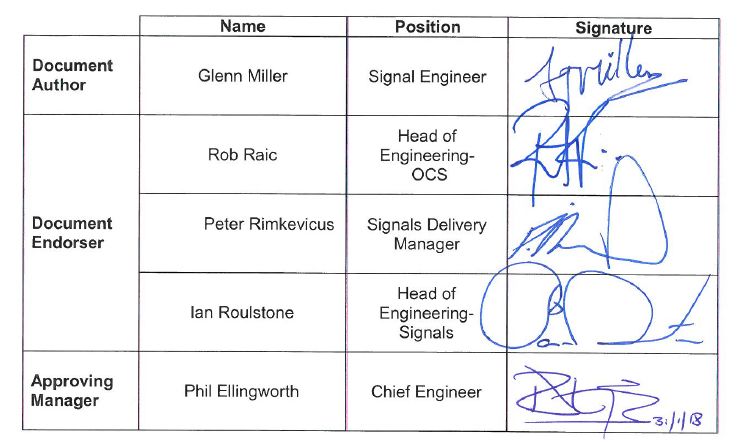
Approved By:

Phil Ellingworth
Chief Engineer

       PRINTOUT MAY NOT BE UP-TO-DATE; REFER TO METRO INTRANET FOR THE LATEST VERSION
SIGNALS RAIL SAFETY WORKER
                                                   COMPETENCE
  L1-CHE-MAN-003                          Version: 3                 Effective from: 1st February 2018

                                                 Approval

                                          Amendment Record

 Approval
                    Version                                        Description
   Date
01/03/2013              1          Initial release.
30/08/2013              2          Mid-year review.
                                   Document ownership changed from P&P to Engineering.
                                   Document number and Title amended previously
                                   L0-HMR-MAN-002.

                                   Document reviewed and updated to include the added roles of
                                   Signal Project Manager and Signal Project Engineer, additional
01/02/2018              3          forms created to assist RSW and assessors and capturing
                                   transfer of competencies.

                                   Enhanced information and guidance for RSW, assessors, SME
                                   and mentors

         Approving Manager: Chief Engineer            Approval Date: 01/02/2018   Next Review Date: 01/02//2021
PRINTOUT MAY NOT BE UP-TO-DATE; REFER TO METRO INTRANET FOR THE LATEST VERSION          Page 2 of 56
SIGNALS RAIL SAFETY WORKER
COMPETENCE
L1-CHE-MAN-003 Version: 3 Effective from: 1st February 2018
Table of Contents
1. Introduction .................................................................................................................. 7
1.1 Purpose ................................................................................................................................... 7
1.2 Scope ....................................................................................................................................... 7
1.3 Definitions and Responsibilities ............................................................................................... 7
1.4 Responsibilities ...................................................................................................................... 13
1.4.1 Chief Engineer ....................................................................................................... 13
1.4.2 Head of Engineering -Signals ................................................................................ 13
1.4.3 General Manager-Safety, Environment and Quality Systems ............................... 13
1.4.4 Card Issuing Body ................................................................................................. 13
1.4.5 RSW....................................................................................................................... 13
1.4.6 Signalling and Rail Systems Contracting Companies ........................................... 13
1.4.7 Assessors .............................................................................................................. 13
1.4.8 Subject Matter Experts .......................................................................................... 13
1.4.9 Alliance Partners and Projects .............................................................................. 14
2. Reference Documents .................................................................................................14
3. Working in Metro’s Rail Corridor ................................................................................14
4. Identifying and Determining Competence .................................................................14
5. How to Apply ...............................................................................................................15
5.1 RIW Card Process Flow ........................................................................................................ 15
5.2 Evidence Requirements – Process Flow Steps 1-3 .............................................................. 15
5.3 The Assessment Process – Process Flow Steps 4-6............................................................ 15
5.4 Metro Validation and Card Issue – Process Flow Steps 7-8 ................................................. 16
6. Roles and Classifications ...........................................................................................17
6.1 Signals, CS&C Roles and Classifications ............................................................................. 17
6.2 Company Position Descriptors versus RSW Roles ............................................................... 18
6.3 Role & Classification Descriptors .......................................................................................... 18
6.4 Signal Design......................................................................................................................... 18
6.4.1 Signal Principles Design Engineer ........................................................................ 18
6.4.2 Signal Senior Design Engineer .............................................................................. 18
6.4.3 Signal Design Engineer ......................................................................................... 19
6.4.4 Signal Designer ..................................................................................................... 19
6.4.5 Signal Assistant Designer ...................................................................................... 19
6.5 Signal Construction ............................................................................................................... 19
6.5.1 Signal Senior Construction Engineer..................................................................... 19
6.5.2 Signal Construction Engineer ................................................................................ 20
6.5.3 Signal Construction Supervisor / Signal Construction Team Leader .................... 20
6.5.4 Signal Constructor ................................................................................................. 20
6.5.5 Signal Assistant Constructor ................................................................................. 20
6.6 Signal Maintenance ............................................................................................................... 21
Approving Manager: Chief Engineer Approval Date: 01/02/2018 Next Review Date: 01/02//2021
PRINTOUT MAY NOT BE UP-TO-DATE; REFER TO METRO INTRANET FOR THE LATEST VERSION Page 3 of 56SIGNALS RAIL SAFETY WORKER
COMPETENCE
L1-CHE-MAN-003 Version: 3 Effective from: 1st February 2018
6.6.1 Signal Maintenance Senior Engineer .................................................................... 21
6.6.2 Signal Maintenance Engineer................................................................................ 21
6.6.3 Signal Maintenance Supervisor / Signal Maintenance Team Leader/ Signal
Maintenance Officer in Charge .............................................................................................. 21
6.6.4 Signal Maintainer / Technician .............................................................................. 21
6.6.5 Signal Assistant Maintainer /Signals Maintenance Works Assistant ..................... 22
6.7 Signal Test ............................................................................................................................. 22
6.7.1 Signal Principles Test Engineer ............................................................................. 22
6.7.2 Signal Senior Test Engineer .................................................................................. 22
6.7.3 Signal Test Engineer ............................................................................................. 22
6.7.4 Signal Tester.......................................................................................................... 23
6.7.5 Signal Assistant Tester .......................................................................................... 23
6.8 Control Systems & Communications ..................................................................................... 23
6.8.1 CS&C Senior Engineer .......................................................................................... 23
6.8.2 CS&C Engineer ..................................................................................................... 23
6.8.3 CS&C Technician .................................................................................................. 24
6.8.4 CS&C Assistant Technician ................................................................................... 24
6.9 Signal Project Management and Signal Project Engineering ................................................ 24
6.9.1 Signal Project Manager ......................................................................................... 24
6.9.2 Signal Project Engineer ......................................................................................... 24
6.10 Note 1. Recognised Equivalents ........................................................................................... 25
6.11 Note 2. TIC Requirements ..................................................................................................... 25
7. Assessment of RSW ....................................................................................................26
7.1 Assessment ........................................................................................................................... 26
7.2 Reassessment of a RSW ...................................................................................................... 26
7.3 Documentation and Requirements ........................................................................................ 26
7.4 Metro Signals Competency Management Forms .................................................................. 27
7.4.1 Statement of Competency-SoC ............................................................................. 27
7.4.2 Signals Competency Assessment Request .......................................................... 27
7.4.3 Signals Competency Work Experience Record (WER)......................................... 28
7.4.4 Signals Education and Training Record ................................................................ 28
7.4.5 Signals Competency Training Qualification Equivalence ...................................... 28
7.4.6 Signals Competency Upgrade Request ................................................................ 28
7.4.7 Signals Work Based Training Assessment ........................................................... 29
7.4.8 Signals Alternate Training Certificate .................................................................... 29
7.4.9 Signals Transfer of Competency Assessment Checklist ....................................... 29
7.4.10 Signals Assessment Checklist ............................................................................... 29
7.4.11 Metro Letter of Authorisation ................................................................................. 29
8. Education, Training and Experience ..........................................................................30
8.1 Education & Training Records ............................................................................................... 30
8.1.1 Education Record .................................................................................................. 30
8.1.2 Industry Training Record ....................................................................................... 30
Approving Manager: Chief Engineer Approval Date: 01/02/2018 Next Review Date: 01/02//2021
PRINTOUT MAY NOT BE UP-TO-DATE; REFER TO METRO INTRANET FOR THE LATEST VERSION Page 4 of 56SIGNALS RAIL SAFETY WORKER
COMPETENCE
L1-CHE-MAN-003 Version: 3 Effective from: 1st February 2018
8.1.3 Work Based Training Record ................................................................................ 30
8.1.4 Training Certificates ............................................................................................... 31
8.2 Training - Qualification Equivalence/ Predecessor Qualifications ......................................... 31
8.3 Assessment and Capture of Work Experience and Training ................................................ 31
8.4 Capturing Work Based Training ............................................................................................ 31
8.4.1 Non AQF Skill or Competency............................................................................... 32
8.4.2 Work Based Training and Assessment ................................................................. 32
8.4.3 Alternate Assessment for Technically Difficult Skills ............................................. 32
8.5 Work Experience Records ..................................................................................................... 33
8.5.1 Supervised Higher Level Work Experience ........................................................... 33
8.5.2 Relevant Past Experience ..................................................................................... 33
8.6 Transfer of RSW competencies............................................................................................. 33
8.7 Upgrading of Competencies .................................................................................................. 34
8.8 Recording Assessments ........................................................................................................ 35
8.9 Statement of Competency ..................................................................................................... 35
9. Competency Proficiency Levels .................................................................................36
9.1 Level 0 Proficiency ................................................................................................................ 36
9.2 Level 1 Proficiency ................................................................................................................ 36
9.3 Level 2 Proficiency ................................................................................................................ 37
9.4 Level 3 Proficiency ................................................................................................................ 37
9.5 Complex Tasks and Skill Levels demonstrated..................................................................... 38
9.5.1 Complex Tasks Definition ...................................................................................... 38
9.5.2 Examples of Complex Skill and Tasks .................................................................. 38
10. Maintaining Competence ............................................................................................39
11. Head of Engineering -Signals Issued Mentoring Role ..............................................39
12. Assessors and Subject Matter Experts ......................................................................40
12.1 Assessors .............................................................................................................................. 40
12.2 Obligations of External Assessors during the Assessment Process ..................................... 40
12.3 External Assessor Re-certification ........................................................................................ 41
12.4 Subject Matter Experts .......................................................................................................... 41
13. Auditing........................................................................................................................41
13.1 In-Field Auditing ..................................................................................................................... 41
13.2 Off-Site Auditing .................................................................................................................... 41
14. Safeworking Breach and Competency Management ................................................42
14.1 Introduction ............................................................................................................................ 42
14.2 Safeworking Breach .............................................................................................................. 42
15. Dispute Resolution ......................................................................................................42
16. Appendices ..................................................................................................................43
16.1 Appendix 1: Signalling, Control Systems & Communications Roles Matrix .......................... 43
Approving Manager: Chief Engineer Approval Date: 01/02/2018 Next Review Date: 01/02//2021
PRINTOUT MAY NOT BE UP-TO-DATE; REFER TO METRO INTRANET FOR THE LATEST VERSION Page 5 of 56SIGNALS RAIL SAFETY WORKER
COMPETENCE
L1-CHE-MAN-003 Version: 3 Effective from: 1st February 2018
16.2 Appendix 2: Levels of Supervision ........................................................................................ 43
16.3 Appendix 3: Process Flow for a Signals RSW applying for Metro Assessment.................... 44
16.4 Appendix 4: Process flow for a RSW applying to be a Signals Assessor/SME/TIC/ Mentor 45
16.5 Appendix 5: Supporting Documents and Filenames ............................................................. 46
16.6 Appendix 6: Work Experience Record Requirement and example ....................................... 47
16.7 Appendix 7: Assessor Competencies .................................................................................... 49
16.8 Appendix 8: Project Management and Project Engineering .................................................. 50
List of Tables
Table 1- Design skills for Signal Design Engineer or Signal Designer ..................................51
Table 2- Maintenance skills for Signal Technician ................................................................51
Table 3- Maintenance skills for Signal Maintenance Engineer ..............................................52
Table 4- Construction skills for Signal Constructor ...............................................................52
Table 5- Construction and Testing skills for Signal Construction Engineer ...........................53
Table 6- Signals Project Manager skills ................................................................................53
Table 7- Signals Project Engineer skills ................................................................................54
Table 8: List of Metro Forms .................................................................................................55
Approving Manager: Chief Engineer Approval Date: 01/02/2018 Next Review Date: 01/02//2021
PRINTOUT MAY NOT BE UP-TO-DATE; REFER TO METRO INTRANET FOR THE LATEST VERSION Page 6 of 56SIGNALS RAIL SAFETY WORKER
COMPETENCE
L1-CHE-MAN-003 Version: 3 Effective from: 1st February 2018
1. Introduction
1.1 Purpose
The purpose of this manual is to detail the signals, control systems and
communications competency management system requirements; a subset of Metro
competency requirements for all rail safety workers governed by L0-HMR-MAN-001
Business Rules Manual for the Contracting Rail Safety Worker.
1.2 Scope
This manual covers the competence of all signal, control systems and
communications contractors, subcontractors, consultants and advisors who carry out
any form of rail safety work in support of Metro’s signalling, control systems,
communications and related Infrastructure; including includes project management,
project and rail systems engineering, design, construction, testing, commissioning and
maintenance of this infrastructure.
This includes providing or undertaking any form of signal, control systems and
communications, engineering advice or activities related to these areas, guidance,
direction, consultation during the various life cycle and phases of rail signalling and
allied areas of engineering, rail systems, control systems and communications and
associated areas.
The Act requires that competence should be assessed with reference to the AQF
which has requirements for obtaining qualifications through an approved course. It is
Metro’s responsibility to record and determine the competencies gained through the
AQF as well as the competencies required for those areas outside the AQF.
1.3 Definitions and Responsibilities
The following terms and acronyms are used within this document:
Term or acronym Description
Academic Transcript Is an official, comprehensive verifiable copy of a student’s record of
courses relating to their qualification
Act or ‘the Act’ Refers to the Victorian Rail Safety Act 2013. Rail Safety (Local
Operations) Act 2006
AMIRSE Associate Member of the Institution of Railway Signal Engineers
(IRSE) See http://www.irse.org
ARA Australasian Railways Association. See https://ara.net.au
ARTO Accredited Rail Transport Operator
ARTC Australian Rail Track Corporation
Assessor Is the qualified person responsible for assessing a RSW’s
evidence against the assessment criteria and ensuring all Metro
processes are followed, and completing the final and signed SOC.
AQF Australian Qualifications Framework. The national policy for
regulated qualifications in Australian education and training. See
https://www.aqf.edu.au
Approving Manager: Chief Engineer Approval Date: 01/02/2018 Next Review Date: 01/02//2021
PRINTOUT MAY NOT BE UP-TO-DATE; REFER TO METRO INTRANET FOR THE LATEST VERSION Page 7 of 56SIGNALS RAIL SAFETY WORKER
COMPETENCE
L1-CHE-MAN-003 Version: 3 Effective from: 1st February 2018
Term or acronym Description
Card Issuing Body Refers to Onsite – the ARA and Metro approved external provider
of the RIW Card.
CBI Computer or processor based type interlocking
Certified Documents Documents which are confirmed as true copies of the originals, by
a person authorised to do so.
Checklist Checklist form used to capture the evidence required by the RSW
for assessment within one document. It captures the RSW’s work
experience records and training records, then the draft and final
agreed assessed competency level of the RSW. It directly relates
to the SoC for the Role. The competency level as defined within
the Checklist is then transferred to the SoC. Additional types of
infrastructure can be added to the checklist by the RSW or
Assessor to better reflect the skills of the RSW
Competency The framework that governs the CMS.
Assurance
Framework (CAF)
Competence Is the ability of an individual to do a task well or correctly, a
competency is a set of defined behaviours that provide a structured
guide enabling the identification, evaluation and development of
the skills in individual employees.
May be a combination of a number of skills
Competency A system of capturing the competencies of all RSW to meet the
Management requirements of the Act. Metro uses Onsite CMS to manage the
System (CMS) competencies of contracting RSW’s.
Complex Task Any task or skill requirement that requires the use of non-generic
or special skills to perform.
Contractor, A company or individual engaged by Metro or Others to undertake
Consultant signalling work in accordance with an agreement. A contractor or
consultant may be a sole trader or an employee of a parent signal
contracting company. For the purpose of this manual; Metro staff,
contractors, consultants, subcontractors and others are referred to
as RSW.
CS&C Control Systems & Communications
CSR Combined Service Route
CWP Commissioning Work Package
DMS Document Management System. Captures all drawings, CAD files,
standards pertaining to drawing and other standards. See
https://dms.ptv.vic.gov.au
Forms Forms required for use within the competency process and
available from the Metro Academy website
http://www.Metrotrains.com.au/academy/
Approving Manager: Chief Engineer Approval Date: 01/02/2018 Next Review Date: 01/02//2021
PRINTOUT MAY NOT BE UP-TO-DATE; REFER TO METRO INTRANET FOR THE LATEST VERSION Page 8 of 56SIGNALS RAIL SAFETY WORKER
COMPETENCE
L1-CHE-MAN-003 Version: 3 Effective from: 1st February 2018
Term or acronym Description
IRSE Institution of Railway Signal Engineers is an engineering institution
representing signal engineers and others internationally. See
http://www.irse.org
ID Identification
Matrix Reference related to Appendix one, Metro Matrix of Signalling,
Control Systems & Communications Roles
Mentor, Mentoring For the purpose of this document shall mean to provide guidance,
help and support in the learning process of a RSW or others.
Mentor Role A role that can be applied for and issued to a RSW for the
purposes of providing mentoring activities only. No rail safety
related work can be undertaken.
Metro Metro Trains Melbourne. See http://www.metrotrains.com.au
Metro Academy The website where all required information and forms can be
website obtained for competencies required when working within the Metro
network. http://www.Metrotrains.com.au/academy/
Metro Letter of The Metro Letter of Authorisation (form L4-CHE-FOR-088) is the
Authorisation form of approval issued by Metro Head of Engineering-Signals for
approving the roles of TIC, Signals Assessor, Signals Mentor,
SME, and captured within Onsite.
ONRSR Office of the National Rail Safety Regulator. See
https://www.onrsr.com.au
Onsite CMS The Onsite CMS is the system behind the RIW Card program.
Found at http://railindustryworker.com.au/pegasus-powered-by-
onsite/
PM Project Manager
Project A task requiring the allocation of resources outside of normal
maintenance, operations or contract administration activities. A
Project has a start and finish date. Alternatively a Project can be
defined as “a temporary organisation that is created for the
purpose of delivering one or more business products according to
a specified business case”.
PTV Public Transport Victoria
Rail Corridor Fence to fence either side of the nearest track. If no fence, 15
metres either side of the outermost rail.
Rail Safety Work Refers to work carried out specific to Metro’s accreditation with
ONRSR.
Approving Manager: Chief Engineer Approval Date: 01/02/2018 Next Review Date: 01/02//2021
PRINTOUT MAY NOT BE UP-TO-DATE; REFER TO METRO INTRANET FOR THE LATEST VERSION Page 9 of 56SIGNALS RAIL SAFETY WORKER
COMPETENCE
L1-CHE-MAN-003 Version: 3 Effective from: 1st February 2018
Term or acronym Description
Rail Safety Worker Refers to those carrying out rail safety work under one or more of
(RSW) Metro’s Functional Categories.
Registered Training A vocational education and training organisation registered to
Organisation (or deliver training in accordance with the AQF.
RTO)
Responsible A person whom is assessed as a RSW and competent in a Role to
Competent Person confirm that work is correct. Is able to Mentor others in a activity or
Role.
RIW Rail Industry Worker. See http://railindustryworker.com.au
Risk Effect of uncertainty on objectives
Risk Management Coordinated activities to direct and control an organisation with
regard to risk
RORE Record of Relevant Experience related to Signal Project
Management and Signal Project Engineering roles and capture of
evidence
RSW Card / Rail The smart card used to identify each RIW and the roles which the
Industry Worker RSW is authorised to undertake.
(RIW) Card
Relevant Any experience presented for assessment needs to be directly
Experience related, directly connected or directly pertinent to the role.
SAP Signal Arrangement Plan
Signals For the purpose of this manual relates to rail signalling, rail
systems, control systems, communications, project management,
engineering and all related areas.
Signal Assessor An individual approved by Metro to review evidence pertaining to a
Signal’s RSW and issue authorising documents to Onsite in
support of this manual.
Signal Competence The signal and communications functional roles – Design,
Roles Construction, Test, Maintenance and Control Systems &
Communications, Project Management and Project Engineering.
Signals Within the signals competency roles there are competency
Competence Class classes(classifications)
Signals Proficiency Within each Signals Competence Class there are a range of skills
Skills that are separately identified on the statement of competency.
Approving Manager: Chief Engineer Approval Date: 01/02/2018 Next Review Date: 01/02//2021
PRINTOUT MAY NOT BE UP-TO-DATE; REFER TO METRO INTRANET FOR THE LATEST VERSION Page 10 of 56SIGNALS RAIL SAFETY WORKER
COMPETENCE
L1-CHE-MAN-003 Version: 3 Effective from: 1st February 2018
Term or acronym Description
Signals Proficiency Within each Signals Competency skill there may be a range of
Level signals Proficiency Levels. These levels 0, 1, 2, 3 cover the level
of proficiency achieved by the RSW. The RSW must only
undertake work for which they have the appropriate and assessed
proficiency level.
Signal Project A senior person who is specifically responsible for the non-
Manager technical and management function of the signalling works within a
project. This individual would work under the direction of the overall
Project Manager. In some Projects this individual may carry out
dual roles and fulfil the overall Project Manager role as well.
Signal Project The person who is responsible for specific signalling technical
Engineer components of the project. The role at times can also perform
some duties of a Signalling Project Manager and should hold an
engineering degree and be AMIRSE.
Skill The required knowledge and training and the ability to complete a
task to meet a defined performance measure. A number of skills
combine to form a competency (A singular skill can form a
competency)
Statement of This is the document which details the signals classification, skills,
Competence (SoC) range and levels of the RSW. Additional types of infrastructure can
be added to the SoC by the Assessor to better reflect the skills of
the RSW.
Standards For the purpose of this manual can comprise documents, plans
used for technical and related references and information, VRIOG
standards, ARTO design practice notes, guidelines, procedures,
instructions, specifications, manuals, National and International
documents
Subject Matter SME are RSW who have met the Metro evidence requirements
Expert (SME) associated with a Proficiency Level 3 within a given role
classification. Once endorsed by Metro the SME provides expert
guidance to the Assessor during the assessment process.
Systems Systems Engineering is an interdisciplinary field of engineering and
Engineering engineering management that focuses on how to design and
manage complex systems over their life cycles.
TIC Tester in Charge
Upload Sending documents from a computer to another system using the
internet.
Approving Manager: Chief Engineer Approval Date: 01/02/2018 Next Review Date: 01/02//2021
PRINTOUT MAY NOT BE UP-TO-DATE; REFER TO METRO INTRANET FOR THE LATEST VERSION Page 11 of 56SIGNALS RAIL SAFETY WORKER
COMPETENCE
L1-CHE-MAN-003 Version: 3 Effective from: 1st February 2018
Term or acronym Description
VET Quality It sets the nationally agreed standards for the Australian vocational
Framework education and training system. This replaced the Australian Quality
Training Framework. See
https://www.asqa.gov.au/about/australias-vet-sector/vet-quality-
framework
Victorian Rail Standards specific to Victoria and inclusive of VRIOGS, Metro,
Industry Standards PTV, Victrack, DMS
VRIOGS Victorian Railway Industry Operators Group Standards. All
standards and documents are stored within the DMS
Work Experience This is the record of work undertaken by the RSW involving the
Record(WER)/ Log application of the signalling competencies. It ;
Book
• Shows the extent of tasks performed, responsibilities in
undertaking the tasks and the technology applied
• Includes information in the referenced form which is part of
this procedure
• Is verified by an appropriate supervisor or manager
Approving Manager: Chief Engineer Approval Date: 01/02/2018 Next Review Date: 01/02//2021
PRINTOUT MAY NOT BE UP-TO-DATE; REFER TO METRO INTRANET FOR THE LATEST VERSION Page 12 of 56SIGNALS RAIL SAFETY WORKER
COMPETENCE
L1-CHE-MAN-003 Version: 3 Effective from: 1st February 2018
1.4 Responsibilities
1.4.1 Chief Engineer
• Is the owner of this manual
1.4.2 Head of Engineering -Signals
Or the delegated representative of the Head of Signals
• Is responsible for providing signal expertise in the implementation of this
manual.
• Is the Metro approver of all RIW card applications for signalling, control systems
and communications roles and classifications
• Is responsible for the auditing of RSW competencies
• Is the Metro approver of all Metro signalling, control and communication
systems competencies for all RSW in all signals and C.S&C roles and
classifications inclusive of Assessor, SME, TIC, Mentors, etc.
• Is able to make decisions on RSW competency whilst awaiting formal
approval(s)
1.4.3 General Manager-Safety, Environment and Quality Systems
• Is responsible for managing the process of ensuring all RSW’s are in
compliance with this manual.
1.4.4 Card Issuing Body
• Is responsible for verifying RSW competencies and issuing the RIW Card.
1.4.5 RSW
• Shall ensure the competencies required to work for Metro are valid, current and
relevant to the work they undertake;
• Shall not undertake rail safety work for which they have not been deemed
competent under this manual; and
• Shall provide and maintain all evidence requirements used in assessing
competence in accordance with this manual.
1.4.6 Signalling and Rail Systems Contracting Companies
• Shall ensure compliance with this manual; and
• Are responsible for ensuring subcontracting RSW’s, engaged by the parent
contracting company are compliant with this manual.
1.4.7 Assessors
• Are responsible for assessing a RSW evidence against the assessment criteria
and ensuring all Metro processes are followed, and completing the final and
signed SOC, in a format acceptable for uploading to the card issuing body.
1.4.8 Subject Matter Experts
• Are responsible for providing assessors with expert technical knowledge in their
assessed areas of expertise against all the roles and skills being assessed.
Approving Manager: Chief Engineer Approval Date: 01/02/2018 Next Review Date: 01/02//2021
PRINTOUT MAY NOT BE UP-TO-DATE; REFER TO METRO INTRANET FOR THE LATEST VERSION Page 13 of 56SIGNALS RAIL SAFETY WORKER
COMPETENCE
L1-CHE-MAN-003 Version: 3 Effective from: 1st February 2018
1.4.9 Alliance Partners and Projects
• Shall ensure all RSW engaged by the alliance or projects are compliant with this
manual.
2. Reference Documents
The following documents support this manual:
• L0-SQE-PRO-014 – Safety and Environmental Requirements for Contractors
Working on Metro Premises
• L0-HMR-MAN-001 – Business Rules Manual for the Contracting Rail Safety
Worker
• L1-SQE-PRO-057 Competency Management Following a Safeworking Breach
• L1-SQE-PRO-005 Incident Reporting and Investigation Procedure
3. Working in Metro’s Rail Corridor
Where a role or classification requires a RSW to work within Metro’s rail corridor the
RSW must select and comply with the competency requirements of the Around the
Track Person role.
The minimum requirements shall be:
• Category 3 Health Assessment,
• Train Track Safety Awareness,
• Metro Safety & Environmental Induction, and
• Construction Industry Induction.
Note; RSW that are not working within the Metro rail corridor do not require the roles
within Onsite for “around track”, or Metro Rail Operator or the directly related Health
Assessment requirement (includes RSW working off-site, Overseas and not within the
rail corridor)
4. Identifying and Determining Competence
As an accredited rail operator under the Act, Metro must have a CMS that ensures
RSWs are competent to carry out their rail safety work and the CMS maintains the
competency records for all RSWs.
Further details on the generic process for ensuring the RSW user profile has been
created in Onsite and can be found in the L0-HMR-MAN-001.
Approving Manager: Chief Engineer Approval Date: 01/02/2018 Next Review Date: 01/02//2021
PRINTOUT MAY NOT BE UP-TO-DATE; REFER TO METRO INTRANET FOR THE LATEST VERSION Page 14 of 56SIGNALS RAIL SAFETY WORKER
COMPETENCE
L1-CHE-MAN-003 Version: 3 Effective from: 1st February 2018
5. How to Apply
5.1 RIW Card Process Flow
This manual and process assumes the RSW has a profile within the Onsite website
found at http://railindustryworker.com.au/pegasus-powered-by-onsite.
If this is not the case, refer to the L0-HMR-MAN-001for the Contracting Rail Safety
Worker to be in this position and then return to this paragraph.
The following should be read in conjunction with process flow chart. Refer to Section
16.3 or appendix 3.
Note; RSW that are not working within the Metro rail corridor, although undertaking
Metro work, are located Overseas, and require the mandatory identity verification to
obtain a RIW profile, can apply and have their identity validated by an approved
certifier of documents in their own Country of Origin, as are acceptable to Pegasus
(Onsite track easy).
5.2 Evidence Requirements – Process Flow Steps 1-3
Applicants should refer to Appendix 1, Signals, Control Systems and Communications
matrix to view the specific evidence requirements associated with each role and
classification.
Once the individual has selected the role and classification(s), the requirements
identified on the matrix will now appear against the individual’s profile within Onsite.
Evidence must now be uploaded by the RSW to satisfy each requirement.
Part of this evidence includes downloading and completing a self-assessment on the
Metro SoC associated with that role and classification from the Metro Academy
website www.Metrotrains.com.au/academy.
Note; in completing the SoC, refer to section 9 for assistance in determining what
constitutes each proficiency level.
5.3 The Assessment Process – Process Flow Steps 4-6
This commences with the RSW uploading all their evidence required for the
assessment, then selecting an Assessor within Onsite from the list provided within
Onsite. The Assessor is notified by Onsite and the assessment process commences.
The assessor will review the RSW’s evidence and determine whether the evidence is
valid, current, sufficient, and authentic and therefore substantiates the RSW self-
assessed proficiency level.
Depending on the evidence provided by the RSW, the assessor can:
• Assess them as competent to carry out the classification to the levels applied for;
or
• Request further evidence if the evidence provided is deemed insufficient.
Where the RSW disputes the assessment the RSW is encouraged to elect to follow
Metro’s dispute process and seek resolution in accordance with section14.
When the assessment is complete the assessor completes the SoC. This step
involves the completed SoC being signed by the assessor, the engaged SME and the
RSW in question, then being scanned and uploaded into Onsite.
Approving Manager: Chief Engineer Approval Date: 01/02/2018 Next Review Date: 01/02//2021
PRINTOUT MAY NOT BE UP-TO-DATE; REFER TO METRO INTRANET FOR THE LATEST VERSION Page 15 of 56SIGNALS RAIL SAFETY WORKER
COMPETENCE
L1-CHE-MAN-003 Version: 3 Effective from: 1st February 2018
Note. Where an assessor is not a Metro endorsed SME, the assessor shall engage
an SME from within the corresponding signal role as the SME to assist with the
assessment.
5.4 Metro Validation and Card Issue – Process Flow Steps 7-8
Once the completed SoC has been uploaded, a member of the Metro CMS team will
receive notification from Onsite that validation can commence.
If the Metro representative is satisfied with the evidence and approves the application,
the process is complete and the RSW receives an email from Onsite and their RIW
Card generally within 48 hours.
If the Metro CMS team believe there is an error with the application, e.g.; the
evidence does not support the classification and/or proficiency, Metro will reject the
application.
Rejection results in the individual receiving an email notification from Onsite and the
CMS team; with the latter providing information on the areas requiring rectification so
the RSW can recommence the process at step 3.
Approving Manager: Chief Engineer Approval Date: 01/02/2018 Next Review Date: 01/02//2021
PRINTOUT MAY NOT BE UP-TO-DATE; REFER TO METRO INTRANET FOR THE LATEST VERSION Page 16 of 56SIGNALS RAIL SAFETY WORKER
COMPETENCE
L1-CHE-MAN-003 Version: 3 Effective from: 1st February 2018
6. Roles and Classifications
6.1 Signals, CS&C Roles and Classifications
The roles below are based on the typical grouping within the Australian rail industry.
RSW should first identify the role they undertake and then the classification. Roles
are Design, Construct, Test, Maintain, CS&C, and Project Manage. Classification
examples are; principles design engineer, senior design engineer, designer,
constructor, technician, tester, signal project manager, etc.
Where a RSW cannot identify a role or classification that aligns to the work that they
undertake and perform in their company position, they should contact the Metro
competencies team to seek clarification via the competencies@metrotrains.com.au
email address.
ROLES
Control
Systems
and Project
Design Construct Test Maintain Communica Manager
tion
(CS&C)
Signal Signal
Principles Principles
Design Test
Engineer Engineer
Signal Senior Signal Senior Signal Senior Signal Senior Senior
Design Construction Test Maintenance CS&C
Engineer Engineer Engineer Engineer Engineer
Signal
Project
Manager
CLASSIFICATIONS
Signal
Signal Signal
Signal Design Signal Test CS&C Project
Construction Maintenance
Engineer Engineer Engineer Engineer
Engineer Engineer
Signal Signal
Construction Maintenance
Supervisor / Supervisor /
Signal Team Signal Team
Leader Leader
Signal Signal Signal CS&C
Signal Tester
Designer Constructor Maintainer Technician
Signal Signal Signal CS&C
Signal Assistant Assistant Assistant Assistant
Assistant Constructor Tester Maintainer Technician
Designer
Approving Manager: Chief Engineer Approval Date: 01/02/2018 Next Review Date: 01/02//2021
PRINTOUT MAY NOT BE UP-TO-DATE; REFER TO METRO INTRANET FOR THE LATEST VERSION Page 17 of 56SIGNALS RAIL SAFETY WORKER
COMPETENCE
L1-CHE-MAN-003 Version: 3 Effective from: 1st February 2018
6.2 Company Position Descriptors versus RSW Roles
Individual company position descriptors for RSW may or may not align in title or
function with the RSW role classifications listed above. In both cases the question
remains:
What rail safety work does the individual undertake for Metro as a function of their
position within the company?’
In many cases the company position might actually involve multiple signal roles and
classifications. In this case, the difference is simply the amount of evidence required
to support all classifications, e.g. a RSW might hold a Bachelor of Engineering and
hold the position of Signals Superintendent within their company. The rail safety work
they actually undertake and perform however falls under the classification of Test
Engineer and Maintenance Engineer.
In this example both roles should be selected and all evidence requirements for both
role classifications provided for assessment.
The identification of the role and tasks undertaken by the RSW shall determine the
classification that the RSW shall apply for competency.
Note; this applies similarly to graduates, cadets, trainees, apprentices and the role
selected within Onsite should reflect the actual rail safety work being undertaken and
performed by the RSW.
6.3 Role & Classification Descriptors
Role and classification descriptors are captured in the following sections.
Role classifications are explained below; however, the RSW should refer to Appendix
1, Signals, Control Systems and Communications matrix for all requirements
associated with each role and classification.
6.4 Signal Design
6.4.1 Signal Principles Design Engineer
This covers the role of the Principles Design Engineer who will typically be
responsible for interpreting and complying with Standards, Book of Rules and
Operating Procedures and Operational Requirements, train control systems and
capable of producing and final sign-off on signalling principles with a proficiency of
level 3, in the required design activity. The RSW will have an in-depth knowledge of
all systems that interface to signalling such as, rolling stock, power, communications,
track and civil, etc. And understand systems approach to signalling principles
activities. This includes independent principles verification function. This classification
would typically be the signal industry eminent person, with over ten years of senior
responsible roles and activities, and hold formal qualifications from a university.
See Note 1 at the end of this section for a recognised equivalent pathway.
6.4.2 Signal Senior Design Engineer
This covers the senior design engineer who will typically be responsible for checking /
verification including the final sign-off of designs with a typical proficiency of level 3, in
Approving Manager: Chief Engineer Approval Date: 01/02/2018 Next Review Date: 01/02//2021
PRINTOUT MAY NOT BE UP-TO-DATE; REFER TO METRO INTRANET FOR THE LATEST VERSION Page 18 of 56SIGNALS RAIL SAFETY WORKER
COMPETENCE
L1-CHE-MAN-003 Version: 3 Effective from: 1st February 2018
the required design activity. The skills of checking / verification should not be
undertaken unless the skills in design are a minimum level 2, (practitioner level).
Checkers under mentorship of a responsible competent person shall hold a minimum
competency of Level 2 in design and Level 1 in checking for the task(s) they are
being mentored to check. Mentoring of independent verifiers is not permitted. The
RSW typically has greater than ten years engineering experience in railway signalling
with at least 5 years in a responsible signal engineering design position and holds a
relevant degree from a university.
See Note 1 at the end of this section for a recognised equivalent pathway.
6.4.3 Signal Design Engineer
This covers the general signal design and checking area of the works. The person
typically has greater than 5 years engineering experience in railway signalling and
holds a formal qualification e.g. being a Bachelor degree from a university.
As a Signal Design Engineer the person will typically be responsible for production of
signal designs and final checking by interpreting signalling principles / standards and
functional design documentation to proficiency level 2, in the required design activity.
This can also include independent design review function. The skills of checking /
verification should not be undertaken unless the skills in design are a minimum level 2
(Practitioner level). Checkers under mentorship of a responsible competent person
shall hold a minimum competency of Level 2 in design and Level 1 in checking for the
task(s) they are being mentored to check. Mentoring of independent verifiers is not
permitted.
See Note 1 for a recognised equivalent pathway.
6.4.4 Signal Designer
This covers the signal design area for design and initial / minor works checking. The
RSW typically has greater than 3 years engineering experience in railway signalling
and holds a formal qualification, e.g. a Certificate IV through to Advanced Diploma in
a relevant field, but not a recognised degree.
As a Signal Designer the RSW will typically be responsible for production of signal
designs by interpreting signalling principles / standards and functional design
documentation to a minimum proficiency of level 2, in the required design activity.
6.4.5 Signal Assistant Designer
This covers the training / entry level signal design area for drafting and design. The
RSW typically has less than 3 years engineering experience in railway signalling and
holds a formal qualification, e.g. a Certificate IV through to Advanced Diploma in a
relevant field.
As a Signal Assistant Designer the RSW will typically be capable of drafting and initial
production of signal designs under supervision to a proficiency of level 1.
6.5 Signal Construction
6.5.1 Signal Senior Construction Engineer
This covers the signal construction area predominantly at a senior level. The RSW
typically has greater than 10 years engineering experience in railway signalling with at
least 5 years in a responsible signal construction management position and holds
formal qualification from a university.
Approving Manager: Chief Engineer Approval Date: 01/02/2018 Next Review Date: 01/02//2021
PRINTOUT MAY NOT BE UP-TO-DATE; REFER TO METRO INTRANET FOR THE LATEST VERSION Page 19 of 56SIGNALS RAIL SAFETY WORKER
COMPETENCE
L1-CHE-MAN-003 Version: 3 Effective from: 1st February 2018
As a Senior Construction Engineer the RSW will typically be responsible for
interpretation of signalling requirements and the final sign off for construction of the
signalling works with a typical proficiency of level 3, in the required signal construction
activity.
See Note 1 at the end of this section for a recognised equivalent pathway.
6.5.2 Signal Construction Engineer
This covers the general signal discipline area for construction. The RSW typically has
greater than 5 years engineering experience in railway signalling and holds a formal
qualification from a university.
As a Signal Construction Engineer the RSW will typically be responsible for
coordination of construction works by interpreting signalling design plans,
construction standards and functional construction documentation to a proficiency of
level 2, in the required construction activity.
See Note 1 at the end of this section for a recognised equivalent pathway.
6.5.3 Signal Construction Supervisor / Signal Construction Team Leader
This covers the signal trade / site construction area of the works. The RSW typically
has greater than 5 years engineering experience in railway signalling and holds a
formal qualification e.g. a Certificate IV through to Advanced Diploma in a relevant
field.
As a Signal Construction Supervisor / Team Leader the RSW will typically be
responsible for overseeing and leading the physical construction activities by
interpreting signalling documentation and functional construction documentation to a
minimum proficiency of level 2, in the required construction activity. The construction
activity may require supervision of ‘set to work’ activities as required.
6.5.4 Signal Constructor
This covers the signal trade / site construction area of the works. The RSW typically
has greater than 3 years engineering experience in railway signalling and holds a
formal qualification e.g. a Certificate III through to Advanced Diploma in a relevant
field.
As a Signal Constructor the RSW will typically be responsible for undertaking the
physical construction activities by interpreting signalling documentation, functional
construction documentation and ‘set to work’ activities as required to a minimum
proficiency of level 2, in the required construction activity. This would also include
such activities as mechanical signals and point construction activities.
6.5.5 Signal Assistant Constructor
This covers the training / entry level in signal construction area undertaking the
physical signal construction activities. The RSW typically has less than 3 years
engineering experience in railway signalling and holds a formal qualification e.g. a
Certificate III through to Advanced Diploma in a relevant field.
As an Assistant Signal Constructor the RSW will typically be capable of assisting the
signal constructor under supervision in the physical works and has a basic
understanding of signalling construction drawings and construction standards to a
proficiency of level 1.
Approving Manager: Chief Engineer Approval Date: 01/02/2018 Next Review Date: 01/02//2021
PRINTOUT MAY NOT BE UP-TO-DATE; REFER TO METRO INTRANET FOR THE LATEST VERSION Page 20 of 56SIGNALS RAIL SAFETY WORKER
COMPETENCE
L1-CHE-MAN-003 Version: 3 Effective from: 1st February 2018
6.6 Signal Maintenance
6.6.1 Signal Maintenance Senior Engineer
This covers the signal maintenance area predominantly at a senior level. The RSW
typically has greater than 10 years engineering experience in railway signalling with
at least 5 years in a responsible signal maintenance management position and holds
a formal qualification from a university.
As a Senior Maintenance Engineer the RSW will typically be responsible for
maintenance of the signalling system and sign off for signalling maintenance
documentation or works with a typical proficiency of level 3, in the required signal
maintenance activity.
See Note 1 at the end of this section for a recognised equivalent pathway.
See Note 2 for TIC requirements.
6.6.2 Signal Maintenance Engineer
This covers the general signal maintenance area. The RSW typically has greater than
5 years engineering experience in railway signalling and holds a formal qualification
from a university.
As a Signal Maintenance Engineer the RSW will typically be responsible for
production and management of signal technical maintenance plan documentation by
interpreting signalling documentation and functional maintenance documentation to a
proficiency of level 2, in the required maintenance activity. This can also include
‘minor works’ TIC activities.
See Note 1 at the end of this section for a recognised equivalent pathway.
See Note 2 for TIC requirements.
6.6.3 Signal Maintenance Supervisor / Signal Maintenance Team Leader/ Signal
Maintenance Officer in Charge
This covers the signal trade / site signal maintenance area of the signalling system.
The RSW typically has greater than 5 years’ experience in railway signalling and
holds a minimum of Certificate IV in Rail Signalling. As a Signal Maintenance
Supervisor / Team Leader the RSW will typically be responsible for overseeing,
leading and signing off the signal maintenance activities by interpreting signalling
documentation, including maintenance instructions and technical maintenance plans
and functional signal maintenance documentation to a minimum proficiency of level 2,
in the required signal maintenance activity. This can also include ‘minor works’ TIC
activities.
See Note 2 for TIC requirements.
6.6.4 Signal Maintainer / Technician
This covers the signal trade / site signal maintenance area of the system. The RSW
typically has greater than 3 years engineering experience in railway signalling and
holds a Certificate IV in Rail Signalling.
As a Signal Maintainer the RSW will typically be responsible for undertaking the
physical maintenance activities by interpreting signalling documentation and
functional maintenance documentation to a minimum proficiency of level 2, in the
required signal maintenance activity.
Approving Manager: Chief Engineer Approval Date: 01/02/2018 Next Review Date: 01/02//2021
PRINTOUT MAY NOT BE UP-TO-DATE; REFER TO METRO INTRANET FOR THE LATEST VERSION Page 21 of 56SIGNALS RAIL SAFETY WORKER
COMPETENCE
L1-CHE-MAN-003 Version: 3 Effective from: 1st February 2018
6.6.5 Signal Assistant Maintainer /Signals Maintenance Works Assistant
This covers the training / entry level in the signal maintenance area undertaking the
physical signal maintenance activities. The RSW typically has less than 3 years’
experience and holds a formal qualification, e.g. a Certificate III through to Advanced
Diploma in a relevant field.
As an Assistant Signal Maintainer the RSW will typically be capable of assisting the
signal maintainer under supervision in signal maintenance works and has a basic
understanding of signal maintenance procedures and documentation to proficiency of
level 1.
6.7 Signal Test
6.7.1 Signal Principles Test Engineer
This covers the role of the Principles Test Engineer who will typically be responsible
for interpreting and ensuring compliance with Standards, Book of Rules and
Operating Procedures and Operational Requirements, train control systems and
capable of principles testing and final sign-off on signalling principles with a
proficiency of level 3, in the required testing activity.
The RSW will have an in-depth knowledge of all systems that interface to signalling
such as, rolling stock, power, communications, and track and civil, etc. They will
understand systems approach to signalling principles activities. This includes
independent principles validation applicable to the TIC activities. This classification
would be the signal industry eminent person, with over ten years of senior
responsible roles and activities, holds a formal qualification from a university.
See Note 1 at the end of this section for a recognised equivalent pathway
See Note 2 for TIC requirements.
6.7.2 Signal Senior Test Engineer
This covers the senior test engineer who will typically be responsible for validation
and the final sign-off of testing activities with a typical proficiency of level 3, in the
required testing activity. This can also include factory acceptance testing.
Testing should not be undertaken unless the skills of the RSW in testing are a
minimum level 2(Practitioner level). The RSW typically has greater than ten years
engineering experience in railway signalling with at least 5 years in a responsible
signal engineering testing position and holds a formal qualification from a university.
See Note 1 at the end of this section for a recognised equivalent pathway.
See Note 2 for TIC requirements.
6.7.3 Signal Test Engineer
This covers the general Signal Testing area of the works. The person typically has
greater than 5 years engineering experience in railway signalling and holds a formal
qualification from a university.
As a Signal Test Engineer the person will typically be responsible for performing
testing, producing documents such as; Signalling Test and Commission
documentation, testing methodology and testing charts by interpreting the signalling
functional documentation to a proficiency of level 2, in the required Signal Testing
activity.
See Note 1 at the end of this section for a recognised equivalent pathway.
Approving Manager: Chief Engineer Approval Date: 01/02/2018 Next Review Date: 01/02//2021
PRINTOUT MAY NOT BE UP-TO-DATE; REFER TO METRO INTRANET FOR THE LATEST VERSION Page 22 of 56You can also read


