Wolf-Livestock Conflict Prevention Grants - Outcomes and Impacts on Livestock Compensation Claims FY 2017 - Present
←
→
Page content transcription
If your browser does not render page correctly, please read the page content below
This document is made available electronically by the Minnesota Legislative Reference Library
 as part of an ongoing digital archiving project. http://www.leg.state.mn.us/lrl/lrl.asp

Wolf-Livestock Conflict Prevention Grants
Outcomes and Impacts on Livestock Compensation Claims
                 FY 2017 – Present

                               (SPACE FOR PICTURE/GRAPHIC)

                                      Whitney Place
                        625 Robert Street North, Saint Paul, MN 55155
                                   www.mda.state.mn.us

                                       January 15, 2020

                                            Page 1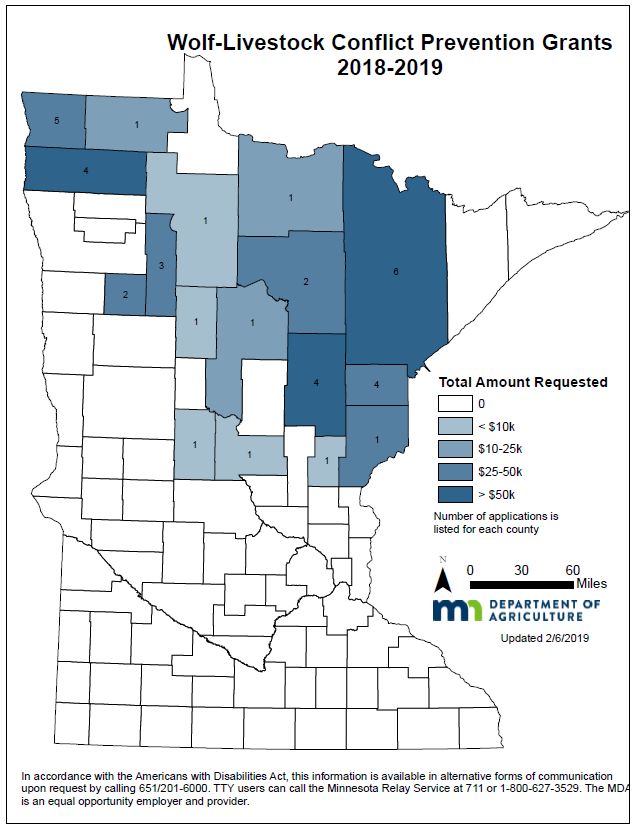
Table of Contents

Background…………………………………………………………………………………………………………………………………..Page 3

FY18 Wolf-Livestock Conflict Prevention Grants……………………………………………………………………………Page 3

       Figure 1. Project budget amounts for wolf-livestock grant applications for FY18 grant cycle…Page 4

       Figure 2. Amounts requested in applications to FY18 wolf-livestock grant cycle by activity…..Page 4

       Figure 3. Numbers of applications to FY18 wolf-livestock grants and amounts of depredation
       claims paid in past 18 months by county…………………………………………………………………….…………Page 5

       Figure 4. Amounts awarded for FY18 wolf-livestock grants by activity…………………………………..Page 5

       Figure 5. Number of grants and total amounts awarded for FY18 grant cycle by county……….Page 6

       Table 1. Summary of grant projects funded during FY18 grant cycle…………………………….……….Page 7

       Table 2. Information provided in final reports by grant recipients for FY18 grant cycle………...Page 8

FY19 Wolf-Livestock Conflict Prevention Grants………………………………………………………………………….Page 17

       Table 3. Comparison of FY18 and FY19 grant applications……………………………………………….…..Page 17

       Figure 6. Numbers and total amounts requested by county for FY19 grant applications……..Page 18

       Figure 7. Amounts requested in FY19 wolf-livestock grant applications by activity……………..Page 19

       Figure 8. Amounts awarded for FY19 wolf-livestock grants by activity………………………………..Page 19

       Figure 9. Number of grants and total amounts awarded for FY19 grants by county…………….Page 20

       Table 4. Summary of FY19 grant projects…………………………………………………………………………….Page 21

       Table 5. Information provided by grantee’s in FY19 grant reports……………………………………….Page 22

Impact of Wolf-Livestock Conflict Prevention Grants on Wolf Depredation Claims…………………….Page 27

       Table 6. Wolf losses before and after completed grant projects for relevant farms…………….Page 28

       Figure 10. Wolf depredation claims by number and total amount paid as well as dollars granted by
       fiscal year……………………………………………………………………………………………………………………………Page 29

Pursuant to Minn. Stat. § 3.197, the cost of preparing this report was approximately $850.

In accordance with the Americans with Disabilities Act, this information is available in alternative forms of communication upon request by calling
651-201-6000. TTY users can call the Minnesota Relay Service at 711. The MDA is an equal opportunity employer and provider.

Background
                                                                         Page 2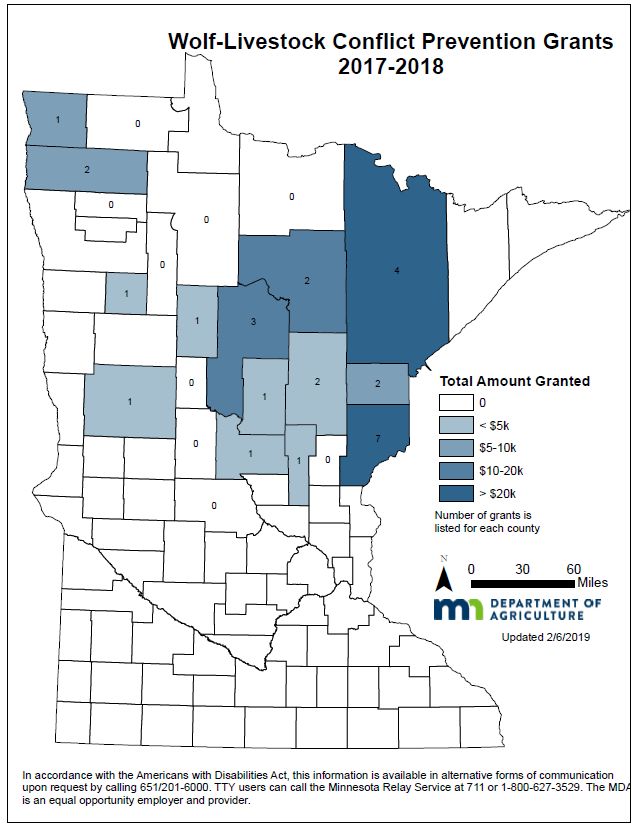
The Minnesota Department of Agriculture (MDA) receives an appropriation of $350,000 each biennium
to reimburse wolf depredation claims made by livestock producers. Over the last 10 years, the MDA
has paid between 80-140 claims worth approximately $100,000 - $250,000 per year. In order to be
reimbursed for livestock lost to wolves, a producer must have evidence of the loss verified by an
official such as a Minnesota Department of Natural Resources (MN DNR) Conservation Officer, United
States Department of Agriculture (USDA) Animal and Plant Health Inspection Service (APHIS) Wildlife
Specialist, or other authorized entity. If evidence is not available or is not conclusive, a claim payment
will not be made. Many producers participating in the grant program report that suspected losses to
wolves are much greater than what can be verified.

The MDA was appropriated $120,000 in FY 2018 and 2019 to award grants to livestock producers to
prevent wolf-livestock conflicts. Specific grant-eligible activities were highlighted in the legislation
including purchase of guard animals, veterinary costs for guard animals, installation of wolf barriers
such as pens, fladry and fencing, installation of wolf-deterring lights and alarms, calving and lambing
shelters. The legislation did not limit grants to these activities only. To be eligible for a grant, a livestock
producer needed to raise livestock within Minnesota’s wolf range.

FY18 Wolf-Livestock Conflict Prevention Grants
The FY18 request for proposal was announced on October 16, 2017, with an application deadline of
November 24, 2017. Due to low response, the deadline was extended to December 15, 2017.

A total of 53 eligible applications were received requesting a total of $611,336, although nearly half of
the applications were for amounts less than $5,000 (Figure 1). Most of the funds requested were for
fencing and shelters (Figure 2). Applications were received from 21 counties, lining up well with
counties having depredation claims during the 18 months prior to the initiation of the grant program
(Figure 3).

Grant applications were reviewed and ranked by a panel of representatives from Minnesota
Cattlemen, Minnesota Lamb and Wool Producers, Minnesota Farm Bureau, Minnesota Farmer’s Union,
University of Minnesota, MN DNR, USDA APHIS Wildlife Services, and the MDA. Criteria used to
evaluate proposals included:
   • Documented losses from wolves (up to 10 points)
   • Completeness of application (up to 5 points)
   • Demonstrated knowledge (up to 5 points)
   • Effectiveness of tactics (up to 5 points)
   • Cost efficiency (up to 5 points)

The final applications to receive grant funds were selected by the Commissioner of Agriculture. Of the
53 applications made for the FY18 grant cycle, 26 projects were initially selected for funding and the
earliest projects began in February 2018. Prior to the end of FY18, two of the grant recipients decided
to withdraw from the grant program and an additional five projects were initiated with the savings
from those projects and from others which had been completed under budget. One more grant
recipient withdrew from the program after the end of FY18 when the funds could no longer be granted
to another applicant.

                                                    Page 3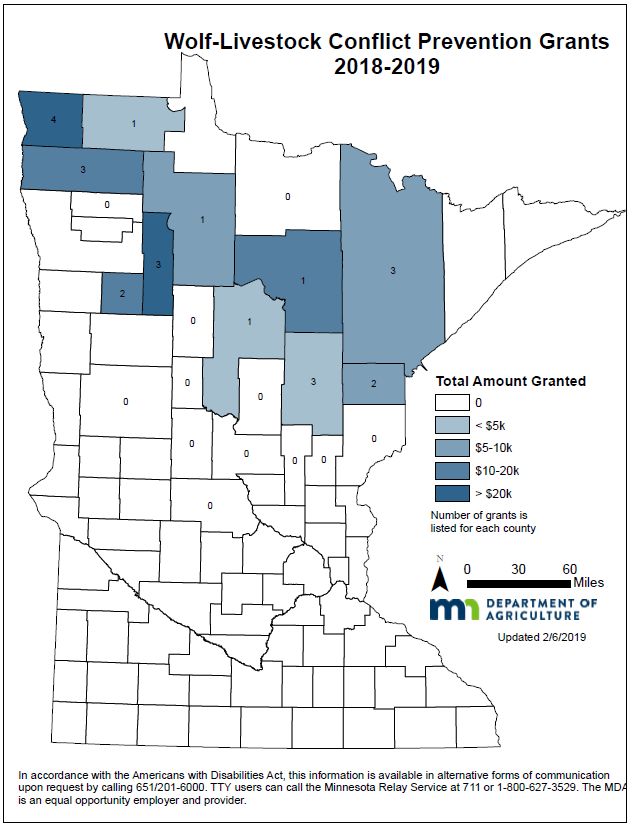
A total of 28 projects were completed by June 30, 2019, and nearly all expenses have been submitted
and paid, which totals $109,068 to date. A summary of the completed projects can be found in Table 1.
At the end of their project, each grantee was asked to complete a final report and answer three
questions:
    1. Please describe past issues with wolf depredation and how this project should reduce future
        depredation.
    2. Were there any particular challenges that you had with the grant application process, grant
        agreement process or completing your project?
    3. Do you feel this project will reduce future wolf-livestock conflict? If no, why not?
Participants in this grant cycle generally did not have significant challenges with the grant program and
were optimistic that their project would reduce future wolf depredation. The information from the
FY18 reports can be found in Table 2.

                                     25
                                                           FY18 Wolf-Livestock Grants: Total $ Requested
 Number of Applications by Request

                                     20

                                     15
             Amount

                                     10

                                     5

                                     0
                                          $5,000        $15,000              $25,000            $35,000          $45,000          $55,000
Figure 1. Project budget amounts for wolf-livestock grant applications for FY18 grant cycle.

                                                                FY18 $ Requested by Activity
                                               Other, $19,745
                                                                                                                   Guard animals, $42,091

                                                                                                         Vet costs for guard
                                                                                                          animals, $16,079

                                                                      Shelters, $220,662
                                                                                           Fencing, $298,729

                                                   Lights / Alarms,
                                                       $21,512

Figure 2. Amounts requested in applications to FY18 wolf-livestock grant cycle by activity.
                                                                                       Page 4
Figure 3. Numbers and total amounts of applications to FY18 wolf-livestock grants and numbers of depredation claims paid in past 18
months by county.
FY18 $ Granted by Activity Guard
animals,
Other, $5,700 $8,350
Vet costs for guard
Shelters, $14,840
animals, $4,887
Lights / Alarms,
$560
Fencing,
$86,663
Figure 4. Amounts awarded for FY18 wolf-livestock grants by activity.
Page 5Figure 5. Number of grants and total amounts awarded for FY18 grant cycle by county.
Page 6Table 1. Summary of grant projects funded during the FY18 grant cycle.
Past Losses Amount Completion
ID County Livestock Type Project Spent
Score* Granted Date
1 Otter Tail Unknown 2 $5,000 Fencing 8/6/2018 $5,000
6 Pine Sheep, cattle, pigs, poultry 2 $1,983 Vet care for existing animals 6/28/2018 $1,983
8 Pine Cattle, sheep 8 $5,884 Fencing plus lambing shelter 8/22/2018 $5,884
12 Cass Cattle 2 $1,750 Barriers and lights Withdrew
14 Pine Cattle 8 $3,200 Donkeys and vet care 6/8/2018 $2,297
18 Morrison Cattle 4 $2,120 Calving shelter 5/29/2018 $2,120
19 Pine Sheep 4 $3,837 Guard dog 4/16/2018 $3,837
20 Mahnomen Cattle 8 $2,000 Donkeys 6/21/2018 $1,925
24 Cass Cattle 4 $9,000 Calving shelters 8/29/2018 $9,000
25 Mille Lacs Unknown 2 $1,750 Fencing and lights 9/5/2018 $1,750
26 Cass Cattle 4 $400 Lights 5/22/2018 $400
29 Pine Sheep 2 $2,237 Vet care for existing animals, fencing 8/20/2018 $2,237
32 Carlton Cattle 4 $7,272 Donkey and vet care, fencing 11/4/2019 $4,963
35 Itasca Cattle 8 $10,000 Fencing 11/13/2018 $10,000
36 Itasca Cattle, sheep, goats 4 $5,418 Vet care for existing animals and fencing 8/29/2018 $5,418
37 Aitkin Cattle, sheep 2 $1,500 Donkeys and guard dog 7/1/2019 $1,385
41 Aitkin Cattle 2 $1,500 Fencing 7/25/2018 $1,500
43 Marshall Unknown 4 $2,050 Donkeys, guard dogs and vet care 11/14/2018 $1,845
45 Hubbard Sheep 2 $2,897 Fencing 7/10/2018 $2,897
46 Pine Cattle 8 $10,000 Fencing 8/27/2018 $10,000
48 Kittson Unknown 6 $5,762 Barriers, fencing 5/25/2018 $5,762
49 Pine Sheep 2 $1,500 Fencing 11/28/2018 $1,500
50 Saint Louis Cattle 4 $7,500 Barriers 8/6/2018 $7,500
51 Saint Louis Cattle 4 $7,500 Barriers 7/12/2018 $7,500
52 Saint Louis Sheep 2 $1,224 Fencing, shelter 8/29/2018 $1,224
54 Crow Wing Cattle 2 $3,340 Calving shelters 9/10/2018 $3,340
22a Saint Louis Cattle 6 $7,500 Barriers 7/5/2018 $7,500
27a Carlton Cattle 4 $700 Donkeys 9/4/2019 $301
Continued in
39a Marshall Cattle, poultry 8 $5,160 Fencing and lights
FY19 project
*2 = No past documented losses
4 = Past documented losses but not in last 2 years
6 = Losses during past 2 years < $2,000
8 = Losses during past 2 years $2,000-$5,000
10 = Losses during past 2 years > $5,000
a
same producer also received grant in FY19 cycle
Page 7Table 2. Information provided in final reports by grant recipients for FY18 grant cycle.
Please describe past issues with wolf Were there any particular challenges that you had
Completion Do you feel this project will reduce future
ID depredation and how this project should with the grant application process, grant agreement
date wolf-livestock conflict? If no, why not?
reduce future depredation: process or completing your project?
Documentation. Buying railroad ties to be used for
Have had issues with lambs disappearing. corner posts. Hoping I get reimbursed for them. Yes, definitely will. However, my other
Wolves getting into our pasture and causing Probably should have called them fence posts on the pasture needs to be made more secure as
1 8/6/2018
havoc. Two wolves shot that were on our receipt. The other issue is coming up with an estimate well as our winter feedlot. Should be a lot
property. as to cost. Prices have gone up. Almost impossible to more peace of mind.
hire anyone to help.
We just bought our farm and began raising
livestock -- sheep, cattle, pigs, and chickens --
in the summer of 2016. Thankfully we have not
had any wolf-livestock conflicts in the past two
years; however, we have utilized livestock
The grant application and agreement process was very
guardian dogs with our sheep flock since we
straight-forward, clear, and easy to complete. My
began because we heard reports from
questions were answered quickly. In terms of
neighbors of sightings on our land as well as
completing the project, veterinary care of livestock
removals on nearby farms. We have also
guardian dogs has been difficult to obtain in the past This project will absolutely reduce future
spoken with the USDA's Wildlife Services
because many small animal vets are unwilling to make wolf-livestock conflict. Livestock guardian
which stated that Pine County is a confirmed
6 6/28/2018 calls to the farm when they know farmers will refuse dogs have been proven as one of the most
high wolf complaint and removal area.
their more expensive recommended services. It is not effective deterrents against wolves and
Veterinary care of the dogs is a huge cost
worth their time when they reluctant practitioners other predators.
against the profitability of our farm enterprise,
willing to give us estimates and entertain coming to the
but essential in order to deter wolf predation.
farm for the first time. already have busy clinic
This project will reduce future depredation by
practices. Mentioning the grant award made previously
keeping our livestock guardian dogs healthy
uninterested or
and in good working condition, protecting
them from and treating them for parasites and
practically unavoidable (as working dogs that
live outside 24/7) mosquito and tick-borne
diseases.
The past 10 years we have seen signs of
wolves and they have killed calves. This year
(2018) our neighbors had wolves kil some of
I had no problem with completing this particular Yes I feel that this project will reduce
8 8/22/2018 their calves and we also saw a wolf close to
project livestock-loss due to wolf conflict.
cattle pens and sheds at our own farm. This
project should therefore reduce the ease with
which wolves can enter pens and kill livestock.
12 Withdrew
Page 8Please describe past issues with wolf Were there any particular challenges that you had
Completion Do you feel this project will reduce future
ID depredation and how this project should with the grant application process, grant agreement
date wolf-livestock conflict? If no, why not?
reduce future depredation: process or completing your project?
Yes, it helps. The donkeys have been very
No, it was good
14 6/8/2018 Loss of calves and cows due to wolf activity helpful and the fencing has/will continue to
serve its purpose.
Wolves came to where cows were alone with
their young calves and got the new babies. Everything was pretty easy to follow. If you didn't have
18 5/29/2018 Yes, for the reasons above
Now we can lock up the cows until the calves a computer it would be more difficult
are big enough to go with the herd.
The contract person (mark) was exceptionally good to
Getting the sheep into the yard close to the
Past issues with wolves have been at night on work with, answering questions immediately. The
house should be a big deterrent. Should
pasture. Using this herding dog to bring sheep application and grant agreement process went
19 4/16/2018 the wolves move into the yard, we would
home every night should alleviate that issues smoothly. Finding a trained farm dog wasn't easy. Was
have a problem. I think this will definitely
unless wolves move into yard. very fortunate to find Mick. Thank you to everyone for
help reduce future wolf-sheep conflict.
this wonderful and positive opportunity.
As you are aware, the timber wolf is a very
illusive animal and changes its territory at
times. This year as of yet I have had a pair of
wolves that were here in early May or end of
April but have not killed or bothered the cattle
at this time. I have the Jack and the Jenny in
20 6/21/2018 separate pastures, they may be doing their job
and I am not aware because you rarely see the
wolves to begin with. I haven't had any calves
killed or attacked. If I have the opportunity to
witness either pasture where they would be
chasing either a coyote or wolf I will let you
know. Thank you for the help.
We have lost many calves and cows to wolves,
The application was straight forward and easy to
some of which have been able to be verified
complete and the communication from the grant team
by USFW officials or MN DNR Officers. We
was great! We checked with a couple of local welders I believe these shelters will reduce our
have tried many options to try and reduce
to make the shelters but between their schedules and chances of wolves attacking calves during
wolf-livestock conflicts by using blinking lights,
cost we were unable to source them locally; then due calving season. By giving them a place that
moving cattle, 24-hour surveillance, changing
24 8/29/2018 to adverse weather this spring the company we chose is protected on 3 sides, it will give them a
calving dates, among other things, and we still
was backordered on our shelters, and then to get a place to hide away from the wolves while
have calves lost. The shelters will allow the
reduced rate on shipping we had them hauled at the they sleep which is when most of our wolf
calves to go into an enclosed area keeping the
shipper’s convenience. Overall the process was done attacks occur during the night.
calves protected, making the cows congregate
and will be in place for next calving season to help
in front of the shelter creating a barrier for the
reduce the potential for wolf attacks.
wolves to get at the calves.
Page 9Please describe past issues with wolf Were there any particular challenges that you had
Completion Do you feel this project will reduce future
ID depredation and how this project should with the grant application process, grant agreement
date wolf-livestock conflict? If no, why not?
reduce future depredation: process or completing your project?
We have not had any wolf depredation issues,
but this is primarily due to the lengths we have
gone to secure animals at night. We have seen
wolves on multiple occasions on our property Yes. This grant allowed me to install high
and our farm is located directly across the road quality wolf-resistant gates on our property
No. Overall, the MDA seems to have done a good job of
from a 39,000 acre wildlife management area that compliment a 10-wire high tensile
making the application process user-friendly.
25 9/5/2018 known to have numerous wolves present. By electrified perimeter fence. It also allowed
Additionally, the process to request reimbursement is
installing secure, wolf-resistant gates to our me to install additional wires on fencelines
also easy to navigate.
newly installed fencing, we can now begin to closer to the ground to reduce the
leave animals out on pasture at night which likelihood of wolf entry.
will greatly improve our farm productivity,
profitability and land stewardship (rotational
grazing.)
Lost 8, 400 pound calves in one night and 13
the next year. Wolves only ate the guts and Depending on the amount of wolves and
killed another calf. Wolves killed within a short their fear of the lights over a period of
distance of our house at 4pm. Wolves chased With our late spring the time frame to get it done is too time. Wolves get to know it is just lights.
26 5/22/2018
cattle to death and DNR didn't help. The game short Once they start to kill the only way to stop
warden liked wolves. John Hart helped and them is to kill the wolf. Neighbors don't like
took 9 wolves before killing slowed down. the lights.
Wolves are still here, real problem.
We have had a number of wolf depredation
events, but the worst was in 1999 when a very
large pack took 75 lambs and a dozen ewes in
a very short time. At the time I had no secure
I had difficulties saving a copy of the electronically
place to put the sheep. Fortunately parvo
completed grant application. Otherwise the instructions Yes I do. Helping farmers adapt to wolves is
reduced that pack later that year, but the
were very clear and well-organized. I had more than a a very sensible idea. My experience has
lesson remained that we need a secure place
few challenges completing the project. I had major back been that electrified fencing, livestock
to retreat to in the event of another large
surgery in December, and a longer recovery than guard dogs, and secure yards are essential
29 8/20/2018 pack. Since then there has been packs of 8 and
expected. Plus a very late spring. I was very grateful for to preventing depredation. The grant is
10 wolves in the area. Our dogs were able to
the deadline extension. In the future, I might suggest providing these things, and also helps other
dissuade them and they moved on each time,
that a Sept 1 to Aug 31 period is actually easier to work farmers gain ideas as to how they can stop
but I was quite aware that we were
with as most people are going to bey very busy in the depredation.
unprepared should the wolves start killing
Spring lambing or calving.
dogs, which has been a problem with ranches
in the Rockies. I have always had a feed yard
but it was never "wolf proof". The grant
project enabled me to use 5 x 16 ft welded
Page 10Please describe past issues with wolf Were there any particular challenges that you had
Completion Do you feel this project will reduce future
ID depredation and how this project should with the grant application process, grant agreement
date wolf-livestock conflict? If no, why not?
reduce future depredation: process or completing your project?
panels to make a sturdy fence that, with the
sheep and dogs on the inside, should be able
to prevent any depredations should another
large pack return. My experience has been
that if we can prevent wolves from getting a
meal, they will move on in a week or so. So the
fortress is a place to put the sheep and dogs
temporarily until the pack moves on.
I the past I have had a problem with wolves Yes, I feel this will help with the wolf
taking my calves when they were very young The problems I had were not with the grant program, problem with the woven wire fence should
and newborn. I had problems both in the fall the coordinators were very accommodating as I was keep them out of the calving area but now I
32 11/4/2019
and spring calving. We built a fence with having trouble getting the fence built due to the had problems with the wind, and cold due
woven wire and electricity for a calving area weather. to moving the calving area to a more
along with adding a donkey for a guard animal. open/less wooded area.
It should help during calving but to protect
We have had wolf problems for many years. the cattle during the rest of the summer we
Sometimes we find remains and others the The biggest problem was time. We were busy with would have to fence the entire farm and
calves are just gone from the pasture. This other farm work especially haying and couldn't spend that would be impossible. When the wolves
35 11/13/2018 fence will keep the wolves out during calving the time on additional work. We called and got an are hungry they will find a way to get food.
but once the cattle are out in the pasture it extension. Then when we started it rained so much we If there was a bounty there would be a
won't help. We had a guard dog and that were working in the mud which delayed it again. balance. As it is we hunt the deer so the
helped a little. wolves have to find a different source for
food.
The 9-R Ranch has been a chronic wolf The challenged I had with the grant application was This project should definitely reduce wolf-
predation farm for the 40 years we have been understanding what detail was needed in describing livestock conflict on our farm. The woven
operating it, with nearly annual the type of barrier/fencing we wanted to construct and wire perimeter fencing is already proving to
claims/documented losses thru the MDA how to account for the cost, as some supplies were be wolf-resistant as even our farm dogs
program. The 9-R Ranch is primarily a beef already owned and some products had a significant cannot penetrate it to get into the fields.
cow/calf operation that also raises a small price hike after submitting the grant. Another challenge Recent thunderstorms caused the flock to
flock of sheep and a few goats for both meat was due to the cool and wet spring, which did not allow scatter, and they remained contained in
36 8/29/2018 and fiber. We have experienced both cattle us to start the fencing project when we had hoped to. the woven wire fenced pasture. It appears
and sheep/goat losses. Because the farm is The weather also caused our other farming projects that it will successfully keep the sheep in
primarily a cattle operation, fencing consists of including spring field work, calving, and breeding their pasture and keep wolves, coyotes,
a combination of barbed wire and high-tensile season to further impact our fencing timeline. I ended and bear out. Maintaining a healthy group
electric. This fencing has proved problematic up applying for and receiving an extension to the of donkeys seems to be a worthwhile
for keeping the sheep close to the farmstead completion date. And finally, we had to modify our addition to the farm. Wolf presence has
where the wolf traffic is less. To help prevent original fencing plans. We had to sink the T-posts been documented on our farm this spring
future wolf predation, our project set up two further into the ground to ensure their stability and and summer and to date we cannot
Page 11Please describe past issues with wolf Were there any particular challenges that you had
Completion Do you feel this project will reduce future
ID depredation and how this project should with the grant application process, grant agreement
date wolf-livestock conflict? If no, why not?
reduce future depredation: process or completing your project?
connected pastures with perimeter fencing ability to withstand pressure of both sheep and cattle, document any calf losses due to predation.
that would effectively contain the sheep, which is necessary to keep the fence intact as a The donkeys are alert and healthy and
including the lambs. These pastures are predator barrier. This change allowed up to top the move continuously amongst the cow/calf
located alongside the main farmyard, woven wire fencing with only one high-tensile wire herd. I feel this project made good use of
minimizing wolf traffic exposure. The instead of 2. In testing the wire, it does carry enough grant dollars, allowing us to better manage
perimeter fenced is comprised of woven wire charge to discourage animal pressure. Going with taller our livestock to both keep them safe and
topped with high-tensile electric wire, gates T-posts would have been cost-prohibitive, especially productive, and to reduce the incidence of
and an electric energizer for the portable since the one electric wire carries a potent charge. wolf-livestock predation conflicts.
netting that would further sub-divide the two
pastures to maximize grazing potential.
Grazing efficiency should allow the flock to be
supported in this woven-fenced area,
eliminating the need to station the flock in
more vulnerable fields fenced by traditional
cattle fencing. Please note that our original
plans were to top the woven-wire fence line
with 2 strands of high-tensile wire, however
sinking the T-posts deep enough to be secure
in our soil did not allow enough post height for
two strands. The single strand does carry a
sufficient charge to discourage animal
crossing. Additional wolf predation prevention
measures include establishing 5 guard donkeys
with the cow/calf herd. This herd is pastured in
adjacent and outlying acreage to the sheep
pastures. The donkeys seem to have
discouraged wolf predation over the past 3
years, and having them with the cows helps
keep the wolves further from the sheep flock.
Maintaining the donkey's mobility is key to
their effectiveness. Our grant project allowed
the farrier to service the donkeys twice, and
included the sedation necessary to safely do
this work.
They have killed baby lambs and calves in the
37 7/1/2019 past. Having donkeys out with cows and sheep No, overall thought the process went good. Yes
keeps predators like wolves at bay.
Page 12Please describe past issues with wolf Were there any particular challenges that you had
Completion Do you feel this project will reduce future
ID depredation and how this project should with the grant application process, grant agreement
date wolf-livestock conflict? If no, why not?
reduce future depredation: process or completing your project?
Wolves have harassed cattle giving birth in the
past. Lost one calf in 2017. The chainlink fence Yes, the chainlink fence will eliminate wolf-
41 7/25/2018 blocks access to cattle during calving. This The largest challenge was the short timetable involved. cattle contact during calving. Should be
protects the calves during this vulnerable stage 100% effective.
of production.
43 11/14/2018 No Final Report Submitted
Our 317 acre farm in Hubbard Co is within MN Yes, by installing boundary panelled fencing
wolf range. We have no documented losses around our feeding and lambing area will
from wolves thus far, but wolves have been provide protection to our sheep in the
sighted on our farm and it is more common for No, it was clearly defined. We appreciated the winter months and for spring lambing
45 7/10/2018
people in our neighborhood to witness extended deadline. when they are most vulnerable. Spring is
sightings of wolves. The completed fencing also a time when the wolves are deprived
project will provide wolf-livestock conflict since wild prey are hard for them to
prevention in the future. capture.
Shortly after completion of the woven wire
and electric our fall cows started calving
and as of today, we are approaching
Our operation consists of spring and fall
halfway finished and so far no wolf
calving season. We have wolf issues at calving
Didn't realize that we could have applied for the 2nd depredation. We wish we could afford to
and again at grass turn out. This project should
round grant. Trouble finding a contractor that could do do the whole farm. Last year at this time
46 8/27/2018 help prevent the taking of calves at birth.
the project in the time we needed or even in the same we had 4 wolf kills and 2 injured. Lots of
Someday need to do the entire pasture so our
year. wolf sign out there, hope they stay our
cows can utilize the pasture again instead of
there. All of this to fence out wildlife
being subsidized all year on feed.
wolves that are overpopulated and causing
us to invest extra money to protect our
livelihood on property we own.
In the past we've had issues with predators
getting at our livestock in late winter and early In my opinion the application process and agreement
spring when food sources are getting tough for process were both very simple. Everything was
I feel this project will help reduce conflict in
48 5/25/2018 them to find. With this project the coral panels explained in detail and the instructions were easy to
the future.
and windbreak panels should deter any follow. As for completing my project, everything went
roaming predators from getting at our young well with that as well.
stock and threatening our livelihood.
We used to shepherd our sheep on the 20
No, we did not have any particular challenges with Yes, with the 20 additional acres fenced,
acres of open pasture without our guard dogs
49 11/28/2018 either the grant process or getting our project we now have safer grazing area for our
for protection. We have found tracks larger
completed. We were surprised to receive the $1500 sheep. The guard dogs can now also guard
than a coyote and also bear tracks at a carcass.
Page 13Please describe past issues with wolf Were there any particular challenges that you had
Completion Do you feel this project will reduce future
ID depredation and how this project should with the grant application process, grant agreement
date wolf-livestock conflict? If no, why not?
reduce future depredation: process or completing your project?
We cannot always be certain of the predators after our original application was denied for the $2500. the sheep and we longer have to worry
but possibly could be wolves or coyotes. We We thought we were out of the running. about them dogs wandering off.
have, however, saw a coyote actually come
onto property and kill a lamb.
Wolves have been a constant problem on our The grant was not very well publicized. We heard about
farm. We have had 17 confirmed kills and have it from another farmer just days before the deadline so
had the federal trappers at our farm seven we had to hurry to get the application in on time. I was
different times. We have been reimbursed unable to download some of the forms. The amount of
Yes, by having the cows in a confined well-
over $10,000 over the years. Calving season money we received from the grant got our project
lit area connected to our barn, we have
has been a difficult time with wolves coming started but was not enough to do all we wanted. We
more control when they are calving. It
into our pasture and taking young calves. With were hoping to make the penned area larger and add a
helps protect the newborn calves when
the panels that we purchased with the grant separate area for our heifers that were calving. With
they are most vulnerable to attack and
50 8/6/2018 money, we were able to create a pen behind the original completion date in June, it was a quick
allows them to stay in a more projected
the barn in a lighted area keeping the cattle in turnaround to finish the project. We had to order the
area until they are able to run with the
a more confined area rather than having them panels from our supplier and wait until he was able to
herd. The panels also make it more difficult
calve through the pasture. It is connected to get them all made before we could complete the
for wolves to enter the area than the
the barn enabling us to bring calves into the project. When we finally got the panels and were
barbed wire fence.
barn if needed. Also, the panels have bars starting to create the pen it was late spring and very
close together at the bottom and are close to wet which made it difficult to get the panels in place. It
the ground to help keep the wolves out of the help when we were able to get an extension to finish
penned area. the project.
The project will most definitely help in the
I had one documented cow kill and one
context of wolves killing newborn calves
documented calf kill in recent years due to
The application process itself was acceptable, but and cow in the calving pens. The project
wolf depredation. Other calves have
included too much contractual paperwork that does had to be reduced greatly from my original
disappeared, but without proof of a carcass,
not apply to this grant. I was also disappointed that I plan as I was only able to fence the
documentation could not be verified. I have
was not immediately contact that this grant money was perimeter of the calving area next to the
had wolf hair on fencelines and wolf tracks in
51 7/12/2018 originally available, especially because of my prior calving building. Without being able to fully
my driveway as well as seeing wolves on my
documented wolf kills. As far as completing m project I complete the proper fencing to include the
property. I am sure this project will be very
was very happy to receive the funding that I got, but immediate pasture loafing area that the
helpful in reducing depredation because the
the money was not sufficient to fully complete the plan cow/calf pairs have to go into after one
wolves will not have access to the newborn
I had for my project. week in the calving pen area, it will not
calves in the pens, where they are the most
reduce the depredation as much as my
vulnerable.
original project intent.
Our farm backs up to Rocky Run and I do feel that this will be a great measure to
The application process and grant agreement was quite
associated wetlands. Knowing that there is no reduce wolf-livestock conflict. Lambing in
52 8/29/2018 simple and straightforward. The weather did provide
way to change the wildlife moving along the March, the snow conditions often reduce
some challenges to getting started, as did the need to
stream corridor I chose to work on keeping the effectiveness of electric fence resulting
Page 14Please describe past issues with wolf Were there any particular challenges that you had
Completion Do you feel this project will reduce future
ID depredation and how this project should with the grant application process, grant agreement
date wolf-livestock conflict? If no, why not?
reduce future depredation: process or completing your project?
lambs safe by assuring that the fence system get the work done during the busiest time of the year in a perimeter that was not completely
keeps them in a secure area close to our barn with lambing, general farm maintenance and haying. reliable. We now have an area on the south
and adult animals. Replacing 5-strand electric side of our barn that is well lit and keeps
fence with woven wire will keep new born and ewes - that like to hide in the darkest
young lambs from wandering through the corners to lamb, secure in our barnyard.
fence and into the woods or large pastures, The south paddock will deter predators
eliminating the opportunity for wolf attracted by the smell of the birth, from
depredation. finding a way through the perimeter
electric fence. In addition, newborn lambs,
often ignored as the ewe has a second or
third lamb, will not be able to roll under or
through the fence. The lamb paddock on
the north side of our barn will allow the
groups of curious young lambs (who are
not always interested in sticking close to
their mothers), to be secure in the new
woven wire sheep fencing and unable to
wander into the adjacent woodlot.
Grant application went well including extension. One
No depredation to date, however we have
challenge was the delay from the shelter supplier
past sightings and hearing of wolves in the
completing our order. Another was only finding the Yes! I feel confident this will give our cattle
54 9/10/2018 area. The calf shelters and blockade will
blockades in South Dakota and having to pay SD sales the protection needed at calving time.
provide excellent protection for newborn
tax. Steel prices increased greatly from last years
calves.
application time to actual purchase time.
I greatly appreciate the grant funds for
prevention of wolf-livestock conflict, but I
Being this is the first grant I have applied for, I found had 12 calves killed and could only confirm
I have had wolf problems since the 1990's and
this hard to fill out. For the simple farmer, steps should one by a wolf due to necessary proof. I
lost many cattle since right up to last year. The
be an easy 1,2,3 - filling out the application. The received $1050 for that one calf and $0 for
panels will play a major part in helping control
contract included was repetitive and not applicable to the other 11 because wolves ate the whole
22 7/5/2018 the conflict of wolves killing newborn calves as
this grant. Due to the fact I have documented losses I calf. It's not uncommon for wolves to eat
well as other cattle. However, I needed to
felt I should have been automatically informed about the whole calf in a 24 hr period. This
reduce the planned project because of
the program from the start. I only found out about it in program should be extended on an annual
insufficient funds I received.
the farm paper a week before the application deadline. basis. The funds for this project should
definitely deter wolves from getting at the
newborns in the future.
27 9/4/2019 No Final Report Submitted
Page 15Please describe past issues with wolf Were there any particular challenges that you had
Completion Do you feel this project will reduce future
ID depredation and how this project should with the grant application process, grant agreement
date wolf-livestock conflict? If no, why not?
reduce future depredation: process or completing your project?
39 In progress
Page 16FY19 Wolf-Livestock Conflict Prevention Grants
The FY19 request for proposal was announced on May 3, 2018, with an application deadline of June 29,
2018. A total of 39 eligible applications were requesting a total of $608,006. Proposed projects for the
FY19 grant cycle were generally for higher dollar amounts than in the FY18 grant cycle (Table 3).
The geographic distribution of applications was similar to the FY18 grant cycle (Figure 6) as was the
breakdown of requested funds by activity, with the greatest requests again coming for fencing and
shelters (Figure 7).
Grant applications were reviewed and ranked by a panel consisting of representatives from Minnesota
Cattlemen, Minnesota Lamb and Wool Producers, Minnesota Farm Bureau, Minnesota Farmer’s Union,
University of Minnesota, MN DNR, USDA APHIS Wildlife Services, and the MDA. Criteria used to
evaluate proposals included:
• Documented losses from wolves (up to 10 points)
• Past grant funds received (up to 10 points)
• Completeness of application (up to 5 points)
• Demonstrated knowledge (up to 5 points)
• Effectiveness of tactics (up to 5 points)
• Cost efficiency (up to 5 points)
The final applications to receive grant funds were selected by the Commissioner of Agriculture. Of the
39 applications made for the FY19 grant cycle, 24 projects were initially selected for funding and the
earliest projects began in October 2018. One grant recipient withdrew from the program after the end
of FY19 when the funds could no longer be granted to another applicant.
A total of 23 projects remain, 14 are completed, and nine are scheduled to be completed by June 30,
2020. A summary of these projects can be found in Table 4. As with the FY18 grant cycle, at the end of
their project, each grantee was asked to complete a final report and answer three questions:
1. Please describe past issues with wolf depredation and how this project should reduce future
depredation.
2. Were there any particular challenges that you had with the grant application process, grant
agreement process or completing your project?
3. Do you feel this project will reduce future wolf-livestock conflict? If no, why not?
Like the FY18 participants, the FY19 participants were optimistic that their projects would reduce
future losses to wolves. The information from the FY19 reports received can be found in Table 5.
Table 3. Comparison of FY18 and FY19 grant applications.
FY18 FY19
Total applications 53 39
Total $ requested $611,336 $608,006
Maximum $ requested $52,809 $70,050
Minimum $ requested $336 $334
Mean $ request $11,537 $15,590
Median $ request $5,883 $10,740
Page 17Figure 6. Numbers and total amounts requested by county for FY19 grant applications.
Page 18Guard
animals, FY19 $ Requested by Activity Vet costs for guard
animals, $10,707
$21,550
Other,
$84,244
Shelters, Fencing, $293,323
$192,243
Lights / Alarms,
$9,270
Figure 7. Amounts requested in FY19 wolf-livestock grant applications by activity.
FY19 $ Granted by Activity
Guard animals,
$10,500 Vet costs for guard
animals, $3,835
Other,
$12,700
Shelters, $19,854
Lights / Alarms, Fencing, $71,439
$4,156
Figure 8. Amounts awarded for FY19 wolf-livestock grants by activity.
Page 19Figure 9. Number of grants and total amounts awarded for FY19 grants by county.
Page 20Table 4. Summary of FY19 grant projects.
Past Losses Amount Completion
ID County Livestock Type* Project Spent
Score* Granted Date
2 Marshall Sheep, cattle 2 $4,906 Guard dogs, vet care and lights $2,250
3 Kittson Cattle, goats 4 $2,488 Barriers 5/14/2019 $2,488
4 Aitkin Cattle 2 $1,405 Vet care for existing animals and fencing 9/19/2019 $1,405
7 Cass Cattle, sheep, goats 2 $5,000 Fencing and lights 7/26/2019 $4,945
9 Kittson Cattle 6 $5,020 Donkeys and vet care, fencing and lights
10 Roseau Cattle 2 $3,000 Fencing 4/19/2019 $3,000
11 Carlton Sheep, poultry 6 $7,148 Guard dogs and vet care, fencing, lights and shelter
13 Aitkin Cattle, goats, poultry 2 $700 Fencing and lights
15 Beltrami Cattle 4 $6,583 Fencing 10/29/2019 $6,583
16 Marshall Cattle 10 $10,000 Calving shelter Withdrew
17 Mahnomen Cattle 6 $7,853 Calving shelter 12/12/2018 $7,853
21 Clearwater Cattle 4 $1,700 Guard dogs and vet care 7/2/2019 $1,700
30 Anoka Cattle 4 $4,000 Calving shelter 7/25/2019 $3,690
31 Aitkin Sheep, poultry, cattle 2 $2,000 Guard dogs and vet care 10/7/2019 $911
33 Mahnomen Cattle 2 $3,500 Fencing
34 Clearwater Cattle 2 $4,000 Calving shelter 6/21/2019 $4,000
38 Aitkin Cattle 10 $15,000 Barriers 11/1/2019
42 Kittson Cattle 6 $5,000 Fencing $1,863
44 Kittson Cattle 6 $7,500 Fencing, lights 3/20/2019 $7,500
47 Itasca Sheep, cattle 8 $15,000 Fencing
53 Marshall Cattle 10 $3,600 Donkeys, lights 3/20/2019 $3,600
a
23 Saint Louis Cattle 4 $4,000 Barriers 7/23/2019 $4,000
28a Carlton Cattle 4 $380 Lights
40a Marshall Cattle, poultry 8 $2,000 Fencing
*2 = No past documented losses
4 = Past documented losses but not in last 2 years
6 = Losses during past 2 years < $2,000
8 = Losses during past 2 years $2,000-$5,000
10 = Losses during past 2 years > $5,000
a
same producer also received grant in FY18 cycle
Page 21Table 5. Information provided by grantee's in FY19 grant reports.
Please describe past issues with wolf Were there any particular challenges that you had
Completion Do you feel this project will reduce future
ID depredation and how this project should with the grant application process, grant agreement
date wolf-livestock conflict? If no, why not?
reduce future depredation: process or completing your project?
2 In Progress
The past problems I have had is wolves killing
This project will reduce the number of
newborn to very young calves. This grant will
conflicts between wolves and my newborn
allow me to make barriers around the barn
and very young calves, which is what I have
3 5/14/2019 that has existing lights so I will be able to Not other than some repetitive paperwork.
had a problem with in the past. I do still
protect newborn calves and this will also allow
worry about my older calves once they are
me to move newborn calves more easily into
on pasture and vulnerable to wolf attacks.
the barn to protect them.
In the past we have lost calves to wolf
depredation. Currently we have observed a
significant wolf population near our farm.
When we decided to add meat goats to our
farm we began implementing depredation
control measures immediately. The guardian
dogs have been an invaluable benefit to
keeping predators, such as wolves, out of the
Absolutely. As I mentioned above, I am
smaller livestock pastures. I appreciate that
looking towards long-term solutions that
they protect by persuading predators not to
allow me to continue increasing and
come closer rather than going out and killing
improving livestock production while also
them. In order to be a responsible owner I
providing wildlife management and
need to maintain their vaccinations, health I felt like the entire process was pretty smooth and I
improved living areas along the river bank
checks, and nutritional well-being. The was able to quickly access assistance from Nicole when
4 9/19/2019 and back wooded areas that are more
healthier they are, the more effectively they I did have questions. This grant process has definitely
beneficial to the wildlife then to my
do their job. In addition, visitors always ask been a positive experience for me.
livestock. My goal is to improve my
about the dogs, how they work, and the
farming, continue to improve the land
benefit to owning them. Keeping the dogs
around me, and make choices that also
health and properly maintained helps me
benefit the naturally found wildlife. So far
convince others of their value. The benefit of
it feels like it has been going well.
adding in more woven wire fencing along the
river is that it is providing a physical barrier
both to keep wolves on the outsides of the
pens as well as to allow them a safe
passageway along the riverbank to move
through their territory. I can expand my
grazing areas to double graze cows and goats
which is helping me improve pastures and
Page 22Please describe past issues with wolf Were there any particular challenges that you had
Completion Do you feel this project will reduce future
ID depredation and how this project should with the grant application process, grant agreement
date wolf-livestock conflict? If no, why not?
reduce future depredation: process or completing your project?
improve my livestock management
techniques. I am working on long-term
solutions that reduce the conflict rather than
just short-term problem solving.
I am not sure yet. We did have an attack
inside the fence. We lost four sheep in one
night. Another has a severe bite wound but
she is healing well. I believe the problem
We have lost multiple young and small
was my gates were too short. I purchased
livestock. Wolves are very predominant in our
The grant application itself was easy and simple to longer gate panels. I am thinking the tall
area, we have weekly sightings. Our hopes are
understand. After receiving the grant agreement some panels will prevent future intrusion.
that with the woven wire fence and gate
7 7/26/2019 minor details were hard to comprehend. However, However, until the wolves are taken off the
panels, we can ease our minds a little bit by
NiCole was great to work with. She made all details endangered list, I don't truly feel the
knowing the predators cannot access our
clear. problem can be fully addressed. I am
young calves in the spring and our sheep
grateful for the state of Minnesota trying to
during the summer.
help ranchers while our hands are tied by
the federal government. Please continue to
offer these grants. They are much needed
and appreciated.
9 In Progress
I have lost many cows-calves to timberwolves
over the years. By having a better corral
system I will be able to hold cows in longer,
avoiding calving on pasture issues. The last calf
Yes, having better control on cattle herd
10 4/19/2019 killed by timberwolves, I was not paid by the No, everything went really smooth.
will really help
State. Game warden said just because a
timberwolf was eating my calf doesn't mean
he killed it. The calf was fine the day before
death.
11 In Progress
13 In Progress
15 10/29/2019 No Final Report Submitted
Withdrew
16
from Project
Our calf losses happen in the first 10 days after We feel this project will help to reduce
The grant was very easy to complete and follow. Our
17 12/12/2018 birth, especially with our younger cows. future wolf-livestock conflict. The older the
actual expenses came in slightly higher due to increase
Calving our younger cows in the sheltered area calves are, the smarter they become. They
Page 23Please describe past issues with wolf Were there any particular challenges that you had
Completion Do you feel this project will reduce future
ID depredation and how this project should with the grant application process, grant agreement
date wolf-livestock conflict? If no, why not?
reduce future depredation: process or completing your project?
will give them time to bond with their calf and in cost of lumber and tin. We didn't expect to have to learn to stay closer to their moms and have
become better mothers to them before pay tax on the cattle panels since they are for the farm. a better chance of being able to run away
turning them out into the larger pasture where and get to safety. The shelter is being used
the wolves are more likely to be. right now to help provide a safe area for
our calves that we weaned.
Wolves came to where cows were alone with
their young calves and got the new babies. Everything was pretty easy to follow. If you didn't have
18 5/29/2018 Yes, for the reasons above
Now we can lock up the cows until the calves a computer it would be more difficult
are big enough to go with the herd.
The contract person (mark) was exceptionally good to
Getting the sheep into the yard close to the
Past issues with wolves have been at night on work with, answering questions immediately. The
house should be a big deterrent. Should
pasture. Using this herding dog to bring sheep application and grant agreement process went
19 4/16/2018 the wolves move into the yard, we would
home every night should alleviate that issues smoothly. Finding a trained farm dog wasn't easy. Was
have a problem. I think this will definitely
unlesss wolves move into yard. very fortunate to find Mick. Thank you to everyone for
help reduce future wolf-sheep conflict.
this wonderful and positive opportunity.
As you are aware, the timber wolf is a very
illusive animal and changes its territory at
times. This year as of yet I have had a pair of
wolves that were here in early May or end of
April but have not killed or bothered the cattle
at this time. I have the Jack and the Jenny in
20 6/21/2018 separate pastures, they may be doing their job
and I am not aware because you rarely see the
wolves to begin with. I haven't had any calves
killed or attacked. If I have the opportunity to
witness either pasture where they would be
chasing either a coyote or wolf I will let you
know. Thank you for the help.
I do believe that the guardian dogs are
In the past 13 years we have lost 5 baby calves helping. One of our neighbors bought 3
We had a hard time locating some puppies. We ended
to wolves and coyotes. All of our neighbors boys that we hope to breed to our girls.
up buying 2 before the grant came into effect. We used
have lost calves to predators. The deer The neighbor across the road would like a
21 7/2/2019 the grant money for vet bills. We have no complains
population has also gone down drastically. We pup or two. All of our neighbors seem to
about the grant process. Everyone had great advice and
have 2 female livestock guardian dogs who are have respect for the dogs and are in awe
was very helpful.
now 1.5 years old. So far, no more kills. when they see them out with the herd.
They call them the "polar bears"
Page 24Please describe past issues with wolf Were there any particular challenges that you had
Completion Do you feel this project will reduce future
ID depredation and how this project should with the grant application process, grant agreement
date wolf-livestock conflict? If no, why not?
reduce future depredation: process or completing your project?
I have wolf problems since 1990's and lost Yes, I feel this project will reduce future
many cattle up to last year. One late calf to No, I learned a lot from the first grant application and wolf-livestock conflict. But there are so
23 7/23/2019
coyotes four week old. This project has helped NiCole help a lot. many wolf in the area. Thank you for the
keep cattle penned and wolves out. help of this program.
28 In Progress
Have had problems with wolves for many
years and lost cattle. This project will keep
My first application and NiCole Rawski helped me Yes, this will help but still concerned about
30 7/25/2019 cattle contained and housed so calves will be
through it, greatly appreciated. all the wolves in the area.
bigger when they go out to pasture, giving
them protection.
From 1999 to 2009, wolf packs travelling along
the Willow River adjacent to my farm became
increasingly bold, even coming right into the
homestead yard where I had two Australian
cattle dogs. The dogs did not discourage the
wolves at all. Interaction between my work
horses and wolves and coyotes was a concern
too. In 2009, I acquired two Great Pyrenees
livestock guardian puppies. From that time on,
I didn't see wolves in close proximity to the
The process is fairly straightforward, but I had some
farmstead. One of those dogs is now deceased
difficulty getting a pup in the right time frame to be I do believe that the project will help
from natural causes; the other is very elderly. I
trained with lambs in the spring. Also, there seem to be reduce wolf-livestock conflict. It's a small
used some of the money from this grant to
quite a few breeders that are selling pups with no amount of help, but the expenses
purchase a puppy from an established sheep
31 10/7/2019 experience with livestock, and who have been raised associated with maintaining a pack of
farmer and livestock guardian dog breeder.
around other breeds. This is detrimental to their ability working dogs are very significant, especially
That pup is expected to be available in June. I
to guard. I was fortunate to be able to secure a pup during an economic downturn such as
have a younger female Great Pyrenees that is
from Ms. McNally at Tamarack Sheep and Wool, near farmers are experiencing right now.
just starting to work to protect the sheep. She
Pine City.
will require additional training, but that seems
to be working well. Last year (2018) I took in
two livestock guardians that were abandoned
on a farm in Remer, Minnesota. I was hoping
they would adjust to being part of my pack,
but one had to be rehomed. The other is
getting trained and seems to be working out
fairly well. The grant funds helped me get
those dogs vetted and neutered , which was a
great help. To maintain protection, I need a
Page 25You can also read


