SOCIAL AND LABOUR PLAN - KRIEL COLLIERY MINING RIGTING PERIOD:HT MP 30/5/1/2/2 (236) MR - Anglo American
←
→
Page content transcription
If your browser does not render page correctly, please read the page content below
Kriel Colliery 2014 In compliance with Regulation 46 (a) of the Mineral and Petroleum Resources Development Act, 2002

                                                                                                COAL

SOCIAL AND
LABOUR PLAN

KRIEL COLLIERY
MINING RIGTING PERIOD:HT MP 30/5/1/2/2 (236) MR
PERIOD: 2014-2018

                                                                                                                        1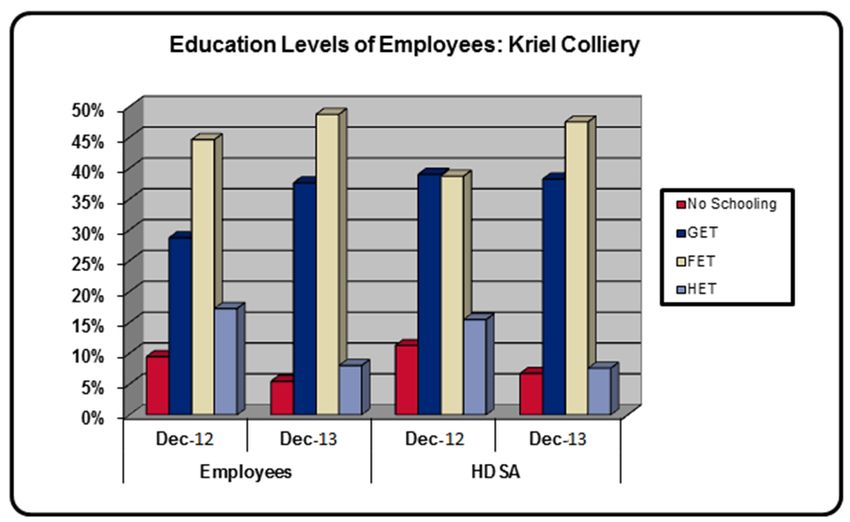
Kriel Colliery 2014 In compliance with Regulation 46 (a) of the Mineral and Petroleum Resources Development Act, 2002

PART ONE
Preamble

                                                                                                                        2
Kriel Colliery 2014 In compliance with Regulation 46 (a) of the Mineral and Petroleum Resources Development Act, 2002

1. Background

About Anglo AmericanThermal Coal

Anglo American Thermal Coal (referred to in this document as Thermal Coal) is a division of
Anglo American plc. We wholly own and operate seven mines and have a 50% interest in Mafube
Colliery, which is jointly owned by Exxaro. We also have a 73% interest in Kriel and Zibulo
collieries, both Anglo American Inyosi Coal (AAIC) operations.

All our mines, with the exception of one situated in the Free State, are located in the Mpumalanga
province. Our mines supply thermal coal to both the export and local markets and metallurgical
coal for export.

Our coal is exported via the Richards Bay Coal Terminal in which we have a 27% interest. In
addition, our Kriel, New Vaal, New Denmark and Mafube mines supply thermal coal to Eskom,
South Africa’s state-owned electrical power utility.

Our Isibonelo Colliery produces five million tonnes of coal for Sasol Synthetic Fuels per annum
under a 21-year supply contract. We employ a total of 9,300 employees and 7,100 contractors.

About Kriel Colliery

Kriel Colliery is situated in Ga-Nala, a unit of the eMalahleni Local Municipality, in the Nkangala
District Municipality of the Mpumalanga province. It is located 160km east of Johannesburg, 45km
south of eMalahleni and 30km north of Secunda and Bethal. Ga-Nala, formerly known as Kriel Town,
is located about 12km from the colliery, with the Thubelihle township 19km away. Several farming
communities are also in close proximity to the mine.

Kriel Colliery forms part of AAIC, an empowered coal company, housing key current and future
domestic and export-focussed coal operations.

In terms of an agreement signed on 8 February 2007, Inyosi, a newly-formed broad-based BEE
company, acquired 27% of AAIC and created a company valued at R7 billion. This incorporated
several key Thermal Coal assets, namely Kriel Colliery, and the projects at Elders, Zondagsfontein,
New Largo and Heidelberg. Final transaction documents were signed on 23 November 2007.
Zondagsfontein has commenced operations and is now known as Zibulo Colliery.

                                                                                                                        3
Kriel Colliery 2014 In compliance with Regulation 46 (a) of the Mineral and Petroleum Resources Development Act, 2002
Inyosi is led by the Lithemba Consortium and Pamodzi Coal, and has a beneficiary base that will
benefit in excess of 27,000 individuals, the majority of whom are female Historically Disadvantaged
South Africans (HDSAs). Women’s Development Bank Investment Holdings is also a shareholder and
Inyosi has created an independent broad-based Community Trust that will benefit HDSA communities
around AAIC operations.
Kriel Colliery was established by Thermal Coal in 1975, and produces coal for power generation by
Eskom’s Kriel Power Station. The colliery covers 179km² of land and produces over 10 million tonnes
of coal per annum. Its underground operation uses mechanised bord and pillar mining methods and
produces five million tonnes per annum.
Its opencast operation makes use of draglines, trucks and shovels to extract 5.5 million tonnes a year,
which contributes 55% of the colliery’s total production. The mine also manages a mini-pit operation
that produces one million tonnes a year. At the end of 2009, the mine had 974 permanent employees
2.3 Compliance with Anglo American Corporate Policy Requirements
Anglo American has a firm commitment to good citizenship, hence ethics being the foundation for the
organisation, guiding behaviour of individuals both locally and globally. Anglo American is known for
best practice stakeholder engagement.
Anglo American complies with those standards set out by the Department of Minerals (DMR), Mine
Health and Safety Act (MHSA) and the Department of Labour (DOL), through these statutes they
uphold their company values, show good citizenship to all stakeholders and live up to their
commitments of good ethical qualities, thus giving them a good, sustainable reputation and creating a
competitive edge which places them one step ahead of their competitors. Anglo American may be
described as both ethical and successful in their operations.
2.4 Future Capital Investments and Expansion Plans
Planned future capital investments of the colliery with regards to rising labour costs, the colliery has a
process for identifying major factors facing the workplace in the next 5-10 years. The following critical
factors have been identified:
The need for Collective Bargaining i.e. Wage Negotiations
Improvement of technology – this will assist to reduce raising labour costs
Training people smarter
Specialised skills will improve
Reduce the number of contractors
Natural Attrition
Utilising best practices
Future projects are set to take place from 2014 to 2019. In 2014 Block 7 (North West Shaft), 2 mini
pits are in the forecast. Pits 5 and 6 will be on a stop between 2015 and 2016, rehabilitation will take
place. In addition, Kriel Colliery has a contract to supply coal to Eskom’s Kriel Power Station. Kriel
Colliery intends on extending their mining operations to meet the Power Station’s coal requirements,
in so doing, this includes the construction of a Beneficiation Plant (Washing plant) in order to supply
coal to the correct quality
4Kriel Colliery 2014 In compliance with Regulation 46 (a) of the Mineral and Petroleum Resources Development Act, 2002
2.5 Existing Closure Plans
Kriel Colliery acknowledges the fact that mine closure could have significant social and economic
impacts on its employees, this being said, Kriel Colliery will ensure that it leaves a positive
environmental, social and economic legacy. As part of sustainable development planning, Anglo
American has the SEAT (Socio-Economic Assessment Tool) along with the Anglo Environmental
Way.
Community Development abides to its policies and procedures in place for mine closure. A close
relationship with stakeholders is maintained and other forums in place to address social and
economic impacts on the community. Anglo American strives to be sustainable in the communities in
which they operate. Business Integrity is critical success factor in mine closure plans
1.1 The purpose of the SLP
The aims of our Social and Labour Plan are:
To promote employment and advance the social and economic welfare of those who work for
us and to uplift all the stakeholders in the communities in which we operate;
To contribute to the transformation of our industry; and
To ensure that the holders of mining rights contribute to the socio-economic development of
the communities in which they operate, including major labour sending areas.
1.2 Definitions
In the text that follows, these terms should be clearly understood:
Thermal Coal includes all employees at head office, technical divisions and mining
operations, and is a wholly-owned division of Anglo Operations Limited.
Thermal Coal operations include all operational and technical personnel, but exclude staff
from our head office.
Kriel Colliery is a specific operational entity and business unit of Anglo American’s thermal
coal business.
This document follows Regulation 46 of the Regulations of the Mineral and Petroleum Resources
Development Act (2002), which outlines the required contents of the Social and Labour Plan.
Progress is aligned to the pillars of the Mining Charter.
5Kriel Colliery 2014 In compliance with Regulation 46 (a) of the Mineral and Petroleum Resources Development Act, 2002
1.3 Particulars of the holder of mining rights
Name of the company: Anglo American Thermal Coal
Name of the mine Kriel Colliery
Physical address Mining and Property Law
Department
First Floor, 45 Main Street
Johannesburg
2001
Postal address Anglo Operations Limited
PO Box 61587
Marshalltown
2107
Telephone number +27 11 638 3781
Fax number +27 11 638 4608
Mine address Kriel Power Station Road
Farm Driefontein
Kriel
Mpumalanga
PO Box 27
Mine postal address Kriel
2271
Telephone number +27 17 617 1111
Mine fax number +27 17 617 3910
Location of mine Kriel Colliery is situated between
eMalahleni, Ogies and Bethal in the
Mpumalanga province, and forms
part of the Witbank Coalfield within
the Bethal Magisterial District and
the Nkangala District Municipality
Commodity Coal
Life of mine 19 years, with further opportunities
being explored
Breakdown of See section 2.4.3
employees per
sending area
Financial year January to December
6Kriel Colliery 2014 In compliance with Regulation 46 (a) of the Mineral and Petroleum Resources Development Act, 2002
PART TWO
Human Resources and Development
Programme
7Kriel Colliery 2014 In compliance with Regulation 46 (a) of the Mineral and Petroleum Resources Development Act, 2002
2. Human Resources Development Programs
At Thermal Coal our aim is to be an employer of choice for people in the mining industry. As part of
our drive to achieve this, we provide world class and sustainable education for employees across our
business, while also extending our capacity-building initiatives to members of our host communities.
During 2012, time spent on training across our entire business was the equivalent of 7 days per
employee, representing 9% of the company’s wage bill.
The safety of our employees is our number one priority. To ensure that we reach our goal of Zero
Harm, much of our focus was placed on safety risk management training across the organisation.
This section of the report highlights the progress that Kriel Colliery has made against the targets set in
its Social and Labour Plan for:
The Skills Development Plan
Career progression and planning
Mentorship plans
The internship and bursary plan
The employment equity plan
Plans to meet the Mining Charter requirements
2.1 Skills Development Plan
Kriel Colliery has a fully-equipped training centre which holds ISO 9001:2000 certification and training
provider status from the Mining Qualifications Authority (MQA). As per SETA requirements, it submits
a Workplace Skills Plan and Annual Training Report to the MQA every year. Both were accepted
during 2012. The payment of levies and the claiming of grants are conducted in accordance with the
provisions of the MQA.
Kriel Colliery’s Levy number is L930713955
2.1.1 Skills Development Facilitator
Our mine has two dedicated skills development facilitators, Steve Clarke and Timothy Nkuna. The
latter is an executive member of the National Union of Mineworkers Branch Committee. They are
responsible for co-ordinating the compilation of the Workplace Skills Plan and Annual Training Report
in consultation with Kriel Colliery’s joint employment equity and skills development committees. The
committee meets at least every two months to discuss compliance, current training programmes, skills
development planning and operational requirements. The committee includes management, union
representatives and employees from various disciplines.
8Kriel Colliery 2014 In compliance with Regulation 46 (a) of the Mineral and Petroleum Resources Development Act, 2002
9Kriel Colliery 2014 In compliance with Regulation 46 (a) of the Mineral and Petroleum Resources Development Act, 2002
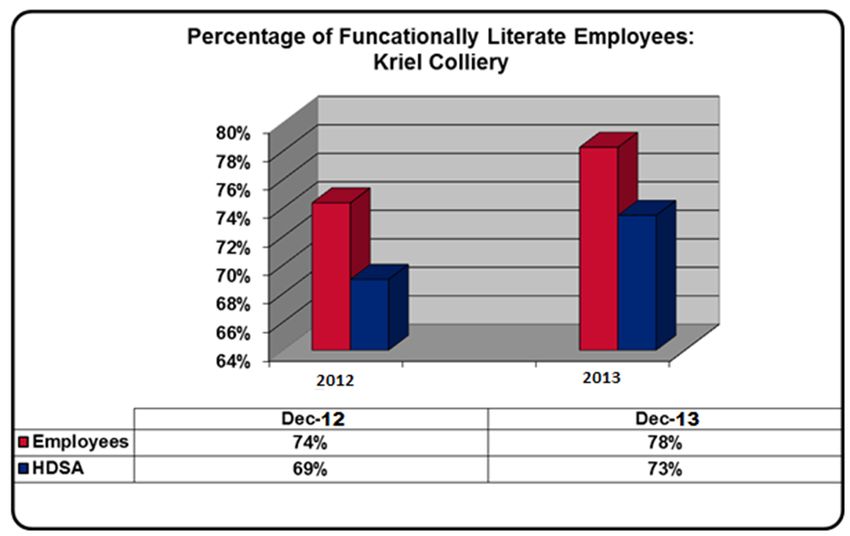
2.1.2 Number and education levels of employees
Table 2.1 Number and education levels of employees: Kriel Colliery (2014 )
MALE FEMALE TOTAL
NQF African Coloured Indian White African Coloured Indian White Male Female
BAND LEVEL OLD SYSTEM
No Schooling / Unknown 40 0 0 0 7 0 0 0 40 7
Grade 0 / Pre 20 0 0 0 0 0 0 0 20 0
Grade 1 / Sub A 30 0 0 0 1 0 0 0 30 1
Grade 2 / Sub B 0 0 0 0 0 0 0 0 0 0
General
Grade 3 / Std 1 ABET 1 0 0 0 0 0 0 0 0 0 0
Education
and 1 Grade 4 / Std 2 35 0 0 0 0 0 0 0 35 0
Training
Grade 5 / Std 3 / ABET 2 34 0 0 0 3 0 0 0 34 3
(GET)
Grade 6 / Std 4 15 0 0 0 1 0 0 0 15 1
Grade 7 / Std 5 / ABET 3 13 0 0 1 1 0 0 0 14 1
Grade 8 / Std 6 35 0 2 27 2 0 0 1 64 3
Grade 9 / Std 7 / ABET 4 40 17 1 29 17 0 0 0 87 17
Further 2 Grade 10 / Std 8 / N1 35 0 2 27 2 0 0 1 64 3
Education
and 3 Grade 11 / Std 9 / N2 62 0 0 29 21 0 0 0 91 21
Training
4 Grade 12 / Std 10 / N3 160 0 0 32 40 1 1 7 192 49
(FET)
Higher 5 Diplomas / Certificates 17 0 0 8 10 0 0 5 25 15
Education 6 First degrees / higher diplomas 11 0 0 6 4 0 0 3 17 7
and
Training 7 Honours / Master’s degrees 2 0 0 2 1 0 0 0 4 1
(HET) 8 Doctorates 0 0 0 0 0 0 0 0 0
TOTAL 549 17 5 161 110 1 1 17 732 129
861
10Kriel Colliery 2014 In compliance with Regulation 46 (a) of the Mineral and Petroleum Resources Development Act, 2002
11Kriel Colliery 2014 In compliance with Regulation 46 (a) of the Mineral and Petroleum Resources Development Act, 2002
2.1.3 Adult-based education and training (ABET)
We have a fully-functional ABET centre on mine property. This is open to employees, their dependents and members of the surrounding community and
courses are funded by the colliery. Unfortunately, employee attendance is not as high as we would like. Investigations show that social issues and fatigue
play a role in this. In addition, employees say that they do not attend classes as there is not enough time to prepare meals before and after work. They also
believe that it is too challenging to work shifts and study.
12Kriel Colliery 2014 In compliance with Regulation 46 (a) of the Mineral and Petroleum Resources Development Act, 2002
To overcome these barriers, we present classes at times that are convenient to shift workers, and provide food after classes. Classrooms are modern and
conducive to learning and we have graduation ceremonies at the end of each year to inspire greater numbers of employees to participate. Twenty-one
community members participated in ABET in 2012. We believe that the ABET targets set in our Social and Labour Plan cannot be achieved and have
therefore set more achievable targets in this area.
Table 2. 4 ABET Targets
LEVEL 2014 2015 2016 2017 2018
1 3 3 3 3 3
2 3 3 3 3 3
3 3 3 3 3 3
4 12 7 6 6 5
TOTAL 21 16 15 15 14
2.1.4 Non-mining skills programmes
During 2011 a total of 254 community members, 61 dependants and 29 employees received training at our computer centre. The following gives a reflection
on non-mining skills training for employees.
Table 2.5 Target on non-mining skills training: 2014 – 2018
Target Target Target Target Target
Discipline
2014 2015 2016 2017 2018
Basic welding 3 3 3 4 3
Bricklaying 2 2 2 3 2
Carpentry 3 3 3 4 3
Computer training 20 20 20 20 20
Financial skills 50 50 50 50 50
TOTAL 78 78 78 81 78
13Kriel Colliery 2014 In compliance with Regulation 46 (a) of the Mineral and Petroleum Resources Development Act, 2002
2.1.5 Learnerships and other training plans
Learnerships and training programmes ensure capacity for the future of the mining industry and the country as a whole. Kriel Colliery uses the Anglo
American ratio of 3.5 artisans to 1 learner, and employees (18.1 learner) will have the opportunity to have a career development pathway from operator to
artisan, increasing their skills and quality of life. It is also in our interest to employee 18.2 learners from the surrounding communities to ensure that
opportunities are also given them.
Table 2.6 Learnerships and other training plans
YEAR Discipline Target 2014 Target 2015 Target 2016 Target 2017 Target 2018
Electrician 15 15 15 15 15
Fitter 14 14 14 14 14
Boilermaker 3 3 3 3 3
Diesel mechanic 7 7 7 7 7
Mechanicians 2 2 2 2 2
Rigger 3 3 3 3 3
TOTAL 44 44 44 44 44
2.1.6 Skills programmes
Skills programmes provide employees with the technical skills needed to meet operational requirements and their own goals for personal development and
growth.
Table 2.7 Skills programmes for Kriel employees: 2014 – 2018
YEAR Target Target Target Target Target 2018
Discipline 2014 2015 2016 2017
2012 Competent person A 245 20 20 20 20
Competent person B 25 25 20 20 20
Machine Licenses 250 200 100 100 80
TOTAL 520 245 140 140 120
14Kriel Colliery 2014 In compliance with Regulation 46 (a) of the Mineral and Petroleum Resources Development Act, 2002
2.1.7 Hard to fill vacancies
At Thermal Coal, we have initiated a number of capacity-building initiatives to become self-sufficient in the supply of labour. One of these initiatives is the
existence of an in-house bursary scheme. In 2009, this included 166 group vacation students, 135 trainees and eight technikon students who were employed
as part of the Joint Initiative for Priority Skills Acquisition (JIPSA). In addition, we had 321 learners in the system. We continuously strive to provide training
and development opportunities to address the critical skills shortage in South Africa and have created internal trainee positions for surveyors, ventilation,
environmental and safety officers to develop these scarce skills internally.
The following positions are regarded as hard to fill within Thermal Coal:
Geologists
Electrical engineers
Mechanical engineers
Mining engineers
Surveyors
Metallurgists
Tradesmen
Hard to fill vacancies are addressed through bursary allocation programmes, study assistance schemes and the provision of learnerships and skills
programmes. Employees are encouraged to study in fields where there is a scarcity of skills. Kriel Colliery experienced no hard to fill vacancies during the
reporting period.
15Kriel Colliery 2014 In compliance with Regulation 46 (a) of the Mineral and Petroleum Resources Development Act, 2002
2.1.8 Role and activities of the MQA
Thermal Coal works with the MQA to identify scarce skills and develop unit standards and
qualifications to address these. The MQA offers bursaries to students mainly on the scarce skills
identified in the sector skills plan and offers practical training in these areas.
2.2 Career progression and mentorship
2.2.1 Career development planning
At Thermal Coal, we continuously look for opportunities to further enhance our career development
planning processes for employees. We strive to have generic career paths for all disciplines and work
with individuals to develop a customised career path that will be most suitable for them. This is an
ongoing initiative, which we continue to refine. The company has also developed, implemented and
communicated role profiles to all employees in Band 6 and above. In addition, we have extended role
profiles to all our Professionals in Training (graduates who have just completed their academic
studies) in Band 7.
This enables members of our workforce to manage their careers more effectively and to pursue
specific career opportunities, not only within Thermal Coal, but within the Anglo American Group.
2.2.2 Coaching and mentoring for employees
As per the Mining Charter’s requirements, we have investigated further opportunities to enhance our
mentorship programme. A refresher programme will allow for the better matching and closer
monitoring of mentor-mentee relationships. We also provide employees with the opportunity to be
mentored as part of the talent management and personal development planning process. We
specifically focus on HDSAs, with emphasis on the development of women.
Employees are afforded the opportunity to participate in mentoring relationships with an individual
they feel could add value to their growth and development. This occurs particularly at the following
levels:
All graduates brought into the organisation are assigned ‘buddy’ and technical mentors who
provide support and guidance in the early stages of their careers
Middle to senior management – aimed at employees in Bands 5 and 6
Senior leadership – aimed at Band 4 and above
Executive leadership – aimed at members of the mine executive committee
16Kriel Colliery 2014 In compliance with Regulation 46 (a) of the Mineral and Petroleum Resources Development Act, 2002
The effectiveness of the mentoring relationship is monitored through our career development plans.
We also use external coaches who are contracted to provide support and guidance to employees at
different levels of the organisation.
Emphasis is placed on developing and coaching senior-skilled employees to progress to first-line
supervisors. The focus is specifically on HDSA employees and seeks to ensure that we prepare
sufficient numbers of future leaders for the demands created by the growth of our company.
Coaching and mentorship development checklist
Item Yes No
Annual identification of coaching and mentoring requirements
X
is aligned to career paths
Appropriate guidelines are in place to administer the
X
coaching and mentoring process
A formal system is in place to monitor, evaluate and improve
X
the coaching and mentoring process
The provision of external coaching and mentoring X
A diverse group of trained coaches and mentors is in place X
2.2.3 Talent management
We have a talent management strategy that caters for the needs of the company and the individual.
This results in a net gain for both and a competitive edge for our organisation. Talent management is
a continuous process and does not solely rely on recruitment but focuses strongly on retention and
development. Our goal is to become the employer of choice and thus we focus on appreciating each
individual and keeping them by winning over their hearts and minds.
The People Development Way
We have refreshed our existing WiWTTSiA framework to create one common global capability
framework called the People Development Way. This sets out the behavioural attributes, knowledge,
skills, experience and potential required to succeed as a company and as individuals. This framework
and our new interactive development portal will provide employees with the tools and information
needed to help them take ownership of their career development.
2.2.4 Scholarships, bursaries and internships
In living up to the Mining Charter’s objective to address the skills gaps in the industry by working with
a number of stakeholders. Activities in this area include:
Regular interaction with statutory bodies such as the MQA on the formulation of skills
development strategies. This includes the conducting of annual skills audits.
17Kriel Colliery 2014 In compliance with Regulation 46 (a) of the Mineral and Petroleum Resources Development Act, 2002
Working closely with educational authorities and providing scholarships and bursaries to
promote mining as a career option.
We also provide resources to improve the level of education in maths and science which will
increase the number of learners who will be able to study further in professions related to the
mining industry.
We actively promote mining as an exciting career opportunity by hosting career exhibitions,
school visits and participating in initiatives such as the annual Take a Girl Child to Work Day.
On an internal level, we provide skills training opportunities so that employees can improve
their income-earning capacity after mine closure.
Bursaries and internships
At Thermal Coal, we have a well-established bursary scheme which aims to develop suitable students
who – once they have completed their studies – are afforded professional career opportunities within
our organisation.
We aim to attract bursars in the areas that surround our operations and have launched a number of
drives to improve marks in maths and science among local learners for this reason. In addition, the
scheme is open to the general public as well as the children and relatives of employees. We award
bursaries to those interested in studying the following disciplines:
Geology
Metallurgical and chemical engineering
Electrical and mechanical engineering
Mining engineering
Mine surveying
Industrial engineering
Rock engineering
Environmental management
Finance and accounting
We offer experiential learning to a number of students, which not only affords them an opportunity to
complete the practical component of their studies but provides Thermal Coal with a pipeline of
students who could be offered bursaries and ultimately permanent employment within the company.
The adopted approach is to offer experiential learning to at least 40 learners per annum.
18Kriel Colliery 2014 In compliance with Regulation 46 (a) of the Mineral and Petroleum Resources Development Act, 2002
Table 2.8 Professionals in training for Thermal Coal
% HDSA
Actual Actual as of
Budget Actual Budget Actual Budget Budget Budget Budget Budget Budget Budget
Discipline 2012 2013 current
2014 2015 2016 2017 2018
month
2010 2010 2011 2011 2012 February 2013 February actual
Mining 22 33 24 39 28 39 32 29 90% 26 33 33 43 39
Engineering 43 61 30 64 34 64 33 39 92% 28 34 29 32 32
Industrial
5 6 6 7 7 7 5 4 80% 6 5 4 5 4
engineering
Rock
2 2 2 2 2 2 2 3 100% 3 2 2 2 2
engineering
Geology 6 10 13 16 11 16 16 16 69% 15 10 12 14 11
Metallurgy 10 15 7 18 7 12 12 9 78% 15 10 6 8 7
VOHE 3 6 4 6 5 6 5 7 71% 6 4 4 4 4
Environmental 4 4 5 4 5 4 8 5 80% 8 4 4 4 4
Human
4 5 5 4 5 4 6 5 100% 4 3 2 2 2
resources
Commerce
(finance and 8 12 11 12 6 12 5 3 100% 5 6 8 5 0
payroll)
Survey 3 2 4 3 3 3 5 2 100% 3 2 3 2 1
Safety 5 3 6 3 5 3 5 5 80% 4 4 4 4 4
TOTAL: ALL 115 159 117 178 118 172 134 127 123 117 111 125 110
19Kriel Colliery 2014 In compliance with Regulation 46 (a) of the Mineral and Petroleum Resources Development Act, 2002
Table 2.9 University of Technology bursars for Thermal Coal
February % HDSA as of
Budget Actual Budget Actual Budget Budget Actual
Discipline 2011 current month
Actual actual
2010 2010 2011 2011 2012 2013 2013
Mining 20 14 16 10 16 9 17 12 100%
Metallurgy 4 2 4 0 5 0 4 1 100%
Engineering 7 2 7 4 5 4 6 0 0%
Geology 2 2 4 2 4 2 2 0 0%
Survey 3 6 2 1 3 1 3 3 100%
Technicians 9 12 9 5 7 5 6 3 100%
TOTAL 45 38 42 22 40 21 38 19
Table 2.10 University of Science bursars for Thermal Coal
Actual Actual % HDSA as of
Budget Actual Budget Actual Budget Budget
Discipline 2012 2013 current month
actual
2010 2010 2011 2011 2012 February 2013 February
Mining 36 36 31 31 34 31 33 33 84%
Commerce 13 13 14 15 16 15 15 15 93%
Electrical Engineering 20 20 13 13 10 13 14 10 90%
Mechanical Engineering 22 22 18 19 22 19 23 23 74%
Geology 22 22 17 18 18 18 19 19 68%
Rock Engineering 0 0 0 0 2 0 0 0 0%
Metallurgy 18 18 21 21 19 21 23 21 86%
Industrial Engineering 6 6 7 7 10 7 11 11 82%
TOTAL 137 137 90 124 97 124 138 132
20Kriel Colliery 2014 In compliance with Regulation 46 (a) of the Mineral and Petroleum Resources Development Act, 2002
Bursar Training Programmes
Thermal Coal has well-established training and development programmes for all graduates in the different disciplines. These are reviewed on an annual basis
and are updated where necessary. Programmes allow for continuous monitoring and evaluation to ensure that our trainees get the best exposure available.
The company encourages trainees to take ownership of their development and has processes in place to allow for further studies where required.
Table 2.11 Internships and bursaries to be awarded by Thermal Coal (five-year plan)
FIELD OF STUDY 2014 2015 2016 2017 2018
University of Science
Mining engineering 36 40 49 41 50
Mechanical engineering 21 24 20 26 21
Electrical engineering 10 13 18 17 17
Metallurgy 14 20 23 19 20
Geology 20 21 22 15 20
Commerce 13 15 17 12 13
Other (Industrial engineering,
15 22 26 24 23
environmental)
TOTAL 129 155 175 154 164
University of Technology
Mining 9 9 13 21 23
Engineering 4 6 16 16 18
Metallurgy 2 2 2 2 2
Survey 2 5 6 6 7
Geology 2 2 2 2 2
Technicians 3 3 3 3 3
TOTAL 22 27 42 50 55
21Kriel Colliery 2014 In compliance with Regulation 46 (a) of the Mineral and Petroleum Resources Development Act, 2002
In-House Study Assistance Programme: Kriel Colliery
Mining 1 1 1 1
Engineering 2 2 2 1
Metallurgy 1 0 0 0
Human resources 1 0 1 1
Finance 1 2 1 1
VOHE - environment 2 2 1 0
Safety 2 1 2 1
Security 2 1 1 0
Survey 1 1 1 0
TOTAL 13 10 10 5
22Kriel Colliery 2014 In compliance with Regulation 46 (a) of the Mineral and Petroleum Resources Development Act, 2002
Budget provision
Budget provision for the company’s bursary and internship schemes is managed centrally. The
budget is drawn up and approved on an annual basis, specifically to address the educational needs of
the organisation.
2.3 Employment Equity
One of our greatest assets is the diversity of our people and we pride ourselves for having moved
beyond compliance over the past couple of years . At the end of 2012, 71% of our management was
made up of HDSAs, well beyond the Mining Charter’s requirement of 40%. We have an excellent
pipeline of talent and continuously focus on ways of improving our performance in this area.
We pay a great deal of attention to the attraction, retention and advancement of women in all
disciplines and at all levels of our organisation. At the end of 2012, women accounted for 16% of our
total workforce and 14% of management. A number of initiatives are in place to increase the number
of women in mining and to address their particular needs, including the physical aspects and health
2.
3.
4.
5.
23Kriel Colliery 2014 In compliance with Regulation 46 (a) of the Mineral and Petroleum Resources Development Act, 2002
6. T ML 10/1995
7. Table 2.14 Employment equity statistics for Kriel Colliery (Q1, 2014 )
MALE FEMALE TOTAL DISABLED HDSAs
HDSA
Occupational Levels African Coloured Indian White African Coloured Indian White Male Female Male Female (%)
Top management 0 0 0 0 0 0 0 0 0 0 0 0 NA
Senior management 4 0 0 1 1 0 0 0 5 1 0 0 83.33%
Professionally qualified and
experienced specialists and
mid-management 22 0 0 21 5 0 0 3 43 8 0 0 58.82%
Technical and academically
qualified workers, junior
management, supervisors,
foreman and
superintendents 141 0 3 73 31 0 0 2 217 33 0 0 70.80%
Semi-skilled and
discretionary decision-
making 51 0 0 5 10 2 1 12 56 25 0 0 93.83
Unskilled and defined
decision-making 394 1 0 7 89 0 0 1 402 90 1 0 98.58%
TOTAL 612 1 3 107 136 2 1 18 723 157 1 0 87.84
Non-permanent employees 1 o 0 3 0 0 0 1 4 1 0 0 40.%
TOTAL PERMANENT 613 1 3 110 136 2 1 19 727 158 1 0 87.57%
885
24Kriel Colliery 2014 In compliance with Regulation 46 (a) of the Mineral and Petroleum Resources Development Act, 2002
8. Table 2.7.2 Employment equity targets
Occupational Levels 2014 Minimum 2015 Minimum 2016 Minimum 2017
Progress to Progress to be Progress to be
be achieved achieved achieved
Executive Management N/A N/A N/A N/A N/A N/A N/A
Senior Management 42% 30% 55% 30% 55% 30% 55%
Middle Management 59% 30% 70% 30% 70% 30% 70%
Junior Management 62% 40% 70% 40% 70% 40% 70%
Core Skills 96% 40% 100% 40% 100% 40% 100%
ual Progress Report
LANDAU COLLIERY
MINING RIGHT ML 10/1995
25PART THREE Local Economic Development Progamme
Kriel Colliery 2014 In compliance with Regulation 46 (a) of the Mineral and Petroleum Resources Development Act, 2002
3. Social and Economic Background
At Thermal Coal we are committed to delivering improvements in the social and human capacities of
the people who surround our operations, not only to maintain our social licence to operate, but to
create real opportunities for socio-economic advancement.
Thermal Coal operates mainly in three municipal districts, namely Nkangala, Gert Sibande and Fezile
Dabi. Nooigedacht, along with Landau, Kleinkopje, Goedehoop and Kriel collieries, is situated in the
Emalahleni Local Municipality. Emalahleni Local Municipality is located within the Mpumalanga
Province and is situated in the jurisdictional area of the Nkangala District Municipality. The district is
located to the North-West of the province and is the smallest district in land mass (21%) and has the
second largest population concentration (35%) in the province. The Nkangala District Municipality
(NDM) comprises an area of approximately 240km² which includes the following municipalities:
The eMalahleni Local Municipality
The Steve Tshwete Local Municipality
The Delmas Local Municipality
The Emakhazeni Local Municipality
The Thembisile Hani Local Municipality
The Dr JS Moroka Local Municipality
3.1. Socio-Economic Profile
Population size and growth
Ranking:
Mpumalanga’s
(1) –
lowest
2011 2011
(18)
276 413 395 466 9.8% 3
82 298 119 874
2 677.67 3.5%
Population per
Source: Census South Africa 2011
27Kriel Colliery 2014 In compliance with Regulation 46 (a) of the Mineral and Petroleum Resources Development Act, 2002
According to Stats SA (2011 Census) 395 466 people were recorded in 2011 – 30.2% of
Nkangala's population.
Population grew by 43.1% between 2001 & 2011 while annualized population growth rate was
measured at 3.6%.
81.3% Africans, 15.7% Whites, 1.7% Coloured, 0.9% Asians and other 0.3%.
Youth up to 34 years – 65.6% of Emalahleni’s population.
Number of households 119 874 (3.3 people per household) – 33.6% of Nkangala’s
households.
(See attached IDP and LED Strategies for ELM’s baseline data)
Economic Indicators
Contribution by Local Municipal Areas to Nkangala's industries (GVA constant 2005 prices)
INDUSTRY Victor Khanye Emalahleni Steve Emakhazeni Thembisile Hani Dr JS Nkangala
Tshwete
Agriculture 30.8% 13.0% 42.8% 6.8% 2.0% Moroka
4.6% 100.0%
Mining 2.4% 52.8% 40.6% 3.3% 0.8% 0.0% 100.0%
Manufacturing 1.4% 19.0% 74.9% 1.7% 2.4% 0.6% 100.0%
Utilities 0.3% 74.1% 20.9% 1.2% 1.9% 1.7% 100.0%
Construction 4.4% 52.5% 27.7% 3.9% 6.7% 4.8% 100.0%
Trade 5.8% 46.1% 26.0% 3.2% 14.7% 4.3% 100.0%
Transport 8.5% 48.3% 25.9% 9.9% 4.8% 2.6% 100.0%
Finance 5.1% 48.9% 39.6% 2.3% 2.3% 1.9% 100.0%
Community
services
6.6% 34.5% 26.1% 3.6% 14.9% 14.3% 100.0%
Total 4.5% 45.2% 38.7% 3.5% 4.9% 3.2% 100.0%
Contribution to Nkangala economy 45.2% - largest of the 6 municipal areas.
Dominant contributions especially in utilities (74.1%), mining (52.8%) and construction
(52.5%), to relevant district industries.
Leading industries in terms of % contribution to Emalahleni economy – mining (52,8%),
finance (48,9.2%) and utilities (74,1%).
Increasing role/share of finance & transport and decreasing role/share of mining (but still
more than one-third of the local economy).
10
28Kriel Colliery 2014 In compliance with Regulation 46 (a) of the Mineral and Petroleum Resources Development Act, 2002
3.2. Key Economic Activities
At district level Emalahleni contributes 46% of the GDP of the region. This clearly indicates the nature of
concentration of economic activities in the area followed by Steve Tshwete (at 37%). Emakhazeni, Dr JS
Moroka, Thembisile Hani and Victor Khanye (Delmas) have the least contributions.
The economic dominance of Emalahleni within Nkangala has the potential of influencing population
migration from nearby localities thereby putting a strain on the provision of job opportunities and basic
services. Growth and development within neighbouring municipalities is therefore a key priority at the
district level.
The Economy of the municipality is driven by the Mining sector which contributed more than 50% in
2009 followed by Electricity at 12.1% and Finance at 10.8%. Over the three year period, mining has had
a stead increased contribution to the economy of Emalahleni; from 41% in 2007, 50.8% in 2008, with a
slight decline to 49.8% in 2009.
Electricity has also had significant contribution as well, although marginal decline was experienced.
However, Agriculture’s contribution to the economy of Emalahleni is relatively low compared to the other
sectors of the economy. It is critical to investigate and establish the current state of the primary
agricultural activities and the value chain activities associated with the sector. The other sectors with
potential include Finance, Trade and the green economy (given the dominance of mining and electricity
and their environmental degradation potential).
From the socio-economic analysis, it is evident that Emalahleni faces a number of challenges that
should be addressed by growing certain sectors of the economy that are capable of generating
employment opportunities, reduce poverty as well as the poverty gap in line with the terms of the New
Growth Path. This is the challenge that must be addressed through the development of the
Emalahleni LED plan. The following sectors have the potential to grow the economy:
Potential development sectors and investment opportunities
Mining
Manufacturing
Agriculture and rural development
Tourism and hospitality
SMME and cooperative development
(See the attached IDP and LED for further details)
29Kriel Colliery 2014 In compliance with Regulation 46 (a) of the Mineral and Petroleum Resources Development Act, 2002
Other mining companies in the area:
BHP Energy Coal South Africa
Glencore
Exxaro
Total Coal
3.2 Community Engagement
3.2.1 Socio-Economic Assessment
To improve our understanding of both the positive and negative impacts of our operations on our host
communities, Thermal Coal utilizes Anglo American’s Socio-Economic Assessment Toolbox (SEAT)
process, which facilitates more structured dialogue with our stakeholders.
This three-year cycle, involves profiling of communities as well as gathering information on the
impacts (negative and positive) of our operations on host communities. Management responses to the
concerns and priorities of stakeholders are published in a form of a report, which is distributed to all
stakeholder groups, including local, provincial and national government; non-governmental
organisations and interested and affected parties. The implementation of the management responses
generated by the SEAT process is taken forward through the social management plan, which is
updated annually.
During the SEAT process, stakeholders are identified and engagement takes place through formal
and informal meetings and interviews.
We subscribe to the Anglo Social Way, which sets out non-negotiable standards across more than 20
dimensions of social performance. It covers all activities that have the potential to impact on
communities during the entire life cycle of our operations – from exploration through to project design,
development, operation, decommissioning, closure and post closure.
Each year our mines undertake an assessment of their level of compliance against the various social
requirements. Kriel Colliery strives to maintain a performance rating of 4 which means pro-active in
dealing with social and community issues.
3. 3 Stakeholder Engagement Planning
We subscribe to Anglo American’s Good Citizenship principles which guide the way we conduct our
business. Our main aim is to promote strong relationships with the communities that surround our
operations through regular engagement on the issues that may affect them. Our engagement
planning include, stakeholder mapping, profiling – determining their interests, influence on the
business and the relation health.
30Kriel Colliery 2014 In compliance with Regulation 46 (a) of the Mineral and Petroleum Resources Development Act, 2002
We have quarterly Synergy forums, including directly and indirectly affected parties, interested parties
and local authorities. These enable our stakeholders to bring issues to our attention so that they can
be resolved promptly. We have a broad stakeholder base which includes both internal and external
stakeholders. Our internal stakeholders include mine management, labour unions, permanent
employees and contractors. Our external stakeholders are made up of various communities,
regulators and provincial and local authorities, non-governmental organisations, local enterprise and
competing mining organisations.
Local community needs
No Needs Purpose Partner
Generate employment opportunities by setting up
1 Unemployment SEDA
cooperatives to reduce poverty
Empower the community with skills that will create
2 Skills Development DoL
jobs and generate income
To improve the environmental conditions within the
3 Waste Management ELM
community
Provide resources to improve learners performance
Department of
4 Learner Development in Maths and Science to enable them to get access
Education
to tertiary education
3.4 Skills programmes that contribute to poverty alleviation
Sakhimfundo Trading, previously known as the Siyaphambili Commercial Sewing Project: This
project started in 2004, and is run by five women from the community. The women provide
embroidery of employees’ uniforms and overalls, design golf shirts and engage in other sewing-
related work within the community. There is a need to relocate this project to the Ga-Nala central
business centre to ensure greater exposure and the growth of the business, however, there are
challenges with acquiring a suitable venue for the project. The project is registered on the Anglo
supplier database.
Masizakhe Makhosikazi Trading, previously known as the Zenzeleni Skills Development Project:
This Skills Development Project started in 2003, to enable dependents, mainly spouses, to acquire
various skills, which they can use to start up small businesses. The project has six members from the
community. The women are trained in flower arranging, creating table settings, and in producing
Invitation cards and artwork. The project started making reflector vests in May 2008. Kriel Colliery is
its first major client for reflector vests with the client base expected to grow as it expands. The project
is registered on the Anglo supplier database.
Ulwazi Computer Centre: The colliery actively seeks to contribute to the educational well-being of
the community by supporting the Ulwazi Computer Centre, a computer training facility situated on the
colliery and managed by an independent party. The Ulwazi Computer Centre has been registered as
a closed corporation with the assistance of Anglo Zimele, operating as a successful, sustainable
project. This computer centre is ISO 9001:2000 certified and is also ISETA-accredited he objective of
the centre is to impart computer literacy skills to employees and their dependents as well as to
31Kriel Colliery 2014 In compliance with Regulation 46 (a) of the Mineral and Petroleum Resources Development Act, 2002
provide nearby schools and communities with an accessible computer facility. Another benefit is that
skills are provided that will enable the beneficiaries to have a competitive advantage in the job market.
All employees are encouraged to attend computer classes at this facility at no cost. Teachers from
community schools are also invited to undergo training at the mine’s expense. The invitation has been
extended to include pupils from secondary schools, as well as children from local orphanages. A total
of 444 people participated in training during 2012. In the year 2013, the Colliery contributed an
amount of R602 350.00 towards computer training.
Maths and Science Supplementary Classes
By way of Learner development Programme the Colliery strives to improve the learners’ academic
performance in Mathematics, Science and English to a level where they can obtain access to tertiary
education and funding to tertiary studies. In order to achieve this, the Colliery has appointed TEN
(Tsebo Education Network to provide supplementary classes to the grade 10,11 and 12 learners
within the community where we operate. In the year 2012 the Colliery contribute R1 600 000.00
towards supplementary classes in Mathematics and Science. In the year 2013 an amount of
R2 300 180 was contributed towards the Maths and Science Supplementary classes.
3.5 Local Economic Development projects
In its Social and Labour Plan, Kriel Colliery committed to five major community development projects.
The following provides an update on their status:
32Kriel Colliery 2014 In compliance with Regulation 46 (a) of the Mineral and Petroleum Resources Development Act, 2002
Table 3.5.1 LED PROJECTS
CATEGORY PROJECT DESCRIPTION BUDGET PROJECT PARTNER
Skills Development Training of community youth on Carpentry skills R7 million Department of Labour
Enterprise Development Refuse removal and waste recycling
R 3 million eMalahleni Local Municipality
Waste management
eMalahleni Local Municipality
Infrastructure Development Construction of Bonginhlanhla Primary School R10 million
Department of Education
Education and Training Maths and Science -Learner Development R7 million
Department of Education
Learner Development Program
Community Scholarship Scheme – provision of
Education and Training R 1. million Department of Education,
scholarships per study cycle
Total R 28 million
33Kriel Colliery 2014 In compliance with Regulation 46 (a) of the Mineral and Petroleum Resources Development Act, 2002
Project 1: Skills Development
Project Name The name of the project : Carpentry Skills Training Classification of project: Income generation
Background The Community is characterised by high unemployment rates, low income levels and skill shortage. Need to create jobs and enterprise development by
training community on carpentry skills and set them up as a business and earn an income.
Geographic location of the District Municipality Local Project start date Project end date
project: Thubelihle Nkangala Municipality 2015 End of 2018
Emalahleni
Output: Key Performance Key Performance Responsible Quarterly Quarterly Quarterly timelines Budget
Securing the training facility Area indicator entity(inclusive timelines and timelines and year and year R7 million
and funding towards the Income generation Qualified of all role year Q4 Finalisation of 2015-2017
provision of carpentry skills Carpenters, players) Q3 Feasibility institutional implementation
training, setting up a Job creation, AATC studies arrangements and
business DMR funding agreements
Sustainable Wood
shop DoA
No of jobs to be created Classification of jobs Male adults Female adults Male youth Female youth Total Comments
Short term 0 0 0 0 0 A cooperative to be set up as
Medium term Tech 7 8 7 8 30 a business
Long term 0 0 0 0 0 0
Completion date and exit strategy
2017 exit and link with Zimele for financial support as independent business
34Kriel Colliery 2014 In compliance with Regulation 46 (a) of the Mineral and Petroleum Resources Development Act, 2002
Project 2: Waste Management and Recycling
Project Name The name of the project : Waste removal and recycling Classification of project: Infrastructure support
Background The Ganala area is not environmentally friendly with excessive dumping sites and insufficient resources to manage waste.
The project will assist in creating jobs, skills training and SMME development.
Geographic location District Municipality Local Village name Project start date Project end date
of the project: Nkangala Municipality Thubelihle 2015 End of 2018
Ga Nala Emalahleni Rietspruit
Kriel
Output: Key Performance Area Key Performance Responsible Quarterly Quarterly Quarterly timelines Budget
Procurement of waste Waste management and indicator entity(inclusive timelines and timelines and year and year R3 million
trucks and waste recycling cooperative Clean and Healthy of all role year Q4 finalisation of 2015-2017
management related Environment players) Q3 Feasibility funding agreements Implementation
equipment including Job creation, AATC study
training on waste Skills Training, ELM
management and enterprise
recycling development
No of jobs to be Classification of jobs Male adults Female adults Male youth Female youth Total Comments
created
Short term The mine to incubate the
Medium term Tech 4 6 4 6 20 project for 2 years
Long term 0 0 0 0 0 0
Completion date and exit strategy
Exit in 2017
Hand-over of waste management project to the cooperative to run it.
Link with Zimele for financial support
35Kriel Colliery 2014 In compliance with Regulation 46 (a) of the Mineral and Petroleum Resources Development Act, 2002
Project 3: Learner Development Project.
Project Name The name of the project : Maths & Science Supplementary Classification of project: Learner Development
Classes
Background Poor performance in Mathematics and Science is a barrier for learners to get access to tertiary education and financial aid..
This project will provide resources to improve learners performance in Maths and Science which will enable learners to get access to tertiary learning.
Geographic location of District Municipality Local Village name Project start date Project end date
the project: Ga Nala Nkangala Municipality Thubelihle 2014 End of 2016
Emalahleni Rietspruit
Kriel
Output: Key Performance Key Performance Responsible Quarterly Quarterly Quarterly timelines Budget
Improve learners Area indicator entity(inclusive timelines and timelines and year and year R7 million
performance in Maths Education Improvement in of all role year Q3 Implementation 2014-2016
and Science learners players) Q2 Finalise Implementation over 3
performance AATC funding years
Increased number DoE agreements
of learners getting
access to tertiary
education
No of jobs to be created Classification of jobs Male adults Female adults Male youth Female youth Total Comments
Project to be reviewed
after 3 years
Short term 0 0 0 0 0 0
Medium term Non Tech 0 0 0 0 0
Long term 0 0 0 0 0 0
Completion date and exit strategy
2016 project review
36Kriel Colliery 2014 In compliance with Regulation 46 (a) of the Mineral and Petroleum Resources Development Act, 2002
Project 4: Construction of Bonginhlanhla Primary School
Project Name The name of the project : Bonginhlanhla Primary School Classification of project: Infrastructure Development
Background
The only primary school in Thubelihle township prefabricated and made out of asbestos material which poses a health risk to both learners and educators.
The environment is not conducive for learning.
Geographic location of District Municipality Local Village name Project start date Project end date
the project: Ga Nala Nkangala Municipality Thubelihle 2016 End of 2018
Emalahleni
Output: Key Performance Key Performance Responsible Quarterly Quarterly Quarterly timelines Budget
Funding towards the Area indicator entity(inclusive timelines and timelines and year and year R10 million
construction of the school Education Newly built school of all role year Q4 Tendering and 2015-2017
players) Q3 Feasibility adjudication
Improved Construction and hand
educational AATC study, process over to the DoE
wellbeing of DoE Scope work,
learners and ELM funding
educators in agreements
Thubelihle
township
No of jobs to be created Classification of jobs Male adults Female adults Male youth Female youth Total Comments
Short term Non Tech 15 10 15 15 55 Non-technical skills to be
Medium term recruited from local
community to support job
creation
Long term
Completion date and exit strategy : 2017 School handover to DoE
37Kriel Colliery 2014 In compliance with Regulation 46 (a) of the Mineral and Petroleum Resources Development Act, 2002
Project 5: Scholarship Bursary Scheme
Project Name The name of the project : Bursary Scheme Classification of project: Community Development
Background High unemployment rate in the community which hinders access to tertiary education for learners in the community.
Geographic location of District Municipality Local Municipality Village name Project start date Project end date
the project: Ga Nala Nkangala Emalahleni Thubelihle 2014 End of 2018
Output: Key Performance Key Performance Responsible Quarterly timelines and Quarterly timelines Budget
Financial Assistance for Area indicator entity(inclusive of year and year R1. million
Tertiary education Education Number of learners all role players) Q1 Implementation 2014-2018
supported through the AATC Implementation
scholarship scheme DoE
Improvement in learners’ ELM
performance in terms of
maths and science
No of jobs to be created Classification of jobs Male adults Female adults Male youth Female youth Total Comments
Short term Non Tech 0 0 0 0 0
Medium / Long term Tech
0 0 0 0 0
Completion date and Project is on going
exit strategy
38Kriel Colliery 2014 In compliance with Regulation 46 (a) of the Mineral and Petroleum Resources Development Act, 2002
3.8 HIV/AIDS
Thermal Coal’s HIV/AIDS workplace programme was named the best in the world when it won an
award from the Global Business Coalition on HIV/AIDS, Tuberculosis and Malaria at the
organisation’s Business Excellence Awards hosted in Washington DC in June 2009.
The GBC Awards for Business Excellence are earned by companies that have demonstrated
extraordinary commitment, action and results, and have achieved exceptional success in putting their
assets to work in the fight against HIV/AIDS, tuberculosis and malaria.
All employees at the company are encouraged to find out their HIV status and undergo free voluntary
counselling and testing (VCT) on an annual basis. By the end of 2009, 88% of Thermal Coal’s
workforce was tested, representing a 2% rise on the previous year’s figure. The prevalence rate
declined slightly to 14% and more than 1,200 employees are currently enrolled in our HIV disease
management programme.
During 2011, 89% of Kriel employees underwent VCT, while 195 employees are on the company’s
disease management programme. In 2012, 84% of the employees knew their status and in 2013,
there was a 6% increase giving rise to 90% of employees knowing their status. We have a team of 8
wellness peer educators. Who are being trained by Education Training & Counselling. They are being
trained on HIV/AIDS and wellness as a whole. Their tasks include the following:
To educate employees on HIV/AIDS
Provide frontline counseling
Assist in driving HIV/AIDS campaigns at the mine and in the community
Assist with the communication of HIV/AIDS information to stakeholders
To organize and present educational sessions at their respective shafts
To conduct informal individual and small group discussions on HIV/AIDS and related topics
To facilitate discussions around issues of wellness
To motivate a behavior change among employees
To provide support and proper guidelines on treatment programmes
To refer employees for VCT and other counseling services, if necessary
To provide detailed information to employees on safe sexual practices
Interpret the Anglo American HIV/AIDS policy to employees
Explain Thermal Coal’s five-pillar approach to employees
39Kriel Colliery 2014 In compliance with Regulation 46 (a) of the Mineral and Petroleum Resources Development Act, 2002
All HIV-infected employees at Thermal Coal have had access to free anti-retroviral treatment for the
last six years, and in late 2007, we implemented a compulsory medical aid scheme for employees
who were not previously covered. This means that dependants who are registered as beneficiaries of
the scheme now have access to HIV disease management at no cost.
Our HIV/AIDS programme is increasingly being extended into our local communities, and our
wellness peer educators provide home-based care and counselling, VCT and educate people at
schools and community events about the disease.
3.9 Housing and living conditions
Thermal Coal promotes home ownership with the long-term goal of meeting the Mining Charter’s
requirement that all employees live in sustainable human settlements. The Mining Charter has been
revised as follows: By 2014, mining companies must implement the following measures to improve
the standards of housing and living conditions for mineworkers:
Demolition of hostel blocks
Attain the occupancy rate of one person per room,
Facilitate home ownership options for all mine employees in consultation with organised
labour.
3.9.1 The type of housing provided for employees
The table below provides a summary of the accommodation provided for Kriel employees, and the
number of those who receive a housing allowance:
Table 3.7 Types of accommodation per employee type: Kriel (January 2014)
Employee Houses Married Flatlets Single Total in *Total on
type (Anglo and quarters quarters housing housing
Eskom) allowance
Officials 47 1 6 0 54 189
Senior-skilled 189 0 0 0 189 49
Skilled 23 27 126 0 176 329
Other 0 0 0 0 0 0
TOTAL 259 28 132 0 419 567
3.9.2 Progress against targets
In terms of the first two revised targets, Kriel Colliery has met its targets in 2013 by ensuring that all
employees stay with their families in owned company provided accommodation, all employees
resides in family flats which are in liveable conditions. The company has introduced housing
allowances to promote home ownership and 60% of employees cater for their own accommodation in
sustainable areas.
40Kriel Colliery 2014 In compliance with Regulation 46 (a) of the Mineral and Petroleum Resources Development Act, 2002
Kriel Colliery has achieved mining charter compliance in 2013 by having no single employee residing
in the single quarters. Hostel demolition is in progress and is aimed to be completed by no later than
December 2013. A plan is underway to start demolishing vacant family units since the demand for
occupancy has dropped, employees opt for own accommodation it will kick start in 2014 in the first
quarter.
Table.3.8 Progress made against the housing targets: Kriel (January 2014)
Kriel 2013 2014 Milestone Home Ownership Milestone
Employee type Target Actual Target Actual
Officials 100% 100% N/A 65%
Senior-skilled 100% 100% N/A 55%
Skilled 100% 100% N/A 60%
Other 100% 100% N/A N/A
TOTAL 100% 100% N/A 60%
3.9.3 Thermal Coal Housing Strategy
Our vision for housing is long-term home ownership. As a result, we wish to move away from housing
provision entirely and to ensure that employees are accommodated in their own formal
accommodation located within the metropolitan frameworks of the regions where our new and existing
operations are based.
The primary aims of this vision are:
To meet the new requirements outlined in the revised Mining Charter for 2014.
To support the integration of future corporate social investment activities within the
regional municipal framework and infrastructure development.
To assist the Chamber of Mines to meet the Housing Forum commitments and to ensure
that the Social and Labour Plan and Mining Charter’s obligations are met and are
sustainable.
To enhance the social and economic sustainability of the regions in which Thermal Coal
operates through a housing model that is integrated within the greater metropolitan
centres and aligned with the Integrated Development Plans for those regions.
Key challenges:
Lack of affordable housing which encourages employees to remain in mine-provided
accommodation in unsustainable areas.
Bulk infrastructure costs and constraints which have delayed the delivery of serviced
stands for residential developments in sustainable areas and which have added to the
cost of housing and selling prices.
Chronic housing backlogs. This has resulted in long waiting lists and delivery lead times.
Limited municipal resources, particularly funding and capacity, to provide infrastructure
and services for residential developments.
41You can also read


