SPECIAL India's COVID-19 Vaccination Campaign: A Marathon, Not a Sprint - Observer Research Foundation
←
→
Page content transcription
If your browser does not render page correctly, please read the page content below
SPECIAL

                                                                                                              143
                                                                                                               no.
                         India’s COVID-19 Vaccination
                            Campaign: A Marathon,
                                  Not a Sprint
                                                          Haryax Pathak

                                                         JUNE 2021
© 2021 Observer Research Foundation. All rights reserved. No part of this publication may be reproduced, copied, archived, retained or transmitted through
                                      print, speech or electronic media without prior written approval from ORF.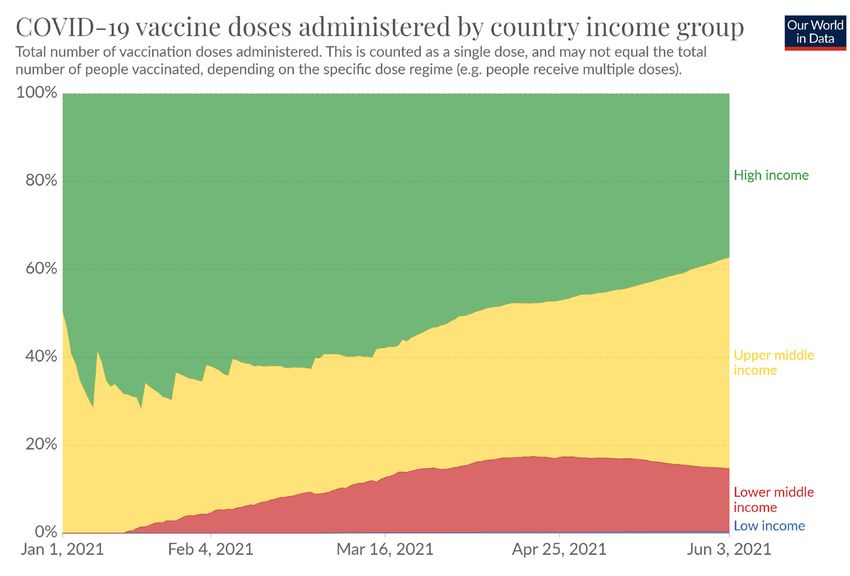
Abstract

T
             he year 2021 began with hope that
             the development, manufacture, and
             deployment of vaccines will soon bring
             the COVID-19 pandemic to an end.                  States and Israel – where the vaccination drive
             Halfway through the year, vaccination             has proven to be successful, and where health
is underway across the world, albeit at a much                 experts are considering the lifting of certain rules,
slower pace for the mostly poorer nations. There               such as that on wearing masks. India is still far
is promising news from countries like the United               from reaching its own targets. This special report
                                                               examines the obstacles to India’s vaccination
                                                               campaign, other than the question of supply.

Attribution: Haryax Pathak, “India’s COVID-19 Vaccination Campaign: A Marathon, Not a Sprint,” ORF Special Report No. 143,
June 2021, Observer Research Foundation.

                                                          2
Introduction
T
he first confirmed case of COVID-19
in India1 was reported in the southern
state of Kerala on 30 January 2020,
of a 20-year-old female returning
from Wuhan. Sixteen months later,
the reported cumulative case count stands at 28.3
million.2 Globally, India stands second only to the Analysts agree that a quick vaccine rollout is
United States (US) in absolute numbers of cases. In India’s only way through the pandemic.7 On
proportion to India’s entire population, the cases 30 May, the government informed the public
comprise two percent. As of 3 June 2021, India that while a little more than 79 million doses of
has had over 300,000 deaths due to COVID-19,3 COVID-19 vaccine were available with the states
the highest number in the world after the US and in May, nearly 120 million doses will be made
Brazil. In terms of deaths per million population, available in June.8
India’s number is 234.4
Other than the question of supply, however,
India officially launched its COVID-19 there are issues that are critical to whether or not
vaccination drive on 16 January 2021, with two India will succeed in its vaccination campaign.
approved vaccines – Covishield and Covaxin. As
of 3 June 2021, as per reports from the Ministry of
Health and Family Welfare (MoHFW),5 India has
administered just over 221 million vaccine doses.
Of India’s 1.38 billion population, only 45.1 million
have been fully vaccinated at the time of writing –
about 3.26 percent of the total population. The US,
for instance, has fully vaccinated 41 percent of its
population.6
3Obstacles to India’s
Vaccination Campaign
M
yths and misinformation around
vaccines circulating on both
traditional and social media have
had a significant impact on the usually take years to be developed and undergo
global vaccination drive. Probably trials, and Operation Warp Speed aimed to reduce
the greatest fears towards vaccination stem from the that length of time, without compromising on the
fact that the vaccines have been developed at a rapid due scientific process. Other countries soon also
pace and the mechanism of how these vaccines started accelerating their vaccine development
work is almost completely unknown to the general and approval process. (See Table 1) As a result,
population.9,10 today there are over 300 vaccines in development
across the world, with some already having
The US is one example of how a specific policy received approval for emergency use.12
and mechanism has been put in place for the rapid
development of vaccines—called Operation Warp
Speed,11 which it launched in May 2020. Vaccines
4Table 1:
COVID-19 Accelerated Vaccine Development
PRE-CLINICAL CLINICAL REGULATORY
LOGISTICS
DEVELOPMENT TRIALS APPROVAL
2-4 years
1 year
1-2 years 4-6 years Infrastructure,
TYPICAL manufacturing
After completion
PROCESS Laboratory Sequential human and distribution
and analysis of data
Research and clinical trials in 3 channels set-up
from all phases of
Animal studies Phases after Phase 3 trials
Clinical Trials
or after Regulatory
Approval
1 year
1 year 1 year
6 months
Human Clinical
ACCELERATED Fast-tracked Infrastructure and Analysis of data
Trials in 3 Phases
PROCESS Manufacturing and procedure of
research and use – conducted in
set-up even before approval in parallel
of existing vaccine parallel with
Approval to enable with the Clinical
platforms continuous
faster distribution Trials
analysis
Source: World Health Organization13
For India, the sheer magnitude of its 1.38-billion
population makes it difficult to execute a swift
rollout. Recognising the need for more vaccines to or approved by organisations like the United
match the demand and the rising case count, the States Food and Drug Administration (USFDA),
Drugs Controller General of India (DCGI)14 made the European Medicines Agency (EMA), the
the decision to approve for use in the country United Kingdom Medicines and Healthcare
all the vaccines being administered to different products Regulatory Agency (UK MHRA), and
populations globally—as listed in the World Health the Pharmaceuticals and Medical Devices Agency,
Organization’s (WHO) Emergency Use Listing, Japan (PMDA Japan).
5Table 2:
Development and Manufacture of Vaccines in India
DEVELOPMENT &
NAME TYPE OF VACCINE STATUS
MANUFACTURING
Inactivated Whole
COVAXIN Bharat Biotech / ICMR EUA
Virion
Non-replicating Simian Oxford-AstraZeneca / Serum Institute of
COVISHIELD EUA
Adenoviral Vector India
Non-replicating Human Gamaleya Institute, Russia /Dr. Reddy’s
SPUTNIK-V EUA
Adenoviral Vector Lab
Protein Subunit EUA (Phase 2/3
NVX-
(Recombinant Novavax / Serum Institute of India Bridging Trials
CoV2373
Nanoparticle) ongoing)
BNT162b2 mRNA Pfizer/BioNTech EUA
mRNA-1273 mRNA Moderna/NIAID EUA
Non-replicating Human
Ad26.CoV2.S Johnson & Johnson / Biological E EUA
Adenoviral Vector
ZyCoV-D Plasmid DNA Zydus Cadila Phase 3
BECOV Protein Subunit Baylor College of Medicine / Biological E Phase 3
HDT-301 HDT Bio Corp, USA / Gennova
mRNA Phase 1/2
(HGCO19) Biopharmaceuticals
Non-replicating Simian
BBV154 Adenoviral Vector Bharat Biotech Phase 1
(Intranasal)
Live Attenuated
COVI-VAC Codagenix / Serum Institute of India Phase 1
(Intranasal)
VesiculoVax VesiculoVaxTM VSV Aurovaccine, USA / Aurobindo Pharma
Pre-clinical
Platform Vector Ltd
Multitope Peptide Based
UB-612 Covaxx, USA / Aurobindo Pharma Pre-clinical
Vaccine
Griffith University, Australia / Indian
- Live Attenuated Pre-clinical
Immunologicals
- Protein Subunit Mynvax / Indian Institute of Science Pre-clinical
Sources: WHO, ”Draft Landscape and Tracker of COVID-19 Vaccine Candidates” ; Jeff Craven, “COVID-19 Vaccine Tracker”16; Sharun and
15
Dhama, “India’s role in COVID-19 vaccine diplomacy”17
6Sputnik-V—manufactured and distributed in
India by Dr. Reddy’s Lab—is the third vaccine
after Covishield and Covaxin to receive Emergency
Use Approval in India. Meanwhile, the MatrixMTM
protein subunit vaccine platforma from Novavax has While India has reached a notable number of
shown promising results18 against the variants and individuals for its vaccine rollout in a short time of
is undergoing Phase II/III bridging trialsb in the five months, it is nowhere near enough to have an
country, in collaboration with the Serum Institute impact on the overall targets for herd immunity.
of India. For their part, the mRNA vaccinesc India’s primary healthcare setup has the capacity
from Pfizer and Moderna are expected to receive to vaccinate five to 10 million people per day.
emergency use approval in the near future as However, there has been a palpable degree of
negotiations are ongoing between the companies vaccine hesitancy, coupled with difficulties in
and the Government of India. They are expected using the online Co-WIN portal for securing slots
to be important vaccines in the Indian context as for appointment, a shortage in doses, and wastage.
they have shown some measure of efficacy against
the B.1617,19, 20, 21 B.1.1.7, and the B1.13522 variants. Vaccine Hesitancy
Gennova Biopharmaceuticals is also developing
a vaccine, HGCO19, based on a similar mRNA Across the globe, there are sections of people
platform. who have historically denied the need for
vaccines. These people—referred to as “vaccine
The BBV154 intranasal vaccine from Bharat denialists”—launch vocal, active public campaigns
Biotech is another vaccine candidate in development. against the use of any vaccine, including the ones
Being intranasal, it is expected to induce mucosal for COVID-19. Their protests against the use of
immunity which should prevent infection and vaccines find space in both mainstream and new
transmission of the virus as well. COVI-VAC, another media, and reach significant numbers of people.
intranasal vaccine from Codagenix, should also be
crucial in reducing the transmission.
a Protein Subunit Vaccine - The antigenic proteins of the virus – the Spike Protein in this case – are developed outside the human body,
in a lab, and then delivered to the human body as a vaccine.
b Bridging trials are small-scale clinical trials conducted in a new region/population to extrapolate the efficacy, safety and
immunogenicity data from the large-scale clinical trials conducted in a foreign population.
c mRNA is a piece of genetic code responsible for protein synthesis in the human body. The genes coding for the Spike protein are
encoded onto an mRNA segment. This mRNA vaccine delivers the code to the human cells that eventually express the Spike protein on
their surface.
7Another aspect of vaccine hesitancy is related
fundamentally to fear. As vaccines are biological
agents, they are bound to have side effects, differing
in form and degree between individuals. The
perception of the side effects of the COVID-19
vaccines has become exaggerated. Rarely, adverse Digital Gaps
events, allergies, anaphylactic reactions, or some
other life-threatening events may occur post- To streamline the process of vaccination, the
vaccination, owing to multiple factors other than the Indian government developed a digital platform
vaccines themselves. But even rare events, like the —called Co-WIN—where one could book an
post-vaccination clotting incidents in Europe,23 are appointment for vaccination, check the status of
enough to create massive doubt in the minds of the vaccination, and later download their vaccination
potential recipients. certificate. The same portal allows the government
to keep track of the country’s vaccination statistics.
India must engage in proactive measures to The idea was simple enough: digitise the process,
address and dispel hesitancy and gain trust for avoid the hassles of analog record-keeping, and
vaccination. allow for easy data management. However, Co-
WIN has had its fair share of problems.
A successful story comes from the remote village
of Janefal,24 in Aurangabad, Maharashtra, where the As India opened up Phase 2 of its vaccination
authorities have managed to vaccinate 100 percent campaign in March for the elderly and those with
of the eligible population through constant health comorbidities, the portal was flooded with millions
messaging, awareness campaigns, and confidence- of users trying to book a slot. The surge resulted in
building measures. Indeed, effective vaccination glitches in the mobile application or the website,
coverage and uptake in rural areas requires a with servers going down and users unable to find
bottom-up approach: developing infrastructure at and block an appointment. Even as medical staff
the ground level and mobilising human resources are required to undergo training in using the web
like grassroots health workers and volunteers to portal, errors have been reported in data entry—
disseminate proper and adequate information to either from the recipients or the authorities—that
rural families who might be initially hesitant to get has led to duplication or erasure of many details.
themselves vaccinated. The flaws were heightened as vaccination opened
up, first, for everyone above 45 including those
without comorbidities, and later for those above
the age of 18. The portal was overloaded, and
there was a shortage of slots available for those
who logged in.
8India must engage in
proactive measures
to address and dispel Vaccine Wastage
hesitancy and gain trust
Wastage is a common enough issue for any
for vaccination. vaccination drive of a similar scale as what India is
attempting. There are various reasons,26 primary
of which are improper cold-chain maintenance
and poor vaccine administration practices like
inability to draw the stipulated number of doses
from a vial. The concern with COVID-19 vaccines,
While Co-WIN was meant to facilitate the however, is the amount of wastage occurring in
vaccination drive, it needs more logistical support in India. Wastage creates an unnecessarily high
terms of ease of access and use. The past few weeks demand for vaccines, while also slowing down the
have revealed the system’s weaknesses, especially entire campaign.
for use in the rural regions, as pointed out by the
Supreme Court of India in a recent directive.25 Wastage of both Covishield and Covaxin has
been brought down drastically over the past two
months to under five percent as of 22 May 2021.
The national average, as of 25 May 2021,27 is 6.5
percent, with many states reporting wastage levels
of over 30 percent. Consistent efforts are needed
to keep this wastage to a minimum.
9Towards Vaccine
Equity
T
he key to curbing the COVID-19
pandemic is widespread vaccination,
at a rapid pace, among the populations
in rich and poor countries alike. The and COVAX—where the wealthy regions have
aim is vaccine equity. The Lower pledged to supply vaccines to the poorer nations.
Middle Income Countries (LMIC), with their As seen in Figure 1, while the large economies
limited technology and resources, are dependent have vaccinated a majority of their populations,
on the global vaccine alliances of WHO, the United the pace in the poorer nations has been painfully
Nations, The Gates Foundation, as well as GAVI slow.
Figure 1:
COVID-19 Vaccination by Country Income Group
Source: Our World in Data28
10At the same time, India, as part of its ‘Vaccine
Maitri’ initiative, has sent vaccines to many poor
nations across the globe. As of 28 May, India has sent
over 66.37 million doses29 of both Covishield and
Covaxin, to 95 countries. Amidst growing concerns The Rural Challenge
that the effort is resulting in domestic shortages, the
government and the Ministry of External Affairs30 As large and diverse India is, vaccine equity is a
have maintained that the vaccine diplomacy has not challenge within the country as well. During the
compromised the country’s own need. first wave of the pandemic, the rural areas were
relatively less affected compared to the urban
In October 2020, India and South Africa moved regions. Eventually, the rural regions saw a
the World Trade Organization (WTO) to waive significant surge in cases, especially in the second
certain provisions of the agreement on Trade-Related wave. An analysis conducted by the State Bank of
Aspects of Intellectual Property Rights (TRIPS).31 India36 states that the share of rural districts in
The aim of this plea was to encourage data-sharing COVID-19 cases is 52.9 percent as of May 2021.
and the necessary technology transfer, thus enabling Even in the first wave, the peak was at 53.7 percent
the low-income nations to manufacture the mRNA of cases. It is a worrying trend, as rural areas also
vaccines and drugs for wider distribution and faster see lower rates of testing and poor reporting.37
treatment/vaccination of their populations.
While the plea received a largely negative
response initially, seven months later, the US has
given its conditional approval32 of the proposal.
Following this, even the European Union,33 New
Zealand,34 and France35 have shown willingness to
negotiate the terms and conditions of the TRIPS
waiver.
11The primary reason for this urban-rural divide is
logistical constraints—infrastructure, supply chain,
and skilled personnel, especially in the poorer
states.38 For the vaccination drive to be effective, the distribution of cold chain points in India is uneven.
poorer states need resources and capacity building As of December 2020, India has 29,000 cold chain
to improve the health infrastructure, which includes points across the country.39 A detailed analysis by
a very important component— i.e., Cold Chain.d the IDFC Institute40 in March 2021 reveals that
While the vaccines in use currently do not have six states with 34 percent of India’s population
extreme cold chain requirements, the nationwide have 52 percent of the entire country’s cold chain
points (See Figure 2).
Figure 2:
No. of Cold Chain Points and Equipment across
India, by State
Cold Chain Points Cold Chain Equipment*
Maharashtra 3257 Maharashtra 8643
Karnataka 2870 Karnataka 7285
Tamil Nadu 2599 Tamil Nadu 5483
Rajasthan 2405 Rajasthan 7029
Gujarat 2291 Gujarat 5076
Andhra Pradesh 1650 Andhra Pradesh 4431
The 6 States 15072 The 6 States 37947
Other States 13860 Other States 47713
28932 India Total 85660
India Total
0 5000 10000 15000 20000 25000 30000 0 20000 40000 60000 80000 100000
Source: IDFC (The Indian COVID-19 Alliance). *Cold Chain equipment includes walk-in coolers, freezers, and vaccine carriers.
d Cold Chain is a temperature-controlled supply chain network of cold-chain points comprising of cold rooms, walk-in coolers, ice-lined
refrigerators, deep freezers, vaccine carriers and solar units. This cold-chain is necessary to maintain the viability of the vaccine during
transportation and storage - as per the given temperature requirements.
12Recommendations and
Conclusion
T
he vaccination of an individual may
seem like a straightforward process—
like a 100m sprint. Mass inoculation,
however, is more of a 10,000m
marathon and obstacle run, with This report offers the following recommendations.
hurdles erected in various points and manifesting
in myriad forms. India will need a multipronged 1. Manufacture and procurement. The Indian
approach to tackle these hurdles. At the time of government must proactively negotiate deals for
writing this report, the second wave was on the bulk procurement of vaccines and raw materials.
downward trend; the third wave is expected around With ongoing negotiations for the TRIPS waiver,
November—this interval must be used as a buffer rapid technology transfer and the import of raw
to launch the vaccination campaign into overdrive. materials should be initiated. At the same time,
local manufacturing capacity needs a boost.
Until the time that India can stock up or set up
production lines for foreign-made vaccines – the
locally made Covishield and Covaxin remain the
best bets. Periodic assessments must be done with
a viable plan for expansion by the end of 2021.
132. Infrastructure and Capacity Building. The
existing supply chain and cold chain infrastructure
need reinforcements, including public-private
partnerships to ensure transportation and storage 4. Reducing waste and Increasing vaccine uptake.
of vaccines even in remote areas. While the storage Evaluation of the vaccination process is required
requirements for the mRNA vaccines have been —from manufacturing, transport, storage and
relaxed, a robust setup must be in place to ensure administration—to identify the areas of vaccine
quality control. With an influx of vaccine stocks wastage. Efforts must be made to reduce the
expected in the coming months, all states must have wastage—this requires stringent documentation
adequate resources for storage and distribution. of wastage, training of healthcare staff, following
the open-vial policy and/or WHO’s multi-vial
3. Equitable distribution. High-risk areas and high- policy, which dictate that any vial of vaccines
risk populations must be identified and targeted opened/used in a vaccination session can be stored
distribution of vaccines launched accordingly. for 28 days and used for another immunisation
Periodic assessments with respect to burden of session provided they meet certain criteria.41 A
cases, positivity rates, and mobility trends should marker for wastage is reduced uptake, which
be conducted to guide the effective disbursement of is primarily observed at smaller centres or
vaccine supplies. Supply chain logistics also need to outreach sites. Such vaccination sessions must be
be adequately upgraded for equitable distribution carefully planned, with prior communication and
in rural India. mobilisation of human resources like Accredited
Social Health Activist (ASHA) workers and
Auxiliary Nurse Midwives (ANM).
145. Improving accessibility. Deploy mobile vaccination
units with trained personnel and equipment to
manage immediate adverse events, especially for
6. Vaccine advocacy. Hesitancy or denialism
the elderly and infirm. Outreach sessions should
must be countered proactively, especially in rural
be initiated in rural and remote areas with proper
areas where there is generally lower penetration
planning and prior announcements. Some cities
of adequate and proper information. Behaviour
have started drive-through vaccination42,43,44—a
change communication, with community-level
practice that can be replicated nationwide. For
engagement, must be done immediately.
mandatory registration in rural areas, district- or
panchayat-level personnel can be deployed at the
Covid Vaccination Centres. Both government and
private CVCs should have the facility for walk-in
registrations.
The top imperatives are in
vaccine manufacture and
procurement; ensuring
equitable distribution;
reducing wastage; and
battling hesitancy.
15Endnotes
1 Andrews, M. A., Binu Areekal, K. R. Rajesh, Jijith Krishnan, R. Suryakala, Biju Krishnan, C. P. Muraly, and P. V. Santhosh.
2020. “First Confirmed Case of COVID-19 Infection in India: A Case Report.” The Indian journal of medical research 151 (5):
490–92. https://doi.org/10.4103/ijmr.IJMR_2131_20
2 Ministry of Health and Family Welfare, “COVID-19 Statewise Status”, https://www.mohfw.gov.in/#state-data
3 Ministry of Health and Family Welfare, “COVID-19 Status”, https://www.mohfw.gov.in/
4 Worldometer, “COVID-19 Coronavirus Pandemic”, https://www.worldometers.info/coronavirus/#countries
5 Ministry of Health and Family Welfare, “Cumulative Covid Vaccination Report 2nd June 2021”, https://www.mohfw.gov.in/
pdf/CumulativeCovidVaccinationReport2ndJune2021.pdf
6 Centers for Disease Control and Prevention, “COVID-19 Vaccinations in the United States”, https://covid.cdc.gov/covid-
data-tracker/#vaccinations
7 Rakesh Sood, Kriti Kapur and Oommen C Kurian, “India’s Vaccine Rollout: A Reality Check,” ORF Special
Report No. 139, May 2021, Observer Research Foundation. https://www.orfonline.org/research/indias-vaccine-
rollout-a-reality-check/
8 Government of India, “Update on COVID Vaccine Allocation”, Press Information Bureau, May 30, 2021, https://pib.gov.in/
PressReleasePage.aspx?PRID=1722831
9 Loomba, Sahil; Figueiredo, Alexandre de; Piatek, Simon J.; Graaf, Kristen de; Larson, Heidi J. (2021): Measuring the
impact of COVID-19 vaccine misinformation on vaccination intent in the UK and USA. In Nature human behaviour 5 (3),
pp. 337–348. DOI: 10.1038/s41562-021-01056-1.
10 Islam, Md Saiful; Kamal, Abu-Hena Mostofa; Kabir, Alamgir; Southern, Dorothy L.; Khan, Sazzad Hossain; Hasan, S.
M. Murshid et al. (2021): COVID-19 vaccine rumors and conspiracy theories: The need for cognitive inoculation against
misinformation to improve vaccine adherence. In PloS one 16 (5), e0251605. DOI: 10.1371/journal.pone.0251605.
11 United States Department of Defense, “Coronavirus: Operation Warp Speed”, https://www.defense.gov/Explore/Spotlight/
Coronavirus/Operation-Warp-Speed/
12 COVID-19 Vaccine Tracker, https://vac-lshtm.shinyapps.io/ncov_vaccine_landscape/
13 World Health Organisation (2020): Update on COVID-19 Vaccine Development. Available online at https://www.who.int/
docs/default-source/coronaviruse/risk-comms-updates/update45-vaccines-developement.pdf?sfvrsn=13098bfc_5, updated
on 12/21/2020
1614 Directorate General of Health Services (2021). Central Drugs Standard Control Organisation. Available online at https://
cdsco.gov.in/opencms/export/sites/CDSCO_WEB/Pdf-documents/notice15april21.pdf.
15 World Health Organisation (2021): Draft landscape and tracker of COVID-19 candidate vaccines. Available online at https://
www.who.int/publications/m/item/draft-landscape-of-covid-19-candidate-vaccines, updated on 6/1/2021.
16 Jeff Craven (2021): COVID-19 vaccine tracker. Regulatory Affairs Professionals Society (RAPS). Available online at https://
www.raps.org/news-and-articles/news-articles/2020/3/covid-19-vaccine-tracker, updated on 5/27/2021
17 Sharun, Khan; Dhama, Kuldeep (2021): India’s role in COVID-19 vaccine diplomacy. In Journal of travel medicine. DOI:
10.1093/jtm/taab064.
18 Shinde, Vivek; Bhikha, Sutika; Hoosain, Zaheer; Archary, Moherndran; Bhorat, Qasim; Fairlie, Lee et al. (2021): Efficacy
of NVX-CoV2373 Covid-19 Vaccine against the B.1.351 Variant. In The New England journal of medicine 384 (20), pp. 1899–
1909. DOI: 10.1056/NEJMoa2103055.
19 Planas, Delphine; Veyer, David; Baidaliuk, Artem; Staropoli, Isabelle; Guivel-Benhassine, Florence; Rajah, Maaran Michael
et al. (2021): Reduced sensitivity of infectious SARS-CoV-2 variant B.1.617.2 to monoclonal antibodies and sera from
convalescent and vaccinated individuals. In bioRxiv : the preprint server for biology. DOI: 10.1101/2021.05.26.445838.
20 Tada, Takuya; Zhou, Hao; Dcosta, Belinda M.; Samanovic, Marie I.; Mulligan, Mark J.; Landau, Nathaniel R. (2021): The
Spike Proteins of SARS-CoV-2 B.1.617 and B.1.618 Variants Identified in India Provide Partial Resistance to Vaccine-
elicited and Therapeutic Monoclonal Antibodies. In bioRxiv : the preprint server for biology. DOI: 10.1101/2021.05.14.444076.
21 Edara, Venkata-Viswanadh; Lai, Lilin; Sahoo, Malaya K.; Floyd, Katharine; Sibai, Mamdouh; Solis, Daniel et al. (2021):
Infection and vaccine-induced neutralizing antibody responses to the SARS-CoV-2 B.1.617.1 variant. In bioRxiv : the preprint
server for biology. DOI: 10.1101/2021.05.09.443299
22 Abu-Raddad, Laith J.; Chemaitelly, Hiam; Butt, Adeel A. (2021): Effectiveness of the BNT162b2 Covid-19 Vaccine against
the B.1.1.7 and B.1.351 Variants. In The New England journal of medicine. DOI: 10.1056/NEJMc2104974.
23 Cines, Douglas B.; Bussel, James B. (2021): SARS-CoV-2 Vaccine-Induced Immune Thrombotic Thrombocytopenia. In The
New England journal of medicine. DOI: 10.1056/NEJMe2106315.
24 Puja Changoiwala (2021): How a village in India reached 100% vaccination in the face of misinformation and hesitancy.
National Geographic. Available online at https://www.nationalgeographic.com/science/article/how-a-village-in-india-
reached-100-vaccination-in-the-face-of-misinformation-and-hesitancy, updated on 5/22/2021
25 Supreme Court of India, of 5/31/2021, Suo Motu Writ Petition (Civil) No.3 of 2021 IN RE: DISTRIBUTION
OF ESSENTIAL SUPPLIES AND SERVICES DURING PANDEMIC, pp. 27–31. E.5 https://main.sci.gov.in/
supremecourt/2021/11001/11001_2021_35_301_28040_Judgement_31-May-2021.pdf
26 Ministry of Health and Family Welfare, “Vaccine Wastage Assessment”, April 2010. https://www.mofa.go.jp/mofaj/gaiko/oda/
seisaku/kanmin/chusho_h24/pdfs/a20-12.pdf
1727 Ministry of Health and Family Welfare, 25 May 2021. https://pib.gov.in/PressReleasePage.aspx?PRID=1721704
28 Mathieu, Edouard; Ritchie, Hannah; Ortiz-Ospina, Esteban; Roser, Max; Hasell, Joe; Appel, Cameron et al. (2021): A global
database of COVID-19 vaccinations. In Nature human behaviour. DOI: 10.1038/s41562-021-01122-8.
29 Ministry of External Affairs, COVID-19 Vaccine Supply, “Vaccine Maitri”. https://www.mea.gov.in/vaccine-supply.htm
30 Ministry of External Affairs, “Statement by External Affairs Minister in Lok Sabha on the Vaccine Maitri Initiative”, 17
March 2021. https://mea.gov.in/Speeches-Statements.htm?dtl/33655/Statement_by_External_Affairs_Minister_in_Lok_
Sabha_on_the_Vaccine_Maitri_Initiative
31 World Trade Organization: “Waiver From Certain Provisions Of The Trips Agreement For The Prevention, Containment And
Treatment Of Covid-19”. https://docs.wto.org/dol2fe/Pages/SS/directdoc.aspx?filename=q:/IP/C/W669.pdf&Open=True.
32 Office of the United States Trade Representative, “Statement from Ambassador Katherine Tai on the Covid-19 Trips
Waiver.” Washington. 5 May 2021 https://ustr.gov/about-us/policy-offices/press-office/press-releases/2021/may/statement-
ambassador-katherine-tai-covid-19-trips-waiver
33 European Union, “Statement by President von der Leyen at the joint press conference with President Michel and Prime
Minister Costa following the informal meeting of EU Leaders and the EU-India leaders’ meeting.” 8 May 2021 https://
ec.europa.eu/commission/presscorner/detail/en/STATEMENT_21_2361
34 New Zealand, “NZ backs moves to improve global access to COVID vaccines.” 6 May 2021 https://www.beehive.govt.nz/
release/nz-backs-moves-improve-global-access-covid-vaccines
35 Macron backs waiving IP rights for COVID-19 vaccines. Reuters. 6 May 2021 https://www.reuters.com/business/healthcare-
pharmaceuticals/macron-backs-waiving-ip-rights-covid-19-vaccines-2021-05-06/
36 State Bank of India (2021): INDIAN STATES & GLOBAL VACCINATION MARKET: THE TEMPLATE FOR
MAKING STATE VACCINE PROCUREMENT A SUCCESS. Issue no. 12, FY22 (Ecowrap). https://sbi.co.in/
documents/13958/10990811/210521-Ecowrap_20210521.pdf/dd572518-7507-7ef1-9e41-2db797f632a7?t=1621577280519
&utm_campaign=fullarticle&utm_medium=referral&utm_source=inshorts
37 Vignesh Radhakrishnan: Vaccination in rural India trails urban areas even as cases surge. The Hindu. https://www.thehindu.
com/news/national/vaccination-in-rural-india-trails-urban-areas-even-as-cases-surge/article34589734.ece
38 Ministry of Health and Family Welfare, “Rural Health Statistics”, 2018-19. https://main.mohfw.gov.in/sites/default/files/
Final%20RHS%202018-19_0.pdf
39 Ministry of Health and Family Welfare, 25 December 2020 https://pib.gov.in/PressReleaseIframePage.
aspx?PRID=1683529&RegID=3&LID=1
40 The Indian COVID-19 Alliance (2021): India COVID-19 Vaccination Distribution Report. IDFC Institute. https://www.
idfcinstitute.org/site/assets/files/16432/tica_distribution_report_web_v1.pdf
1841 World Health Organisation: WHO Policy Statement: Multi-dose Vial Policy (MDVP). 2014 https://apps.who.int/iris/
bitstream/handle/10665/135972/WHO_IVB_14.07_eng.pdf?sequence=1
42 Sangeeta Ojha, “Drive-in Covid-19 vaccinations centres in these cities in India. Full list.” Mint. 18 May 2021 https://www.
livemint.com/news/india/drivein-covid-19-vaccinations-centres-in-india-full-list-of-cities-11621318002085.html
43 PTI “Drive-through COVID-19 vaccination centre starts in Ahmedabad.” 27 May 2021 http://www.ptinews.com/
news/12447860_Drive-through-COVID-19-vaccination-centre-starts-in-Ahmedabad.html
44 PTI, “Kolkata to Get Its First Drive-through Vaccination Centre.” News 18 India. 2 June 2021 https://www.news18.com/
news/india/kolkata-to-get-its-first-drive-through-vaccination-centre-3804107.html
About the Author
Haryax Pathak is a medical doctor from Vadodara.
Cover image: Getty Images/Andriy Onufriyenko
Back cover image: Getty Images/Andriy Onufriyenko
19Ideas . Forums . Leadership . Impact 20, Rouse Avenue Institutional Area, New Delhi - 110 002, INDIA Ph. : +91-11-35332000. Fax : +91-11-35332005 E-mail: contactus@orfonline.org Website: www.orfonline.org
You can also read


