Statin-Associated Myalgias and Muscle Injury-Recognizing and Managing Both While Still Lowering the Low-Density Lipoprotein - BINASSS
←
→
Page content transcription
If your browser does not render page correctly, please read the page content below
Statin-Associated Myalgias
    a n d M u s c l e In j u r y —
    Recognizing and Managing Both
    W h i l e S t i l l L o w e r i n g t h e Lo w -
    D e n s i t y L i p o p ro t e i n
                                              a,b,c,
    Andrew L. Mammen,               MD, PhD         *

      KEYWORDS
       Statin  Myalgia  Weakness  Myotoxicity  Myopathy  Autoantibody

      KEY POINTS
       Patients who have muscle discomfort attributable to statins, but do not have muscle
        enzyme elevations or demonstrable weakness, are defined as having statin-associated
        muscle symptoms (SAMS).
       Those with CK elevations attributable to statins that resolve with discontinuation of the
        medication are defined as having statin-associated myotoxicity (SAMT).
       Statin-exposed individuals with elevated CK levels, proximal muscle weakness, and
        antihydroxy-methyl-glutaryl coenzyme A reductase autoantibodies are defined as having
        statin-associated autoimmune myopathy (SAAM).
       Patients with SAMS or SAMT can be managed by changing the statin regimen or using
        alternative lipid lowering medications such as ezetimibe or PCKS9 inhibitors.
       Those diagnosed with SAAM usually require chronic immunosuppressive therapy, should
        not be reexposed to statins, and may be treated with PCSK9 inhibitors if lipid-lowering
        therapies are indicated.

     Funding: This work was supported by the Intramural Research Program of the National Insti-
     tute of Arthritis and Musculoskeletal and Skin Diseases of the National Institutes of Health.
     a
       Muscle Disease Unit, Laboratory of Muscle Stem Cells and Gene Regulation, National Institute
     of Arthritis and Musculoskeletal and Skin Diseases, National Institutes of Health, 50 South
     Drive, Room 1141, Building 50, MSC 8024, Bethesda, MD 20892, USA; b Department of
     Neurology, Johns Hopkins University School of Medicine, Baltimore, MD, USA; c Department of
     Medicine, Johns Hopkins University School of Medicine, Baltimore, MD, USA
     * Muscle Disease Unit, Laboratory of Muscle Stem Cells and Gene Regulation, National Institute
     of Arthritis and Musculoskeletal and Skin Diseases, National Institutes of Health, 50 South
     Drive, Room 1141, Building 50, MSC 8024, Bethesda, MD 20892.
     E-mail address: andrew.mammen@nih.gov

     Med Clin N Am 105 (2021) 263–272
     https://doi.org/10.1016/j.mcna.2020.10.004                                               medical.theclinics.com
     0025-7125/21/Published by Elsevier Inc.

Descargado para Anonymous User (n/a) en National Library of Health and Social Security de ClinicalKey.es por Elsevier en febrero 26,
2021. Para uso personal exclusivamente. No se permiten otros usos sin autorización. Copyright ©2021. Elsevier Inc. Todos los derechos
                                                             reservados.
264 Mammen
INTRODUCTION
Hyperlipidemia is a major risk factor for developing cardiovascular disease, the most
common cause of death for virtually all populations in the United States. Indeed, nearly
30% of adults in the United States have elevated levels of low-density lipoprotein
cholesterol (LDL-C), which doubles the risk for heart attack. Statin medications, which
lower cholesterol levels by inhibiting hydroxy-methyl-glutaryl coenzyme A reductase
(HMGCR), significantly reduce cardiovascular events. Unfortunately, despite their ef-
ficacy, only a fraction of those eligible for statin therapy use one of these cholesterol-
lowering drugs. For example, one recent study estimated that of those adults at high
risk for cardiovascular disease, nearly half are not taking a statin.1 Thus, underutiliza-
tion of statins for managing hypercholesterolemia remains a significant public health
concern.
Although statins are generally safe and well tolerated, skeletal muscle side effects,
which range from mild myalgias to severe rhabdomyolysis, may limit their use in a sig-
nificant number of patients. In one telling study that included more than 10,000 current
and former statin users, muscle side-effects were reported by 25% and 65%, respec-
tively. Furthermore, nearly two-thirds of former users stopped taking statins because
of side effects.2 With the ultimate aim of optimizing compliance with cholesterol-
lowering therapy and thereby reducing the risk of cardiovascular disease, this review
describes the different types of statin-associated muscle side effects and provide rec-
ommendations about how to manage hypercholesterolemia in patients who experi-
ence them.
THE SPECTRUM OF STATIN-RELATED MUSCLE SIDE EFFECTS
The term “statin myopathy” has been used to describe a broad range of muscle prob-
lems experienced by patients taking statins. However, this term was poorly defined
and did not distinguish between patients who had different symptoms, laboratory find-
ings, and histopathological findings on muscle biopsy. In order to capture the hetero-
geneity of statin-associated muscle complaints, the National Lipid Association Task
Force (NLATF) proposed using more precise terminology in 2014.3 The term “myalgia”
was used to describe muscle discomfort in patients without serum creatine kinase
(CK) elevations or objective weakness. Those with “myopathy” have muscle weakness
(not attributable to muscle pain) with or without CK elevations. Patients with “myositis”
have muscle biopsies revealing inflammatory cell infiltrates. The term “myonecrosis”
was used to describe a process that includes significant CK elevations that are at least
3-fold higher than untreated baseline levels or the normative upper limit when adjusted
for age, sex, and race. And finally, the term “myonecrosis with myoglobinuria” defines
the most severe patients, who have CK elevations along with an increased serum cre-
atine greater than or equal to 0.5 mg/dL and, in some cases, acute renal failure due to
precipitation of myoglobin in the kidney tubules (ie, rhabdomyolysis).
Although the NLATF-proposed terminology represents a significant improvement
over the vague term “statin myopathy,” it does not define mutually exclusive disease
categories. For example, a patient with muscle weakness, serum CK elevations, and
an inflammatory muscle biopsy could be described as having myopathy, myonecro-
sis, and myositis. Furthermore, since this terminology scheme was proposed, it has
become increasingly clear that statins may trigger an autoimmune myopathy associ-
ated with autoantibodies recognizing HMGCR.4 Given the limitations of the NLATF
and other existing classification schemes, the author has found it clinically useful to
divide statin-related muscle problems into 3 categories: statin-associated muscle
Descargado para Anonymous User (n/a) en National Library of Health and Social Security de ClinicalKey.es por Elsevier en febrero 26,
2021. Para uso personal exclusivamente. No se permiten otros usos sin autorización. Copyright ©2021. Elsevier Inc. Todos los derechos
reservados.Statin-Associated Myalgias and Muscle Injury 265
symptoms (SAMS), statin-associated myotoxicity (SAMT), and statin-associated
autoimmune myopathy (SAAM) (Box 1).
STATIN-ASSOCIATED MUSCLE SYMPTOMS
Patients who experience muscle discomfort, such as myalgias or cramps, without CK
elevations or demonstrable muscle weakness can be classified as having SAMS.
Although this seems to be the most common type of statin-related muscle problem,
estimates of its prevalence have varied widely between studies. For example, in the
retrospective and unblinded PRediction of Muscular Risk in Observational Conditions
(PRIMO) study, 832 (10.5%) of 7924 hyperlipidemic patients reported muscle pain
while on statin therapy.5 In contrast, a meta-analysis including 26 randomized
controlled clinical trials in which muscle symptoms were reported found that these
symptoms occurred in 12.7% of statin-treated and 12.4% of placebo-treated subjects
(P 5 .06).6 This study raises 2 points. First, it suggests the possibility that the high rate
of muscle symptoms in observational studies may be at least partially due to the fact
that patients know and anticipate that muscle pain may be a side effect of statins, an
example of the “nocebo effect.” Second, it underscores the high prevalence of back-
ground nonspecific muscle pain even in patients not on statin therapy. Indeed, this
study has been taken by some to suggest that muscle pain alone is rarely, if ever, a
consequence of the toxic effect of statins on muscle. However, none of the clinical tri-
als included in the meta-analysis were specifically designed to capture the true prev-
alence of muscle symptoms in those exposed to statins.
The Effect of Statins on Muscle Performance (STOMP) study was designed, in part,
to determine how often muscle pain that occurs in statin-treated patients is directly
Box 1
Typical clinical features of the statin-associated muscle conditions
Statin-associated muscle symptoms (SAMS)
Muscle discomfort present
Normal manual muscle strength testing
Normal CK levels
Resolution with discontinuation of statins
Recurrence with statin rechallenge
Lipids managed by changing the statin regimen or using alternative agents
Statin-associated myotoxicity (SAMT)
Muscle discomfort common
Muscle weakness possible
Elevated CK levels present
Minimal SAMT: CK 3-fold greater than normal limit
Mild SAMT: CK >3-fold greater than normal limit
Moderate SAMT: CK >10-fold greater than normal limit
Severe SAMT: CK >50-fold greater than normal limit
Resolution with discontinuation of statins
Recurrence with statin rechallenge (advisable only in selected patients)
Lipids managed by changing the statin regimen or using alternative agents
Statin-associated autoimmune myopathy (SAAM)
Muscle discomfort common
Muscle weakness common
Elevated CK levels present (>5-fold greater than normal limit)
Does not resolve with discontinuation of statins; requires immunosuppression
Disease flares likely with statin rechallenge (not advised)
Lipids managed by using a PCSK9 inhibitor
Descargado para Anonymous User (n/a) en National Library of Health and Social Security de ClinicalKey.es por Elsevier en febrero 26,
2021. Para uso personal exclusivamente. No se permiten otros usos sin autorización. Copyright ©2021. Elsevier Inc. Todos los derechos
reservados.266 Mammen
related to the medication. In this study, 420 statin-naı̈ve subjects were treated with
either 80 mg of atorvastatin or placebo for 6 months. Among these, 19 statin-
treated and 10 placebo-treated subjects reported new muscle pain or cramping
that lasted more than 2 weeks, resolved within 2 weeks of treatment cessation, and
returned within 4 weeks of treatment reinitiation (P 5 .05).7 Taken together with
data from 2 other double-blind, placebo-controlled studies in which subjects with a
history of statin intolerance were treated with statin or placebo, washed out, and
then treated with the alternative therapy,8,9 the STOMP trial suggests that in as
many as half of statin-treated patients with muscle discomfort, this symptom is not
due to the statin.
Given that there is no definitive diagnostic test to establish whether muscle discom-
fort can be directly attributed to statin use, physicians must rely on clinical features to
determine how likely it is that a patient has SAMS. The location and pattern of muscle
symptoms may be informative in that symmetric and proximal symptoms are more
likely due to statins than asymmetric and/or distal muscle symptoms. In the authors’
experience, SAMS is more often characterized by persistent myalgias than intermit-
tent cramping.10 In addition, most relevant studies (eg, STOMP) have shown that mus-
cle symptoms tend to occur earlier in patients with verified SAMS than in those with
nonspecific muscle symptoms.7,8 Furthermore, once statins are discontinued, pa-
tients with SAMS usually experience a marked improvement in their symptoms within
weeks; when symptoms persist longer than 8 weeks, alternative diagnoses should
definitely be sought. Finally, once statins have been discontinued and muscle symp-
toms have resolved, statin rechallenge is likely to provoke muscle symptoms in a rela-
tively short time, most often within 4 weeks. These statin rechallenges, although
usually unblinded, are critical for establishing the likelihood that a patient has SAMS.
It is worth noting that statin exposure can cause mild CK elevations, usually within
the normal range, even in patients who do not experience muscle symptoms. For
example, in the STOMP study, statin-treated patients experienced a 20 IU/L increase
in CK over baseline compared with those treated with placebo.7 And although studies
have shown that modest statin-related CK increases may occur more often in those
who develop SAMS,11,12 observing a mild CK increase while on statins may not be
specific enough to have diagnostic utility in individual patients.
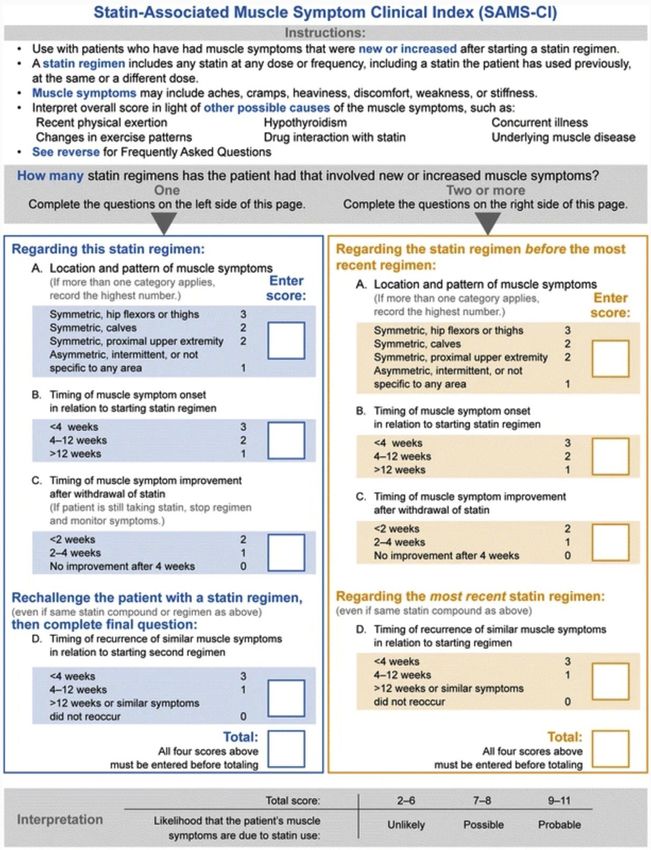
Based on these clinical observations, a tool known as the Statin-Associated Muscle
Symptoms Clinical Index (SAMS-CI; Fig. 1) was developed13 to help clinicians deter-
mine the probability of SAMS in statin-treated patients who develop muscle symp-
toms. Although the SAMS-CI still needs to be validated in large-scale clinical trials,
preliminary studies suggest that less than 10% of patients with a score of 4 or less
(out of 11 possible points) have SAMS. However, because only half of those with
confirmed SAMS had scores of 6 or more, the SAMS-CI seems most useful for iden-
tifying those patients least likely to have true SAMS.10
Although circumstances may vary, diagnosis of suspected SAMS should usually
begin by documenting the location, pattern, and timing of muscle symptoms as
detailed on the SAMS-CI. Next, statins should be stopped and the timing of muscle
symptom improvement should be documented; failure to improve after 4 to 8 weeks
strongly suggests the patient does not have SAMS and alternative causes for the pa-
tient’s symptoms should be sought. During the statin wash out period, factors that
may contribute to the risk of statin intolerance should be eliminated if possible. This
includes testing for and treating hypothyroidism and vitamin D deficiency. Assuming
that the muscle symptoms do resolve and that the patient meets the American College
of Cardiology and the American Heart Association guidelines for initiating treatment
with a statin, rechallenging the patient with a statin regimen is an essential component
Descargado para Anonymous User (n/a) en National Library of Health and Social Security de ClinicalKey.es por Elsevier en febrero 26,
2021. Para uso personal exclusivamente. No se permiten otros usos sin autorización. Copyright ©2021. Elsevier Inc. Todos los derechos
reservados.Statin-Associated Myalgias and Muscle Injury 267
Fig. 1. The Statin-Associated Muscle Symptom Clinical Index (SAMS-CI). (From Rosenson RS,
Miller K, Bayliss M, et al. The Statin-Associated Muscle Symptom Clinical Index (SAMS-CI):
Revision for Clinical Use, Content Validation, and Inter-rater Reliability. Cardiovasc Drugs
Ther 2017;31(2):182; with permission.)
of the diagnostic process. No further workup is required for those who do not experi-
ence a return of muscle symptoms with the statin rechallenge. However, in those
whose symptoms return, especially if they have SAMS-CI scores of 5 or greater, the
statin should be stopped until symptoms resolve and then an alternative statin
regimen may be initiated. For example, rosuvastatin, atorvastatin, and pitavastatin
Descargado para Anonymous User (n/a) en National Library of Health and Social Security de ClinicalKey.es por Elsevier en febrero 26,
2021. Para uso personal exclusivamente. No se permiten otros usos sin autorización. Copyright ©2021. Elsevier Inc. Todos los derechos
reservados.268 Mammen
have long half-lives and can be given every other day (or even once per week) resulting
in a lower weekly dose of statin. Although some patients with SAMS tolerate these
lower dose regimens, which may not be inferior to daily dosing to reduce LDL-C
and triglyceride levels,14 it remains to be shown how effectively it reduces the risk
of cardiovascular events.
Nonstatin medications should be considered for patients who do not reach their
target cholesterol levels after demonstrated intolerance to 2 or 3 different statin regi-
mens. The 2017 Focused Update of the 2016 American College of Cardiology Expert
Consensus Decision Pathway provides detailed recommendations for choosing an
alternative to statins in different statin-intolerant patient populations.15 Specific rec-
ommendations vary depending on the age of the patient, whether the statin is pre-
scribed for primary or secondary prevention, and the presence of certain
comorbidities. In most cases, either ezetimibe or a proprotein convertase subtilisin/
kexin type 9 (PCSK9) inhibitor is recommended for statin-intolerant patients who
would benefit from a reduction in cholesterol levels. Several studies have shown
that these agents are less likely to cause muscle symptoms than statin medications
and that patients treated with PCSK9 inhibitors may have even fewer muscle symp-
toms than those on ezetimibe.9,16,17
STATIN-ASSOCIATED MYOTOXICITY
The author defines SAMT as statin-induced CK elevations with or without muscle
discomfort and/or weakness. By this definition, SAMT encompasses a broad range
of patients, from those with modest asymptomatic CK elevations to those with very
high CK elevations, myoglobinuria, weakness, and acute renal failure (ie, rhabdomyol-
ysis). “Minimal” SAMT will be defined when CK elevations are at less than 3-fold higher
than untreated baseline levels or the normative upper limit (see18 for normative values
based on sex and race). And in keeping with the NLATF terminology, “mild,” “moder-
ate,” and “severe” SAMT will be defined by CK levels that are elevated by 3-fold to 10-
fold, 10-fold to 50-fold, and greater than 50-fold, respectively.
The risk that an individual will develop SAMT after statin exposure depends on
several factors including their age and gender, the type and dose of statin prescribed,
the coadministration of other medications, and the presence of genetic susceptibility
factors. A 2008 paper published by the Study of the Effectiveness of Additional Reduc-
tions in Cholesterol and Homocysteine (SEARCH) Collaborative Group illustrates how
multiple factors contribute to the risk of SAMT.19 In this randomized trial of 12,064 pa-
tients with prior myocardial infarction, simvastatin was administered to 6031 patients
at a dose of 80 mg each day and to 6033 patients at a dose of 20 mg per day. Although
just 8 (0.1%) patients on the lower dose of simvastatin developed SAMT (as defined by
CK levels at least 3 times greater than the normal limit or 5 times greater than the base-
line), 98 (1.6%) patients on the higher statin dose developed this side effect. Among
patients on 80 mg of simvastatin each day, this adverse event was 2.3 times more
likely in those older than 65 years and 1.6-times more likely in women than in men.
Those with impaired renal function had a 2.4-fold increased risk of SAMT. Further-
more, the concurrent use of amiodarone or calcium channel antagonists resulted in
an 8.8-fold and 2.7-fold increased risk of developing SAMT, respectively. Finally,
this study demonstrated that the rs3471512C allele of the SLCO1B1 gene (encoding
the solute carrier organic anion transporter family member 1B1 protein) confers signif-
icant risk for developing SAMT. Specifically, the risk of developing SAMT during the
first year among those taking 80 mg of simvastatin each day was 0.6%, 3%, and
18% for those with 0, 1, and 2 copies of the C allele, respectively. Based on the results
Descargado para Anonymous User (n/a) en National Library of Health and Social Security de ClinicalKey.es por Elsevier en febrero 26,
2021. Para uso personal exclusivamente. No se permiten otros usos sin autorización. Copyright ©2021. Elsevier Inc. Todos los derechos
reservados.Statin-Associated Myalgias and Muscle Injury 269
of the SEARCH collaborative study, it is now recognized that most patients should be
started on a low dose of simvastatin and that amiodarone should be avoided in pa-
tients taking simvastatin, especially at higher doses. However, genetic testing is not
yet routinely performed to identify those patients at highest risk for SAMT.
In patients with suspected SAMT, the first intervention should be to discontinue the
statin and document that the CK level returns to normal or baseline. Of note, although
checking a baseline CK level before statin initiation is not currently recommended by
most published guidelines, knowing the baseline value for the individual patient can be
very helpful in those who develop muscle symptoms. Consequently, some clinicians
do favor checking the baseline CK before starting statin therapy. That being said, there
is no practical role for subsequent monitoring of CK levels in asymptomatic patients
who are on statins.
At the same time that statins are discontinued, alternative diagnoses should also be
considered. These include exposure to other potential myotoxins (eg, colchicine),
endocrinopathies (eg, hypothyroidism), and idiopathic inflammatory myopathies (eg,
inclusion body myositis). In SAMT patients, initial CK level reductions should be ex-
pected in the first few weeks after stopping the statin and a return to normal levels
should rarely take longer than a month. In the event that the CK continues to increase
or does not substantially decrease within this time frame, additional alternative diag-
noses should be considered. As these include SAAM (discussed later) and previously
unrecognized adult-onset inherited myopathies (eg, acid maltase deficiency), evalua-
tion by a neuromuscular specialist would be recommended.
In those with suspected minimal or mild SAMT, a statin rechallenge could be
considered to confirm the diagnosis. Depending on individual circumstances, a statin
rechallenge might also be performed in some patients with suspected moderate
SAMT. For example, some clinicians would consider a statin rechallenge in a white fe-
male patient with a CK of 3000 IU/L who experienced muscle discomfort but no weak-
ness while on a statin. However, the author would not recommend a diagnostic statin
rechallenge for those with suspected severe SAMT, especially if the patient suffered
from renal dysfunction as part of their initial presentation. Furthermore, any statin
rechallenge in a suspected SAMT patient should be done cautiously, using a low-
dose statin once per week and slowly increasing the frequency or weekly dose while
measuring CK levels at regular intervals. In those with documented SAMT based on
CK level increases on rechallenge, or in those for whom statin rechallenge seems
too risky, hypercholesterolemia should be managed with alternative agents such as
ezetimibe or PCSK9 inhibitors.
STATIN-ASSOCIATED AUTOIMMUNE MYOPATHY
Anti-HMGCR myopathy is a subtype of immune-mediated necrotizing myopathy char-
acterized by the presence of muscle weakness, elevated CK levels, and autoanti-
bodies recognizing HMGCR.4,20 Although some patients develop anti-HMGCR
myopathy without having ever been prescribed a statin, exposure to statins is a signif-
icant risk factor for developing anti-HMGCR myopathy, and patients who develop the
disease in this context are defined as having SAAM. Of note, SAAM is exceptionally
rare and has been estimated to occur in just 2 or 3 of every 100,000 patients treated
with these agents.4 One study suggested that those with preexisting diabetes and/or
atorvastatin exposure may be at the greatest risk for this adverse event.21 Although
patients with SAAM typically present with myalgias, symmetric proximal muscle
weakness, and CK levels greater than 1000 IU/L,4 occasional SAAM patients may pre-
sent with muscle pain and elevated CK levels before muscle weakness becomes
Descargado para Anonymous User (n/a) en National Library of Health and Social Security de ClinicalKey.es por Elsevier en febrero 26,
2021. Para uso personal exclusivamente. No se permiten otros usos sin autorización. Copyright ©2021. Elsevier Inc. Todos los derechos
reservados.270 Mammen
apparent. Importantly, SAAM is an autoimmune disease that can be confirmed based
on the presence of autoantibodies recognizing HMGCR. Statin-exposed patients with
muscle pain, weakness, and/or CK elevations who test negative for anti-HMGCR au-
toantibodies may have SAMS or SAMT but do not have SAAM.22,23
Although anti-HMGCR testing is highly sensitive and specific for SAAM, the test
may have a false-positive rate of about 0.5%.22 To avoid misdiagnosis based on
this test, only patients with a relatively high pretest probability of having SAAM
should be screened for these autoantibodies. For example, patients without CK el-
evations should not be tested for anti-HMGCR autoantibodies. Furthermore, pa-
tients with minimal or mild CK elevations (10-fold greater
than normal limits), especially if they are also weak. Of note, patients with elevated
CK levels, symmetric proximal muscle weakness, and anti-HMGCR autoantibodies
can be diagnosed with SAAM without performing electromyography, muscle imag-
ing, or muscle biopsy.20
SAAM is usually a chronic autoimmune disease requiring long-term treatment by an
experienced rheumatologist or neurologist. Guidelines recently published by a work-
ing group of the European Neuromuscular Center suggest that treatment should begin
with corticosteroids along with a second agent such as methotrexate or IVIG.20
Because IVIG may be effective as monotherapy,24 this approach may also be consid-
ered, especially in patients with diabetes or another contraindication to steroids.
Importantly, patients with SAAM should never be rechallenged with statins, which
may cause disease flare. Although controlled trials remain to be performed, one
case series including 8 subjects with SAAM suggests that PCSK9 inhibitors seem to
be safe and effective in this population.25
SUMMARY
Although statins are generally safe and well tolerated, some patients experience mus-
cle complaints that can limit their use, leading to an increased risk of cardiovascular
events. In this review, diagnostic and management approaches were proposed for
3 major types of statin side effects: SAMS, SAMT, and SAAM. Patients with SAMS,
who have muscle discomfort and elevated CK levels, must be diagnosed based on
their clinical features and recurrence of symptoms following a statin rechallenge. Mak-
ing a definite diagnosis of SAMS can be challenging given that many individuals have
background nonspecific muscle discomfort; future work to define a biomarker for
SAMS would be of great potential clinical utility. Hypercholesterolemia can usually
be managed effectively in these patients by using an alternative statin regimen or non-
statin cholesterol-lowering agent. The diagnosis of SAMT is often more straightfor-
ward because these patients have high CK levels that recur on statin rechallenge (if
deemed safe). These patients also usually tolerate an alternative statin regimen or
another type of cholesterol-lowering agent. Finally, patients with SAAM can be diag-
nosed based on the presence of anti-HMGCR autoantibodies. These patients require
immunosuppressive therapy and should not be reexposed to statins. Rather, if indi-
cated, their hypercholesterolemia may be managed with a PCSK9 inhibitor. Fortu-
nately, as shown here, after arriving at the correct diagnosis, it should be possible
to effectively manage hypercholesterolemia and reduce the chance of cardiovascular
events in patients with each type of statin intolerance.
Descargado para Anonymous User (n/a) en National Library of Health and Social Security de ClinicalKey.es por Elsevier en febrero 26,
2021. Para uso personal exclusivamente. No se permiten otros usos sin autorización. Copyright ©2021. Elsevier Inc. Todos los derechos
reservados.Statin-Associated Myalgias and Muscle Injury 271
CLINICS CARE POINTS
In patients with suspected statin-associated muscle symptoms, a statin rechallenge is
required to confirm the diagnosis.
Statins may cause mild CK elevations, usually within the normal range, even in patients who
do not experience muscle symptoms.
In patients with suspected statin-associated myotoxicity, other causes, such as hypothyroidism
and inflammatory myopathies, should be excluded.
Ezetimibe or PCSK9 inhibitors can be used to manage lipid levels in those who cannot
tolerate statins.
Testing for anti-HMGCR autoantibodies should be done in patients who are on statins and
have CK levels greater than 1000 IU/L.
Patients with statin-associated autoimmune myopathy and anti-HMGCR autoantibodies
usually require chronic immunosuppression.
DISCLOSURE
None.
REFERENCES
1. Ueda P, Lung TW, Lu Y, et al. Treatment gaps and potential cardiovascular risk reduc-
tion from expanded statin use in the US and England. PLoS One 2018;13(3):e0190688.
2. Cohen JD, Brinton EA, Ito MK, et al. Understanding Statin Use in America and
Gaps in Patient Education (USAGE): an internet-based survey of 10,138 current
and former statin users. J Clin Lipidol 2012;6(3):208–15.
3. Rosenson RS, Baker SK, Jacobson TA, et al, The National Lipid Association’s
Muscle Safety Expert Panel. An assessment by the Statin Muscle Safety Task
Force: 2014 update. J Clin Lipidol 2014;8(3 Suppl):S58–71.
4. Mammen AL. Statin-Associated Autoimmune Myopathy. N Engl J Med 2016;
374(7):664–9.
5. Bruckert E, Hayem G, Dejager S, et al. Mild to moderate muscular symptoms with
high-dosage statin therapy in hyperlipidemic patients–the PRIMO study. Cardio-
vasc Drugs Ther 2005;19(6):403–14.
6. Ganga HV, Slim HB, Thompson PD. A systematic review of statin-induced muscle
problems in clinical trials. Am Heart J 2014;168(1):6–15.
7. Parker BA, Capizzi JA, Grimaldi AS, et al. Effect of statins on skeletal muscle
function. Circulation 2013;127(1):96–103.
8. Taylor BA, Lorson L, White CM, et al. A randomized trial of coenzyme Q10 in pa-
tients with confirmed statin myopathy. Atherosclerosis 2015;238(2):329–35.
9. Nissen SE, Stroes E, Dent-Acosta RE, et al. Efficacy and Tolerability of Evolocu-
mab vs Ezetimibe in Patients With Muscle-Related Statin Intolerance: The
GAUSS-3 Randomized Clinical Trial. JAMA 2016;315(15):1580–90.
10. Taylor BA, Sanchez RJ, Jacobson TA, et al. Application of the Statin-Associated
Muscle Symptoms-Clinical Index to a Randomized Trial on Statin Myopathy. J Am
Coll Cardiol 2017;70(13):1680–1.
11. Ballard KD, Parker BA, Capizzi JA, et al. Increases in creatine kinase with ator-
vastatin treatment are not associated with decreases in muscular performance.
Atherosclerosis 2013;230(1):121–4.
Descargado para Anonymous User (n/a) en National Library of Health and Social Security de ClinicalKey.es por Elsevier en febrero 26,
2021. Para uso personal exclusivamente. No se permiten otros usos sin autorización. Copyright ©2021. Elsevier Inc. Todos los derechos
reservados.272 Mammen
12. Taylor BA, Panza G, Thompson PD. Increased creatine kinase with statin treat-
ment may identify statin-associated muscle symptoms. Int J Cardiol 2016;
209:12–3.
13. Rosenson RS, Miller K, Bayliss M, et al. The Statin-Associated Muscle Symptom
Clinical Index (SAMS-CI): Revision for Clinical Use, Content Validation, and Inter-
rater Reliability. Cardiovasc Drugs Ther 2017;31(2):179–86.
14. Juszczyk MA, Seip RL, Thompson PD. Decreasing LDL cholesterol and medica-
tion cost with every-other-day statin therapy. Prev Cardiol 2005;8(4):197–9.
15. Lloyd-Jones DM, Morris PB, Ballantyne CM, et al. 2017 Focused Update of the
2016 ACC Expert Consensus Decision Pathway on the Role of Non-Statin Thera-
pies for LDL-Cholesterol Lowering in the Management of Atherosclerotic Cardio-
vascular Disease Risk: A Report of the American College of Cardiology Task
Force on Expert Consensus Decision Pathways. J Am Coll Cardiol 2017;70(14):
1785–822.
16. Moriarty PM, Thompson PD, Cannon CP, et al. Efficacy and safety of alirocumab
vs ezetimibe in statin-intolerant patients, with a statin rechallenge arm: The OD-
YSSEY ALTERNATIVE randomized trial. J Clin Lipidol 2015;9(6):758–69.
17. Stroes E, Colquhoun D, Sullivan D, et al. Anti-PCSK9 antibody effectively lowers
cholesterol in patients with statin intolerance: the GAUSS-2 randomized, placebo-
controlled phase 3 clinical trial of evolocumab. J Am Coll Cardiol 2014;63(23):
2541–8.
18. George MD, McGill NK, Baker JF. Creatine kinase in the U.S. population: Impact
of demographics, comorbidities, and body composition on the normal range.
Medicine (Baltimore) 2016;95(33):e4344.
19. Group SC, Link E, Parish S, et al. SLCO1B1 variants and statin-induced myop-
athy–a genomewide study. N Engl J Med 2008;359(8):789–99.
20. Allenbach Y, Mammen AL, Benveniste O, et al. 224th ENMC International Work-
shop:: Clinico-sero-pathological classification of immune-mediated necrotizing
myopathies Zandvoort, The Netherlands, 14-16 October 2016. Neuromuscul Dis-
ord 2018;28(1):87–99.
21. Basharat P, Lahouti AH, Paik JJ, et al. Statin-Induced Anti-HMGCR-Associated
Myopathy. J Am Coll Cardiol 2016;68(2):234–5.
22. Mammen AL, Pak K, Williams EK, et al. Rarity of anti-3-hydroxy-3-methylglutaryl-
coenzyme A reductase antibodies in statin users, including those with self-limited
musculoskeletal side effects. Arthritis Care Res (Hoboken) 2012;64(2):269–72.
23. Floyd JS, Brody JA, Tiniakou E, et al. Absence of anti-HMG-CoA reductase auto-
antibodies in severe self-limited statin-related myopathy. Muscle Nerve 2016;
54(1):142–4.
24. Mammen AL, Tiniakou E. Intravenous immune globulin for statin-triggered auto-
immune myopathy. N Engl J Med 2015;373(17):1680–2.
25. Tiniakou E, Rivera E, Mammen AL, et al. Use of Proprotein Convertase Subtilisin/
Kexin Type 9 (PCSK9) inhibitors in statin-associated immune mediated necro-
tizing myopathy: a case-series. Arthritis Rheumatol 2019;71(10):1723–6.
Descargado para Anonymous User (n/a) en National Library of Health and Social Security de ClinicalKey.es por Elsevier en febrero 26,
2021. Para uso personal exclusivamente. No se permiten otros usos sin autorización. Copyright ©2021. Elsevier Inc. Todos los derechos
reservados.You can also read


