Subterranean Termites of a University Environment in Port Harcourt, Nigeria - Semantic Scholar
←
→
Page content transcription
If your browser does not render page correctly, please read the page content below
Asian Journal of Biology

                            8(1): 1-10, 2019; Article no.AJOB.48208
                            ISSN: 2456-7124

   Subterranean Termites of a University Environment
                             in Port Harcourt, Nigeria
                                 C. Wekhe1, A. P. Ugbomeh1*, N. Ebere1 and D. D. S. Bawo2
     1
    Department of Animal and Environmental Biology, Rivers State University, Nkpolu Port Harcourt,
                                                                             Rivers State, Nigeria.
2
 Department of Animal and Environmental Biology, Niger Delta University, Amassoma, Bayelsa State,
                                                                                           Nigeria.

                                                                                              Authors’ contributions

This work was carried out in collaboration among all authors. Author APU designed the study. Authors
     CW and APU performed the statistical analysis, wrote the protocol and wrote the first draft of the
        manuscript. Authors CW and NE managed the analyses of the study. Authors CW and DDSB
                managed the literature searches. All authors read and approved the final manuscript.

                                                                                                    Article Information

                                                                                       DOI: 10.9734/AJOB/2019/v8i130052
                                                                                                                   Editor(s):
               (1) Dr. P. Dhasarathan, Department of Biotechnology, Prathyusha Engineering College, Anna University, India.
                                                                                                                 Reviewers:
                                          (1) Manoel Fernando Demétrio, Universidade Federal da Grande Dourados, Brazil.
                                                                  (2) Coşkun Köse, Istanbul University-Cerrahpasa, Turkey.
                                              Complete Peer review History: http://www.sdiarticle3.com/review-history/48208

                                                                                          Received 04 January 2019
                                                                                           Accepted 26 March 2019
  Original Research Article                                                                 Published 03 April 2019

ABSTRACT

 Termites are diverse, ubiquitous and abundant in tropical ecosystems and are major examples of
 soil-dwelling ecosystem service providers that influence the ecosystem functioning by physically
 altering their biotic and abiotic surroundings. With increasing development in the environment, there
 is a gradual loss of their habitat. This study was carried out to determine the subterranean termite
 species in Rivers State University campus and relate the species and prevalence to their soil types.
 The study area was divided into 10 zones and from each zone 3 stations were selected randomly
 for sampling. Samples were collected in January and February 2018. Samples were taken from
 available mounds and soil in each station and termites were sorted, identified and counted. The
 temperature, organic content, pH, soil particle analysis and moisture content were determined for
 the soil samples. Five termite species from two families were identified;Termitidae: Amitermes
 spp1, Amitermes spp2, and Globitermes spp; Macrotermitidae: Macrotermes gilvusand another
 Macrotermes spp. The Amitermes spp was the most abundant as it was found in all 10 zones,
 followed by Macrotermes spp and then the Globitermes spp being the least abundant. Termite
 abundance, moisture content and soil type were significantly different in the 10 zones (p < 0.05).
_____________________________________________________________________________________________________

*Corresponding author: E-mail: ugbomeh.adaobi@ust.edu.ng;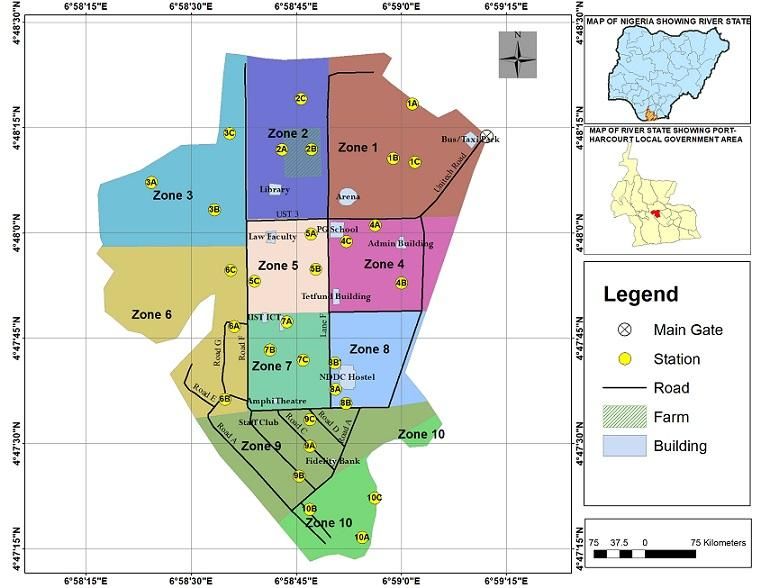
Wekhe et al.; AJOB, 8(1): 1-10, 2019; Article no.AJOB.48208

 Total Organic Content was negatively correlated with Macrotermes spp. The Amitermes were more
 abundant in residential areas as they are wood eating termites suggesting that most destructive
 aspect of termite behaviour on residential areas may be perpetuated by the Amitermes species.
 The Macrotermes spp were found only in cultivated areas and from soil with higher percentage of
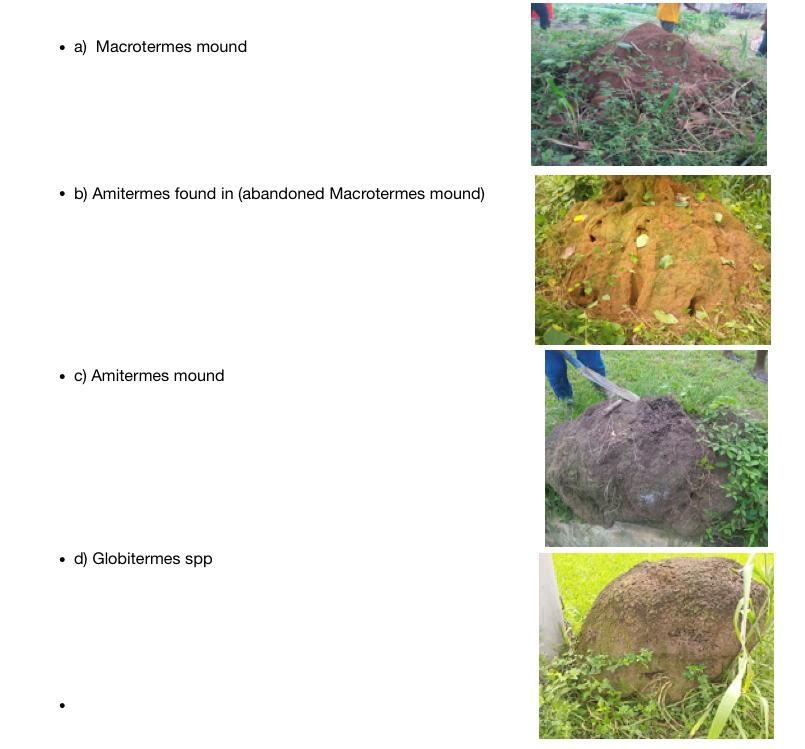
 clay, and they are basically soil feeders. M. gilvus and Macrotermes spp were seen in reddish
 mounds with fresh soil at the peak (showing termite activity) giving it a cone shape whereas the
 mound Globitermes spp was black, no fresh soil at the peak and had a circular shape. Amitermes
 was found in abandoned reddish Macrotermes mounds in residential areas. This study has
 provided some information on the termites in the University community as their habitat is gradually
 being destroyed with new buildings resulting in biodiversity loss. Moisture and TOC appeared to
 affect abundance.

Keywords: Termites; subterranean; Rivers State University; macrotermes; amitermes; globitermes.

1. INTRODUCTION                                             particularly associated with population increase
                                                            in sub-Saharan Africa where millions of people
Termites are eusocial insects that belong to the            depend on agriculture for their livelihoods [7].
phylum Arthropoda, the Class Insecta, and Order             Termite      population      is     dependent       on
Isoptera. Their population, species richness and            environmental variables such as rainfall, soil
distribution can be used as a tool for determining          moisture content, availability of food, soil texture
environmental integrity. The ubiquity, diversity,           and soil temperature. They are known as ‘silent
and abundance of the different termite species in           destroyer’ because of their ability to cause
the tropical ecosystems represent about 80% of              deterioration of building materials, discolouration
animal biomass [1]. The termites are prime                  of houses, destruction of furniture etc. Some
shapers of their habitat dynamics through their             species of termite construct nest or mound in soil
interaction with several aspects of the ecosystem           and are known as subterranean termites while
via modification, maintenance, and creation of              others on dead and growing trees are known as
macro and micro niches [2]. They are ecosystem              arboreal. Mounds are constructed using body
modifiers and as such termites play significant             fluids such as saliva to bind soil particles
roles in tropical forest. Termites and ants as              together [8]. They feed on cellulose and
decomposers have been implicated in nutrient                therefore harbour bacteria, flagellate and fungi in
cycling, soil formation and soil structural                 their digestive tract that aid in the digestion of the
modification, and their biophysical and chemical            cellulose [9].
processes aid in regulating soil fertility as well as
counteracting with the physical and chemical                Out of about 2,600 known termite species, only
processes of soil degradation [3]. Mounds built             300 of these species are known to be destructive
by termites and other species of insect have                pests in agriculture and termite families known to
been found to be highly mineralized and                     occur in tropical forest and grassland savannah
enrichment minerals and exchangeable cations                areas worldwide include Mastotermitidae,
have been reportedly high in biogenic mounds                Kalotermitidae, Hodotermitidae, Termopsidae,
than the surrounding soil [3]. Termite mounds               Rhinotermitidae, Seritermitidae and Termitidae
can reveal some changes in the soil properties              [10]. The most economically important termite
via change in litter around mounds which could              genera in agricultural and forest areas are
be responsible for appearance, performance and              Macrotermes,          Allodontermes,     Amitermes,
composition of plant community assemblage in                Pseudacanthotermes,                   Odontotermes,
agro ecology. Termites and ants are major                   Ancistrotermes, Trinervitermes, Hodotermes and
examples of soil-dwelling ecosystem service                 Microtermes [11]. Species of termites vary from
providers that influence ecosystem functioning              locality to locality. Iqra [12] on population density
by physically altering their biotic and abiotic             of termites in garden trees of Gujranwala
surroundings [4]. Their movement in soil helps to           Pakistan, recorded six species (Coptotermes
increase soil porosity, aeration and soil water             heimi,         Microcerotermes            championi,
permeability which increases soil micropores [5].           Odontotermes obesus, Microtermes obesi,
Their richness and abundance may be severely                Microtermes mycophyagus and Odontotermes
affected by land-use practices such as                      guptia. Kemabonta [13] in the study of species
agricultural practices, industrialisation and               richness, diversity and relative abundance of
habitat fragmentation which are leading causes              termites in the University of Lagos, Nigeria
of biodiversity loss [6]. Land degradation is               recorded two families (Rhinotermitidae and

                                                        2
Wekhe et al.; AJOB, 8(1): 1-10, 2019; Article no.AJOB.48208

Termitidae)     and       six     sub     families       State University has a tropical wet climate with a
(Rhinotermitinae,                   Amitermitinae,       long and heavy rainy season and short dry
Macrotermitinae, Nasutitermitinae, Termitinae            season. Port Harcourt's heaviest precipitation
and Microcerotermitinae with Amitermes spp as            occurs during September with an average of 367
the most abundant and widely distributed                 mm of rain. The driest month of the year is
species. Subterranean termites constitute a              December, with an average rainfall of 20 mm.
major menace to our everyday life as they                Temperatures are relatively constant, showing
continually eat up source of livelihood and              little variation. Average temperatures are
support. In the Niger delta there is a paucity of        typically between 25°C - 28°C in the study area.
information on termites and their prevalence             The vegetation of RSU campus is sparsely
thereby justifying this research work. This              distributed as there are farms and farming
research is the first of its kind in Rivers State        activities in the school farm, offices, lecture halls,
University and the main aim of this research             libraries, residential quarters and small gardens
work was to determine the prevalence of                  behind these residential quarters.
subterranean termites in Rivers State University
community (a closed community in the Niger               2.2 Sample Collection and Treatment
Delta of Nigeria) as a baseline survey
considering the rapid habitat degradation that is        The study area was divided into 10 zones (Fig.
ongoing as the place is built up.                        1) and each zone into three transects of 50 m by
                                                         50 m. Three of the 10 sample zones were within
2. MATERIALS AND METHODS                                 the farm area while the remaining seven were in
                                                         the built-up area. From each 50 m x 50 m
2.1 Brief Description of Study Area                      transect, a quadrant of 10 cm x 10 cm was
                                                         measured. From each of the quadrant top soil
The research was carried out in the campus of            was excavated to 10 cm depth (giving a 1000
                                                            3
Rivers State University (RSU), Port Harcourt in          cm volume of sample) from the mound and
the Niger Delta region of Nigeria. The study area        around the mound (about 30 cm distance). The
is located between longitude 6.972 and 6.986             excavated soil was taken to the laboratory for
and latitude 4.787 and 4.807 (Fig. 1). Rivers            sorting in a transparent plastic container.

                      Fig. 1. Map of RSU showing sample collection points

                                                     3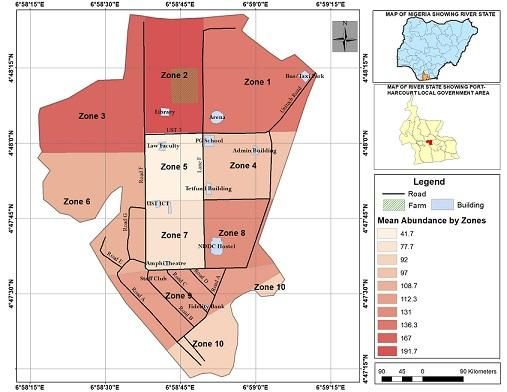
Wekhe et al.; AJOB, 8(1): 1-10, 2019; Article no.AJOB.48208

Temperature for mound and soil were measured               software. These packages were used to compute
in-situ. Soil and mound samples were also                  for both inferential and descriptive statistics.
collected for the analysis of soil texture, moisture       Turkey and One-way ANOVA was    as used for the
content, total organic content (TOC), and pH               comparison of abundance across stations.
using standard methods. The shape, colour and              Correlation, PCA (Principal component Analysis)
texture of mounds were noted in each station.              and cluster analysis were used to relate
Sampling was in January - February 2018 for 8              physicochemical     parameters     to   termite
weeks.                                                     abundance. All tests were done at 95%
                                                           confidence level. GIS mapping using mean
2.3 Laboratory Analysis                                    abundance was used to provide a colour chart
In the laboratory, all the soil samples collected          presentation.
were sorted for termites. The isolated termites
were grouped into casts according to their                 3. RESULTS
morphology and counted. The termites were
identified by observing the mandibles, pronotum,           3.1 Species of Subterranean                     Termite
postmentum and number of articles on the                       found in Study Area
antenna under a light microscope with the aid of
a key provided by [14]. Identification was to              The species of subterranean termites belonged
genus level. Filtration method was used to                 to 2 families :Termitidae and Macrotermidae.
determine the particle size of the soil samples            Two species of Amitermes and 1 species of
[15]. Moisture content was determined by                   Globitermes from the family Termitidae and two
weighing 100 g of the sample on foil paper with a          species of Macrotermes from Macrotermidae
weighing balance (W1). The weighed samples                 (Plate 1). Their distribution (Fig. 2) in study area
were placed on the work bench and allowed to               revealed that Amitermes was found in mounds
air dry for five days and reweighed (W2). The              and soil from the 10 zones, Macrotermes was in
percentage of moisture content was calculated              mounds and soil from zones 1 and 2 (Farm area)
with the equation:                                         and Globitermes mound was found in zone 9
                                                           (built up residential, area).
    Moisture Content % =                   [16]
                                                           The Macrotermes mounds located in zone 1 and
    TOC determination        was     by   standard         2, were active (Plate 1c) as they had freshly built
    methods [17].                                          extension of the mound at the peak,eak, where as
2.4 Data Analysis                                          abandoned mounds were overgrown with
                                                           grasses. The Amitermes spp 2 was seen in zone
The statistical tests were done using EXCEL                1 and zone 5 in abandoned Macrotermes mound
computer package and the JMP statistical                   (Plate 1b) with weeds growing on every side.

                        Plate 1 (a-d).
                                   d). Species of termites found in study area

                                                       4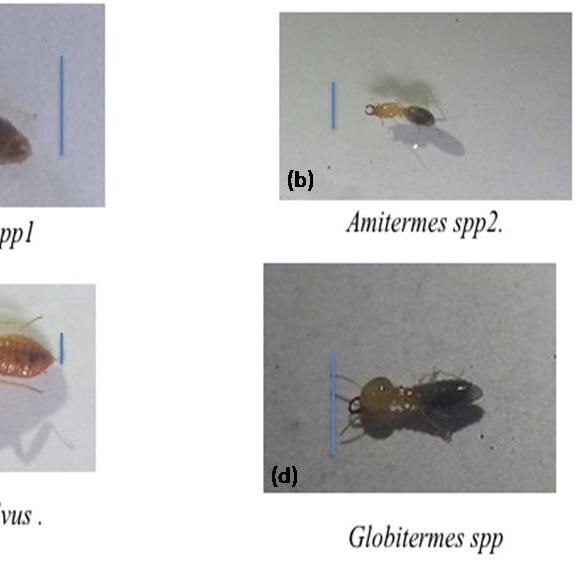
Wekhe et al.; AJOB, 8(1): 1-10, 2019; Article no.AJOB.48208

                     Fig. 2. Distribution of termite species in the study area

                       Plates 2(a -d). Mound types observed in study area

The mound of Amitermes spp1 was found in all           while Globitermes spp mound was found in zone
the zones, circular and dark coloured (Plate 1a)       7 and zone 9 (Plate 1d).

                                                   5
Wekhe et al.; AJOB, 8(1): 1-10, 2019; Article no.AJOB.48208

3.2 Abundance of Termites in the Study                 zones with the highest abundance per
                                                                 3
    Area                                               1000 cm of soil. Zones 1 - 3 had the
                                                       highest mean abundance of 138.3 - 191.7
GIS mapping by colour chart presentation of            termites per area of sampled soil and zone 5
mean abundance is shown in Fig. 3. The area            had the least (41.7 / 1000 cm3) with the lightest
with the highest colour intensity represents           color.

       Fig. 3. Map of study area using colour intensity to show zonal mean abundance

                     Table 1. Environmental properties (mean) of study area

 Sample    Temp (°C)      pH       Organic content        Moisture              PSA %               *Texture
 Id                                mg/kg                  (%)           Sand     Silt      Clay     (USDA)
                 a             a                                bcd
 Zone_ 1   23.85          5.8      1.70                   12.21         24       36        40       SCL
                a            a                                  abc
 Zone _2   24.85          6.0      1.41                   16.71         24       30        46       C
                a            a                                  ab
 Zone_ 3   24.90          5.4      1.37                   17.75         23       32        45       C
                a            a                                d
 Zone _4   24.50          5.6      1.88                   9.71          29       25        46       C
                a            a                                  bcd
 Zone 5    20.81          5.5      1.48                   11.51         22       31        47       C
                a            a                                  d
 Zone 6    24.83          5.3      2.16                   10.11         22       28        50       C
 Zone 7    24.36a         5.5a     2.19                   11.05bcd      24       30        46       C
                a            a                                  bcd
 Zone 8    25.21          5.7      1.66                   12.71         25       30        45       C
                a            a                                  bcd
 Zone 9    24.33          5.3      1.64                   11.25         30       30        40       SCL
 Zone 10   24.20a         5.6a     1.84                   19.46a        25       30        45       C
                        Same superscript along column = not significantly different.
      *Where: C, clay; CL, clay loam; L, loam; LS, loamy sand; SCL, sandy clay loam; SL, sandy loam

                                                   6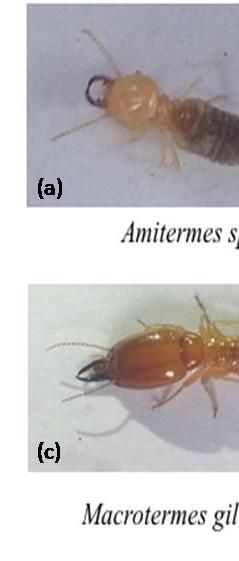
Wekhe et al.; AJOB, 8(1): 1-10, 2019; Article no.AJOB.48208

3.3 Physicochemical Parameters                              TOC and % clay accounted for the 24% of the
                                                            factors influencing the abundance negatively
                                                                                              negatively.
The mean temperature, pH and organic content
of soil ranges were 20.81 - 25.21
                                25.21°C, 5.3 - 6.0          3.5 Cluster Analysis of Termite Species
and 1.37 - 2.19 mg/kg respectively. The pH and
organic content of soil revealed slight variations          The cluster analysis of the samples in the study
that were not statistically significant (p < 0.05) in       area (Fig. 5) showed two groups. The first group
the sampled zones. The moisture content ranged              was the drifters or generalist which were
from 9.71 to 19.46% and was significantly                   characterised by occurrence in more than one
different in the study zones @ p < 0.05. The                station of the study area; while the second group
particle size analysis showed zones 1 and 9 as              were the specialist, characterised by a single
sandy clay loam while all other zones were clay             station occurrence in the study area. The
(Table 1).                                                  generalist species were Amitermes spp1 and
                                                            spp2 Macrotermes spp and Globitermes spp,
3.4 Principle Component Analysis of Data                    while the specialist was Macrotermes gilvus.

The principal component analysis of the                     4. DISCUSSION
environmental      parameters       and    termites
abundance (Fig. 4) showed the percentage and                4.1 Species Abundance and Distribution
cumulative percent accounted for by each
principal component. The square and loading                 Five (5) species of termites were found on RSU
plots show that the first two principal components          campus. Amitermes spp were more abundant
accounted for 51.1% (27.1% for component 1                  than the other genera. The abundance of
and 24% for component 2) of the variation in the            Amitermes spp according to [17] is because they
data. In the loading plot, moisture content, pH, %          are polyphagous and able to feed on all
sand and termite abundance were positively                  substrate available in an area. [13] while
correlated with the first principal component               studying species diversity and richness of
accounting for the 27.1% of the factors                     termites observed Amitermes and Macrotermes
influencing abundance; while temperature, % silt,           as the dominant species, reporting a population

                         Fig. 4. Principal component analysis of the data set

                                                        7
Wekhe et al.; AJOB, 8(1): 1-10, 2019; Article no.AJOB.48208
of 40% for Macrotermes and 27% for Amitermes. foraging, creating of feeding tunnels and building
High population of Macrotermes spp is common of nest. It was further stated that Anoplotermes
in the tropical climate and favoured by climatic pacificus and Anoplotermes group had positive
factors and soil nutrient content.The presence of correlation with temperature, saying although
Amitermes in all the study zones, indicates their tropical termites are tolerable to high
ability to tolerate and exist in different temperature, they may be affected by extreme
environments with differing physico
physico-chemical end temperature regime. There was no
parameters. Amitermes species were found in significant difference in the temperature of the
both disturbed habitat and secondary or newly study area, so the distribution of the termites
cultivated habitat. [13] reported that abundance may not be significantly affected.
of Amitermes and Macrotermes in most of their
studied zones was in connection with the fact With respect to soil moisture content, it was
that they fed on soil, dead woods, grasses and noticed that the study zone had a mean moisture
litters. From this study, Amitermes was found in content range of 9.71 -19.46 that was not in
both cultivated and human inhabited areas while agreement with the observations of [18] who
Macrotermes were dominant in cultivated recorded moisture content range of 16.7 and
vegetation and Globitermes in more inhabited 62.0% in the external and internal walls of
areas. Habitat and food preference by termite Macrotermes bellicosus mounds. While some
according to [18], showed that Amitermes was species such as Macrotemes and some species
found to tolerate a range of habitat, preferring of Amitermes prefer high soil moisture content,
wood concentrate high in cellulose content. others such as Globitermes and Amitermes show
less preference to soil and mound with high
moisture content. This may affect their
behaviour, abundance, diversity and nesting. It
could also impede the availability of food, such
as dry wood species, which could require less
moisture to forage and nest. While dead wood
stump and soil feeders could show positive
preference to moisture at certain regime. The
results showed significant differences in moisture
content of the study zones, and this could affect
Fig. 5. Cluster analysis of the species distribution as it positively affected the
abundance of termites. [22] has observed that
4.2 Physico-chemical Parameters nesting, foraging and other social behaviour of
termites were affected by moisture contents of
The pH of study area (mounds and surrounding the surrounding environment making termites to
area) was all acidic (5.3 - 6.0) and appeared not build their nest on high elevated soil and at far
to affect termite distribution. This falls within the distance from river source.
range recorded by [19] of 5.4 to 7.6 for pH of
external and internal walls of Macrotermes Particle-size distribution of the study zone were
bellicosus mounds. [20] also observed the pH in analyzed and found that, termite abundance
termite colony to be within the range of 5.9-7.6. varied with soil texture of the surrounding. It
Depending on the species, pH plays a key role in could be deduced from this study that, termite in
soil preference for construction of nest, foraging the study area preferred soil with high
and social behaviour of termites [21]. percentage of clay. The different mean values for
sand grain ranged from 18.3 - 33.3%, silt 24.2-
Temperature of mound and soil of the study 35.0%, and clay from 40.83-49.16%
49.16% across the
zones of 20.8 - 25.2°C, is in agreement with the study area revealing that clay content was more
report of [22], that species composition of followed by silt and sand. These results were not
termites depend on the temperature regimes to consistent with [18], who reported that sand
carry out their activities, as high temperatures content was more (32.60-88.2%) followed by silt
tend to retard termite foraging and population (6.70-37.10%) and clay (0.40-48.20%).
48.20%). Soil
assemblage. Also high temperatures could lead feeding termites prefer soil with a high
to insect going into diapause (an arrested state percentage of sand because the more clayey the
of development) and subsequent death. soil, the higher the water logging capacity which
Temperature also affects food availability, may affect the activities of termites. The result in
solubility of organic compounds and nutrients. this study is in agreement with [22] who reported
Termites depend mostly on temperature for that humus feeding species may be affected by
8Wekhe et al.; AJOB, 8(1): 1-10, 2019; Article no.AJOB.48208
factors such as soil grain type which may deprive collected from and around mounds. The results
termites the needed feeding potential. The grain revealed only three genera of termites -
size did not significantly affect the distribution of Amitermes, Macrotermes and Globitermes.
the termites. Amitermes was a generalist found in every zone
sampled, but higher counts were recorded
The mean TOC (Total Organic Carbon) ranged around residential areas while Macrotermes and
between 1.37 and 2.19% in the study area and Globitermes were seen in the cultivated areas.
their correlation to termite abundance varied This suggests that, most destructive aspect of
across the stations and within species. For some termite behaviour on residential areas are
species such as Amitermes (0.336), Globitermes perpetuated by the Amitermes species. The
(0.31) and Macrotermes gilvus (0.06), an Macrotermes and Globitermes spp were
increase in TOC may not significantly effect an basically soil feeders while Amitermes species
increase in species abundance. However, in were dry wood and dead stump feeders.
some aspects there appeared to be a negative Moisture and TOC appeared to affect abundance
(significant or non significant) relationship while pH, particle size and temperature did not
between the various species and TOC. For affect the distribution and abundance of the
example, Amitermes (- 0.19) was not significantly species. Amitermes appeared to colonise
affected by TOC while Macrotermes (- 0.68) deserted Macrotermes mounds in built up areas..
negatively correlated with soil TOC. Foraging This is a baseline report that will be useful for
activities like construction of tunnels which future studies. This study does not include
require feeding on debris and soil may affect the arboreal termites found on trees and those
termites and their distribution [23]. Some termite infesting buildings in the community.
species (Anoplotermes spp) are soil-feeders that
are found in abandoned termite nest and feed on COMPETING INTERESTS
very rotten wood and substrates rich in organic
matter [24]. Authors have declared that no competing
interests exist.
The Principal Component Analysis (PCA) of the
correlation between the physico-chemical REFERENCES
parameters and abundance showed pH and
moisture content as the principal components 1. Cranshaw W. Bugs rule: An introduction to
affecting the abundance of termites by 27.1% the world of insects. Princeton, New
while temperature, silt, clay and TOC negatively Jersey: Princeton University Press; 2013.
influenced termite abundance by 24%. The 2. Bandiya HM, Majeed Q, Ibrahim ND,
cluster analysis revealed two groups of termites Shindi HA. Density and dispersion pattern
related by their distribution. The first group which of mounds of Macrotermes bellicosus
was made up of the Amitermes spp1, Amitermes [Isoptera: Termitidae] in some local
spp2, Macrotermes spp and Globitermes spp government areas of Sokoto. Semi-arid
were the generalist because they were found in Zone of Nigeria Research in Zoology.
more than one station while the other group was 2012;2(1):1-4.
the M. gilvus which is the specialist found only in 3. Vrsanky P, Aristov D. Termites (Isoptera)
one station. This is as a result of the types of from the Jurassic/Cretaceous boundary:
vegetation and landform found in the study area. Evidence for the longevity of their earliest
[25] reported that Amitermes spp prefer regions genera. European Journal of Entomology.
containing herbs and shrubs while Microtermes 2014;111(1):137–141.
spp prefer areas with large trees and grass and 4. Jones C, Lawton J, Shachak M.
are more abundant in plains. Organisms as ecosystem engineers.
Oikos. 1994;69:373–386.
5. CONCLUSIONS 5. French JRJ, Ahmed BM. Biomimicry of
termite social cohesion and design to
Termites exist in almost all biomes and are major inspire and create sustainable systems. In
threat to wood, buildings, crops, and forest. This Biomimetics, L. D. Pramaturova, E. D.,
study was to determine the subterranean Rijeka, C. International Technology.
termites in a university community where the 2011;571-586.
trees, grasses and soil surface are fast 6. Millennium Ecosystem Assessment; 2005.
disappearing due to increasing rapid Available:https//www.org/sites/defaults/PD
development of infrastructure. The area was F/ecosystem…/MEA-A-Toolkit-pdf
divided into 10 zones and soil samples were (Retrieved from December 4th, 2017)
9Wekhe et al.; AJOB, 8(1): 1-10, 2019; Article no.AJOB.48208
7. Batjes NH. Option for increasing carbon Government Area, Edo State, Nigeria.
sequestration in West African soils: An International Journal of Pure and Applied
exploration study with special focus on Sciences and Technology. 2015;27(2):65-
Senegal. Land Degradation and 76.
Development. 2001;12:131-142. 18. Timothy MJ, Corbin CC. Effect of cellulose
8. Ibraham GA, Gray S, John RJ, French F, concentration on the feeding preferences
Berhan M. Ecological benefits of termites of the termite Reticulitermes flavipes
soil interaction and microbial symbiosis in (Isoptera: Rhinotermitidae). Sociobiology.
the soil ecosystem. Journal of Earth 2009;1(53):3.
Science and Geotechnical Engineering. 19. Susumu SA, Sadahro Y, Toshiyuki W. Soil
2013;3(4):63-85. particle selection by mound – building
9. Andya P, Tubagus MI, Adi B, Miller DM. termite Macrotermes bellicosus on a sandy
subterranean termite biology and behavior. loam soil catena in Nigerian tropical
Virginia Tech (Virginia State University); savanna. Tropical Ecology. 2009;449-
2010. 452.
10. Krishna K, Weesner FM. Biology of 20. Abe SS, Yamamoto S, Wakatsuki T.
termites. New York and London: Academic Physicochemical and morphological
Press. 1970;2:477-525. properties of termite (Macrotermes
11. Christopher M, Jacob Y, Bruno N. Damage bellicosus) mounds and surrounding
caused by termites (Isoptera: Termitidae) pedons on a toposequence of an inland
in coconut nurseries of Rufiji District, valley in the southern Guinea savanna
Tanzania. International Journal of zone of Nigeria. Soil Science and Plant
Agricultural Science Research. 2013;2(7): Nutrition. 2009;55:514–522.
227-233. 21. Dhembare AJ. Physiochemical properties
12. Iqra AM, Kaleem S, Waheed I, Nadia I, of termite mound soil. Scholars Research
Fareeha A. Studies on population density Library. Archives of Applied Science.
and diversity of termites of district 2013;5(6):123-126.
Gujranwala, Pakistan. Journal of Entomo- 22. Dahlsjo CAL, Parr CL, Malhi Y, Meir P,
logy and Zoology Studies. 2015;3(6):160- Eggleton P. Describing termite
163. assemblage structure in a Peruvian
13. Kemabonta KA, Balogun SA. Species lowland tropical rain forest: A comparison
richness, diversity and relative abundance of two alternative methods. Insect Society.
of termites (Insecta: Isoptera) in the 2014;40-41.
University of Lagos. FUTA Journal of 23. Robert OE, Frank UD, Agbonsalo OU.
Research in Sciences. 2014;2(2):188-197. Influence of activities of termites on some
14. Ahmad M. Termites (Isoptera) of Thailand. physical and chemical properties of soils
Bull. Am. Mus. Nat. Hist. 1965;131(art 1):1- under different land use patterns.
113. International Journal of Soil Science.
15. ASTMD. Standard test methods for 2015;2(1):1-14.
moisture, ash, and organic matter of peat 24. Bourguignon T, Drouet T, Sobotnik J,
and other organic soils. ASTM Hanuce R, Roisin Y. Influence of soil
International, West Conshohocken, PA: properties on soldier-less termite
USA; 2014. distribution. PLOS ONE. 2015;10(8):135-
16. Standards Association of Australia AS. 341.
1289 B1.1-1977 Soil Moisture Content 25. Badawi A, Al-Kady H, Faragella AA. Some
Determination; 1977. factors affecting the distribution and
17. Ogedegbe ABO, Eloka EV. Biodiversity of abundance of Termites in Saudi Arabia.
termites on farmlands in Anz. Schadlingskde., Pflanzenschutz,
Ugoniyekorhionmwon, Orhionwmon Local Umweltschutz. 1986;59:17-19.
_________________________________________________________________________________
© 2019 Wekhe et al.; This is an Open Access article distributed under the terms of the Creative Commons Attribution License
(http://creativecommons.org/licenses/by/4.0), which permits unrestricted use, distribution, and reproduction in any medium,
provided the original work is properly cited.
Peer-review history:
The peer review history for this paper can be accessed here:
http://www.sdiarticle3.com/review-history/48208
10You can also read


