The Utility of Real-Time Remote Auscultation Using a Bluetooth-Connected Electronic Stethoscope: Open-Label Randomized Controlled Pilot Trial
←
→
Page content transcription
If your browser does not render page correctly, please read the page content below
JMIR MHEALTH AND UHEALTH                                                                                                             Hirosawa et al

     Original Paper

     The Utility of Real-Time Remote Auscultation Using a
     Bluetooth-Connected Electronic Stethoscope: Open-Label
     Randomized Controlled Pilot Trial

     Takanobu Hirosawa1*, MD; Yukinori Harada1*, MD, PhD; Kohei Ikenoya2*, MD; Shintaro Kakimoto1*, MD; Yuki
     Aizawa1*, MD; Taro Shimizu1, MD, MBA, MPH, PhD
     1
      Department of Diagnostic and Generalist Medicine, Dokkyo Medical University, Tochigi, Japan
     2
      Docodemo Clinic Mashiko, Tochigi, Japan
     *
      these authors contributed equally

     Corresponding Author:
     Taro Shimizu, MD, MBA, MPH, PhD
     Department of Diagnostic and Generalist Medicine
     Dokkyo Medical University
     880 Kitakobayashi, Mibu-cho, Shimotsuga
     Tochigi, 321-0293
     Japan
     Phone: 81 282 87 2498
     Email: shimizutaro7@gmail.com

     Abstract
     Background: The urgent need for telemedicine has become clear in the COVID-19 pandemic. To facilitate telemedicine, the
     development and improvement of remote examination systems are required. A system combining an electronic stethoscope and
     Bluetooth connectivity is a promising option for remote auscultation in clinics and hospitals. However, the utility of such systems
     remains unknown.
     Objective: This study was conducted to assess the utility of real-time auscultation using a Bluetooth-connected electronic
     stethoscope compared to that of classical auscultation, using lung and cardiology patient simulators.
     Methods: This was an open-label, randomized controlled trial including senior residents and faculty in the department of general
     internal medicine of a university hospital. The only exclusion criterion was a refusal to participate. This study consisted of 2
     parts: lung auscultation and cardiac auscultation. Each part contained a tutorial session and a test session. All participants attended
     a tutorial session, in which they listened to 15 sounds on the simulator using a classic stethoscope and were told the correct
     classification. Thereafter, participants were randomly assigned to either the real-time remote auscultation group (intervention
     group) or the classical auscultation group (control group) for test sessions. In the test sessions, participants had to classify a series
     of 10 lung sounds and 10 cardiac sounds, depending on the study part. The intervention group listened to the sounds remotely
     using the electronic stethoscope, a Bluetooth transmitter, and a wireless, noise-canceling, stereo headset. The control group
     listened to the sounds directly using a traditional stethoscope. The primary outcome was the test score, and the secondary outcomes
     were the rates of correct answers for each sound.
     Results: In total, 20 participants were included. There were no differences in age, sex, and years from graduation between the
     2 groups in each part. The overall test score of lung auscultation in the intervention group (80/110, 72.7%) was not different from
     that in the control group (71/90, 78.9%; P=.32). The only lung sound for which the correct answer rate differed between groups
     was that of pleural friction rubs (P=.03); it was lower in the intervention group (3/11, 27%) than in the control group (7/9, 78%).
     The overall test score for cardiac auscultation in the intervention group (50/60, 83.3%) was not different from that in the control
     group (119/140, 85.0%; P=.77). There was no cardiac sound for which the correct answer rate differed between groups.
     Conclusions: The utility of a real-time remote auscultation system using a Bluetooth-connected electronic stethoscope was
     comparable to that of direct auscultation using a classic stethoscope, except for classification of pleural friction rubs. This means
     that most of the real world’s essential cardiopulmonary sounds could be classified by a real-time remote auscultation system
     using a Bluetooth-connected electronic stethoscope.

     https://mhealth.jmir.org/2021/7/e23109                                                         JMIR Mhealth Uhealth 2021 | vol. 9 | iss. 7 | e23109 | p. 1
                                                                                                                  (page number not for citation purposes)
XSL• FO
RenderX
JMIR MHEALTH AND UHEALTH Hirosawa et al
Trial Registration: UMIN-CTR UMIN000040828; https://tinyurl.com/r24j2p6s and UMIN-CTR UMIN000041601;
https://tinyurl.com/bsax3j5f
(JMIR Mhealth Uhealth 2021;9(7):e23109) doi: 10.2196/23109
KEYWORDS
telemedicine; electronic stethoscope; simulator; remote auscultation; lung auscultation; cardiac auscultation; physical examination
Introduction Methods
Since the French physician René Laennec invented the Study Design, Setting, and Participants
stethoscope in 1816 [1], auscultation has been an essential An open-label randomized controlled trial was designed to
component of clinical examination [2]. Auscultation is not only assess the utility of real-time remote auscultation using a
a highly cost-effective screening tool to detect abnormal clinical Bluetooth-connected electronic stethoscope. Direct auscultation
signs but also a useful means to build a good relationship using a traditional stethoscope was used as control. To
between physician and patient. Although there has been a standardize and enhance the reliability of the assessment, we
concerning decline in physicians’ auscultatory skills [2], used a lung simulator for lung auscultation and a cardiology
auscultation will remain important in the 2020s, as patient simulator for cardiac auscultation [10]. All sessions in
cardiopulmonary diseases are important underlying or direct this study were conducted at the skills laboratory at Dokkyo
causes of death and morbidity, substantially impacting quality Medical University. As study participants, we recruited senior
of life and health care costs [3,4]. residents and faculty in the Department of Diagnostic and
However, auscultation became challenging during the Generalist Medicine, as they were considered representative of
COVID-19 pandemic. As medical staff also need to be protected general physicians working in community hospitals or clinics,
from infection during an outbreak, the need for telemedicine is the main population expected to perform auscultation in routine
growing rapidly worldwide [5]. Therefore, remote auscultation clinical practice. The only exclusion criterion was refusal to
should be developed for patients with acute or chronic participate in this study. At baseline, no physicians exhibited
cardiopulmonary diseases. However, several barriers exist for hearing loss at their previous annual health checkup. This study
implementing telemedicine in clinical practice [6], including a was conducted in accordance with the current version of the
lack of effectiveness via remote examination that can act as a Declaration of Helsinki. The study protocols were approved by
substitute for direct physical examination. Auscultation is not the institutional ethics committee of Dokkyo Medical University,
one of the procedures typically mentioned in discussions of and Tochigi, Japan (No. R-33-20J and R-37-19J). Written informed
research on telemedicine [2], which makes telemedicine seem consent was obtained from all participants after a detailed
impractical for patients with cardiopulmonary diseases. explanation of the study and before participation.
Electronic stethoscopes are promising options to solve the Procedures
problem of the lack of remote auscultation systems [7]. The
Study Flow and Randomization
electronic stethoscope not only is useful for remote auscultation
but also has other advantages over the classic stethoscope. It This study consisted of a lung auscultation part and a cardiac
can facilitate the differentiation of several types of cardiac and auscultation part. Each part contained a tutorial and a test
lung sounds by visualization of their sonograms during session. Prior to the test session, all participants attended a
auscultation [2]; it can improve sound quality [8]; and it can tutorial session to become familiar with the device. Thereafter,
contribute to better performance on auscultation, as personalized participants were randomly assigned (simple randomization) to
adjustments can be made [9]. Therefore, the electronic either the real-time remote auscultation group (intervention
stethoscope can be used in telemedicine without a reduction in group) or the classical auscultation group (control group). The
the quality of auscultation. randomization was conducted separately in the lung and cardiac
parts. Researchers were blinded in terms of allocation, by using
To the best of our knowledge, only a few studies have been a computer-generated allocation table to assign participants.
conducted to determine the utility of real-time remote
auscultation using an electronic stethoscope [7]. However, we Tutorial Session
are not aware of studies conducted for the direct comparison In the tutorial sessions, all participants took part in auscultation
between real-time remote auscultation and direct auscultation. using a traditional stethoscope (Littmann Cardiology III, 3M,
Therefore, in this study, we tested the hypothesis that the utility St Paul, MN) on the lung simulator (Lung Sound Auscultation
of real-time remote auscultation by a physician would be Trainer “LSAT” ver.2, model #MW28, Kyoto Kagaku Co, Ltd,
comparable to that of classical auscultation by a physician. Kyoto, Japan) and on the cardiac patient simulator (Cardiology
Patient Simulator “K” ver.2, model #MW10, Kyoto Kagaku
Co, Ltd). In each tutorial session, the participant listened to 15
sounds, with the correct classification being provided to
participants. A short instruction for the simulator and the correct
placements for auscultation were provided. In the tutorial session
https://mhealth.jmir.org/2021/7/e23109 JMIR Mhealth Uhealth 2021 | vol. 9 | iss. 7 | e23109 | p. 2
(page number not for citation purposes)
XSL• FO
RenderXJMIR MHEALTH AND UHEALTH Hirosawa et al
for lung auscultation, the following 15 sounds were played in (S3 gallop enhanced, S3 gallop, and S3-S4 gallop), aortic stenosis
a random order: normal lung sounds (standard, loud), wheezes (twice), aortic regurgitation (twice), mitral regurgitation (3
(350-450 Hz, 600-700 Hz, 200-1000 Hz), 2 different rhonchi, times), mitral stenosis, and atrial fibrillation. Each participant
stridor (twice), 2 different coarse crackles, 2 different fine was instructed to auscultate in the standardized positions on the
crackles, and 2 different pleural friction rubs. In the tutorial simulators: 4 on the anterior and 4 on the posterior on the lung
session for cardiac auscultation, the following 15 sounds were simulator; 4 on the cardiology patient simulator (Figure 1). Each
played in random order: 3 different normal cardiac sounds (no sound was played for a maximum of 1 minute.
S2 split, S2 split, and S1 split), 3 different third cardiac sounds
Figure 1. The 8 different areas of auscultation on the lung simulator and the 4 different areas of auscultation on the cardiac patient simulator.
stethoscope, placing it by themselves. For lung auscultation, of
Test Session the 15 sounds played during the tutorial session, the following
In the test sessions, participants in the intervention group 10 sounds were played in a random order during the test session:
auscultated all sounds remotely using an electronic stethoscope normal lung sounds (normal, loud), wheezes (350-450 Hz,
(JPES-01, MEMS CORE Co, Ltd, Miyagi, Japan), a Bluetooth 600-700 Hz, 200-1000 Hz), rhonchi, stridor, coarse and fine
transmitter and receiver (BT-DUO, TROND, Eastvale, CA), crackles, and pleural friction rubs. For cardiac auscultation, of
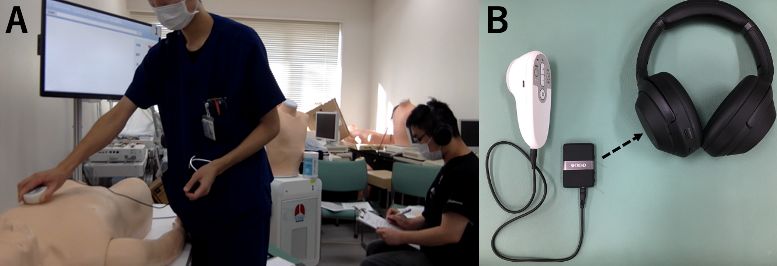
and a wireless, noise-canceling, stereo headset (WH-1000XM3, the 15 sounds played during the tutorial session, the following
Sony Co, Tokyo, Japan), as depicted in Figures 2A and 2B. For 10 sounds were played in random order during the cardiac test
this group, the researcher placed the electronic stethoscope and session: 2 different normal cardiac sounds (no S2 split, S2 split),
transmitter on the simulator, and participants could monitor the 2 different S3 (S3 gallop enhanced, S3 gallop), aortic stenosis,
placement of the electronic stethoscope in real time. In the lung aortic regurgitation, mitral regurgitation (twice), mitral stenosis,
simulator, the LED panel on the side of the simulator indicated and atrial fibrillation. Auscultation positions and length were
whether it was the inspiration or expiration phase. The also the same as those in the tutorial session. During the test
monitoring screen of the cardiology patient simulator was session, all participants filled in forms to indicate the types of
modified to display only a heartbeat icon. Participants in the sounds they recognized (Multimedia Appendix 1 and
control group auscultated all sounds directly using the traditional Multimedia Appendix 2).
https://mhealth.jmir.org/2021/7/e23109 JMIR Mhealth Uhealth 2021 | vol. 9 | iss. 7 | e23109 | p. 3
(page number not for citation purposes)
XSL• FO
RenderXJMIR MHEALTH AND UHEALTH Hirosawa et al
Figure 2. The remote auscultation processes: (A) The researcher is on the left, placing the electronic stethoscope on the cardiac patient simulator, and
the participant is on the right listening to the cardiac sounds via a wireless, noise-canceling, stereo headset and Bluetooth transmitter; (B) the remote
auscultation equipment including an electronic stethoscope; wireless, noise-canceling, stereo headset; and Bluetooth transmitter (Bluetooth connection
is indicated with a dashed double arrow).
All participants’ answers for each sound in the test session were
Lung Simulator collected. The primary outcome measure was the test score in
For lung auscultation, the same lung simulator (MW28) was each group. The rates of correct answers for each sound were
used in the tutorial and test sessions. This simulator was the secondary outcome measures.
designed for medical education training and includes 34 samples
of lung sounds recorded from actual patients and reproduced Statistical Analysis
using a high-quality sound system. These lung sounds were The correct answer in each group was compared using the Fisher
classified, according to the American Thoracic Society exact test for primary and secondary outcome measures.
classification system, as continuous (wheezes, rhonchi, or Continuous variables for participant baseline characteristics are
stridor) or discontinuous (fine or coarse crackles) [11]. Fine presented as medians (IQRs) and were compared using the
crackles were defined as “relatively high-pitched sounds usually Mann-Whitney U test. Categorical and binary variables for
heard at the end of inspiration as air enters the acinar unit.” participant baseline characteristics are presented as numbers
Coarse crackles were defined as “the low-pitched, bubbling (percentages) and were compared using the Fisher exact test.
sounds that result from the accumulation of secretions in larger A P valueJMIR MHEALTH AND UHEALTH Hirosawa et al
Figure 3. Flowchart of participant inclusion in the study.
Table 1. Baseline characteristics of participants in the classical and remote cardiopulmonary auscultation groups.
Lung auscultation Cardiac auscultation
Variable Remote lung auscul- Classical lung auscul- P value Remote cardiac aus- Classical cardiac P value
tation (n=11) tation (n=9) cultation (n=6) auscultation (n=14)
Age (years), median (IQR) 34.0 (7.0) 29.0 (9.0) .25a 32.5 (6.3) 32.5 (6.5) .99a
Men, n (%) 9 (82) 7 (78) .82b 6 (100) 11 (79) .99b
Years after graduation 10.0 (6.0) 4.0 (5.0) .15a 8.0 (4.8) 7.4 (5.5) .78a
(years), median (IQR)
a
Mann-Whitney U test
b
Fisher exact test.
intervention group correctly auscultated pleural friction rubs,
Diagnostic Performance whereas 7/9 (78%) in the control group did (P=.03).
Test scores and rates of correct answers for each lung sound are
summarized in Table 2. The total combined test score was Details of the answers for lung auscultation are supplied in
80/110 (72.7%) in the intervention group and 71/90 (78.9%) in Table 3 and Table 4. During exploratory data analysis, we
the control group, with no differences between the groups determined that 4/22 (18%) instances of normal lung sounds
(P=.32). There were no differences between the groups for were assigned as pleural friction rubs in the intervention group.
normal lung sounds, wheezes, rhonchi, coarse crackles, fine On the other hand, 5/11 (45%) instances of pleural friction rubs
crackles, or stridor. Only 3/11 (27%) participants in the were assigned as normal lung sounds in the same group.
https://mhealth.jmir.org/2021/7/e23109 JMIR Mhealth Uhealth 2021 | vol. 9 | iss. 7 | e23109 | p. 5
(page number not for citation purposes)
XSL• FO
RenderXJMIR MHEALTH AND UHEALTH Hirosawa et al
Table 2. Lung sounds correctly identified.
Variable Remote auscultation (n=11) Classical auscultation (n=9) P valuea
Total, n/N (%) 80/110 (72.7) 71/90 (78.9) .32
Normal, n/N (%) 16/22 (72.7) 18/18 (100) .99
Wheezes, n/N (%) 25/33 (75.8) 19/27 (70.4) .64
Rhonchi, n/N (%) 9/11 (81.8) 5/9 (55.6) .21
Coarse crackles, n/N (%) 7/11 (63.6) 7/9 (77.8) .50
Fine crackles, n/N (%) 9/11 (81.8) 6/9 (66.7) .44
Pleural friction rubs, n/N (%) 3/11 (27.3) 7/9 (77.8) .03
Stridor, n/N (%) 11/11 (100) 9/9 (100) N/Ab
a
Fisher exact test.
b
N/A: not applicable.
Table 3. Details of the participants’ answers for lung auscultation in the intervention (remote lung auscultation) group.
Correct answer Normal Wheezes Rhonchi Coarse crackles Fine crackles Pleural friction Stridor
rubs
Normal (n=22) 16 0 0 2 0 4 0
Wheezes (n=33) 2 25 3 0 0 1 2
Rhonchi (n=11) 0 1 9 0 0 0 1
Coarse crackles 2 0 0 7 0 2 0
(n=11)
Fine crackles 0 0 0 2 9 0 0
(n=11)
Pleural friction 5 1 0 2 0 3 0
rubs (n=11)
Stridor (n=11) 0 0 0 0 0 0 11
Table 4. Details of the participants’ answers for lung auscultation in the control (traditional lung auscultation) group.
Correct answer Normal Wheezes Rhonchi Coarse crackles Fine crackles Pleural friction Stridor
rubs
Normal (n=18) 18 0 0 0 0 0 0
Wheezes (n=27) 0 19 6 0 0 0 2
Rhonchi (n=9) 0 2 5 0 0 0 2
Coarse crackles 0 0 0 7 2 0 0
(n=9)
Fine crackles 0 0 0 2 6 1 0
(n=9)
Pleural friction 1 0 1 0 0 7 0
rubs (n=9)
Stridor (n=9) 0 0 0 0 0 0 9
Test scores and rates of correct answers for each cardiac sound difference in the score for mitral stenosis between the 2 groups:
are summarized in Table 5. The total combined test score was While 5 of 6 (84%) participants in the intervention group
50/60 (83.3%) in the intervention group and 119/140 (85.0%) correctly auscultated, only 7 of 14 (50%) participants in the
in the control group, with no differences between the groups control group did (P=.19).
(P=.77). There were no differences between the groups for
Details of the answers in the remote cardiac auscultation group
normal cardiac sounds, S3, aortic stenosis, aortic regurgitation,
are provided in Table 6. Misinterpretations between normal
mitral stenosis, mitral regurgitation, and atrial fibrillation. cardiac sounds and S3 sounds were frequently observed in the
Although not statistically significant, there was over a 30%
intervention group: 2 of 12 (17%) instances of normal cardiac
https://mhealth.jmir.org/2021/7/e23109 JMIR Mhealth Uhealth 2021 | vol. 9 | iss. 7 | e23109 | p. 6
(page number not for citation purposes)
XSL• FO
RenderXJMIR MHEALTH AND UHEALTH Hirosawa et al
sounds were assigned as S3 sounds. On the other hand, 4 of 12 sounds occurred in 5 of 28 (17%) sounds. On the other hand,
(33%) instances of S3 sounds were assigned as normal cardiac misinterpretations between mitral stenosis sounds and mitral
sounds. Compared to the intervention group, participants in the regurgitation sounds were frequently observed in the control
control group made fewer misclassifications between normal group: 6 of 14 (43%) instances of mitral stenosis sounds were
cardiac sounds and S3 sounds (Table 7): Misclassifications of assigned as mitral regurgitation sounds. In comparison, 4 of 28
normal cardiac sound as S3 sounds occurred in 2 of 28 (7%) (14%) instances of mitral regurgitation sounds were assigned
as mitral stenosis sounds.
sounds, and misclassifications of S3 sounds as normal cardiac
Table 5. Cardiac sounds correctly identified.
Variable Remote auscultation (n=6) Classical auscultation (n=14) P valuea
Total, n/N (%) 50/60 (83.8) 119/140 (85.0) .77
Normal, n/N (%) 9/12 (75.0) 26/28 (92.9) .14
S3, n/N (%) 8/12 (66.7) 22/28 (78.6) .43
Aortic stenosis, n/N (%) 5/6 (83.3) 14/14 (100) .99
Aortic regurgitation, n/N (%) 6/6 (100) 13/14 (92.9) .99
Mitral stenosis, n/N (%) 5/6 (83.8) 7/14 (50.0) .19
Mitral regurgitation, n/N (%) 11/12 (91.7) 23/28 (82.1) .45
Atrial fibrillation, n/N (%) 6/6 (100) 14/14 (100) N/Ab
a
Fisher exact test.
b
N/A: not applicable.
Table 6. Details of the participants’ answers for cardiac auscultation in the intervention (remote cardiac auscultation) group.
Correct answer Normal S3 Aortic stenosis Aortic regurgitation Mitral stenosis Mitral regurgitation Atrial fibrillation
Normal (n=12) 9 2 0 0 1 0 0
S3 (n=12) 4 8 0 0 0 0 0
Aortic stenosis (n=6) 0 0 5 0 0 1 0
Aortic regurgitation 0 0 0 6 0 0 0
(n=6)
Mitral stenosis (n=6) 0 0 0 0 5 1 0
Mitral regurgitation 0 0 0 0 1 11 0
(n=12)
Atrial fibrillation 0 0 0 0 0 0 6
(n=6)
https://mhealth.jmir.org/2021/7/e23109 JMIR Mhealth Uhealth 2021 | vol. 9 | iss. 7 | e23109 | p. 7
(page number not for citation purposes)
XSL• FO
RenderXJMIR MHEALTH AND UHEALTH Hirosawa et al
Table 7. Details of the participants’ answers for cardiac auscultation in the control (traditional cardiac auscultation) group.
Correct answer Normal S3 Aortic stenosis Aortic regurgitation Mitral stenosis Mitral regurgitation Atrial fibrillation
Normal (n=28) 26 2 0 0 0 0 0
S3 (n=28) 5 22 0 0 1/28 0 0
Aortic stenosis 0 0 14 0 0 0 0
(n=14)
Aortic regurgitation 0 0 0 13 1 0 0
(n=14)
Mitral stenosis 0 0 0 1 7 6 0
(n=14)
Mitral regurgitation 0 0 1 0 4 23 0
(n=28)
Atrial fibrillation 0 0 0 0 0 0 14
(n=14)
the cause of the difficulty observed in auscultation of pleural
Discussion friction rub.
Principal Findings Fourth, the rate of correct answers for mitral stenosis was higher
In this study, there were 4 main findings. First, using a simulator, in the real-time remote cardiac auscultation than in the direct
we demonstrated that the utility of real-time remote auscultation cardiac auscultation group. According to the participants, the
using a Bluetooth-connected electronic stethoscope was monitoring screen of the simulator was on the caudal side. The
comparable to that of direct auscultation using a classic screen showed a heartbeat icon regardless of whether it was the
stethoscope. From previous finding of lung auscultation, coarse systolic or diastolic phase without any waveform. In the direct
crackles, fine crackles, wheezes, and stridor are useful for cardiac auscultation group, it was difficult to watch a display
diagnosing bronchitis or pneumonia [12-14], interstitial with auscultation. On the other hand, in the real-time remote
pulmonary fibrosis or pneumonia [12,15-19], exacerbation of auscultation group, the participants could watch the screen to
asthma or chronic obstructive pulmonary disease [12,19], and detect the systolic or diastolic phase with auscultation. This
upper-airway obstruction [19,20], respectively. For cardiac may have been the cause for the misinterpretations between
auscultation, valvular cardiac diseases and irregular rhythm mitral stenosis sounds and mitral regurgitation sounds in the
disease were not misclassified as normal cardiac sounds in direct auscultation group.
real-time remote auscultation and classical groups. The correct Strengths
detection of S3 is also an essential skill in diagnosing various
There were 3 strengths of note in this study. First, use of
cardiac diseases such as congestive heart failure, ischemic heart
simulators allowed us to gather standardized data, reducing bias.
disease, cardiomyopathies, myocarditis, cor pulmonale,
Second, the direct comparison of a novel auscultation technology
high-output states, left-to-right intracardiac shunts, and complete
with classical auscultation as control adds value to this
atrioventricular block [21]. Therefore, the results of this study
randomized controlled study. Third, all participants were
suggest that real-time remote auscultation would be useful for
physicians who specialized in general internal medicine. Thus,
the diagnosis of these diseases. At the bedside, this would allow
the study participants were representative of general physicians
medical staff to screen patients for adventitious sounds at a
working in community hospitals or clinics, the main population
distance, protecting themselves from infectious diseases such
expected to perform auscultation in routine clinical practice.
as COVID-19.
Second, the rate of correct answers for pleural friction rubs was Limitations
lower in the real-time remote lung auscultation group than in This study was a pilot study and had several limitations. First,
the direct lung auscultation group. Therefore, it would be the sample size was small and did not include real patient data.
challenging to diagnose pleuritis with real-time remote lung Fully powered trials need to be conducted to better show
auscultation [12]. equivalence. There was grouping variation through simple
randomization, especially in the cardiac part, with 6 in the
Third, in the real-time remote lung auscultation group, we intervention group vs 14 in the control group. This grouping
observed a trend for confusion of normal lung sounds and variation may have affected the detection power in this study.
pleural friction rubs. Respecting pleural friction rubs, 45% were Therefore, in future studies, the efficacy of real-time remote
misclassified as normal lung sounds in the remote auscultation auscultation has to be confirmed at the bedside with a larger
group in this study. According to the participants, placement of sample size. Second, as the researcher who placed the electronic
the electronic stethoscope to the surface of the lung simulator stethoscope on the simulators could not hear the sounds while
caused a bit of noise. Electronic stethoscopes are sensitive to doing so, the timing of the change in auscultation position could
electronic and ambient noise, and this placement noise may be not be adjusted for optimum auscultation. Participants in the
classical auscultation group were able to change the auscultation
https://mhealth.jmir.org/2021/7/e23109 JMIR Mhealth Uhealth 2021 | vol. 9 | iss. 7 | e23109 | p. 8
(page number not for citation purposes)
XSL• FO
RenderXJMIR MHEALTH AND UHEALTH Hirosawa et al
position on their own, which may have given this group an In a previous study of the accuracy of identifying lung sounds
advantage over the remote auscultation group. Third, the using classical auscultation, stridor was not included in the
respiratory rate and phase of crackle could not be adjusted with evaluation [10]. Stridor can be identified without a stethoscope.
the lung simulator. The default respiratory rate was slower than However, we included stridor in this study, as its detection with
that of real patients with respiratory diseases. Therefore, the electronic stethoscopes was reported in other studies [23].
results from this study may not be generalizable to auscultation
We are aware of 1 study reporting results regarding the utility
at the bedside. Fourth, in this study, the technique used for
of real-time remote auscultation [7]. In that study, the
classical auscultation was not standardized. This may have
interobserver concordance of remote auscultation via the internet
limited the reproducibility of our results. Fifth, there might be
(93.7%-94.0%) was lower than that of direct auscultation
some dependences among answers within-subject.
(98.4%-98.9%), but not statistically significant. Although remote
Comparison With Prior Work auscultation in that study was not conducted in real time, the
To the best of our knowledge, there has been no other study in results are similar to ours in terms of a slightly lower accuracy
which real-time remote auscultation and classical auscultation in the remote auscultation group than in the conventional
were directly compared. In terms of the accuracy of classical auscultation group.
auscultation using the simulator, our results, which showed Conclusions
variable accuracy depending on the type of sounds, were
This study demonstrates that the utility of a
consistent with previous studies [10,22]. In both previous
Bluetooth-connected, real-time remote auscultation system is
studies, the total accuracies varied from 62% to 89.7%, which
comparable to that of classical, direct auscultation, except for
may have depended on the difficulty of tests. For example, one
pleural friction rubs. Future studies focused on real-time
study that showed a low accuracy rate included 3 types of S2,
auscultation through Wi-Fi or the internet are warranted.
S4, and S3+S4, whereas another study that showed a high Furthermore, this study leads the way for further studies in real
accuracy rate only included S2 split, mitral regurgitation, and patients with fully powered trials. In a future study, visualized
aortic stenosis. Regarding the difficulty of testing, our study waves of sounds [24] or artificial intelligence [25] would be
may be close to the previous 2 studies. supported to detect abnormal sounds.
Acknowledgments
This study was made possible using the resources from the Department of Diagnostic and Generalist Medicine, Dokkyo Medical
University. Special thanks to Mr Masahiro Sato, manager of the MEMS CORE, Miyagi, Japan, who advised to adjust the electronic
stethoscope. Special thanks to Mr Yukio Hanatani, chief executive officer of SMART GATE, Tokyo, Japan, who advised to
adjust the electronic devices. An electronic stethoscope (JPES-01) used in this study was provided by MEMS CORE, Miyagi,
Japan.
Authors' Contributions
TH, YH, KI, SK, YA, and TS contributed to the study concept and design. TH and YH performed the statistical analyses. TH
contributed to the drafting of the manuscript. YH, KI, and TS contributed to the critical revision of the manuscript for relevant
intellectual content. All authors read and approved the final manuscript.
Conflicts of Interest
None declared.
Multimedia Appendix 1
The format of the questionnaire for identification of the 10 lung sounds.
[PDF File (Adobe PDF File), 46 KB-Multimedia Appendix 1]
Multimedia Appendix 2
The format of the questionnaire for identification of the 10 cardiac sounds.
[PDF File (Adobe PDF File), 45 KB-Multimedia Appendix 2]
Multimedia Appendix 3
CONSORT-eHEALTH checklist (V 1.6.1).
[PDF File (Adobe PDF File), 1516 KB-Multimedia Appendix 3]
References
https://mhealth.jmir.org/2021/7/e23109 JMIR Mhealth Uhealth 2021 | vol. 9 | iss. 7 | e23109 | p. 9
(page number not for citation purposes)
XSL• FO
RenderXJMIR MHEALTH AND UHEALTH Hirosawa et al
1. Morris JS. Laennec's stethoscope--the Welsh connection. J R Soc Med 2004 Mar;97(3):137-141 [FREE Full text] [doi:
10.1258/jrsm.97.3.137] [Medline: 14996966]
2. Pereira D, Castro A, Gomes P, Areias JCNC, Reis ZSN, Coimbra MT, et al. Digital Auscultation: Challenges and Perspectives.
In: Cruz-Cunha MM, Miranda IM, Martinho R, Rijo R, editors. Encyclopedia of E-Health and Telemedicine. Hershey, PA:
IGI Global; 2016:910-927.
3. Forum of International Respiratory Societies. The Global Impact of Respiratory Disease, Second Edition. World Health
Organization. 2017. URL: https://www.who.int/gard/publications/The_Global_Impact_of_Respiratory_Disease.pdf [accessed
2021-07-14]
4. NCD Countdown 2030 collaborators. NCD Countdown 2030: worldwide trends in non-communicable disease mortality
and progress towards Sustainable Development Goal target 3.4. Lancet 2018 Sep 22;392(10152):1072-1088. [doi:
10.1016/S0140-6736(18)31992-5] [Medline: 30264707]
5. Omboni S. Telemedicine During the COVID-19 in Italy: A Missed Opportunity? Telemed J E Health 2020 Aug
01;26(8):973-975 [FREE Full text] [doi: 10.1089/tmj.2020.0106] [Medline: 32324109]
6. Scott Kruse C, Karem P, Shifflett K, Vegi L, Ravi K, Brooks M. Evaluating barriers to adopting telemedicine worldwide:
A systematic review. J Telemed Telecare 2018 Jan;24(1):4-12. [doi: 10.1177/1357633X16674087] [Medline: 29320966]
7. Marani R, Gelao G, Perri AG. High quality heart and lung auscultation system for diagnostic use on remote patients in real
time. Open Biomed Eng J 2010 Nov 03;4(1):250-256 [FREE Full text] [doi: 10.2174/1874120701004010250] [Medline:
21379392]
8. Tavel ME. Cardiac auscultation. A glorious past--but does it have a future? Circulation 1996 Mar 15;93(6):1250-1253.
[doi: 10.1161/01.cir.93.6.1250] [Medline: 8653848]
9. Høyte H, Jensen T, Gjesdal K. Cardiac auscultation training of medical students: a comparison of electronic sensor-based
and acoustic stethoscopes. BMC Med Educ 2005 May 09;5(1):14 [FREE Full text] [doi: 10.1186/1472-6920-5-14] [Medline:
15882458]
10. Bernardi S, Giudici F, Leone MF, Zuolo G, Furlotti S, Carretta R, et al. A prospective study on the efficacy of patient
simulation in heart and lung auscultation. BMC Med Educ 2019 Jul 23;19(1):275 [FREE Full text] [doi:
10.1186/s12909-019-1708-6] [Medline: 31337361]
11. American Thoracic Society. Updated nomenclature for membership reaction- Reports from the ATS AdHoc Committee
on Pulmonary. Am Thoracic Soc News 1977;3:5-6.
12. Bohadana A, Izbicki G, Kraman SS. Fundamentals of lung auscultation. N Engl J Med 2014 Feb 20;370(8):744-751. [doi:
10.1056/NEJMra1302901] [Medline: 24552321]
13. Piirilä P. Changes in crackle characteristics during the clinical course of pneumonia. Chest 1992 Jul;102(1):176-183. [doi:
10.1378/chest.102.1.176] [Medline: 1623749]
14. Nakanishi M, Yoshida Y, Takeda N, Hirana H, Horita T, Shimizu K, et al. Significance of the progression of respiratory
symptoms for predicting community-acquired pneumonia in general practice. Respirology 2010 Aug;15(6):969-974. [doi:
10.1111/j.1440-1843.2010.01807.x] [Medline: 20630031]
15. Cottin V, Cordier J. Velcro crackles: the key for early diagnosis of idiopathic pulmonary fibrosis? Eur Respir J 2012 Sep
31;40(3):519-521 [FREE Full text] [doi: 10.1183/09031936.00001612] [Medline: 22941541]
16. Melbye H, Straume B, Aasebø U, Brox J. The diagnosis of adult pneumonia in general practice. The diagnostic value of
history, physical examination and some blood tests. Scand J Prim Health Care 1988 May 12;6(2):111-117. [doi:
10.3109/02813438809009300] [Medline: 3387706]
17. Gennis P, Gallagher J, Falvo C, Baker S, Than W. Clinical criteria for the detection of pneumonia in adults: guidelines for
ordering chest roentgenograms in the emergency department. J Emerg Med 1989;7(3):263-268. [doi:
10.1016/0736-4679(89)90358-2] [Medline: 2745948]
18. Melbye H, Straume B, Aasebø U, Dale K. Diagnosis of pneumonia in adults in general practice. Relative importance of
typical symptoms and abnormal chest signs evaluated against a radiographic reference standard. Scand J Prim Health Care
1992 Sep 12;10(3):226-233. [doi: 10.3109/02813439209014066] [Medline: 1410955]
19. Reichert S, Gass R, Brandt C, Andrès E. Analysis of respiratory sounds: state of the art. Clin Med Circ Respirat Pulm Med
2008 May 16;2:45-58 [FREE Full text] [doi: 10.4137/ccrpm.s530] [Medline: 21157521]
20. Forgacs P. The functional basis of pulmonary sounds. Chest 1978 Mar;73(3):399-405. [doi: 10.1378/chest.73.3.399]
[Medline: 630938]
21. Silverman ME. The Third Heart Sound. In: Walker HK, Hall WD, Hurst JW, editors. Clinical Methods: The History,
Physical, and Laboratory Examinations. Boston, MA: Butterworths; 1990.
22. Kagaya Y, Tabata M, Arata Y, Kameoka J, Ishii S. Variation in effectiveness of a cardiac auscultation training class with
a cardiology patient simulator among heart sounds and murmurs. J Cardiol 2017 Aug;70(2):192-198 [FREE Full text] [doi:
10.1016/j.jjcc.2016.10.011] [Medline: 27916238]
23. Gurung A, Scrafford CG, Tielsch JM, Levine OS, Checkley W. Computerized lung sound analysis as diagnostic aid for
the detection of abnormal lung sounds: a systematic review and meta-analysis. Respir Med 2011 Sep;105(9):1396-1403
[FREE Full text] [doi: 10.1016/j.rmed.2011.05.007] [Medline: 21676606]
https://mhealth.jmir.org/2021/7/e23109 JMIR Mhealth Uhealth 2021 | vol. 9 | iss. 7 | e23109 | p. 10
(page number not for citation purposes)
XSL• FO
RenderXJMIR MHEALTH AND UHEALTH Hirosawa et al
24. Kudriavtsev V, Polyshchuk V, Roy DL. Heart energy signature spectrogram for cardiovascular diagnosis. Biomed Eng
Online 2007 May 04;6:16 [FREE Full text] [doi: 10.1186/1475-925X-6-16] [Medline: 17480232]
25. Li S, Li F, Tang S, Xiong W. A Review of Computer-Aided Heart Sound Detection Techniques. Biomed Res Int
2020;2020:5846191 [FREE Full text] [doi: 10.1155/2020/5846191] [Medline: 32420352]
Edited by L Buis; submitted 01.08.20; peer-reviewed by G Gelao, B Bente; comments to author 05.11.20; revised version received
09.11.20; accepted 24.06.21; published 27.07.21
Please cite as:
Hirosawa T, Harada Y, Ikenoya K, Kakimoto S, Aizawa Y, Shimizu T
The Utility of Real-Time Remote Auscultation Using a Bluetooth-Connected Electronic Stethoscope: Open-Label Randomized Controlled
Pilot Trial
JMIR Mhealth Uhealth 2021;9(7):e23109
URL: https://mhealth.jmir.org/2021/7/e23109
doi: 10.2196/23109
PMID: 34313598
©Takanobu Hirosawa, Yukinori Harada, Kohei Ikenoya, Shintaro Kakimoto, Yuki Aizawa, Taro Shimizu. Originally published
in JMIR mHealth and uHealth (https://mhealth.jmir.org), 27.07.2021. This is an open-access article distributed under the terms
of the Creative Commons Attribution License (https://creativecommons.org/licenses/by/4.0/), which permits unrestricted use,
distribution, and reproduction in any medium, provided the original work, first published in JMIR mHealth and uHealth, is
properly cited. The complete bibliographic information, a link to the original publication on https://mhealth.jmir.org/, as well as
this copyright and license information must be included.
https://mhealth.jmir.org/2021/7/e23109 JMIR Mhealth Uhealth 2021 | vol. 9 | iss. 7 | e23109 | p. 11
(page number not for citation purposes)
XSL• FO
RenderXYou can also read


