Summer Diet and Distribution of the Red Panda (Ailurus fulgens fulgens) in Dhorpatan Hunting Reserve, Nepal
←
→
Page content transcription
If your browser does not render page correctly, please read the page content below
Zoological Studies 51(5): 701-709 (2012)

Summer Diet and Distribution of the Red Panda (Ailurus fulgens fulgens)
in Dhorpatan Hunting Reserve, Nepal
Saroj Panthi1,2, Achyut Aryal3,*, David Raubenheimer 4, Jennie Lord5, and Bikash Adhikari1
1
  Institute of Forestry, Tribhuvan University, Pokhara, Nepal
2
  Dhorpatan Hunting Reserve, Department of National Park and Wildlife Conservation, Ministry of Forests and Soil Conservation, Nepal
3
  Ecology and Conservation Group, Institute of Natural Sciences, Massey University, Auckland, New Zealand
4
  Nutritional Ecology Research Group, Institute of Natural Sciences, Massey University, Auckland, New Zealand
5
  URS, Environment and Natural Resources, Brunel House, 54 Princess Street, Manchester M1 6HS, UK

(Accepted March 16, 2012)

           Saroj Panthi, Achyut Aryal, David Raubenheimer, Jennie Lord, and Bikash Adhikari (2012) Summer diet
           and distribution of the red panda (Ailurus fulgens fulgens) in Dhorpatan Hunting Reserve, Nepal. Zoological
           Studies 51(5): 701-709. The red panda (Ailurus fulgens fulgens) is distributed throughout the Himalayas and
           is found in both protected and unprotected areas of Nepal. Loss and fragmentation of habitat threaten red
           panda populations throughout its range, and as a consequence, it is listed as vulnerable on the IUCN Red List
           of Threatened Species. Despite this pressing situation, data on the ecology of the red panda in western Nepal
           are lacking. Our aim in the current study was to determine the distribution, associated habitats, and summer
           diet of the red panda in Dhorpatan Hunting Reserve (DHR), Nepal. Evidence of red pandas was found in all 6
           blocks (except Dogadi block) of the reserve, spanning an area of 345.8 km2, between elevations of 2800 m and
           4000 m and predominantly (> 75%) in forests comprising plant communities dominated by Abies spectabilis,
           Acer caesium, Tsuga domusa, and Betula utilis, with ground cover of Arundinaria spp. The dominant plant
           found in scat of the red panda was Arundinaria spp. (81.7%), with Acer spp., B. utilis, and lichen also frequently
           present. Livestock grazing and human activities were significantly higher in habitats where signs of pandas
           were recorded than in areas where they were absent. This habitat overlap between the red panda and livestock
           potentially poses a major threat to the panda’s survival in the DHR, a fact that should be taken into account in
           devising management strategies for this threatened species.
           http://zoolstud.sinica.edu.tw/Journals/51.5/701.pdf

           Key words: Diet, Habitat, Distribution, Habitat overlap.

      T he red panda (Ailurus fulgens) is associated                    al. 2001, Wei et al. 1999, Yonzon et al. 1991). It
with the eastern Himalayas, and has a range that                        is estimated that there are fewer than 10,000
extends from eastern Nepal through Bhutan, India,                       mature individuals, and populations continue to
and Burma to southern Tibet and western Yunnan                          decline (Wang et al. 2008). For this reason both
Province of China (Chowdury 2001, Wang et al.                           subspecies (A. f. fulgens and A. f. styani) are listed
2008). Its habitat is typically characterized by                        as vulnerable in the IUCN Red List of Threatened
the presence of mixed deciduous and coniferous                          Species (Wang et al. 2008). In Nepal, A. f. fulgens
forests with a bamboo-thicket understory (Roberts                       is protected by the National Parks and Wildlife
and Gittleman 1984, Chakraborty 1999). The                              Conservation Act (1973). Despite this level of
loss and fragmentation of this habitat threatens                        protection and increased research efforts on A. f.
the red panda throughout its range (Pradhan et                          fulgens in Nepal over the last decade (Pradhan et

*To whom correspondence and reprint requests should be addressed. E-mail:savefauna@gmail.com

                                                                 701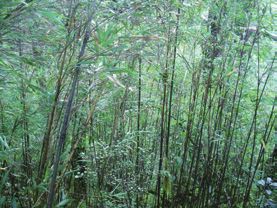
702                                    Panthi et al. – Summer Diet and Habitat of Red Panda

al. 2001, Mahato 2003, Williams 2006, Sharma                            and Beltan 2009, Aryal and Kreigenhofer 2009,
and Belant 2009), detailed information on the                           Aryal et al. 2010a b, DNPWC 2011). These factors
status, ecology, and causes of population declines                      are considered to be the most significant threats to
is lacking, particularly for western Nepal and in                       red panda habitat in other areas of Nepal (Thapa
unprotected areas.                                                      2007, Yonzon et al. 1991, Williams 2006). Our aim
      Studies of the habitat use and diet of the                        was to investigate the distribution, diet, habitat use,
red panda have been performed in other regions.                         and influence of livestock grazing on the red panda
In the Dharjeeling area of India, the red panda                         in the DHR, with a view to contributing information
was found to occur most frequently at sites on                          required to develop a sustainable management
steeper slopes, with high densities of fallen                           plan.
logs, tree stumps, shrubs, and bamboo culms
(Shrestha 1988, Wei et al. 2000, Wang et al.
2008). In the same region, the diet of red panda                                    MATERIALS AND METHODS
was characterized as being largely vegetarian
and consisting of young leaves and shoots.                              Study area
Bamboo of the genera Arundinaria, Phyllostachys,
Thamnocalamus, Chimonobambusa,                                               The DHR (Fig. 1) covers approximately
Semiarundinaria, Pseudosyachyum, and                                    1325 km2 and is situated in western Nepal within
Qiongzhuea were most commonly consumed                                  Rukum, Myagdi, and Baglung Districts in the
(Chowdury 2001).                                                        Dhaulagiri Himal range, at 23°30'N-28°50'N,
      Herein, we report on the ecology of the red                       82°50'E-83°15'E (Figs. 1, 2) (Aryal and Kreigen-
panda in Dhorpatan Hunting Reserve (DHR)                                hofer 2009). It was established in 1987 as the
western Nepal (Fig. 1). The presence of red                             only hunting reserve in Nepal, with the objective of
panda was confirmed in this reserve < 10 yr                             providing an area for sport hunting of blue sheep
ago (Sharma and Beltan 2009). However, high                             while simultaneously preserving a representative
rates of poaching, grazing pressures, and habitat                       high-elevation natural ecosystem that ranges
fragmentation have also been recorded (Sharma                           2850-5500 m (Aryal and Kreigenhofer 2009).

                                                                                                                             N

           ANCA
                                RNP                                 CHINA
                 KNP

                                                              ACA
                                               DHR

                                                                                       LNP
                                                                NEPAL                                     SNP
                                                                                                   GCA
                                                                                                             MBNP            KCA

      0          100            200 km

                                                                INDIA                                     llam district
           Country boundary (Nepal)

           Red panda presence protected area of Nepal

           Unprotected area and red panda presence

Fig. 1. Protected and unprotected areas of Nepal supporting red panda: ANCA, Appi Nappa Conservation Area; KNP, Khaptad National
Park; RNP, Rara National Park; DHR, Dhorpatan Hunting Reserve; ACA, Annapurna Conservation Area; LNP, Langtang National Park;
GCA, Gauri Shankar Conservation Area; SNP, Sagarmatha National Park; MBNP, Makalu Barun National Park; KCA, Kanchanjunga
Conservation Area. Also shown is the Ilam District; Williams (2006) confirmed the presence of the red panda in its northeastern portion.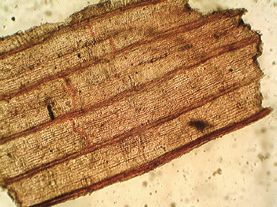
Zoological Studies 51(5): 701-709 (2012)                                    703

      The monsoon season in this area occurs                                 (Macaca radiata), and wolf (Canis lupus) (Aryal
between June and Oct., with annual precipitation                             and Kreigenhofer 2009, Aryal et al. 2010a b).
of < 1000 mm (Aryal and Kreigenhofer 2009).                                        There are human settlements inside the DHR
Higher elevations are subject to strong winds                                of different castes including Bishowkarma, Magar,
throughout the year, and snow usually lasts, even                            Nauthar (Chhetri), Chhantyal, Thakali, Bhotias
at lower elevations, until early Apr. (Aryal et al.                          (Tibetan refugees), and Brahmin. People are
2010b). During the dry season, the weather is                                dependent on traditional agricultural practices in
dry and cold, with light snow in midwinter and                               the southern part of the reserve. In the northern,
unpredictable heavier snowstorms into late spring                            higher-elevation parts of the reserve, animal
(Wegge 1976). The reserve is characterized                                   husbandry and trans-boundary trade are the
by alpine, sub-alpine, and high-temperate                                    major sources of livelihood (Aryal 2008, Aryal and
vegetation. Common plant species include fir                                 Kreigenhofer 2009, Aryal et al. 2010).
(Abies spectabilis), blue pine (Pinus wallichina),
birch (Betula utilis), rhododendron (Rhododendron                            Distribution of the red panda within the DHR
spp.), hemlock (Tsuga domusa), oak (Quercus
semicarpifolia), juniper (Juniperus indica), spruce                                Between Dec. 2010 and Oct. 2011, local
(Picea smithiana), maple (Acer caesium), juglans                             residents (n = 119) were interviewed to identify
(Juglans regia), taxus (Taxus bacata), and chirpine                          potential and confirmed red panda habitat. A map
(P. roxburghii) (Aryal and Kreigenhofer 2009, Aryal                          of the area (1: 50,000) (provided by the Department
et al. 2010a b). The reserve supports red panda                              of Survey, Government of Nepal, Katmandu)
and also blue sheep (Pseudois nayaur), leopard                               was used in the interviews; interviewees were
(Panthera paradus), goral (Naemorhedus goral)                                requested to indicate the locations of any evidence
serow (Capricornis sumatraensis), Himalayan                                  of red panda presence (direct observation, scat,
thar (Hemitragus jemlachicus), Himalayan black                               nesting site, and footprints). Evidence was noted
bear (Ursus thibetanus), barking deer (Munticus                              in all 6 blocks within the DHR, and field surveys
muntjak), wild boar (Sus scrofa), rhesus macaque                             were subsequently conducted in these blocks to

                                   Districts boundary      Rivers
                                   7 blocks of DHR                                                         N
                                   Barse           Dogari             Fagune        Gustung
                                   Seng                Sundaha        Surtibang
                                              Dunai
                                                                   Shahartara
                      Sisne                                                          DOPLA
                                                                                              Mukot

                                                     Ranmamaikot
                         Jang

                                                   Rukum
                                                                                         Gurja
                                                Hukam
                              Kol
                                                                                           MYAGDI
                                          Takasera
                                  Kakri                             Bobang               Lulang

                                                                        BAGLUNG
                                                                         Adhikarichaur
                              0      5     10 km

Fig. 2. Demarcation of the districts, surrounding villages, and 7 blocks of the Dhorpatan Hunting Reserve (DHR).
704 Panthi et al. – Summer Diet and Habitat of Red Panda
corro-borate the interview information. During the were defined as ‘livestock-only’ plots, and those
surveys, existing manmade trails were walked, and containing signs of both red panda and livestock
the traversed habitat was examined for red panda were defined as ‘shared’ plots. The spatial habitat
signs. In total, 342 GPS points were recorded, overlap of red panda (A) and livestock (B) was
indicating the locations of observed evidence of analyzed using Jaccard’s similarity index (J) (Real
red panda, and these were uploaded into Arc GIS- and Vargas 1996, Real 1999) which is expressed
9.3 (ESRI). This information was overlaid on a as J = C / (A + B - C), where A is the number
vegetation-type layer (http://geoportal.icimod.org) of plots used by red panda, B is the number of
and distribution map, from which the size of the plots used by livestock, and C is the number of
area was calculated. plots used by both red panda and livestock. The
associated probability for J was calculated to
Habitat availability and use by the red panda in determine if the value for the index differed from
the DHR what would be expected at random (Real and
Vargas 1996, Real 1999), using the formula given
Sixty habitat use (U) and 60 availability plots below. In this case, the probabilities associated
(A) were laid out throughout the study area to with Jaccard’s index depended on the total number
estimate habitat selection. U plots were located of attributes present in either of the 2 habitats
in areas that contained red panda signs (direct compared (N). N was calculated as (A + B)/(1 + J).
observations, scat, hair, footprints, and resting
sites; Fig. 3), as determined from the distribution Dietary analysis
survey. For each U plot, a paired A plot was laid
out at a distance of 100-150 m in a randomly During the summer of 2011, 61 scat samples
chosen direction (as described by Aryal 2009). were collected from the DHR. Micro-histological
Where signs of red panda were observed in the fecal analysis was used to estimate the diet of
A plots, the status was changed to U. The slope, the red panda. This is a widely used method for
elevation, percentage crown cover, ground cover, studying the diet of ungulates (Anthony and Smith
and land features were recorded for these plots. 1974, Robbins et al. 1975, Holechek et al. 1982),
The quadrate sizes for each plot were as and is considered the most appropriate method for
suggested by Schemnitz (1980) for vegetation estimating the diet of wild herbivores (Dearden et
analysis in both the U and A plots: 10 × 10 m for al. 1975) where direct observations (Rothman et
the tree layer (plants above 3 m high and 5 cm al. 2011) are not possible.
diameter at breast height (DBH)), 4 × 4 m for the Samples were dried to constant weight in
shrub layer (woody plants of < 3 m high), and an oven, then ground and subsequently boiled
1 × 1 m for herbs and saplings (plants up to 1 m in a solution of 10% sodium hydroxide (NaOH)
height). In each plot, the DBH, height, and crown until a color change was observed. Samples
cover of trees were recorded as well as ground were washed with distilled water to remove the
cover, the number of trees, the frequency of shrubs NaOH, and passed through a series of ascending
and herbs, and signs of other animal species. alcohol solutions before being treated with xylene
Any livestock signs (direct observation, dung, for complete dehydration. For each sample, 1
and prints) were recorded in each plot to analyze slide was prepared (61 in total) for examination.
potential habitat overlap between livestock and red Reference samples were collected from the study
panda. A one-way analysis of variance (ANOVA; area to prepare reference slides. Photographs of
SPSS vers. 16.0, SPSS, Chicago, IL, USA) was each reference slide for each plant species (81 in
used to compare the following habitat features total) were taken using a microscope (100x and
between U and A plots: vegetation, slope, aspect, 400x magnifications). Twenty fragments from
and elevation (Aryal et al. 2010c, Aryal 2009). each slide were observed and compared with the
reference slides of vegetation samples (Fig. 3E).
Habitat overlap of red panda and livestock Samples were identified under a microscope at
100x or 400x. Finally, the relative frequency (RF)
Signs of livestock presence, including grazing of each species was calculated to estimate the
signs and dung, were noted in our habitat survey. percentage of that species in the diet of red panda
Plots containing signs of red panda but not (Sparks and Malechek 1968, Metillo 2011, Giri et
livestock were defined as ‘red panda-only’ plots, al. 2011).
those containing livestock dung but no red pandaZoological Studies 51(5): 701-709 (2012) 705
RESULTS nesting sites were observed in 6 blocks (Barse,
Fagune, Surtibang, Seng, Sundaha, and Ghustang
Distribution of red panda in the DHR blocks) of the DHR, particularly in the lower belt
including parts of the Myagdi, Baglung, and Rukum
Red pandas were found to be distributed in a Districts (Fig. 4), and 4 red pandas (all male) were
345.8-km2 area of the reserve (Fig. 4). Scat and observed in Barse and Surtibang blocks (Fig. 3).
(A)
(B) (C)
(D) (E)
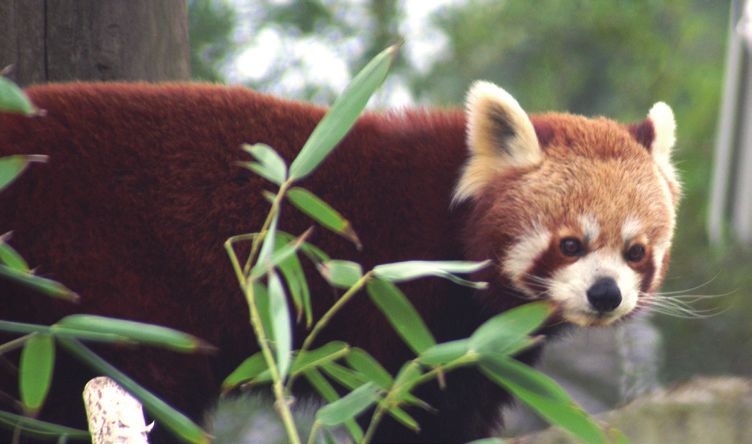
Fig. 3. (A) red panda (photo by A. Aryal). (B) red panda scat; (C) a red panda in an Abies spectabilis tree; (D) Arundinaria spp. in red
panda habitat (photo by S. Panthi). (E) cellular structure of the leaf of Arundinaria spp. (photo by B. Adhikari).706 Panthi et al. – Summer Diet and Habitat of Red Panda
All cases of red panda sign occurred in forests panda, because of the very small amount of forest
dominated by A. spectabilis, R. arboretum, and associated with the higher elevation of the area,
B. utilis trees, with ground cover predominantly and we found no evidence of red panda in this
of Arundinaria spp. (Fig. 3). Red pandas were area. However, the lower belt of the forest area
found in the following regions of the reserve: in (< 10 km2) of the block was suitable habitat for
Khopriban, Sivaodhar area of Baglung and Myagdi red panda. The south face of the Surtibang peak
Districts of Barse block; in Surtibang and Dija of Baglung (Bobang VDC) District and Lalpatan
khung of Baglung District of Surtibang block; in of Rukum (Jhang VDC) District were identified
Kanga khung, Masa khung, and the Thakur area of as potential habitat for red panda outside of the
Baglung District of Fagune block; on the river side reserve, and they were surveyed for signs of red
of the Ghustang (Ranma maikot and Gurjakhani panda and livestock (Fig. 4).
VDC of the Rukum and Myagdi Districts) of
Ghustung block; in Sengkhola and Dule of Rukum Habitat use and availability
District of Seng block; and in the Sundaha area
of the Sundaha block (Fig. 4). The Doghadi block Red pandas were identified in 75% of plots
was not considered potential habitat for the red dominated by forests, and 16% of plots dominated
by shrub habitat, whereas all habitat types were
observed within U plots (Fig. 5).
Rivers Plots ranged in elevation from 2300 to
7 blocks of DHR 4380 m with slopes of 1°-78°, whereas red panda
Potential red panda distribution forest area
signs were recorded only at elevations of 2800-
4000 m (Fig. 6). There was a significant difference
Sundaha in the use of different elevations in proportion to
Seng their availability, with elevations of 3000-3800 m
Dogari
used the most frequently (F = 3.51, p < 0.05) (Fig.
6).
In total, 10 tree species, 11 shrub species,
Gustung and 17 herb species were recorded in the 120
sampled plots. Out of 10 tree species, Ab.
Fagune Barse spectabilis, R. arboretum, Acer spp., and Q.
semicarpifolia were most commonly found in both
Surtibang U plots and A plots (F = 4.20, p > 0.05) (Fig. 7).
Areas dominated by T. domusa, P. wallichiana, and
0 5 10 km J. indica were used less often by the red panda
(Fig. 7).
Fig. 4. Forested areas in the Dhorpatan Hunting Reserve
identified as potential habitat for the red panda. 40 Use % Available %
35
80 Use % Availability % 30
Percentage
70 25
60 20
Percentage
50 15
40 10
30 5
20 0
10
0
00
00
00
00
00
00
0
0
0
28
30
32
34
36
38
40
40
-
-
-
-
-
-
<
>
00
00
00
00
00
00
0
28
30
32
34
36
38
Barren land Cliff Forest Grassland Gully Shurb land
Habitat types Elevation (m)
Fig. 5. Availability and use by the red panda of different habitat Fig. 6. Availability and use by the red panda of different
types in the Dhorpatan Hunting Reserve. elevations in the Dhorpatan Hunting Reserve.Zoological Studies 51(5): 701-709 (2012) 707
Habitat overlap of red panda with livestock species present in scat were Acer spp. (4.5%),
Q. semicarpifolia (3.3%), Berberis spp. (2.1%),
There was appreciable overlap in resources and lichens (2%). Arundinaria spp. were found in
shared by the red panda and livestock in the significantly higher proportion to others species in
DHR, with human disturbances and livestock red panda scat (χ2 = 25.24, p < 0.001). The stem
grazing observed in 53% of red panda habitats in portion of Arundinaria spp. was recorded more
the reserve (Jaccard’s similarity index, J = 0.22, frequently (58%) than the leaf portion (23.7%)
n = 86, p < 0.001). (Table 1).
Diet composition of the red panda
DISCUSSION
Six plants were identified in the scat of red
panda, and 2.5% of the diet was unidentifiable We recorded the presence of red pandas in
(Table 1). From the scat analyses, Arundinaria 6 blocks of the DHR, and further detailed studies
spp. comprised the largest portion (81.7%) of should be carried out in Dogadi block for the
the red panda diet in the DHR. Other plant presence or absence of red panda. Red pandas
are known to be habitat specialists, maintain a
small home range, and are restricted to small
45
Use % Availability % pockets of microhabitat (Yonzon et al. 1991). In
40 our study, red pandas were distributed in specific
forest habitats (i.e., those dominated by A.
35
spectabilis, R. arboretum, and B. utilis), within an
30 elevation range of 2800-4000 m. However, in the
Percentage
Langtang region of Nepal and in India, red pandas
25
were recorded across a broader range of 2200-
20 4800 m (Roberts and Gittlemen 1984, Yonzon and
Hunter 1989). Previous studies showed the red
15 panda to utilize areas of steep slopes with bamboo
10 and fallen logs (Wei et al. 1999 2000, Zhang et al.
2002).
5 Our survey revealed the presence of red
0
panda in areas outside of the conservation area
(the southern part from the Sundaha block of the
m
lia
*
lis
ca
e*
na
a
a
ilis
s)
us
at
tu
fo
bi
at
di
hi
lu
ut
DHR), and Williams (2006) similarly recorded this
ac
re
m
pi
ta
sk
in
ic
u
la
bo
sc
do
ar
b
ec
l
Pa
l
s
a
tu
s
ic
ru
(A
ar
sp
w
species outside of a protected area in the Ilam
xu
a
Be
m
pe
ug
s
n
le
Ta
se
s
nu
ro
ni
ie
ai
Ts
nd
Ju
Ab
Pi
district of Nepal. Conservation of pandas outside
us
ip
r
de
rc
ha
ue
do
C
of protected areas is challenging, and requires
Q
ho
R
Tree species specific conservation measures at the local level to
motivate villagers to conserve this species in those
Fig. 7. Availability and use of major tree species by the red
areas.
panda in the Dhorpatan Hunting Reserve (*local name).
Our study recorded that red pandas used
several tree species (A. caesium, A. spectabilis, B.
Table 1. Plants identified in the red panda fecal utilis, and Q. semicarpifolia), shrubs (Urtica dioica,
pellets (diet composition of red panda) R. campanulatum, and Rubus spp.), and herb
species (Artemosia spp., Bistorta amplexicaulis,
Scientific name Frequency (%) Duschesnea indica, and Arundinaria spp.). As in
our study, Sharma and Belant (2009) reported that
Arundinaria spp. 81.7 A. spectabilis was the main species occurring in
Acer spp. 4.5 red panda habitat in Nepal, whereas in India, red
Betula utilis 3.3 panda habitats were typically characterized by
Quercus semicarpifolia 2.9 the presence of mixed deciduous and coniferous
Berberis spp. 2.1
forests with bamboo-thicket understory (Roberts
Lichens 3
and Gittleman 1984, Chakraborty 1999). Several
Unidentified 2.5
tree species found in red panda habitat, including708 Panthi et al. – Summer Diet and Habitat of Red Panda
A. spectabilis, B. utilis, and Q. semicarpifolia, are population size in Nepal. An approach that shows
harvested to fulfill the needs of local communities. particular promise for such studies is a genetic-
Studies revealed a preference of red pandas for based population survey method (Wang et al.
forests with fallen logs and tree stumps (Zejun et 2008, Gomerčić et al. 2010, Chu et al. 2012).
al. 2006), but in our study area, fallen logs and
trees stumps are removed for firewood and other Acknowledgments: The 1st author, serving as
purposes by the local people. A conservation a government ranger at the DHR, would like to
strategy should consider managing this situation to thank the Department of National Park and Wildlife
balance the needs of local villages and the habitat Conservation-DHR and all DHR staff for their
requirements of the red panda. support in conducting this study. IDEA WILD USA
In China and India, the main food resources kindly provided funding to support fieldwork. We
for red pandas are bamboo (Wei et al. 1999 would also like to thank the Institute of Forestry,
2000, Pradhan et al. 2001). Pradhan et al. (2001) Tribhuvan University, Pokhara, Nepal for their
reported that the bamboo species Arundinaria support in providing lab facilities for the diet
maling and Aru. aristata constituted 68.4% of the analysis, and the Massey University Research
total diet, followed by berries of Sorbus cuspidata, Fund (New Zealand) for continuing support. We
Sorbus microphylla, Actinidia strigosa, and Rosa thank Shreekanta Sharma Khatiwada and Thakur
sericera. In contrast, our results showed the Silawal for their help during the study period.
diet of the red panda in DHR to be dominated by
Arundinaria spp. (> 81%). The reason for this
difference might be that our survey was conducted REFERENCES
in the rainy season (summer) when buds of
Arundinaria spp. were abundant. Arundinaria spp. Anthony RG, NS Smith. 1974. Comparison of rumen and fecal
is heavily used by red pandas, and also by local analysis to describe deer diets. J. Wildl. Manage. 38:
535-540.
villagers in the study area: the buds are eaten as Aryal A. 2008. Population ecology and predators of blue
a vegetable, the leaves are used as fodder, and sheep (Pseudois nayaur) in Dhorpatan Hunting Reserve.
the bark (locally known as “choya”) is used for MSc thesis, Albert-Ludwigs Univ. of Freiburg, Freiburg,
making baskets. The harvesting of this species for Germany.
local use and sometimes for commercial purposes Aryal A. 2009. Habitat ecology of Himalayan serow
(Capricornis sumatraensis subsp. thar) in Annapurna
poses a serious threat to the survival of the red Conservation Area of Nepal. Tiger Paper/FAO 36: 12-20.
panda in the DHR. Aryal A, S Gastaur, S Menzel, TB Chhetri, J Hopkins. 2010a.
Through much of its distribution, the red Estimation of blue sheep population parameters in the
panda is threatened by habitat loss and fragmen- Dhorpatan Hunting Reserve, Nepal. Int. J. Biodivers.
tation, poaching, and inbreeding depression (Wei Conserv. 2: 51-56.
Aryal A, B Kreigenhofer. 2009. Summer diet composition of the
et al. 1999). The same is true in our study area, common leopard Panthera pardus (Carnivora: Felidae) in
where each year herders graze their livestock Nepal. JoTT. 1: 562-566.
inside the DHR, which constitutes a substantial Aryal A, D Raubenheimer, S Subedi, B Kattel. 2010c. Spatial
source of disturbance to red panda habitat. The habitat overlap and habitat preference of Himalayan musk
ultimate cause of this and the aforementioned deer “Moschus chrysogaster ” in Sagarmatha (Mt. Everest)
National Park, Nepal. Curr. Res. J. Biol. Sci. 2: 217-225.
threats to the red panda are the high growth rate Aryal A, S Sathyakumar, B Kreigenhofer. 2010b. Opportunistic
of human populations within the species’ range animal’s diet depend on prey availability: spring dietary
and surrounding areas (Choudhury 2001), and the composition of the red fox (Vulpes vulpes) in the
associated growth in livestock populations. In our Dhorpatan Hunting Reserve, Nepal. J. Ecol. Nat. Environ.
study, the magnitude of this effect is underscored 2: 59-63.
Chakraborty T. 1999. Himalayan heritage: the endangered red
by the finding that > 53% of red panda habitat panda in Himalayan Paryavaran. J. Environ. Prot. Soc. 6:
significantly over-lapped with livestock grazing and 129-132.
indicators of human disturbance. This should be Choudhury A. 2001. An overview of the status and conser-
an immediate cause of concern for managing red vation of the red panda Ailurus fulgens in India, with
panda populations in Nepal. reference to its global status. Oryx 35: 250-259.
Chu TJ, D Wang, HL Huang, FJ Lin, TD Tzeng. 2012.
The present study provides information Population structure and historical demography of the
on current distribution patterns, habitat charac- whiskered velvet shrimp (Metapenaeopsis barbata) off
teristics, and diet of the red panda in the DHR and China and Taiwan inferred from the mitochondrial control
surrounding area. However, further information region. Zool. Stud. 51: 99-107.
is needed on the population distribution and total Dearden BL, RE Pegau, RM Hansen. 1975. Precision ofZoological Studies 51(5): 701-709 (2012) 709
microhistological estimates of ruminant food habits. J. red panda (Ailurus fulgens fulgens) in Dhorpatan Hunting
Wildl. Manage. 39: 402-407. Reserve, Nepal. Small Carniv. Conserv. 40: 33-35.
DNPWC. 2011. Protected area of Nepal. Department of Shrestha M. 1988. Vegetation study of red panda in Langtang
National Park and Wildlife Conservation (DNPWC)/ National Park, central Nepal., Nepal: Central Department
Ministry of Forest and Soil Conservation, Kathmandu of Zoology. Kirtipur Campus, Tribhuvan Univ.
Nepal. 52+ pp. (Nepali version). Available at http://www. Sparks DR, JC Malechek. 1968. Estimating percentage dry
dnpwc.gov.np/publications/pustika Accessed 20 Jan. weight indiets using a microscopic technique. J. Range
2012. Manag. 21: 264-265.
Giri S, A Aryal, RK Koirala, B Adhikari, D Raubenheimer. 2011. Thapa BB. 2007. Dhorpatan Sikar Aararksha ko Parichaya.
Feeding ecology and distribution of Himalayan serow Baglung, Nepal: Department of National Park and Wildlife
(Capricornis thar) in Annapurna Conservation Area, Conservation, DHR office.
Nepal. World J. Zool. 6: 80-85. Wang X, A Choudhury, P Yonzon, C Wozencraft, Z Than. 2008.
Gomerčić T, M Sindičić, A Galov, H Arbanasić, J Kusak, I Ailurus fulgens. In IUCN 2011. UCN red list of threatened
Kocijan et al. 2010. High genetic variability of the grey species. Vers. 2011.2. Available at www.iucnredlist.org
wolf (Canis lupus L.) population from Croatia as revealed Accessed 26 Nov. 2011.
by mitochondrial DNA control region sequences. Zool. Wegge P. 1976. Himalayan shikar reserves; surveys and
Stud. 49: 816-823. management proposals. Field Document No. 5. FAO/
Holechek JL, BD Gross. 1982. Training needed for quantifying NEP/72/002 Project, Kathmandu. 96 pp.
simulated diets from fragmented range plants. J. Range Wei FW, ZJ Feng, ZW Wang, J Hu. 1999. Current distribution,
Manage. 35: 644-647. status and conservation of wild red pandas Ailurus fulgens
Mahato NK. 2003. Status of red panda, Ailurus fulgens (Cuvier, in China. Biol. Conserv. 89: 285-291.
1825) in the Kanchenjunga Conservation Area, Nepal. Wei FW, ZJ Feng, ZW Wang, J Hu. 2000. Habitat use and
BSc thesis, Institute of Forestry, Tribhuvan Univ., Pokhara, separation between the giant panda and the red panda. J.
Nepal. Mammal. 80: 448-455.
Metillo EB. 2011. Feeding ecology of Acetes intermedius Williams BH. 2006. Red panda in eastern Nepal: How do they
Omori 1975 (Crustacea: Decapoda: Sergestidae) in Iligan fit into ecoregional conservation of the Eastern Himalaya?
Bay, the Philippines. Zool. Stud. 50: 725-736. In JA McNeely, TM McCarthy, A Smith, L OlsvigWhittaker,
Pradhan S, GK Saha, JA Khan. 2001. Ecology of the red ED Wikramanayake, eds. Conservation biology in Asia.
panda (Ailurus fulgens) in the Singhalila National Park, Katmandu, Nepal: Society for Conservation Biology Asia
Darjeeling, India. Biol. Conserv. 98: 11-18. Section and Resources Himalaya, pp. 236-251.
Real R. 1999. Tables of significant values of Jaccard’s index of Yonzon P, R Jones, J Fox. 1991. Geographic information
similarity. Misc. Zoologica 22.1: 29-40. systems for assessing habitat and estimating population
Real R, M Vergajs. 1996. The probabilistic basis of Jaccard’s of red pandas in Langtang National Park, Nepal. Ambio
index of similarity. Systematic Biology 45: 380-385. 20: 285-288.
Robbins CT, PJ Vansoest, WW Mautz, AN Moen. 1975. Feed Yonzon PB, ML Hunter. 1989. Ecological study of the
analysis and digestion with reference to white-tailed deer. red panda in the Nepal-Himalayas. The Hague, the
J. Wildl. Manage. 39: 67-79. Netherlands: SPB Academic Publishing.
Roberts MS, JL Gittleman. 1984. Ailurus fulgens. Mamm. Zejun Z, F Wei, M Li, J Hu. 2006. Winter microhabitat
Spec. 222: 1-8. separation between giant and red pandas in Bashania
Rothman JM, D Raubenheimer, CA Chapman. 2011. Nutri- faberi bamboo forest in Fengtongzhai Nature Reserve. J.
tional geometry: gorillas prioritize non-protein energy Wildl. Manage. 70: 231-235.
while consuming surplus protein. Biol. Lett. 7: 847-849. Zhang Z, JC Hu, H Wu. 2002. Comparison of habitat
Schemnitz SD. 1980. Wildlife management technique manual. selection of giant pandas and red pandas in the Qionglai
4th ed. Washington, DC: Wildlife Society. Mountains. Acta Their. Sin. 22: 161-168.
Sharma HP, JL Belant. 2009. Distribution and observation ofYou can also read


