System Operator Business Plan 2021/22 - Network Rail
←
→
Page content transcription
If your browser does not render page correctly, please read the page content below
OFFICIAL

System Operator
Business Plan 2021/22
OFFICIAL

      Contents
      Foreword                           1

1.    Executive Summary                  3         7.    Finance Plan                           63
                                                   7.1    Financial Summary                     64
2.    Introduction                       11        7.2    Efficiencies                          66

3.    System Operator                    13        8.    Governance and Reporting               67
3.1    Our purpose                       14        8.1    System Operator governance
3.2    Our role in system safety         16               framework                             68
3.3    Our Organisational Structure      17        8.2    Risks, opportunities, constraints &
3.4    Our operating model &                              assumptions                           70
       governance                        20        8.3    System Operator reporting             73
3.5    System Operator Scorecard         22        8.4    Long Term scorecard & GRAI
                                                          Maturity                              74
4.    Meeting the needs of our customers
      and stakeholders              25             Appendices                                   76
4.1    Our customers & stakeholders      26        APPENDIX A - System Operator Scorecard
4.2    Our engagement approaches         27        2020/21                                      77
                                                   APPENDIX B - System Operator Long-Term
5.    Delivery and Activity Plans        29        Scorecard 2021/22                            78
5.1    Long-term planning                30
                                                   APPENDIX C - Customer Engagement
5.2    Network Integration               36
                                                   Governance                                   79
5.3    Industry Timetable Assurance
                                                   APPENDIX D -Draft Capacity Planning Calendar
       PMO                               44
                                                   of Events                                    80
5.4    Timetable Planning                49
                                                   APPENDIX E – Event Steering Group (ESG)
5.5    Expert Analysis and Forecasting   56
                                                   activity                                     84
5.6    Other industry-wide activities    58
                                                   APPENDIX F - Our People Strategy             85
6.    Investment in our people           60        APPENDIX G - New Governance Structure 90
6.1    Our people plan                   61        APPENDIX H – Assumptions                     91
                                                   APPENDIX I - Glossary of Terms               94
OFFICIAL

                                            Foreword by
                                            Paul McMahon,
                                            Managing Director,
                                            System Operator

As with the whole rail industry, the last year            These and other successes demonstrate the
for the System Operator has been                          benefits of, and crucial need for, a single
dominated by the COVID-19 pandemic.                       organisation with a focus on network-wide
This has hugely impacted what we do, how                  activity and integrity, able to work in close
we do it and our ability, at this stage, to plan          and constructive partnership with the
with complete confidence for the future.                  regions and wider industry to deliver for
                                                          passengers and freight users.
The System Operator has reacted very well
to the crisis, implementing business                      We have also continued work started in
continuity plans and stepping up to deliver               2019/20, under the commission of
for our customers including:                              Department for Transport (DfT), on the
                                                          development of a Whole Industry Strategic
• Planning and implementing four                          Plan that will look over the 30 years ahead.
  timetable changes during a six-month                    We are engaging with stakeholders across
  period to reduce, and then increase the                 the industry on this critical work.
  train service, as well as dealing with up to
  four times the normal levels of short term              A key area of focus for us over the last year
  (week-to-week) train planning activities.               has been to improve how we work with our
                                                          customers, using feedback from last year’s
• Providing daily station passenger footfall              customer advocacy survey to initiate several
  reports, during this period, to enable                  improvement workstreams, overseen by our
  regional teams to react dynamically to                  independently chaired Advisory Board.
  demand.
                                                          During the last year we have worked to
• Establishing a cross-industry COVID-19                  deliver our programme of strategic plans,
  demand forecasting group and working                    working in partnership with our customers
  with the industry on the creation of rail               and stakeholders. Highlights include the
  passenger demand forecasts and                          Traction Decarbonisation Network Strategy
  scenarios, updating these as the                        and the London Rail Freight Strategy both
  pandemic unfolded.                                      of which were published in 2020.

                                                                                                   1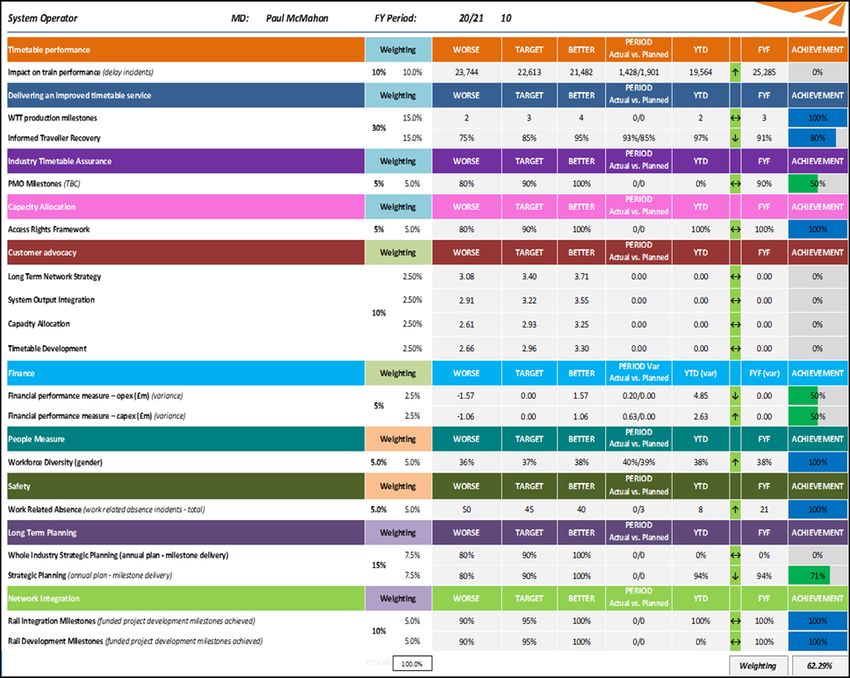
OFFICIAL

 Foreword

I am also pleased with the work we have                      deliverable and cost effective.
undertaken jointly with the DfT and ORR:
‘Better Value Railway’ to support more                     • Improve the capabilities and processes of
effective rail scheme identification and                     the System Operator function. Including
development                                                  the development of network integration
                                                             capability.
Our focus for the coming year is to work in
partnership with the regional businesses, the              • Deliver benefits in timetable planning
DfT and other funders and stakeholders, and                  technology and work towards the delivery
the wider rail industry, to:                                 of the Industry Timetable Technical
                                                             Strategy.
• Continue to do our ‘day job’, delivering
  the commitments we made in our CP6                       • Continue working with DfT, Transport for
  Strategic Business Plan.                                   the North, Midlands Connect, the
                                                             National Infrastructure Commission and
• Lead work on production of robust                          HS2 Ltd to support the development of
  timetables as the industry continues to                    the Integrated Rail Plan (IRP), Rail Needs
  respond to the challenges of COVID-19,                     Assessment, Northern Powerhouse Rail
  including adapting the timetable                           and HS2.
  development process to support this.
                                                           The System Operator will continue to be on
• Support effective implementation of the                  the side of passengers and freight users,
  rail reform agenda, including the                        striving always to be easy to engage with -
  development of the Whole Industry                        an efficient and dependable partner and an
  Strategic Plan and support to DfT on new                 instinctive industry leader, doing our part to
  train operator contractual arrangements                  make Network Rail a company people are
  and train service specifications.                        proud to work for. Our ongoing successes will
                                                           continue to be supported by the
• Continue our work to improve the                         collaborations we forge with our industry
  framework for capacity allocation                        partners and stakeholders.
  including changes to the Sale of Access
  Rights, policy and processes and the
  Network Code.

• Continue to work with the DfT and
  regional businesses to support the
  development and delivery of the
  government’s ‘Restoring Your Railway’
                                                           Paul McMahon
  programme so that schemes are
                                                           Managing Director, System Operator

                                                                                                      2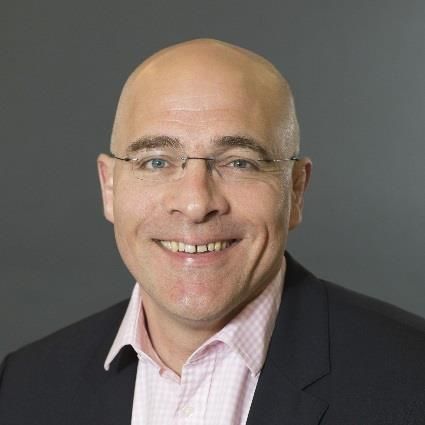
OFFICIAL

1. Executive Summary
This document sets out the business plan for Network Rail’s System
Operator function for the financial year 2021/22, year 3 of regulatory
control period 6 (CP6) which ends on the 31st March 2024.

We give an overview of our business performance for 2020/21 to date and
set out our strategies and plans for 2021/22 and beyond.

In Section 3 we set out the System Operator’s new operating model and
how this has been implemented. We then consider the following themes in
more detail:

      •   Customers and Stakeholders
      •   Delivery and activity plans
      •   People
      •   Finance
      •   Governance

The following Executive Summary is a seven-page overview of the rest of
the document.

                                                                          3
OFFICIAL

1. Executive summary
Network Rail’s transformation journey has seen us move from a highly centralised organisation to
one with devolved businesses operating within a national framework.

In 2018 a review of the organisation took place which looked at three main things:
•   How to provide the best possible service for passengers and freight users
•   How to ensure we deliver the promises we've made for CP6
•   How to improve the way we work together and with the industry

In 2019 we started the Putting Passengers First programme to change the way we work –
including our culture and capabilities – and deliver structural changes. Key to this transformation
is real devolution to businesses with empowered leaders. This phase set up 14 new Network Rail
routes across five regions, established Network Services alongside Route Services, and set up three
network-wide functions – of which System Operator is one; building on the original creation of the
System Operator in 2017.

The System Operator works to ensure that passengers, freight users and society benefit more
from a network that’s greater than the sum of its parts, examining the full spectrum of system
opportunities to deliver more capacity, better timetables, longer and more trains, new technology
and, where necessary, new infrastructure.

Our activities span the breadth of railway planning in terms of time horizons from short term
changes to tomorrow’s timetable and all the way to what the railway could look like in 30 years.
Our work is underpinned by high quality technical and economic analysis so that decisions are
well informed and robust.

                Figure 1: Network Rail’s structure

                                                                                              4
OFFICIAL

1. Executive summary
The System Operator works with railway funders, operators, governments and the Regions to bring
together timetables, network and industry strategies and plans that are supported by expert
analysis.

Network wide benefits

System Operator is a function with a view that spans across the network, whose job it is to provide
strategic oversight on behalf of the whole of the rail industry and foster partnerships in Network
Rail’s devolved organisation and wider industry. Sharing of knowledge across the routes, regions
and with operators strengthens the business as a whole and helps to make the network greater
than the sum of its parts – to the benefit of passengers and freight users.

Long-term Planning

Devolution has given the regions responsibility for their own medium and long-term planning.
However, System Operator remains accountable for the strategic planning framework, profession
and long-term planning at a network level. System Operator will continue to provide strategies and
oversight to ensure a consistent and high quality approach is taking to long term planning. This will
result in our customers getting a similar quality no matter where in the country they operate.

The Secretary of State for Transport has asked Network Rail to start work on the development of a
30 -year strategy for the railway. This strategy will inform decisions made by the Secretary of State
on the funding and outputs of the railway. The Whole Industry Strategic Plan will reflect the
priorities of the Secretary of the State as to how the railway can contribute to wider social,
economic and environmental outcomes.

The WISP must offer options and choices to the Secretary of State reflecting the need for a
strategy that is flexible, affordable, innovative and efficient, drawing on expertise from across the
whole industry. A dedicated team has been established to support this work. The programme is still
being agreed with the DfT in light of broader industry reform, the anticipated White Paper and the
interaction with key processes such as the spending review and periodic review.

We will continue to embed the strategic planning profession in System Operator and the regions
following devolution. Regular transparent engagement will continue with our regulator, customer &
stakeholders to provide assurance that we are fulfilling the requirements of the network licence.

                                                                                               5
OFFICIAL

1. Executive summary
Long-term planning (continued)

During 2020/21 we have been undertaking planning at a network level, working with Department
for Transport (DfT), National Infrastructure commission (NIC), Transport for the North (TfN), High
Speed 2 (HS2) Ltd and Midlands Connect on the transformational train service changes and
associated infrastructure schemes for HS2 Phase 2b, Midlands Engine Rail and Northern
Powerhouse Rail. This planning will inform government decisions within the Integrated Rail Plan
(IPR). The IRP is expected to be published by government shortly.

Following the publication by government of the IRP we will be taking forward the decisions made
by the government. We will publish the associated milestones at this point. We will provide an
integrated picture of how train services will be transformed for passengers and freight users
facilitating the government’s levelling up agenda across the midlands and the north of England.

We will lead network-wide strategy development and several strategies will be developed these
include interoperability strategy, power supply planning, Traction Decarbonisation Network
Strategy (TDNS) and Freight.

There are a number of deliverables planned to begin or be continued in 2021/22 these include but
are not limited to;

• Continue the Better Value Rail programme – this framework will facilitate making better
  decisions earlier leading to improved project solutions at reduced cost in reduced timescales
• London Rail Freight land use - This strategy will carry out a comprehensive review of railway-
  adjacent land across the London area, with a view to the identification and safeguarding of any
  remaining sites with potential to be of value for future freight use

Network integration and policy

As a newly-established System Operator activity following the System Operator Transformation in
2020, our focus is on growing and establishing our capability to integrate plans for change across
the railway so the network as a whole can really deliver for passengers, freight and the wider
economy. As we develop our tools, and processes to do this, we’ll work with industry and funders on
the reform of the framework for access, lead the improvement of train service specifications, and
continue to give expert advice and support on station passenger requirements, train service
contracting, and track access decisions. All this we do working in close partnership with regions and
across Network Rail and the wider industry.

                                                                                               6
OFFICIAL

1. Executive summary
.
Network integration and policy (continued)

There are a number of deliverables planned to begin or be continued in 2021/22 these
include but are not limited to;

• Establishing a new network integration framework and supporting capability
• Developing a blueprint that defines the future configuration of the network and its
  outputs and the underpinning processes to sustain value-adding support and advice to
  Executive Leadership Team, Regions, funders and governments.

Timetable change assurance

Industry Timetable Assurance is managed by the Industry Programme Management Office
(PMO) and overseen by the PMO Steering Group, comprising senior representatives from
train and freight operators, owning groups and Network Rail. The primary objective of the
team is to enable changes to train services to be implemented successfully, delivering a
reliable service for passengers and freight users, and an efficient operation for funders. The
PMO acts independently to provide challenge, peer review, and be the ‘critical friend’ of all
parties in the timetable development process, including Network Rail. This independence
provides the safeguard that funders and service specifiers need to be satisfied that timetable
changes will deliver the expected outcomes.

Preparations for each timetable change are assessed for risk, and monitored through to
implementation. The past year saw the successful implementation of six major timetable
changes in response to the COVID pandemic, with development timescales measured in
weeks rather than months. In the coming year, the focus will be to take the lessons learned
in 2020, to build a more agile and responsive timetable process whilst continuing to deliver
reliable and efficient services.

There are a number of deliverables planned to begin or be continued in 2021/22 these
include but are not limited to;

• Own and direct the robust and collaborative industry-wide risk and assurance framework
  for timetable change
• Continue to deliver industry-wide, independent assurance assessments for the timetable
  changes

                                                                                                 7
OFFICIAL

1. Executive summary

Timetable Planning

Capacity Planning is responsible for producing high quality timetables to meet the needs of
customers, funders, passengers and freight-user. During 2020 the team have moved to an agile
Production model, delivering five major Timetable changes in 2020 (2020/21): March, May, July,
September, December; instead of the usual two and processing much higher levels of Short Term
Plan (STP) change. In 2021/22 a more agile approach will again be delivered with 4 fixed change
dates agreed with the industry.

The impact of the pandemic has led to the Informed Traveller publication process being
temporarily withdrawn as funders have required much shorter timescales to make decisions on
service specification. The Capacity Planning team will work with funders, operators and the ORR to
make sure the right balance is struck throughout 2021/22 between advance publication of
Informed Traveller timetables and the ongoing flexibility in later decision making that funders seek.

During 2020 the Capacity Planning team completed the introduction of a dedicated Timetable
Performance modelling team and dedicated advance timetabling teams to support Event Steering
Groups (ESGs).

These new capabilities will be deployed throughout 2021/22 to support the production of better
structured and more reliable timetables – in line with our SBP targets to reduce the level of
timetable driven delay.

Prior to the pandemic the System Operator started work on timetable process reform, including a
move to a more permanent agile model but also with greater resource placed upfront in the
development process to support funders and Regions in timetabling specification decisions . During
2021/22, the System Operator will work with the industry to formalise these plans within industry
processes for the long term.

There are a number of deliverables planned to begin or be continued in 2021/22 these include but
are not limited to;

• Continue to deliver the agreed timetable changes on time and to the volume required
• Deliver quantifiable improvements to the network performance through establishing targets for
  the reduction of timetable caused delay incidents

                                                                                              8
OFFICIAL
1. Executive summary
Analysis and Forecasting
We work with our partners and stakeholders to enable them to make value for money decisions to
give the best outcomes for the industry’s customers – passengers, freight users and the travelling
public – and taxpayers.
We do this by providing expert advice about future passenger and freight demand on the network,
and applying transport appraisal expertise to balance decisions around industry costs, revenues and
socioeconomic benefits to end users.
There are a number of deliverables planned to begin or be continued in 2021/22 these include but
are not limited to;
• Input into business case development for enhancement decisions by providing evidence based
advice and analysis
• Continue to lead on industry COVID-19 demand forecasting which includes analysing current
and forecasted passenger numbers
Finance
Our financial plan for 2021/22, included below, identifies an efficient expenditure requirement
totalling £50.3m operating expenditure and £19.5m capital expenditure. The plan has been
developed using resource plans for each team based on the forecast workload for that team, and
we are confident that this represents a robust yet deliverable plan.
Summary of Financials for Control Period 6 (CP6) in £m
Activity/team 19/20* 20/21* 21/22 22/23 23/24 CP6 total
Operational Expenditure (£m) 38.6 37.5 50.3 48.8 51.2 226.5
Capital expenditure (£m) 7.6 13.7 19.5 27.9 27.6 96.3
*Note: 19/20 financial year figures are actuals, 20/21 figures are actuals to period 10 with periods 11-13 forecast
9OFFICIAL
1. Executive summary
How we will measure success
Network Rail uses a scorecard approach to set its expected outcomes and to measure success. The
2021/22 scorecard presented at the end of this section has been created with consideration for our
customers and stakeholders. The Putting passengers first programme enables us to align our
measures to maximising customer satisfaction. The measures all can be categorised under the
umbrella of Network Rail’s vision;
System Operator scorecard 2021/22 Yr1 Actuals Yr2 Forecast Yr3 Forecast Yr4 Forecast Yr5 Forecast CP6 Forecast
ON THE SIDE OF PASSENGERS AND FREIGHT USERS 19/20 20/21 21/22 22/23 23/24 Achievability
Current Forecast 20601 25285 22,273 TBC TBC
Impact on train performance (delay incidents)
Last Year's Plan 22957 22613 22273 19838 TBC G
Current Forecast 4 3
WTT Production Milestones
Last Year's Plan 4 4 G
Current Forecast 96% 20%
TW12 Compliance
Last Year's Plan 90% 90% G
Current Forecast -2.82 0 19.5 TBC TBC
Financial Performance OPEX £m
Last Year's Plan 0 0 0 19.5 TBC G
Current Forecast -0.52 0 19.5 TBC TBC
Financial Performance CAPEX £m
Last Year's Plan 0 0 0 19.5 TBC G
Whole Industry Strategic Planning (milestone Current Forecast 93% 100%
delivery) Last Year's Plan 80% 90% G
Current Forecast 93% 94%
Strategic Planning
Last Year's Plan 80% 90% G
Current Forecast N/A 85% 90% TBC TBC
Timetable Milestones
Last Year's Plan N/A N/A N/A 90% TBC G
EASY TO ENGAGE WITH, EFFICIENT AND DEPENDABLE PARTNER 19/20 2021 2122 2223 2324 Achievability
Current Forecast 100%
Capacity Allocation - Access rights framework
Last Year's Plan 90% G
Current Forecast 3.40
Long term Network Strategy
Last Year's Plan 3.40 G
Current Forecast 3.22
System Output Integration
Last Year's Plan 3.22 G
Current Forecast 2.93
Capacity Allocation
Last Year's Plan 2.93 G
Current Forecast 2.96 2.96
Timetable Development
Last Year's Plan 2.93 2.96 G
Current Forecast N/A N/A 90% TBC TBC
Customer Advocacy Action Plan Milestones
Last Year's Plan N/A N/A N/A 90% TBC G
PROUD TO WORK FOR NETWORK RAIL 19/20 2021 2122 2223 2324 Achievability
Current Forecast 38%
Workforce diversity (gender)
Last Year's Plan 37% G
Current Forecast 21
Work related absence
Last Year's Plan 45 G
Current Forecast N/A N/A 44% TBC TBC
Diversity & Inclusion - Female Headcount
Last Year's Plan N/A N/A N/A 44% TBC G
Current Forecast N/A N/A 15% TBC TBC
Diversity & Inclusion - Ethnicity Headcount
Last Year's Plan N/A N/A N/A 15% TBC G
Current Forecast N/A N/A TBC TBC TBC
Your Voice Action Plan Milestones
Last Year's Plan N/A N/A N/A TBC TBC G
Current Forecast N/A N/A 90% TBC TBC
Mental Wellbeing Training
Last Year's Plan N/A N/A N/A 90% TBC G
INSTINCTIVE INDUSTRY LEADER 19/20 2021 2122 2223 2324 Achievability
Current Forecast 93% 90%
Industry Timetable Assurance -PMO Milestones
Last Year's Plan 90% 90% G
Current Forecast 100%
Rail Integration Milestones
Last Year's Plan 95% G
Current Forecast 100%
Rail Development Milestones
Last Year's Plan 95% G
Industry Timetable Technical Strategy Delivery Current Forecast N/A N/A 90% TBC TBC
Milestones Last Year's Plan N/A N/A N/A 90% TBC G
Current Forecast N/A N/A 90% TBC TBC
Network Integration & Policy Delivery Milestones
Last Year's Plan N/A N/A N/A 90% TBC G
Current Forecast N/A N/A 90% TBC TBC
Strategic Planning Milestones
Last Year's Plan N/A N/A N/A 90% TBC G
Note: this Business Plan does not take account of the organisational changes announced on 20 January 2021 which will be
incorporated in a later revision.
These targets represent our strategic plans. We continue to refine our annual targets to reflect changing circumstances so
they are appropriately challenging.
10OFFICIAL
2. Introduction
This Business Plan sets out what the System Operator plans to deliver
throughout Control Period 6 (CP6), with a focus on delivery within
2021/22. Our primary concern has been and will continue to be the
safety and wellbeing of our people whether they are working from
home or in a COVID-19 secure office space. 2020/21 was certainly a
testament to the flexibility, adaptability and dedication of our teams
within the System Operator.
This plan also outlines the development of the programmes and
initiatives System Operator has worked on over the past year including
our delivery and activity plans. It explains how our new purpose to
make the railway more than the sum of its parts and new operating
model will drive value creation, to the benefit of passengers and freight
users.
Our plan sets out our key functional objectives and proposed key
performance indicators. We continue to strive to meet the needs of our
customers and stakeholders, including developing improvement plans
initiated from the results of the annual customer advocacy survey. This,
coupled with the people plan, will drive continual improvement within
System Operator and the service we provide.
11OFFICIAL
2. Introduction
The changes we have made to the System Operator purpose, operating model and
organisation through our transformation during 2020/21 enable the Network Rail regions
to each be accountable for their future through development of their own strategic plans,
as well as taking on programme integration for HS2 and East West Rail. This will allow
them to develop closer and stronger relationships with the funders, customers and
transport planners who have the greatest stake in their railway, providing an improvement
for passengers and freight users and supporting delivery of Network Rail’s vision:
On the side of Proud to work Easy to
Instinctive
passengers for Network engage with,
industry leader
and freight Rail efficient and
users dependable
partner
Figure 2: Network Rail’s vision
Our people are our greatest asset and throughout the year we continue to build on the
foundation of our commitment to them, increasing opportunities to develop and
contribute to sustainable change. Our People Plan sets out how we aim to achieve Network
Rail’s key outcomes for investing in our people.
2021/22 holds more uncertainty, not only in our working practices but also in the longer
term challenges that the railway faces as patterns of passenger demand shift. Our plan,
laid out in the following sections, positions us well to respond to these challenges but will
also require us to be nimble and agile as the world around us continues to evolve and
change.
Note: this Business Plan does not take account of the organisational changes
announced on 20 January 2021 which will be incorporated in a later revision.
12OFFICIAL
3. System Operator
The railway system drives economic growth. It transports people to and
from work, education and leisure activities and it carries goods to
markets, connecting businesses. Before the COVID-19 pandemic, many
parts of the network were at or approaching full capacity, and with
demand for rail expected to grow further over the coming years,
capacity had become an increasingly valuable and in-demand
commodity. Consequently, getting best use of track and station
capacity today and expanding the capacity of the system for the future
– while pursuing affordability and delivering value for money – is a key
challenge for the rail industry, and the country.
However, the effect of significantly reduced rail passenger numbers
during the pandemic along with the possibility of a more sustained
reduction due to changes to working patterns into the longer term
could lead to differing requirements on the railway such as less demand
for capacity boosting schemes and the opportunity to promote more
connectivity schemes. The impact of these reductions in industry
revenues and therefore funding for Network Rail is as yet unknown and
unquantifiable, although our demand forecasting team is working
closely with DfT and the wider industry to understand this better and
develop planning scenarios.
13OFFICIAL
3.1. Our Purpose
Our new purpose, launched in 2020/21 as part of our transformation, is:
To make the
network more than
the sum of its parts
Working with … the We … bring together
funders and operators of the timetables, network and
railway, including industry strategies and
governments, regions and plans underpinned by expert
train operators analysis
In a way that’s … In order that … passengers,
collaborative, pragmatic, freight users and society
evidence-based and built on benefit more from a network
sound knowledge and that’s greater than the sum
capability of its parts
14OFFICIAL
3.1. Our Purpose
It is the System Operator’s new purpose to We assess and present options to decision-
make the railway more than the sum of its makers for how to achieve their aspirations
parts by working in partnership with the for train service outcomes. This enables
regional teams and wider industry to ensure timely and evidence-based decisions to be
the integrity of the network. We provide a taken which maximise benefits to
whole-system, long-term view, informed by passengers, freight users and the tax-payer.
the detailed knowledge we have from
planning and timetabling the network and There have been several key changes over
from the industry-wide interfaces we have the past twelve months impacting the
with every train operating customer, region environment in which the System Operator
and infrastructure manager, enabling the exists. These include a new Managing
industry to deliver for passengers and Director, changes implemented as part of
freight users. the Putting Passengers First programme
and a new governance structure. The
The implementation of several cross-route ongoing industry reform agenda is likely to
or -region programmes such as Thameslink, result in further changes for our
Crossrail, HS2 and East-West Rail, link the organisation so continued collaboration
routes that comprise the network more than and transparency with our stakeholders
ever. The need to radically rethink the throughout the next year will be essential.
future use of the railway to accommodate
changing passenger and freight user needs, Although the landscape in which we
fundamental to the decarbonisation of operate remains changeable, Network Rail’s
transport and building back a stronger, operating model retains the System
greener economy, further reinforces the Operator with a clear role both internally,
“network” nature of the railway system. This working with our new regional businesses,
means that the importance of the activities and across the rail industry as a whole in
of a System Operator will continue to grow, delivering a number of fundamental cross-
for example, in the integration of system industry, cross-system and cross-network
changes across the network. functions. An example of this role in
practice is realised through the
development network-wide strategies such
as for traction decarbonisation.
15OFFICIAL
3.2 Our role in system safety
Safety is at the heart of everything we do
As well as supporting the health, safety and
wellbeing of our team, as System Operator we
have a unique opportunity to drive improvements
in system safety throughout the processes
described in our operational model, through the
quality of our work and the advice we provide to
decision makers.
We make a vital contribution to railway system
safety by embedding safety consideration into
our planning framework. In addition, we make
specific contributions through activities such as
station capacity analysis, undertaken by a team
which sits with the System Operator and analyses
the movements of passengers in and around
stations, informing project development
decisions.
We influence system safety through the
frameworks and support we provide our route and
region colleagues in the implementation of
timetable change, as well as through the
development of a safe and robust network-wide
timetable.
16OFFICIAL
3.3 Our organisational
structure
System Operator Transformation Programme
The railway industry has changed and will
continue to do so for the foreseeable future.
The creation of the regional businesses,
strengthened by the PPF programme, the
emerging industry reform impact, including the
development of the Whole Industry Strategic
Plan, and the cross-industry response to the
COVID-19 pandemic have been, and are, all
drivers for change.
In response to these changes and, importantly,
feedback from our customers that the way
System Operator works is sometimes difficult to
understand, and that our operating model was
overly complex, we revisited our role and
purpose and how we describe these things.
In June 2020 the Network Rail Executive
Leadership Team, and subsequently the System
Operator Advisory Board, endorsed a revised
purpose and operating model along with a
proposal to devolve accountability for regional
strategic planning and programme integration
to the regions.
These organisational changes and our new
purpose and operating model were
implemented on 12 October 2020.
17OFFICIAL
3.3 Our organisational structure
The changes to the System Operator The System Operator will also develop
operating model and organisation mean network and industry strategies such as
that the regions are now each accountable TDNS (Traction Decarbonisation Network
for their future through development of Strategy) and the WISP (Whole Industry
their own strategic plans, as well as taking Strategic Plan) , working with the regions,
on programme integration for HS2 and the wider rail industry and across
East West Rail. This will enable the regions government as appropriate whilst sharing
to develop closer and stronger best practice. This will be done working
relationships with the funders, customers closely with the ongoing rail reform
and transport planners who have the workstreams and builds on existing cross-
greatest stake in their railway, ultimately government arm’s-length body working
providing an improvement for passengers groups.
and freight users and supporting delivery
of Network Rail’s vision – making our In parallel with the delivery of these
people proud to be part of the business. changes we have updated the System
Operator operating model as set out in
The System Operator team will continue to section 3.4.
work in partnership with the regional
teams to join up and de-conflict regional To support and enable the new operating
strategies to ensure they fit together as a model a number of changes have been
coherent whole. made to the top line System Operator
organisation, the changes are summarised
For example: in figure 3. This structure went live on 31
December 2020 and will continue to
• Where regional strategies contribute to embed throughout 2021/22, it marks the
an improvement across the whole final major changed planned as part of the
railway such as regional System Operator transformation
decarbonisation strategies supporting programme 2020.
delivery of net zero carbon across the
network. At the time of writing, the changes to
Network Rail announced on 20 January,
• Where cross- or multi-regional plans for including the dissolution of Network
use of capacity could be misaligned Services, are being worked through and are
such as long-distance, commuter and not included in this plan.
freight services all operating on the
same part of the network.
This joined-up approach to network level
strategic planning and integration is
essential for maintaining and optimising
network integrity.
18OFFICIAL
3.3 Our organisational structure
Graham Botham Helen McAllister
Strategy & Planning Strategy & Planning
Director (IRP) Director (Network)
Michael Murphy
Michelle Barber Finance Director
Personal Assistant
Paul David
McMahon Harding
Calvin Lloyd Managing Head of
Strategy & Planning Director (WISP) Director Analysis &
Economics Rupert Walker
Planning & Delivery
Director
Paul McMahon
Managing Director
Chris Curtis Neil
Industry TT Change Kirkwood
Director, & David Harding
Assurance Director Policy
Head of Analysis &
Economics
Michelle Croft Neil Kirkwood
Head of Human Resources Director, Network Chris Rowley
Figure 3: System Operator Leadership Team Integration & Policy Capacity Planning Director
19OFFICIAL
3.4 Our operating model &
governance
Following the changes described in Section 3.1, we have focussed on evolving and developing
our Operating Model. The revised model underpins the purpose of System Operator – making
the railway more than the sum of its parts.
Figure 4: System Operator ’s new operating model
Through the new GRAI business framework (Governance, Risk, Assurance and Improvement
Plans) the System Operator owns two of Network Rail’s core business processes, at either end of
the train service delivery process illustrated in our operating model:
• Long-Term Planning
• Timetable Planning.
These core business processes are joined up through two more activities: ‘Network Integration’
and ‘Timetable Change Assurance’, all four of our activities are underpinned by the ‘Expert
Forecasting and Analysis’ activity. Together, these five activities work to ensure network
integrity - a unified and robust rail network. We want to use our new model to clearly
demonstrate that all of our accountabilities add value to passengers and freight users and help
us work effectively with the regional teams.
20OFFICIAL
3.4 Our operating model and governance
The core blocks of our new operating model explained
Network Integration – Timetable Change
Integrating the whole railway means identifying Assurance –
and highlighting gaps, conflicts and risks Established following the
between the five key elements of the railway May 2018 timetable
system, these are: incident; the Industry
Programme Management
• The Timetable Office (PMO) is there to
• The Operations needed to make the timetable provide confidence that
work timetable changes will be
• The Rolling Stock used delivered effectively for
• The Infrastructure passengers and freight
• The Contractual and Regulatory Framework users in the run up to each
change. It does this
This work, done in partnership with the regions, through a process called
supports the successful development and ‘timetable change
delivery of joined up programmes across regions. assurance activity’ which
It also gives funders and stakeholders clear builds on outputs from
visibility of the choices and opportunities they Network Integration
have available to them. activity.
Timetable Planning – Long-term Planning –
Working in collaboration with the regions The System Operator’s long-term
and the wider industry we deliver the planning activity delivers network
railway timetable. and industry strategies and
The Capacity Planning team works to make provides advice for the rail
the best use of the railway network by co- industry. We work in partnership
ordinating, validating, de-conflicting and with regions, funders and
finally, publishing the national timetable. stakeholders to identify and offer
The team also provides advance choices and plans to meet their
timetabling and timetable performance objectives which together
modelling capabilities for industry partners. strengthens the development of
Delivers Timetable Performance Modelling an integrated railway.
Expert Forecasting and Analysis –
All of our work is underpinned by our expertise in forecasting and analysis. We
provide station and network capacity and economic analysis to provide evidence
bases for strategies and choices. Building a strong professional capability in this area
supports the development and delivery of an efficient, and ever more integrated
future railway.
21OFFICIAL
3.5 System Operator
Scorecard
3.5.1 Scorecard Performance 2020/21(P01- A snapshot of our scorecard updated for
P10) 2020/21 (based on Period 10), showing
year to date performance, is shown in
below.
Successful delivery of our scorecard this year has
been challenging due to the emergence of the
COVID-19 global pandemic and its impact on the
rail industry. Despite this, delivery of the vast
majority of our measures within our scorecard are
in a good position, for example:
• Workforce diversity, a measure of gender balance
in the team is forecast to finish the year over
target at 38%
•Financial performance is forecast to finish the
year better than target.
However, the impact of the COVID-19 global
pandemic on our scorecard is clearly reflected by
the Capacity Planning function being 18% over
target for incidents affecting train timetable
performance because of the need for multiple
rewrites of the timetable since the start of the
pandemic, to reduce and then increase the train
service, with an end of year forecast of being 10%
over target The main driver of the over target score
has been the need to reduce time spent by the
team on timetable quality in order to process the
increased volume of short term change.
22OFFICIAL
System Operator Scorecard
Scorecard Performance 2020/21(P01-P10)
23OFFICIAL
3.5 System Operator Scorecard
3.5.2 Scorecard 2021/22
The content for the 2021/22 scorecard is
complete and demonstrates a clear focus on:
•Ensuring we are committed to successfully and
efficiently delivering high quality, risk assured
timetables within agreed timescales.
•Ensuring we are an easy to engage with, efficient
and dependable partner through building on
feedback received through our Customer
Advocacy survey
•Ensuring every employee understands the role
they play in delivering the Network Rail Story
through effective use of the Your Voice survey
results, and continuing to mature focus on health
& wellbeing throughout our organisation
•Demonstrating we are an instinctive industry
leader through fully embedding our new
Operating Model and effective engagement with
regional businesses.
Our 2021/22 scorecard contains realistic yet
challenging targets, some of which will be realised
within the financial year and others will be
achieved over the longer term throughout CP6.
The structure of our
21/22 scorecard can
be visualised in our
Long Term
Scorecard, shown in
Appendix B.
24OFFICIAL
4. Meeting the
needs of our
customers and
stakeholders
Our customers include all funders of the railway, rail infrastructure
businesses (including the regions) and operators running trains on the
network – all of whom depend on us to establish and maintain an efficient
and effective process for managing the allocation of capacity on the
Network. Undertaking our responsibilities in an informed, fair and
balanced way – including coordinating network integration and advising on
issues including performance and capacity impacts - enables the industry to
deliver better value for money and a more reliable railway for passengers
and freight end-users.
There is an accompanying wide-ranging base of stakeholders whose input
and opinion is sought at various stages of our work. Many of whom act on
behalf of the end user, wider economic and social priorities, and may fund
specific projects and programmes. They include user groups (e.g. Transport
Focus, Rail Freight Operators’ Association), local enterprise partnerships
(LEPs), regional transport partnerships, and city deals.
25OFFICIAL
4.1 Our Customers &
Stakeholders
4.1.1 Funders and specifiers 4.1.3 Network Rail regions, routes, and
other infrastructure managers (IMs)
Our funders include national governments,
sub-national transport bodies (SNTBs), and Network Rail routes and regions, as well as
can include combined authorities, local other IMs are our direct customers. They
authorities, LEPs or private businesses. benefit from analytical work informing the
sale of access rights and development of
Funders and other specifiers are also key in business cases to support infrastructure
our support and management of client decisions, and the creation of the network-
portfolio role for enhancements, and in wide timetable.
informing choices for investment supported
by socio-economic & capacity analysis.
We support these businesses in their
4.1.2 Train operators & owning groups operations by:
Our operating customers include the • Building a resilient network
franchised and open access operators (both timetable.
passenger and freight) as well as potential
• Supporting preparations for delivery
operators.
(e.g. timetable change assurance
Their priorities and needs span the breadth activity).
of our operating model, as well as reflecting • Managing frameworks for devolved
the different geographies on which their activities that are carried out by
train services operate. Network Rail route and regional
teams (e.g. engineering access
planning, regional strategic
planning).
26OFFICIAL
4.2 Our Engagement
Approaches
We utilise regular engagement and 4.2.2 Customer Advocacy Results
governance meetings, such as the PMO
Steering Group, ORR Director level
meetings, and the System Operator
Advisory Board’s Standing Advisory Group
56% Over half of customers are
favourable towards the System
meetings to engage formally with our Operator overall. Those who are
customers and stakeholders and positive tend to base this sentiment
on their good working relationships
understand their priorities. Our teams also .
with individuals at the System
work with customers and seek feedback Operator and an understanding of
regularly on a 1:1 basis. the challenging environment in which
the team operates
We also use feedback from our customers
received through our Customer Advocacy .
survey to inform and improve how we work.
The 2019/20 survey was conducted in
Autumn 2019, the results of which have
53% A majority of customers trust the
System Operator overall. For many,
been discussed in our Annual Narrative its rigour, robustness and stringency
Report. Market research experts Yonder are appreciated as this enables more
inclusiveness and fairness
(previously known as Populus) conducted
throughout decision-making
the survey on our behalf using a structured, processes.
conversational style approach via telephone
to draw out rich qualitative narratives to
complement the more quantitative data.
The fieldwork took place from 4 September
– 29 October 2019 and from the 179 key
customers we had identified, 115 agreed to
71%
take part in the survey – a 64% response Over two thirds of customers agree
rate, significantly better than achieved that the System Operator engages
through previous online-only versions. well with them in a professional
capacity.
27OFFICIAL
4.2 Our Engagement Approaches
Whilst the System Operator’s satisfaction • Work more effectively with
scores are above or broadly in line with the government – some customers,
targets we set, customer satisfaction overall particularly Funders and Infrastructure
is not ‘good’ because all the scores sit Managers are concerned that the System
largely at neutral. Clearly this gives us Operator’s role as a strategic planner
something to strive towards, including a needs to be better defined and perhaps
better understanding of industry extended. They are sometimes frustrated
satisfaction benchmarks to ensure realistic that the System Operator doesn’t always
targets are set in future. provide sufficiently clear advice (or
compelling enough arguments) to
4.2.3 Responding to the results governments and funders about the
prioritisation of plans that will benefit
The feedback we received from customers passengers and freight users.
as part of the 2019 survey was distilled into
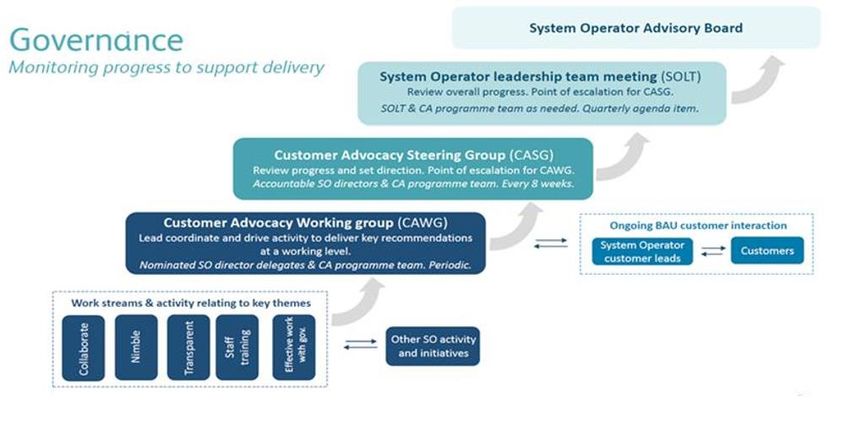
five key aspirations: To deliver these aspirations a working group
with representatives from across the System
• Collaborate more – a range of customer Operator was established. Each member is
types, especially Passenger Operators, responsible for one of the key aspirations
want greater and better collaboration and developed an action plan to improve
with the System Operator. our maturity in that area. To support the
working group, a Steering Group was also
• Be more nimble – while the System established, formed of five accountable
Operator’s rigor, robust approach and System Operator directors.
attention to detail are appreciated by
most customers across each of the See Appendix G for a visual of the
operational areas, there is also concern governance structure.
that the System Operator ‘tends to
bureaucracy’ and sometimes places The 2020/21 survey commenced in January
process ahead of practical outcomes. 2021 and has been delivered by market
research consultants Yonder (formerly
• Train staff better – particularly in the Populus) on our behalf. The conversations
timetabling area, customers want better have been conducted via Microsoft Teams
trained staff who know the rail industry or an equivalent platform depending on the
well rather than good general project customer’s preference, and whilst the
managers. survey is ongoing at time of writing, initial
indications show a very positive uptake on
• Be more transparent – some customers the survey and our customers have engaged
are concerned that the System Operator positively. This is encouraging and will
‘hides away in the shadows and they enable us and our Regional strategic
want the System Operator to be more planning colleagues to update
visible and transparent and ‘take them improvement plans for the coming year.
on the journey to getting to the
decision’.
28OFFICIAL
5. Delivery and
Activity Plans
The following pages set out the activities and outputs we plan to deliver in
2021/22, through our operating model, to achieve the best outcomes for
customers, funders, the rail industry and the wider economy. We will
continue to update these plans on an annual basis working with our
customers and stakeholders.
29OFFICIAL
5.1 Long-term Planning
5.1.1 Strategy and Planning – Whole 5.1.2 Strategy and Planning - Network
Industry Strategic Plan (WISP) Level Planning
The Secretary of State for Transport (SoS)
System Operator is accountable for the
has asked Network Rail to lead the
future of the rail network being planned in
collaborative development of a long-term
an efficient, effective and impartial manner.
(30 year) strategy for the railway by the rail
As part of the System Operator
industry, known as the Whole Industry
transformation in 2020, the accountability
Strategic Plan (WISP). The WISP seeks to
for regional medium- and long-term
support and inform decisions made by the
planning was devolved to the regions, whilst
SoS and other funders of the railway,
the System Operator retains accountability
including providing a longer-term context
for the strategic planning profession and
for decisions in relation to funding and
the long-term planning framework at a
outputs for the whole railway post-CP6.
network level.
The System Operator has created a new
Deciding what regional strategic questions
WISP team to lead this work, with a remit
need answering and when to do this work is
from the Department for Transport to
now the accountability of the regions.
define the frameworks in which the strategy
Making sure that there are common and
is developed and integrated, and to bring
agreed building blocks and a clear
together industry experts in a collaborative
framework within which this is done is the
fashion to develop a strategy with a clear
accountability of the System Operator. The
line of sight to key outcomes centred on
System Operator also delivers network level
passengers and freight customers,
Strategic Planning under the same
economic and social objectives and
framework and using the same building
environmental sustainability.
blocks. This means that long-term planning
The WISP will also be developed in close is carried out to a consistently high
collaboration with Network Rail’s regions, standard in line with our licence condition.
taking into account the aspirations, A library of completed and planned
forecasts and priorities of funders, Sub- strategic planning work will be held by the
National Transport Bodies, combined System Operator so that there can be clear
authorities and regional/’metro’ mayors. communication to our stakeholders on the
portfolio of strategic planning activity that
is taking place across the network and the
recommendations that result from it.
30OFFICIAL
5.1 Long-term Planning
Strategic Planning will draw on initiatives Network Strategy activity over the coming
such as Better Value Rail (a tripartite DfT- year will include delivery of an overarching
NR-ORR initiative, led by the System Freight Strategy that will bring together
strategic activity such as the economic
Operator for Network Rail - looking at how value of freight to UK PLC, the strategic
the industry can deliver outcomes more corridors and traffic flows and growth
efficiently and effectively to deliver better forecasts for these and how they can be
value) and other Network Rail programmes accommodated. this will support the WISP
focussed on speed and efficiency of activity described earlier. We will also act as
delivery. an integrator for the traction
decarbonisation portfolio, providing a link
The System Operator is accountable for
between the regions’ evolving
leading the strategic planning profession
decarbonisation plans and the Traction
and all that it entails, including the
Decarbonisation Network Strategy. This will
framework for delivery referred to
give confidence to funders and stakeholders
previously; competency requirements for
that NR is seeking to deliver governments’
strategic planners; the building blocks of
decarbonisation policies efficiently and
consistent information for strategic plans
effectively. Other areas of Network
and a view of the integration of the
Strategy delivery are described in our Long
strategic planning activity being carried out
term planning deliveries table.
across the industry. This integration of
strategic planning starts the process of In order to support the quality of the
ensuring network integrity that then strategic advice that we provide, it is vital
continues through our operating model via that our engagement with other arm’s
Network Integration, the Programme length bodies such as Highways England
Management Office and Timetable continues, to give coordinated advice to
Development. Network Integration Fora funders and specifiers.
are being established with the regions in
order to provide a regular, formal discussion
on the strategic planning and network
integration activity that is underway in the
region and within the System Operator.
This will allow stakeholders and the
regulator to be assured that strategic
planning activity is being carried out
effectively, consistently and transparently.
It will also support the sharing of best
practice and provide a route for resolution
of any issues that arise.
31OFFICIAL
5.1 Long Term Planning
The System Operator also has a valuable 5.1.3 Integrated Rail Plan
role working between national funders and
The Integrated Rail Plan (IRP) is currently
regional strategic planning teams We have
expected to be published in early 2021 and
worked closely with DfT on a consistent
will describe the government’s strategy to
network-wide approach to the Restore Your
transform rail services across the North and
Railway portfolio which also allows for
the Midlands. Following the publication of
dissemination of best practice and an
the National Infrastructure Commission’s
integrated approach to support both
advice, System Operator continues to
regions and funders with this network wide
support DfT in providing advice using
portfolio to deliver improved connectivity
evidence from its Northern Powerhouse Rail
for communities.
(NPR) and HS2 Phase 2b teams.
The System Operator is also working closely
The IRP is expected to be published shortly
with the DfT and the National
and the System Operator will continue to
Infrastructure Commission to develop a
work with DfT, Midlands Connect, Transport
plan for the integration of HS2 Phase 2b
for the North and HS2 Ltd to take forward
with Northern Powerhouse Rail (NPR) and
the strategy laid out within the IRP. This
Midlands Connect’s (MC) aspirations. This
section will be updated on publication of
later review was subsequently confirmed as
the IRP identifying the work to be
the Integrated Rail Plan for the Midlands
completed with associated deliverables.
and the North (IRP).
The programmes of work that are underway
are described in the ‘deliverables’ section at
the end of this chapter. We will continue to
develop our plans for these workstreams,
and reflect key deliverables in our scorecard
structure throughout the year.
32OFFICIAL
5.1 Long Term Planning
5.1 Long-term Planning Deliverables
By summer 2021, in cooperation with DfT and ORR, we will launch
the Better Value Rail framework for use by project promoters
Better Value across the industry and external transport planning community.
Railway Consistent with wider government objectives, adoption of the BVR
framework will facilitate making better decisions earlier leading to
improved project solutions at reduced cost in reduced timescales.
We will continue to work collaboratively with Regions, train
operators, DfT and scheme promoters to assess and develop the
business cases for RYR proposals, enabling the CP6 RYR fund to be
Restoring Your fully allocated. Additionally for all committed proposals we will
Railway facilitate industry adoption of ‘Project Speed’ principals across the
RYR portfolio to maximise passenger value in terms of increased
community connectivity by the end of CP6.
In addition to enhancements to the handling capacity of rail-
connected terminals (i.e. the quantity of material the facility itself
can process), there also remains room for improvement to the
capability of several railheads and branch lines serving them
around London in terms of the maximum length of train that they
can accommodate. A number of railheads are routinely receiving
trains of fewer than 20 wagons and in certain instances this is due
to operable train length constraints arising from sidings
London infrastructure either within or connecting to them. Establishing a
consistent minimum standard of train length capability across all
Rail London construction terminals would enable many services to be
Freight lengthened. This would in turn ensure a consistent minimum
Strategy payload for all trains, increasing the efficiency of rail freight even
Freight - Target further. Industry stakeholders view 20-wagon operation of
construction trains across the London area, equivalent to a
26
standard load of about 2000t, as an achievable minimum to work
towards. This could require enhancements to connecting
infrastructure at terminals that do not currently meet this level of
capability. This cross-London programme of works will examine a
consistent operational standard for construction sector terminals.
It is envisaged that this workstream would make 20 wagons its
threshold train dimension, with an aspiration toward achievement
of optimal 26 wagon operation (an established contemporary
maxima for single loco operation, as evidenced by trains now). This
work will begin in the first quarter of 21/22.
33You can also read


