Tamworth Regional Council Section 94 (Direct) Development Contributions Plan 2013 - Adopted by Council: 9 April 2013 Effective from: 13 April 2013 ...
←
→
Page content transcription
If your browser does not render page correctly, please read the page content below
Tamworth Regional Council
Section 94 (Direct)
Development Contributions Plan 2013

Adopted by Council: 9 April 2013
Effective from: 13 April 2013

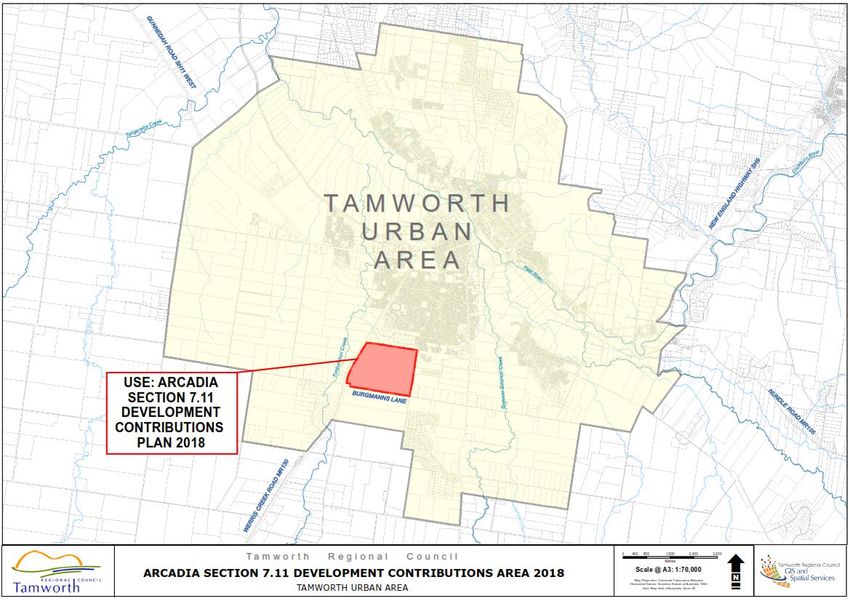
Update 1: (Arcadia Map)
Effective from: 7 April 2018

Tamworth Regional Council
Section 94 (Direct) Development Contributions Plan 2013

Tamworth Regional Council
PO Box 555
Tamworth NSW 2340

Telephone:      (02) 6767 5555
Facsimile:      (02) 6767 5499
e-mail:         trc@tamworth.nsw.gov.au
internet:       www.tamworth.nsw.gov.au

Specialist advisors:

Disclaimer
Every effort has been made to provide accurate and complete information. However, the authors assume no
responsibility for any direct, indirect, incidental, or consequential damages arising from the use of information in this
document.

Copyright Notice
No part of this publication may be reproduced in any form, or stored in a database or retrieval system, or transmitted or
distributed in any form by any means, electronic, mechanical photocopying, recording, or otherwise without written
permission from Tamworth Regional Council. All rights reserved.

Copyright © 2013, Tamworth Regional Council
Copyright © 2018, Tamworth Regional Council (Insertion of Arcadia Map)
Tamworth Regional Council
Section 94 (Direct) Development Contributions Plan 2013

Executive Summary

Purpose and Objectives of the Plan
This Plan is the Tamworth Regional Council Section 94 (Direct) Development Contributions
Plan 2013 and has been prepared to satisfy the requirements of the Environmental Planning and
Assessment Act and Regulation, enabling Council or an accredited certifier to levy development for
the provision of community infrastructure required to meet the demands of that development.
In order to levy these contributions when granting consent to development, Council must be satisfied
that the proposed development will or is likely to require the provision of or increase the demand for
the community infrastructure for which the levy is being required.
This Plan will ensure that adequate community infrastructure is provided to meet the demands
generated by new development and that the existing community is not burdened by the provision of
community infrastructure required as a result of future development.
In addition, this Plan provides an administrative framework under which specific community
infrastructure strategies may be implemented and coordinated and a comprehensive strategy for the
assessment, collection, expenditure, accounting and review of development contributions on a
reasonable and equitable basis. In this way, Council can be publicly and financially accountable in
its assessment and administration of the Plan.
Nature of future development
Between 2012 and 2021, there is forecast to be 4,320 additional private residential dwellings in the
Tamworth LGA generating an additional population of 11,730 new residents over this ten year period.
This future residential population will create a demand for new, enhanced or augmented community
infrastructure and hence all new residential development is to be levied under this Plan.
In addition, this Plan levies for public car parking for non-residential development in the Tamworth
Central Business District that is unable to meet its on-site requirements under Council’s DCP and
also levies for road haulage for development entailing heavy vehicular traffic.
Life of the Plan
The Plan caters for a planning period from 2012 to 2021 which is the period for which residential
population forecasts have been prepared, based on a number of Council strategies which provide for
additional development over this period.
The Plan will be monitored during this time to ensure that community facilities are provided as
development proceeds and to amend the Plan if necessary, as it is unlikely that growth will remain
exactly in accordance with that forecast in the Plan.
The cost estimates and land values within the Plan will be indexed between the date of adoption of
this Plan and the date of payment of the contribution. Cost estimates and land values will also be
monitored during the life of the Plan to ensure that they reflect current costs and if necessary,
amendments will be made to the Plan.
Apportionment of costs
To ensure that future development is only levied for the demand it generates, the cost of some
facilities in this Plan are apportioned to account for demands of the existing population. However,
where the demand for facilities is solely as a consequence of future development, the full costs of
those facilities are to be borne by future development.
This Plan also accounts for the varying demands generated by different types of development.
Where for instance, standalone dwelling houses generate greater demand for a particular facility than
does multi-unit housing (due to varying occupancy rates for instance), it will be levied a greater
proportion of the costs of that facility.
Apportionment rationales are detailed within the Plan and relate to, amongst other things, the level of
traffic generation of different types of development.

ii
Tamworth Regional Council
Section 94 (Direct) Development Contributions Plan 2013

Summary of contributions by facility type
Table E1 summarises the facilities for which contributions are sought under this Plan and the base upon which levies are to be calculated ($2013):

 Table E1: Summary of Contribution Rates by Facility Type by Sub-CatchmentA

                                                                                                                                                                                                       Tamworth Urban
 Facility Category                                             Base Factor to Generate Contribution Rate                           Calala                Hills Plain             Kootingal
                                                                                                                                                                                                        Area (Residue)

 Roads                                                         per Peak Vehicle Trip (PVT)                                           $5,911.96                $7,581.40                $1,223.69                   $1,703.84

 Car Parking                                                   per car parking space not provided on-siteB                                   N/A                     N/A                      N/A                 $15,710.00

 Open Space and Recreation (Land)                              per person (residential)                                              $2,657.12                $1,826.48                $1,510.33                       $51.60

 Open Space and Recreation (Capital)                           per person (residential)                                                 $485.40                 $163.08                  $771.82                     $160.08

 Plan Preparation and Administration                           per person (residential)                                                  $97.11                   $84.46                  $52.14                       $14.37

 Road Haulage                                                  per tonne                                                                                               See Note C

 Notes:
 A. See Figure 1.
 B. Applies to non-residential development in the CBD only (see Section 4.2 and Figure 2).
 C. Applies to agriculture, extractive industry, forestry, freight transport facilities, industry, mining, rural industry, transport depots, truck depots and waste or resource management facilities (see Section 4.4).

For the purposes of applying this Plan, the above rates are converted to a development type as set out in Table E2 below.

iii
Tamworth Regional Council
Section 94 (Direct) Development Contributions Plan 2013
Summary of contributions by development type
Table E2 summarises the total contribution rates per development type as at the time that this Plan is adopted. The rates will be indexed between the date of
commencement of the Plan and the date payment (see Section 2.6 for further details). A development consent or complying development certificate will reflect
the indexed rate that applies at that the date of consent.
Table E2: Summary of Contribution Rates by Development Type by Sub-CatchmentA
Contribution by Sub-CatchmentC
Base Occupancy
Development Type PVTs
(per) RateB Tamworth Urban
Calala Hills Plain Kootingal
Area (Residue)
Contribution for Land and Capital
Dwelling House / Lot, Exhibition Home dwelling 2.79 0.85 $14,054.89 $12,225.07 $7,546.46 $2,078.34
Residential AccommodationD with 1 bedroom / bedsit dwelling 1.10 0.45 $6,234.14 $5,699.57 $3,125.71 $1,016.10
D
Residential Accommodation with 2 bedrooms dwelling 1.49 0.45 $7,490.45 $6,503.87 $4,030.94 $1,103.76
D
Residential Accommodation with 3 or more bedrooms dwelling 2.13 0.575 $10,295.01 $8,773.92 $5,672.23 $1,460.87
Contribution for Capital Only (i.e. excluding Land)
Dwelling House / Lot, Exhibition Home dwelling 2.79 0.85 $6,648.78 $7,134.16 $3,336.75 $1,934.50
D
Residential Accommodation with 1 bedroom / bedsit dwelling 1.10 0.45 $3,302.97 $3,684.70 $1,459.61 $959.17
D
Residential Accommodation with 2 bedrooms dwelling 1.49 0.45 $3,528.86 $3,780.70 $1,779.14 $1,026.82
D
Residential Accommodation with 3 or more bedrooms dwelling 2.13 0.575 $4,639.26 $4,886.21 $2,457.45 $1,351.03
Other Development See Note E
Notes:
A. See Figure 1.
B. This is the forecast average occupancy rate of new dwellings in the LGA between 2012 and 2021.
C. All figures exclude Tamworth CBD Car Parking.
D. Excluding dwelling houses/residential lots/exhibition homes.
E. Other development not specified in this table (such as canal estate development, caravan parks, eco-tourist facilities, moveable dwellings and tourist and visitor accommodation) will be assessed in accordance
with Section 1.5 of this Plan and the per person and per PVT rates specified in Table E1.
ivTamworth Regional Council
Section 94 (Direct) Development Contributions Plan 2013
Table E3 provides specific details of the constituent components of the contribution rate for single dwelling houses /new residential lots at the time that this Plan
is publicly exhibited.
Table E3: Contribution Rate per Single Dwelling House / Lot by Sub-CatchmentA
Contribution by Sub-CatchmentB
Facility Type
Tamworth Urban Area
Calala Hills Plain Kootingal
(Residue)
Roads $5,025.17 $6,444.19 $1,040.13 $1,448.26
Open Space and Recreation Facilities (Land) $7,406.12 $5,090.91 $4,209.71 $143.84
Open Space and Recreation Facilities (Capital) $1,352.94 $454.55 $2,151.29 $446.18
Plan Preparation and Administration $270.66 $235.43 $145.33 $40.06
TOTAL $14,054.89 $12,225.07 $7,546.46 $2,078.34
Notes:
A. See Figure 1.
B. All figures exclude Tamworth CBD Car Parking.
vTamworth Regional Council
Section 94 (Direct) Development Contributions Plan 2013
Summary of works schedule
The works to be provided by funds generated by this Plan are summarised in the Table E4. A
specific code has been applied to the individual projects referred to in the schedule of works at
Appendix B.
Table E4: Summary of Works Schedule
Cost Attributable Cost
Reference/
Description to New Attributable to Total Cost
Code
Development Council/Others
Road Facilities
R-100 Calala $4,271,395 $192,803 $4,464,198
R-200 Hills Plain $7,088,605 $20,681,395 $27,770,000
R-300 Kootingal $260,033 $215,636 $475,669
R-400 Tamworth Urban Area (Residue) $2,520,800 $2,566,200 $5,087,000
Sub-Total $14,140,833 $23,656,034 $37,796,867
Open Space and Recreation Facilities
OS-100 Calala $7,445,200 $0 $7,445,200
OS-200 Hills Plain $6,100,000 $0 $6,100,000
OS-300 Kootingal $1,590,250 $464,750 $2,055,000
OS-400 Tamworth Urban Area (Residue) $1,025,500 $0 $1,025,500
Sub-Total $16,160,950 $464,750 $16,625,700
Plan Preparation and Administration
PA-100 Preparation of Contributions Plan $45,000 $0 $45,000
PA-200 Plan Administration $550,000 $0 $550,000
Sub-total $595,000 $0 $595,000
TOTAL $30,896,783 $24,120,784 $55,017,567
viTamworth Regional Council Section 94 (Direct) Development Contributions Plan 2013 Table of Contents Executive Summary ii 1 Introduction 1 1.1 Name of this Plan 1 1.2 Commencement of this Plan 1 1.3 Purpose and Objectives of this Plan 1 1.4 Land to which the Plan applies 1 1.5 Development forms to which this Plan applies 3 1.6 Operation Period of the Plan 3 1.7 Structure of this Plan 3 1.8 Glossary 3 1.9 Relationship with other plans, reports and policies 4 1.10 Savings and transitional arrangements 4 1.11 Key Considerations 4 2 Administration and operation of this Plan 5 2.1 Scope of this Plan 5 2.2 Types of community infrastructure addressed by this Plan 5 2.3 How will contributions be imposed? 5 2.4 Methods of payment 6 2.5 Timing of payments 8 2.6 Indexation of contributions 10 2.7 Exemptions 10 2.8 Allowances for existing development 11 2.9 Credits 11 2.10 Monitoring and review of the Plan 12 2.11 Accounting and management of funds 12 3 Expected development and demand for community infrastructure 14 3.1 Overview 14 3.2 Existing Population Characteristics 14 3.3 Forecast Development and Population 15 3.4 Demand for public facilities and services 18 4 Community infrastructure and contributions 20 4.1 Public roads 20 vii
Tamworth Regional Council
Section 94 (Direct) Development Contributions Plan 2013

4.2       Public car parking                                                                         22
4.3       Open space and recreation facilities                                                       24
4.4       Road Haulage                                                                               26
4.5       Plan Preparation and Studies                                                               29

Appendices
A.        Glossary
B.        Works Schedules
C.        Maps of Facility Locations by Sub-Catchment
D.        Pro forma Condition of Development Consent
E.        Pro forma Complying Development Certificate Condition
F.        References

Figures
1.        Map – Where this Plan applies and Sub-Catchments & Map where Arcadia S.7.11 Plan applies    2
2.        The Tamworth CBD                                                                           22

Tables
E1.       Summary of Contribution Rates by Facility Type by Sub-Catchment                            iii
E2.       Summary of Contribution Rates by Development Type by Sub-Catchment                         iv
E3.       Contribution Rate per Single Dwelling House / Lot by Sub-Catchment                          v
E4.       Summary of Works Schedule                                                                  vi
1.        TRC LGA Dwelling Composition (ABS, 2006 Census)                                            14
2.        Forecast Population 2012-2021                                                              16
3.        Estimated Residential Development 2006-2021                                                17
4.        Forecast Demographic Profile 2006-2021                                                     18
5.        Summary Rates for Road Facilities by Sub-Catchment                                         21
6.        Open Space Areas in Tamworth Regional Council LGA (TRC, 2012)                              24
7.        Summary Rates for Open Space and Recreation Facilities by Sub-Catchment                    25
8.        Plan Preparation and Administration                                                        29
9.        Summary Rates for Plan Preparation and Administration by Sub-Catchment                     30

viii
Tamworth Regional Council
Section 94 (Direct) Development Contributions Plan 2013

1        Introduction
1.1      Name of this Plan
         This Plan is the Tamworth Regional Council Section 94 (Direct) Development
         Contributions Plan 2013 (the “Plan”).

1.2      Commencement of this Plan
         This Plan has been prepared pursuant to the provisions of the Environmental Planning and
         Assessment Act 1979 (the Act) and the Environmental Planning and Assessment
         Regulation 2000 (the Regulation) and takes effect from the date on which public notice
         was published, pursuant to the Regulation.

1.3      Purpose and Objectives of this Plan
         This Plan has been prepared to satisfy the requirements of the Act, which enables Council
         or an accredited certifier to levy contributions from development for the provision of
         community infrastructure that is required to meet the demands of that development.
         Contributions may be in the form of a monetary contribution, dedication of land to Council
         or the provision of a material public benefit, which may include a work commonly referred
         to as a ‘work-in-kind’.
         In order to levy contributions under the Act, the Consent Authority must be satisfied that
         the proposed development will or is likely to require the provision of or increase the
         demand for the community infrastructure for which the levy is being required as detailed in
         the provisions of this Plan. Accordingly, the objectives of this Plan are to:
         (a)    authorise Council or an accredited certifier to impose conditions under the Act when
                granting consent to development on land to which this Plan applies including
                Complying Development;
         (b)    ensure that adequate community infrastructure is provided to meet the demands
                generated by new development;
         (c)    provide an administrative framework under which specific community infrastructure
                strategies may be implemented and coordinated;
         (d)    provide a comprehensive strategy for the assessment, collection, expenditure
                accounting and review of development contributions on an equitable basis;
         (e)    ensure that the existing community is not burdened by the provision of community
                infrastructure required as a result of future development;
         (f)    enable Council to be both publicly and financially accountable in its assessment and
                administration of the Plan.

1.4      Land to which the Plan applies
         This Plan applies to land within the Tamworth Regional Council Local Government Area
         (LGA) as shown on the Map (see Figure 1).

1
Tamworth Regional Council Section 94 (Direct) Development Contributions Plan 2013 Figure 1: Map – where this Plan applies and Sub-Catchments. Figure 1a: Map – where the Arcadia Section 7.11 Development Contributions Plan 2018 applies. 2
Tamworth Regional Council
Section 94 (Direct) Development Contributions Plan 2013
1.5 Development forms to which this Plan applies
This Plan applies to:
residential development which would result in the creation of additional private
lots/dwellings or in the case of non-private residential development, additional
dwellings, beds or people;
non-residential development in the Tamworth CBD which is unable to provide the
full on-site car parking requirement under Council’s DCP due to site constraints or
because it is desirable to deter vehicles from interfering with pedestrian movement
and public spaces;
development which results in heavy vehicle haulage including agriculture, extractive
industry, forestry, freight transport facilities, industry, mining, rural industry, transport
depots, truck depots and waste or resource management facilities.
Where development is of a type not specifically stated in this Plan but which would result in
additional demands for community infrastructure, Council will determine an appropriate
occupancy rate and/or traffic generation rate and apply the per person and/or per PVT
rates as specified in Table E1 of this Plan.
1.6 Operation Period of the Plan
The Plan is intended to cater for a planning period up to the year 2021 which is the period
for which residential population forecasts have been prepared.
The Plan will be monitored and if growth appears likely to occur earlier or later than
forecast, the operation period of the Plan may be adjusted to suit.
1.7 Structure of this Plan
This Plan is arranged into four sections:
Section 1 – Introduction (this section), identifies the name of the Plan, its commencement
date, the purpose, aims and objectives of the Plan, the land to which the Plan applies and
the Plan’s relationship to other plans, reports and policies.
Section 2 – Administration and operation of the Plan, outlines the scope of the Plan, the
forms of development to which it applies, the types of community infrastructure addressed
by the Plan, describes how and when contributions are to be made and provides details
regarding the ongoing management and review of the Plan.
Section 3 – Expected development and demand for community infrastructure, outlines the
forecast future development and basis for increased demand for facilities and services.
Section 4 – Community infrastructure and contributions, provides details of each category
of community infrastructure in the Plan, including details of existing provision, nexus, what
will be provided and when, apportionment and how contributions have been calculated.
The Appendices to this Plan include a Glossary which explains the meaning of words and
terms used in this Plan, a detailed Works Schedule, maps showing the location of facilities
by sub-catchment, pro-forma conditions for development consents and Complying
Development Certificates, and a list of References including the plans, policies and other
information which support the contents of the Plan.
1.8 Glossary
The meanings of key words and terms used in this Plan are contained in the Glossary at
Appendix A.
3Tamworth Regional Council
Section 94 (Direct) Development Contributions Plan 2013
1.9 Relationship with other plans, reports and policies
The Plan supplements the provisions of and should be read in conjunction with the Act and
Regulation, Tamworth Regional Council’s Local Environmental Plan, Development Control
Plan and other relevant plans and polices adopted by Council.
1.10 Savings and transitional arrangements
There are no savings or transitional provisions under this Plan. That is, if a development
application has been made before the commencement of this Plan in relation to land to
which this Plan applies and the application has not been finally determined before that
commencement, the application shall be determined in accordance with the provisions of
this Plan.
1.11 Key Considerations
There are a number of key considerations for development contributions that Council will
consider before introducing a development contributions plan or entering into a planning
agreement. These key considerations address the main principles that underpin the
development contributions system and their intent is to ensure that:
the demand for, cost and timing of infrastructure which is the subject of the
proposed contribution, has been fairly assessed; and
the proposed level of contributions will not unreasonably impact upon the
affordability of the development subject to the contribution.1
This Plan has been prepared giving due regard to these considerations.
1
Department of Planning, Draft Local Development Contributions Guidelines (November 2009)
4Tamworth Regional Council
Section 94 (Direct) Development Contributions Plan 2013
2 Administration and operation of this Plan
2.1 Scope of this Plan
Between 2012 and 2021, there is expected to be an increase in private residential
accommodation in the LGA of 4,320 dwellings accommodating 11,730 additional persons
(see Section 3). This future development in the LGA will create a demand for new,
enhanced or augmented community infrastructure.
In addition, there is likely to be an increase in haulage vehicle use of the existing road
network that will require additional maintenance of certain public roads.
This Plan has been prepared in response to this anticipated growth, to ensure that Council
is capable of meeting the demands from future development for community infrastructure.
This Plan sets out the range of community infrastructure considered necessary to cater for
this demand and how the cost of infrastructure will be imposed on development proposals.
2.2 Types of community infrastructure addressed by this Plan
2.2.1 Community infrastructure
Under this Plan, Council will require development contributions for the following
‘community infrastructure’:
Public roads, including:
- Road, bicycle and footpath infrastructure; and
- Traffic management facilities;
Public car parking facilities for non-residential development in the CBD where it is
impractical or undesirable to provide the car parking on-site;
Local open space and recreation facilities including:
- New and embellished public open space and associated landscaping;
- New and embellished recreation facilities including children’s play equipment;
District infrastructure of a kind referred to in the above bullet points where there is a
direct connection with the development to which the contribution relates;
Road haulage associated with the repair, maintenance and reconstruction of roads
which are used by heavy vehicles;
Preparation of this Plan and supporting studies; and
Administration and management activities associated with this Plan.
2.3 How will contributions be imposed?
In accordance with the Act, development contributions under this Plan will be imposed as a
condition of development consent (see guideline pro-forma condition at Appendix D) or as
a condition on a Complying Development Certificate (see guideline pro-forma condition at
Appendix E).
5Tamworth Regional Council
Section 94 (Direct) Development Contributions Plan 2013
2.4 Methods of payment
In accordance with the Act, an obligation to provide contributions toward community
infrastructure can be satisfied by one or more of the following methods:
Payment of a monetary contribution;
The dedication of land; or
Provision of a material public benefit.
Generally, the method of payment will be specified as a condition of the development
consent although Council may consider any of the abovementioned alternative methods of
payment at its sole discretion and in accordance with the provisions of this Plan (see
below).
2.4.1 Monetary contributions
Payment of contributions can be made by cash, money order, bank cheque, credit card or
any other means determined acceptable by Council from time to time.
2.4.2 Dedication of land
In accordance with the provisions of this Plan, Council may require that land be dedicated
as a form of contribution toward the provision of community infrastructure. Where such
dedication is required, it must be undertaken in accordance with the following:
The process for dedication of land is to occur in conjunction with the payment of
monetary contributions applicable to any development consent granted for the land;
The dedication of land is to be ‘free of cost’ – meaning that all costs associated with
the dedication of the land and its transfer to Council's ownership (including but not
limited to survey, legal and administration costs) are to borne by the
applicant/developer;
At the time of transfer, the land is to be in a condition which is suitable for its
identified public purpose and is to be cleared of all rubbish and debris and have a
separate title.
2.4.3 Material public benefits / ‘works-in-kind’
Council may accept an offer by the applicant to provide an ‘in-kind’ contribution (i.e. the
applicant completes part or all of work/s identified in the Plan) or through provision of
another material public benefit (other than the dedication of land) in lieu of the applicant
satisfying its obligations under this Plan.
Council is under no obligation to accept works-in-kind or material public benefit offers and
in considering any such offer, will assess the benefits to the Council and the Community
and give due consideration to relevant matters including the following:
(a) an assessment of the value of the material public benefit proposed, which must be
provided by the applicant at the time of the request and must be independently
certified by a Quantity Surveyor who is registered with the Australian Institute of
Quantity Surveyors or a person who can demonstrate equivalent qualifications;
(b) the value of the material public benefit proposed is at least equal to the value of the
contribution that would otherwise be required under this Plan;
(c) an assessment that the design specification of the proposed material public benefit
is equivalent to that intended by the Plan, which must be provided by the applicant
at the time of the request and must be independently certified by a person who can
demonstrate qualifications relevant to the design of the facility;
(d) the extent to which the material public benefit satisfies the purpose for which the
contribution was sought;
6Tamworth Regional Council
Section 94 (Direct) Development Contributions Plan 2013
(e) the material public benefit being facilities which are already included in the Plan;
(f) the extent to which the material public benefit satisfies a community need or may
reduce the demand for levied items;
(g) the impending need to construct the material public benefit for which the
contributions are to be offset;
(h) the provision of the material public benefit will not prejudice the timing, the manner
or the orderly provision of public facilities included in the works program or the
financial integrity of Council's Plan;
(i) the provision of the material public benefit must not result in piecemeal delivery of
infrastructure or result in the need to reconstruct the works due to likely future
nearby developments (i.e. normally the works will need to relate to a whole street
block or a defined precinct); and
(j) Council will require the applicant to enter into a written agreement for the provision
of the works. It is Council’s preference that such an agreement should take the
form of a Planning Agreement (see Section 2.4.4).
In accepting other material public benefits, Council must be satisfied that the offer provides
a substantial benefit to the community not envisaged by the Plan and that this benefit
warrants Council accepting responsibility in fulfilling the intent of the Plan notwithstanding a
reduction in expected cash contributions.
A work-in-kind relates to the undertaking of a specific or equivalent work specified in the
Plan, and is therefore more readily capable, in comparison to other material public benefits
of meeting the above criteria.
However, Council may not accept an offset to the cash otherwise required to be paid which
exceeds the quantum of cash payable under the facility category that relates to the work-
in-kind. For example, if a condition of development consent requires a certain cash
payment towards roads, the provision of a work-in-kind for road works proposed by the
Plan will meet only the cash payment required towards roads by that consent, even if the
cost of the works exceeds that amount.
2.4.4 Planning agreements
An applicant may voluntarily offer to enter into a planning agreement with Council in
connection with a development application. Under a planning agreement, the applicant
may offer to pay money, dedicate land, carry out works, or provide other material public
benefits for public purposes. The applicant’s provision under a planning agreement may
be additional to or instead of making contributions provided for by the Act.
An applicant’s offer to enter into a planning agreement, together with the draft agreement,
will generally need to accompany the relevant development application or an application to
modify the development consent. Council may also consider an offer to enter into a
planning agreement where an applicant has sought a change to an environmental planning
instrument (commonly referred to as a rezoning application).
Council will publicly notify the draft planning agreement and explanatory note relating to
the draft agreement along with the relevant application and will consider the draft planning
agreement as part of its assessment of the relevant application.
If Council agrees to enter into the planning agreement, it may impose a condition of
development consent requiring the agreement to be entered into and performed.
7Tamworth Regional Council
Section 94 (Direct) Development Contributions Plan 2013
2.5 Timing of payments
A contribution must be paid to Council at the time specified in the condition of development
consent that imposes the contribution. If no such time is specified, the contribution must
be paid:
In the case of subdivisions - prior to the issue of the Subdivision Certificate for each
stage; or
In the case of development involving building work – prior to the issue of the first
Construction Certificate; or
In the case of development that involves both subdivision and building work – prior
to issue of the Subdivision Certificate or first Construction Certificate, whichever
occurs first; or
In the case of development that does not involve subdivision or building work – prior
to occupation or the issue of an interim occupation certificate or issue of a final
occupation certificate, whichever occurs first; or
In the case of Complying Development:
- where works are proposed - prior to any works commencing; or
- where no works are proposed - prior to occupation or issue of an interim occupation
certificate or issue of a final occupation certificate, whichever occurs first.
In the case of road haulage levies – on a monthly or quarterly basis.
It is the responsibility of the an accredited certifier to ensure that a condition is
imposed on a complying development certificate in accordance with this Plan and
that any monetary contributions have been paid to Council prior to authorising
works to commence.
2.5.1 Deferred or periodic payments
Deferred payment of development contributions may be permitted in certain circumstances
in accordance with the criteria outlined below:
(a) an application for deferred payment or payment by instalments is to be made in
writing to Council explaining the circumstances of the request;
(b) the decision to allow deferred payment will be at the sole discretion of Council;
(c) the timing or the manner of the provision of public facilities included in the works
program will not be prejudiced;
(d) the works to which the request applies does not relate to public safety or health;
(e) the amount of the contribution or outstanding balance is not less than $5,000;
(f) where the applicant intends to make a contribution by way of a planning agreement,
material public benefit or work-in-kind in lieu of a cash contribution or by land
dedication and Council and the applicant have a legally binding agreement for the
provision of the works or land dedication;
(g) the maximum period of deferred payment of the contribution is two years from the
standard payment date; and
(h) the maximum period for payment by instalments is five years from the standard
payment date;
(i) deferred payments and payments by instalments are subject to interest charges
equivalent to that applied to overdue rates and an administration charge equivalent
to the bank guarantee lodgement fee for subdivision related matters as stated in
Council’s Fees and Charges.
8Tamworth Regional Council
Section 94 (Direct) Development Contributions Plan 2013
If Council does decide to accept deferred payment or payment by instalments, Council will
require the applicant to provide a bank guarantee with the following conditions:
The Bank Guarantee(s) must be in Australian Dollars from a major Australian
Trading Bank and in the name of Tamworth Regional Council;
The Bank Guarantee(s) must have no end date, be unconditional and irrevocable,
and be in favour of Tamworth Regional Council;
The sum of the Bank Guarantee(s) will be the amount due to Council at the date of
issue, plus an additional amount specified by Council to make provision for any
anticipated indexation during the life of the Bank Guarantee until the estimated date
of release;
the bank unconditionally pays the guaranteed sum to Council if Council so demands
in writing;
the bank must pay the guaranteed sum without reference to the applicant or
landowner or other person who provided the guarantee, and without regard to any
dispute, controversy, issue or other matter relating to the development consent or
the carrying out of development;
the bank's obligations are discharged when payment to Council is made in
accordance with this guarantee or when Council notifies the bank in writing that the
guarantee is no longer required;
where a bank guarantee has been deposited with Council, the guarantee shall not
be cancelled until such time as the original contribution, indexation and other
charges are paid.
2.5.2 Construction certificates and the obligation of accredited certifiers
In accordance with the Act and the Regulation, a certifying authority must not issue a
construction certificate for building work or subdivision work under a development consent
unless it has verified that each condition requiring the payment of monetary contributions
has been satisfied.
In particular, the certifier must ensure that the applicant provides a receipt(s) confirming
that contributions have been fully paid and copies of such receipts must be included with
copies of the certified plans provided to Council in accordance with the Regulation. Failure
to follow this procedure may render such a certificate invalid.
The only exceptions to this requirement are where a material public benefit, dedication of
land, deferred payment or payment by instalments has been agreed by Council. In such
cases, Council will issue a letter confirming that an alternative payment method has been
agreed with the applicant.
2.5.3 Complying development and the obligation of accredited certifiers
In accordance with the Act, accredited certifiers must impose a condition on a Complying
Development Certificate, requiring monetary contributions in accordance with this Plan for
all types of development.
The conditions imposed must be consistent with Council's standard condition for
Complying Development Certificates (see Appendix E) and be strictly in accordance with
this Plan. It is the professional responsibility of an accredited certifier to inform themselves
of any amendments to this Plan (including current indexed rates), to accurately calculate
the contribution and to apply the development contributions condition correctly in
accordance with Council current consent condition requirements.
It is also the professional responsibility of an accredited certifier to ensure that any
applicable monetary contributions have been paid to Council prior to authorising works to
commence.
9Tamworth Regional Council
Section 94 (Direct) Development Contributions Plan 2013
2.6 Indexation of contributions
To ensure that the value of contributions is not eroded over time, the contributions stated in
this Plan will be indexed at the time of payment to reflect changes in the cost of facilities in
the following manner:
$CPY = $CPC x CPIPY
CPIPC
Where:
$CPY is the amount of the contribution at the date of Payment.
$CPC is the amount of the contribution for works schedule items at the date of the Plan
Commencement.
CPIPY is the Consumer Price Index (Sydney – All Groups) (CPI) as published by the
Australian Bureau of Statistics (ABS) for the financial year at the date of
Payment.
CPIPC is the CPI (Sydney – All Groups) as published by the ABS for the financial year
at the date of the Plan Commencement.
A development consent or complying development certificate will show the contribution
payable at the date the consent/certificate is issued. Contributions are subject to indexation
from the date the consent/certificate is issued to the date of payment in accordance with the
above formula.
Contribution rates under this Plan and the estimated costs upon which they are based will
also be indexed by Council on a regular basis consistent with the above methodology. The
adjustment of contribution rates and estimated costs will occur by way of an amendment
without the need to prepare a new contributions plan, in accordance with the Regulation.
The current contributions rates are available from Council Administration Offices or
Council’s website.
2.7 Exemptions
Council will not provide exemption to development contributions made under this Plan
other than exemptions or discounts afforded under direction of the Minister for Planning
and Infrastructure. At the time of commencement, these Ministerial exemptions and
discounts included:
development undertaken by a ‘social housing provider’ for the purposes of ‘seniors
housing’ as defined in State Environmental Planning Policy (Housing for Seniors or
People with a Disability) 2004;
development for the purposes of a school (as defined by the Education Act 1990)
that is a project under the Building the Education Revolution (BER) program;
development within a greenfield urban release area for the purpose of one or more
dwellings or in the case of subdivision, the creation of one or more residential lots, is
limited to $30,000 for each dwelling or lot authorised by the development consent;
and
development within an established urban area for the purpose of one or more
dwellings or in the case of subdivision, the creation of one or more residential lots, is
limited to $20,000 for each dwelling or lot authorised by the development consent.
Council does not apply discounts to the payment of development contributions unless
otherwise stated in this Plan.
10Tamworth Regional Council
Section 94 (Direct) Development Contributions Plan 2013
2.8 Allowances for existing development
All forecasts of future additional development within this Plan have been calculated
allowing for existing development at the time of preparing the Plan (i.e. as at 1 January
2012).
Contributions required under this Plan will be levied according to the estimated net
increase in demand. An amount equivalent to the contribution attributable to any existing
lawful development on the site of a proposed new development, at the time of undertaking
the demand assessment underpinning this Plan, will be allowed for in the calculation of
contributions.
Accordingly, if an applicant wishes to obtain an allowance against contributions payable
based on pre-existing development, information must be provided with the development
application which demonstrates the lawful existence of the development on the subject site
as at 1 January 2012.
Council will only consider an allowance for the existing development to the extent of the
demand for specific community facilities and services arising from that development. For
instance, where a residential development is proposed which replaces an employment
generating land use, there may be a reduced peak traffic generation relative to the site’s
prior use. In this case, no levy would be applicable toward roads. Council will not
however, accept a state of credit as such a reduction in demand for this type of facility
does not offset the demand for other facilities and services.
For instance, the same development may result in an increase in demand for other
services such as public open space, which are distinct from traffic demands. Accordingly,
the levies under this Plan for these other facilities and services would continue to apply.
2.9 Credits
A credit may be provided by Council where the net contributions provided by any particular
development exceed that required by the Plan. This could arise where a developer
proposes the provision of a material public benefit or dedication of land, at a value
determined by Council to exceed the amount of cash otherwise payable in accordance with
the Plan. However, credits will only be provided at Council’s absolute discretion.
A credit will be provided only against the same facility category for which the surplus
contribution relates. For example, if the developer proposes to dedicate more public open
space that would otherwise be required under the Plan, then a credit could be accrued
against open space contributions requirements of future development.
Consequently, if a developer dedicates more public open space than would otherwise be
required under the Plan, the value of the additional open space cannot be used the offset
the cash contribution otherwise payable under a different contribution category, such as
roads. The objective is to ensure that Council maintains an adequate flow of contributions
across the range of facilities to be funded under this Plan to provide for the orderly and
staged delivery of all categories of facilities.
The amount and terms of the credit are to be negotiated prior to the dedication of land or
commencement of works and will be for the additional value only as agreed by Council. If
agreed, Council will advise the applicant of the credit which would be redeemable in lieu of
contributions in the same facility category otherwise payable by the developer for future
development in the area to which this Plan applies.
Council reserves the right to require payment of a monetary contribution or to terminate the
‘credit agreement’ should the applicant be unwilling or unable to meet its terms. No credit
will be given for land or works which are not nominated in the works schedule in this Plan.
11Tamworth Regional Council
Section 94 (Direct) Development Contributions Plan 2013
If a developer seeks to off-set a credit against the cash payable under a different facility
category or to be reimbursed in cash, then this would need to be negotiated with Council
as part of a planning agreement or a works-in-kind/material public benefit agreement in
accordance with the provisions of this Plan.
2.10 Monitoring and review of the Plan
It is intended that this Plan be monitored and reviewed on a regular basis as it contains
forecasts of future development including likely future population and about the likely
demands and costs of providing community infrastructure for that population.
Monitoring actual developments, population changes and community demands will allow
appropriate updating and amendment as necessary.
The cost of works proposed by the Plan (including land values) may also need review over
time if there is a concern that the indexation of costs may not be adequately reflecting
actual current costs.
Council’s aim is that all forecasts, costs and assumptions are reviewed and adjustments
and/or amendments as appropriate will be made at five yearly intervals after the date of
adoption of this Plan.
2.11 Accounting and management of funds
2.11.1 Accounting standards and contributions register
Separate accounting records are maintained for all development contributions made to
Council under this Plan and a development contributions register will be maintained by
Council in accordance with the Regulation.
Council is also required to publish details of development contributions accounts annually
and this is undertaken as part of Council annual financial reporting cycle.
2.11.2 Treatment of funds received prior to the commencement of this Plan
Funds levied and received under previous plans prior to 1 July 2012 will be used to deliver
community infrastructure of the same facility category identified under this Plan as ‘Cost
Attributable to Council’ as these funds were levied to meet the demands of that prior
development.
Funds levied and received under previous plans from 1 July 2012 will be used toward the
delivery of community infrastructure of the same facility category identified under this Plan
as ‘Cost Attributable to New Development’.
2.11.3 Investment of funds
To maintain the time-value of monetary contributions received under this Plan, Council will
invest these funds until the time of expenditure for the purpose for which they were
received.
Council will report all investment returns as part of its annual contributions accounts
reporting and all investment returns will be retained within the development contributions
accounts, to be used of the purpose for which the original contribution was made.
2.11.4 Pooling of contributions
This Plan expressly authorises monetary contributions paid for different purposes to be
pooled and applied (progressively or otherwise) for those purposes. The priorities for the
expenditure of the levies are shown in the works schedule.
12Tamworth Regional Council
Section 94 (Direct) Development Contributions Plan 2013
2.11.5 Other funding sources
All works proposed in this Plan represent infrastructure to be funded pursuant to the
development contributions provisions of the Act.
There were no grants or other external funding sources secured for the works proposed in
this Plan, at the time of its adoption. Should such funding become available in the future,
the works schedule in this Plan will be reviewed and the contribution rates may be
adjusted.
2.11.6 Goods and services tax
At the date of preparing this Plan, monetary development contributions were exempt from
the Federal Government Goods and Services Tax (GST).
In addition, at the date of preparing this Plan, Council’s advice was that non-monetary
contributions by way of dedication of land, works-in-kind or material public benefit in lieu of
contributions that would be exempt under Section 81-5 of the GST Act, do not constitute a
taxable supply. Therefore, there are no GST implications for non-monetary contributions.
However, if legislative changes (including Australian Tax Office tax rulings) determine
otherwise, contributions in this Plan will be adjusted to include GST.
13Tamworth Regional Council
Section 94 (Direct) Development Contributions Plan 2013
3 Expected development and demand for community infrastructure
3.1 Overview
The TRC LGA is located in the Northern Region of NSW and is bordered by Gwydir to the
north, Uralla and Walcha to the east, the Upper Hunter to the south and Narrabri,
Gunnedah and Liverpool Plains to the west.
The regional centre of Tamworth is supported by the towns of Kootingal, Barraba, Manilla
and Nundle as well as 19 other villages.
Future residential development is expected to occur primarily in designated Urban Release
Areas (URAs) in and around Tamworth centre, although it is also recognised that there is
considerable scope for infill development throughout the remainder of the LGA.
3.2 Existing Population Characteristics
The LGA comprises a total land area of approximately 9,900 square kilometres and the
total resident population was 53,670 persons2 in 2006 (ABS, 2006).
Table 1 provides a brief summary of the dwelling composition in the LGA, according to the
2006 ABS Census.
Table 1: TRC LGA Dwelling Composition (ABS, 2006)
Dwelling type Dwelling Units %
Separate House 17,971 79.3
Medium DensityA 2,277 10.0
B
High Density 94 0.4
Other Dwellings/Not Stated 295 1.3
Unoccupied Dwellings 2,032 9.0
Total 22,668 100
Notes:
A. Includes all semi-detached, row, terrace, townhouses and villa units, plus flats and apartments in blocks of 1 or 2
storeys, and flats attached to houses;
B. Includes flats and apartments in 3 storey and larger blocks.
Approximately 1,830 dwellings have been constructed between the 2006 census and the
end of 2011, with an estimated population in these dwellings of 4,840 persons. This
provides an estimated existing population to the end of 2011 of 58,510 persons.
This population varies only very slightly (0.12%) from the ABS’s 2011 Estimated Resident
Population (ERP) of 58,351 persons.
In addition, this Plan’s estimate of 58,510 persons varies only slightly (less than 4%) from
the ABS’s early release 2011 Census population of 56,292 persons.
Both the ERP and the early release population are subject to change and only account for
population to 30 June 2011 rather than the end of 2011.
Accordingly, it is considered that the estimate of population to the end of 2011 stated in
this Plan is a reasonable estimate and with sensitivity testing of +/- 4% is within the range
of the ABS’s current population estimates.
2
NB: This includes persons in private dwellings plus persons in non-private dwellings but does not include visitors
(based on the Place of Usual Residence statistics from the 2006 ABS Census). This figure may vary to figures quoted
elsewhere which may represent all persons enumerated on the night of the Census (Place of Enumeration) or other
temporal adjustments such as the Estimated Resident Population data set.
14Tamworth Regional Council
Section 94 (Direct) Development Contributions Plan 2013
For the purposes of this Plan, Council must also have regard to the future population within
dwellings which have been approved but not yet constructed as these dwellings have been
levied under previous contributions plans and cannot be levied under this Plan.
It is estimated that 1,530 dwellings have been approved by Council but not yet constructed
as at 1 January 2012 and these dwellings are anticipated to house a further 4,250 persons.
Accordingly, when these dwellings and persons are added to the 2006 Census figures and
known completions, a population of 62,760 persons as at 1 January 2012. This population
is deemed to be ‘existing’ for the purposes of this Plan as it is not able to be levied under
this Plan and the demand for community infrastructure for this population has been met by
way of existing facilities and/or will be met by the contributions levied under previous
contributions plans.
The LGA is ranked 77 out of 153 LGAs in NSW with regard to the Socio Economic Index of
Disadvantage/Advantage (SEIFA) where 1 is the most disadvantaged LGA and 153 the
least disadvantaged LGA (ABS, 2006b).
Approximately 5.1% of the resident population was born elsewhere than Australia although
only 1.7% speak a language other than English at home which is far less than the New
South Wales average of 20.1%. Notwithstanding this, the TRC LGA has a culturally
diverse population with over 30 different countries of origin represented.
The median household income in the LGA in 2006 was $818 per week which is lower than
the NSW average of $1,035 per week.
The most dominant family type in 2006 was couple without children (41.6%) which was
lower than the NSW average of 46.2%. Approximately 25.3% of the population live in lone
person households, which is slightly higher than the NSW average of 23%.
3.3 Forecast Development and Population
3.3.1 Introduction
Residential forecasts for the LGA have been undertaken to inform the various tables in this
section. These forecasts are based on:
(a) 2006 ABS Census data;
(b) Historical development approvals and constructions;
(c) Adopted and emerging draft master plans for urban release areas and significant
redevelopment sites; and
(d) Estimates of potential infill development in existing urban areas.
The following subsections provide a brief summary of the data derived from these sources,
for the purposes of forecasting the future residential growth in the LGA to the year 2021.
3.3.2 Forecast Residential Development
Table 2 provides a summary of the estimated existing dwellings and resident population in
the LGA as at 1 January 2012. This is based on 2006 ABS data with additions for known
dwelling completions and approved but not yet constructed dwellings. The latter has been
included in the existing calculations as it has been levied under previous development
contributions plans and cannot therefore be levied again under this Plan.
15Tamworth Regional Council
Section 94 (Direct) Development Contributions Plan 2013
A
Table 2: Forecast Population 2012-2021
B E
Estimated Existing 2012 Forecast 2012-2021 Forecast at 2021 Forecast 2022+
Locality
C Occupancy C,F G C C,F
Dwellings Persons D Dwellings Persons Dwellings Persons Dwellings Persons
Rate
Calala 1,350 3,650 2.78 850 2,370 2,200 6,020 0 0
Hills Plain 1,480 4,120 2.78 1,100 3,070 2,580 7,180 520 1,450
Kootingal 640 1,660 2.77 250 700 890 2,360 230 630
Tamworth Urban Area (Residue) 16,850 40,780 2.48 1,835 4,840 18,690 45,620 710 1,970
Rest of LGA 5,710 12,550 2.49 285 750 5,990 13,310 0 0
TOTALS 26,030 62,760 2.49 4,320 11,730 30,350 74,490 1,460 4,050
Notes:
A. All figures rounded to the nearest 10
B. The estimated ‘existing’ population to 1 January 2012 is described in Section 3.2 of this Plan and varies from ABS early release 2011 Census data and ERP due to the manner in which
estimates are undertaken and the time period to which those estimates relate.
C. Includes occupied and unoccupied private dwellings
D. Based on 2006 Census data adjusted for typical new development occupancy rate of 2.79 persons per dwelling (ppd).
E. Estimated additional dwellings/persons based on current proposals for urban release areas with an average occupancy rate of 2.79ppd.
F. Assumed 1% per annum growth -for Tamworth Urban Area (Residue) and 0.5% for Rest of LGA.
G. Persons in Tamworth Urban Area (Residue) and Rest of LGA based on dwelling occupancy rate of 2.79ppd and average of 1.51ppd for multi-unit dwellings.
16Tamworth Regional Council
Section 94 (Direct) Development Contributions Plan 2013
Table 2 also includes information relating to the forecast future development based on
adopted master plans and advanced development proposals for the main urban release
areas and redevelopment sites in the LGA. These forecasts also include an allowance for
infill development outside of the urban release areas in the Tamworth urban area and
throughout other towns and villages in the LGA.
These localities are shown in Figure 1 and are used as Sub-Catchments for the purposes
of calculating contribution rates within this Plan.
This indicates that between 2012 and 2021, there is forecast to be an additional 4,320
dwellings with an estimated additional resident population of 11,730 persons. This is an
average annual growth in residents of 1.87% from 2012 to 2021 which is only slightly
higher than the population growth experienced from 2006-2011 of 1.67% but reflective of
the number of urban release areas planned for development in future years.
Utilising these forecasts, Table 3 provides a summary of the forecast growth in private
dwellings to 2021 including the LGA-wide average occupancy rate for different dwelling
types (i.e. not solely the occupancy rate of future dwellings).
This demonstrates that the majority of future residential development is anticipated to be
single dwelling houses. The mix of other residential accommodation (medium/high density
housing) has been derived using the 2006 Census data which represented a unit mix of
21% one bedroom, 64% two bedroom and 15% three bedroom units.
A
Table 3: Estimated Residential Development 2006-2021
# Dwellings / Beds Growth
Occupancy
Residential Dwelling Type
RateC
2006 2011 2016 2021 2012-21
Private DwellingsB 2.49 22,670 26,030 28,190 30,350 4,320
Dwelling House / Lot 2.62 19,580 22,490 24,360 26,220 3,730
Residential AccommodationD with
1.10 560 640 690 750 110
1 bedroom / bedsit
Residential AccommodationD with
1.49 1,700 1,950 2,110 2,280 320
2 bedrooms
Residential AccommodationD with
2.13 400 460 500 530 80
3+ bedrooms
Other, not stated 1.88 430 490 530 570 80
Notes:
A. All figures rounded to the nearest 10
B. Includes occupied private dwellings and un-occupied private dwellings
C. Occupancy rates based on occupied private dwellings only
D. Excluding boarding houses, dwelling houses and hostels
The demographic profile of the future population in private dwellings has also been
forecast using a demographic model. The model utilises base demographics for the LGA
from the 2006 Census, factors in the additional population in new private housing to be
constructed in the Plan period and applies NSW average fertility and mortality rates
published by the ABS.
Table 4 provides a summary of the forecast demographic profile of the future population in
private dwellings in the LGA. This demonstrates that between 2012 and 2021 there is
likely to be:
1,740 additional persons aged 0-9 years;
2,010 more persons aged 10-24 years;
17You can also read


