THE AFRIKAANS LANGUAGE MONUMENT - From Concept to Being - Afrikaanse Taalmuseum en ...
←
→
Page content transcription
If your browser does not render page correctly, please read the page content below
THE AFRIKAANS LANGUAGE MONUMENT
           From Concept to Being

                                         ’n agentskap van die
                                   Departement van Kuns en Kultuur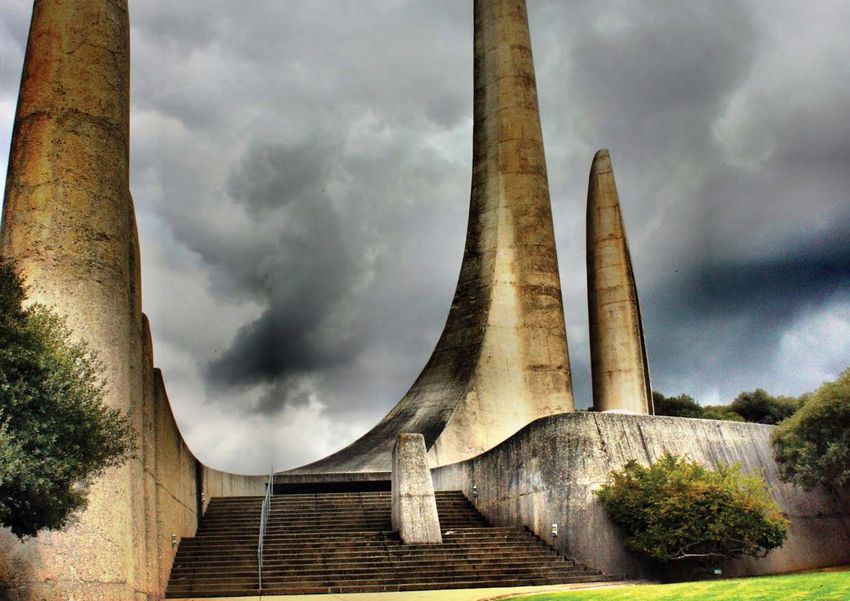
2

     The girl who kicked off her
    European shoes, pulled on
     Indonesian socks and tied
    her ”vellies” (rawhide shoes)
      here in Africa, she is that
          treasure that we
           call Afrikaans.
           – Chris Chameleon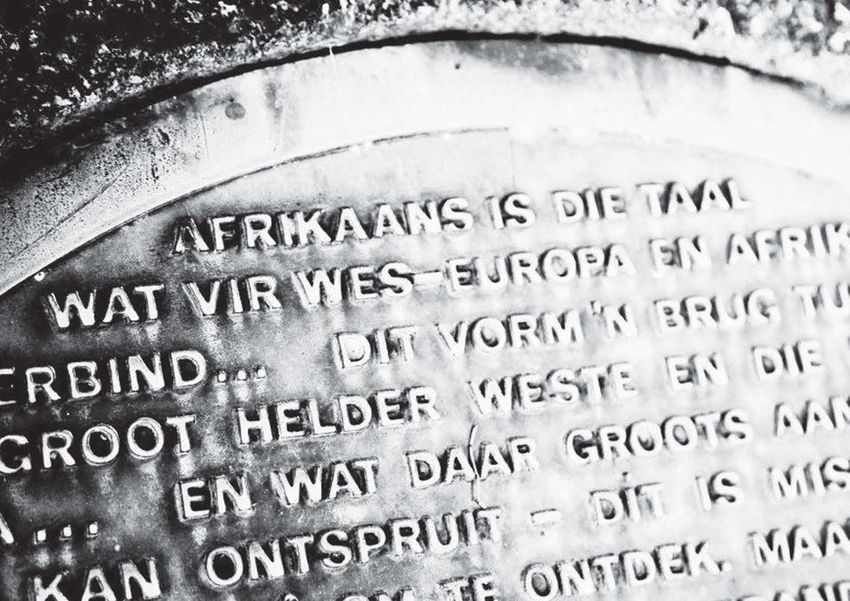
3

                                 WHERE FROM, AFRIKAANS?
Khoi                                 Indo-European                                       Austronesian
                                                                                                             The Afrikaans
                                                                                                          Language Museum
                                       European
                                                                                                            and Language
                                       Germanic      Romance
                                                                                                          Monument in Paarl
                                                                                                        celebrate the birth and
                                         West         Gallo-     Ibero-                    Malayo-
                                       Germanic      Romance    Romance                   Polynesian     continuing existence
                                         Low
                                                                                                             of Afrikaans.
       High German   Anglo-Frisian    Franconian                                           Malayic
                                                                                                             Everyone who can or
         German        English          Dutch         French   Portuguese                                 wants to speak Afrikaans,
                                                                             Malayo-                        or who is interested in
                                                                            Portuguese                    the language, should visit
                                                                                                           this unique museum and
                                                                                            Malay
                                                                                                          monument to learn more
                                                                                                          about Afrikaans, the third
                                                                                                          most spoken language in
                                                                                                        South Africa. Afrikaans is the
                                                                                                        mother tongue of more than
                                                                                                         seven million speakers and
                                                                                                          is spoken by just as many
                                                                                                         people as a second or third

                  Afrikaans                                                                                        language.
                                                                                                           *Statistics South Africa 2011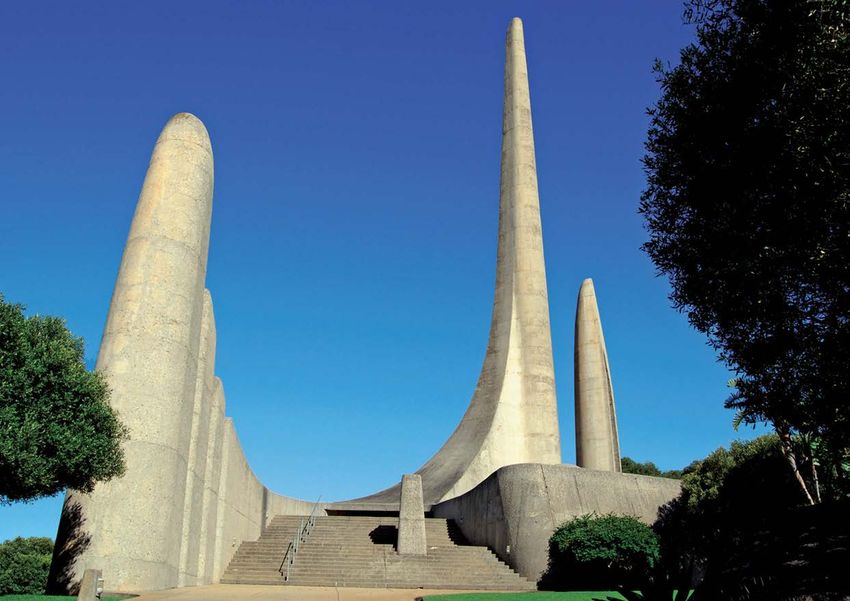
4

    Contents
    1   Inception of the monument				           p5
    2   Inspiration for the design 				         p 10
          The written word at the monument			   p 12
    3   Building process					p 16
          Sculpture rather than architecture			 p 20
    4   Symbolism 						p 22
    5   The architect Jan van Wijk				          p 24
    6   The environment					p 26
    7   Other language monuments				            p 28
    8   The institution					p 30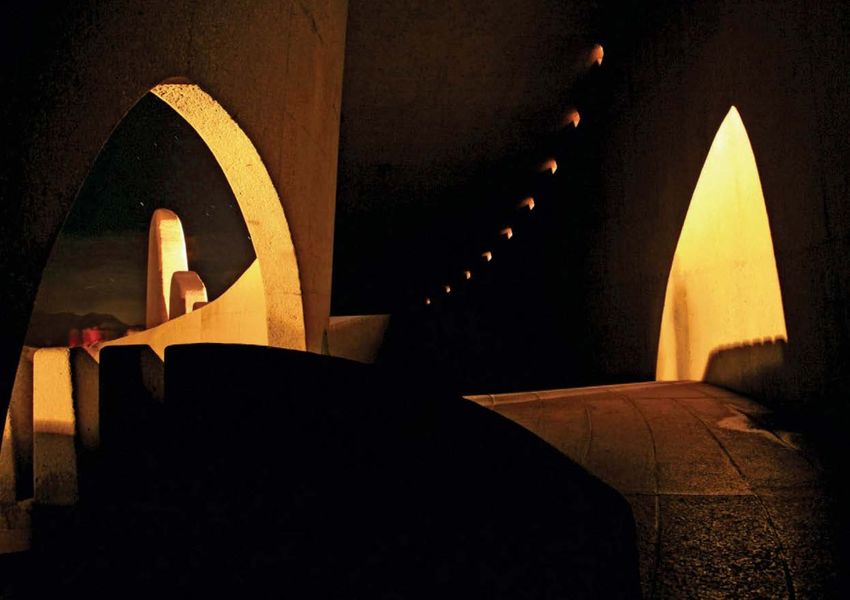
5 1 Inception of the monument The idea of constructing a monument to the Afrikaans language was raised on 14 August 1942 on the farm Kleinbosch in Dal Josaphat near Paarl. The event was the unveiling of a memorial plaque at the cemetery, in honour of SJ du Toit, DF du Toit and PJ Malherbe, three founder members of the Genootskap van Regte Afrikaners (GRA) or ‘Society of True Afrikaners’, who are buried there. This led to a public meeting in Paarl on 26 September 1942 where the Afrikaanse Taal monument Komitee (Afrik aans Language Monument Committee) was formed. The chairman was Reverend PJ Loots, and the vice-chairman was the well-known Mr SPH (‘Oom Seppie’ or ‘Uncle Seppie’) de Villiers. The rest of the committee consisted of Drs AL de Jager, W de Vos Malan, JJ Muller, GG Cillié, Messrs GC Burger (secretary), HA Rust, WA Joubert, WH Louw, and Miss J Meyer. The aim of the committee was to raise funds for the construction of a ‘worthy language monument in Paarl’, and to provide bursaries to ‘deserving post-graduate students studying specific aspects of the Afrikaans language’.
6

                                               The venture was embarked on with great enthusiasm and
                                               a so-called Oproep (Appeal; or ‘Movement’ as the committee
                                               called it) was composed to bring the matter to the attention of
                                               all South Africans. Although the ‘Oproep’ enjoyed widespread
                                               media coverage, the fundraising was not as successful as had been
                                               hoped for, and more than three decades were to pass before the
                                               monument eventually became a reality.
                                               From 1963 onwards, the Afrikaanse Taal- en Kultuurbond (ATKB),
                                               (an association for the promotion of the Afrikaans language and
                                               culture, which was assimilated into the Afrikaanse Taal en Kultuur
                                               Vereniging (ATKV) in 1991) was intensively involved in the effort,
                                               and gradually took on all the administrative and secretarial duties.
                                               The organisation also played a significant role in fundraising.
                                               In 1964 the committee organised a competition for the design of
                                               the monument, and invited 12 architects to participate. The brief
                                               stated that the monument had to be visible from afar and among
                                               other things had to depict the cultural and political flowering
                                               of Afrikaans. Architect Jan van Wijk’s design was selected as the
                                               winner.
                                               As early as 1963, the terrain west of Bretagne Rock on Paarl
                                               Mountain had been chosen for the monument. In 1968 the Paarl
One of the other designs for the monument.     municipality transferred approximately 84 hectares to the state at
    Eleven designs were received from 10       no cost.
    participants in the competition.Twelve     Construction of the monument began in late 1972 and was
 architects were originally invited, but two   completed at the end of 1974. The total cost of construction was
 of them withdrew. A number was awarded        around R700 000. The monument was inaugurated in 1975, a
   to each to ensure anonymity during the      hundred years after the founding of the GRA.
  competition.The poet Eitemal was one of
             the three assessors.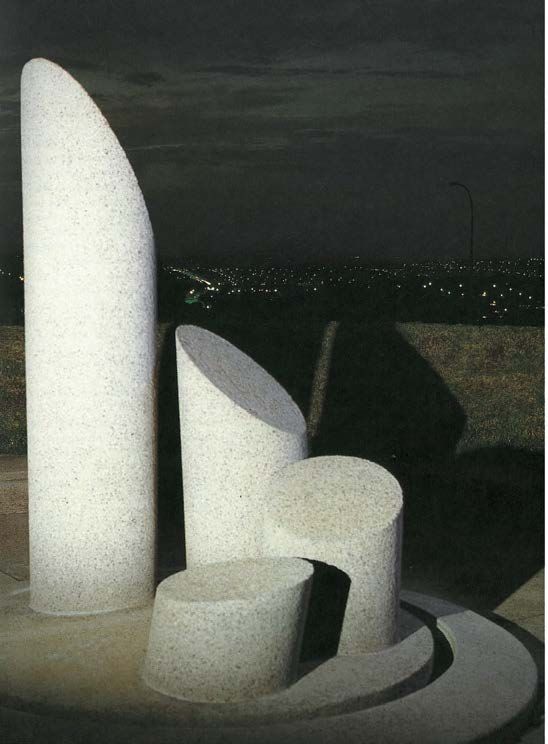
7

WHO AND WHAT WAS THE GRA?
• Arnoldus Pannevis, Dutch linguist, realised that the language
  spoken by South Africans was already a language in its own
  right. He proposed that it be called Afrikaans.
• Pannevis wrote to the British and Overseas Bible Society
  proposing that the Bible should be translated into Afrikaans
  so that everyone in South Africa could understand it.
• The Bible Society commissioned Rev SJ du Toit to ascertain
  whether there really was such a need.
• Rev Du Toit invited a group of friends and relatives to a       Arnoldus Pannevis   CP Hoogenhout   SJ du Toit
  meeting on 14 August 1875 in the house of his cousin,
  Gideon Malherbe, to discuss this matter.
• The meeting was attended by CP Hoogenhout; ds SJ du
  Toit; GJ Malherbe; DF du Toit (son of DP); August Ahrbeck;
  PJ Malherbe; DF du Toit (son of DF) and SG du Toit.
• The men decided to launch an association which could
  campaign for the acknowledgement of Afrikaans as written
  language, and thus the “Genootskap van Regte Afrikaners”
  (Society of True Afrikaners) or GRA came into existence.
• One of the first things the GRA did, was to publish an
  Afrikaans newspaper titled Die Afrikaanse Patriot, which
  appeared for the first time on 15 January 1876.
• Various other Afrikaans publications were printed on the
  printing press of the GRA and distributed.
• The GRA stopped meeting at the beginning of the 20th
  century. By that time the Afrikaans Language Movement had
  built up enough momentum to be unstoppable.
8

                                  INAUGURATION
    Over 40 000 people attended   Over 40 000 people attended the inauguration of the Language Monument,
                                  held in the amphitheatre, on 10 October 1975. The official dedication
       the inauguration of the
                                  speech was delivered by the then prime minister, Mr BJ Vorster. The
    Language Monument, held in    programme featured performances and recitations by well-known Afrikaans
        the amphitheatre, on      actors and voice-artists. Among these was a dramatisation of the inaugural
          10 October 1975.        meeting of the GRA, written by Pieter Fourie. Interestingly (given that in
                                  those days apartheid was still flourishing), Adam Small’s poem ‘Nkosi sikelel
                                  iAfrika’ was recited.
                                  In the months leading up to the inauguration, a row nearly erupted when
                                  leading white Afrikaans writers threatenend to boycott the occasion if
                                  coloured writers were not invited as well. Consequently, various coloured
                                  writers together with representatives from other sectors of the coloured
                                  community were invited. Many attended the festivities, along with a large
                                  number of coloured schoolchildren. However, certain white writers still
                                  stayed away.
                                  The event was also a choir festival with nine choirs participating, including
                                  the Bel Canto Choir conducted by David Samaai, the Primrose Choir
                                  conducted by Abdullah Maged, and the Drakensberg Boys’ Choir conducted
                                  by Louis van der Westhuizen.
                                  The highlight of the occasion was the arrival of eight torches (each
                                  representing a founder member of the GRA), which had left the Voortrekker
                                  Monument in Pretoria on 14 August for Paarl along various routes. The
                                  prime minister and seven descendants of the GRA founders received
                                  the torches and used these to ignite the main flame. This symbolically
                                  represented the spread of the language to the furthest corners of the
                                  country, returning to Paarl, its point of origin.
9

Nkosi Sikelel iAfrika                                     Nkosi Sikelel iAfrika
Hier, halfversteen                                        Petrified,
onder die geel gloed van die son                          fossilised and still,
staan-staan ’n swartman                                   under the glowing yellow sun
en sy twaalf rooi beeste                                  like the one
in gelid                                                  of Van Gogh's at Arles,
en in die stilte
                                                          a black man guides
wat groen glinster teen die bulte
                                                          his twelve red cattle
wys die dorings wit;
                                                          in the shimmering silence
ou geeste                                                 glistening green on the Eastern hills,
kan weer leef soos ou vulkane                             (also white with thorns).
as die bloed in hul bly kook het
                                                          Who knows:
vir ’n duisend mane,
                                                          Spirits of old
maar wie kan vir ons bid
                                                          – of the long dead –
dat God die wêreld seën
                                                          may live again like old volcanoes
en elke os en nasie
                                                          if the blood in them had kept boiling
vet laat reën
                                                          for a thousand years ...
en ons laat weet hoe feilbaar was Nonkwasi.
                  – Adam Small (uit Sê sjibbolet, 1963)   And there'll be prayer for us
                                                          and our earth                            Translated by
                                                          and all our people will be blessed,       Adam Small
Interestingly (given that in those days apartheid                                                       from his
                                                          and will forsake their fast,                   volume
    was still flourishing), Adam Small’s poem
     ‘Nkosi sikelel iAfrika’ was recited at the           and know how false                            of verse,
                                                                                                    Sê Sjibbolet,
         inauguration of the monument.                    was the prophesy of Nonquasi!               May 2016
10

          2      Inspiration for the design
     One of Van Wijk’s most important design considerations          To visually express this definition, van Wijk used the words
     was that the monument should harmonise with and                 of writer NP van Wyk Louw who described Afrikaans as the
     complement the natural environment. He explained that           language that connects Western Europe and Africa, like a
     he visited the proposed site on Paarl Mountain via an old       bridge. Louw also described Afrikaans as a ‘gleaming tool’
     fire-break: ‘My wife and I first walked around here, and        and a ‘double-edged sword’. All these concepts shaped
     then we drove to Franschhoek and also to Klapmuts, to           the monument in the mind’s eye of Van Wijk, and were
     view the terrain from afar, because the monument had to         eventually realised in its structure and symbolism.
     be visible from a distance.’ Van Wijk felt that the lines and
     other elements of the monument should reflect the natural
     lines and forms of the environment, and that the building
     materials should blend in with the rocks on the mountain.
     The next step was to look for a suitable
     image that could represent Afrikaans. The
     geometrician in Van Wijk immediately                    Wonderful – there you see your language
     recognised a mathematical hyperbola                         – a nice shape. But it can’t be just a
     in the imagery used by the famous writer                    shape, it must also have definition.
     CJ Langenhoven to describe the growth of
     Afrikaans, namely a ‘rapidly ascending arc’.
     Thus the idea of the main column was born,
     with an opening at the apex to represent growth. Van Wijk
     said to himself: ‘Wonderful – there you see your language
     – a nice shape. But it can’t be just a shape, it must also have
     definition.’
11 Preliminary sketches
12

                           THE WRITTEN WORD AT THE MONUMENT

                                          CJ Langenhoven
     CJ (CORNELIS JACOBUS) LANGENHOVEN, also known as Sagmoedige Neelsie (an affectionate diminutive meaning
     ‘sweet-natured Neels’; Neels being the short form of his name), was one of South Africa’s most prolific writers. In the
     early decades of the 20th century he was viewed as a national treasure. In July of 1914, in Bloemfontein, he delivered
     a lecture, entitled ‘Afrikaans as language medium’, before De Zuid-Afrikaanse Akademie voor Taal, Lettere en Kunst
     (The South African Academy for Language, Literature and Art). Architect Jan van Wijk used the following words from
     the lecture as inspiration:

              Were we to plant a row of posts in a line down this hall, ten posts to represent
                  the past ten years, and on each post we made a mark at a height from
                  the floor corresponding to the relative written usage of Afrikaans in the
              respective year, and we drew a line through the marks, from the first near the
               floor to the last, there on the other side against the attic, then the line would
               describe a rapidly ascending arc – not only ascending swiftly, but ascending
               on a rapidly increasing scale. Now let us, in our imagination, extend this arc
              for the following ten years hence. Do you see, gentlemen, where the apex will
                   be, out there in the blue sky high over Bloemfontein, in the year 1924?
13
THE WRITTEN WORD AT THE MONUMENT
NP van Wyk Louw
NP (NICOLAAS PETRUS) VAN WYK LOUW was one of the greatest Afrikaans writers, poets and thinkers, and part
of a literary group known as the Dertigers (Poets of the 1930s). In 1959 he wrote an essay on the status of Afrikaans,
bearing the title ‘Laat ons nie roem nie’ (‘Let us not boast’). In this he wrote, among other things:
Afrikaans is the language connecting Western Europe and Africa; it draws
its strength from these two sources; it forms a bridge between the great
lucid West and mystical Africa – the sometimes still so obscure Africa;
they are both great powers, and great things can arise from their
association – this is perhaps what lies ahead for Afrikaans to discover.
HE ADDED: It is not by virtue of our merit, ours as Afrikaners, that we have been given a
tool forged in two smithies so far apart, and over so many centuries. It has been given to us;
we did not produce it. Our task (and if there ever is to be any merit, this alone can be ours),
our task lies in how we use and will use this gleaming tool, this double-edged sword.14
THE WRITTEN WORD AT THE MONUMENT
Dit is ons erns (We are dedicated to this cause)
The history of the wording that appears on the paving at under the heading: ‘Laat’t ons toch ernst wezen’ (roughly:
the approach to the monument, which states ‘Dit is ons ‘Come, let us be dedicated about this’). He thus turned
erns’, dates back a long way, to 6 March 1905. On that Onze Jan’s call to his own advantage, using it to spur on
day, the politician JH Hofmeyer (known as Onze Jan or the use of Afrikaans instead of Dutch. He pointed out that
‘Our Jan’) delivered a speech in Stellenbosch with the the problem lay not with a lack of dedication, but with the
title ‘Is’t u ernst?’ (‘Are you dedicated?’). He was the guest disregard for Afrikaans exhibited by the government of
speaker at a meeting of Ons Spreekuur (roughly translated: the day.
‘Our Discussion Hour’), a Dutch language and cultural In 1908, once again in Stellenbosch, Dr DF Malan, chairman
organisation for students. Ironically, this speech was not of the Afrikaanse Taalvereniging (Afrikaans Language
aimed at promoting Afrikaans. Onze Jan was an advocate Association) and subsequently member of the Volksraad
for simplified Dutch, and his speech was a plea for the (House of Assembly) and prime minister, delivered
restoration and recognition of Dutch. This was, a powerful plea for the use of Afrikaans in a speech
of course, in reaction to the British regime’s entitled ‘Het is ons ernst’ (‘We are dedicated). This
anglicisation policy. speech was so popular that it was distributed in
Many of the pro-Afrikaans members of the pamphlet form.
audience were rubbed the wrong way by his When, in 1974, a central theme was sought for
allegations that English was being spoken the 1975 Taalfeesjaar (Language Festival Year), the
everywhere at the expense of Dutch, by people Afrikaans form of this quotation, namely ‘Dit is ons
he called ‘Dutch-Afrikaans boers’. erns’ was decided upon. The phrase subsequently
In reaction to this speech, historian and language appeared on all publications connected with the
activist Gustav Preller wrote a series of articles Design by Language Monument, and was even used on the
in De Volkstem between April and June 1905, Ernst de Jong monument committee’s official stationery.15
Architect Jan van Wijk proposed that the words be inscribed in the paving at the approach
to the monument, to attract people’s attention as they ascend the steps, and to draw their
attention to what the monument stands for.16
3 Building process
• The monument was erected by ATM Construction, a • A special concrete mix was cast in a preconstructed
consortium comprising Murray & Stewart (Boland) and system of shuttering, which was made up of a metal
Holtzhausen & Hugo. framework lined with marine plywood. Each section of
metal piping was shaped to the requisite curvature on
• The complex task of positioning the monument
site. At the tops of the columns, where the curves became
proportionally correctly and in the correct place was
too narrow for this method, wooden moulds were made.
achieved by using scale models and then mathematically
converting these into precise geometrical arcs. • The concrete mix used for the monument consisted
of cement, white sand and Paarl granite. Because the
• The geometrical arcs were then projected onto a
architect wanted to reflect the colour of the rocks on
three-dimensional system of axes using 1100 points
the site, he insisted on using the greyish-brown outer
to determine the outlines of the monument. For every
layers of the granite as well as the bluish inner part.
point, three co-ordinates were determined by a surveyor,
The texture of the rocks on the site was imitated by
using a large boulder on the site as reference point.
removing the outer cement layer of the hardened
The resulting geometrical model was then used to
concrete with pneumatic hammers, so as to expose the
construct shutters, or moulds, for the curves of the
granite chips embedded in the mixture.
monument. Before the concrete was cast into the
moulds, the co-ordinates were once again confirmed • The main spire was tested by the CSIR in a wind
mathematically. tunnel in Stellenbosch, and it was found to be able to
withstand wind speeds of up to 160km/h.17
18
19

       Where are you, my language?
    What do you look like, my language?
Where can I fetch you from – to place you here?
                 – Jan van Wijk
20
SCULPTURE RATHER THAN ARCHITECTURE
The Afrikaans Language Monument must be seen as stark lines, a blockish appearance and square
as a sculptural rather than an architectural work or rectangular forms, are not present in the
and therefore assigning a specific architectural monument.
style to it is not strictly relevant. Van Tonder claims that Jan van Wijk did not borrow
If one were to discuss the monument in terms or use any existing architectural style or elements
of architectural style, however, elements of when he designed the language monument. He is
Brutalism will be noted in the structure. Brutalist of the opinion that the design was very personal
buildings are described as “often constructed of and therefore it would not have been possible
cast concrete, which allowed for thick walls with to reapply this design without compromising its
deep recesses for the windows. Also … the cast meaning. The use of raw concrete as can be seen
concrete [is] often executed in rough finished in the Monument was, however, common practice
aggregate, with the imprint of the casing during the 1960s and 1970s. Many monuments
forms functioning to create additional built in South Africa during this time consisted of
visual appeal.” concrete as well as natural rock elements obtained
It must be noted, however, that from the environment.
there are only certain elements Jan van Wijk’s other monuments, in particular the
of this style present in the Irish monument, are also in many ways similar to
monument and that the language monument (for example abstractness,
the overall style round shapes and columns of increasing height).
cannot be described as The Irish monument was designed in the same
Brutalist. Some of the period in which Van Wijk was working on the
most important Language Monument and was also unveiled in
elements of 1975. Van Wijk also re-utilised the elements of
Brutalism, amphitheatre and dome in his monument for
such Bishop Zulu, who died in 1988.
Irish monument21
The Voortrekker Monument at Winburg is the South The use of raw concrete in monuments was a
African monument with the greatest resemblance to the world-wide phenomenon at this time. Interesting
language monument. This monument has similar abstract examples are a series of approximately 25
motives, rich symbolism, hammered concrete, a circular monuments built during the 1960s and 1970s in
form and massive domes with varying heights. Although Yugoslavia to commemorate the Second World
this monument was unveiled in 1969, architects had to War, and several post-modernist monuments in
submit proposals for its design in the same time period America. It can therefore be accepted that the
during which proposals for the language monument use of raw concrete and abstract forms was a
were made. The architect Hans Hallen’s design won the fairly common practice world-wide during this
competition. If these two architects had in fact been time and that this trend was followed by local
influenced by one another’s work, it will be impossible architects.
to determine who influenced whom.
A DISPLAY OF LIGHT
Visitors often enquire about the date on which the sun shines into the main spire of the Language
Monument. They are however confusing it with the Voortrekker Monument, where the sun
shines on the centre of the Cenotaph every year on 16 December at twelve o’clock.
Jan van Wijk’s vision was that the main spire of the Language Monument should be open at
the top, to indicate that the language is still growing. The rising interior of the column has
a series of openings through which the variations of light and the sun outside conjure
up a variety of light displays. This light, along with the water of the fountain, symbolise
the vigour of the language, which requires sustenance.
Van Wijk said of the Language Monument: “At any time of the year, on any day, under
any circumstances whatsoever, there is a display of light ...”22
4 Symbolism
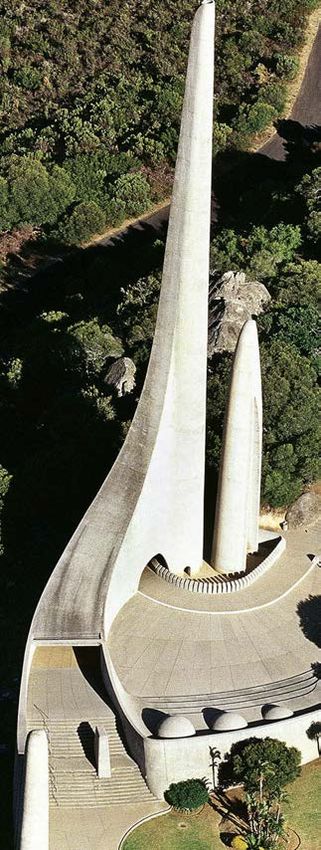
A-C represents the different languages that shaped combine to form a bridge symbolically depicting the basis
Afrikaans: of Afrikaans.
1. To the left (west) of the approach to the monument
D-E visually expresses the inspiration Van Wijk found in
stand three columns (A), representing the languages and
two Afrikaans authors:
cultures of Western Europe – Dutch, Portuguese, German,
4. Where the two arcs of Western Europe and Africa meet (D),
English and others. No single column represents a specific
a bridge is formed, symbolising the fusion of languages
language; the number three was used because it is
from these two continents, as described by NP van Wyk
indivisible. The columns progressively diminish in height
Louw.
to express the diminishing influence of the European
5. The main column, or spire of the monument (E) represents
languages on Afrikaans. These columns begin as separate
the ‘rapidly ascending arc’ and accelerated growth of
structures which then merge into an ascending arc to form
Afrikaans, inspired by CJ Langenhoven. This column
part of the main outline of the monument. The tallest of
stands in a pool of water, further reinforcing the concept of
the three is roughly 13,5 m tall.
Afrikaans as a living, growing entity requiring sustenance
2. To the right (east) of the approach is a podium with three
for its continued existence. The sharp lines of the spire
round convex mounds (B), which represent the southern
suggest Van Wyk Louw’s ‘double-edged sword’. The spire
tip of Africa. It symbolises the influence of Khoi and other
is approximately 57 m, with its tip blunt and open, to
African languages (i.a. isiXhosa, isiZulu and seSotho). These
indicate continuing growth. The play of light inside the
structures progressively increase in size, thereby indicating
monument, caused by the pond and openings in the main
the increasing African influence on the language. They are
column, symbolises the language as a ‘gleaming tool.’
positioned in an arc that connects with the monument’s
main curve (symbolising Afrikaans), thereby connecting F places Afrikaans in context with Africa:
them physically as well as spiritually. 6. A second, shorter column (F), representing the Republic
3. The Indonesian languages and dialects (mainly Malay) are of South Africa (the birthplace of Afrikaans), stands in the
represented by a wall (C) on the stairs leading towards the same pond. It is hollow, and open to Africa, indicating
monument. The wall is positioned between the arcs of the continuous interaction and discourse taking place
Western Europe and Africa so that (being from the East), between Afrikaans, South Africa and Africa. The column is
it is separate, but yet united with these two forces, which approximately 26 m.23
DOES YOUR LANGUAGE SPEAK AFRIKAANS?
Afrikaans is a melting pot of languages which inherited words from many
different languages. Many of these words reached us via other languages,
notably Dutch and English.
DUTCH – smous (hawker), kasarm (rambling building), pampoen (pumpkin)
PORTUGUESE – kraal (corral, fold), mielie (corn), ramkie (home-made guitar)
KHOI – abba (piggyback), koedoe (kudu), geitjie (gekko)
MALAYSIAN – amper (almost), baie (many,very), piesang (banana)
GERMAN – heimwee (nostalgia), sweis (weld), blits (lightning)
FRENCH – parlement (parliament), boetiek (boutique), stasie (station)
NGUNI LANGUAGE – donga (gully), indaba (meeting), pasella (free of charge)
SOTHO LANGUAGES – mampoer (moonshine), makietie (party), maroela (marula)
ENGLISH – krieket (cricket), bottel (bottle), piekniek (picnic)
ARABIC – koeskoes (couscous), assegaai (assegai), koffie (coffee)
WHAT IS ARABIC AFRIKAANS?
Afrikaans in Arabic script is one of the earliest forms of written Afrikaans. It was
used at the Cape from the early 1800s. Islamic slave children received religious
instruction in their home language, later known as Cape Afrikaans, but still
had to write in Arabic. Special symbols were developed to represent Afrikaans
sounds phonetically in the Arabic script. Abu Bakr Effendi’s Bayaan-ud-diyn
(An Explanation of the Religion) was printed in Arabic Afrikaans in 1871.
At least 78 books were written in Arabic Afrikaans between 1870 and 1950.24
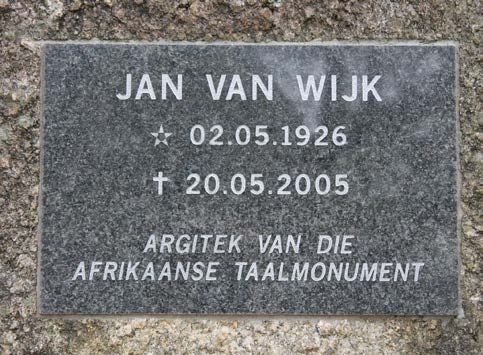
5 The Architect Jan van Wijk
The monument’s architect, Johan Carel van were interred in a granite boulder on the site,
Wijk (2 May 1926 – 20 May 2005), obtained and it is surely no coincidence that this was
a B.Arch. degree from the University of the selfsame rock where he and his wife had
Pretoria in 1949. He worked for architectural rested, one day in 1964, while exploring the
firms in Cape Town, Pretoria, London and mountain in preparation for his design.
New York. In 1960 he married Erna Marais.
During his lifetime, Jan received various
In 1963 he established his own practice
awards, among which a medal of honour
which eventually expanded into a company
for architecture from the South African
with partners, directors and offices in
Academy for Arts and Sciences (1983), and
Verwoerdburg, Johannesburg, George,
the Chancellor’s Medal (1994) and Alumni
Mossel Bay and Mmabatho. In 1993 he and
Laureate (2003) from the University of
Erna moved to Wilderness in the Southern
Pretoria. An excerpt from the latter award
Cape, where he lived until his death.
reads as follows: ‘Jan van Wijk’s work is true
During his career, Jan was involved in more than 870 to the context and culture from which it originates. His work
projects, including the building complex of the University illustrates a sensitive attitude to the South African landscape
of Johannesburg (previously the Rand Afrikaans University), and finds expression in organic forms that portray his love of
and several commissions for the Rembrandt Group. Apart nature.’ These qualities were already evident 40 years before,
from the Language Monument, he designed several other when Jan designed the Taalmonument.
monuments, among them one for the 43 child victims of the
Van Wijk’s plea continues to live on, long after his death:
Westdene bus tragedy.
‘Afrikaans ... create it, speak it, love it, learn it, teach it, carry
Of all the projects that Jan undertook during his lifetime, his on with it. Don’t let it die. Up there, at the very top, the spire
magnum opus, the Language Monument in Paarl, lay closest forms a root tip that stands for growth, growth without
to his heart. It was therefore entirely fitting that his ashes ceasing, like Afrikaans.’25
26

                               6       The environment
     Paarl Mountain is some 500 million years old, and famous for its three enormous granite domes named Paarl Rock,
     Bretagne Rock, and Gordon Rock. The indigenous Khoi pastoralists named it Tortoise Mountain, because of its appearance.
     Approximately in the middle of the site where the Language Monument is situated, there is a rocky outcrop consisting
     of a group of granite boulders. They are all small replicas of Paarl Rock and create the impression that nature has
     repeated the same lines and curves over and over on the mountain.

        VEGETATION – The vegetation on Paarl               BIRDS – A variety of bird species          ANIMALS – Small wild antelope
     Mountain is unique, as it comprises a type of           endemic to the south-western                such as the southern or Cape
       fynbos (indigenous plant type) that grows           Cape, such as the Cape sugarbird            grysbok (Raphicerus melanotis),
        in clayey granite soil, and is found only in    (‘Kaapse suikervoël’ or ‘suikerbekkie’;    grey rhebok (Afrikaans ‘vaalribbok’;
      certain limited areas, such as this mountain     Promerops cafer) and orange-breasted           Pelea capreolus) and klipspringer
        and against the foothills of mountains in         sunbird (‘oranjeborssuikerbekkie’;         (Oreotragus oreotragus), as well as
      Somerset West and Wellington. The fynbos            Anthobaphes violacea) occur in the           other small mammals including
     is particularly dense and reaches a height of       fynbos. Raptors such as the African           the rock hyrax (‘dassie’; Procavia
     two to three meters as the veld matures. The            black eagle or Verreauxs’ eagle        capensis), Cape porcupine (‘Kaapse
                                                          (‘witkruisarend’; Aquila verreauxii),      ystervark’; Hystrix africaeaustralis)
       grey-leaf sugarbush (Afrikaans ‘suikerkan’;
                                                              booted eagle (‘dwergarend’;              and scrub hare (‘kolhaas’; Lepus
         Protea laurifolia), spinning top conebush
                                                            Aquila pennatus) and the jackal             saxatilis) inhabit the mountain.
       (‘tolletjiesbos’; Leucadendron rubrum) and
                                                             buzzard (‘rooiborsjakkalsvoël’;      Predators recorded on the mountain
          slangbos or ‘Khoi-kooigoed’ (Seriphium           Buteo rufofuscus) can sometimes           include the caracal or African lynx
                plumosum) grow prolifically.             be spotted. Several types of canary,     (‘rooikat’; Felis caracal), black-backed
        A feature of Paarl Mountain is the hillocks       the Cape spurfowl (‘Kaapse fisant’;     jackal (‘rooijakkals’; Canis mesomelas)
         and piles of round granite rocks around           Pternistis capensis), the southern       and banded mongoose (‘gebande
            which evergreen trees such as rock-             double-collared sunbird (‘klein-           muishond’; Mungos mungo). It is
          candlewood (‘klipkershout’; Maytenus               rooiborssuikerbekkie’; Cinnyris       likely that lions once occurred here,
           oleoides), rockwood (‘kliphout’; Heeria          chalybeus), and the Cape bulbul           and it is suspected that leopards
            argentea) and wild olive (‘olienhout’;      (‘Kaapse tiptol’; Pycnonotus capensis)        from surrounding mountains still
                    Olea africana) thrive.                          can also be seen.                 occasionally visit Paarl Mountain.
27
A network of paths makes Paarl Mountain ideal for strolling, walking and hiking.
The Language Monument walking trail takes roughly half an hour to complete, and the
Klipkershout circular route through the Paarl Mountain Nature Reserve takes about two hours.
In the past, Paarl Mountain was a popular camping site. Every year during the Christmas holidays, people would
pitch tents at the aptly-named Krismiskamp and at Meulwater and Oukraal. By day, the ‘Oukralers’ played games
such as jukskei (a traditional Afrikaner folk sport played with the wooden pins from ox yokes) and at night they
made music led by musician Manas de Villiers. ‘Die Oukraal-liedjie’ (‘The Oukraal Song’) composed by him and
his wife Amie is still sung throughout the country today.28
7 Other language monuments
IN SOUTH AFRICA: IN THE WORLD:
The monument on Paarl Mountain is not the only As far as we could ascertain, there are only a
language monument in the country. The oldest one, few other language monuments in the world,
as far as can be established, is in Burgersdorp and was including a monument to Russian in Belgorod,
actually erected in honour of the Dutch language. Russia, and L’obélisque des idéogrammes,
The towns of Kroonstad and Welkom both erected a monument to four indigenous languages
monuments to Afrikaans in 1959. in Bamako, Mali.
The nation-wide campaigns for raising awareness There is also the Shaheed Minar in Dhaka,
and collecting funds for the Language Monument Bangladesh, a monument honouring the martyrs
in Paarl created a wave of patriotism, and many of their language movement. As in South
towns decided to erect their own monuments round Africa, there were bloody uprisings around the
about the time of the language festival year, 1975. language problem in that country. There are
We are aware of monuments in Aberdeen, Belfast, smaller replicas of the Shaheed Minar in many
Burgersdorp, Delareyville, Ermelo, Johannesburg, Bangladeshi communities around the world,
Kroonstad, Ladismith (Cape), Lichtenburg, Louis including Italy, America, England and Japan.
Trichardt, Milnerton, Ohrigstad, East London, Petrus Recent research shows that there are about
Steyn, Reddersburg, Reitz, Riebeeck West, Touwsriver, 60 other language-related museums in
Ventersdorp, Welkom and Worcester. the world.
Visit the ATM’s website at www.taalmuseum.co.za for more information.
Please let us know if you have more information about any language monuments.29
Lichtenburg also The oldest language monument On the campus of the
unveiled a language in South Africa, as far as we could University of Johannesburg
monument in 1975, establish, stands on Burger Square in (at the time the Rand
through the mediation Burgersdorp. It was unveiled on Afrikaans University or RAU)
of the Rapportryers. 18 January 1893. The statue was a monument consisting
It is in the shape of damaged by vandals during the Anglo of three granite boulders
an oyster with a pearl Boer War, and after the war Lord Milner from Paarl Mountain was
inside. Langenhoven’s had the whole monument removed. unveiled on 12 August
words “Afrikaans, our The people of Burgersdorp demanded 1975. The inscription is
pearl of great value” their monument back, and since the “Smal swaard en blink”
were affixed around original statue could not be found (Thin, shining sword),
the ball in brass anywhere, the British government had words with which iconic
letters. a replica erected in 1907. In 1939 the Afrikaans writer NP van
missing statue was found in a trench in Wyk Louw described the
King William’s Town, minus its head and language.
one arm. In 1957 this statue, still in its
damaged state, was erected behind
the replica.30
8 The institution
The Afrikaans Language Museum and Monument VISION AND MISSION
(ATM) today incorporate the Paarl Amphitheatre.
As an inclusive institution, the ATM strives for all South
The Language Museum is situated at 11 Pastorie
Africans to respect and appreciate Afrikaans. In this spirit,
Avenue, in the former home of Gideon Malherbe,
the ATM works hard to encourage and support Afrikaans
a founder member of the Society of True Afrikaners
among the youth and non-mother-tongue speakers. The
(GRA). The 4 000-seat amphitheatre is situated
ATM constantly endeavours to establish mutual respect
close to the monument against the southern slope
between Afrikaans and other indigenous languages by,
of Paarl Mountain and is often used for hosting big
among other things, acknowledging and exhibiting the
events.
mutual influence of different languages one another.
After two years of self-government, ownership of
the ATM was transferred to the state in 1977. Today,
the ATM is a public entity governed by a council OBJECTIVES
which is appointed by the national Department The institution’s main objectives are to gather relevant
of Arts and Culture. It receives an annual subsidy material and information; conduct research on Afrikaans;
from this department and generates additional portray the origin, development, use and growth of
funds through sponsorships, donations, entrance Afrikaans through exhibitions, lectures and articles;
fees, facility hire, product sales, and events. Please offer educational programmes, guided tours and cultural
contact us if you would like to make a donation or activities; and to preserve the ATM’s cultural history
to subscribe to our newsletter. heritage sites, as well as the legacy of Afrikaans itself.31
The Afrikaans Language Museum before restoration in 1975. Gideon Malherbe had the house built in approximately
1860 in the late-Georgian style. He was one of the founder members of the GRA which was established in this house on
14 August 1875. The ground floor of the house has been restored back to approximately 1875 to give visitors a glimpse
of the lifestyle at the time. The first floor hosts an interactive exhibition about Afrikaans and its development.vrgraphics | 021 863 3165
SOURCES
Afrikanerbakens, FAK: Aucklandpark, 1989
FAK-SangbuAfrikanerbakens, FAK: Aucklandpark, 1989
FAK-Sangbundel, Protea Boekhuis: Stellenbosch, 1986
PHOTOS/ILLUSTRATIONS
Langenhoven, CJ, Ons weg deur die wêreld, JH de Bussy: Pretoria, 1918
Adrian Shields for Banshee 22
Louw, NP van Wyk, Vernuwing in die prosa, Human & Rousseau: Cape Town, 1961
ATM
Nienaber, CS, PJ Nienaber and CJM Nienaber, Dit was ons erns, Nasionale Boekhandel: Cape Town, 1962
Gerald Hoberman
Nienaber, PJ, Die Vrystaatse Taalbeweging, Afrikaanse Pers Boekhandel: Johannesburg, 1947
Scholtz, J du P, Wording en ontwikkeling van Afrikaans, Tafelberg: Cape Town, 1980 Gideon Nel
Van Wijk, J, Taalmonument – Simbool van Afrikaans, Historical Media: Cape Town, 2014 Heinz Dullaart
Pieters, H: The Taalmonument: A monument for what? Unpublished master’s thesis, University of Maastricht, no date Jan van Wijk
Van Tonder, WB: The Taal monument: An analytical study, Unpublished semester project, University of Pretoria, 1994 Len Staples
ATM documentation Libella Photography
Drakenstein Municipality, Paarl Mountain Nature Reserve information pamphlet Melinda Els/Mel Photography
Interviews with Erna van Wijk, widow of architecht Jan van Wijk Oswald Gerber
www.historicdenver.org/resources/brutalism/ Susanne Botha
www.retronaut.com/2011/04/yugoslav -war-memorials-1960s-1970s/ Susanne Joubert
www.weburbanist.com/2011/07/29/postmodern-monuments-20-worthy-architectural-memorials/ Thomas Talkner
Please contact us for further information:
Taalmuseum 021 872 3441 | Taalmonument 021 863 4809/0543
admin@taalmuseum.co.za | www.taalmonument.co.za | www.taalmuseum.co.za
Facebook: Afrikaanse Taalmonument | Twitter: @taalmonument ©ATM 2016You can also read


