The Ageing Society and Human Resources to Care for the Elderly in Thailand
←
→
Page content transcription
If your browser does not render page correctly, please read the page content below
Chapter          4
The Ageing Society and Human Resources to
Care for the Elderly in Thailand

Patcharawalai Wongboonsin, Yupin Aungsuroch, and Naomi
Hatsukano

November 2020

This chapter should be cited as
Wongboonsin, P., Y. Aungsuroch and N. Hatsukano (2020), ‘The Ageing
Society and Human Resources to Care for the Elderly in Thailand’, in Tsujita,
Y. and O. Komazawa (eds.), Human Resources for the Health and Long-term
Care of Older Persons in Asia. Jakarta: ERIA, pp.104-35.
The Ageing Society and Human
             4                        Resources to Care for Older People
                                                             in Thailand
                                       Patcharawalai Wongboonsin, Yupin Aungsuroch,
                                                              and Naomi Hatsukano

Abstract

Thailand has attained the status of an ageing society. By 2025 and 2040, Thailand is
projected to transform into an aged and super-aged society, respectively. According to
statistics, family members are the main source of assistance for older people’s daily living
activities. Through the government’s policies, communities are also expected to play a
greater role in older people’s care. To support these families and communities, together
with the recent appearance of better-qualified nursing homes, the trained caregivers’ role
is becoming more important. Standard training programmes have to be prepared by the
relevant institutions and an official caregiver certification is necessary as a professional
qualification to ensure high-quality care. Some Thai caregivers are working abroad, but the
number is still limited.

Keywords: Education, Human Resources, International Migration, Thailand, Ageing Society

1.       Introduction

Thailand has attained the status of an ageing society.1 The Thai Government has been
preparing policies for the care of the growing elderly population since the 1980s. Family
members are still the most important caregivers for aged parents. At the same time,
local communities are expected to play a more important role. To support families and

1
 In this paper, an ageing society means a society in which more than 7% of the population is 65 years or older;
an aged society means a society which has more than 14% of the population aged 65 years or older; and a
super-aged society is when more than 21% of the population is aged 65 years or older.
The Ageing Society and Human Resources to Care for
Older People in Thailand
communities, and to support the nursing homes and long-term care facilities for older
people that have gradually appeared in the 2010s, the role of trained caregivers with
professional knowledge is becoming more important and the demand for them is growing.
Firstly, in this chapter, we introduce the progress of population ageing and the current
status of care provision for older people based on statistical data, followed by discussions
on the Thai Government’s policies and programmes for population ageing. Secondly, the
current situation and challenges regarding the management of the human resources of
trained caregivers are analysed. Thirdly, we introduce some case studies of nursing homes
in Thailand where trained caregivers work. Finally, the caregivers’ opportunities to work
abroad are discussed.
2. Status of population ageing and human resources in Thailand: Statistics
and policy
2.1. Statistical situation
During the process towards the realisation of the ASEAN Vision 2025 and the new ASEAN
Vision 2040, Thailand exemplifies a society at a crossroads due to a series of prominent
changes in the demographic and socio-economic landscape.
Based on the latest (2010) national census (NSO, 2012), Thailand has a population of
65.98 million, as of 1 September 2010, of which 50.9% are female and 49.1% male, with
a sex ratio of 96.2 (males to 100 females). The population in Thailand is increasing at a
declining rate, from a 3.2% annual rate of population growth in 1960 to around 2% in
1990, and to 0.8% by the time of the 2010 national census. This is attributable to the fact
that Thailand is experiencing a drastic decline in its fertility rate, from more than six births
per woman before 1961 to 1.41 in the 2000s (Wongboonsin, Keeratipongpaibul, and
Wongboonsin, 2018). According to the United Nations (2013), Thailand’s total fertility rate
(TFR) is projected to reach its lowest point of 1.36 births per woman by 2020. Thereafter,
the TFR is projected to increase slightly, due to population momentum, to 1.82 births per
woman by 2100.
In the meantime, based on the data from the United Nations (2013), Thailand is
experiencing an upward trend in life expectancy at birth. This has risen from 51.6 years
in 1950–1955 to 73.3 years by 2005–2010. Assuming the median variance, it is expected
to increase further to 80.5 years by 2050, and 86.4 years by 2100. As in other countries,
105Human Resources for the Health and Long-term
Care of Older Persons in Asia
female life expectancy in Thailand has remained higher than that of males, at 77.2 and
71.0 years, respectively, during 2005–2010.
Accordingly, the demographic structure in Thailand is changing rapidly. While the
proportion of children and the working-age population is declining, that of the elderly is
increasing.
Figure 4.1: Demographic Shift by Broad Age Groups in Thailand, 2015–2040
Source: Wongboonsin and Wongboonsin (2015), based on data from the United Nations (2013).
Figure 4.1 shows the demographic shift by broad age groups in Thailand from 2015 to 2040,
and Thailand has currently attained the status of an ageing society. By 2025 and 2040, Thailand
is projected to transform into an aged and super-aged society, respectively. The proportion of
the Thai population aged 65 years and above is projected to increase from 10% of the total
population in 2015, to 16% by 2025, 19.5% by 2030, then more dynamically reaching 26% by
2040 (Wongboonsin and Wongboonsin, 2015).
One may note that the process of population ageing in Thailand is not homogeneous. In
2010, 9 of 77 provinces were below the threshold of 7% elderly aged 65 years and above. This
will continue until 2030, when all provinces will have an elderly group above 7% of the total
population. At that time, 69 provinces will be aged with the elderly accounting for over 14% of
the population.
106The Ageing Society and Human Resources to Care for
Older People in Thailand
The current snapshot and demographic projection for Thailand have raised concerns whether
families will continue to play the same roles as effectively in the future. In other words, the
changing demographic and socio-economic circumstances at the macro level place enormous
pressure on the working-age population, particularly on females, who provide care and
protection for their family members (Wongboonsin, Keeratipongpaibul, and Wongboonsin
2018). This is given the notion that the rapid drop in TFRs, the lengthening period of
vulnerability over the lifecycle, and other temporal social changes have created a drastic shift
in the population’s age structure, which may produce a more complex dimension of care that
makes it difficult for the working-age cohort to sustain informal care over the longer term without
formal support.
According to Keeratipongpaibul (2013), an estimation reveals that the province of Chai Nat in
the central region of Thailand had the highest old-age dependency ratio2 in 2010 (31.5%), and
the lowest old-age dependency ratio at 10.7% was in Samut Sakorn, another province in the
central region. By 2030, Uthai Thani, a province in the northern region, and Chonburi, a province
in the eastern region, are projected to have the highest (77.3%) and the lowest (23.1%) old-age
dependency ratios in Thailand, respectively. Samut Sakorn in the central region, Rayong in the
eastern region, and Phuket and Krabi in the southern region of Thailand are also projected to
have relatively low old-age dependency ratios by 2030. This is due to the emerging economy,
which will attract the migration of a younger workforce for employment opportunities.
The National Statistical Office of Thailand, the NSO, has carried out a regular survey of older
persons in Thailand. The latest was carried out during June–August 2017, covering a sample
size of 83,880 households in both municipal and non-municipal areas across the Kingdom of
Thailand to estimate the situation of 11,312,447 older people.
As shown in Figure 4.2, the 2017 survey was not limited to just Thai people. Out of the total
11,312,447 older people, defined as those aged 60 years and above, there were 35,476 non-
Thai older people. In Bangkok, the survey’s targeted older people included 1,071,462 Thai and
15,897 non-Thai people. In the central region, the survey included 2,900,686 Thai and 9,031
non-Thai older people; in the north, 2,381,572 Thai and 6,472 non-Thai older people; and in the
northeast, 3,568,552 and 1,508, respectively. Finally, the southern region’s older people included
1,331,419 Thai and 2,567 non-Thai people.
2
The old-age dependency ratio is the ratio of the number of elderly people at an age when they are generally
economically inactive, compared to the number of people of working age.
107Human Resources for the Health and Long-term
Care of Older Persons in Asia
Figure 4.2: Number of Older Persons in Thailand by Nationality, 2017
Source: 2017 Survey of Older Persons in Thailand.
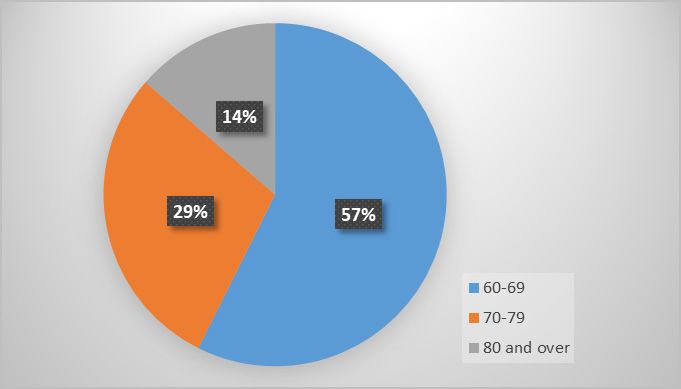
The participants in the 2017 Survey of Older Persons in Thailand were mainly in the 60–69
age group, followed by those who were 70–79 years old, and 14% who were aged 80+
years (Figure 4.3).
Figure 4.3: Percentage of Participants by Age Group
in 2017 Survey of Older Persons in Thailand
Source: 2017 Survey of Older Persons in Thailand.
108The Ageing Society and Human Resources to Care for
Older People in Thailand
As shown in Figure 4.4 out of the total 11,312,447 older people, 5,083,681 were male
and 6,228,766 were female across the whole country. There were 2,062,919 males from
municipal areas and 3,020,762 from non-municipal areas.3 Of the women, 2,593,850 were
from the municipal areas and 3,634,916 persons were from non-municipal areas.
Figure 4.4: Number of Older Persons by Gender in Thailand, 2017
MA = municipal area.
Source: 2017 Survey of Older Persons in Thailand.
Figure 4.5 depicts the ageing index, or the ratio of the number of older people per 100
people younger than 15 years old in Thailand. Based on the data from the 2017 Survey
of Older Persons in Thailand, the average ageing index for all of Thailand was as high as
97. Yet, the ageing index of the northern region was much greater than that of the whole
country. This region reached an ageing index of 126.4. Meanwhile, the south had the
lowest ageing index at 69.7 in 2017.
3
Municipal areas mean a locality which has a Royal Decree issued under the Municipal Act of 1953 and is
established as a municipality and the Sanitation Change Act to be a Sub-district Municipality 1999 as a Sub-dis-
trict Municipality by specifying the boundaries of that municipality as well. Non-municipal areas mean the area
outside the municipality, also known as the village. Municipalities in Thailand are divided into three types ac-
cording to the population and income of the municipality. In the Municipal Act of 1953 (Section 9, 10, and 11) a
Sub-district Municipality consists of the locality in which the Ministry of Interior has announced the status of the
Sub-district municipality. The announcement of the Ministry of Interior specifies the name and municipality area
as well. A Town Municipality is a locality with a population of more than 10,000 and a reasonable income for the
performance of duties required by this Act. A City Municipality is a locality with a population of 50,000 or more,
with sufficient income to perform duties required under the Act.
109Human Resources for the Health and Long-term
Care of Older Persons in Asia
Figure 4.5: Ageing Index in Thailand, 2017
MA = municipal area.
Source: 2017 Survey of Older Persons in Thailand.
The 2017 Survey of Older Persons in Thailand investigated older persons by source of
income. Figure 4.6 shows that there were various sources of income for older people in
Thailand during the 12 months before the date of the interviews, adopting a multiple
response approach. From the perspective of private transfers, parents, spouses, brothers/
sisters, and children were reported as their source of income. The government’s living
allowance, pension, and social security funds are the reported sources of income from the
perspective of public transfers. They also earned from their own sources of income, which
included working remuneration and savings interest/savings/assets. Overall, the data show
that most older persons participating in the 2017 survey received the governmental living
allowance. Children were revealed to rank second as the source of income, followed by
savings interest/savings/assets, working, spouses, brothers/sisters, and pensions.
110The Ageing Society and Human Resources to Care for
Older People in Thailand
Figure 4.6: Number of Older Persons by Source of Income, Age Group, and Gender,
2017
Source: Calculated from 2017 Survey of Older Persons in Thailand.
Despite the governmental living allowance as a source of income reported by the majority
of the 2017 survey’s participants, this study opines that the survey’s results support a
previous study to a certain extent. According to Wongboonsin, Keeratipongpaiboon, and
Wongboonsin (2018), Thailand belongs to a family-based welfare regime. In other words,
Thai society has so far largely relied upon private, non-monetary transfers within families.
This regime is borne out of a long-standing norm whereby the family has an important role
in the family’s care arrangements, and parents rank superior in social position and age.
In such a society, the family members have traditional roles and designations based on
a hierarchical structure that defines the relationship between husband and wife, parents
and children, and older and younger siblings. This is expressed in terms of the expected
responsibility to support, in both cash and kind.
One may note, also, that the 2017 survey’s participants were active older persons to a
certain extent, given that working was reported as a source of income. This seems to
support the data on the self-health assessment shown in Figure 4.7. Overall, the majority
of the survey’s participants rated their own health as fair, followed by good.
111Human Resources for the Health and Long-term
Care of Older Persons in Asia
However, there were 1,518,324 older persons who considered themselves to have a bad
health condition. The number of people reporting bad health was highest in the northeast,
followed by people in the central region. The lowest number of older people that
considered themselves to be in bad health was in Bangkok (Figure 4.7).
Figure 4.7: Number of Older Persons by Self-health Assessment in Thailand, 2017
Source: 2017 Survey of Older Persons in Thailand.
The 2017 survey’s data revealed that there were 16 categories of those taking care of the
older persons as part of their daily activities, along a multi-response approach. They are
the spouse, single son, single daughter, married son, married daughter, son/daughter-
in-law, grandchildren, brother/sister/relatives, parents, friend/neighbour, nurse, assistant
nurse, institutional caregiver, freelance caregiver, assistant caregiver, volunteer, servant,
and others (Figure 4.8).
Overall, Figure 4.8 reveals that familial support was the main source of assistance for the
elderly’s daily living activities. The majority of the older people participating in the 2017
survey were cared for by their spouse, followed by married daughter, single daughter,
married son, single son, and brother/sister/relatives. Those in the age group of 60–69
years old were mainly cared for by their spouse, while those in the 80+ age group were
mainly cared for by a married daughter. For these age groups, almost the same numbers
of 70–79 year-old people answered that they were cared for by married daughters and
spouses, but the number cared for by their married daughters was slightly bigger than for
spouses. The data reveal that non-family members play a very small role in daily-activity
care provision, even in the age group of 80+ years old.
112The Ageing Society and Human Resources to Care for
Older People in Thailand
Figure 4.8: Number of Older Persons by Main Caregivers for Daily Activities by Age
Group, 2017
Source: 2017 Survey of Older Persons in Thailand.
2.2. Governmental policies and programmes related to older persons
Elderly welfare has been an issue of concern in Thailand for decades. This was reflected in
as early as 1982, when the National Elderly Council was established to begin addressing
the issues impacting the elderly. Then, in 1991, the National Committee of Senior Citizens
was established in response to a resolution by the UN Assembly on elderly persons’ rights
with respect to autonomy, involvement, care, self-satisfaction, and esteem.
113Human Resources for the Health and Long-term
Care of Older Persons in Asia
Thailand is currently implementing the Second National Plan for Older Persons (2002-
2021) with five implementation strategies (National Commission on the Elderly, 2009).
They are:
• Preparation for quality ageing
• Promotion of well-being by older persons
• Social security for older persons
• Management system and personnel development at the national level
• Research for policy and programme development support, monitoring, and
evaluation for the Second National Plan for Older Persons every five years
The Second National Plan for the Older Persons is based on the philosophy that ‘the
elderly are not a vulnerable group nor a social burden, but able to take part as social
development resources, so they are entitled to recognition and support by the family,
community, and the State, to lead a valuable life with dignity and sustain their health and
living standard for as long as possible’ (National Commission on the Elderly, 2009: 1). The
objectives of the plan are fivefold: 1) to encourage older persons’ well-being, whereby
they can lead their lives as an asset to society with dignity and personal independence
and autonomy with reliable security; 2) to raise society’s conscience regarding the respect
for and recognition of the elderly’s valuable contribution to society, whereby their valuable
experience shall be promoted for as long as possible; 3) to raise all people’s awareness
regarding the necessity for readiness preparation for quality ageing; 4) to encourage the
people, family, community, and the local, public, and private sectors to realise and take
part in actions involving the elderly; and 5) to formulate the framework and guidelines
for good practice regarding the elderly for all concerned parties to observe aiming at an
integral and comprehensive implementation on the elderly persons’ mission (National
Commission on the Elderly, 2009: 2–3).
The Act on Older Persons was enacted in 2003 and has been in force since 1 January
2004, consisting of 24 sections. The focus of the act includes: 1) elderly persons’ rights;
2) national mechanisms for the elderly; 3) tax privileges for children who take care of
their parents; and 4) an elderly person fund. The National Commission on the Elderly is
prescribed to be established by the Act on Older Persons.
In 2014, the elderly welfare budget – which covers the old civil servant pension scheme,
living allowances for the elderly, and the government’s contribution to the Government
114The Ageing Society and Human Resources to Care for
Older People in Thailand
Pension Fund, the Social Security Fund, and the National Savings Fund – amounted to
B270 billion, or 2.1% of gross domestic product (GDP). The budget is expected to increase
to B680 billion by 2024, accounting for about 3% of the anticipated GDP. Moreover, the
budget for pension-related schemes is expected to increase from B287 billion currently to
B698 billion by 2024.
There are strong expectations by policy makers for families to continue to perform their
traditional role for the care of elderly people. This is amid concerns arising regarding how
the Thai elderly can be helped to be better-off, and how the welfare schemes could be
made sustainable in the years to come.
From the perspective of public transfers, public welfare for the elderly in Thailand covers
the following: 1) the former civil servant pension scheme; 2) living allowances for the
elderly and the government’s contribution to the Government Pension Fund; 3) the Social
Security Fund; and 4) the National Savings Fund (Wongboonsin, Keeratipongpaibul, and
Wongboonsin, 2018).
The government’s current policies and programmes are in line with the Second National
Plan for Older Persons (2002-2021) mentioned above. A partial welfare state is accordingly
the option taken by the Thai government. Recently, to ease the financial burden on
the government, new measures for old-age security have been launched to promote
a social safety net for security and quality of life in old age. Intergenerational family
relationships have been strengthened through different policy measures, in addition to
the promotion of a positive attitude towards the elderly, health promotion for the elderly,
social protection for the elderly, and old-age security programmes. The latter includes
old-age employment, housing development plans for low-income and lower-middle
income earners along a public-private partnership (PPP) approach, reverse mortgage
loans, and elderly-friendly banking services. Amongst the measures for old-age security,
those relating to the pension system are in relatively slow development (Wongboonsin,
Keeratipongpaibul, and Wongboonsin, 2018). Thailand also opts for a community-
based system for long-term care. A ‘sub-district role model’ is relied upon to strengthen
community collaboration with other stakeholders – namely family, the local government,
the private sector, and several governmental agencies – in the provision of services for
dependent elderly people in the community to serve their needs. Yet, one may note that
this is still at an early stage of building capacity.
115Human Resources for the Health and Long-term
Care of Older Persons in Asia
2.3. Human resource management for the care of older people in Thailand
a) Overview
The older population in Thailand continues to grow, which is leading to high demand
for caregivers. However, being a caregiver is not an easy task; there are many factors to
consider, including each individual’s availability and care-giving capabilities. This section
presents brief information on today’s caregivers in Thailand, the Thai Government’s efforts,
training for caregivers, curriculum, regulation, and certification.
Today, Thailand faces the progressive ageing of its population, and the country is ranked
as the second-most aged in Southeast Asia. The proportion aged 80 years and above is
estimated to rise tenfold between 2000 and 2050 (Knodel et al., 2018). The majority of
people hold the Buddhist principle whereby most long-term care is provided informally
at home by family members.4 As in other Asian countries, family members are the ones to
support older Thais for personal assistance with the activities of daily living (ADL) (Knodel
et al., 2015).
However, Thailand has started to face difficulties in providing care for its elderly citizens
due to the increased out-migration of adult children, which have raised concerns about
the sustainability of the home-based care by family members model in the future (Knodel,
2014; Knodel et al., 2013). In addition to a lack of availability of caregivers, unequal
access to services, insufficient quantity and quality of health resources (i.e., infrastructure,
manpower, and financing), and a lack of coordination within and between health
institutions in delivering care services remains (Suwanrada et al., 2014). Therefore, efforts
to solve these issues are needed.
b) Government efforts for the care of older persons
The Thai Government is fully aware of these challenges and has set up a working team
to revise the Health Development Strategic Plan for the Elderly (2013-2023) to address
long-term care for older persons by combining assistance within the family and a support
4
Suwanrada et al. (2014) explain that the Buddhist principle of filial piety prevailing in Thailand means that most
long-term care is provided informally at home by family members. They also mention that given the current
demographic changes, Thai families have started to face difficulties in elderly care issues.
116The Ageing Society and Human Resources to Care for
Older People in Thailand
system of health care and social services within their own communities (Suwanrada et al.,
2014). This emphasises the need for the community and local administrative organisations
to cooperate in implementing the long-term care system, including allocating a budget for
the purpose. The components of the system include databases on older people, good-
quality clubs for older people, volunteers to provide home-based care for older people,
preventive dental services, and a system to ensure care for older people who are home- or
bed-bound (Foundation of Thai Gerontology Research and Development Institute and
College of Population Studies, 2012).
To provide home-based assistance for older people, the Home Care Service Volunteers for
the Elderly Program was launched by the Bureau of Empowerment for Older Persons (now
Department of Older Persons) in 2003, to establish a system of community-based care and
protection for older persons with chronic illnesses, especially for those who are bedridden,
who have no caregivers, or who are underprivileged (Knodel et al., 2018). By 2013, some
level of services in all communities throughout Thailand had been provided by the Bureau
of Empowerment for Older Persons, involving over 51,000 elderly home care volunteers
responsible for nearly 800,000 older persons (Ministry of Social Development and Human
Security, 2013). However, the extent and quality of the services provided by such home
care volunteers varies greatly across communities.
In 2011, a new community care policy was developed by the Thai Government as part of
a project in Lam Sonthi District, Lopburi Province. A fund of US$17.4 million was created
by the National Health Security Office (NHSO) to provide long-term care facilities for older
people (Khongboon and Pongpanich, 2018). In 2016, a trial programme was announced to
cover 1,000 sub-districts, including 100,000 severely disabled individuals (National Health
Security Office, 2015).
There are only 12 institutional old-age homes, called Social Welfare Development Centres
for Older Persons (introduced in section 3.1), supported by the national government with
under 2,000 residents, and 13 others under the supervision of the Department of Local
Administration (Foundation of Thai Gerontology Research and Development Institute and
College of Population Studies, 2012).
117Human Resources for the Health and Long-term Care of Older Persons in Asia c) Elderly care stakeholders at the community level Direct stakeholders providing care for older people at the community level include three entities: senior citizen centres, sub-district health-promoting hospitals, and sub-district administration organisations. Senior citizen centres These are places for older persons to develop themselves and extend their social network at the local level. The centres belong to older persons, are run by older persons, and are for the benefit of older persons, with regulations, physical locations, and separate funding. The activities of the centres are mainly arranged according to the demands and interests of the members. The first senior citizen centres were established in Thailand on 20 December 1962 (formerly called the Senior Citizen Assembly) by the Neuroscience Research Foundation under the Royal Patronage of H.M. the King, Nerve System, Phaya Thai Hospital, and based on the concept of Professor Doctor Prasop Ratanakorn (Daranee, 1997; Uttawichai, 1996). By 2008, 19,475 senior-citizen centres had been officially established. But, it is likely that more centres have been unofficially established under the support or supervision of other organisations (Council of the Elderly of Thailand, 2008). The role of senior-citizen centres are for home visits and checking physical health, such as measuring blood pressure, reviewing health conditions related to food, diet, and exercise, along with monitoring mental health by talking and allocating a companion, organising music, folk art, handcrafts, planting, and travel, etc. The centres help to arrange the home environment to be more elderly-friendly, such as by organising the bedroom to be bright, with good ventilation, installing handrails in the bathroom, changing squat toilets to sitting toilets, or adjusting stair railings and inclines (Suwanrada et al., 2014). Sub-district health promotion hospitals These are governmental authorities at the primary care unit level under the control of the Department of Health, Ministry of Public Health. Their key role is to prevent disease, as well as promote and restore health. In addition to having government officers who are responsible for the hospitals’ operation, the Ministry of Public Health also arranges for village health volunteers, who are community members trained by the sub-district health promotion hospitals to provide primary, first-stage health care to the people in the community and, in cases where a situation is beyond the capability of the village health volunteer, to refer the elderly to a hospital. The key role of the sub-district health promotion hospitals is to create a database of elderly; coordinate and work closely with 118
The Ageing Society and Human Resources to Care for
                                                                        Older People in Thailand

professional nurses, physical therapists, and occupational therapists at the community
hospitals using ADL; arrange home visits to follow up; and provide advice and knowledge
to the village health volunteer so that they can take care of the patients under the
supervision of the sub-district health promotion hospital (Suwanrada et al., 2014).

Sub-district administration organisations
Local administrative units have established four welfare plans for older people: 1) A health
services plan; 2) a plan to promote living together and strengthening elderly organisations;
3) an older people’s and disabled people’s occupation and income promotion plan;
and 4) a plan to arrange volunteers to take care of older people and disabled people
(Foundation of Thai Gerontology Research and Development Institute, 2008). The Second
National Plan on Older Persons (2002-2021) mandated that one of the missions of the
local administrative units is to arrange for elderly services in the community, comprising:
1) multi-purpose centres for older people, 2) day-care centres for older people, 3) elderly
people’s home visits, 4) healthcare services at the homes of older people, 5) transportation
services for older people in the community, 6) systemisation of the promotion of
elderly care, 7) elderly care volunteers, 8) training for caregivers and volunteers, and 9)
authorities/third parties to train caregivers and volunteers for elderly care inside the village
(Prachuabmoh et al., 2008).

d)      Training for caregivers

The challenge in Thailand is the insufficient numbers of qualified and skilled home care
volunteers. Therefore, caregiver training is needed. In Thailand, caregivers refer to persons
who have been trained in child or elderly care for at least 420 hours or 3 months. To
provide training for caregivers, we first need to understand the needs of the older people.

Needs of older people
Studies (Ayudhya et al., 2007; Rittirong, et al., 2014) provide the types of needs for older
people as follows:
        Meal preparation refers to meals that may be cooked at the house where the
        older person resides, or cooked elsewhere and brought to the house of the older
        person.
        Personal care includes any care or assistance regularly or occasionally given by a
        person to an older person who is not able to care for themselves due to physical
        limitations. Personal care, for example, includes feeding food, bathing, toileting,

                                                                                                   119
Human Resources for the Health and Long-term
Care of Older Persons in Asia
dressing, and caring for them when they are sick.
Mobility involves the changing of positions, such as from supine to sitting,
standing, for going upstairs, and ambulatory with mechanical or a caregiver’s
assistance.
Use of medication specifies the preparation and dosage of medicine. Most older
people and caregivers do not have enough basic language skills to read and
write. Caregivers need to remember what the doctors prescribe. Main caregivers
will pass the information along by word of mouth if there are many caregivers in a
home.
Sleeping and monitoring. The caregivers have to care for the older people 24
hours a day. They must make sure the older people do not fall or get up and
walk unaided. At night, they have to be ready to get up and turn their position or
check if they need to change their diaper, leading to a lack of sleep and health
deterioration.
Transportation refers to assistance and transportation given to older persons for
medical appointments or treatments and to do business in the community.
Financial support refers to any financial assistance given directly to an older
person, or to the household where the older person resides. This includes money
the older person receives for expenses, such as for household consumption and
medical treatment.
Emotional support includes any action, such as talking, consulting, or discussing,
which expresses the giver’s feelings of affection, sympathy, and/or understanding
toward the older persons.
Institutions that provide training for caregivers
Caregiver training in Thailand is provided by public and private institutions. Public
institutions include 1) the Office of Non-Formal and Informal Education, Ministry of
Education, 2) Department of Health, Ministry of Public Health, 3) Department of Skill
Development, Ministry of Labour, and 4) Department of Older Persons, Ministry of Social
Development and Human Security; while there are about 76 private institutions that
provide training for caregivers.
120The Ageing Society and Human Resources to Care for
Older People in Thailand
Regulations for caregivers and care for older persons
The caregivers and elderly care in Thailand are arranged and regulated by the following
regulations:
1) The Act on Older Persons (2003) by the Department of Older Persons, Ministry of
Social Development and Human Security, Section 10, established a community-
based care system for older persons to cooperate and coordinate with the central,
provincial, and local authorities and the state’s enterprises and other organisations
that facilitate older persons’ access to the protection, promotion, and support they
are entitled to under this Act and other relevant laws.
2) The Office of the Decentralization to the Local Government Organization
Committee, in providing personnel and personnel expenses for caring for
dependent elderly/long-term care and to support caregiver training for dependent
elderly.
3) The Ministry of Education’s regulation in 2003 regarding the determination of
private school standards and curriculum covers places and buildings, teachers,
courses, the capacity of the students, evaluation of learning, study fees and school
management, and the school system establishment and operation.
4) The Department of Skill Development, Ministry of Labour provides the National
Labour Standards Test (a test of the knowledge, ability, and attitude of the
occupation according to the criteria set by the National Skills Standard), arranging
the standards and the qualification of the test for the elderly care profession for
Level 1.
5) The Ministry of Public Health provided guidelines for controlling the operation of
elderly care services at home in 2010.
Training curricula for caregivers
There have been various curricula for caregiver training courses, as follows:
1) Training course by the Ministry of Social Development and Human Security for
three days (minimum 15 hours) by lectures and practices. The content of the
course includes general knowledge about older people, ageing change, elderly
psychology, health promotion for older people, elderly care skills, basic care for
older people, morality and ethics in caring for older people, services and networks
for older people, the role of elderly care volunteers, and elderly care practices.
2) Training course by the Ministry of Public Health for three days (minimum 18 hours)
with 15 hours of lectures and 3 hours of practical training. The content includes
general knowledge about older people, ageing change, elderly psychology,
121Human Resources for the Health and Long-term
Care of Older Persons in Asia
health promotion for older people, elderly care skills, basic care for older people,
morality and ethics in caring for older people, services and networks for older
people, the role of elderly care volunteers, and elderly care practices. Participants
are considered to have passed the test if their scores for the practical, knowledge,
and attendance ratio are more than 80%, and the moral and ethical test should be
100%.
3) Training course by the Ministry of Public Health for two weeks, with 30 hours of
lectures and 40 hours of practical. The content includes the need for elderly care,
elderly concepts, common diseases in older persons, emergency care and first aid
for older persons, basic care for older persons, caring for long-term older people
with dependency, drug use by older persons, health promotion for older persons,
elderly psychology, providing a suitable living environment for older persons,
indigenous knowledge and elderly care, elderly rights/labour laws, the roles
and ethics of older persons’ caregivers, recreational activities, and elderly care
practices. Participants are considered to have passed the test if their scores for the
practical, knowledge, and attendance ratio are more than 80%, and the moral and
ethical test should be 100%.
4) A 420-hour training course provided by the Ministry of Public Health with 115
hours of lectures and 255 hours of practical. The content includes the needs for
elderly care, elderly concepts, common diseases in older persons, emergency care
and first aid for older persons, basic care for older persons, caring for long-term
elderly people with dependency, drug use by older persons, health promotion
for older persons, elderly psychology, providing a suitable living environment for
older persons, indigenous knowledge and elderly care, elderly rights/labour laws,
the roles and ethics of elderly caregivers, recreational activities, English skills,
computer skills, and elderly care practices. Participants are considered to have
passed the test if their scores for the practical, knowledge, and attendance ratio
are more than 80%, and the moral and ethical test should be 100%.
5) A 420-hour training course provided by the Ministry of Education with 300 hours
of lectures and 120 hours of practical. The content includes principles of elderly
care, elderly psychology, recreational activities for older persons, nutrition for older
persons, cleaning and storing the home equipment, Thai and English language,
the roles and ethics of elderly caregivers, health education, labour laws, and
elderly care practices. Participants are considered to have passed the test if the
scores for the practical, knowledge, and skill performance are more than 50%, and
the attendance ratio should be more than 80%.
122The Ageing Society and Human Resources to Care for
Older People in Thailand
6) A 420-hour training course provided by the Ministry of Labour, with 162 hours
of lectures and 258 hours of practical. The content includes activities to improve
work habits, work safety, elderly psychology, first aid for older persons, basic
laws related to the caregivers’ profession, principles of elderly care, basic work
for elderly care, elderly care, nutrition for older persons, recreational activities
for older persons, occupational care for elderly caregivers, basic computer skills,
English at work, and personal business. Participants must complete at least 80% of
the study time and pass an assessment by the Skill Development Institute.
Given the different types of training courses above, it remains unclear which one
candidates need to follow, or for which caregivers can be said to be ‘competent’. Is one
training enough? Should a caregiver join any or all six courses? These questions need
further exploration to develop unified training that can be accepted in all institutions.
Instructors, the target population, and certificates for training
The instructors of caregiver training include nurses, physicians, therapists, and
pharmacists. The target population for such training varies. For 18 hours of training, the
target is volunteers who care for older people in their family (grandchildren of the elderly)
and volunteers for general elderly care. For 70 hours of training, the target population
is village health volunteers and elderly caregivers, and for the 420 hours of training, the
target is all individuals. After the training is completed, all the participants who pass the
criteria will be awarded certificates from the institutions that provided the training.
2.4. Thailand Professional Qualification Institute
The Thailand Professional Qualification Institute (TPQI), is an organisation under the
supervision of the Prime Minister of Thailand, established as an accredited registrar of
personal competency according to the relevant occupational standards (TPQI, 2014). In
order to be skilled trainers for caregivers, each individual should pass an occupational
standard test and receive certification. There are four levels of occupational standards
based on the characteristics of outcomes, qualification pathways, and performance. The
details of each level are described in Table 4.1. The four levels are to describe the levels
of skills of caregivers from the lowest (level 1) to the highest (level 4). These standards,
however, are to maintain and improve the personal competency of caregivers in order to
provide high-quality care.
123Human Resources for the Health and Long-term
Care of Older Persons in Asia
Table 4.1: Levels of Occupational Standards Based on the Characteristics
of the Outcomes, Qualification Pathways, and Performance
• Characteristics of outcomes include performing
basic routine tasks in general, being able to solve
basic problems in the operation in a limited way,
the ability to identify nutrition details, daily activi-
ties, cleaning environmental care, ability to work in
the body and mind care at Level 1, social aspects
of environmental management, and role of ethics
for elderly caregivers with good service.
• Qualification pathways include age of not less than
18 years, not being a person with bad behaviour,
Level 1 a medical certificate stating that they are healthy,
not insane or mentally ill, graduating not lower
than primary level or equivalent, having knowl-
edge and skills in caring for the elderly for at least
one year, or having passed the training course
test.
• Performance includes taking care of nutrition for
the elderly with hygiene, elderly hygienic clean-
ing, preparing medicine for the elderly correctly
and completely, following the roles and duties of
caring for the elderly correctly and efficiently, and
complying with the code of ethics for elderly care.
• Characteristics of outcomes include the ability to
solve basic problems that are found regularly by
applying the theories, tools and basic information,
competent in the process of safety and health in
the workplace, and to support the steps other
than the initial operation.
• Qualification pathways include being a person
who has passed the assessment to upgrade from
professional qualification Level 1, has passed the
training course on elderly care that covers the con-
Level 2 tent and knowledge in all aspects, has received
rehabilitation training for elderly care at home
during work at least every two years, and has
experience of caring for the elderly for at least two
years or who has passed the training course test.
• Performance includes selecting food for the elder-
ly appropriately, supervising daily activities for the
elderly with accuracy, completeness, and quality,
promoting the exercise and psychological aspects
of elderly correctly and appropriately, and provid-
ing hygienic and hygienic equipment and tools for
the elderly.
124The Ageing Society and Human Resources to Care for
Older People in Thailand
• Characteristics of outcomes include persons with
knowledge and skill at the level of specialised skill
and technique in the operation, there are various
thinking processes and practices, able to solve
technical problems along with using the manual
and to observe the work, and clarifying and im-
proving.
• Qualification pathways include being qualified to
advance to the level of professional qualification
Level 3 Level 3, passed the elderly care curriculum that
covers the content and knowledge in all aspects,
and receiving training in specialised care for the
elderly.
• Performance includes caring for the prevention of
complications by the elderly correctly and safely,
promoting the stimulation and rehabilitation of the
elderly by correct and appropriate methods, and
practice in providing tube feeding for the elderly
by the correct and safe method.
• Characteristics of outcomes include persons with
specific skills and operational techniques, there
are various thinking processes and practices,
able to solve technical problems along with using
the manual, and able to control the operation to
achieve the correct conclusion.
• Qualification pathways include being qualified to
qualify for Level 4 or a relevant professional qual-
ification, having experience to take care of the
elderly for at least four years, or have passed the
Level 4 training course test, and performed work in pro-
viding care for the elderly for at least four years.
• Performance includes effectively able to assess
the emotional state of the elderly, promoting the
elderly to have interaction between people and
society, preventing accidents that will occur to the
elderly effectively, maintaining hygienic health of
the elderly, correctly linking family and caring for
the elderly when emergencies occur, and assess-
ing the physical and mental condition of the elder-
ly with effective reports.
125Human Resources for the Health and Long-term Care of Older Persons in Asia 2.5. Challenges in human resource management for elderly care in Thailand There are several challenges in the human resource management for elderly care in Thailand. First, the lack of availability of caregivers is the main concern in elderly care in Thailand. The government needs to fully pay attention to attracting human resources or caregiver candidates from inside or outside the country. Second, there is an unequal distribution of health personnel in the Bangkok Metropolis and other provinces amongst community health centres in urban and rural areas. In addition, the shortage of healthcare personnel still remains. Third, a lack of availability and sufficient numbers of skilled care assistants in Thailand remains. Therefore, training is needed. Fourth, currently, there is no clear model for long-term care in Thailand, especially regarding the standard of care, training curriculum, staffing norms, and the evaluation of services. Last, no assessment tool can be found for human resources in long-term care institutions for older persons. 3. Elderly care facilities in Thailand 3.1. Social welfare development centres for older persons The Ministry of Social Development and Human Security (MSDHS) operates 12 centres across the country, in Bangkok, Chon Buri, Chiang Mai, Ayuthaya, Buri Ram, Phuket, Yala, Pathum Thani, Lam Pang, Songkhla, Nakhon Phanom, and Khon Kaen. Besides these centres operated by the central government, there are more facilities for older people provided at the local government level as well. They divide older persons into three groups when they select the clients who can be accommodated: A) those who can walk and move by themselves, B) those who need some assistance to move, and C) those who are bedridden. In Bangkok, at the Ban Bang Khae Social Welfare Development Centre for Older Persons, there are 118 persons in Group A, 39 persons in Group B, and 80 persons in Group C. In Chiang Mai, at the Thammapakon 126
The Ageing Society and Human Resources to Care for
                                                                              Older People in Thailand

Centre, there are 97 persons in Groups A and B, and 27 persons in Group C.5

Older persons who are over 60 years old can use the centres, but usually most are over
70 years old. Group A can enjoy singing, playing games, and so on according to the
time schedule. In the ‘Friends Support Friends’ programme, people in Group A visit the
neighbouring communities to support older persons in the community. Even within the
centres, the clients who can support others often provide some level of support.

They are operated by the government and, at the same time, some foundations support
these centres. Donations from companies and individuals are also an important source of
funding for the activities. Recently, as part of many companies’ social responsibility (CSR)
programmes, they donate money or perform voluntary work at these centres.

Usually the price is free for the clients who are older people. But in Bangkok, people who
belong to Groups A and B and wish to stay in larger rooms with some private space have to
pay B1,500 per month plus the water/electricity fee.

The centres not only accommodate older people but also approach communities to support
older persons in the community. Sometimes, they support the reform of houses, such as the
toilet facilities, to make them user-friendly for older persons.

In Chiang Mai, the Thammapakon Centre covers seven provinces and accepts 124 older
persons from seven provinces, with 40 staff, including eight trained caregivers. In Bangkok,
there are almost 40 caregivers working, with five to six trained caregivers for each group of
30–40 persons.

All caregivers in the centres are considered competent as they have been trained through
formal and non-formal education. However, although the Social Welfare Development
Centres are working well, the classification of the clients is still unclear. The ratio between
caregivers and clients (5–6 clients per 1 caregiver), which leads to a high workload amongst
caregivers, causing them stress and depression. It is recommended to increase the number
of caregivers and arrange for better classification of clients based on their care needs.

5
 As of the end of 2018 (Annual Report on Ban Bang Khae and interviews with the staff at the centres in Novem-
ber 2018).

                                                                                                                127
Human Resources for the Health and Long-term
Care of Older Persons in Asia
3.2. Private nursing homes and home care services
Even though home care by family members is common in Thailand, the role of the nursing
home and various elderly care facilities is also beginning to become important due to the
progress of ageing, the change of family composition, and so on. Of course, the majority
still believes that care by the family is the best option; therefore, not only nursing homes but
also sending trained caregivers to provide support inside the home is one of the options.
When older people suffer a severe sickness, before returning home from the big hospitals,
rehabilitation facilities can provide the necessary information, knowledge, or skills for them
to live at home. These facilities and services are still at the initial stage but have an important
role in elderly care in Thailand.
Gradually, some private elderly care facilities have been appearing within and in the suburbs
of Bangkok in recent years, but there is no data available. Here, we introduce five nursing
homes and facilities for elderly care in Bangkok: P (established in 1993), Q (established in
2012), R (established in 2003 and opened a nursing home in 2011), S (established in 2018),
and T (established in 2016). S and T focus more on rehabilitation by cooperating with the
hospitals, and they provide training to improve the rehabilitation skills of the patients and
families before the patients return home.
The founder of P and Q are nurses. The founder of P noticed the importance of care for
older persons in the early 1990s and decided to share her professional skills in care for older
persons. The founder of Q also decided to start the home in order to utilise her professional
skills when she saw the difficulties her neighbours were facing in taking care of people with
dementia. R is a Japanese company that decided to open a nursing home to introduce
Japanese nursing care quality. Except for P, all these facilities opened in the 2010s.
The prices vary by nursing home/facility. B30,000–50,000 per month appears to be the
standard price for such services, but the price can be more expensive if extra services
are required. Considering that the average monthly salary for a worker is B12,570 and
B51,088 for a manager in the manufacturing sector in Thailand,6 such nursing home fees are
expensive for the general public. They are still luxury services targeting wealthier families.
6
Based on the investment climate survey by JETRO (JETRO website).
128The Ageing Society and Human Resources to Care for
Older People in Thailand
At least one or more registered nurses stay in each facility. Trained caregivers work for each
room or each floor, one to four clients per caregiver, depending on the situation of the
clients. Caregivers often come from the north or north-eastern regions of Thailand, with
only a few from Bangkok. They graduate from the nursing aid schools near their hometowns
or in Bangkok after high school and then get jobs in nursing homes and hospitals. In some
facilities, there are some caregivers who have worked at the same place for several years,
and they find a way forward to gain more skills as practical nurses or registered nurses.7
However, some caregivers tend to quit quickly, within a few weeks, due to low remuneration
because of the low minimum wage levels, or because they find more attractive or easier
jobs. The demand for trained caregivers is always high. Therefore, many of the nursing
homes or elderly care facilities have started nursing aid schools to meet the demand for
their own sustainably and to share their professional knowledge with the people who really
need it. P, Q, R, and T have their own training schools.
3.3. Facilities for foreigners
a) Facilities in Chiang Mai
The elderly care industry in Thailand is not only for the Thai elderly but is also open for
older persons from other Asian and Western countries, in the context of the promotion
of medical tourism and long-term stayers. There are assisted living facilities for seniors in
Chiang Mai, such as the Care Resort Chiang Mai, Dok Kaew Gardens, Vivo Bene Village,
Baan Meesuk; in Pattaya, the Mabprachan Garden Resort, Namthip Nursing Home Pattaya,
Zbreeze Elderly Resort, and Golden Years Hospital that support the elderly (Zander, 2017).
Costs for home care vary greatly. Fulltime caregivers without a nursing degree can be hired
for as little as B8,000–10,000 per month (US$225–280) in Chiang Mai. Studies conducted
in other countries show that health care and long-term costs are related to factors like age,
gender, comorbidity, admission, dependence on personal ADL, living arrangements, and
health status, amongst others (Kehusmaa et al., 2012; Khongboon and Pongpanich, 2018;
Zyaambo et al., 2012).
An example of a senior assisted living facility is Vivo Bene Village, which was awarded
the highest score by the Thai Ministry of Tourism for providing long-term care for both
7
Practical nurses have one year of training and hold an official licence, while registered nurses are who have
finished a bachelor of nursing science and hold an official license.
129Human Resources for the Health and Long-term
Care of Older Persons in Asia
foreigners and Thai people in Thailand. The levels of care provided by this institution are
grouped into four: 1) essential care (minimal assistance, such as for getting dressed and
bathing; the guests are able to organise their own schedules), 2) comfort care (assistance
with various tasks throughout the day but able to manage simple aspects without difficulty),
3) intensive care (full hands-on assistance in every aspect of daily living from waking until
sleeping), 4) permanent care (similar to intensive care with support 24 hours a day). The cost
varies depending on the level of care, starting from B47,500 (US$1,435) per 30 nights. This
institution seems to have the most luxurious facilities in Chiang Mai.8
In addition, it provides services for foreign elderly, mainly Swiss and German guests, as well
as those from the United States, the United Kingdom, and so on. They have a staff of 40
nurses and nurse aide/caregivers to take care of the elderly amongst the 100 staff. In Chiang
Mai, there are more qualified hospitals – therefore, if the patients need medical treatment,
they can go to hospital with support from the resort hotel. Medical treatment is not the only
focus; there are also attractive sightseeing places with fresh air and nice facilities that allow
families to visit comfortably.
Basically, all caregivers are well trained, and the training for caregivers for foreign clients is
the same as the training for caregivers for Thai clients. However, the caregivers for foreigners
have to learn foreign languages. Therefore, they have to attend additional language training
courses, such as for English, German, and Japanese.
b) Challenges for foreign elderly
More foreign elderly have decided to stay longer or live in Chiang Mai because of the
relatively lower living expenses and hospitality in Chiang Mai. Japanese older people have
also shown interest long-stay options or migration to Chiang Mai after retirement. As of
2017, more than 3,200 Japanese live in Chiang Mai, and half are over 60 years old. There
are several clubs or associations to help the older Japanese in Thailand to enjoy their
second lives.
8
Vivo Bene (https://www.vivobene.ch/documents/vivobene-price-list-usd-thb.pdf) accessed on 5 May 2019.
130You can also read


