The Cottage EFSAC Trip Generation Assessment - August 2021 Church Road, Moreton CM5 0JD - Epping Forest District Council
←
→
Page content transcription
If your browser does not render page correctly, please read the page content below
EFSAC Trip Generation
         Assessment
             August 2021

          The Cottage
       Church Road, Moreton CM5 0JD
Document History
JOB NUMBER: 3509/2021
DOCUMENT REF: EFSAC Trip Generation Assessment (01)
REVISION: A – Client Draft
Revision Comments By Checked Authorised Date
A Client Draft AJP BM SA 26/08/2021
EFSAC Trip Generation Assessment | The Cottage, Church Road, Moreton CM5 0JD Page 2Contents
1 Introduction 4 4 Summary of Trip Figures 9
Introduction 4 Introduction 9
Existing Land Use (a) 9
2 Development 5 Existing Use Trips (b) 9
Proposed Land Use (c) 9
Site Location and Context 5
Proposed Use Trips (d) 9
Existing and Proposed Use 5
Net AADT (e) 9
Results of Analysis 9
3 Analysis 6
Existing Use Trip Generation 6 5 Summary 10
Proposed Use AADT – TRICS 6
Trip Distribution – Census Journey to
6 Appendices 11
Work Data 7 Appendix: A – Location Plan
Distribution of AADT Trips 8 Appendix: B – Epping Forest District
Council Guidance Note
Appendix: C – EFSAC Map
Appendix: D – Proposed Site Layout
Appendix: E – TRICS Outputs
Appendix: F – Trip Distribution
Spreadsheet
EFSAC Trip Generation Assessment | The Cottage, Church Road, Moreton CM5 0JD Page 31 Introduction
Introduction
1.1 Epping Forest District Council (‘EFDC’ or ‘the Council’) has a duty under the Habitats
Regulations to ensure that plans and projects, either alone or in combinations with other plans
and projects, do not adversely affect the integrity of the Epping Forest Special Area of
Conservation (EFSAC).
1.2 This includes an Air Pollution Mitigation Strategy (APMS), which involves assessing
development proposals to determine whether expected net trip generation in terms of Annual
Average Daily Trips (AADT) is greater than that modelled and thus may engender adverse
effects.
1.3 The application site comprises a single residential dwelling, The Cottage, located on Church
Road, Moreton CM5 0JD. A location plan is included at Appendix A.
1.4 This report comprises an ‘EFSAC Trip Generation Assessment’ regarding a proposal to
demolish the existing residential dwelling and replace with two new residential dwellings.
1.5 This Trip Generation Assessment has been prepared with regard to the Council’s Guidance note
on site specific assessment process: effects of development on atmospheric pollution
(December 2020). The guidance note is included at Appendix B.
1.6 This Assessment provides the figures regarding trip generation as set out in Section 3 Part 1 of
the guidance note in order to facilitate EFDC’s assessment of the proposals in terms of
associated trip generation and if necessary calculate suitable mitigation measures.
EFSAC Trip Generation Assessment | The Cottage, Church Road, Moreton CM5 0JD Page 42 Development
Site Location and Context
2.1 The application site is The Cottage, Church Road, Moreton, Essex CM5 0JD. A location plan is
included at Appendix A.
2.2 The site is located circa 10.2km northeast of the edge of the EFSAC.
2.3 The site comprises the existing property known as The Cottage, a residential dwelling, located
at the eastern side of the village.
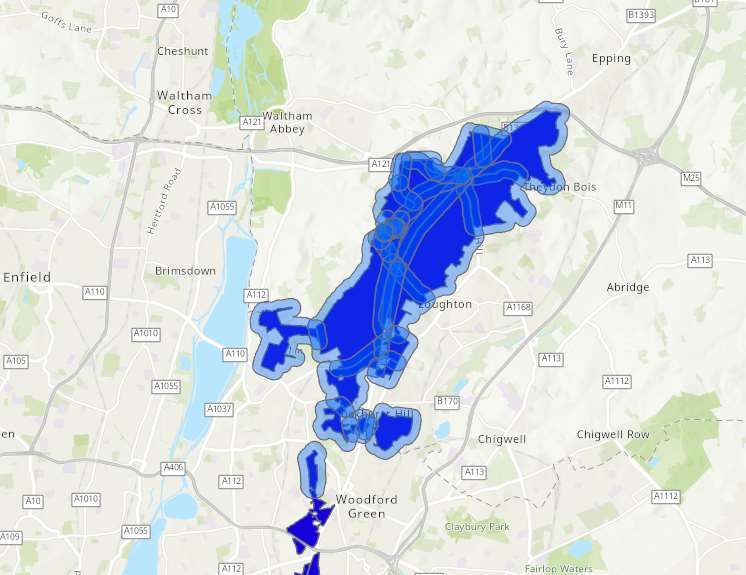
2.4 A map of the EFSAC with a 200m buffer, as used in the route distribution analysis, is included
at Appendix C.
Existing and Proposed Use
2.5 The Cottage is an existing detached residential dwelling. This is proposed to be demolished
and replaced by two semi-detached two dwellings, resulting in a net increase of one dwelling.
2.6 The proposed site plan is included at Appendix D.
EFSAC Trip Generation Assessment | The Cottage, Church Road, Moreton CM5 0JD Page 53 Analysis
Existing Use Trip Generation
3.1 There are no existing traffic surveys for the site and therefore the TRICS database was
interrogated to find surveys of sites that met the following criteria:
• Multimodal survey;
• Privately owned houses (03/A);
• Located in the England outside of London;
• Situated in ‘Edge of town’ or ‘Suburban area’ locations;
• Population within 1 mile of up to 10,000 and within 5 miles of up to 100,000;
• Carried out on a weekday in the last five years (discounting surveys carried out since
the onset of Covid-19 in March 2020).
3.2 10 surveys were found that met these criteria, from which estimates of trip generation for the
proposed site are drawn, as summarised in Table 3.1 below. The TRICS datasheet is
included at Appendix E.
Table 3.3 – TRICS trip rates (privately owned houses)
Daily (07:00-19:00)
In Out Total
Vehicle trip rate (per unit) 2.525 2.528 5.053
Vehicle trip numbers (1 unit) 3 3 5
OGV trip rate (per unit) 0.032 0.026 0.058
OGV trip numbers (1 unit) 0 0 0
3.3 It can be seen above that the proposed site is expected to generate 5 (5.053) two-way
vehicle trips over the 12-hour weekday period, with 0 (0.058) HGV trips (1.2%) over the
same period.
3.4 The 12-hour weekday trip generation can then be converted into AADT using the COBA 2018
User Manual Part 4 Chapter 9. The 12-hour trip rate is first multiplied by 1.15 (E factor) to
give 16-hour (06:00-22:00) trip rates, and then by an M factor to give the total annual trip
rate. There are different M factors for each month in the year and given that the TRICS data
comprise surveys from different months the M factors were averaged as 369.16. Finally, the
figure is divided by 362.25 (days) to give an AADT.
5.053 x 1.15 = 5.81 x 369.16 = 2145.2 / 365.25 = 6 (5.9) AADT for the existing site.
0.058 x 1.15 = 0.07 x 369.16 = 24.6 / 365.25 = 0 (0.07) HGV AADT for the existing site.
HGV trips comprise 1.2% of the existing use AADT.
Proposed Use AADT – TRICS
3.5 The development proposes demolishing the existing residential dwelling and replacing with
two new residential dwellings, giving a net increase of one residential dwelling. Therefore
using the same trip generation rates as above;
EFSAC Trip Generation Assessment | The Cottage, Church Road, Moreton CM5 0JD Page 65.053 x 1.15 = 5.81 x 369.16 = 2145.2 / 365.25 = 6 (5.9); or 12 (11.8) AADT for the proposed
site.
0.058 x 1.15 = 0.07 x 369.16 = 24.6 / 365.25 = 0 (0.07); or 0 (0.14) HGV AADT for the proposed
site.
HGV trips comprise 1.2% of the proposed use AADT.
Trip Distribution – Census Journey to Work Data
3.6 Trips were distributed on the road network based on journey to work data from Nomis table
WU03EW ‘Location of usual residence and place of work by method of travel to work (MSOA
level)’.
3.7 While of course not all trips will be commuting, no other data sources provide as robust and
comprehensive an estimation of trip origins and destinations, and moreover it is considered
that distribution of workplaces broadly replicates distribution of other land uses.
3.8 The site’s MSOA, E02004529 (Epping Forest 003), was selected as the location of residence,
with all other Epping Forest MSOAs plus all other districts/unitary authorities selected as the
locations of workplaces.
3.9 Only the ‘car or van driver’ mode of travel was used to calculate the distribution from each
origin/destination.
3.10 Next, the route by car between the site and the approximate centre of each of the areas of
residences (i.e. MSOAs or district/unitary authorities) were plotted using Google Maps, with
the fastest route by car selected as the route that would be driven between the site and the
given origin/destination. Where there were two routes of similar journey duration both were
noted.
3.11 These routes were then compared to the outline of the EFSAC with a 200m buffer, as per the
EFDC guidance note.
3.12 A total of 1,709 people were found to have reported working in the site’s MSOA, travelling from
98 MSOAs or districts/unitary authorities.
3.13 Of these, 1,079 (63.1%) would not be expected to route on roads in the EFSAC or within 200m
of it; these are referred to as ‘No’ on the associated spreadsheet which is contained at
Appendix F.
3.14 166 (9.7%) would be expected to route on roads within the EFSAC or within 200m of it; these
are referred to as ‘Yes’ on the associated spreadsheet contained at Appendix F.
3.15 464 (27.2%) would be expected to have two routes of roughly similar duration, one of which
routes on roads in the EFSAC or within 200m of it, and the other not doing so; these are
referred to as ‘50/50’ on the associated spreadsheet contained at Appendix F.
3.16 Taking half of the ‘50/50’ trips in addition to the ‘Yes’ trips it is reasoned that 23.3% of trips
associated with the site would route within 200m of the EFSAC.
EFSAC Trip Generation Assessment | The Cottage, Church Road, Moreton CM5 0JD Page 7Distribution of AADT Trips
3.17 Of the AADT of 6 associated with the existing use there would be 1 (1.4) trips routing through
or within 200m of the EFSAC, including 0 HGV trips.
3.18 Of the AADT of 12 associated with the proposed use there would be 3 (2.8) trips routing
through or within 200m of the EFSAC, including 0 HGV trips.
EFSAC Trip Generation Assessment | The Cottage, Church Road, Moreton CM5 0JD Page 84 Summary of Trip Figures
Introduction
4.1 The Section summarises from the broader calculations in Section 3 the specific required
figures as set out in Section 3 Step 1 of the EFDC guidance note.
Existing Land Use (a)
4.2 The existing land use is a single residential dwelling.
Existing Use Trips (b)
4.3 AADT generated by the site = 6
4.4 Proportion of AADT as HGVs = 1.2%
4.5 Proportion of site generated AADT on roads within 200m of the EFSAC = 23.3%
4.6 Proportion of site generated AADT as HGVs on roads within 200m of the EFSAC = 0.3%
Proposed Land Use (c)
4.7 The proposed use of the site is for two residential dwellings.
Proposed Use Trips (d)
4.8 Total AADT forecast to be generated by the site = 12
4.9 Proportion of AADT as HGVs = 1.2%
4.10 Proportion of site generated AADT on roads within 200m of the EFSAC = 23.3%
4.11 Proportion of site generated AADT as HGVs on roads within 200m of the EFSAC = 0.3%
Net AADT (e)
4.12 Net AADT (total) = 6
4.13 Net AADT (roads within the EFSAC or within 200m) = 2
Results of Analysis
4.14 It is expected that there would be a net increase of vehicles routing through or within 200m of
the EFSAC of 2. It is therefore expected that sufficient mitigation to offset this would be sought
by EFDC.
EFSAC Trip Generation Assessment | The Cottage, Church Road, Moreton CM5 0JD Page 95 Summary
5.1 The existing site comprises a single residential dwelling, which is proposed to be demolished
and replaced by two new residential dwellings, giving a net increase of one residential dwelling.
5.2 TRICS data and COBA Manual conversion factors were used to estimate trip generation
associated with the existing and proposed uses.
5.3 Census journey to work data was used to distribute AADT on the road network, in order to
calculate the number of total vehicle and HGV trips routing through or within 200m of the
EFSAC.
5.4 Longer calculations and explanations are provided in Section 3, with the key figures, as set
out in Section 3 Step 1 of EFDC’s guidance note, summarised in Section 4.
5.5 Net AADT was calculated as being 6 trips, of which 2 would be expected to route through or
within 200m of the EFSAC. It is therefore expected suitable mitigation would be sought by
EFDC on the basis of a net increase of AADT of 2 trip routing through or within 200m of the
EFSAC.
5.6 Supporting data are included in the Appendices.
EFSAC Trip Generation Assessment | The Cottage, Church Road, Moreton CM5 0JD Page 106 Appendices
Appendix: A – Location Plan
Appendix: B – Epping Forest District Council Guidance Note
Appendix: C – EFSAC Map
Appendix: D – Proposed Site Layout
Appendix: E – TRICS Outputs
Appendix: F – Trip Distribution Spreadsheet TRICS Outputs
EFSAC Trip Generation Assessment | The Cottage, Church Road, Moreton CM5 0JD Page 11Appendix: A – Location Plan EFSAC Trip Generation Assessment | The Cottage, Church Road, Moreton CM5 0JD
SJK Planning
Chartered Town Planners and Design Consultants
Byways, Landview Gardens, Chipping Ongar, Essex CM5 9EQ
Tel 01277 362489 or 07866 486349
steve.kuschel@btinternet.com www.sjkplanning.co.uk

The Cottage, Church Road, Moreton
Location Plan
Scale                  Date                  Dwg
1:1250 @A4             Mar 21                2812-01
Appendix: B – Epping Forest District Council Guidance Note

 EFSAC Trip Generation Assessment | The Cottage, Church Road, Moreton CM5 0JD
Appendix 2: PFH report on adoption of the Interim Air Pollution Mitigation Strategy

Epping Forest District Council Habitats Regulations: Site-specific assessment
processes in relation to the effects of development on atmospheric pollution

December 2020

1.      Introduction
1.1     Under UK legislation, Epping Forest District Council (the Council) is a competent
        authority with a duty to ensure that plans and projects (including the emerging Local
        Plan) will not adversely affect the integrity of the Epping Forest Special Area of
        Consideration (EFSAC). As part of that responsibility, the Council has undertaken a
        Habitats Regulations Assessment (HRA) of its emerging Local Plan. The Habitats
        Regulations places a legal duty on the Council that it must carry out an Appropriate
        Assessment on any plan or project likely to have a significant effect on
        internationally important ecological assets, either alone, or in combination with
        other plans and projects. The Council’s Local Plan evidence base has identified that
        development proposed for allocation within the emerging Local Plan would have an
        adverse impact on the Epping Forest Special Area of Conservation (EFSAC) as a result
        of, amongst other things, atmospheric pollution arising primarily from vehicle
        emissions.
1.2     In order to be able to draw a conclusion of no adverse effect on the integrity of the
        EFSAC in relation to atmospheric pollution, the Council has adopted an Air Pollution
        Mitigation Strategy (APMS). The APMS and the evidence published alongside it is
        based on the quantum, distribution and nature of development proposed for
        allocation in the emerging Local Plan and a small proportion of ‘windfall’
        developments based on an annual average.
1.3     The Council recognises that planning applications may be submitted on Local Plan
        sites with proposals that differ in land use or quantum from that originally assessed
        as part of the Council’s air pollution evidence base. In such cases, there is a need to
        undertake an assessment of the proposals against the evidence base to confirm if
        there are additional adverse effects over and above that which the APMS seeks to
        address, i.e. adverse effects which may arise if the Annual Average Daily Trips from
        the site is greater than that modelled. Of specific importance in this regard is the
        number of vehicle trips associated with each site expected to use roads within the
        EFSAC or within 200 metres of the EFSAC.
1.4     This guidance note has been prepared to set out the Council’s process for reviewing
        and assessing potential impacts arising from proposals where additional vehicle trips
        through the EFSAC may occur in order to help applicants. This includes, for example,
        where the quantum or nature of development on a site differs from that modelled as

                                                                                                             1
EFDC: Guidance note on site specific assessment processes: effects of development on atmospheric pollution
December 2020
Appendix 2: PFH report on adoption of the Interim Air Pollution Mitigation Strategy
part of the emerging Local Plan’s evidence base. It identifies the triggers for when
such an assessment will be necessary, and the information required to be provided
by applicants to enable the Council to undertake an appropriate analysis in
accordance with the requirements of the Habitats Regulations.
1.5 Applicants are strongly encouraged to complete these assessments early in the
process, and ideally through the Council’s pre-application service. This will help the
Council to assess applications, in consultation with Natural England, and determine
them efficiently and effectively.
2. Scoping and triggers for HRA assessment
2.1 The method of assessing transport and highway impacts associated with each
development will need to proceed through a scoping exercise with the Council, Essex
County Council (ECC) and in some cases Highways England (HE), ideally at the pre-
application stage. During this exercise, the requirement for and scope of a Transport
Statement (TS) or Transport Assessment (TA) to support an application will be
determined, as well as the need to undertake a specific assessment of potential
impacts on the EFSAC.
2.2 The triggers for determining if the transport impact of a development proposal being
brought forward need to be assessed in relation to its effects on the EFSAC are:
a) If the development proposal is not specifically proposed for allocation within the
emerging Local Plan (in relation to residential developments this will apply to
proposals for six or more dwellings or those greater than 0.2 Ha recognising that
a small sites windfall allowance has been included in the evidence work); or
b) if the development proposal represents a variation (which results to an increase
in the quantum of development or changes the proposed use) from the site’s
land use allocation as set out in the emerging Local Plan.
2.3 In these instances, applicants will be required to provide evidence to support an
assessment against the traffic and air quality modelling used to support the
development of the adopted APMS. This assessment will be undertaken by the
Council and, if necessary, its consultant team. The process for such an assessment is
set out in the following section.
2.4 If a proposed development does not involve any of the above triggers, no additional
assessment by EFDC’s consultant team will be required. In either case a project-level
HRA will still be required, and a TS or TA may be necessary for highway/transport
assessment purposes to support a development proposal, the need for which should
be determined and agreed at the pre-application phase.
2
EFDC: Guidance note on site specific assessment processes: effects of development on atmospheric pollution
December 2020Appendix 2: PFH report on adoption of the Interim Air Pollution Mitigation Strategy
3. HRA assessment process
3.1 For development sites that meet either of the triggers set out above, there will be a
need to review the traffic generating characteristics of the site in further detail, and
assess any potential adverse effects on the EFSAC over and above that accounted for
in the Council’s adopted APMS. This will enable the Council and Natural England to
be satisfied that any adverse effects in connection with each site application will
either not arise, or if they do, will be either appropriately mitigated through the
APMS or identify where further mitigation measures are required.
3.2 It is expected that for development proposals requiring a TS/TA, the trip generation
methodology feeding into the HRA assessment will be scoped by the applicant and
reviewed by the Council/ECC/HE at an early stage as appropriate.
3.3 The assessment process follows four steps, set out as follows:
Step 1:
As part of pre-application and transport scoping discussions with the Council,
applicants will be required to provide the following information relating to each
development site:
(a) The land use and quantum of the authorised existing use of the subject land
as was correct at February 20171, or confirmation that the site was vacant or
not generating traffic at that time (in which case proceed to [c]);
(b) Calculation of the number of vehicle trips in Annual Average Daily Traffic
(AADT) generated by the site under its existing use, including:
i. Total AADT generated by the site, including heavy duty vehicles as a
proportion of total AADT (HDV%).
ii. Proportion of site generated AADT on roads within 200 metres of the
EFSAC, including HDV%.
These calculations must be supported by evidence such as traffic surveys or
other appropriate data source, e.g. TRICS, journey to work data, etc2. If it
can be clearly demonstrated that a site which was vacant prior to February
2017 could be brought back into use for the purposes for which it was
authorised (without the need for any planning permission) the Council may
be in a position to consider taking this into account in calculating (b) above.
1
This date is significant as it represents the period during which traffic survey data was collected to inform the
“Baseline” scenario for the Local Plan transport modelling.
2
The source of the evidence, calculation methods and all relevant details must be provided. When using
empirical data such as TRICS, applicants should ensure they rely on data points which best represent the
nature and location of land uses on each site.
3
EFDC: Guidance note on site specific assessment processes: effects of development on atmospheric pollution
December 2020Appendix 2: PFH report on adoption of the Interim Air Pollution Mitigation Strategy
(c) A schedule of the land use and quantum proposed at the site (as is best
known at the time).
(d) Calculation of the forecast number of vehicle trips (AADT) generated by the
site under its proposed use to the end of the plan period in 2033:
i. Total AADT forecast to be generated by the site, including HDV%.
ii. Proportion of site generated AADT on roads within 200 metres of the
EFSAC, including HDV%.
These calculations must be supported by evidence such as traffic surveys or
other appropriate data source, e.g. TRICS, journey to work data3, etc
(e) A calculation of the net AADT figure (proposed (d) minus existing (b)) both in
total and for roads within the EFSAC or within 200 metres of the EFSAC.
(f) Details of any mitigation measures proposed to be secured through
recognised planning mechanisms in support of the application, and if the
proposed mitigation is expected to impact on trip generation and/or
distribution. Forecasts under (d) and (e) should be provided for both ‘with’
and ‘without’ the proposed mitigation.
Step 2:
Council officers will undertake an initial appraisal of the existing (if applicable)
and proposed AADT forecasts and liaise with the applicant to ensure the
required information has been supplied and is fit for purpose. Where applicable,
the proposed methodology will also be reviewed against any pre-application
scoping discussions and advice from ECC/HE.
Step 3:
The relevant site information and AADT will be provided to the Council’s
appointed transport consultant to check against the site-specific land use and
trip data previously forecast in the Council’s evidence base.
A short technical note will be prepared setting out any difference in AADT
between the site allocation assumptions used in the Council’s evidence base
and the applicant’s forecasts, including any reasoning for this (e.g. difference in
land use assumptions, application of a different trip rate and/or trip distribution,
mitigation impacts, etc).
The assessment will indicate either:
(a) There is no forecast increase in AADT at any location that would alter the
outputs of the evidence base; or
4
EFDC: Guidance note on site specific assessment processes: effects of development on atmospheric pollution
December 2020Appendix 2: PFH report on adoption of the Interim Air Pollution Mitigation Strategy
(b) There is likely to be an increase in AADT of any number at any
location that may alter the outputs of the evidence base.
(b1) Whether there is an overall increase in the distance travelled by
vehicles or HDVs associated with the development on roads within
the EFSAC or within 200 metres of the EFSAC as this would result in
an increase in pollution within the EFSAC.
Where outcome (a) is reached, no further site-specific assessment of HRA
impacts will be required. Where outcome (b) is reached and/or (b1) is also true,
the assessment will move to Step 4.
Step 4:
The relevant transport data will be provided to the Council’s appointed air
pollution modelling consultant, who will undertake a revised assessment to
determine the effects against those presented within the Council’s evidence
base and subsequently addressed through the adopted APMS.
Specifically, the revised assessment outcomes will be reviewed to determine if
the mitigation measures identified within the APMS will be capable of
satisfactorily addressing any further impact, or if additional measures need to be
secured. Such measures will need to be considered on a site-by-site basis and
may require additional assessment(s).
4. Costs
4.1 Site promoters will be responsible for covering the Council’s costs associated with
undertaking the above assessments. The level of cost associated with each site will
depend on how many assessment steps the application proceeds through.
4.2 These costs are separate from any contribution applicants will be required to make
towards the implementation of the APMS.
4.3 The costs for undertaking each step assuming one enquiry and the corresponding
technical note per site is as follows:
Step 1: Nil (To be completed by the applicant)
Step 2: £215-800 per site (internal EFDC review)
Step 3: Initial assessment (EFDC appointed consultant) £900 plus VAT
per site
Step 4: initial assessment (EFDC appointed consultant) £3,180 plus
VAT per site
5
EFDC: Guidance note on site specific assessment processes: effects of development on atmospheric pollution
December 2020Appendix: C – EFSAC Map EFSAC Trip Generation Assessment | The Cottage, Church Road, Moreton CM5 0JD
Appendix: D – Proposed Site Layout

 EFSAC Trip Generation Assessment | The Cottage, Church Road, Moreton CM5 0JD
B/S
                                          B/S

                Hall   Hall

Kitchen/Diner
                               Kitchen/Diner

       Living
                          Living

                                                                                       SJK Planning
                                                                                       Chartered Town Planners and Design Consultants
                                                                                       Byways, Landview Gardens, Chipping Ongar, Essex CM5 9EQ
                                                                    N                  Tel 01277 362489 or 07866 486349
                                                                                       steve.kuschel@btinternet.com www.sjkplanning.co.uk

                                                                                       The Cottage, Church Street, Moreton
                                                    1   2   3   4
                                                                         Scale 1:200   Proposed dwellings
                                                0                   5   10(metres)
                                                                                       Block Plan
                                                                                       Scale                  Date                  Dwg
                                                                                       1:200@A3               March 21              2812-02
Appendix: E – TRICS Outputs EFSAC Trip Generation Assessment | The Cottage, Church Road, Moreton CM5 0JD
TRICS 7.8.2 210621 B20.20       Database right of TRICS Consortium Limited, 2021. All rights reserved             Thursday 26/08/21
                                                                                                                               Page 1
EAS Transport Planning    Unit 10 The Maltings      Stanstead Abbotts                                               Licence No: 743101

                                                                                        Calculation Reference: AUDIT-743101-210826-0803
       TRIP RATE CALCULATION SELECTION PARAMETERS:

       Land Use      : 03 - RESIDENTIAL
       Category      : A - HOUSES PRIVATELY OWNED
       MULTI-MODAL TOTAL VEHICLES

       Selected regions and areas:
       02    SOUTH EAST
             HC     HAMPSHIRE                                             1   days
             HF     HERTFORDSHIRE                                         1   days
             KC     KENT                                                  1   days
             WS     WEST SUSSEX                                           1   days
       04    EAST ANGLIA
             NF     NORFOLK                                               3 days
       08    NORTH WEST
             CH     CHESHIRE                                              2 days
       09    NORTH
             DH     DURHAM                                                1 days

       This section displays the number of survey days per TRICS® sub-region in the selected set

       Primary Filtering selection:

       This data displays the chosen trip rate parameter and its selected range. Only sites that fall within the parameter range
       are included in the trip rate calculation.

       Parameter:                    No of Dwellings
       Actual Range:                 24 to 799 (units: )
       Range Selected by User:       6 to 1817 (units: )

       Parking Spaces Range:         All Surveys Included

       Parking Spaces per Dwelling Range: All Surveys Included

       Bedrooms per Dwelling Range:           All Surveys Included

       Percentage of dwellings privately owned:            All Surveys Included

       Public Transport Provision:
       Selection by:                                                   Include all surveys

       Date Range:         27/08/16 to 01/03/20

       This data displays the range of survey dates selected. Only surveys that were conducted within this date range are
       included in the trip rate calculation.

       Selected survey days:
       Monday                                                  2   days
       Tuesday                                                 3   days
       Wednesday                                               2   days
       Thursday                                                3   days

       This data displays the number of selected surveys by day of the week.

       Selected survey types:
       Manual count                                          10 days
       Directional ATC Count                                  0 days

       This data displays the number of manual classified surveys and the number of unclassified ATC surveys, the total adding
       up to the overall number of surveys in the selected set. Manual surveys are undertaken using staff, whilst ATC surveys
       are undertaking using machines.

       Selected Locations:
       Suburban Area (PPS6 Out of Centre)                            3
       Edge of Town                                                  7

       This data displays the number of surveys per main location category within the selected set. The main location categories
       consist of Free Standing, Edge of Town, Suburban Area, Neighbourhood Centre, Edge of Town Centre, Town Centre and
       Not Known.

       Selected Location Sub Categories:
       Residential Zone                                             10

       This data displays the number of surveys per location sub-category within the selected set. The location sub-categories
       consist of Commercial Zone, Industrial Zone, Development Zone, Residential Zone, Retail Zone, Built-Up Zone, Village,
TRICS 7.8.2 210621 B20.20 Database right of TRICS Consortium Limited, 2021. All rights reserved Thursday 26/08/21
Page 2
EAS Transport Planning Unit 10 The Maltings Stanstead Abbotts Licence No: 743101
Secondary Filtering selection:
Use Class:
C3 10 days
This data displays the number of surveys per Use Class classification within the selected set. The Use Classes Order 2005
has been used for this purpose, which can be found within the Library module of TRICS®.
Population within 500m Range:
All Surveys Included
Population within 1 mile:
1,001 to 5,000 1 days
5,001 to 10,000 9 days
This data displays the number of selected surveys within stated 1-mile radii of population.
Population within 5 miles:
5,001 to 25,000 2 days
25,001 to 50,000 2 days
50,001 to 75,000 3 days
75,001 to 100,000 3 days
This data displays the number of selected surveys within stated 5-mile radii of population.
Car ownership within 5 miles:
0.6 to 1.0 2 days
1.1 to 1.5 7 days
1.6 to 2.0 1 days
This data displays the number of selected surveys within stated ranges of average cars owned per residential dwelling,
within a radius of 5-miles of selected survey sites.
Travel Plan:
Yes 8 days
No 2 days
This data displays the number of surveys within the selected set that were undertaken at sites with Travel Plans in place,
and the number of surveys that were undertaken at sites without Travel Plans.
PTAL Rating:
No PTAL Present 10 days
This data displays the number of selected surveys with PTAL Ratings.TRICS 7.8.2 210621 B20.20 Database right of TRICS Consortium Limited, 2021. All rights reserved Thursday 26/08/21
Page 3
EAS Transport Planning Unit 10 The Maltings Stanstead Abbotts Licence No: 743101
LIST OF SITES relevant to selection parameters
1 CH-03-A-10 SEMI-DETACHED & TERRACED CHESHIRE
MEADOW DRIVE
NORTHWICH
BARNTON
Edge of Town
Residential Zone
Total No of Dwellings: 40
Survey date: TUESDAY 04/06/19 Survey Type: MANUAL
2 CH-03-A-11 TOWN HOUSES CHESHIRE
LONDON ROAD
NORTHWICH
LEFTWICH
Suburban Area (PPS6 Out of Centre)
Residential Zone
Total No of Dwellings: 24
Survey date: THURSDAY 06/06/19 Survey Type: MANUAL
3 DH-03-A-01 SEMI DETACHED DURHAM
GREENFIELDS ROAD
BISHOP AUCKLAND
Suburban Area (PPS6 Out of Centre)
Residential Zone
Total No of Dwellings: 50
Survey date: TUESDAY 28/03/17 Survey Type: MANUAL
4 HC-03-A-23 HOUSES & FLATS HAMPSHIRE
CANADA WAY
LIPHOOK
Suburban Area (PPS6 Out of Centre)
Residential Zone
Total No of Dwellings: 62
Survey date: TUESDAY 19/11/19 Survey Type: MANUAL
5 HF-03-A-03 MIXED HOUSES HERTFORDSHIRE
HARE STREET ROAD
BUNTINGFORD
Edge of Town
Residential Zone
Total No of Dwellings: 160
Survey date: MONDAY 08/07/19 Survey Type: MANUAL
6 KC-03-A-07 MIXED HOUSES KENT
RECULVER ROAD
HERNE BAY
Edge of Town
Residential Zone
Total No of Dwellings: 288
Survey date: WEDNESDAY 27/09/17 Survey Type: MANUAL
7 NF-03-A-04 MIXED HOUSES NORFOLK
NORTH WALSHAM ROAD
NORTH WALSHAM
Edge of Town
Residential Zone
Total No of Dwellings: 70
Survey date: WEDNESDAY 18/09/19 Survey Type: MANUAL
8 NF-03-A-05 MIXED HOUSES NORFOLK
HEATH DRIVE
HOLT
Edge of Town
Residential Zone
Total No of Dwellings: 40
Survey date: THURSDAY 19/09/19 Survey Type: MANUALTRICS 7.8.2 210621 B20.20 Database right of TRICS Consortium Limited, 2021. All rights reserved Thursday 26/08/21
Page 4
EAS Transport Planning Unit 10 The Maltings Stanstead Abbotts Licence No: 743101
LIST OF SITES relevant to selection parameters (Cont.)
9 NF-03-A-06 MIXED HOUSES NORFOLK
BEAUFORT WAY
GREAT YARMOUTH
BRADWELL
Edge of Town
Residential Zone
Total No of Dwellings: 275
Survey date: MONDAY 23/09/19 Survey Type: MANUAL
10 WS-03-A-06 MIXED HOUSES WEST SUSSEX
ELLIS ROAD
WEST HORSHAM
S BROADBRIDGE HEATH
Edge of Town
Residential Zone
Total No of Dwellings: 799
Survey date: THURSDAY 02/03/17 Survey Type: MANUAL
This section provides a list of all survey sites and days in the selected set. For each individual survey site, it displays a
unique site reference code and site address, the selected trip rate calculation parameter and its value, the day of the
week and date of each survey, and whether the survey was a manual classified count or an ATC count.TRICS 7.8.2 210621 B20.20 Database right of TRICS Consortium Limited, 2021. All rights reserved Thursday 26/08/21
Page 5
EAS Transport Planning Unit 10 The Maltings Stanstead Abbotts Licence No: 743101
TRIP RATE for Land Use 03 - RESIDENTIAL/A - HOUSES PRIVATELY OWNED
MULTI-MODAL TOTAL VEHICLES
Calculation factor: 1 DWELLS
BOLD print indicates peak (busiest) period
ARRIVALS DEPARTURES TOTALS
No. Ave. Trip No. Ave. Trip No. Ave. Trip
Time Range Days DWELLS Rate Days DWELLS Rate Days DWELLS Rate
00:00 - 01:00
01:00 - 02:00
02:00 - 03:00
03:00 - 04:00
04:00 - 05:00
05:00 - 06:00
06:00 - 07:00
07:00 - 08:00 10 181 0.085 10 181 0.340 10 181 0.425
08:00 - 09:00 10 181 0.174 10 181 0.429 10 181 0.603
09:00 - 10:00 10 181 0.170 10 181 0.199 10 181 0.369
10:00 - 11:00 10 181 0.124 10 181 0.165 10 181 0.289
11:00 - 12:00 10 181 0.142 10 181 0.170 10 181 0.312
12:00 - 13:00 10 181 0.162 10 181 0.160 10 181 0.322
13:00 - 14:00 10 181 0.169 10 181 0.158 10 181 0.327
14:00 - 15:00 10 181 0.176 10 181 0.206 10 181 0.382
15:00 - 16:00 10 181 0.301 10 181 0.183 10 181 0.484
16:00 - 17:00 10 181 0.297 10 181 0.162 10 181 0.459
17:00 - 18:00 10 181 0.372 10 181 0.161 10 181 0.533
18:00 - 19:00 10 181 0.353 10 181 0.195 10 181 0.548
19:00 - 20:00
20:00 - 21:00
21:00 - 22:00
22:00 - 23:00
23:00 - 24:00
Total Rates: 2.525 2.528 5.053
This section displays the trip rate results based on the selected set of surveys and the selected count type (shown just
above the table). It is split by three main columns, representing arrivals trips, departures trips, and total trips (arrivals
plus departures). Within each of these main columns are three sub-columns. These display the number of survey days
where count data is included (per time period), the average value of the selected trip rate calculation parameter (per
time period), and the trip rate result (per time period). Total trip rates (the sum of the column) are also displayed at the
foot of the table.
To obtain a trip rate, the average (mean) trip rate parameter value (TRP) is first calculated for all selected survey days
that have count data available for the stated time period. The average (mean) number of arrivals, departures or totals
(whichever applies) is also calculated (COUNT) for all selected survey days that have count data available for the stated
time period. Then, the average count is divided by the average trip rate parameter value, and multiplied by the stated
calculation factor (shown just above the table and abbreviated here as FACT). So, the method is: COUNT/TRP*FACT. Trip
rates are then rounded to 3 decimal places.
The survey data, graphs and all associated supporting information, contained within the TRICS Database are published
by TRICS Consortium Limited ("the Company") and the Company claims copyright and database rights in this published
work. The Company authorises those who possess a current TRICS licence to access the TRICS Database and copy the
data contained within the TRICS Database for the licence holders' use only. Any resulting copy must retain all copyrights
and other proprietary notices, and any disclaimer contained thereon.
The Company accepts no responsibility for loss which may arise from reliance on data contained in the TRICS Database.
[No warranty of any kind, express or implied, is made as to the data contained in the TRICS Database.]
Parameter summary
Trip rate parameter range selected: 24 - 799 (units: )
Survey date date range: 27/08/16 - 01/03/20
Number of weekdays (Monday-Friday): 10
Number of Saturdays: 0
Number of Sundays: 0
Surveys automatically removed from selection: 3
Surveys manually removed from selection: 0
This section displays a quick summary of some of the data filtering selections made by the TRICS® user. The trip rate
calculation parameter range of all selected surveys is displayed first, followed by the range of minimum and maximum
survey dates selected by the user. Then, the total number of selected weekdays and weekend days in the selected set of
surveys are show. Finally, the number of survey days that have been manually removed from the selected set outside of
the standard filtering procedure are displayed.TRICS 7.8.2 210621 B20.20 Database right of TRICS Consortium Limited, 2021. All rights reserved Thursday 26/08/21
Page 6
EAS Transport Planning Unit 10 The Maltings Stanstead Abbotts Licence No: 743101
TRIP RATE for Land Use 03 - RESIDENTIAL/A - HOUSES PRIVATELY OWNED
MULTI-MODAL OGVS
Calculation factor: 1 DWELLS
BOLD print indicates peak (busiest) period
ARRIVALS DEPARTURES TOTALS
No. Ave. Trip No. Ave. Trip No. Ave. Trip
Time Range Days DWELLS Rate Days DWELLS Rate Days DWELLS Rate
00:00 - 01:00
01:00 - 02:00
02:00 - 03:00
03:00 - 04:00
04:00 - 05:00
05:00 - 06:00
06:00 - 07:00
07:00 - 08:00 10 181 0.002 10 181 0.001 10 181 0.003
08:00 - 09:00 10 181 0.003 10 181 0.002 10 181 0.005
09:00 - 10:00 10 181 0.007 10 181 0.004 10 181 0.011
10:00 - 11:00 10 181 0.003 10 181 0.003 10 181 0.006
11:00 - 12:00 10 181 0.002 10 181 0.005 10 181 0.007
12:00 - 13:00 10 181 0.002 10 181 0.002 10 181 0.004
13:00 - 14:00 10 181 0.001 10 181 0.001 10 181 0.002
14:00 - 15:00 10 181 0.002 10 181 0.001 10 181 0.003
15:00 - 16:00 10 181 0.003 10 181 0.002 10 181 0.005
16:00 - 17:00 10 181 0.002 10 181 0.002 10 181 0.004
17:00 - 18:00 10 181 0.003 10 181 0.001 10 181 0.004
18:00 - 19:00 10 181 0.002 10 181 0.002 10 181 0.004
19:00 - 20:00
20:00 - 21:00
21:00 - 22:00
22:00 - 23:00
23:00 - 24:00
Total Rates: 0.032 0.026 0.058
This section displays the trip rate results based on the selected set of surveys and the selected count type (shown just
above the table). It is split by three main columns, representing arrivals trips, departures trips, and total trips (arrivals
plus departures). Within each of these main columns are three sub-columns. These display the number of survey days
where count data is included (per time period), the average value of the selected trip rate calculation parameter (per
time period), and the trip rate result (per time period). Total trip rates (the sum of the column) are also displayed at the
foot of the table.
To obtain a trip rate, the average (mean) trip rate parameter value (TRP) is first calculated for all selected survey days
that have count data available for the stated time period. The average (mean) number of arrivals, departures or totals
(whichever applies) is also calculated (COUNT) for all selected survey days that have count data available for the stated
time period. Then, the average count is divided by the average trip rate parameter value, and multiplied by the stated
calculation factor (shown just above the table and abbreviated here as FACT). So, the method is: COUNT/TRP*FACT. Trip
rates are then rounded to 3 decimal places.Appendix: F – Trip Distribution Spreadsheet EFSAC Trip Generation Assessment | The Cottage, Church Road, Moreton CM5 0JD
WU03EW - Location of usual residence and place of work by method of travel to work (MSOA level)
ONS Crown Copyright Reserved [from Nomis on 17 August 2021]
population All usual residents aged 16 and over in employment the week before the census
units Persons
date 2011
usual residence E02004529 : Epping Forest 003 (2011 super output area - middle layer)
All categories:
Method of travel Driving a car
place of work EFSAC
to work (2001 or van
specification)
Enfield 48 46 Yes Results
E02004537 : Epping Forest 011 37 32 Yes Passes SAC 166 9.7%
E02004538 : Epping Forest 012 28 20 Yes 50/50 464 27.2%
E02004541 : Epping Forest 015 15 12 Yes Doesn’t Pass SAC 1,079 63.1%
E02004540 : Epping Forest 014 13 11 Yes
E02004539 : Epping Forest 013 10 8 Yes Total 1,709
E02004534 : Epping Forest 008 6 6 Yes
Hertsmere 5 5 Yes
Barnet 8 5 Yes
Hillingdon 5 5 Yes
Luton 4 4 Yes
E02004533 : Epping Forest 007 2 2 Yes
Cardiff 2 2 Yes
Watford 1 1 Yes
Harrow 1 1 Yes
Windsor and Maidenhead 1 1 Yes
Milton Keynes 1 1 Yes
Chiltern 1 1 Yes
Swindon 1 1 Yes
Tewkesbury 1 1 Yes
Caerphilly 1 1 Yes
Redbridge 143 131 50/50
Waltham Forest 82 73 50/50
Barking and Dagenham 62 58 50/50
Tower Hamlets 102 54 50/50
Westminster,City of London 212 34 50/50
Broxbourne 36 33 50/50
E02004536 : Epping Forest 010 24 21 50/50
E02004542 : Epping Forest 016 19 17 50/50
Islington 34 10 50/50
Hackney 21 9 50/50
Haringey 9 9 50/50
E02004535 : Epping Forest 009 10 7 50/50
St Albans 3 2 50/50
Brent 4 2 50/50
Hammersmith and Fulham 8 2 50/50
Richmond upon Thames 2 2 50/50
E02004529 : Epping Forest 003 153 121 No
Havering 124 110 No
Brentwood 119 102 No
Chelmsford 106 97 No
Harlow 105 85 No
E02004531 : Epping Forest 005 86 74 No
E02004530 : Epping Forest 004 91 73 No
Uttlesford 66 59 No
E02004527 : Epping Forest 001 64 52 No
East Hertfordshire 57 51 No
Basildon 47 41 No
Newham 41 33 No
E02004532 : Epping Forest 006 26 25 No
Thurrock 21 20 No
Braintree 14 14 No
Welwyn Hatfield 12 12 No
E02004528 : Epping Forest 002 14 10 No
Southwark 20 10 No
Camden 38 7 No
Maldon 6 6 No
Southend-on-Sea 5 5 No
Cambridge 5 5 No
Colchester 9 5 No
South Cambridgeshire 6 4 No
Greenwich 5 4 No
Dartford 5 4 No
Wakefield 3 3 No
Castle Point 3 3 No
Lambeth 8 3 No
Wandsworth 5 3 No
E02004543 : Epping Forest 017 5 2 No
Central Bedfordshire 2 2 No
Stevenage 2 2 No
St Edmundsbury 2 2 No
Kensington and Chelsea 5 2 No
Lewisham 2 2 No
Reigate and Banstead 2 2 No
Salford 1 1 No
Liverpool 1 1 No
Melton 1 1 No
Bassetlaw 1 1 No
South Staffordshire 1 1 No
Huntingdonshire 1 1 No
Rochford 1 1 No
Tendring 1 1 No
North Hertfordshire 1 1 No
North Norfolk 1 1 No
South Norfolk 1 1 No
Bromley 1 1 No
Croydon 1 1 No
Merton 1 1 No
Sutton 1 1 No
Lewes 1 1 No
Fareham 1 1 No
Gravesham 1 1 No
Shepway 1 1 No
Tonbridge and Malling 1 1 No
Mole Valley 1 1 No
Crawley 1 1 No
Horsham 2 1 No
Mid Sussex 1 1 No
1,709
In order to protect against disclosure of personal information, records have been swapped between different geographic areas. Some counts will be affected, particularly small counts at the lowest geographies.You can also read


