The Devil Is in the Detail-Understanding Divergence between Intention and Implementation of Health Policy for Undocumented Migrants in Thailand - MDPI
←
→
Page content transcription
If your browser does not render page correctly, please read the page content below
International Journal of
           Environmental Research
           and Public Health

Article
The Devil Is in the Detail—Understanding Divergence
between Intention and Implementation of Health Policy
for Undocumented Migrants in Thailand
Rapeepong Suphanchaimat 1,2, * , Nareerut Pudpong 2 , Phusit Prakongsai 2 ,
Weerasak Putthasri 3 , Johanna Hanefeld 4 and Anne Mills 4
 1    Bureau of Epidemiology, Department of Disease Control, the Ministry of Public Health,
      Nonthaburi 11000, Thailand
 2    International Health Policy Program (IHPP), the Ministry of Public Health, Nonthaburi 11000, Thailand;
      nareerut@ihpp.thaigov.net (N.P.); phusit@ihpp.thaigov.net (P.P.)
 3    National Health Commission Office of Thailand, Nonthaburi 11000, Thailand; weerasak@ihpp.thaigov.net
 4    London School of Hygiene and Tropical Medicine (LSHTM) WC1E 7HT, London, UK;
      johanna.hanefeld@lshtm.ac.uk (J.H.); Anne.Mills@lshtm.ac.uk (A.M.)
 *    Correspondence: rapeepong@ihpp.thaigov.net; Tel.: +66-2-590-2366; Fax: +66-2-590-2385

 Received: 6 February 2019; Accepted: 15 March 2019; Published: 20 March 2019

 Abstract: Migrants’ access to healthcare has attracted attention from policy makers in Thailand for many
 years. The most relevant policies have been (i) the Health Insurance Card Scheme (HICS) and (ii) the
 One Stop Service (OSS) registration measure, targeting undocumented migrants from neighbouring
 countries. This study sought to examine gaps and dissonance between de jure policy intention and
 de facto implementation through qualitative methods. In-depth interviews with policy makers and
 local implementers and document reviews of migrant-related laws and regulations were undertaken.
 Framework analysis with inductive and deductive coding was undertaken. Ranong province was
 chosen as the study area as it had the largest proportion of migrants. Though the government required
 undocumented migrants to buy the insurance card and undertake nationality verification (NV) through
 the OSS, in reality a large number of migrants were left uninsured and the NV made limited progress.
 Unclear policy messages, bureaucratic hurdles, and inadequate inter-ministerial coordination were key
 challenges. Some frontline implementers adapted the policies to cope with their routine problems
 resulting in divergence from the initial policy objectives. The study highlighted that though Thailand has
 been recognized for its success in expanding insurance coverage to undocumented migrants, there were
 still unsolved operational challenges. To tackle these, in the short term the government should resolve
 policy ambiguities and promote inter-ministerial coordination. In the long-term the government should
 explore the feasibility of facilitating lawful cross-border travel and streamlining health system functions
 between Thailand and its neighbours.

 Keywords:    migrants; access to healthcare;                          health policy;   health insurance;     policy
 implementation; Thailand

1. Introduction
     The volume of global migration has been increasing rapidly. By 2017 there were approximately
258 million international migrants, accounting for 3.4% of the world’s population [1], many of these
without access to health services. A number of international agencies, particularly the United Nations
(UN), the World Health Organization (WHO), and the International Organization for Migration
(IOM) have strongly advocated policies or measures that aim to protect the health of migrants.
This is evidenced by a number of World Health Assembly (WHA) resolutions such as WHA60.26,

Int. J. Environ. Res. Public Health 2019, 16, 1016; doi:10.3390/ijerph16061016            www.mdpi.com/journal/ijerph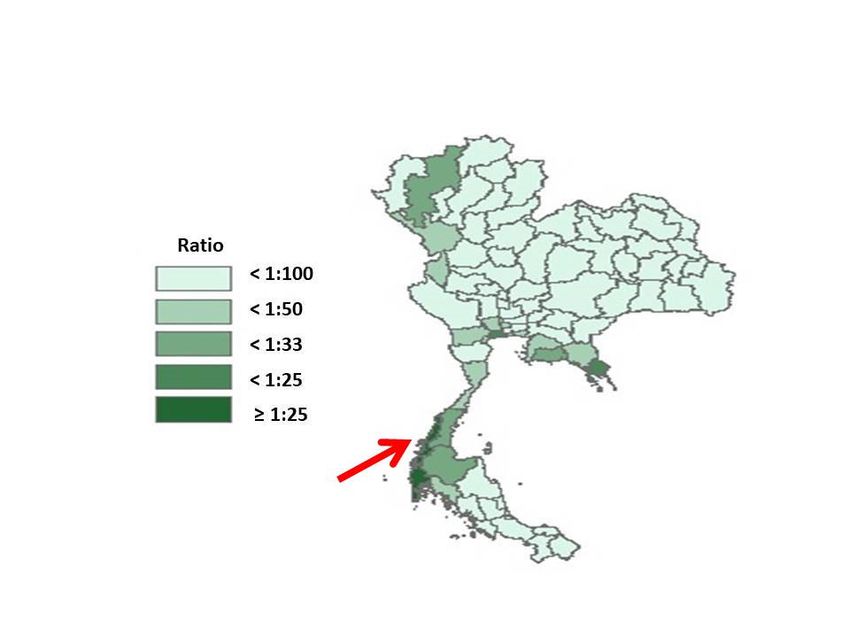
Int. J. Environ. Res. Public Health 2019, 16, 1016                                                 2 of 19

WHA61.17 and WHA70.15 [2]; and the ‘Global Compact for Safe, Orderly and Regular Migration’
recently adopted by UN member states in 2018 [3].
      Southeast Asia is one of the most economically dynamic regions in the world, with a large
number of migrants travelling within the region, and between the region and the rest of the world [4].
Amongst countries in the Southeast Asia region, Thailand is one of the recipient countries for
international migrants. As of 2018, the majority of international migrants in Thailand were workers
and their dependents travelling from Cambodia, Lao PDR, and Myanmar, so-called CLM migrants.
The accumulated number of CLM migrants living in Thailand each year was around three million [5].
About two thirds of these migrants crossed the border without valid travel documents and were usually
recognized as undocumented or irregular migrants. Though Thai immigration law requires these
migrants to be deported, the Thai government adopted a leniency measure by allowing undocumented
migrants to live and work in the country legally, conditional upon registration with the government [6].
In other words, undocumented migrants need to undergo a legalisation process to acquire legitimate
residence and work permits.
      Registration policies for undocumented migrants in Thailand have varied over time, depending
on the openness and political attitudes towards migrants in a particular period [6,7]. Suphanchaimat et
al. suggested that migrant policies in Thailand could be divided into four eras [8]. The first era was
between the early 1900s to the 1990s when nationalism grew in response to the advent of colonialism
in Southeast Asia, and became more apparent in the 1970s due to a fear of communism. One response
was the special law (Por Wor 337) which removed the Thai nationality of a person born in Thailand to
non-Thai parents [9].
      The second era, in the early 1990s, was characterised by the country’s increasing industrialised
economy. This resulted in a serious shortage of low-skilled labour, particularly in difficult, dangerous,
and dirty jobs (e.g., construction work, fishing, and farming). A huge influx of migrants, fleeing
from political violence in Myanmar, was a solution to the country’s labour shortage. Instead of
deporting these undocumented migrants, the governments initiated registration policies to allow
them to legally reside and work in the country within a given period through issuing work and
residence permits. Economic interests meant the government turned a blind eye to the illegal status of
migrants [10]. In addition, a Memorandum of Understanding (MOU) was agreed between Thailand
and CLM nations to recruit low-skilled migrants directly from their country of origin in a lawful
manner. However, undocumented migrants still far outnumbered MOU migrants. As of 2018, around
800,000 migrants were recruited through the MOU compared to about 2 million CLM migrants who
crossed the border illegally [5].
      The third era commenced after 2004 when CLM migrants were required to register with the
government in order to participate in ‘nationality verification’ (NV). While NV was being processed,
these migrants could obtain a temporary identity card from the Ministry of Interior (MOI), and a
work permit from the Ministry of Labour (MOL). Once the NV was complete they would receive a
‘temporary passport’ as evidence of their ‘legalised’ status.
      Parallel to the NV the (registered) CLM migrants were required to buy health insurance at a
yearly cost of 1300 Baht (US$ 39). The insurance is called the ‘Health Insurance Card Scheme’ (HICS),
managed by the Ministry of Public Health (MOPH). The card price was 1300 Baht (US$ 39) between
2004 and 2013, and 2200 Baht (US$ 67) from 2013 onwards [11]. In 2013 the benefit package was
expanded to cover antiretroviral treatment (ART) for HIV/AIDS and the MOPH initiated a new
insurance scheme for a migrant child no older than 7 years, charging 365 Baht (US$ 11) for one-year
coverage [11].
      The fourth era, which continues to the present time, began in mid-2014 after the military coup.
The military government launched a new measure, namely, the ‘One Stop Service’ (OSS), to facilitate
the registration of undocumented migrants. Those failing to register with the OSS are subject to
deportation [11,12]. The price of a HICS card in the OSS era was reduced for a migrant adult to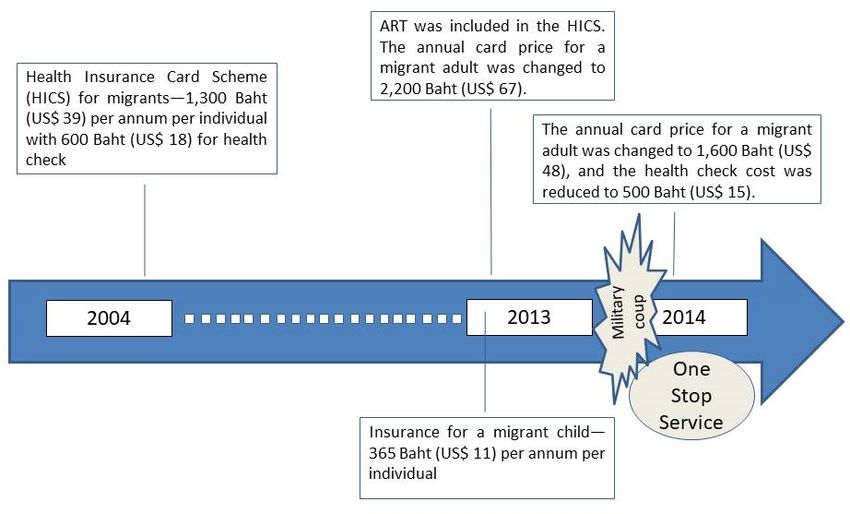
Int. J. Environ. Res. Public Health 2019, 16, 1016                                                            3 of 19
Int. J. Environ. Res. Public Health 2019, 16, x                                                              3 of 19

Baht
1600 (US$
     Baht 48) while
           (US$     the price
                48) while the for a migrant
                               price        child remained
                                     for a migrant         unchanged.
                                                   child remained     Figure 1Figure
                                                                  unchanged.  shows 1the timeline
                                                                                       shows  the
of HICS changes.
timeline of HICS changes.

      Figure 1. Chronological evolution of the ‘Health Insurance Card Scheme’ for migrants. Source: adapted
      Figure 1. Chronological evolution of the ‘Health Insurance Card Scheme’ for migrants. Source:
      from Health Insurance Group [11].
      adapted from Health Insurance Group [11].
      The inclusion of undocumented migrants in the HICS was commended by some global health
      The inclusion of undocumented migrants in the HICS was commended by some global health
agencies as showing the country’s effort in extending Universal Health Coverage (UHC) not only to its
agencies as showing the country’s effort in extending Universal Health Coverage (UHC) not only to
nationals, but also to people with precarious legal status such as undocumented migrants [4,13].
its nationals, but also to people with precarious legal status such as undocumented migrants [4,13].
      Nevertheless, there have been a number of implementation challenges that are yet to be solved,
      Nevertheless, there have been a number of implementation challenges that are yet to be solved,
as demonstrated by the fact that the number of insured migrants has varied substantially across years
as demonstrated by the fact that the number of insured migrants has varied substantially across years
despite strong messages from the government that all undocumented migrants ought to be enrolled in
despite strong messages from the government that all undocumented migrants ought to be enrolled
the insurance scheme [14]. Though there is some research on migrants in Thailand, most of it focuses
in the insurance scheme [14]. Though there is some research on migrants in Thailand, most of it
on specific medical services for migrant patients, while research to identify discrepancies between
focuses on specific medical services for migrant patients, while research to identify discrepancies
policy intention and actual implementation is relatively sparse [15].
between policy intention and actual implementation is relatively sparse [15].
      Therefore, this study aimed to (i) explain factors that contributed to the formulation of the above
      Therefore, this study aimed to (i) explain factors that contributed to the formulation of the above
migrant health policies, and (ii) examine gaps and dissonance between de jure objectives and de
migrant health policies, and (ii) examine gaps and dissonance between de jure objectives and de facto
facto implementation of the policies. It is hoped that the findings can help inform policy makers and
implementation of the policies. It is hoped that the findings can help inform policy makers and
relevant academics for further improvement of the entire migrant policies in Thailand. Note that the
relevant academics for further improvement of the entire migrant policies in Thailand. Note that the
population scope of this research was confined to undocumented CLM migrants and their dependents
population scope of this research was confined to undocumented CLM migrants and their
who are the target population of the HICS and the OSS. Other groups of non-Thai populations (e.g,
dependents who are the target population of the HICS and the OSS. Other groups of non-Thai
tourists, expatriates, and refugees in temporary shelters) were excluded. In addition, the policies of
populations (e.g, tourists, expatriates, and refugees in temporary shelters) were excluded. In
interest are (1) the expansion of the HICS benefit package to include ART and the introduction of the
addition, the policies of interest are (1) the expansion of the HICS benefit package to include ART
insurance card for a migrant child, and (2) the advent of the OSS.
and the introduction of the insurance card for a migrant child, and (2) the advent of the OSS.
2. Methods
2. Methods
2.1. Conceptual Framework and Scope of the Study
2.1. Conceptual Framework and Scope of the Study
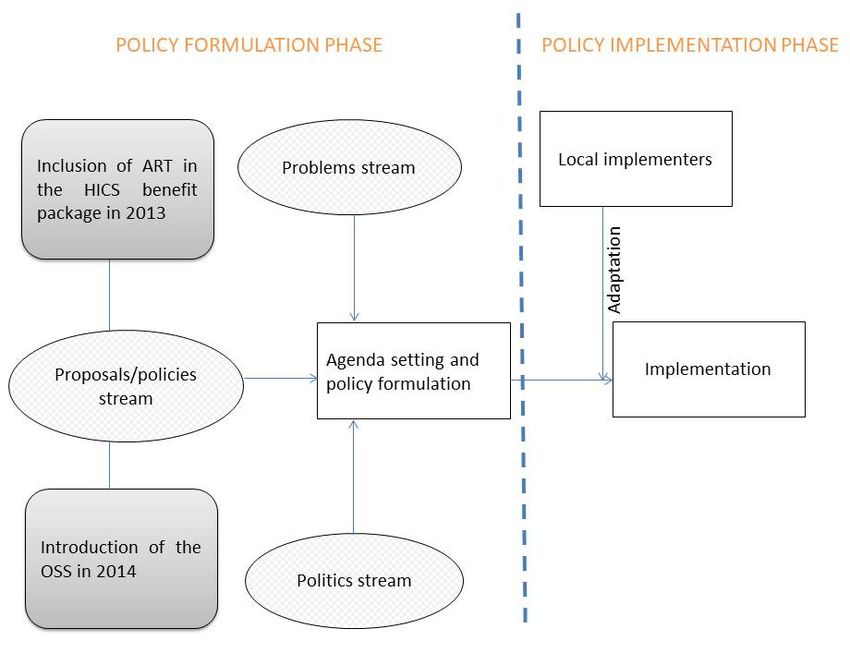
      The conceptual framework consisted of two strands: (1) the policy formulation strand (de jure)
      Thethe
and (2)    conceptual  framework
             implementation         consisted
                               strand           of two
                                        (de facto).  Thestrands:   (1) the policystrand
                                                          policy formulation        formulation    strand from
                                                                                            was adapted     (de jure)
                                                                                                                  the
and  (2) the implementation    strand  (de  facto).  The  policy  formulation     strand    was  adapted
Agenda Setting Theory of Kingdon [16], which suggests that the translation of an idea onto the policy      from   the
Agenda    Setting Theory
agenda requires           of Kingdon
                  a convergence        [16],streams,
                                  of three   which suggests
                                                       namely, that
                                                                (i) a the translation
                                                                       problem  stream   ofwhich
                                                                                            an idea ontoto
                                                                                                  refers  theanpolicy
                                                                                                                issue
agenda   requires aas
being recognised    convergence   of three
                      important and         streams,
                                       deserving       namely, (i) a problem
                                                   of policymaker      attention,stream    which refers to anstream
                                                                                  (ii) a proposals/policy       issue
being
meaningrecognised  as important
           that a solution        and to
                            or policy  deserving    of policymaker
                                          the redress   the identified attention,
                                                                          problem  (ii)exists,
                                                                                        a proposals/policy    stream
                                                                                               and (iii) the politics
meaning that a solution or policy to the redress the identified problem exists, and (iii) the politics
stream referring to political factors around a given issue. Only when these three streams converge,
Int. J. Environ. Res. Public Health 2019, 16, 1016                                                         4 of 19

Int. J. Environ. Res. Public Health 2019, 16, x                                                            4 of 19
 stream referring to political factors around a given issue. Only when these three streams converge,
 that is, when an issue is recognised as deserving policymaker attention, when a solution is available,
 and this is politically
              politically palatable and feasible, a policy change may occur. occur. The
                                                                                    The implementation
                                                                                         implementation strand
 drew
 drew on Lipsky’s Street-Level
                     Street-Level Bureaucracy
                                    Bureaucracy theory
                                                  theory [17].
                                                           [17]. This suggests that what policy makers expect
 to happen
    happen may not always align with reality and rather that actual implementation
                                                                            implementation of policy is shaped
 more
 more by the perceptions
               perceptions and routines
                                  routines of local implementers or frontline workers, whom Lipsky called
‘street-level
 ‘street-levelbureaucrats’.
               bureaucrats’.The Thetheory also
                                     theory    proposes
                                             also         thatthat
                                                   proposes    street-level bureaucrats
                                                                    street-level          mightmight
                                                                                  bureaucrats    adapt the  public
                                                                                                        adapt  the
policies   to dealtowith
 public policies     deal their day-to-day
                          with their         workwork
                                      day-to-day     pressures/problems.
                                                         pressures/problems.   Figure 2 2lays
                                                                                 Figure    laysout
                                                                                                outthe
                                                                                                    the research’s
                                                                                                        research’s
 conceptual framework.
              framework.

               Figure 2. Conceptual
               Figure 2. Conceptual framework.
                                    framework. Source: adapted from
                                               Source: adapted from Kingdon
                                                                    Kingdon [16]
                                                                            [16] and
                                                                                 and Lipsky
                                                                                     Lipsky [17].
                                                                                            [17].
2.2. Participants and Study Areas
2.2. Participants and Study Areas
      Qualitative methods were used. The period of data collection was October 2014 to September 2015.
      Qualitative methods were used. The period of data collection was October 2014 to September
The study was divided into two levels: (1) the policy formulation level and (2) the implementation level.
2015. The study was divided into two levels: (1) the policy formulation level and (2) the
      For policy formulation, most of the analyses and data collections were done at the national level.
implementation level.
Data collection techniques consisted of in-depth interviews with seven purposively selected policy
      For policy formulation, most of the analyses and data collections were done at the national level.
makers and/or policy-level officials, narrative reviews on migrant-related laws in Thailand, ministerial
Data collection techniques consisted of in-depth interviews with seven purposively selected policy
announcements, and minutes/proceedings from the MOPH. These included reports publicized in the
makers and/or policy-level officials, narrative reviews on migrant-related laws in Thailand,
media during the formulation of the policies. For policy implementation, Ranong province was selected
ministerial announcements, and minutes/proceedings from the MOPH. These included reports
as the study site because it represented an area with the largest ratio of (registered) undocumented
publicized in the media during the formulation of the policies. For policy implementation, Ranong
migrants to Thai citizens, compared to other provinces. The province is located in the southern region
province was selected as the study site because it represented an area with the largest ratio of
of Thailand and has a large diversity of populations (such as Thais, Burmese migrants, and stateless
(registered) undocumented migrants to Thai citizens, compared to other provinces. The province is
people). Over 95% of migrant workers in the province were from Myanmar. Seafaring, construction,
located in the southern region of Thailand and has a large diversity of populations (such as Thais,
and farm labour were common occupations amongst migrants (Figure 3).
Burmese migrants, and stateless people). Over 95% of migrant workers in the province were from
      Eighteen key informants were identified for the implementation strand. Most were healthcare
Myanmar. Seafaring, construction, and farm labour were common occupations amongst migrants
providers from Ranong Provincial Public Health Office and public health facilities in migrant-populated
(Figure 3).
districts (Provincial Hospital X, Kraburi District Hospital Y, and two health centres affiliated to
these hospitals). Purposive sampling was used. Also, snowballing sampling was applied until data
were saturated. The researchers also interviewed additional informants from outside the MOPH,
such as local officers of the MOI and the MOL, NGO representatives, and employers of migrants.
About two thirds of the informants were male. Mean age of the informants was approximately 50 years.
Key characteristics of informants are presented in Table 1.
Int. J. Environ. Res. Public Health 2019, 16, x 5 of 19
Int. J. Environ. Res. Public Health 2019, 16, 1016 5 of 19
Figure 3. Ratio of registered migrants to Thai citizens in all provinces in Thailand, 2013. Source:
adapted from Health Insurance Group, the MOPH [11].
Figure 3. Ratio of registered Table 1. Key
migrants to characteristics
Thai citizens inof all
the provinces
participants.
in Thailand, 2013. Source:
adapted from Health Insurance Group, the MOPH [11].
Code Current Workplace Role and Responsibilities
PM01 Office of the Permanent Secretary, the MOPH Policy makers
Eighteen key informants were identified for the implementation strand. Most were healthcare
providers from Ranong PM02 Provincial PublicIndependent academic institute
Health Office Former policy makers
and public health facilities in migrant-
PM03 Office of the Permanent Secretary, the MOPH Policy makers
populated districts (Provincial Hospital X, Kraburi District Hospital Y, and two health centres
affiliatedFormulation PM04
to these hospitals). Office
Purposive of the Permanent
sampling was used. Secretary,
Also,the MOPH
snowballing Policy was
sampling makers
applied
until data were saturated. The researchers also interviewed additional informants frommakers
PM05 Office of the Permanent Secretary, the MOL Policy outside the
MOPH, such as local officers PM06 of the Faculty
MOI andof lawthe
in one of the NGO
MOL, public universities
representatives, andPolicyemployers
makers of
ADM_CO1 Office of the Permanent Secretary, the
migrants. About two thirds of the informants were male. Mean age of the informantsMOPH Administrative staffwas
approximately 50 years.RN_PHO1
Key characteristicsProvincial Public Health
of informants Office
are presented in Table Administrative
1. staff
RN_PHO2 Provincial Public Health Office Executive staff
Table 1. Key characteristics
RN_RNH1 ProvincialofHospital
the participants.
X Executive staff
RN_RNH2
Code Provincial
Current Hospital X
Workplace Insurance
Role and staff
Responsibilities
RN_RNH3
PM01 Provincial
Office of the Permanent Hospitalthe
Secretary, X MOPH General
Policypractitioner
makers
PM02
RN_KH1 Independent academic
District institute
Hospital Y Former policy staff
Insurance makers
PM03 Office of the Permanent Secretary, the MOPH Policy makers
RN_KH2 District Hospital Y Executive staff
Formulation PM04 Office of the Permanent Secretary, the MOPH Policy makers
RN_NGO1 Foundation A NGO
PM05 Office of the Permanent Secretary, the MOL Policy makers
RN_NGO2
PM06 Faculty of law in oneFoundation B universities
of the public NGO
Policy makers
Implementation
ADM_CO1
RN_HC1 Office of the Permanent
HealthSecretary,
centre A the MOPH Administrative staff
Executive staff
RN_PHO1
RN_HC2 * Provincial Public
HealthHealth
centre Office
B Administrative staff
Executive staff
RN_PHO2 Provincial Public Health Office Executive staff
RN_HP1 Health centre B Village health volunteer
RN_RNH1 Provincial Hospital X Executive staff
RN_MOI1 *
RN_RNH2 Department of Provincial
Provincial Administration,
Hospital X the MOI Executivestaff
Insurance staff
RN_WP1
RN_RNH3 Provincial Employment
Provincial HospitalOffice,
X the MOL Executive
General staff
practitioner
RN_KH1
RN_E1 District Hospital Y
Construction site A Insurance staff
Employer of migrants
Implementation
RN_KH2 District Hospital Y Executive staff
RN_E2 Rubber field A Employer of migrants
RN_NGO1 Foundation A NGO
RN_E3
RN_NGO2 Fish dock
Foundation BA Employer
NGOof migrants
RN_B1 *
RN_HC1 HealthFish dockAB
centre Employer of migrants
Executive staff
Note: MOI =RN_HC2
Ministry* of Interior, MOL = Health centre
Ministry of BLabour, MOPH = Ministry Executive
of Publicstaff
Health,
NGO = Non-government
RN_HP1 organisation, * = telephone interview.
Health centre B Village health volunteer
Each interview lasted approximately 45–60 min, was audiotaped with consent, and transcribed
verbatim. In the fieldwork, the lead researcher served as the main interviewer and was assisted byInt. J. Environ. Res. Public Health 2019, 16, 1016 6 of 19
a co-researcher (WP). All interviews were carried out face-to-face at the interviewees’ workplace,
except in some cases (RN_HC2, RN_MOI1, and RN_B1) where telephone interviews were conducted
according to the interviewees’ request.
2.3. Data Analysis and Triangulations
Framework analysis was applied, developing both a deductive and inductive coding frame.
Deductive coding was used to craft the interview guides and these reflected the conceptual framework.
Inductive coding was done where new information emerged from the fieldwork. The interviewers
always asked for relevant documents from the respondents as part of methodological triangulation.
Once the analysis was complete, the draft final report was circulated to all interviewees to confirm
validity of the results. This approach also allowed the researchers to re-check with the respondents as
to whether they agreed to have their quotes anonymously presented in the final report.
2.4. Ethics Standards
Ethical approval was received from (1) the Institute for the Development of Human Research
Protections in Thailand (IHRP 1778/2557), and (2) London School of Hygiene and Tropical Medicine,
UK (Ref 8776). All data are kept anonymous. Dissemination of data can be done only for academic
interest and individual information cannot be identified. For the interview process, the participants
were informed about the study’s objectives and were assured that confidentiality would be strictly
kept. The research team always informed participants that it was perfectly acceptable for them to
withdraw from the study at any time or to refuse to answer any question if they felt uncomfortable.
3. Results
The expansion of the HICS benefit package and insurance scheme for migrant children in 2013.
(de jure) Policy formulation
# Problems stream
The interviewees suggested two main reasons behind the expansion of the HICS benefit package
and the instigation of the migrant child insurance in 2013. The first reason related to the curtailment of
Global Fund (GF) financial support for ART in Thailand. This point was flagged by three interviewees
(PM_01, PM_04, and RN_NGO1). Though the Universal Coverage Scheme (UCS) for Thai citizens had
covered ART since 2006, the HICS did not include ART in its benefit package. Before 2013, the Thai
government addressed this problem by seeking financial support from the GF, which contributed
about 41% of the budget used for HIV prevention activities. The GF was also the main supporter for
ART for uninsured migrants in Thailand. In 2011 the GF adopted a new eligibility criterion, meaning
that an upper-middle income country would no longer be eligible to submit a new proposal to the GF.
The Thai economy had recently passed the upper-middle income benchmark (US$ 4125) [18], and the
inclusion of ART into the benefit package of the HICS was considered a feasible solution to replace GF
support [19].
The second reason was external pressure from the US, warning that Thailand would be
downgraded to the Tier 3 Trafficking Report, the worst amongst all reporting levels. Four interviewees
mentioned this point (PM_01, PM_02, PM_03, and PM_04). ‘Tier 3’ meant a country did not make
exhaustive efforts to combat trafficking problems. The US government reported that more than
23,000 Cambodian trafficking victims left Thailand each year and the Thai government did not
respond adequately to this problem [20]. Thus, the initiation of the migrant child insurance was
intended to demonstrate the country’s ‘Corporate Social Responsibility’ (CSR). One of the interviewees
(PM_01) mentioned that the CSR idea was widely discussed in many policy dialogues in the MOPH.
The expansion of the HICS to migrant children could be used as an excuse, amongst other things,
to counter the Trafficking in Persons (TIPS) Report that the government at least had shown some effortInt. J. Environ. Res. Public Health 2019, 16, 1016 7 of 19
to protect vulnerable populations, especially migrant children. Besides, the MOPH made the migrant
insurance more open to all non-Thais, not just migrant workers: indeed the term workers does not
appear in the Cabinet Resolution of 2013 [21].
“Children and women are potential victims of human trafficking. I am also a member of the
White Ribbon (a campaign against violence on women and children). [The interviewee showed
the White Ribbon badge to the researcher while interviewing.] . . . That is why we made the
15-January-2013 insurance policy to enable us to insure all migrants in Thailand . . . and the
‘365-Baht’ card is the country’s CSR. . . . And if we take care of them well, once they return home,
they will definitely wish to come back to us.” [PM01]
Yet one of the interviewees (PM_02) commented that the initiation of the 365-Baht card policy
reflected unsystematic government management of migrant health problems.
“This (the 365-Baht card) shows how the government has brain but no wisdom. How can
they say that this is a charitable gift? . . . If the problem is so huge, it should not be CSR . . .
it means we must do something systematically.” [PM02]
# Politics stream
Apart from the US threat, domestic politics also played an important role. The Public Health
Minister at that time announced that the MOPH was in the process of improving its health system to
promote Thailand as a ‘medical tourism and wellness hub’ in Southeast Asia. Though the message
did not clearly detail how the MOPH would provide insurance coverage to all non-Thai populations,
it indicated that the MOPH would target three subgroups of non-Thais: (1) medical tourists (especially
from the Gulf states), (2) foreign tourists, and (3) foreign workers and/or migrants who were not
covered by the social health insurance (including CLM migrants) [22]. For the first group, the MOPH
would plan to set charges for those entering Thailand to seek medical treatment, and in the meantime,
help the neighbouring countries to develop insurance systems in an attempt to encourage patients to
receive care in their own countries. Some measures were piloted, such as signing a memorandum of
understanding between some Thai hospitals and border hospitals in Myanmar and Cambodia to boost
healthcare collaboration, especially in terms of sharing disease alerts and referring emergency or severe
cases [23]. For the second group, the government would find measures to promote medical tourism in
Thailand. Some measures were proposed, such as exempting the visa requirement for people from
six Gulf states who come to Thailand for treatment purposes under the condition that the patients (or
tourists) must show an appointment letter issued by a Thai hospital [24]. The HICS was proposed to
cover the third group, that is, the Minister announced that the target beneficiaries of the HICS would
include all non-Thais who are not covered by the existing social health insurance. This implied that all
foreign workers including expatriates were eligible to the HICS. However, the policy was in an early
development phase and sparked much public debate. Some doctor groups called for a removal of the
minister, accusing him of weakening the public sector in the face of the medical hub policy through
supporting the growth of the private sector. The medical hub policy was not the only reason for the
protest, but it was combined with other contentious issues, such as interference in the functioning of
public health authorities (including the governing body of the UCS), removal of a hardship allowance
for rural doctors, and conflict of interest around the Minister’s circles [25]. The minister was in position
for only around one and a half years and was removed from office after the coup in May 2014. At the
time of writing, there are no concrete government measures to advance the hub policy.
(de facto) policy implementation
Though the 2013 HICS was relatively open to all non-Thais (including undocumented migrants),
the number of card holders was quite low. Around a year after the proclamation of the 2200-Baht
card, there were only 66,000 card holders, far from its target of 1 million [14]. Four respondents
(PM03, RN_RNH1, RN_E2, and RN_E3) mentioned that the high price of the card was one of the• (de facto) policy implementation
Though the 2013 HICS was relatively open to all non-Thais (including undocumented migrants),
the number of card holders was quite low. Around a year after the proclamation of the 2200-Baht
card, there were only 66,000 card holders, far from its target of 1 million [14]. Four respondents
Int. J. Environ. Res. Public Health 2019, 16, 1016 8 of 19
(PM03, RN_RNH1, RN_E2, and RN_E3) mentioned that the high price of the card was one of the
most important reasons contributing to the low number of cards purchased. Moreover, there was a
most
problem important
with the reasons contributing
interpretation of theto the low number
eligibility of buyers
of the card cards purchased.
because theMoreover,
2013 HICSthere was a
regulation
problem with the interpretation of the eligibility of the card buyers because the 2013
did not specify the eligible nationality of a buyer. One of the interviewees (PM03) said that European HICS regulation
did not specify
pensioners were the eligible nationality
attempting to buy theofinsurance
a buyer. One
card,ofcreating
the interviewees (PM03)
huge financial risksaid that European
in some hospitals
pensioners
since somewere attempting
European to buyhad
pensioners the insurance card, creating hugediseases
chronic non-communicable financial(NCD)
risk inwhich
some hospitals
required
since some European pensioners had chronic non-communicable diseases (NCD)
long-term care, and cost of care for those patients greatly exceeded the card price. To further confuse which required
long-term
the situation, care,the
andterm
cost of care for those
‘foreigner’ patients
appeared in greatly exceeded
the card’s Englishthetitle,
card but
price.
theToterm
further confuse
‘tang dao’
the situation, the term ‘foreigner’ appeared in the card’s English title, but the
(meaning non-Thai citizen, commonly used to refer to CLM migrants) was used in its Thai title term ‘tang dao’ (meaning
non-Thai
(Figure 4).citizen, commonly used to refer to CLM migrants) was used in its Thai title (Figure 4).
Figure 4. Picture
Figure 4. Picture of
of the
the health
health insurance
insurance card
card in
in 2013.
2013. Source:
Source: adapted
adapted from
from the
the MOPH
MOPH [21].
[21].
To
To resolve
resolve this
this confusion,
confusion, the
the MOPH
MOPH sent
sent an
an official
official letter
letter toto all
all facilities
facilities in
in July
July 2014,
2014, asking
asking
health facilities to temporarily stop selling the card to ‘farang’ (the lay Thai term
health facilities to temporarily stop selling the card to ‘farang’ (the lay Thai term referring to referring to Caucasian
or white foreigners)
Caucasian and to await
or white foreigners) further
and announcements.
to await Yet, so far there
further announcements. hasfar
Yet, so not beenhas
there anynot
official
been
message from the MOPH informing the health facilities what further action
any official message from the MOPH informing the health facilities what further action they should they should take [26].
An
takeinterviewee (PM03) suggested
[26]. An interviewee that the reason
(PM03) suggested why
that the the MOPH
reason why the asked
MOPH all hospitals
asked alltohospitals
pause theto
selling of the card to western foreigners was not only the confusion in the text,
pause the selling of the card to western foreigners was not only the confusion in the text, but morebut more importantly,
because the policy
importantly, becausewasthe
designed for vulnerable
policy was migrants,
designed for not for
vulnerable (those the
migrants, notinterviewee
for (those the considered as)
interviewee
better-off groups, like European pensioners. In contrast, another interviewee (PM06)
considered as) better-off groups, like European pensioners. In contrast, another interviewee (PM06) considered that
as long as the
considered term
that ‘tangasdao’
as long the (non-Thai
term ‘tangcitizen) appeared
dao’ (non-Thai on theappeared
citizen) card, it was justified
on the card, to sell the
it was card
justified
to
to European
sell the cardpensioners.
to European pensioners.
“When policy makers talked to the public, they said ‘everybody.’ Then, it created a problem.
“When policy makers talked to the public, they said ‘everybody.’ Then, it created a problem.
Can a foreign husband of a Thai wife come to buy the card?. . . Those who bought the card
Can a foreign husband of a Thai wife come to buy the card?. . . Those who bought the card
are sick foreigners . . . So, we launched a letter telling the hospitals to stop selling the card
are sick foreigners . . . So, we launched a letter telling the hospitals to stop selling the card
(to western foreigners).” [PM03]
(to western foreigners).” [PM03]
“[Laughing] Oh! they use the term, ‘farang’ (referring to Caucasian foreigners). The MOPH
“[Laughing]
must answer Oh! they these
whether use the term, ‘farang’
foreigners (referringintolegal
are non-Thais Caucasian
terms.”foreigners).
[PM06] The MOPH
must answer whether these foreigners are non-Thais in legal terms.” [PM06]
Before 2013 the direction of migrant policies in Thailand appeared to be open to all non-Thai
populations despite a dissonance between de jure policy intention and de facto implementation,
combined with confusion over who were the target beneficiaries of the policies. This situation became
more complicated since 2014 after the arrival of the coup. The later statement demonstrates how
migrant policies, particularly the HICS, turned to be stricter than the pre-coup era and how frontline
workers responded to such a situation.
The advent of the OSS since 2014 and onwards
(de jure) Policy formulationInt. J. Environ. Res. Public Health 2019, 16, 1016 9 of 19
The OSS is the most recently launched measure on migrants. Some key attributes of the OSS are as
follows [12]. Firstly, it required the MOI, the MOL, and the MOPH to work together in designated places
within a province to facilitate the registration process. Secondly, the OSS targeted migrant workers
and dependents from CLM nations only. However, it did not specify a definition of ‘dependents’.
Thirdly, the essence of the OSS was that an undocumented migrant must (1) register with the MOI to
acquire a legitimate residence permit and undertake the NV, (2) be issued with a work permit by the
MOL and (3) pay for health insurance. Fourthly, the junta explicitly declared that there would not be
any further extension of the OSS after the end of 2014. The OSS aimed to complete the NV process
by 31 March 2015. Undocumented migrants and dependents failing to register with the OSS by the
deadline would be deported. Lastly, the MOPH reduced the price of the health insurance card from
2200 Baht (US$ 67) to 1600 Baht (US$ 49).
# Problems stream
In mid-2014, there was a massive exodus of around 200,000 Cambodian migrants returning home.
This happened a few weeks after the coup, and caused a loss of more than US$ 1 million per day in
cash flow (from reduced wages and remittances) in Thailand and Cambodia because the Cambodian
economy could not absorb the labour in a very short period of time [27]. The OSS was then instigated
to attract those migrants back to Thailand, as highlighted by some interviewees (PM03, RN_RNH1,
and RN_RNH2).
“Initially, this (the OSS) was a measure to pull Cambodian migrant workers back to Thailand.
And finally, it expanded to cover all irregular migrants. . . . At that time, many constructions
in Thailand; let’s say roads, expressways, and so on, were badly affected.” [PM03]
# Politics stream
The ‘problems stream’ above was closely linked with the ‘politics stream’. Thai political instability
occurred in late 2013, triggered by the People’s Democratic Reform Committee (PDRC) protesting
against the elected government. The protesters viewed the government as a puppet of the ex-prime
minister, Thaksin Shinawatra, who was accused of corruption and damaging the country’s democracy.
The turmoil led to the coup d’état in mid-2014. The coup leader claimed that overthrowing the
government was necessary to prevent a potential clash between the PDRC and the pro-Shinawatra
supporters (Red Shirts). During the turmoil, there were reports that some Red Shirt leaders had
hired Cambodian migrants to join the group. This claim coincided with a report by the Cambodian
government that the Cambodian prime minister had appointed Thaksin as an economic adviser to
Cambodia [28]. A month after the coup the junta broadcast that the military would now strictly
regulate the migrant workforce in Thailand. Days after the speech, Cambodian newspapers began
reporting a large number of undocumented migrants returning home. Rumours spread rapidly all
over the country that undocumented migrants would be severely punished—encouraging a massive
voluntary outflow of Cambodian migrants [29]. One respondent commented that this phenomenon
reflected mismanagement of migrant policies by the Thai government.
“I am more than happy to see more than 100,000 Cambodian migrants fleeing the country.
It makes the government realise that they (migrants) are not voiceless [bangs the table].”
[PM02]
(de facto) Policy implementation
Though the OSS aimed to resolve all problems related to the undocumented immigration status of
migrants, its implementation still faced a number of challenges. There were four subthemes emerging
from the interviews: (i) delay in the registration process and poor law enforcement, (ii) unclear policy
messages, (iii) lack of coordination between public authorities, and (iv) difficulties in managing the
insurance for migrant employees.Int. J. Environ. Res. Public Health 2019, 16, 1016 10 of 19
# Delay in the registration process and poor law enforcement
Though the OSS aimed to complete NV by March 2015, as of early 2015 there were more than
500,000 registered migrants who had not completed the NV—let alone those who had failed to register
with the OSS from the outset. The government subsequently announced an extension of the NV
for another 3 months [30]. All interviewees mentioned that they were aware of the existence of
unregistered undocumented migrants in the study area. Three respondents (RN_MOI1, RN_WP1,
and RN_NGO2) pointed out that not all migrant-related laws/measures were strictly enforced. One of
the obvious examples was the zoning policy established locally in Ranong province, where prosecutors
were more relaxed around the fish docks where migrant communities were concentrated, but stricter
around the city centre. The respondent RN_MOI1 mentioned that based on his experience, if the
deportation law had been strictly enforced, there might have been conflicts between the prosecutors
and local entrepreneurs—thus the zoning system was reasonable in his view.
“In our area, we tried to block the influx of migrants. But we admit that we still face some
limitations. In many work sectors, if we always caught undocumented migrants, there might
not be enough workers left. Then, we might have problems with the entrepreneurs. So we
need to use other measures aside from law enforcement. For example, we tried to create the
zoning area that we will be somewhat strict in the inner city and will be more relaxed in the
outer zone.” [RN_MOI1]
# Unclear policy message
Equivocal policy messages lead to confusion at the implementation level as evidenced by the
following examples: (1) difference between how the MOPH and the MOI defined the term ‘dependents’,
and (2) whether or not an undocumented CLM migrant was able to buy the card if he/she failed to
register with the OSS.
Since the junta did not define dependents, this allowed a variety of interpretations by the
authorities. In literal terms, a migrant child aged less than seven was eligible to buy the card at
the cost of 365 Baht, while a child aged between eight and 15 was required to buy the card at the same
price as an adult. However, to buy the adult insurance card a buyer must first hold a work permit, yet a
child under 15 years of age cannot be issued with a work permit according to the Labour Protection
Act [31]. Two interviewees (RN_RNH2 and RN_RNH3) at Provincial Hospital X stated that given
such confusion, the hospital stopped selling the card to children aged between eight and 15 and was
awaiting clarification from the central government.
“Now we are selling the card to only those below seven. For those between eight and 15,
we have not opened (the card selling policy) yet. Because the term ‘dependent’ of the MOI
uses the cut-off at 15. (Interviewer: So far, is there any consensus for this difference?) No! we
have stopped selling the card (to children 8–15 years old) at this moment.” [RN_RNH3]
Another troubling example was whether or not the former health insurance card (2200-Baht
card) endorsed before the OSS was still in effect. All healthcare provider interviewees perceived
that, after the end of the OSS re-registration in late 2014, undocumented migrants were not allowed
to buy the insurance card although there had been no official message from the MOPH informing
local health facilities to stop selling the 2200-Baht card. This interpretation was in accordance with
the political atmosphere at that time as the junta repeatedly informed the media that undocumented
migrants who failed to register with the OSS would be arrested. Yet some interviewees (PM06 and
RN_NGO2) mentioned that undocumented migrants not joining the OSS were still eligible to buy the
2200-Baht card as long as there was no cabinet resolution to revoke this policy. One of the respondents
(RN_PHO1) shared his experience in voicing his concern to the MOPH. The answer from the MOPH
was unclear and the MOPH even informed ground-level providers to decide what they deemed
appropriate themselves.Int. J. Environ. Res. Public Health 2019, 16, 1016 11 of 19
“(Interviewer: If I were Burmese, and I somehow did not join the One Stop Service, what
would you do to me?) We dare not sell the card. Suppose we sell, there might be a question
whether we are against the national policy. (Interviewer: Have you ever raised this issue
to the MOPH?) I did. Dr XXX (policy maker in the MOPH) told me that ‘Yes! you may sell
them the card but do this covertly.’ I then replied, ‘Sir! If you say so, no local facility will
dare sell the card.’ [RN_PHO1]
# Lack of coordination between public authorities
Not only was there confusion about policy content, how the policy was communicated was
also a critical problem as raised by six interviewees (RN_PHO1, RN_PHO2, RN_RNH1, RN_RNH2,
RN_MOI1, and RN_WP1). The interviewee from the MOI (RN_MOI1) exemplified this point. Since the
OSS was quickly endorsed and related authorities were not well informed how to operate the measure
in detail, many constraints arose, including a debate about who should absorb the cost of setting up
the OSS.
“There were some legal and administrative constraints re[garding] the reimbursement of
extra stipend for staff or the problem about human shortage. Because when you summoned
lots of staff in a short time to work in a special venue, you needed to ask for help from many
authorities. But it is difficult for us (the MOI), as the host (of the venue) to ask for support
from others. Because if we cannot give them an extra stipend, they might ask why they have
to participate in this event (the OSS).” [RN_MOI1]
Two interviewees (RN_RNH1 and RN_RNH2) from the MOPH reported that they felt that
the health sector was ‘voiceless’, and the feedback mechanism from the ground level to the central
authorities was also lacking.
“(Interviewer: Could you please tell me about the coordination between you and non-MOPH
authorities?) Frankly, we are voiceless. The two parties (the MOI and the MOL) will inform
us after they had already talked to, and agreed with each after.” [RN_RNH2]
Conflict between ministries was derived from not only a lack of cooperation, but also a
misunderstanding of roles/responsibilities between authorities. An instance was drawn from the
argument between the MOPH and the MOI. Though the MOPH intended to have all registered
migrants buy the insurance card, the MOPH did not have any legal power to penalise migrants,
or employers of migrants, who refused to buy the card because literally, the HICS was just a
ministerial announcement.
“For example, the MOPH always told us to force everybody to buy the insurance. But if
they could not afford the price, can we force them (to buy the card)? To my knowledge, it is
just a ministerial announcement. The MOPH told us to speak in the same language (that
all migrants are obliged to buy the card). That makes us feel uncomfortable (to say so).”
[RN_MOI1]
# Difficulties in managing the insurance for migrant employees
All four employers (RN_E1, RN_E2, RN_E3, and RN_B1) stated that the HICS created difficulties
for employers and should not be compulsory. Their rationale was that most migrant workers, especially
those working in offshore fishing boats, were very mobile. Besides, most seamen spent much of the
time offshore. Thus, the employers considered that it was not worth paying for the insurance for their
employees as they had fewer chances to use services. This problem was coupled with the registration
of migrant workers. Legalised migrants (those who passed the NV) were able to travel throughout the
country. From the perspective of employers, this regulation created the risk of losing their employees.
In contrast, undocumented migrants, who had not completed the NV, were not allowed to move
outside the registered province. As a result, it appeared that migrant employers were not supportive
of the registration measures, including the health insurance card policy and the OSS.Int. J. Environ. Res. Public Health 2019, 16, 1016 12 of 19
“I always opposed the HICS. If that is for land migrants or those at the fish docks, I will be
OK with it. But for seafarers, I totally disagree because they don’t have a chance to use the
insurance . . . I lost over a million for the insurance. Some migrants stayed with me for just
a couple of months, then they left their work. And who paid for their insurance? It is the
employer! . . . Do you think this policy is successfully implemented? I think it was just 30%
successful.” [RN_E3]
Another problem raised by the interviewees was the red tape in the registration. Two employers
(RN_B1 and RN_E2) pointed out that the registration process was burdensome. Use of private
intermediaries (or brokers) was considered an effective means to overcome this difficulty despite
causing additional expenses.
“Now there emerges a new service that helps complete the registration for migrants on
behalf of the employers . . . it is more convenient but I had to pay more (laugh!). It charged
me 500 Baht per head of migrant. But the registration takes numerous steps, and is very
tiresome, and there are so many people. That’s why I don’t want to get involved. So I am OK
with hiring them (brokers).” [RN_E2]
With the accounts above, the discrepancies between policy intention and policy implementation
can be summarised in Table 2 below.
Table 2. Contrasting policy intention and policy implementation.
Examples of Interviewees
Time Policy Intention Policy Implementation
Raising This Point
The number of migrants
Expansion of benefit package to enrolled in insurance PM03, RN_RNH1, RN_E2,
cover HIV/AIDS treatment decreased substantially as and RN_E3
the premium increased.
Pre-OSS (before 2014)
Some Europeans with
Allowing all migrants regardless of
chronic diseases came to buy PM_03
their work status to buy insurance
insurance at health facilities.
Many migrants (precise
Finishing the nationality verification number unknown) failed to RN_B1, RN_E1, RN_E2,
by late March 2015 participate in and RN_E3
nationality verification.
Unclear policy message
regarding the definition of
Aiming to cover children dependents made some
RN_RNH2 and RN_RNH3
of migrants providers reluctant to sell
Post-OSS (after 2014) insurance to
migrants’ children.
Some employers paid
Smooth-running migrant private intermediaries to
RN_B1 and RN_E2
registration process. help overcome red tape
in registration.
Lack of feedback mechanism RN_PHO1, RN_PHO2,
Integration of
for concerns at ground level RN_RNH1, RN_RNH2,
inter-ministerial functions.
to reach central authorities. RN_MOI1, and RN_WP1
4. Discussion
Thailand is amongst the few developing countries that have achieved UHC. Also, the country
has made significant progress in extending UHC to its non-Thai populations, particularly through the
introduction of the HICS for undocumented migrants. This achievement was widely recognized by
media and academics around the world. For instance, in 2016 National Public Radio in Washington
DC published an article on its webpage praising Thailand as the ‘only’ country that offers UHC to all
migrants [32]. Likewise, Upneja [33] mentioned in the Yale Global Health Review that Thailand is a
model for migrant healthcare for other countries.Int. J. Environ. Res. Public Health 2019, 16, 1016 13 of 19
Nevertheless, this study clearly revealed that there is ‘devil in the detail’. It is not argued that
the Thai migrant health policies are a failure, but rather that if policy makers wish to further improve
migrant health policies, it is crucial to learn from the past as well as the existing situation—how
the policies towards migrant health in Thailand were formulated and implemented and what the
implementation challenges are.
From the policy formulation angle, using Kingdon’s Agenda Setting Theory [16], the formulation
of the HICS and the OSS was strongly influenced by pressures from international and Thai politics.
Examples are, among other things, the pressure from the US on Thailand regarding insufficient effort
to combat human trafficking, the weaning off GF support for ART for migrants, and the exodus of
Cambodian migrants, which contributed to the OSS in 2014. On the one hand, the Thai government
may be seen as responsive to emerging problems by further improving initiatives to protect the health
of migrants when ‘windows of opportunities’ opened. On the other hand, their reactions reflect a lack
of long-term planning to address problems of migrants’ access to health services. The challenges are not
only about the policy content, but also appear in the policy formulation process. The history revealed
that none of these policies were formulated according to a rational model where all migrant-related
problems were discussed, and all policy options were considered with ample evidence. Previous and
current governments did not appear to unpack the structural problems. Oftentimes, policies were
quickly generated because of pressures from civil society groups and political tensions.
From the policy implementation angle, this research confirms the importance of a better
understanding of implementation processes and the extent to which policy implementation may
differ from policy initial intent. The Street-Level Bureaucracy Theory of Lipsky [17] provides a useful
perspective in this regard, proposing that frontline implementers have some level of discretion, which
enables them to reshape policy for their own ends. Some prior research has also used this theory
as their analytic frame, for instance, Walker and Gilson [34] in studying the perceptions of primary
care nurses towards user-fee removal policy in South Africa. They reported that primary care nurses
were reluctant to grant free services to certain patient groups (despite the policy intent) since nurses
considered that many patients were abusing the free care system, and such perceptions were reinforced
by the unavailability of medicines at primary care clinics.
In this study, the zoning policy is an obvious example that is congruent with the Street-Level
Bureaucracy theory. The MOI officer admitted that it was impossible to bar undocumented migrants
from Myanmar; therefore the zoning policy was a practical measure in their view (although the
overarching policy intends to sweep and clean all undocumented migrants). Besides, a reliance on
brokers to help migrants pass through all registration process was not uncommon. Some employers
of migrants found that a reliance on brokers to facilitate the registration is an effective strategy that
helps avoid the bureaucratic hurdles. This discovery further highlights the salience of the concept
of street-level bureaucrats in understanding policy. In this case, not only the adaptation of policies
by frontline providers during implementation, but also how employers of migrants circumvented
the bureaucracy by hiring brokers was noted. These stories clearly broaden the insight of the theory,
suggesting that the adaption of policies was done not just by frontline implementers, but also by the
users of the policies—in this case, employers of migrants.
Unclear policy messages and conflicting ministerial policies also aggravated the implementation
problems, such as confusion in the cut-off age of dependants and the question of whether the
pre-OSS health insurance card was still in effect. These examples are in line with what Schofield
mentioned, that implementation failure of a policy can result from various factors including unclear
policy messages, insufficient resources, opposition within a policy community, and unfavourable
socioeconomic conditions [35]. The incoherence between ministerial policies appeared not only in
the implementation details but also in the overarching policy rationale. National security, economic
interests, and human rights including health, are all relevant policy drivers of Thai government’s
actions. From past till present, it seems that national security and economic interests have usually had
the greatest influence on policy decision making, and have dominated health concerns. In other words,Int. J. Environ. Res. Public Health 2019, 16, 1016 14 of 19
state security and economic interests can be seen as ‘high politics’ whereas the health sector was ‘low
politics,’ except in special circumstances (for instance, international pressure on Thailand related to the
Trafficking Report) [8,36].
This study also highlights challenges faced by most nation states in the modern world—how a
country defines ‘social rights’ (including health) for its non-citizens. Harris defined the eligibility to be
insured by the HICS amongst undocumented migrants as ‘conditional rights’ [37]. He also argued
that Thailand’s extension of insurance coverage for migrants was an example of how a state made
judgements with respect to health-related social rights not so much on the basis of nationality or
universal personhood alone, but also in conjunction with many other factors, including work status,
state security and healthcare costs [37].
Implementation challenges in migrant policies have been observed in not only Thailand,
but also other countries. The recent report by the Commission on Migrant and Health strongly
underpinned this. While in some countries, like Kenya, despite the existence of national treaties
that assert rights to healthcare for all persons, migrants (compared to Kenyan patients) often faced
obstacles to care including cost differentials, administrative delays, language and cultural differences,
and harassment [38]. A similar situation was found even in some developed nations where healthcare
rights of undocumented migrants were relatively generous (as ratified in the byelaws), such as
Germany, Italy, Spain, and UK. Gray and van Ginneken [39] reported that some migrants in those
countries faced difficulties in accessing healthcare due to various legal interpretations on the scope of
services for which undocumented migrants were eligible, not to mention other problems that were not
directly related to viewpoints of providers themselves, such as health facilities’ budget constraints and
shortage of human resources that are competent in culturally-sensitive care [39,40].
Note that the implementation challenges do not always mean the restriction of healthcare rights of
migrants. This can be seen from the recent public debate on migrant data sharing in the UK. In 2017 an
MOU between the UK Home Office and National Health Service (NHS) Digital was signed. The MOU
formalised data sharing process between the Home Office and NHS Digital and allowed the Home
Office to track down migrants upon request on the basis of immigration control [41]. This caused
intense public debates in the wider public. The General Medical Council opined that the MOU was
rather set out on the grounds of immigration enforcement instead of public wellness. Such debates,
amongst other things, resulted in an amendment of the data sharing arrangement between the two
agencies. Now the MOU scope is narrowed down, that is, data sharing is permitted only if a person
was suspected of serious criminality [38].
There are some policy implications from this study. For short-term recommendations,
the government should establish an efficient, transparent, and low cost system for insuring all
migrants. Initially, the OSS aimed at perfect registration. Though the OSS is de facto just a facilitating
mechanism that requires different ministries to work together in the same venue at the same time,
it has not sufficiently tackled the problematic work process and incoherent inter-ministerial policies.
Unclear policy messages need to be resolved, and this should be done promptly conditional on mutual
agreement between ministries in areas of uncertainty. In addition, a feedback channel that healthcare
providers could use to voice their concerns to the MOPH should be established as a matter of urgency.
These recommendations will help alleviate the confusion in HICS implementation. Also, healthcare
providers may use this channel to consult the MOPH and other central authorities on the extent
to which the policies can be tailored or adapted to fit the local context without undermining the
overarching policy intention and still maintaining the primary goal in protecting the health of not just
migrants, but also all people on Thai soil.
For long-term recommendations, since migrant health has received much political attention for
years (not only in Thailand, but in the whole region), it is vital for the Thai government to extend
and strengthen collaboration with its neighbouring countries. Such an approach will likely alleviate
many problems originating from the precarious citizenship status of migrants. The OSS and the
HICS are in fact temporary measures to tackle health problems of migrants after they crossed theYou can also read


