The ITR Advisor JUNE 2019 - HubSpot
←
→
Page content transcription
If your browser does not render page correctly, please read the page content below
The ITR Advisor
JUNE 2019

             ITReconomics.com
                     ITReconomics.com©2019 All Rights Reserved   1
ITR Advisor     /   Volume 105       / June 2019

Industry Snapshots                                         Macroeconomic Outlook
Arrow denotes 12-month moving total/average direction.     US Total Industrial Production during the 12 months through April
                                                           was up 3.4% from the year-ago level. The three major segments
                                                           of the industrial economy are rising at slowing rates. The largest
                                                           segment, US Total Manufacturing Production, was up 2.2% from
         RETAIL SALES                                      the year-ago level. US Mining Production was up 12.7%, and US
                                                           Electric and Gas Utilities Production was up 1.7%. US Industrial
                                                           Production activity will peak in the next few months before it enters
                                                           a declining trend.
         WHOLESALE TRADE
                                                           Slowing growth in the consumer sector is contributing to slowing
                                                           industrial activity. US Total Retail Sales will rise at a slowing rate
                                                           through the remainder of this year and the first half of next year.
         AUTO PRODUCTION
                                                           Retail Sales will likely avoid a recession during this business cycle,
                                                           which will limit the severity of the decline expected in US Industrial
                                                           Production during this time. However, firms should not expect the
         MANUFACTURING                                     consumer sector to present the same growth potential in the next
                                                           few quarters that it presented in recent quarters.

         ROTARY RIG

                                                                “Communicate the competitive advantages of your
         CAPITAL GOODS
                                                                products to increase brand loyalty and dissuade your
                                                                buyers from seeking alternatives.”

         NONRESIDENTIAL CONSTRUCTION
                                                           US Exports are rising at a slowing pace. A strengthening dollar
                                                           will likely exacerbate this trend. Waning demand from abroad will
                                                           further hinder US Production. Consider marketing your products
         RESIDENTIAL CONSTRUCTION                          with a lower cost basis to better compete with less-expensive
                                                           foreign goods. Communicate the competitive advantages of your
                                                           products to increase brand loyalty and dissuade your buyers from
                                                           seeking alternatives.

                                                           After it declines into next year, Production will recover and rise
Steep     Mild Rise      Flat        Mild         Steep
                                                           through much of 2020 and 2021. How your business endures the
 Rise                               Decline      Decline
                                                           slowdown in the economy will impact your ability to invest for the
                                                           next cyclical rising trend. Focus on maintaining a cash flow while
                                                           limiting expenditures in the near term.

                                                                    ITReconomics.com          ©2019 All Rights Reserved             2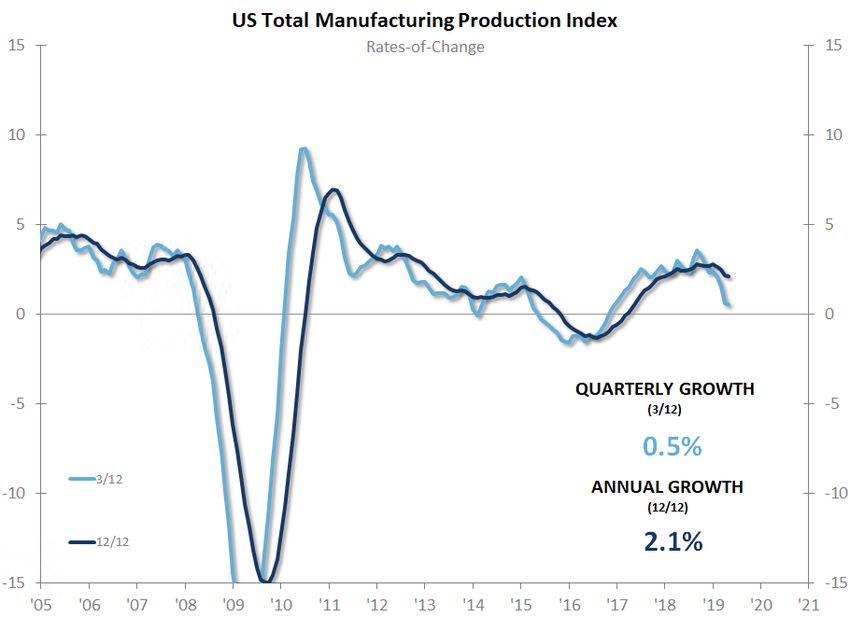
ITR Advisor     /   Volume 105       / June 2019

Make Your Move                                     Investor Update
Market your products with a lower cost             The stock market is showing positive
basis to appeal to increasingly price-             signs despite cyclical decline in the
conscious consumers as the business                industrial economy. However, it is too
cycle moves downward this year and in              early to determine whether stock market
early 2020.                                        conditions will improve further during this
                                                   cycle.

ITR Economics Long-Term View

2019
WEAKER SECOND HALF
                                     2020
                                     MILD GROWTH
                                                                       2021
                                                                       GROWTH

                                                    ITReconomics.com         ©2019 All Rights Reserved        3
ITR Advisor / Volume 105 / June 2019
Industry Analysis
RETAIL SALES WHOLESALE TRADE
• Retail Sales during the 12 months through April • Wholesale Trade was up 5.5% from the year-ago
were up 4.1% on a year-over-year basis level
• Retail Sales will rise at a slowing pace into mid- • Wholesale Trade of Durable Goods, up 5.5%, and
2020 Wholesale Trade of Nondurable Goods, up 5.4%,
are both rising at slowing rates
• The retail sector will likely avoid a recession
during this business cycle • The Nondurable Goods segment will likely enter
a mild recession this cycle
AUTO PRODUCTION MANUFACTURING
• North America Light Vehicle Production was • Total Manufacturing Production was up 2.1% on
down 1.4% from one year ago a year-over-year basis
• Production will generally decline through the • Activity will likely peak around the middle of this
remainder of this year and into next year year before then declining into next year
• Activity in the Light Truck segment was up 1.7% • Medical Equipment and Supplies Production
year over year, while activity in the Passenger and Civilian Aircraft and Parts Production, both
Car segment fell 8.3% growing at accelerating rates, are areas of
opportunity
ROTARY RIG CAPITAL GOODS NEW ORDERS
• The Rotary Rig Count was up 9.4% from the year- • Nondefense Capital Goods New Orders were up
ago level 4.7% from a year ago
• However, the May Rig Count declined mildly
• New Orders will peak imminently before
from the April level
declining into early 2020
• The Oil Rig Count is declining while the Natural
• Defense Capital Goods New Orders were up
Gas Rig Count, up 6.4%, is increasing
20.6%
• Spending on Defense Capital Goods will likely
plateau through the remainder of 2019
TOTAL NONRESIDENTIAL CONSTRUCTION TOTAL RESIDENTIAL CONSTRUCTION
• Nonresidential Construction was up 5.8% from • Residential Construction was down 1.8% from
the year-ago level one year ago
• Construction is rising at an accelerating rate • Single-Unit Housing Starts, which were down
2.9%, will likely recover later this year
• The Hospital segment and the Public Water and
Sewer Facilities segment will likely be areas of • Multi-Unit Housing Starts, down 1.9%, will likely
weakness in 2019, with spending expected to fall decline throughout 2019 and into 2020
below 2018 levels
ITReconomics.com ©2019 All Rights Reserved 4ITR Advisor / Volume 105 / June 2019
Leading Indicator Snapshot
2Q2019 3Q2019 4Q2019
ITR Leading Indicator™
ITR Retail Sales Leading Indicator™
US Leading Indicator
US ISM PMI (Purchasing Managers Index)
US Total Capacity Utilization Rate
Denotes that the indicator signals cyclical rise for Denotes that the indicator signals cyclical decline N/A
the economy in the given quarter. for the economy in the given quarter.
KEY TAKEAWAYS
• Our collection of leading indicators is signaling that US Industrial Production is likely to trend along the back side of the business cycle
through at least the end of this year
• The ITR Leading Indicator ticked up in recent months, but it is too early to determine if it has entered a prolonged rising trend
• The US ISM PMI resumed decline after some recent rise and is now no longer signaling the next rising trend for Industrial Production
ITReconomics.com ©2019 All Rights Reserved 5ITR Advisor / Volume 105 / June 2019
A Closer Look: US Manufacturing
MADE IN AMERICA
BY: ALAN BEAULIEU
What you need to know: Manufacturing is an important, vibrant part of the American economy. However, manufacturing
in America is slowing down in its rate of growth.
It seems to me that most people in the US do not understand how strong manufacturing is in this country. The reality is that manufacturing is an
important, vibrant part of the American economy. US Manufacturing Employment has risen to 12.782 million people (12MMA), the highest level
in 9.9 years, and accounts for 10.01% of total Private Sector Employment.
Yes, the percentage used to be a lot higher, but today’s manufacturing utilizes less human labor. The efficiencies (technologies of the last 30
years) responsible for this change have created our globally competitive manufacturing sector. Having the goal that manufacturing account for a
certain percentage of total employment is unrealistic and harmful, as it would require increasing manufacturing’s labor component, a move akin
to choosing a typewriter over a computer.
Some may be tempted to say that we could increase the labor component and thereby increase our output to match the good old days. That
argument does not hold water, either. Manufacturing output through May 2019, on a 12MMA basis, is a thin 1.2% below the February 2008
record high. Things are slowing down in manufacturing now, but they will rebound in 2020, and it won’t be long before America is producing
more than ever for domestic consumption and to export to our trading partners.
Beyond our being very good at capital intensive manufacturing, the lack of qualified, trained labor is an inhibitor to increased employment in
the manufacturing sector. The monthly trend in US Manufacturing Job Openings is descending off a November 2018 record high, but it is still
impressive at 476,000, 11.7% above the May 2018 level. The lack of labor is not for a lack of compensation; manufacturing wages are a record-
high $27.53/hour (3MMA basis).
Making things in America requires capital, of which there is plenty, and labor, of which there is a functional scarcity. If manufacturers are going
to fill their ranks, they must work aggressively to improve the image of manufacturing in America. There must be an emphasis on clean, modern,
stable, high-paying jobs with professional growth potential. Pride in manufacturing employment needs to be restored; position a manufacturing
job as a great career choice.
SLOWING DOWN
Manufacturing in America is slowing down in its rate of growth. The chart below clearly shows that the annual growth rate (12/12) has slipped
to 2.1%, and the quarterly year-over-year growth rate (3/12) is at 0.5%. The ITR Checking Points™ system is indicating further downside business
cycle pressure on manufacturing through the rest of the year. The 3MMA seasonal rise since February is the mildest since 2009. The diminishing
rates of rise in US Nondefense Capital Goods and in our exports of goods to the rest of the world are significant contributors to this slowdown.
ITReconomics.com ©2019 All Rights Reserved 6ITR Advisor / Volume 105 / June 2019
Automobile Production in the US is also a key contributor to the decelerating rise in manufacturing. Automobile Production’s 12/12 stands at
-0.6% with a 3/12 of -5.1%. The 12MMT is down 1.4% from the January 2019 high. Expect further decline in the second half of 2019. However,
even without automobile production, manufacturing is still in Phase C, Slowing Growth, with a 12/12 of 1.7% and a 3/12 of 0.4%.
In the table below, 3 of the 10 production series listed are in Phase B, Accelerating Growth. Participants in those segments can expect increased
demand on production capacity through at least the near term. It would be worth the effort to grab any low-hanging fruit to increase efficiency
as you work to keep output from bogging down. Manufacturers in Phase C or D might consider focusing more on reducing costs and waste, even
if at the expense of the speed of output. All manufacturers should anticipate a healthy level of demand in 2021 as they consider their longer-
term capital projects.
Description NAICS 12/12 3/12 Notes
Machinery Production 333 4.1% C 1.4% C Decelerating rate of rise
Farm Equipment 3/12 is signaling some deceleration
333111 8.5% B 2.8% C
Production ahead
Construction Equipment
33312 18.3% B 20.8% C More rise ahead
Production
Mining Equipment
33313 11.1% C 8.6% C Tentative March 2019 3MMA peak
Production
Industrial Machinery
3332 -4.6% D -7.2% D Ongoing decline
Production
Refrigeration and HVAC
3334 0.6% C -2.9% D March 2019 12MMA high
Equipment Production
Metalworking Machinery
3335 1.1% C -1.4% D March 2019 12MMA high
Production
Engines and Turbines
333612-8 13.4% C 4.2% C Tentative April 2019 12MMA high
Production
Motor Vehicle Parts Flat to mildly negative 12MMA off a
3363 2.1% C -2.5% D
Production January record high
Aerospace Products and
3364 2.8% B 4.4% C More rise ahead
Parts Production
Slowing growth or decline characterizes most of these production series. This is a great time to assess inventory needs, sales expectations, and
anticipated cash flow through the rest of 2019 and into 2020. Compute your rates-of-change, utilize ITR’s Checking Points system, find a system
of reliable leading indicators, and use them to prepare for the next business cycle shift in your company for maximum profitability and asset
utilization.
ITReconomics.com ©2019 All Rights Reserved 7ITR Advisor / Volume 105 / June 2019
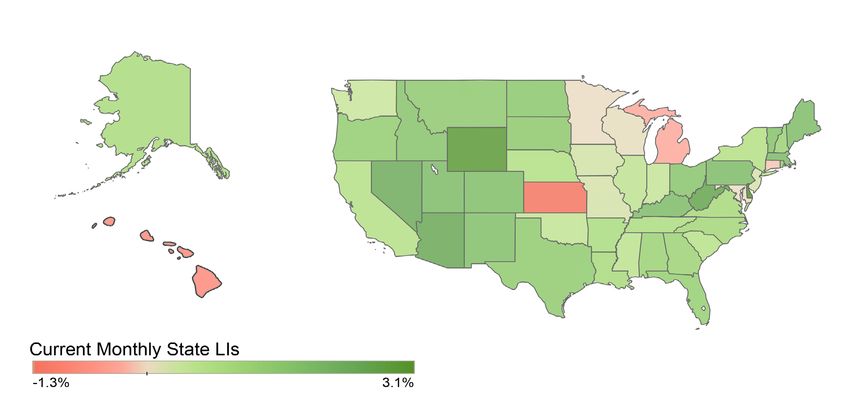
State-by-State: Leading Indexes
• The US Leading Index is signaling cyclical decline in the US economy
• The majority of state leading indexes are suggesting growth in the US economy. However, they are transitioning to the back side of the
business cycle, signaling that opportunity may be waning
• The Hawaii, Kansas, Michigan, and Connecticut Leading Indexes are declining. With a mild macroeconomic recession expected for the
second half of 2019 and into the first half of 2020, it is unlikely that these states will see growth opportunities return before 2020
ITReconomics.com ©2019 All Rights Reserved 8ITR Advisor / Volume 105 / June 2019
Reader’s Forum
With economic activity expected to decline later this year, how should I adjust my pricing strategies to re-
main profitable?
James Giles, Economist at ITR Economics™, answers:
While we are not expecting a particularly severe recession during this cycle, demand will no longer support the inflation rates of recent quarters.
During this time, it will be increasingly important to keep an eye on your competitors’ prices to ensure that you are not raising your own too
rapidly, at the risk of losing market share. Producer Prices are rising at a slowing rate, up just 1.0% from May 2018, with costs for certain inputs
such as oil and steel even falling in recent months. These trends will make it a little easier to keep your own prices down. If your industry is
headed for a recession during this cycle, consider keeping your prices competitive enough to attract new business, and build a backlog to keep
cash flowing into your company as economic activity declines later this year.
Please send questions to: questions@itreconomics.com
Concerned about the slowing economy?
Our personalized programs will show you how this will impact your business
directly! Contact us today to learn more about our services.
LEARN MORE
ITReconomics.com ©2019 All Rights Reserved 9You can also read


