ASSESSMENT GUIDELINES - Ponsonby Primary 2020 - Ponsonby ...
←
→
Page content transcription
If your browser does not render page correctly, please read the page content below

Ponsonby Primary

     2020

ASSESSMENT
 GUIDELINES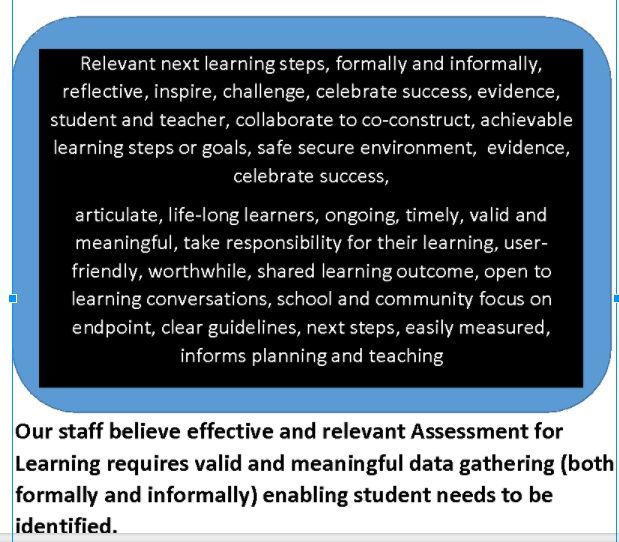
Belief
Statement
Why assess?Schools need to know what impact their teaching and learning programmes are having on student
   learning.
   Hattie says “KNOW THY IMPACT” Ponsonby Primary references learning against the NZC (New Zealand Curriculum) expectations.

Assessment provides data for:
Feedback to children about their learning; parent / student / teacher reporting;BOT reporting and school wide aggregated data for
tracking- Faces to the data; Determining needs of learners;Identifying school needs in staff curriculum development and budgets.
Pg. 38-39 NZ Curriculum framework states:
Assessment for the purpose of improving student learning is best understood as an ongoing process that arises out of the interaction between teaching and learning. It involves
the focused and timely gathering, analysis, interpretation, and use of information that can provide evidence of student progress. Much of this evidence is “of the moment”.
Analysis and interpretation often take place in the mind of the teacher, who then uses the insights gained to shape their actions as they continue to work with their students.
Key characteristics of effective assessment
• benefits students – It clarifies for them what they know and can do and what they still need to learn. When students see that they are making progress, their motivation is
sustained and their confidence increases.
• involves students – They discuss, clarify, and reflect on their goals, strategies, and progress with their teachers, their parents, and one another. This develops students’
capacity for self- and peer assessment, which lead in turn to increased self-direction.
• supports teaching and learning goals – Students understand the desired outcomes and the criteria for success. Important outcomes are emphasised, and the teacher gives
feedback that helps the students to reach them.
• is planned and communicated – Outcomes, teaching strategies, and assessment criteria are carefully matched. Students know in advance how and why they are to be
assessed. The teacher’s programme planning is flexible so that they can make changes in response to new information, opportunities, or insights.
• is suited to the purpose – Evidence is obtained through a range of informal and formal assessment approaches. These approaches are chosen to suit the nature of the learning
being assessed, the varied characteristics and experiences of the students, and the purpose for which the information is to be used.
• is valid and fair – Teachers obtain and interpret information from a range of sources and then base decisions on this evidence, using their professional judgment. Conclusions
are most likely to be valid when the evidence for them comes from more than one assessment.
Assessment is integral to the teaching inquiry process (see page 35) because it is the basis for both the focusing inquiry and the learning inquiry.

School-wide Data Collection Explanation                                               We are an assessment for learning school (AFL).
                                                                                             This means assessment is gathered by teachers to
   ●       Reading, Spelling, Maths, and Writing assessment will be entered onto e-tap.      inform their teaching and learning programmes.
           Syndicate leaders and PDP will aggregate the results.
   ●        Key competences self management/ contributing and resilience are
           reported in school report which is on line in etap.                               We use and AFL coaching and mentoring
   ●       PAT results will be marked externally by NZCER Marking and then entered
           onto e-tap and an analysis carried out by SLT.
                                                                                             methodology to support teachers with feedback
   ●       PROBE and Running Records are entered by teachers – note that                     about their practices.
           instructional level will be entered, as and when tested with 80%
           comprehension and accuracy 96%
   ●       asTTle will be used to test all year 4 to 6 students in Reading and
                                                                                             Teacher s work in coaching and mentoring triangle
           Mathematics as a back-up test to check teacher validity in years 4 - 6.           teams with an overseeing mentor.
   ●       For all year levels we report against curriculum levels beginning proficient      Sanjay Rama determines the groups and mentor
           and achieved-.
   ●       In other curriculum areas children’s achievement will be reported in writing in   coach that contributes to a shared coaching model.
           term 4. It is recommended that as children complete different inquiry topics
           that teachers make comments cumulatively.
   ●       Teams under the direction of team leaders will fortnightly discuss children’s
           learning needs accessing specific data and looking for ways to support
           learners.
   ●       The intervention /learning support register is a guide a guide for all teachers
           and is found on the Google Teacher Drive.
   ●       Targetting children with learning and emotional needs is a part of all
           teachers responsibility with assessment.
   ●       Any child of concern must be raised with SENCO.
       I
Glossary SLT - senior leader team/ PDP principal and Deputy Principal team.SENCO - special
needs coordinator
PAT Progress and achievement tests- normed. NZCER NZ research in education.
Probe- Prose reading observation & evaluation; AsTTLE assessment of teaching and learning
Overview for Student data collection by teachers-Terms 2 to 4
Approximate requirements only -      Term 2                                     Term 3                                     Term 4
see termly timetables that francis
Naera gives out to senior leader
termly

Week 1 & 2                           Continue Running Records and Probes(       Continue Running Records and Probes(       Yr 5-6 PAT testing
                                     All students will be tested twice during   All students will be tested twice during
                                     the Year                                   the Year
                                                                                Start retesting children in Gloss/Jam
                                                                                tests
                                                                                Writing moderation

Week 3 & 4                           Basic Facts Yr 3-6                         Basic Facts Yrs 3-6                        Yr 4-6 E-AsTTle maths
                                                                                Retesting children in Gloss/Jam tests      Yr 4-6 E-AsTTle Reading

Week 4 & 5                           E-Asstle Yr 3 – 6 Reading testing          E- Asstle- Maths Yr 3 – 6                  Reports go home Friday 13th

Week 6 & 7                           Writing moderation (Yrs 1-6)               E-Asstle Yr 3 – 6 Reading testing          Week 6 17/ 18 November Three Way
                                                                                                                           Learning Conversation

Week 8 & 9                           E- Asstle- Maths Yr 3 – 6                  Week 9 student led conferences 18
                                     Mid Year Reports go home to parents at     September
                                     Student led conferences June 26th

Week 10
Week                  Assessment Overview for teachers                                              Data should be on E-tap /Notes                             Note each term the
Term 1                                                                                                                                                        requirements are listed
1                     Drop in Goal setting Monday 9.00-12.30                                        New students will be assessed on the following tests (    in teacher timetables
4th -8th
           February                                                                                 Probe and Gloss)                                          timetables page 1.
2                     Basic Facts Yr 3-6                                                                                                                      Parent /teacher/
10h – 14th Feb        Ponsonby Spelling Lists Yr 1-3                                                All running records for any fragile learners need to be   student reporting
                      Begin Running records/Probes (learners identified below or fragile at 2018)   available for the learning conversation week 10
                      year 4-6 must include fiction and non fiction text.                                                                                     Term 1 Week 9
                      Jam testing begins                                                                                                                       3 way learning
                                                                                                    JAM ongoing - need data on target children as a
                      Meet the Teachers- see dates in claenday- Kowhai/.Puriri/kakariki 11th-
                                                                                                    minimum for learning conversations                        conversations 31st
                      13th February                                                                                                                           March and 1st April
                      8.00am – 8.30am.
                      SLT testing of new year 2-6 children -Gloss/Probe/Running records
                                                                                                                                                              2020
                                                                                                                                                              Day 1 starts at 1.30pm
3                     Begin testing Gloss/ Optional to do in class modified adaptive                 GLoss data for fragile learners on etap by week 10       Day 2 starts 2.30pm
17th – 21nd           PAT Testing Y3-6 start week 3                                                                                                           Term 2 week 9
Feb                   Maths, comprehension, listening, vocab as per timetable
                                                                                                                                                              26th June Student
4                     PAT Testing (Catch ups)
                                                                                                                                                              led conferences &
24th - 29th           Maths, comprehension, listening, vocab                                        Tuesday all PAT tests to Wellington by courier            reports go home out
March                 All tests sent on Friday for scanning                                                                                                    Term 3 Week 9
5                                                                                                                                                               Student led
2nd -6th March
6                     E-Asttle maths Yr 4-6
                                                                                                                                                              conferences 18th
9th -13th                                                                                                                                                     September 2pm- 3pm
March                                                                                                                                                         .
7                     Writing moderation in syndicates: Looking at Top, Middle and Bottom           Basic facts should be on e-tap by the end of week 8       Term 4
16th - 20nd           20th March Teacher Only Day Focus                                                                                                       Week 6 17/18
March                                                                                                                                                         November 3 way
8                     Running records and PROBE( year 4-6 children of concern/below
23rd - 27th           cohort) onto e-tap
                                                                                                                                                              learning conferences.
March                 31st March 3 way learning conferences/ 5 year checks                                                                                    Reports out to families
9                     1st April Learning conversations                                              PAT data will be automatically loaded.                    13th November- Friday
30th Mar - 6th        Sharing of stories ( Teacher Inquiry)                                                                                                   before..
April
10                                                                                                  Running records and PROBE on e-tap with comments
9th - 12th April                                                                                    Enter data for strand maths (Each Term)
Student agency 2020
In school leader - Sarah Radcliffe 2020 a focus on maths student agency linked to school wide focus.
We need to be answering these questions over 2020.
Do children have a say in their learning? What do we do as teachers to use children’s voice in their learning? How are we preparing
children to be involved constructively with their learning? How do we grow student leadership in classrooms and school and
community? Are akonga using their voice and action in the reporting process? How much assessment and reflection do they actually
do? Can children articulate their learning needs, direction , goals, achievements?

 The matrix of student capabilities in their learning                                                             Sharing
 Full matrices are available through Evaluation Associates   Locus of control                                     Students are able to lead conversations about their
 http://www.evaluate.co.nz/resources/matrices-templates-re   Classroom is focused on learning and students        learning with their parents and describe
 view-tools/                                                 can describe their contribution to the learning      their learning progress.
                                                             process.
 Learning environment                                        Co-Constructed                                       Curriculum Understanding
 Students are active and committed                           Students are                                         Students know how their learning relates to
 participants in creating and maintaining the                independent learners who have                        the curriculum in terms of meeting their
 classroom environment that best                             a commitment to evaluating and adjusting             individual needs and identifying their next
 promotes                                                    their learning to meet their needs in
                                                                                                                  steps
 learning and meets the                                      partnership with the teacher.
 ir learning needs                                           Using Assessment Information
                                                                                                                  Clarity about the Learning
 .                                                           Students understand that assessment, both informal
 .                                                                                                                Students are able to describe their learning
                                                             and formal, is central to their learning and use
                                                                                                                  in global and specific terms
                                                             it at all times to determine where they are at
                                                             with their learning
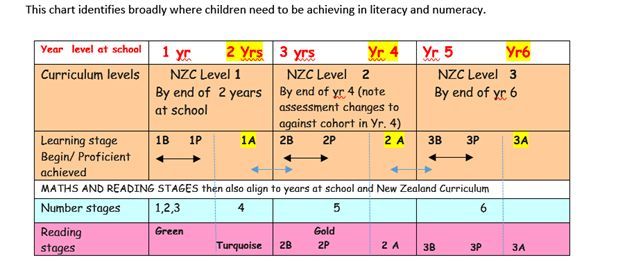
Writing End of Year expectations against the NZ Curriculum Levels. (Subject to some changes with
Verity Hall leading writing development as COL in school writing leader 2020).
If specific learning needs is ticked. This child will be on a support programme and parents will know this.
Year Well Above Above age Expected level for Just below Specific Assessment – Assessment
expectation expectation age expectation learning needs against curriculum
levels.
1 Year at school 2B and above 1A Level 1 P 1B Year 1 –writing
moderation
School spelling lists
2 years at school 2A and above 2B & 2P Level 1A 1P 1B Year 2 moderation
School spelling lists
3 years at school 3B and above 2A Level 2B (& Level 1A 1P Year 3 writing moderation
2P) School spelling lists
Year 4 3A and above 3B & 3P Level 2A 2P and below 1A and below Year 4 writing moderation
/spelling
Year 5 4B and above 3A Level 3B & (Level 2A 2P and below Year 5 writing moderation
3P) / spelling
Year 6 4A and above 4B & 4P Level 3A 3B & 3P 2A and below Year 6 writing moderation
/spellingReading end of year/age group New Zealand curriculum (NZC) expectations
Well Above expectation Above age expectation Expected level for age Just below expectation Specific learning needs Assessment tools
This is the level they are Against the NZ curriculum
working on at Instructional Progressions/ expected levels
level
1 year at school Gold purple Orange, Turquoise Green Blue & Yellow Red & Magenta PM Benchmarks/ Colour
(6 >6yrs 6 mths) wheel
Level 1P
2 years at 2A and above Gold & Purple Turquoise Orange & Green Magenta, Red, Yellow, Blue, PM Benchmarks/ Colour
school Reading at 8 .5 years 8yrs- 8.5 (7yrs < 7rs 6mths) wheel
and above Level 1A
3 years at 3B and above 2A Gold 1A & 1P Magenta, red, PM Benchmarks/ Colour
school Reading above Reading at 8.5-9.5 (8yrsMathematics Strategy Levels – Number
Yellow = WA= Well Above age expectation, Dark Grey = A= Above age expectation. Light grey =W= Expected level for age (based on 3 years sustained numeracy) White boxes = B =Below
expectation. Lined areas = SL specific learning needs- Will be on a support programme and parents will know this
8 WA WA WA WA WA WA
NZC Level 4-5
Advanced
Proportional
3- 4 7 WA WA WA WA A A
Advanced
Multiplicative
6 WA WA A A W W
3 Advanced Additive (Stage 6B/6P or (Stage 6A or Level
Level 3B/3P) 3A)
5 WA A W W W B
2 Early Additive (Stage 5B/5P or (Stage 5A or Beginning/Mid-year
Level 2B/2P) Level 2A) only
4 A W W B B SL
Advanced Counting (Stage 4A or Beginning/Mid-year
Level 1A) only
3 W B B SL SL SL
Counting from One (Stage 3P/3A or
by Imaging Level 1P)
1
2 W B SL SL SL SL
Counting from One Beginning/Mid-year
Materials only
1 B SL SL SL SL SL
One to One
Counting
0 SL SL SL SL SL SL
Emergent
MINZC STAGE
YEAR 1 year at school 2 years at school 3 years at school 4 5 6
LEVELReporting to parents- An overview
In term 1, the teachers and children meet with parents/guardians to talk about learning, competencies and social skills. The 15 minute, Term 1
‘Three-Way Learning Conversations’ were a key request from parents. To further support and celebrate learning.
Term 2 our student led conferences take place. Families can come to school any time between 2pm and 2.55pm on designated date. Children show
their work and outline how they are progressing. The mid-year report is structured as an easy to read document requiring no teacher interpretation.
The levels the teachers have ticked are the children’s instructional levels. Instructional levels relate to the learning happening in the classroom, with
teacher guidance. It must be therefore taken, that the level below is a child’s independent (can do with no teacher or family teaching) level.
The report has 4 pages. The first page identifies New Zealand curriculum level expectations. The data indicates whether a child is instructionally
operating within or above expectations, or requires explicit support to achieve the NZC recommended levels.
Central to the mid-year reporting programme is the very important ‘Student-Led’ conferences”. The goal of the student-led conference to ensure
parents get to see and hear what their children think about learning within their classroom context, as opposed to just listening to a teacher.
Term 3 is a student led conference- sharing of work in week 9
Term 4 the teachers and students report to parents with comments on
all curriculum areas with the report and a 3 way learning conference.You can also read


