The Mirror (13 March 2019) - Amazon AWS
←
→
Page content transcription
If your browser does not render page correctly, please read the page content below
A Level Media Studies – Set Product Fact Sheet

The Mirror
(13 March 2019)
A Level Media Studies – Set Product Fact Sheet

The Mirror
(13 March 2019)
AS Level Component 1:                                       Cameron shortly after the vote, Theresa May has
Investigating the Media                                     faced regular leadership challenges from within her
A Level Component 1: Media Products,                        own party, and a snap general election in 2017 in
Industries and Audiences.                                   which her party suffered heavy losses. Meanwhile,
                                                            she had been regularly visiting Brussels and other
Focus areas:                                                EU countries in an effort to create a Brexit deal that
Media language                                              would satisfy both the EU and the UK parliament.
Representation                                              On the date this edition of the Mirror was published,
Media industries                                            MPs had voted against the deal she had negotiated
Audiences                                                   with the EU. This was very serious as the UK was
Media contexts                                              scheduled to be leaving the EU just ten days after.
                                                            Withdrawing from the EU with ‘no deal’ could have
PRODUCT CONTEXT                                             catastrophic consequences on trade, immigration,
• The Daily Mirror is a British daily                       healthcare etc., affecting all UK citizens.
  national tabloid newspaper. Established
  in 1903, it is aimed at predominantly                     Cultural context
  working class readership. It follows a                    Eastenders is one of the UK’s most popular soap
  traditionally left wing political stance.                 operas, with a reputation for featuring hard-hitting
• One of the Mirror’s main competitors is The               storylines that often feature issues such as rape,
  Sun newspaper which targets a similar socio-              domestic violence and homophobia. Since 1985, it
  economic demographic, but usually adopts                  has been regularly watched by audiences of up to
  a more traditionally right wing stance.                   20 million people. This has turned the actors into
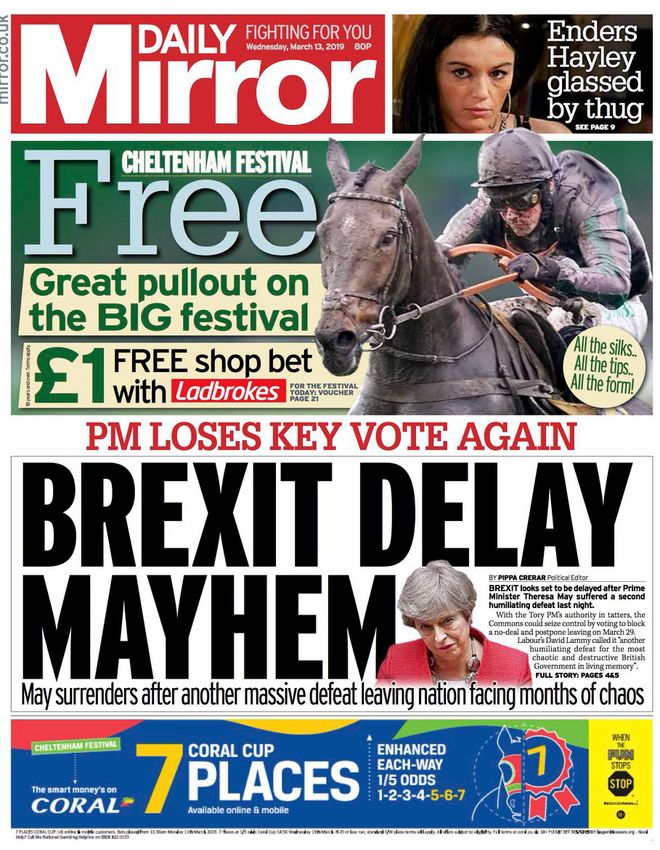
• This edition was published on March 13th, 2019,           celebrities and - like Dyer’s ‘Star Theory’ suggests
  after Theresa May had encountered another                 - tabloid newspapers often run stories about the
  Commons defeat over her Brexit proposals. As a            actor’s lives mirroring their Eastenders’ storylines.
  mostly left-wing newspaper, the Mirror has been           Traditionally, one of the Mirror’s (and other
  critical of the way the conservative government           tabloids’) main elements is sports reporting -
  has been handling the Brexit negotiations.                often over half the paper is dedicated to sport.
                                                            The ‘back pages’ often feature the betting odds
                                                            for horse races and will have special ‘pull out’
PART 1: STARTING POINTS – Media                             features when there is a major racing event. Racing
language and representation                                 ‘meets’ like Ascot and Cheltenham have upper
Political context
                                                            class associations, but have increasingly become
                                                            popular days out for the less wealthy audiences.
On 23rd June 2016, citizens of the UK voted
to leave the European Union (EU). This was                  Front page:
nicknamed ‘Brexit’. The vote was very close with            •   The page is split between the political story, a
51.9% voting to leave and 48.1% voting remain.                  ‘puff box’ promoting the pull-out supplement,
The controversies from the campaign continued                   and an advert for a betting service (that
even after the vote. Remainers accused leave                    obviously links to the Cheltenham pull-out).
voters of xenophobia and racism; leavers accused                The headline ‘Brexit Delay Mayhem’ and
remainers of being unpatriotic and un-democratic.               the use of the emotive words ‘surrender’,
The period since the referendum has been one of                 ‘defeat’ and ‘chaos’ suggest the negotiations
political turmoil. Following the resignation of David           for Britain leaving the EU are disastrous.

                                                        1
A Level Media Studies – Set Product Fact Sheet
• The image of May looking very serious • On either side of the double page there
anchors the headline - that fact the image is are two rival columns offering opposing
tiny (smaller than the photo of attacked actor viewpoints on the proceedings. The style of
in the top right) shows how little respect or these is similar to that of sports journalism,
faith the Mirror has in May’s abilities. and there are numerous light-hearted pop
• The strapline ‘Fighting for you’ provides culture references (e.g. comparing one man to
solidarity for people confused or worried Gandalf from Lord Of The Rings and including
about the political turmoil of Brexit. his famous line “You shall not pass”).
• The Cheltenham Festival pull-out actually Theoretical perspectives:
dominates the page - with bright green font Structuralism ‐ Levi – Strauss
and background, combined with an exciting There is a binary opposition between the MPs
action shot of a horse and rider, it grabs and “the Nation” which feeds into the ‘us vs them’
the attention more than the political story. ideology of ‘populism’. There is also an opposition
The puff box “All the tips! All the form!” between the two political pundits on the double
offers practical advice and the offer of a free page piece. The language in the headlines (plus
bet will also entice the reader. The use of the odds from ‘Honest Jason’) also explains some
these terms positions the reader as someone quite complex political debates in using the allegory
already knowledgeable about racing. of a horse race - this dramatises the details (and
• The advert at the base of the page also also links to the paper’s main advertisers!)
uses brightly coloured graphics, the greens
linking it to the racing feature above. Starting points: Representation
• The article about the assault on the actor Consider how representations are constructed
is a close-up of her upset face, to create through a process of selection and combination
empathy and the reader feel closer to this
‘character’. The headline uses emotive slang Front page:
like ‘glassed’ and ‘thug’ to condemn the • By reducing Theresa May to the smallest
attack. It also doesn’t use the real actor’s image on the page, the Mirror is sending a clear
name (Katie Jarvis) instead addressing her message about the way she is seen by her fellow
as her character’s name. The abbreviation of MPs and by the newspaper’s target audience.
Eastenders along with the slang suggests this • The headline focuses on her defeat and implies
story is less important and more ‘gossipy’. the whole situation is her fault - there is very little
description of the MPs who have challenged her.
Article:
• This personalises a complex story by making
• The central image is a medium shot
it about the experiences of one individual
of Theresa May: her hands are raised
rather than a complicated political progress
which could connote defeat. It could also
involving hundreds of people. This is a
indicate conciliation or resistance.
technique used by news media to help
• The text of the article shows it is a mixture audiences build emotional engagement
of all of these! May is portrayed as about ‘dry’ political or economic stories.
someone who is losing, but who is also
• The small amount of space given to the whole
bravely fighting on against the odds.
story - along with the “...Loses Key Vote Again’
• The language of the whole article is allegorical: headline - suggests that, these political conflicts
portraying the debate in Parliament as if have become almost commonplace, and this
it is a horse race. “A Faller At The 2nd” is is all part of the ongoing Brexit ‘chaos’.
racing track slang for a poorly performing
• Both this and the Eastenders story could
horse, and there is even a book-keeper
suggest women are weak and vulnerable: May
character at the bottom of the page, offering
‘surrenders’, ‘Hayley’ has been physically
odds for the different Brexit outcomes.
assaulted. Yet the images - May in mid-
• Throughout the main article, May is described argument, ‘Hayley’ looking defiant - give the
using light-hearted derogatory language impression of inner strength despite the attacks
(“tottering Theresa”). Though her “dwindling they have experienced. The Mirror has an even
authority” is ridiculed, at some points her efforts gender split in their audience, which may explain
sound almost heroic (“dashing to Brussels”). this more complex portrayal of women.
2A Level Media Studies – Set Product Factsheet
Article: the Mirror’s brand being the “Intelligent Tabloid”.
• The portrayal of May as embattled continues Reach plc is the largest national and regional
with a blow by blow account of the debate. The multimedia content publisher in the UK, comprising
detail of her losing her voice again represents her national and regional news brands across the
as both weak, but also relentless in her aims. country. The group publishes more than 150
• The image of her dominates the page, whilst the newspaper titles across the UK and Ireland,
male politicians are in far smaller photo-boxes. from the national presence of the Daily Mirror,
There is a sense that even though she is failing, the Daily Record, the Daily Express, to local
she is going down fighting. Though this seems newspapers such as the Manchester Evening News
at odds with the Mirror’s political bias, it does fit and Nottingham Post. The Daily Mirror is part of
with the large female market who may admire Independent Press Standards Organisation (IPSO)
May’s tenacity even if they don’t like her politics. - an independent body which is not backed by the
Government and is fully funded by the industry
Theoretical perspectives:
itself. This is a regulatory body that maintains press
Feminist theory ‐ Van Zoonen standards but is anti-Leveson in its approach.
Van Zoonen suggested that women are often Theoretical approaches:Power and media
portrayed as sexualised, weak or vulnerable in industries – Curran and Seaton
the media. Though the two women featured on Reach plc has maintained their position in the
the Mirror’s cover are from stories that seem UK market despite falling sales of the Mirror
to portray them as vulnerable, the images used and other mainstream titles by diversifying into
connote strength and defiance in the face of regional news. This diverse pattern of ownership
adversity; also neither are sexualised (almost a has allowed them to create the conditions for
genre convention in many other UK tabloids!) more varied and adventurous media products.
PART 2: UNDERSTANDING MEDIA Regulation – Sonia Livingstone and Peter Lunt
INDUSTRIES AND AUDIENCES Reach plc is facing increasing pressure alongside the
STARTING POINTS – Media Industry rest of the UK press industry to adhere to strict rules
and regulations on industry practice. This has arisen
Industry context after the phone hacking scandal and subsequent
The Daily Mirror was first published in 1903 as Leveson enquiry into the industry. There is an
a newspaper for women ‘to act as a mirror on underlying issue of protecting citizens from harmful
feminine life’. However the newspaper was quickly material while ensuring choice and press freedom.
redesigned to appeal to a broader audience.
Owned by the Reach plc, the Daily Mirror Cultural industries – David Hesmondhalgh
was once the most popular tabloid in the UK. Reach plc has become a horizontally integrated
However, it has had the largest year on year company with a wide range of titles in order
fall in sales of any national print newspaper to maximise audiences and minimise risks.
in recent years with a current average daily Rather than seeing digital media as a threat, the
sales of just 509, 000 copies (Jan 2019). company has embraced its digital expansion and
now offers digital marketing as well as digital
Online media has largely been responsible for the
classifieds to generate additional income.
downturn in print sales and the Daily Mirror has
responded to this by launching ‘Mirror Online’ Starting points: Audience
and having a presence on social media sites. The
How are audiences grouped and categorised?
website offers interactive opportunities for its
readers with competitions, polls and a ‘Got a story?’ The Daily Mirror’s target audience, according to
feature which invites readers to submit their own NRS and ABC data is predominantly C2DE, over
stories. Though it doesn’t invite users’ comments 35 and are working class Labour supporters.
on political issues, it does have accessible stories How do audiences interpret the product?
breaking down the key events into ‘bitesize’ • The audience is positioned as being disapproving
chunks (e.g. “5 Facts About…”). This reinforces of May, a Tory PM, and towards the other MPs.
3A Level Media Studies – Set Product Factsheet
The use of despairing, defeated language would Theoretical approaches:
resonate with their cynicism towards politicians,
Cultivation theory – Gerbner
and their fears about the ‘chaos’ of Brexit.
Audience exposure to repeated patterns of
• The red font and central positioning of the
representation (of May, of Brexit, or of modern
headline indicates that this story is important,
politics) by newspapers may shape and influence
but the sandwiching between adverts for
their views and opinions. Gerbner went on to say
gambling, along with the ‘Loses Again’
that this is not like ‘hypodermic model’ but rather
indicates this is just another installment in a
depends on what the audience already believes.
long, tedious process, and that it is advisable
The messages (e.g. politicians are ineffectual)
to focus on more entertaining experiences.
need to resonate with an established belief (e.g.
• The use of horse-racing terminology Brexit is a chaotic mess) in the audience (e.g.
in the main article’s headlines relates working class, left-wing men and women).
to the audience’s interest in racing, and
the rival political columnists describe Reception theory ‐ Stuart Hall
the day’s events in the opinionated and There is an ambiguous representation of women
emotive style of a sports ‘pundit’. on the front page. Some may decode the stories
• Despite much emotive and symbolic language as portraying women as defeated and vulnerable,
(that also references popular culture) there others may negotiate a meaning as these
is actually a lot of factual detail about the women being defiant in the face of adversity.
Commons debate. The ‘cut and thrust’ of the End of audience – Clay Shirky
proceedings narrates what could be quite a The concept of audience members as passive
dry and inaccessible series of arguments. consumers is no longer tenable in the age of the
How do different audience interpretations reflect
internet with the rise of the prosumer who can create
social, cultural and historical circumstances?
their own content such as submitting stories and
being part of forums. Newspapers like The Guardian
• The tone of the article - and the prominence of
have embraced this, taking popular ‘below-the-line’
more stereotypical working class entertainment
(i.e. non-professional) commentators and offering
like soap operas and horse-racing - link
them ‘above-the-line’ columns. The Mirror does
to ideology of ‘populism’ that has become
offer some opportunities for ‘citizen journalism’ (e.g.
more prevalent in mainstream politics over
the “What’s Your Story?” section of their website)
the past five years. Donald Trump’s ‘Make
the majority of content is still written by journalists.
America Great Again’ and Nigel Farage’s
attack on the ‘elite’ encourage the view
that mainstream politicians are hopelessly
out of touch with the ‘common people’.
4You can also read


