The Natural Choice? Metaphors for nature in a UK government white paper
←
→
Page content transcription
If your browser does not render page correctly, please read the page content below
Электронный журнал «Язык и текст langpsy.ru»                   E-journal «Language and Text langpsy.ru»
2015. Том 2. № 3. С. 97–120.                                   2015, vol. 2, no. 3, pp. 97–120.
doi: 10.17759/langt.2015020312                                 doi: 10.17759/langt.2015020312
ISSN: 2312-2757 (online)                                       ISSN: 2312-2757 (online)

  The Natural Choice? Metaphors for nature in a UK
  government white paper
  Douglas Ponton,

  Full Ph.D. (Philology), Department of Analysis of Political Social and Institutional Processes,
  Catania, Italy, dmponton@hotmail.co.uk

        George Lakoff (1993) described metaphor as “a major and indispensable part of our ordinary
        conventional way of conceptualizing the world.” In the context of a critical approach to discourse
        studies, however, such conceptualizing is not a neutral phenomenon. Politicians and advertisers,
        among others, understand the potential of metaphor as a persuasive rhetorical figure. In the topical
        public debate on the environment, where environmental discourse has achieved a certain currency
        thanks to pressure groups such as Greenpeace, metaphors have a key role to play in influencing
        attitudes.

        This study explores the construction of environmental discourse in a recent white paper from the
        British government, with an emphasis on the persuasive role of metaphor. It suggests that the
        notion of ‘value’ as a key metaphor can be understood in terms of the appeal it makes to potential
        readers in the corporate sphere.

        Ключевые слова: metaphors, nature, Ecolinguistics, British government, The White Paper.

  Для цитаты:
  Дуглас Понтон К вопросу об употреблении метафор, связанных с природными явлениями в
  правительственных документах Великобритании [Электронный ресурс] // Язык и текст langpsy.ru. 2015.
  Т. 2. №3. URL: http://psyjournals.ru/langpsy/2015/n3/Ponton.shtml (дата обращения: дд.мм.гггг) doi:
  10.17759/langt.2015020312
  For citation:
  Douglas Ponton The Natural Choice? Metaphors for nature in a UK government white paper [Elektronnyi resurs].
  Jazyk i tekst langpsy.ru [Language and Text langpsy.ru], 2015, vol. 2, no. 3. Available                         at:
  http://psyjournals.ru/langpsy/2015/n3/Ponton.shtml (Accessed dd.mm.yyyy). doi: 10.17759/langt.2015020312

         1. 1. Introduction
        Among the many discourses that today compete for political, scientific and popular attention, as
  well as for public funding, that of the environment speaks with the loudest, most urgent tones. During
  the Cold War, nuclear proliferation threatened the future of life on planet Earth; now, the excesses of
  industrial processes have given rise to analogous visions of environmental catastrophe. Such is the
  background against which today’s ecological movement has taken shape. People have come together in
  ‘Green Parties’, which operate in many countries, in private organizations such as Friends of the Earth,
  Greenpeace, the Institute for Deep Ecology, and many more. Such groups express what Castells (2009:
  322), calls ‘the widespread rise of deep ecological awareness’, which characterizes our age. He points
  out that more than one billion people worldwide took part in the 2007 ‘Earth Day’, evidence that, on a

 © 2015 ГБОУ ВПО «Московский городской психолого-педагогический      © 2015 Moscow State University of Psychology &
 университет»                                                        Education
                                                        97
Дуглас Понтон Douglas Ponton
К вопросу об употреблении метафор, связанных с The Natural Choice? Metaphors for nature in a UK
природными явлениями в правительственных government white paper
документах Великобритании Language and Text langpsy.ru
Язык и текст langpsy.ru 2015, vol. 2, no. 3, pp. 97–120.
2015. Том 2. № 3. С. 97–120. doi: 10.17759/langt.2015020312
doi: 10.17759/langt.2015020312
popular level, there is a growing awareness of the importance to human beings of the environment in
which we live.
Environmental discourse has achieved a level of political and social influence, thanks to the
actions of these pressure groups. Multinational businesses now routinely incorporate ecological
discourse as an element of their branding (Vasta 2005). Politicians of all persuasions have at least to
pay lip service to ecological values. This study explores the construction of environmental discourse in
a recent white paper from the British government, with a special emphasis on the persuasive power of
the metaphors used. It uses corpus analysis together with a broadly critical perspective, suggesting
that ideology and political considerations may underpin the apparently natural (sic) discourse of the
‘value’ of Nature.
Ecolinguistics is an emerging field, as many linguists have responded to these social themes. The
website of the Ecolinguistics Association1, collects articles on environmental topics. Some of these are
responses to Goatly’s (1996: 537) call for an ‘ecological critical discourse analysis’, and the current
paper also has a critical orientation.
1.2. Introduction: White Papers
White papers are government documents on key policy issues. Their function is not legislative
but rather to pave the way for future legislation (Chapin 1978: 33). By producing a white paper,
governments invite stakeholders to suggest modifications, raise public consciousness of the issues,
and assess the likely popularity of their future policies. White Papers present government policies
while at the same time inviting opinions upon them (Pemberton 1969: 49). For example, the recent UK
government white paper on the National Health Service makes the following explicit request for
stakeholders and members of the public to express their views:
We are consulting on how best to implement these changes. In particular, the Department would
welcome comments on the implementation of the proposals requiring primary legislation, and will
publish a response to the views raised on the White Paper and the associated papers, prior to the
introduction of the Bill. Comments should be sent by 5th October 2010, to:
NHSWhitePaper@dh.gsi.gov.uk
This consultative dimension is less evident in the Natural Choice white paper on the
Environment. It is mentioned that consultation has already taken place, via public surveys, and the
views of respondents have been incorporated into the text. The paper provides details of the
government’s proposals, and a timetable of future legislation, together with an outline of the expected
budget.
The text features persuasive rhetoric, designed to convince readers of the rightness of the
government’s proposals. This is not only the case with the text, however. The persuasive function
affects the whole document from a wider, semiotic perspective, so that diagrams, photos, choice of
colours, and so on, all play their part. This paper explores the persuasive aspect of the government
document from both a textual and a multimodal perspective.
1
http://www.ecoling.net/#/articles/4563035324. Accessed 10/05/2015.
© 2015 ГБОУ ВПО «Московский городской психолого-педагогический © 2015 Moscow State University of Psychology &
университет» Education
98Дуглас Понтон Douglas Ponton
К вопросу об употреблении метафор, связанных с The Natural Choice? Metaphors for nature in a UK
природными явлениями в правительственных government white paper
документах Великобритании Language and Text langpsy.ru
Язык и текст langpsy.ru 2015, vol. 2, no. 3, pp. 97–120.
2015. Том 2. № 3. С. 97–120. doi: 10.17759/langt.2015020312
doi: 10.17759/langt.2015020312
2.1. Framing Nature: reading the cover image
The picture shows the cover of the 2011 White Paper on the Environment, ‘The Natural Choice:
Securing the Value of Nature’ (Figure One). Kress and Van Leeuwen (e.g. 1996) suggest techniques for
interpreting the grammars of multi-modal communication, which can be used to explore meaning in
an image of this kind.
Figure One: cover of government White Paper on the environment
Colour and features of spatial composition combine in a reassuring image, which has the clarity
of a magazine advert. It shows a multi-ethnic family in a public garden, bending over a flowerbed and
laughing. Green is the dominant colour, and this basic environmental colour is also used for part of the
verbal banner. Such features are predictable components of a document on the environment, and help
associate the message-designers, the government, with ecological values.
Image constructors, say Kress and Van Leeuwen, tend to map given and new elements onto
certain spatial areas, with the left side representing the former, the right side the latter:
Horizontal elongation causes a shape to lean towards the kind of structure in which what is
positioned on the left is presented as ‘Given’, as information that is already familiar to the reader and
serves as a ‘departure point’ for the message, while what is positioned on the right is presented as
‘New’, as information not yet known to the reader, and hence deserving his or her special attention.
(Kress and Van Leeuwen 1996: 57)
Here, then, the family, visibly happy and engaged in some outdoor pursuit, represents the given.
It is taken for granted that British families enjoy spending time together outdoors, in a green context,
interacting with the natural world, like the child here with her bucket and net. The inclusion of a non-
Anglo man in a scene that would otherwise show a stereotypically ‘British’ family in a familiar British
garden seems to acknowledge the transformed social context of a multi-cultural/multi-ethnic Britain.
© 2015 ГБОУ ВПО «Московский городской психолого-педагогический © 2015 Moscow State University of Psychology &
университет» Education
99Дуглас Понтон Douglas Ponton
К вопросу об употреблении метафор, связанных с The Natural Choice? Metaphors for nature in a UK
природными явлениями в правительственных government white paper
документах Великобритании Language and Text langpsy.ru
Язык и текст langpsy.ru 2015, vol. 2, no. 3, pp. 97–120.
2015. Том 2. № 3. С. 97–120. doi: 10.17759/langt.2015020312
doi: 10.17759/langt.2015020312
The group’s attention is focused on the garden border, which occupies a central position, further
underlining the left / right divide. The reader’s curiosity about the object of their attention, however, is
disappointed by what is found on the right of the picture - the ‘new’, or that which is ‘deserving of
special attention’. All that we see in this part of the picture is a combination of different natural objects
- trees, lavender, grass and shrubs. The dominance of different shades of green in the ‘new’ section
gives the colour itself communicative salience. The subliminal message of the picture could be that
nature can provide a satisfying and joyous focus for family activity when encountered in the context of
a well-kept garden.
As Kress and Van Leeuwen (ibid: 57) say, the principle of ‘vertical elongation’ gives greater
communicative status to the elements at the top of an image; in this case, to the text. The picture can
thus be seen as a semiotic representation, or illustration, of the message given textual form in the title.
Somebody, presumably the government, is engaged in ‘securing the value of Nature’. This reading of
the image sees it as a semiotic metaphor which underlines the rhetorical force of the text itself.
2.2. Framing Nature: reading the title
‘Framing’, in Edwards’ succinct description (2005: 15), means ‘organizing information in a way
that provides a particular interpretation or meaning for the audience’ (see also Jaworski and Coupland
1999: 24, Yrjölä 2011: 211). The persuasive function of framing is well illustrated by George Lakoff in
his discussion of political discourse in the USA, where he shows how Republicans appeal to listeners’
experiences of parenthood to covertly enlist their support for right-wing programmes of removing
social support structures2.
In a multimodal sense, framing would refer to the decision to show nature in the context of a
perfectly kept garden of a college or church. A wild landscape showing nature untouched by human
intervention would convey a different message. Nature is here shown to be ‘institutionalised’, a
resource which needs the controlling, nurturing force of government intervention if its value is to be
realised.
Nor are the actual words of the title rhetorically neutral. The paper could have carried the
straightforward label: ‘Government White Paper on the Environment’. Instead, the title helps frame
the discourse, engaging with a specific target audience. The prominence given to the notion of value in
the title serves to emphasise the ‘particular interpretation’ which the writers aim to convey through
the document as a whole.
2.3. The notion of Nature’s value
The following section gives an idea of the general tone of the white paper:
Nature is good for human health. There is a wealth of evidence on the positive effect that
spending time in the natural environment has on the health and emotional wellbeing of children. The
quality of the local natural environment is one of the factors that shape our health over a lifetime. A
good-quality environment is associated with a decrease in problems such as high blood pressure and
high cholesterol. It is also linked with better mental health, reduced stress and more physical activity.
2
http://berkeley.edu/news/media/releases/2003/10/27_lakoff.shtml Accessed: 3/05/2015
© 2015 ГБОУ ВПО «Московский городской психолого-педагогический © 2015 Moscow State University of Psychology &
университет» Education
100Дуглас Понтон Douglas Ponton
К вопросу об употреблении метафор, связанных с The Natural Choice? Metaphors for nature in a UK
природными явлениями в правительственных government white paper
документах Великобритании Language and Text langpsy.ru
Язык и текст langpsy.ru 2015, vol. 2, no. 3, pp. 97–120.
2015. Том 2. № 3. С. 97–120. doi: 10.17759/langt.2015020312
doi: 10.17759/langt.2015020312
If every household in England were provided with good access to quality green space, an estimated
£2.1 billion in healthcare costs could be saved. On the other hand, a poor local natural environment
can damage people’s health and contribute to health inequalities. For example, the social costs of the
impacts of air pollution are estimated at £16 billion per year in the UK.
The text proceeds from a series of positive general statements about the environment to the
following equations, expressive of a monetary value:
Access to quality green space = £2.1 billion
The impacts of air pollution = £16 billion per year
These equations are frequently encountered in the text, supporting the inference that when the
word ‘value’ is used, the intended sense is monetary. Apart from the title, the text itself is full of
references to value:
government and society need to account better for the value of nature, particularly the services
and resources it provides (p.2)
Nature is framed as a resource, with an (economic) value. For example, on p. 52, we are told:
there is evidence that cyclists and walkers spend more in the local economy than visitors
by car, benefiting local communities.
The ‘value’ of nature, for the text creators, can be quantified. As well as the financial increments
to the local communities, there are also benefits to the cyclers and walkers, of an aesthetic/cultural
kind, or in terms of health. These are quantifiable too, especially the latter, and elsewhere in the
document the savings to the nation’s healthcare costs of the population spending time in nature are
given a financial estimation.
Writing in the Guardian newspaper, Green MP Caroline Lucas described the White Paper’s
approach as follows:
while the economic evaluation of the natural world might be a well-intentioned effort to
convince economists and the business community of its importance, putting a price on the
environment risks simply commodifying it. (Guardian 13 June 2011, in Sibley- Esposito 2013: 19)
I suggest, below, that the emphasis on value throughout the document can be explained with
reference to just this factor. The widespread appeal of environmental discourse at a popular level,
alluded to above, demonstrates that the public at large are increasingly aware of the importance of
these issues to their quality of life. The government would indeed seem to be targeting ‘economists
and the business community’, using the language they understand best.
3.1. Metaphor
Since Aristotle’s first discussions of metaphor, in his Poetics and Rhetoric, it has been the subject
of critical attention. It has been seen as central to poetic language or that of philosophical enquiry
(Perelman and Olbrechts-Tyteca 1969: 403-4, Chilton 2009). Its presence has been studied in
scientific discourse (Lemke 1990: 117). It has been identified as among key components of persuasive
political rhetoric (Charteris-Black 2005 and 2009, Fairclough 2000: 32-3, Lakoff and Johnson 1980:
© 2015 ГБОУ ВПО «Московский городской психолого-педагогический © 2015 Moscow State University of Psychology &
университет» Education
101Дуглас Понтон Douglas Ponton
К вопросу об употреблении метафор, связанных с The Natural Choice? Metaphors for nature in a UK
природными явлениями в правительственных government white paper
документах Великобритании Language and Text langpsy.ru
Язык и текст langpsy.ru 2015, vol. 2, no. 3, pp. 97–120.
2015. Том 2. № 3. С. 97–120. doi: 10.17759/langt.2015020312
doi: 10.17759/langt.2015020312
156-63, Rista-Dema 2008: 9-10). While for Aristotle it was an important figure of speech, especially
useful in argumentation, more recent insights have tended to see it as a key, language-based resource
in human cognition (Lakoff and Johnson 1980). In a recent popular work, James Geary summarises
some of these developments:
Metaphorical thinking - our instinct not just for describing but for comprehending one thing in
terms of another - shapes our view of the world, and is essential to how we communicate, learn,
discover and invent […] Our understanding of metaphor is in the midst of a metamorphosis. For
centuries, metaphor has been seen as a kind of cognitive frill, a pleasant but essentially useless
embellishment to 'normal' thought. Now, the frill is gone. New research in the social and cognitive
sciences makes it increasingly plain that metaphorical thinking influences our attitudes, beliefs, and
actions in surprising, hidden, and often oddball ways. (Geary 2011: 3).
Current metaphors about nature are manifold. In his book The Politics of the Earth, John Dryzek
identifies some key metaphors that have figured in environmental discourse:
- Spaceship (the idea of ‘spaceship earth’)
- The grazing commons of a medieval village (‘the tragedy of the commons’)
- Machines (nature is like a machine that can be reassembled to meet human needs)
- Organisms (nature is a complex organism that grows and develops)
- Human Intelligence (ascribed to nonhuman entities such as ecosystems)
- War (against nature)
- Goddesses (treating nature in benign female form, and not just as Mother Nature)
(from Dryzek 2005: 18)
Such metaphors are not simply decorative semantic devices; rather, as Dryzek claims, their
purpose is frequently rhetorical, aiming to “convince listeners or readers by putting a situation in a
particular light” (Dryzek 2005: 19). An example of the ‘nature is an organism’ metaphor is the
following phrase, from a website with an environmental theme:
For our own health we must tend to the health of our environment3
This is an instance of the category, familiar from Critical Discourse Analysis, of ‘presupposition’,
of which Jones and Peccei (1999: 42) say, it can “persuade people to take something for granted which
is actually open to debate” (it presupposes that there is a relationship between our health and that of
the environment). But the metaphor has deontological force as well, which derives from the
associations of the phoros: if a man is sick, he must receive ‘treatment’ and be ‘cured’. Support for
environmental solutions and policies, therefore, is sought by means of this specific verbal formulation.
This familiar ‘sick man’ metaphor for referring to Nature is also found in the White Paper:
3
http://www.johnpaulcaponigro.com/blog/9081/environmental-metaphors-robert-and-shana- parkeharrison/ Accessed
15/05/2015
© 2015 ГБОУ ВПО «Московский городской психолого-педагогический © 2015 Moscow State University of Psychology &
университет» Education
102Дуглас Понтон Douglas Ponton
К вопросу об употреблении метафор, связанных с The Natural Choice? Metaphors for nature in a UK
природными явлениями в правительственных government white paper
документах Великобритании Language and Text langpsy.ru
Язык и текст langpsy.ru 2015, vol. 2, no. 3, pp. 97–120.
2015. Том 2. № 3. С. 97–120. doi: 10.17759/langt.2015020312
doi: 10.17759/langt.2015020312
A healthy, properly functioning natural environment is the foundation of sustained economic
growth, prospering communities and personal wellbeing (p.3)
The tie between a healthy environment and material prosperity is characteristic of the text. Once
again, presupposition is involved, since the writers never spell out details of the cause/effect processes
that connect unpolluted environments with economic success. The proposition is, in fact, questionable.
The most successful global economy is currently that of China, a country notorious for its assault on its
natural environment, and industrial processes in all countries have always been associated with
environmental damage.
The intention is to explore the metaphors which are used by the white paper’s authors, and try
to account for them in terms of an ‘imagined reader’ (Coulthard 1994: 3) on whose behalf the
persuasive attempt is being made. As Charteris-Black (2004: 34) says in his explanation of the purpose
of critical metaphor analysis, the aim is to uncover the covert, possibly unconscious, intentions of the
creators of the text.
3.2. Metaphors in the Natural Choice White Paper
Charteris-Black’s work on metaphor has also provided a methodological guide. I have followed
the procedure outlined in his 2004 book, which envisages:
a close reading of a sample of texts with the aim of identifying candidate metaphors [...] words
that are commonly used with a metaphoric sense are then classified as metaphor keywords and it is
possible to measure the presence of such keywords quantitatively in the corpus (Charteris-Black
2004: 35)
In the first table (Table One) I have recorded all instances of the first three candidate metaphors
found during the close reading4. Other metaphors have only selected instances recorded.
Metaphor Instances Metaphor
scenario
Keyword
/occurrences
Nature is a complex, interconnected system Nature is a
System / 2 system
the way that nature works as a system
the value of natural systems
Systems /14
and functioning natural systems natural systems support us natural water systems
© 2015 ГБОУ ВПО «Московский городской психолого-педагогический © 2015 Moscow State University of Psychology &
университет» Education
103Дуглас Понтон Douglas Ponton
К вопросу об употреблении метафор, связанных с The Natural Choice? Metaphors for nature in a UK
природными явлениями в правительственных government white paper
документах Великобритании Language and Text langpsy.ru
Язык и текст langpsy.ru 2015, vol. 2, no. 3, pp. 97–120.
2015. Том 2. № 3. С. 97–120. doi: 10.17759/langt.2015020312
doi: 10.17759/langt.2015020312
connecting through nature’s health service Nature
Health / 6 given
water bodies in England will be in excellent health human
the health of the country’s natural resources their health is essential for our attributes
wellbeing improve the health of ecosystems
the health of our natural resources
A healthy, properly functioning natural environment Nature a
Healthy / 32 patient
Healthy natural environments
the benefits of a healthy natural environment
economic development and a healthy natural environment
the economic and social benefits of a healthy natural environment biodiversity,
healthy soils, clean air
our seas to be clean, healthy
a healthy environment is essential to long-term growth landscapes with
healthy soils
healthy peat vegetation
healthy, fertile soils
healthy well-functioning ecosystems
healthy neighbourhoods
healthy functioning ecosystems
a healthy, resilient natural environment a healthy planet
a healthy ecosystem the healthy soils
healthy ecosystems healthy water bodies
healthy places to live healthy soil
nature’s intrinsic value Nature a
Value / 75 commodity
a network of 50 Natural Value Ambassadors to value natural capital
© 2015 ГБОУ ВПО «Московский городской психолого-педагогический © 2015 Moscow State University of Psychology &
университет» Education
104Дуглас Понтон Douglas Ponton
К вопросу об употреблении метафор, связанных с The Natural Choice? Metaphors for nature in a UK
природными явлениями в правительственных government white paper
документах Великобритании Language and Text langpsy.ru
Язык и текст langpsy.ru 2015, vol. 2, no. 3, pp. 97–120.
2015. Том 2. № 3. С. 97–120. doi: 10.17759/langt.2015020312
doi: 10.17759/langt.2015020312
the global value of natural resources the value of natural capital
high nature conservation value
the value of the natural world
the value of England’s natural capital the value of natural resources
the highest biodiversity value in the world the wildlife value of the site
the value of
coastal wetlands
the value of
natural services
value of their
green spaces
ecological value
Protecting
natural value
high-value areas
in recognition of their particular
value
Capturing the value of nature
the economic value of the natural
environment nature’s value to
society
the real
value of
nature
innate
value of
nature
biodiversity
value
goods, services and amenity value
the economic and social
value of nature add value to
a local area’s development
the value of the natural
environment the value of
© 2015 ГБОУ ВПО «Московский городской психолого-педагогический © 2015 Moscow State University of Psychology &
университет» Education
105Дуглас Понтон Douglas Ponton
К вопросу об употреблении метафор, связанных с The Natural Choice? Metaphors for nature in a UK
природными явлениями в правительственных government white paper
документах Великобритании Language and Text langpsy.ru
Язык и текст langpsy.ru 2015, vol. 2, no. 3, pp. 97–120.
2015. Том 2. № 3. С. 97–120. doi: 10.17759/langt.2015020312
doi: 10.17759/langt.2015020312
natural systems
the value of physical
environmental assets the
value of environmental
resources
its real value
the true value of
nature
Table One: the Natural Choice White Paper Metaphors (i)
The optimum scenario is clearly to consider all instances involving the keyword, which allows
for the appreciation of nuances. For example, the human, institutional associations of the NHS are
present in:
connecting through nature’s health service (p.46)
The next instance involves a standard phrase, ‘to be in excellent health’, which rather suggests a
doctor’s report on a patient, or a patient’s communication with a relative:
water bodies in England will be in excellent health (p.29)
For reasons of space, however, other keywords only have one instance recorded (table two).
Metaphor Instances Metaphor scenario
keyword/ occurrences
Service / 8 beneficiary of a natural service Nature is a servant
Services / 142 A wide range of ecosystem services,
including the inspiring beauty of
our coasts
© 2015 ГБОУ ВПО «Московский городской психолого-педагогический © 2015 Moscow State University of Psychology &
университет» Education
106Дуглас Понтон Douglas Ponton
К вопросу об употреблении метафор, связанных с The Natural Choice? Metaphors for nature in a UK
природными явлениями в правительственных government white paper
документах Великобритании Language and Text langpsy.ru
Язык и текст langpsy.ru 2015, vol. 2, no. 3, pp. 97–120.
2015. Том 2. № 3. С. 97–120. doi: 10.17759/langt.2015020312
doi: 10.17759/langt.2015020312
Assets / 13 developing countries to value and Nature is a resource
enhance their own natural assets.
Capital / 95 The value of natural capital Ditto
Rebuilds / 1 A new, restorative approach which Nature is a house
rebuilds nature
Functions / 8 valuable natural functions have Nature is an organism
already been degraded
Improvement / 13 support Nature Improvement Areas Nature is an artefact
Restore / 10 We will restore natural capital Nature is a work of art/or a
where it is degraded patient?
Partnership / 10 We will establish Local Nature Nature is a business
Partnerships
Network / 22 a resilient and coherent ecological Nature is a system
network across England
Resources / 5 look after our natural resources Nature is a resource
Benefits / 7 Too many of the benefits we derive Nature is an investment
from nature
Access / 21 Connecting through better Nature is a closed space
neighbourhood access to nature
Recovery / 1 a clear institutional framework to Nature is a patient
achieve the recovery of nature
Table Two: the Natural Choice White Paper Metaphors (ii)
I was interested in recovering metaphors for nature from the text, which meant that my close
reading was directed towards the co-text of the words nature and natural, and this paper deals only
with these terms. There are, however, many other ways of referring to nature, and it is also true that
metaphors are involved in the use of terms such as green (itself a metaphor), biodiversity,
© 2015 ГБОУ ВПО «Московский городской психолого-педагогический © 2015 Moscow State University of Psychology &
университет» Education
107Дуглас Понтон Douglas Ponton
К вопросу об употреблении метафор, связанных с The Natural Choice? Metaphors for nature in a UK
природными явлениями в правительственных government white paper
документах Великобритании Language and Text langpsy.ru
Язык и текст langpsy.ru 2015, vol. 2, no. 3, pp. 97–120.
2015. Том 2. № 3. С. 97–120. doi: 10.17759/langt.2015020312
doi: 10.17759/langt.2015020312
environment/al, ecology/ical, among others. These are only considered where they show up in the
data beside an identified keyword (for example, biodiversity value).
It is also possible to come across metaphors which seem to provide no keywords:
Nature itself also stands to gain from an economy which better reflects its real value (p.35)
The figurative sense is once more in the area of profit / loss.
The metaphors which emerge from analysis of the keyword co-text can also be found in
stretches of text without these keywords. For example, the notion that NATURE IS A PATIENT, clearly
involved in text using the keywords health/y, is also found in the following:
nature in England is highly fragmented and unable to respond effectively to new pressures such
as climate and demographic change (p.3)
This metaphor is suggestive of nature as a clinically depressed patient, unable to cope with the
stresses of modern life.
The graph below shows the values for each keyword:
Figure Two: Metaphor Keywords
Two principle domains of metaphoric reference are clearly visible. Firstly that of business
(capital, value, services, benefits, partnership, assets, resources), secondly that of health (health,
healthy, restore, recovery). A third, smaller group can be identified which refers to system (system/s,
network).
© 2015 ГБОУ ВПО «Московский городской психолого-педагогический © 2015 Moscow State University of Psychology &
университет» Education
108Дуглас Понтон Douglas Ponton
К вопросу об употреблении метафор, связанных с The Natural Choice? Metaphors for nature in a UK
природными явлениями в правительственных government white paper
документах Великобритании Language and Text langpsy.ru
Язык и текст langpsy.ru 2015, vol. 2, no. 3, pp. 97–120.
2015. Том 2. № 3. С. 97–120. doi: 10.17759/langt.2015020312
doi: 10.17759/langt.2015020312
3.3 Discussion (1) Metaphors in ‘the Natural Choice’
80% of the metaphors are found in the domain of business, which is less surprising than it might
be, given what has been said about the orientation of the White Paper. Among the most common
collocates for ‘nature’ are the terms value, partnerships, services, benefits, economy/economic,
businesses and markets, a finding that underlines the centrality of this semantic field.
The business metaphors emphasise a special understanding of nature that sees it primarily as a
social resource on which a monetary value can be put. ‘Value’, of course, is a term which does not
necessarily imply a monetary sense, and it is not always possible to identify the precise meaning in
each case. At times, the context makes it plain that the ‘ordinary sense’ is intended, as in its first
appearance here:
Most people rightly believe in the innate value of nature [...] But the value of nature to our
economy and society, and to our personal wellbeing, is also clearer than ever (p.7)
The second instance, however, by referring to nature’s contribution to the economy, suggests a
monetary value. Although the reference to ‘personal wellbeing’ seems to include non- monetary
notions of value, elsewhere in the document such apparently abstract notions are brought down to
earth:
If every household in England were provided with good access to quality green space, an
estimated £2.1 billion in healthcare costs could be saved (p.46)
Nature, then, is indeed, commodified in these metaphors. Green spaces are not simply good for
people in a vague, general sense; rather, a precise monetary value can be placed upon them. Such
equations allow for activities like jogging, walking the dog, or kids having green spaces to play in to be
included in economic calculations such as the annual budgets of central government.
The same applies to metaphors involving the keyword assets. One of the OED’s first definitions
of the term refers to the realm of business:
an item of property owned by a person or company, regarded as having value and available to
meet debts
Britain is thus metaphorically identified as a company, and its natural resources are seen as
assets with a monetary value.
This is also the case with the term capital, one of the most frequent metaphors. The OED defines
this as
wealth in the form of money or other assets owned by a person or organization or available for a
purpose such as starting a company or investing
The term frequently collocates, in the text, with natural in the noun phrase natural capital (94
instances). This referential strategy may have a predicational purpose, and could be an example of
grammatical presupposition (Treanor 2013) in which the use of natural as an adjective presupposes
that there is such a category of capital (see also Van Dijk 2003: 100, Götzsche 2009: 176). The term is,
in fact, current among economists (Ekins et al 2003). Once more, the metaphor affirms that the
principle evaluation of nature’s significance is in terms of its contribution to the economy:
© 2015 ГБОУ ВПО «Московский городской психолого-педагогический © 2015 Moscow State University of Psychology &
университет» Education
109Дуглас Понтон Douglas Ponton
К вопросу об употреблении метафор, связанных с The Natural Choice? Metaphors for nature in a UK
природными явлениями в правительственных government white paper
документах Великобритании Language and Text langpsy.ru
Язык и текст langpsy.ru 2015, vol. 2, no. 3, pp. 97–120.
2015. Том 2. № 3. С. 97–120. doi: 10.17759/langt.2015020312
doi: 10.17759/langt.2015020312
The Government will take action to capture the value of natural capital on the nation’s balance
sheet. In doing so, we will end the situation where gains and losses in the value of natural capital go
unrecorded and unnoticed. (p.36)
The metaphor aligns the natural world with the interests of a capitalist society. In contrast to a
scenario in which the capitalist project and the natural world are in conflict, nature is here included in
the capitalist world view.
The most frequent of all metaphors for nature sees it as the provider of services of one kind or
another. Services come in different forms:
- Provisioning services, including crops, livestock, fish, energy (wind power), water supply, etc.;
- Cultural services including recreation, landscape and cultural heritage;
- Regulating services including carbon storage, flood management, pollination, improving water,
soil and air quality. (from p. 27)
Nature is positioned as humanity’s benefactor, as it ‘freely provides us’ with all these things
which, acting like spoilt children, we too often ‘take for granted’ (p.2). The authors’ familiar strategy
once more appears, as we are told:
There are multi-million pound opportunities available from greener goods and services, and
from markets that protect nature’s services (p.4)
Rather than as a manservant performing errands for humanity, perhaps closer to the mark is to
see nature as one of the service industries - health, education, or transport - operating on a massive
scale, its activity benefitting the whole society.
These metaphors operate as a kind of systematic web throughout the whole document, and
carry a message which may at times be subliminal, but which is made explicit so often that it appears
central to the communicative purpose of the text as a whole.
The other two metaphorical domains found, that of nature as system and as patient, are related
to this overarching message. To view nature as a system relates it to patterns of human organization
such as bureaucratic, transport or business systems. What is of interest in the metaphors from the
realm of health, meanwhile, is the connection which the writers presuppose between a pristine natural
environment and economic prosperity:
economic development and a healthy natural environment (p.10)
the economic and social benefits of a healthy natural environment (p.3)
a healthy environment is essential to long-term growth (p.10)
Once more the writers make a specific claim about the financial benefits of a ‘healthy’
environment:
we reject the outdated idea that environmental action is a barrier to growth or that achieving
economic development and a healthy natural environment are incompatible objectives [...] protected
© 2015 ГБОУ ВПО «Московский городской психолого-педагогический © 2015 Moscow State University of Psychology &
университет» Education
110Дуглас Понтон Douglas Ponton
К вопросу об употреблении метафор, связанных с The Natural Choice? Metaphors for nature in a UK
природными явлениями в правительственных government white paper
документах Великобритании Language and Text langpsy.ru
Язык и текст langpsy.ru 2015, vol. 2, no. 3, pp. 97–120.
2015. Том 2. № 3. С. 97–120. doi: 10.17759/langt.2015020312
doi: 10.17759/langt.2015020312
natural areas can deliver economic returns that are 100 times greater than the cost of their protection
and maintenance (p.10)
The White Paper’s message, then, is clear. It is also clear why the writers regard ‘protecting the
value of nature’ as a ‘natural choice’. There are sound economic reasons behind environmentally
friendly policies, and the metaphors play an important part in developing the argument.
3.4 The ‘National Ecosystem Assessment’
The Secretary of State for Environment, Food and Rural Affairs, the Right Hon. Caroline Spelman,
states in her foreword to the White Paper:
Over 500 scientists from around the world have now developed a tool by which we can assess
more accurately the value of the natural world around us (p.2)
She is referring to the ‘National Ecosystem Assessment’4, a British government initiative
introduced in response to the publication, in 2005, of the global Millennium Ecosystem Assessment.
This report on the current state of the world’s ecosystems, by more than a thousand prominent
scientists, stimulated individual countries to produce their own ecosystem assessments.
Britain’s was the first to be completed. The point of the tool is precisely that it attempts to assess the
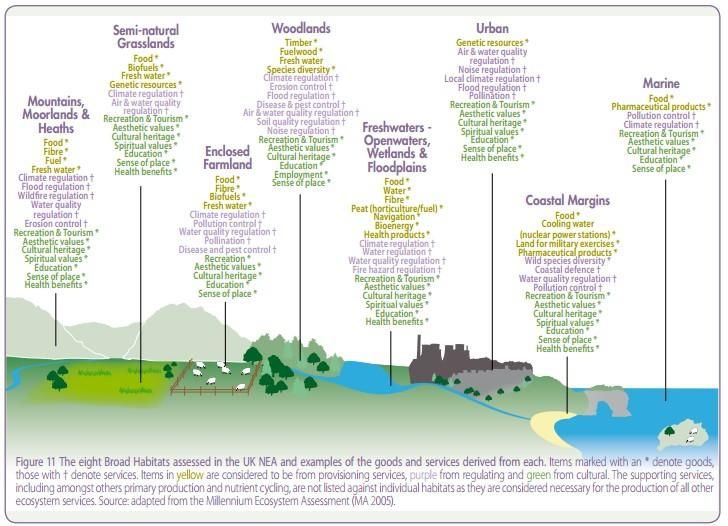
range of ‘services’ nature provides in terms susceptible to economic analysis. Figure Two shows the
division of the UK environment into eight broad habitat types. Of especial interest is the way so-called
‘cultural’ services (recreation and tourism, aesthetic values, cultural heritage, spiritual values,
education, sense of place, health benefits) are tabulated together with regulating services (e.g. flood
and wildfire regulation) and provisioning services such as food, timber and pharmaceutical products.
4
http://uknea.unep-wcmc.org/Resources/tabid/82/Default.aspx Accessed 15/05/2015
© 2015 ГБОУ ВПО «Московский городской психолого-педагогический © 2015 Moscow State University of Psychology &
университет» Education
111Дуглас Понтон Douglas Ponton
К вопросу об употреблении метафор, связанных с The Natural Choice? Metaphors for nature in a UK
природными явлениями в правительственных government white paper
документах Великобритании Language and Text langpsy.ru
Язык и текст langpsy.ru 2015, vol. 2, no. 3, pp. 97–120.
2015. Том 2. № 3. С. 97–120. doi: 10.17759/langt.2015020312
doi: 10.17759/langt.2015020312
Figure Two: from the National Ecosystem Assessment (p.17)
Among other questions posed by the report is why the economic values of ecosystem services
should be incorporated into decision-making. Some of the language is reminiscent of that found in the
subsequent White Paper:
ecosystem services are clearly crucial to the more than 3,000 million outdoor recreational visits
which UK residents make each year. Analyses conducted for the UK NEA shows that these visits
generate a social value in excess of £10,000 million annually (p.42)
In its report on the release of the National Ecosystem Assessment, the Guardian newspaper
quoted Bob Watson, co-author of the report, saying:
Putting a value on these natural services enables them to be incorporated into policy in the same
way that other factors are. We can't persist in thinking of these things as free5.
Later in the article, the newspaper specifies some of the NEA’s findings:
The health benefits of living with a view of a green space are worth up to £300 per person per
year, in part by providing areas for people to exercise but also because simply looking at nature lifts
people's spirits, according to scientific research. Living close to rivers, coasts and wetlands is also a
boon - the benefits to residents are about £1.3bn a year.
5
http://www.theguardian.com/environment/2011/jun/02/uk-green-spaces-value Accessed 15/05/2015
© 2015 ГБОУ ВПО «Московский городской психолого-педагогический © 2015 Moscow State University of Psychology &
университет» Education
112Дуглас Понтон Douglas Ponton
К вопросу об употреблении метафор, связанных с The Natural Choice? Metaphors for nature in a UK
природными явлениями в правительственных government white paper
документах Великобритании Language and Text langpsy.ru
Язык и текст langpsy.ru 2015, vol. 2, no. 3, pp. 97–120.
2015. Том 2. № 3. С. 97–120. doi: 10.17759/langt.2015020312
doi: 10.17759/langt.2015020312
The prominent role given to economic aspects of value found in the White Paper is thus
continuing a discourse also found in the earlier study.
3.5 Political context
White papers are not produced in a political vacuum; rather, they represent policy tools of the
current government, and as such are not free from ideological traces. The Natural Choice White Paper
was published in 2011, during the Conservative-Lib Dem coalition government led by David Cameron.
It would, therefore, seem to make sense to interpret the framing strategy displayed in terms of the
underlying political constraints on the Conservatives, the dominant party in the governing coalition.
The Conservative party has two important strands of support, historically associated with it. On
the one hand it is seen as the British party, par excellence, of industry and business, the natural ally of
capitalist enterprises. On the other, it is associated with the countryside, with the conservation of rural
areas and traditions. Ex-Prime Minister John Major was making an appeal to the country voter when
he famously predicted:
Fifty years on from now, Britain will still be the country of long shadows on cricket grounds,
warm beer, invincible green suburbs, dog lovers and pools fillers and, as George Orwell said, 'Old
maids bicycling to holy communion through the morning mist’6
The white paper recognizes that public concern for the environment has reached unprecedented
levels (‘Most people already recognize that nature has an intrinsic value’/ p.2). By inference there
must be some people excluded from this (‘most’ is not the same as ‘all’). If this were not the case, there
would be no need for government initiatives to protect nature. Given the emphasis on ‘value’
throughout the text, it can also be inferred that the people not recognizing nature’s intrinsic value are
the very people whose activity does the most damage to it, i.e. industrial corporations, multi-nationals,
and capitalists generally. Social actors, that is, for whom the profit motive is the paramount factor in
decision-making. The Conservative Party has always numbered these among its traditional supporters.
Multinational businesses have become accustomed to incorporate ecological discourse as an
element of their branding; as if, far from being the cause of environmental degradation, they are
working in harmony with local eco-systems (see Vasta 2005). Harré et al (1999: 115) speak of ‘the
seemingly incompatible accreditations of scientific, moral and economic discourses’. The writers of the
document, then, attempt to transcend the apparently irreconcilable opposition between the needs of
business and respect for the environment by emphasizing the monetary value of the latter. The aim
could be to keep on board both factions of their traditional support.
However, this is to assume a strict connection between white papers and the government
producing them which may be unwarranted. The White Paper on the environment, in fact, though
published under the Conservative Lib-Dem coalition, must have been conceived some time before they
came to office, during New Labour Prime Minister Gordon Brown’s premiership. The rhetoric of
business applied to environmental issues sits less comfortably with Labour ideology, however far to
the right they may have moved under Tony Blair’s leadership.
6
http://en.wikiquote.org/wiki/John_Major Accessed 15/05/2015
© 2015 ГБОУ ВПО «Московский городской психолого-педагогический © 2015 Moscow State University of Psychology &
университет» Education
113Дуглас Понтон Douglas Ponton
К вопросу об употреблении метафор, связанных с The Natural Choice? Metaphors for nature in a UK
природными явлениями в правительственных government white paper
документах Великобритании Language and Text langpsy.ru
Язык и текст langpsy.ru 2015, vol. 2, no. 3, pp. 97–120.
2015. Том 2. № 3. С. 97–120. doi: 10.17759/langt.2015020312
doi: 10.17759/langt.2015020312
What seems more likely is that the actual branding decisions were not taken by politicians at all,
but by bureaucrats at the Department of the Environment, Food and Rural Affairs (DEFRA), influenced
by the National Ecosystem Assessment which, as we have seen, was another government document
published in the same year (2011). How far the logic of financial evaluation is consistent with the
ideology of Whitehall would make a fascinating study, although data collection would represent a
significant hurdle.
4. Conclusion
We have explored the metaphors used in the White Paper on the environment, and seen their
role in an attempt to convince readers of the financial benefits of smart environmental policies. In part,
I have suggested, the persuasive effort is directed towards those whose actions have most impact, for
good or ill, on the environment. The principle argument in this sense, to which the metaphors make
their contribution, would seem to be:
SINCE
the only language corporate enterprises understand is that of money, and SINCE
their activities put nature at risk and SINCE
it is possible to make money through environmentally-friendly economic activity,
THEREFORE
Such firms should engage more in such activity.
How convincing they may find this argument is a matter, in the end, for the corporate businesses
themselves. The population in general, I have suggested, are already aware of ‘the innate value of
nature’.
Having said as much, however, the public, consultative character of white papers should not be
forgotten. They are not private documents designed for circulation among a target audience, in this
case the business community. It may be that a discourse of the economic value of nature can be
accounted for with reference to wider social trends, even to the prevailing climate of global financial
unrest. Many people across the UK are re- evaluating their relationship with the natural world,
uncovering unexpected sources of income and possibilities of employment8.
Some observers have expressed doubt over whether monetary values can be attributed, at all, to
intangible aspects of our interaction with the environment. In a report for DEFRA, for example,
R.K.Turner, using the term ‘existence values’ to describe these, comments:
Existence value derives from individuals who feel a benefit from just knowing that, for example,
an ecosystem and/or its component parts, exist and will continue to exist somewhere on the planet.
The economic valuation literature has yet to reach a comprehensive consensus on whether use and
non-use value can be formally distinguished using standard welfare economic measures.
The risk of this approach to nature would seem to be precisely that raised by the Guardian
reporter, that it commodifies our environment by attempting to put a price on every aspect of our
interaction with it. It is questionable, though, how far economic values can be attached to an ecological
© 2015 ГБОУ ВПО «Московский городской психолого-педагогический © 2015 Moscow State University of Psychology &
университет» Education
114Дуглас Понтон Douglas Ponton
К вопросу об употреблении метафор, связанных с The Natural Choice? Metaphors for nature in a UK
природными явлениями в правительственных government white paper
документах Великобритании Language and Text langpsy.ru
Язык и текст langpsy.ru 2015, vol. 2, no. 3, pp. 97–120.
2015. Том 2. № 3. С. 97–120. doi: 10.17759/langt.2015020312
doi: 10.17759/langt.2015020312
phenomenon such as a natural park. For many visitors to the Lake District, for example, the experience
may represent a re-charging of batteries that will lead, in turn, to an economic benefit in terms of
improved workplace performance. But for a romantic poet, the inspiration of contact with nature
could lead them to produce a ‘Daffodils’ or a ‘Kubla Khan’. What economic value, one wonders, would
DEFRA place on these?
References
1. Castells, Manuel 2009. Communication power. Oxford: Oxford University Press.
2. Chapin, Henry and Denis Deneau 1978. Citizen involvement in Public Policy-making: Access
and the Policy-making Process. Canadian Council on Social Development: Ottawa.
3. Charteris-Black, Jonathan 2004. Corpus approaches to critical metaphor analysis. Basingstoke
and New York: Palgrave Macmillan.
4. Charteris-Black, Jonathan 2005. Politicians and rhetoric: the persuasive power of metaphor.
Basingstoke and New York: Palgrave Macmillan.
5. Charteris-Black, Jonathan 2009. Metaphor and political communication. In Musolff, Andreas
and Zinken, Jörg (eds) Metaphor and discourse. Basingstoke and New York: Palgrave
Macmillan.
6. Chilton, Paul 2009. Reading Sonnet 30: Discourse, metaphor and blending. In Musolff, Andreas
and Zinken, Jörg (eds) Metaphor and discourse. Basingstoke and New York. Palgrave
Macmillan.
7. Coulthard, Malcolm 1994. On analysing and evaluating written text. In Coulthard, M. (ed)
Advances in written text analysis. London and New York: Routledge.
8. Dryzek, John S. 2005. The politics of the earth: environmental discourses. Oxford University
Press: Oxford.
9. Edwards, Lynne, Y. 2005. Victims, villains, and vixens. Teen girls and internet crime. In
Mazzarella, Sharon R. (ed) Girl wide web: girls, the internet and the negotiation of identity.
New York: Peter Lang.
10. Ekins, Paul, Sandrine Simon, Lisa Deutsch, Carl Folke, and Rudolf de Groot 2003. A framework
for the practical application of the concepts of critical natural capital and strong sustainability.
Ecological Economics 44: 165/185: Elsevier.
11. Fairclough, Norman 2000. New Labour, new language. London and New York: Routledge.
12. Geary, James 2011. I is an other: the secret life of metaphor and how it shapes the way we see
the world. New York: Harper Collins.
13. Goatly, Andrew 1996. Green grammar and grammatical metaphor, or language and myth of
power, or metaphors we die by. Journal of Pragmatics 25 (537-60). Elsevier.
© 2015 ГБОУ ВПО «Московский городской психолого-педагогический © 2015 Moscow State University of Psychology &
университет» Education
115Дуглас Понтон Douglas Ponton
К вопросу об употреблении метафор, связанных с The Natural Choice? Metaphors for nature in a UK
природными явлениями в правительственных government white paper
документах Великобритании Language and Text langpsy.ru
Язык и текст langpsy.ru 2015, vol. 2, no. 3, pp. 97–120.
2015. Том 2. № 3. С. 97–120. doi: 10.17759/langt.2015020312
doi: 10.17759/langt.2015020312
14. Götzsche, Hans 2009. Presupposition. In Chapman, Siobhan and Routledge, Christopher (eds)
Key ideas in linguistics and the philosophy of language. Edinburgh: Edinburgh University
Press.
15. Harré, Rom, Jens Brockmeier and Peter Mühlhaüsler 1999. Greenspeak. A study of
environmental discourse. Thousand Oaks, London, New Delhi: Sage.
16. Jaworski, Adam and Nikolas Coupland (eds) 1999. The Discourse Reader. Abingdon and New
York: Routledge.
17. Jones, Jason and Jean Stilwell Peccei 1999. Language and politics. In Thomas, Linda, Shân
Wareing, Ishtla Singh, Jean Stilwell Peccei, Joanna Thornborrow, and Jason Jones (eds)
Language, society and power. An introduction. Second edition. London and New York:
Routledge.
18. Kress, Gunther and Theo Van Leeuwen, 1996. Reading images: the grammar of visual design.
London, Routledge.
19. Lakoff, George 1993. The contemporary theory of metaphor. In Ortony, Andrew (ed)
Metaphor and thought (2nd edition), Cambridge University Press: Cambridge.
20. Lakoff, George and Johnson, Mark 1980. Metaphors we live by. University of Chicago Press:
Chicago.
21. Lemke, Jay 1990. Talking science: language, learning, and values. Westport: Ablex.
22. Pemberton, John E. 1969. Government Green Papers. Library World 71:49.
23. Perelman, Ch. and L. Olbrechts-Tyteca 1969. The new rhetoric. A treatise on argumentation.
University of Notre-Dame Press: Paris.
24. Rista-Dema, Mimoza 2008. Language register and the impacts of translation. In Gyasi Obeng,
Samuel and A. S. Hartford, Beverly (eds) Political discourse analysis. New York: Nova Science.
25. Sibley-Esposito, Clare 2013. Accounting for ecology? The concept of ‘natural capital’ in British
political discourse and policy (1997-2011). In Leydier, Gilles and Martin, Alexia (eds)
Environmental issues in political discourse in Britain and Ireland. Newcastle-on-Tyne,
Cambridge Scholars Publishing.
26. Van Dijk, Teun A. 2003. The discourse-knowledge interface. In Weiss, Gilbert and Wodak, Ruth
(eds) Critical discourse analysis: theory and interdisciplinarity. Basingstoke and New York:
Palgrave Macmillan.
27. Vasta, Nicoletta 2005. “Profits & Principles: Is There a Choice?” The Multimodal
Construction of SHELL’s Commitment to Social Responsibility and Environmental Care in
and across Advertising Texts. In Cortese, G. and A. Duszak (eds) Identity, community,
discourse: English in intercultural settings. Bern: Peter Lang.
28. Yrjölä, Riina 2011. Visual politics and celebrity humanitarianism. How colonial culture is
revitalised in the West. In Stocchetti, Matteo and Kukkonen, Karin (eds) Images in use.
Amsterdam and Philadelphia: John Benjamins.
© 2015 ГБОУ ВПО «Московский городской психолого-педагогический © 2015 Moscow State University of Psychology &
университет» Education
116You can also read


