The Role of the School Nurse in Creating a Vape- Free School - Kansas ...
←
→
Page content transcription
If your browser does not render page correctly, please read the page content below
The Role of the
   School Nurse in
   Creating a Vape-
   Free School
     As published in NASN School Nurse, May 2020
     Lisa Frey Blume, BA
     Shannon Lines, MPH

Electronic, or “e”-cigarette use
has been adopted by an alarming
number of teens in recent years.
                                      T    obacco prevention and control
                                           advocacy and shifting societal
                                      norms have significantly reduced
                                                                              epidemic has been challenging for
                                                                              the public health community and
                                                                              educational institutions because
E-cigarettes are neither legal        youth cigarette use over the past       of the constantly evolving stream
for youth nor considered safe         20 years. However, electronic           of information and lack of specific
for use by youth. E-cigarette         cigarette (e-cigarette) use has         youth vaping prevention resources.
companies have targeted youth         increased rapidly among youth.          Although all school personnel have
in their marketing strategies and     In the United States in 2019,           a role, the school nurse has unique
developed appealing flavors with      more than one in four high school       expertise within school settings to
high nicotine content to ensure       students (27.5%) and one in ten         help combat this challenging public
dependence on their products.         (10.5%) middle school students          health issue. The role that school
Schools lack adequate resources       reported current use of e-cigarettes,   nurses play in addressing youth
and capacity to address e-cigarette   compared to 11.7% and 3.3% in           vaping relates directly to the skills
use, relying mostly on punitive       2017 (Cullen et al., 2019; Wang         outlined in the key principles of the
sanctions for what is essentially     et al., 2018). From 2017 to 2018,       Framework for 21st Century School
a health issue. School nurses         the prevalence among high school        Nursing Practice.
can help their districts and          students increased 78%. This                E-cigarettes, also known as
schools by navigating appropriate     shocking increase prompted the          vapes, have a variety of names,
consequences for vaping, providing    U.S. Surgeon General, Jerome            shapes and sizes. Juul, a brand
accurate information and education,   Adams, to issue an advisory in          widely used by youth in recent
providing cessation resources,        December 2018 to inform the             years and with a considerable share
advocating for student support,       public of the risks of e-cigarettes     of the e-cigarette market, resembles
and informing stakeholders on         and declare youth vaping to be          a USB flash drive. These types
population health strategies to       an epidemic (U.S. Department            of e-cigarettes are rechargeable
prevent initiation and reduce youth   of Health and Human Services,           and have a disposable pod that
e-cigarette use.                      [USDHHS], 2018). Addressing this        snaps into an atomizer, creating an
aerosol. They are small, produce Nearly 90% of smokers (FDA) banned flavored tobacco in
limited exhaled aerosol, and begin smoking before the age conventional cigarettes in 2009.
generally have either no odor or a of 18 (USDHHS, 2012). Youth However, menthol was exempt as
pleasant smell, making them easier exposure to conventional cigarette were flavored non-cigarette tobacco
to conceal and use frequently advertising causes the initiation products such as e-cigarettes
without detection (Truth Initiative, and continuation of smoking (Public Health Law Center, 2019a).
2019). The aerosol (not ‘water among youth (USDHHS, 2014). Many localities have taken matters
vapor’) produced by e-cigarettes Similarly, researchers are finding into their own hands in the wake
almost always contains nicotine, that youth who are exposed to more of the EVALI outbreak. Various
flavorings and other chemicals. e-cigarette marketing are more jurisdictions have implemented
Vaping devices can also be used to likely to use the product than youth e-cigarette flavor bans in an effort to
inhale marijuana and other drugs. who are not exposed to e-cigarette reduce the availability and appeal of
The Centers for Disease Control marketing (USDHHS, 2019). Unlike vape products to youth.
and Prevention (CDC, 2019a) conventional cigarettes, vape E-cigarette companies have
states that “the use of e-cigarettes products do not have many federal developed innovative ways of
is unsafe for kids, teens and young regulations on their advertisement. delivering nicotine to users. Juul’s
adults” (para. 1). According to USDHHS (2019): addictive formula uses nicotine
E-cigarettes received increased In 2018, more than 5 in 10 salts, allowing its high level of
national attention because of the middle school and high school nicotine to be inhaled more
E-cigarette, or Vaping, product use students – more than 14 million efficiently and with less irritation
Associated Lung Injury (EVALI) youth – said they had seen than the free-base nicotine used in
outbreak first documented in March e-cigarette advertising. Retail stores most other e-cigarettes and tobacco
2019. This outbreak progressed to were the most frequent source products. Even more alarming is
over 2,500 hospitalized cases in all of this advertising, followed by that many students and parents do
50 states, the District of Columbia, the internet, TV and movies, and not know that Juul always contains
Puerto Rico, and the U.S. Virgin magazines and newspapers (para. nicotine. According to Juul Labs,
Islands by December 27, 2019. 6). each 5% pod is manufactured
Among the 2,159 hospitalized E-cigarette brands use the to contain the same amount of
patients with data on age (as of same marketing techniques as nicotine as a pack of conventional
December 3, 2019), 16% of patients conventional cigarette advertising cigarettes or 200 puffs (Truth
are under 18 years old, and 78% did in its heyday: sexual imagery, Initiative, 2019). It is the nicotine
of patients are under 35 years old. implied harm reduction claims that keeps youth dependent on
There is a median age of 24 years and customer satisfaction vape products even when they
with ages ranging from 13 to 77 (USDHHS, 2016). E-cigarette face multiple consequences or
years. In addition to these cases, companies, experiencing increasing punishments. Lastly, it is important
55 deaths are confirmed in 27 investments from the traditional to note that nicotine is harmful to
states and the District of Columbia global tobacco companies, employ the developing brain. Nicotine can
as of December 27, 2019 (CDC, extensive use of social media, impact attention, learning, memory,
2019b). Parents, school staff, and sponsor music festivals and related and other cognitive functions as
teens themselves have become events, and even provide student the brain continues to develop into
more aware that vaping is a risky scholarships (Truth Initiative, 2018). young adulthood (USDHHS, 2016).
behavior because of this media These marketing practices have FDA was granted regulatory
attention. been criticized in recent months authority over all deemed tobacco
Many ask, how did we get and the most obvious ones have products in 2016, including
back to this point of youth tobacco disappeared. Juul and its imitators e-cigarettes, but there are currently
use? Although there are several have found success focusing on no enforced regulations on
contributing factors, the short product design and packaging e-cigarettes. FDA has stated that
answer is marketing, appealing that appeals to the youth market all tobacco products authorized
flavors, and the creation of a (USDHHS, 2019). for the market will only receive
more efficient vehicle for nicotine Most notably, vape approval after undergoing thorough
addiction. manufacturers have marketed scientific review (Sharpless, 2019).
candy, fruity, and similarly appealing In September 2019, the Secretary
The Ingredients to flavors to youth (USDHHS 2019). of Health and Human Services,
Flavoring in products can mask Secretary Alex Azar, announced
the Vaping Epidemic: inhalation harshness and make that FDA would finalize a guidance
Marketing, Flavors and the vapor seem less harmful. The document to ban all flavors, other
Nicotine Food and Drug Administration than natural tobacco flavor (Trump,Azar, & Sharpless, 2019). In these types of violations. As the for young people who want to
December 2019, federal legislation school’s health professional, nurses quit tobacco and vaping have
was signed raising the federal have an opportunity to educate not been established by medical
minimum age of sale of tobacco administrators that addiction is a professionals because there has
products from 18 to 21 years. It complex disease and compulsion not been sufficient study. The
is now illegal for a retailer to sell to use a substance is not a willful American Academy of Pediatrics
any tobacco product, including defiance of school rules. If a student (2015) strongly recommends
cigarettes, cigars and e-cigarettes, is dependent on nicotine or another tobacco dependence treatment in
to anyone under 21 years (U.S. substance, they need treatment the form of behavioral counseling,
Food and Drug Administration, interventions, not further isolation including quitline referral (para.
2020). Upon implementation, these with the increased opportunity to 3) for adolescents who want to
regulations could potentially limit engage in unhealthy behaviors stop using tobacco. The school
the number of vape products and (Public Health Law Center, 2019b). nurse can ensure that whoever is
flavors sold in the U.S. in the future. This is in line with schools shifting dealing with student violations has
to whole child approaches and the state’s quitline materials and
How Do School Nurses trauma-informed schools. information about locally available
Vaping is a long-term issue counseling options. It is best to
Contribute to a Vape- which will not be solved by a contact local organizations first to
Free School? one-time presentation. The school ask if they have the capacity for
nurse should deliver, or coordinate potential school referrals. There are
There is no doubt that schools vape education to staff and parents emerging no-cost programs for text-
have been burdened by the on a regular basis. This practice based cessation help as well (Table
e-cigarette epidemic. Many districts is essential in elementary and 1). Cessation referrals should also
have strengthened their tobacco middle schools when most kids be made for parents and staff who
policies to include e-cigarettes and start experimenting and should use tobacco products and want to
expanded policies to encompass not be limited to just high schools. quit.
all school grounds and school- In addition, nurses can participate School culture is strengthened
sponsored events. School in reviewing current curriculum by students developing positive
districts are also examining their content about alcohol, tobacco social norms. If students perceive
policies for addressing violations. and other drugs and determine that most of their peers do not use
Appropriate violation procedures what updates need to be made. tobacco or vape, then they are
should include product confiscation, Many expensive vaping curricula less likely to initiate tobacco use
parent notification, information are currently being marketed to (USDHHS, 2012). School nurses
for parents and students (Public schools, but credible free resources can encourage coaches and other
Health Law Center, 2019b), and are also available. Curriculum sets influential school personnel to
at the very least, a referral to the should always be evidence-based. discuss the harms of tobacco and
state quitline, 1-800-QUIT-NOW. Table 1 lists vaping prevention and vaping with teams and classes.
Quitlines are telephone and web- cessation resources for schools to Nurses can also sponsor or support
based counseling services available consider. clubs and peer leadership programs
for free to U.S. residents who are As the school administration that seek to raise awareness
trying to quit using tobacco products considers internal procedures for around the dangers of tobacco
(CDC, n.d.). All state quitlines offer addressing policy violations, the and substance use and work to
specific services for youth. school nurse should advocate change school norms. The majority
School districts often have for screening, brief intervention, of students do not use tobacco
existing alcohol, tobacco, and and treatment referral as an products and often welcome
other drug policies which have evidence-based practice to support in resisting target marketing
suspension, expulsion and referral identify, reduce and prevent and daily peer pressure.
to law enforcement as disciplinary student e-cigarette and other Finally, all school staff, including
measures. There is evidence substance use (National Research school nurses, can advocate for
that these punitive measures Council, 2001). If possible, state initiatives and local policies
are applied disproportionately to students who have violated the that have been shown to prevent
minority students and have long- tobacco or other substance use and reduce youth tobacco use.
term negative consequences policies should be referred to the These include increasing taxation
(Public Health Law Center, school nurse or another licensed on tobacco products, prohibiting
2019b). The school nurse can professional within the school smoking in public places, and
exercise leadership by advocating who has training in motivational enforcing the minimum age of sale
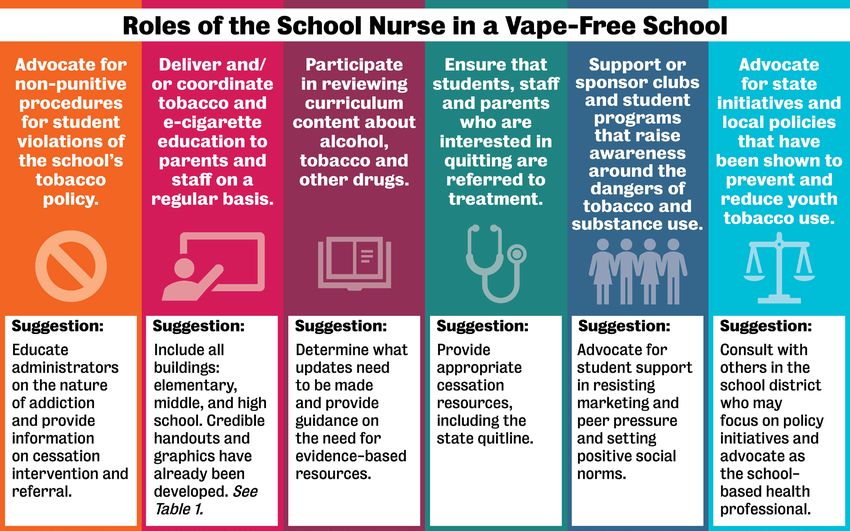
for non-punitive procedures for interviewing. Treatment guidelines for tobacco products to 21 yearsFigure 1. Roles of the School Nurse in a Vape-Free School
(National Academies of Sciences, targeted youth in their marketing
Engineering, and Medicine, 2015; strategies and developed appealing Lisa Frey Blume, BA
USDHHS, 2012). Often, someone flavors with high nicotine content Training and Outreach
from the district is a member of a to ensure dependence on their Coordinator
local health coalition which can be products. Schools are concerned KDHE, Wichita, KS
consulted on local policy initiatives. but overwhelmed, and many rely Lisa has provided training and
In addition, the district’s federally on excessive punishment for assistance to substance abuse
mandated student wellness what is a health issue. School prevention coalitions and grantees
committee may be a source of nurses can help their districts and for 7 years. Before moving to
information. schools by navigating appropriate Kansas and entering the public
consequences for vaping, providing health field, she was a teacher.
Conclusion accurate information and health
education, providing cessation
We all have a part to play in resources, advocating for student Shannon Lines, MPH
curbing the youth e-cigarette support, and educating others Advanced Epidemiologist
epidemic and it will not happen with about population health strategies KDHE, Topeka, KS
public health outcry or legislation to prevent initiation and reduce Shannon has been a tobacco and
alone. Schools, and especially youth tobacco use. ● physical activity and nutrition
school nurses, are integral to epidemiologist for more than 2
reversing the alarming increases Acknowledgements years in Kansas.
in overall youth tobacco use. As
the licensed health professional The authors wish to thank
in the school setting, school Kansas Department of Health Frey Blume, L & Lines, S. The Role
nurses can provide the leadership and Environment staff for their of the School Nurse in Creating a
that is needed to create a vape- help in preparation of this article, Vape-Free School. NASN School
free school. See Figure 1 for an and NASN School Nurse for their Nurse, vol. 35, no. 3. May 2020, pp.
overview of the outlined leadership interest in sharing this information. 166–172. © 2020 The Author(s).
roles. DOI: 10.1177/1942602X20913261
E-cigarette companies haveTable 1. Vaping Prevention and Cessation Resources for Schools
CDC Office on Smoking and Health (CDC/OSH) e-cigarette resources
E-Cigarettes: Talk to Youth About the Evidence based messaging about https://www.cdc.gov/tobacco/features/
Risks e-cigarettes. Includes a presentation back-to-school/e-cigarettes-talk-to-
for youth. youth-about-risks/index.html
Quick Facts on the Risks of Includes resources for learning more https://www.cdc.gov/tobacco/basic_
E-cigarettes for Kids, Teens, and about the youth vaping epidemic, information/e-cigarettes/Quick-Facts-
Young Adults including a toolkit for partners. on-the-Risks-of-E-cigarettes-for-Kids-
Teens-and-Young-Adults.html
E-cigarette focused curriculum
The Real Cost of Vaping school-based Free, evidence-based curriculum for www.scholastic.com/youthvapingrisks
curriculum Grades 6-12 developed by Scholastic
and the FDA.
The University of Texas Health Free program that uses a peer-led https://catchinfo.org/
Science Center at Houston Catch My teaching approach for ages 10-18
Breath Youth E-Cigarette and JUUL and meets National and State Health
Prevention Program Education Standards.
The Stanford Medical School Tobacco Free, evidence-based resources, https://med.stanford.edu/
Prevention Toolkit including an Alternative-to-Suspension tobaccopreventiontoolkit.html
Curriculum.
The American Lung Association Free training/curriculum offers an https://www.lung.org/stop-smoking/
INDEPTH™: Intervention for Nicotine alternative to suspension or citation helping-teens-quit/indepth.html
Dependence: Education, Prevention, for infractions of school tobacco-free
Tobacco and Health policies.
Tobacco-free school policy
The Public Health Law Center Model policies and other resources https://www.publichealthlawcenter.org/
on addressing student commercial
tobacco use as part of school tobacco- Student Commercial Tobacco Use in
free policies. Schools: Alternative Measures
Commercial Tobacco-Free K-12
School Model Policy
Kansas Department of Health & Contains information and resources http://www.kdheks.gov/tobacco/
Environment to help schools effectively implement, download/Vape_Free_Schools_
clearly communicate, regularly enforce Toolkit.pdf
Kansas Vape-Free Schools Toolkit and support a tobacco-free and
e-cigarette-free campus.
E-cigarette cessation for youth
State Tobacco Quitline All states have free, evidence-based Call this number to connect directly to
quitlines with trained counselors. your state’s quitline.
Hours of operation and services vary
from state to state. 1-800-QUIT-NOW (1-800-784-8669)
The Truth Initiative “This is Quitting” A youth/young-adult focused Youth and young adults can access
E-cigarette Quit Program that uses the e-cigarette quit program by texting
text messaging. "DITCHJUUL" to 88709. Parents and
other adults looking to help young
people quit should text "QUIT" to (202)
899-7550.
https://truthinitiative.org/thisisquitting
The National Cancer Institute’s Includes information on how to quit https://teen.smokefree.gov/quit-vaping
SmokefreeTeen vaping.References Public Health Law Center. (2019a). U.S. Department of Health and
Flavored Products. https://www. Human Services. (2014). The
American Academy of Pediatrics. publichealthlawcenter.org/topics/ Health Consequences of Smoking
(2015). Clinical Practice Policy to commercial-tobacco-control/sales- - 50 Years of Progress: A Report of
Protect Children from Tobacco, restrictions/flavored-products the Surgeon General. Atlanta, GA:
Nicotine, and Tobacco Smoke. Centers for Disease Control and
https://pediatrics.aappublications. Public Health Law Center. (2019b). Prevention.
org/content/136/5/1008 Student Commercial Tobacco Use
in Schools: Alternative Measures. U.S. Department of Health
Centers for Disease Control and https://www.publichealthlawcenter. and Human Services. (2016).
Prevention. (2019a). Quick Facts org/sites/default/files/resources/ E-cigarette Use Among Youth
on the Risks of E-cigarettes for Addressing-Student-Commercial- and Young Adults: A Report of the
Young People. https://www.cdc. Tobacco-Use-in-Schools- Surgeon General. Rockville, MD:
gov/tobacco/basic_information/e- Alternative-Measures-2019.pdf Centers for Disease Control and
cigarettes/Quick-Facts-on-the- Prevention.
Risks-of-E-cigarettes-for-Kids- Sharpless, N. (2019). How FDA
Teens-and-Young-Adults.html is Regulating E-cigarettes. https:// U.S. Department of Health and
www.fda.gov/news-events/fda- Human Services. (2018). Surgeon
Centers for Disease Control and voices-perspectives-fda-leadership- General’s Advisory on E-cigarette
Prevention. (2019b). Outbreak of and-experts/how-fda-regulating-e- Use Among Youth. https://www.cdc.
Lung Injury Associated with the Use cigarettes gov/tobacco/basic_information/e-
of E-cigarette, or Vaping, Products. cigarettes/surgeon-general-
https://www.cdc.gov/tobacco/basic_ Trump, D. J., Azar, A., & Sharpless, advisory/index.html
information/e-cigarettes/severe- N. (2019). Remarks by President
lung-disease.html Trump in Meeting on E-cigarettes. U.S. Department of Health and
https://www.whitehouse.gov/ Human Services. (2019). Know
Centers for Disease Control and briefings-statements/remarks- the Risks: E-cigarettes and Young
Prevention. (n.d.). Frequently Asked president-trump-meeting-e- People. https://e-cigarettes.
Questions (FAQ) about 1-800-QUIT- cigarettes/ surgeongeneral.gov/getthefacts.
NOW and the National Network html
of Tobacco Cessation Quitlines. Truth Initiative. (2018). 4 Marketing
https://www.cdc.gov/tobacco/ Tactics E-cigarette Companies U.S. Food and Drug Administration.
quit_smoking/cessation/pdfs/faq_ Use to Target Youth. https:// (2020). Newly Signed Legislation
quitlines.pdf truthinitiative.org/research- Raises Federal Minimum Age
resources/tobacco-industry- of Sale of Tobacco Products
Cullen, K. A., Gentzke, A. S., marketing/4-marketing-tactics-e- to 21. https://www.fda.gov/
Sawdey, M. D., Chang, J. T., Anic, cigarette-companies-use-target tobacco-products/ctp-newsroom/
G. M., Wang, T. W., . . . King, B. newly-signed-legislation-raises-
A. (2019). E-cigarette Use Among Truth Initiative. (2019). How federal-minimum-age-sale-tobacco-
Youth in the United States, 2019. Much Nicotine is in Juul? https:// products-21
JAMA. truthinitiative.org/research-
resources/emerging-tobacco- Wang, T. W., Gentzke, A.,
National Academies of Sciences, products/how-much-nicotine-juul Sharapova, S., Cullen, K. A.,
Engineering, and Medicine. (2015). Ambrose, B. K., & Jamal, A. (2018).
Assessing Progress on the Institute U.S. Department of Health Tobacco Product Use Among
of Medicine Report: The Future and Human Services. (2012). Middle and High School Students -
of Nursing. Washington, DC: The Preventing Tobacco Use Among United States, 2011-2017. Morbidity
National Academies Press. Youth and Young Adults: A Report and Mortality Weekly Report.
of the Surgeon General. Atlanta,
National Research Council. (2001). GA: Centers for Disease Control
Informing America’s Policy on Illegal and Prevention.
Drugs: What We Don’t Know Keeps
Hurting Us. Washington, DC: The
National Academies Press.You can also read


