THREAT INSIGHTS REPORT - HP WOLF SECURITY
←
→
Page content transcription
If your browser does not render page correctly, please read the page content below

HP WOLF SECURITY

THREAT INSIGHTS
REPORT
Q3 - 2021
1   HP WOLF SECURITY THREAT INSIGHTS REPORT

     THREAT LANDSCAPE
     Welcome to the Q3 2021 edition of the HP Wolf Security Threat Insights Report. Here our security experts highlight malware trends
     identified by HP Wolf Security from the third quarter of 2021, equipping security teams with the knowledge to combat emerging
     threats and improve their security postures.1

     NOTABLE THREATS

     CVE-2021-40444 MSHTML exploit offers new way for attackers to run malicious code
     On 7 September 2021, Microsoft released a bulletin for CVE-2021-40444, a high severity zero-day remote code execution vulnerability
     in the MSHTML web browser engine in Windows.2 The vulnerability can be exploited by crafting malicious Microsoft Office files, one
     of the top ways threat actors spread malware. Its potential reach and impact are high because attackers do not need to significantly
     change their tactics, techniques and procedures (TTPs) to use the exploit. In Q3 2021, Office documents and spreadsheets were the
     second and third most popular file types used for delivering malware, accounting for 40% of threats isolated by HP Wolf Security.

     Unlike documents containing malicious macros that require attackers
     to trick users into running unsafe code, exploiting CVE-2021-40444
     needs minimal user interaction because it can be triggered by simply
     opening a document or previewing it in File Explorer. We expect threat
     actors – hacktivist, criminal and nation state – to increasingly use this
     exploit to gain initial access to systems because of its operational
     advantages over other execution techniques and exploits widely used
     today, such as CVE-2017-11882.

     Once exploited, an attacker can run arbitrary code on the system,
     for example, downloading and installing a backdoor giving them
     persistent access. The foothold into the network may then be used to
     achieve their objectives, such as stealing valuable data or holding an
     enterprise to ransom in a human-operated ransomware attack.

     The exploit works by loading an external resource, which causes the
     document to run JavaScript code that exploits the vulnerability. In
     samples analyzed by the HP Threat Research team, JavaScript was
     used to download a cabinet (CAB) archive file from a remote server
     containing a dynamic-link library (DLL). A path traversal vulnerability
     was then used to run the DLL, with control.exe and rundll32.exe being        Figure 1 – CVE-2021-40444 vulnerability timeline
     the executing processes.

     Microsoft provided possible mitigations in the bulletin that disclosed the vulnerability, such as disabling ActiveX controls, before
     releasing a patch on 14 September 2021. The first documented case of this vulnerability being exploited in the wild, however, was
     identified on 21 August 2021, leaving a 24-day window of vulnerability.3 The timeline in Figure 1 illustrates how the conventional
     way software developers and users respond to vulnerabilities favors attackers because of the time lag between an attacker first
     discovering a vulnerability and a user installing a patch.

                        TIME FROM ATTACKER DISCOVERY OF VULNERABILITY TO VENDOR DISCOVERY
                                                                         +
                                                 TIME FOR VENDOR TO RELEASE PATCH
                                                                         +
                                            TIME FOR USERS TO TEST AND DEPLOY PATCH
                                                        = VULNERABILITY WINDOW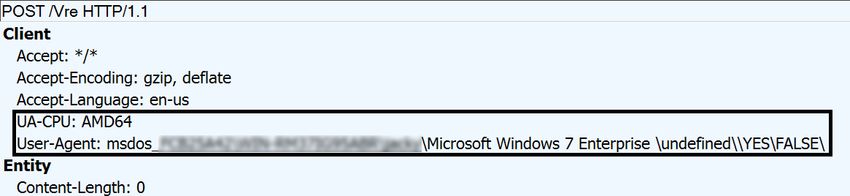
2   HP WOLF SECURITY THREAT INSIGHTS REPORT

      HP Sure Click’s threat containment technology eliminates the risk window of CVE-2021-40444 because the vulnerable MSHTML
      component of Windows is isolated inside a micro-Virtual Machine, protecting the host system from infection.4 This removes the
      need for network defenders to rely solely on detections and mitigations, which may be imperfect and become obsolete quickly as
      the understanding of the scope of a vulnerability evolves. While patch management remains a critical activity for the security of
      any network, threat containment can protect enterprises against unknown vulnerabilities and scenarios where a patch is yet to be
      released – as was the case with CVE-2021-40444.

      Figure 2 – JavaScript that exploits CVE-2021-40444
3 HP WOLF SECURITY THREAT INSIGHTS REPORT
HP Wolf Security stops campaign masquerading as the Ugandan National Social Security Fund
On 31 August 2021, HP Wolf Security protected a user from a malware campaign that impersonated a legitimate quasi-governmental
organization, the Ugandan National Social Security Fund (NSSF). The attackers typosquatted the organization’s domain name by
registering a fake domain that closely resembled the real one.5
Figures 3 & 4 – WHOIS information showing the legitimate NSSF domain (left) and the malicious domain used in the August 2021 campaign (right)
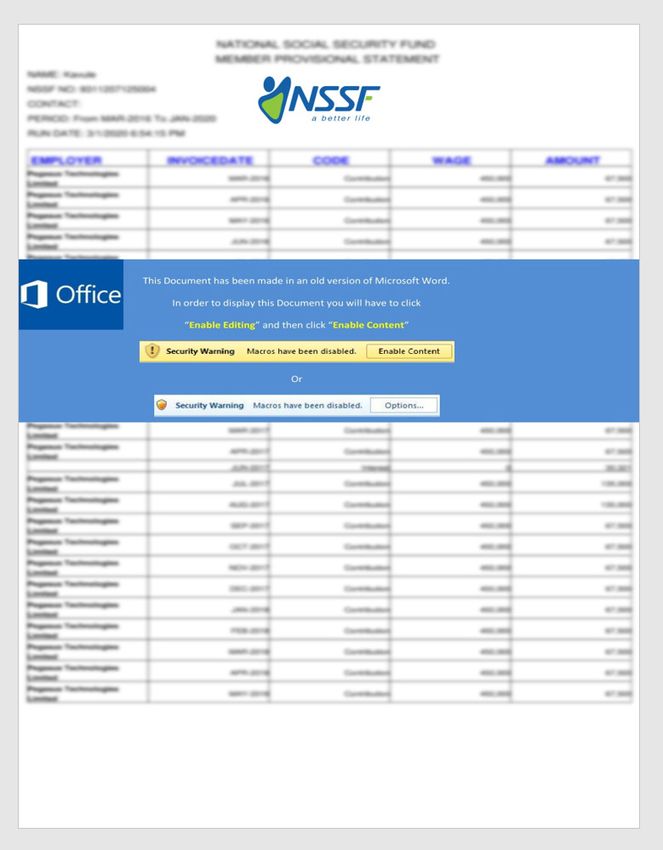
The user received a link to the fake website, where they downloaded a malicious Word document pretending to be a member
statement (Figure 5). The document ran a malicious Visual Basic for Applications (VBA) macro which executed a PowerShell script.
The script first disables PowerShell script block logging to make an investigation of the host more difficult by preventing detailed log
evidence from being recorded.6 Afterwards, the script attempts to evade detection by bypassing the Antimalware Scan Interface
(AMSI) feature in Windows by setting the amsiInitFailed variable to False.7 The script then tries to download and run a second stage
payload, which is RC4 encrypted, using the .Net.WebClient class. This payload, however, was unavailable at the time of execution. To
make the download traffic blend in, the script sets the HTTP User-Agent header to match Internet Explorer 11. The script was almost
identical to the default stager of PowerShell Empire – a command and control (C2) framework that is often used by red teams as well
as cybercriminals. Indeed, the URI and User-Agent values matched PowerShell Empire’s default configuration.8
Figure 5 – Lure document used in malware campaign impersonating the NSSF4 HP WOLF SECURITY THREAT INSIGHTS REPORT
Attackers use legal threats to spread NetWire RAT to Bulgarian users
89%
In July 2021, HP Sure Click isolated a malicious spam campaign delivering NetWire,
a remote access Trojan (RAT) that targeted users in Bulgaria.9 The attackers
sent emails containing malicious Microsoft Word documents purporting to be
civil enforcement claims from a private enforcement agent. The lure documents
OF THREATS ISOLATED BY HP WOLF
contained a message requesting the reader to disable Word’s read-only mode
(Protected View) and to enable macros. Doing so causes a malicious VBA macro to SECURITY WERE DELIVERED BY
run, which downloads a NetWire executable to the victim’s %TEMP% directory and EMAIL IN Q3 2021. 11% WERE WEB
then executes it. DOWNLOADS AND LESS THAN 1%
USED OTHER VECTORS.
Investigation by the HP Threat Research team found that the threat actor most
likely sought to target Bulgarian individuals. The web server hosting the payload
was geofenced so that only IP addresses in Bulgaria could download the malware.
The publisher metadata in the NetWire executable had also been copied from a legitimate Bulgarian software company. Finally, the
email lure was composed in Bulgarian and referenced a Bulgarian private enforcement agent. NetWire is a commercial RAT capable
of controlling a remote system without a user’s knowledge. Its capabilities include keylogging, stealing credentials stored in web
browsers and capturing screenshots.
Figure 6 – Lure document delivering NetWire RAT
TrickBot now being delivered via HTA files as well as Office documents
In July 2021, HP Wolf Security telemetry recorded an increase in TrickBot malware being distributed via HTML Application (HTA)
files sent as email attachments.10 Previously, TrickBot distributors preferred to use macros embedded in Office documents as the
initial infection vector. We last saw HTA files being used to distribute TrickBot at the end of 2020, followed by a switch back to Office
documents. The change reduces the user interaction required to infect a system because the recipient only needs to double click the
malicious HTA file to trigger the chain of infection.
Figure 7 – Malicious spam distributing TrickBot5 HP WOLF SECURITY THREAT INSIGHTS REPORT
If opened, mshta.exe interprets the HTA file and executes an obfuscated VBScript. The script executes a PowerShell command using
cmd.exe, which downloads and runs another PowerShell script from a remote server. The second script downloads TrickBot in the
form of a DLL from another remote server, saves it in the user’s %TEMP% directory and then runs it using rundll32.exe. The Group
Tag (gtag) parameter of the TrickBot sample downloaded by the script in Figure 9 was rob112. After installation, the Trojan determines
the system’s public IP address using an external service, communicates with the botnet’s C2 infrastructure and performs initial
reconnaissance of the environment, before waiting for further commands.
Figures 8 & 9 – Obfuscated (above) and deobfuscated (below) scripts used to download TrickBot
Figure 10 – Process interaction graph showing TrickBot HTA file running inside an isolated HP Wolf Security micro-VM6 HP WOLF SECURITY THREAT INSIGHTS REPORT
Uptick in email-borne JavaScript malware
12%
In Q3 2021, we detected a rise in JavaScript malware families spread through
email, including Vengeance Justice Worm (Vjw0rm).11 Vjw0rm is a RAT that has
worm-like capabilities, including the ability to spread to removable storage
devices. We often see obfuscated JavaScript malware attached to email as .JS files,
which are sometimes successful at bypassing email gateway scanners. Therefore OF EMAIL MALWARE ISOLATED
we recommend organizations enforce email policies that block attachment file BY HP WOLF SECURITY IN Q3
formats that are commonly abused by malware distributors, such as scripts and 2021 BYPASSED AT LEAST ONE
executables. GATEWAY SCANNER.
In one case, VjW0rm was sent as a JS attachment to a Spanish construction
company but was isolated HP Sure Click. The email purported to be a forwarded
quote. When opened, the script decodes and attempts to runs the malware in the
user’s %APPDATA% directory. The malware beacons information about the infected system to a C2 server, storing the data in the
User-Agent and UA-CPU headers of an otherwise empty HTTP POST request. Vjw0rm listens for commands sent by the malware
operator and then runs them on the victim PC. The malware maintains persistence on the system by setting a Run registry key called
B02N3ZE1UL and creating a copy of the script in the Windows start-up folder so that the malware runs each time Windows starts.
Figure 11 – VjW0rm beacon showing an HTTP POST containing information about an infected system
Attackers use Microsoft tools and services to deliver GuLoader and Remcos RAT
In August 2021, HP Sure Click isolated a malware campaign that abused Microsoft tools and services to evade detection. The infection
chain began with an HTA file sent to the target by email. The file was minimally obfuscated and used the living off the land binary
bitsadmin.exe to download and run GuLoader malware on the system.12
GuLoader subsequently downloaded and ran Remcos RAT – a commercial RAT – which was hosted on Microsoft’s OneDrive cloud
storage service.13 Hosting malware on legitimate services increases the likelihood that the payload will evade network security controls
that rely on website reputation. The Remcos binary is never written to disk, a defense-evasion technique. Instead, it is executed in
memory, then injected into a newly started legitimate Windows process. Once the malware is installed on the computer, a connection is
established to the operator’s C2 server, through which the attacker gains full access to the infected system.
Figure 12 – Email delivering GuLoader and Remcos RAT7 HP WOLF SECURITY THREAT INSIGHTS REPORT
NOTABLE TRENDS
Discord and legitimate file-sharing services used to host malware
In Q3 2021, we saw more threat actors piggybacking off legitimate services that allow users to upload and share files to host malware.
This benefits attackers because it removes the need to set up or manage their own hosting infrastructure – bought or compromised.
Legitimate websites are also less likely to be blocked by network security controls, increasing the success rate of malicious
downloads. Since attackers only need their malware hosted long enough to be effective, service providers must respond quickly to
abuse reports to stand any chance of disrupting ongoing malware campaigns. Historically, less-resourced attackers tended to host
malware on file-sharing services, but in Q3 we noticed highly capable threat actors, such as those associated with the crimeware
Trojan Dridex, started following suit too. In total, the HP Threat Research team identified 10 malware families hosted on infrastructure
belonging to Discord, an instant messaging service: Dridex, Cobalt Strike, Agent Tesla, RedLine Stealer, njRAT, AsyncRAT, Android
Cerberus, Formbook, Guloader, and Lokibot.
Figure 13 – Malicious document from Q3 2021 that downloads a Dridex payload hosted on Discord
TOP EXPLOITED TOP ISOLATED
VULNERABILITIES Q3 2021 FILE TYPES Q3 2021
100
90 ARCHIVES 38%
80 DOCUMENTS 23%
70 SPREADSHEETS 17%
60 EXECUTABLES 16%
50 PDF 4%
WEB PAGES 2%
40
OTHER 2%
30
20
10
0
Figures 14 & 15 – Top exploits (left) and file types (above) isolated by
CVE-2017- CVE-2018- CVE-2017- OTHER HP Wolf Security in Q3 2021
11882 0802 01998 HP WOLF SECURITY THREAT INSIGHTS REPORT
Figure 16 – MITRE ATT&CK techniques used by threats isolated by HP Wolf Security in Q3 202114
NOTABLE TECHNIQUES
JavaScript Loader dispensing RATs in the wild
In Q3 2021, HP Wolf Security quarantined a JavaScript loader that was used to distribute eight RAT and information stealer malware
families. Analyzing the obfuscated JavaScript code revealed that the malware not only has the ability to download a payload from a
remote server, but also act as a dropper by embedding the payload within the script – removing the need to download the payload
altogether.
The HP Threat Research team performed a retrohunt over Q3 which identified eight malware families distributed using the loader,
almost half of which were STRRAT (Figure 17).15 One the drivers of information stealers and RATs is the value of access to systems and
compromised data. Q1 2021 saw a strong rise in the value of major cryptocurrencies such as Bitcoin, thereby incentivizing financially-
motivated threat actors to target cryptocurrency wallets and credentials to online currency exchanges.
MALWARE FAMILIES
TOP 5 EMAIL LURE KEYWORDS
SPREAD BY JAVASCRIPT
1. “ORDER”
LOADER
2. “PAYMENT”
STRRAT 47% 3. “NEW”
WSHRAT 34% 4. “QUOTATION”
ADWIND 8% 5. “REQUEST”
FORMBOOK 4%
REMCOS 3%
PANDA STEALER 3% Figures 17 & 18 – Malware families spread by JavaScript loader
GULOADER 1% (left) and top email lures of threats isolated by HP Wolf Security
RATTY 1% in Q3 2021 (above)9 HP WOLF SECURITY THREAT INSIGHTS REPORT
INDICATORS AND TOOLS
The HP Threat Research team regularly publishes Indicators of Compromise (IOCs), signatures, and tools to help security teams defend
against threats. You can access these resources from the HP Threat Research GitHub repository.16
STAY CURRENT
The HP Wolf Security Threat Insights Report is made possible by customers who opt to share their threats with HP. Alerts that are
forwarded to us are analyzed by our security experts and annotated with additional contextual information about each threat.
We recommend that customers take the following actions to ensure that you get the most out of your HP Wolf Enterprise Security
deployments:a
• Enable Threat Intelligence Services and Threat Forwarding in HP Wolf Security Controller.b These enable augmented threat
intelligence for automated threat triage and labeling, plus automatic rules file updates to ensure accurate detection and protection
against the latest attack techniques. To learn more, review the Knowledge Base articles about these features.17, 18
• Plan to update HP Wolf Security Controller with every new release to receive new dashboards and report templates. See the latest
release notes and software downloads available on the Customer Portal.19
• Update HP Wolf Security endpoint software at least twice a year to stay current with detection rules added by our threat research
team. For the latest threat research, head over to the HP Wolf Security blog, where our security experts regularly dissect new threats
and share their findings.20
ABOUT THE HP WOLF SECURITY THREAT
INSIGHTS REPORT
Enterprises are most vulnerable from users opening email attachments, clicking on hyperlinks in emails, and downloading files from
the web. HP Wolf Security protects the enterprise by isolating risky activity in micro-VMs, ensuring that malware cannot infect the host
computer or spread onto the corporate network. Since the malware is contained, HP Wolf Security collects rich forensic data to help our
customers harden their infrastructure. The HP Wolf Security Threat Insights Report highlights notable malware campaigns analyzed by
our threat research team so that our customers are aware of emerging threats and can take action to protect their environments.
ABOUT HP WOLF SECURITY
From the maker of the world’s most secure PCsc and Printersd, HP Wolf Security is a new breed of endpoint security.e HP’s portfolio of
hardware-enforced security and endpoint-focused security services are designed to help organizations safeguard PCs, printers, and
people from circling cyber predators. HP Wolf Security provides comprehensive endpoint protection and resiliency that starts at the
hardware level and extends across software and services.10 HP WOLF SECURITY THREAT INSIGHTS REPORT
REFERENCES
[1] https://hp.com/wolf
[2] https://msrc.microsoft.com/update-guide/en-US/vulnerability/CVE-2021-40444
[3] https://www.microsoft.com/security/blog/2021/09/15/analyzing-attacks-that-exploit-the-mshtml-cve-2021-40444-
vulnerability/
[4] https://www.hp.com/uk-en/security/enterprise-pc-security.html
[5] https://capec.mitre.org/data/definitions/630.html
[6] https://www.mandiant.com/resources/greater-visibilityt
[7] https://www.mdsec.co.uk/2018/06/exploring-powershell-amsi-and-logging-evasion/
[8] https://www.sans.org/white-papers/38315/
[9] https://malpedia.caad.fkie.fraunhofer.de/details/win.netwire
[10] https://malpedia.caad.fkie.fraunhofer.de/details/win.trickbot
[11] https://malpedia.caad.fkie.fraunhofer.de/details/win.vjw0rm
[12] https://malpedia.caad.fkie.fraunhofer.de/details/win.cloudeye
[13] https://malpedia.caad.fkie.fraunhofer.de/details/win.remcos
[14] https://attack.mitre.org/
[15] https://malpedia.caad.fkie.fraunhofer.de/details/jar.strrat
[16] https://github.com/hpthreatresearch/
[17] https://enterprisesecurity.hp.com/s/article/Threat-Forwarding
[18] https://enterprisesecurity.hp.com/s/article/Bromium-Threat-Intelligence-Cloud-Service
[19] https://enterprisesecurity.hp.com/s/
[20] https://threatresearch.ext.hp.com/blog/
a. HP Wolf Enterprise Security is an optional service and may include offerings such as HP Sure Click Enterprise and HP Sure Access Enterprise. HP Sure Click
Enterprise requires Windows 8 or 10 and Microsoft Internet Explorer, Google Chrome, Chromium or Firefox are supported. Supported attachments include
Microsoft Office (Word, Excel, PowerPoint) and PDF files, when Microsoft Office or Adobe Acrobat are installed. HP Sure Access Enterprise requires Windows 10
Pro or Enterprise. HP services are governed by the applicable HP terms and conditions of service provided or indicated to Customer at the time of purchase.
Customer may have additional statutory rights according to applicable local laws, and such rights are not in any way affected by the HP terms and conditions of
service or the HP Limited Warranty provided with your HP Product. For full system requirements, please visit www.hpdaas.com/requirements.
b. HP Wolf Security Controller requires HP Sure Click Enterprise or HP Sure Access Enterprise. HP Wolf Security Controller is a management and analytics platform
that provides critical data around devices and applications and is not sold as a standalone service. HP Wolf Security Controller follows stringent GDPR privacy
regulations and is ISO27001, ISO27017 and SOC2 Type 2 certified for Information Security. Internet access with connection to the HP Cloud is required. For full
system requirements, please visit http://www.hpdaas.com/requirements.
c. Based on HP’s unique and comprehensive security capabilities at no additional cost among vendors on HP Elite PCs with Windows and 8th Gen and higher Intel®
processors or AMD Ryzen™ 4000 processors and higher; HP ProDesk 600 G6 with Intel® 10th Gen and higher processors; and HP ProBook 600 with AMD Ryzen™
4000 or Intel® 11th Gen processors and higher.
d. HP’s most advanced embedded security features are available on HP Enterprise and HP Managed devices with HP FutureSmart firmware 4.5 or above. Claim
based on HP review of 2021 published features of competitive in-class printers. Only HP offers a combination of security features to automatically detect, stop,
and recover from attacks with a self-healing reboot, in alignment with NIST SP 800-193 guidelines for device cyber resiliency. For a list of compatible products,
visit: hp.com/go/PrintersThatProtect. For more information, visit: hp.com/go/PrinterSecurityClaims.
e. HP Security is now HP Wolf Security. Security features vary by platform, please see product data sheet for details.© Copyright 2021 HP Development Company, L.P.
You can also read


