Toilet Training Guide - A simple guide designed to help you and your child during toilet training.
←
→
Page content transcription
If your browser does not render page correctly, please read the page content below

Toilet
Training
Guide
A simple guide designed to help you
and your child during toilet training.
Contents                                                      Foreword
                                                              My first venture into the world of toilet training
                                                              happened almost 10 years ago when my daughter was
• There are only 4 MUSTS . . . . . . . . . . . . . 2          approaching her second birthday. Like many mothers
                                                              and fathers before me, I felt the pressure to train my
                                                              child by a certain age but soon came to realise that
• Look for the Signs of Readiness . . . . . .  4              successful toilet training is all about taking cues from
                                                              your child, letting them decide when to start and
                                                              how best to proceed. It’s easy to get caught up into
• How do I get started? . . . . . . . . . . . . . .  5        thinking that the age at which your child first walks,
                                                              talks or uses the potty is somehow a reflection of your
                                                              effectiveness as a parent. The truth is, these are just
• Toilet Training Tool Kit – At Home . . . . . .  6           developmental stages that every child goes through
                                                              and should be enjoyed not hurried.

• Toilet Training Tool Kit – Out & About . . . . 8            This guide is full of practical and helpful ideas and tips
                                                              to support you and your child through the toilet training
                                                              process. Use the Signs of Readiness to help decide if
• Toilet Training Skills . . . . . . . . . . . . . . . .  9   and when your child is ready. Watching your child grow
                                                              and become increasingly independent is an exciting
                                                              time. While there is no magic age to start toilet training
• Becoming Dry at Night. . . . . . . . . . . . . . 13         – the more ready your child is the easier it will be!

• Frequently Asked Questions . . . . . . . .  14
                                                              Dr Cathrine Neilsen-Hewett
                                                              Early Childhood Education & Child Development Expert

                                     There are only 4 MUSTS
                                     Let your child set the pace
                                      Trust your child, let your child set the pace. Don’t try to force them to learn too
                                      fast. Support them with the encouragement and positive feedback they need.

                                      Be Positive
                                       Say “You’ll do better next time” or “Don’t worry about the accident, we’ll get it
                                       right soon”. Keep building confidence. Encourage those Big Kid feelings.

                                        Be Consistent
                                        Avoid mixed signals. Switching back and forth to nappies is confusing to
                                        a child. Once you make the switch to training pants, stick with it. Wearing
                                        training pants makes your child feel like a ‘big girl’ or ‘big boy’.

                                         Be Patient
                                          There will be accidents! But mistakes are what we learn from. There may be
                                          times when your child seems like they are regressing. Don’t get discouraged
                                          – this is perfectly normal. Be confident that things will be back on track in
                                           no time.

                                                                  2
When is the right time
to start training?
Toilet training is a milestone every child goes
through. It can be an exciting and rewarding time
for your child as they start to become a Big Kid.
This guide outlines a relaxed and effective approach to help
toilet train your child. It’s been designed to take advantage of
the training power of HUGGIES® Pull-Ups® Training Pants
and has been used in thousands of homes around Australia
and New Zealand. It involves recognising when your child is
ready by watching for the “signs of readiness” and then actively
encouraging your child’s desire to become a Big Kid in every
way you can. When training is a partnership between you and
your child and instead of a contest of wills, things automatically
become smoother, simpler and more rewarding.

Every child is different, so the ideal time to start is different in every
case. Some children will take months to toilet train, and others will
go sailing right through. The experience is different for every child.
The key to successful toilet training is timing. The more ready your
child is the smoother the process will be!

The following process is meant to be a general guide - you can
use the information to develop your own toilet training routine, one
that works for you and your child.

Day and Night
Most of the information in this guide is about daytime toilet
training. Being dry at night does not work in quite the same way.
Children become dry at night as their body develops and matures,
and becomes better able at storing the wee overnight or they
learn to wake-up on their own and go to the toilet. For this reason,
nighttime dryness is difficult to achieve through the same process
as daytime training because children are asleep and not in
conscious control of their bladder. For more hints and tips for night
time dryness see page 13.

P.S. We’ll be using the words “wee” and “poo”, in this guide. Please use
any other words that you prefer with your child.

                                                         3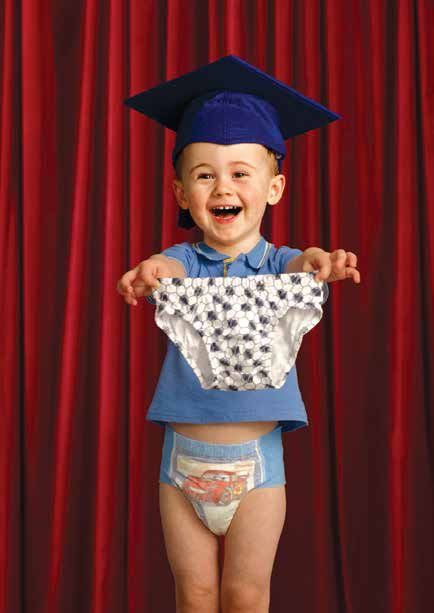
Look for the Signs of Readiness
There is no magic age at which to toilet train your child. Every child is unique.
The majority of children are ready sometime between 18 months and 3 years,
although most do not master readiness skills until after their 2nd birthday.
In order for your child to succeed, they need to be physically, emotionally and mentally ready. There are a number of
stages that your child will go through while developing bladder and bowel control. If many of the Signs of Readiness
listed below are clearly present, it’s probably time to start thinking about toilet training.

Remember, if your first attempts are met with little success, or if your child starts out fine but then regresses, don’t
worry. Just stop and start again later when your child appears more ready or interested in starting. Timing is very
important when it comes to toilet training. Consider delaying toilet training if your child is sick or if there are big
changes in your little ones life, like moving house, starting childcare or if a new baby is on the way.

  Signs of Readiness
  If your toddler shows at least two or three of the physical,
  emotional and mental signs listed below, it’s probably
  time to start thinking about toilet training. Remember the
  more ready your child is the more smoothly the training
  process will go!

  Physical signs of                                              • Your child can predict
  readiness                                                        and communicate
                                                                   when he or she
  • Your child has regular, formed poos and their                  needs ‘to go’
    bowel movements are reasonably predictable                   • Your toddler understands what you
  • Your toddler is developed physically so they                   are saying and can follow simple instructions,
    can move around independently and can get                      like ‘Go and get your teddy’
    themselves to the toilet                                     • Your child may become uncomfortable and
  • Your child has the dexterity to pull their pants up            complain if their nappy is dirty or remove their
    and down with minimum assistance                               nappy following a wee
  • You may notice that the nappy is dry for
    longer periods up to 2-3 hours. This shows that              Social and emotional
    the bladder capacity and control are improving               signs of readiness
  • Your toddler can recognise the feeling that they
                                                                 • ‘I can do it’ becomes a regular saying – this
    need to go to the toilet or can control the urge to go
                                                                   shows that your toddler wants to become more
    – young children will often go off to a secret corner
                                                                   independent
    to poo
                                                                 • Your toddler begins to imitate your behaviour
  Mental signs of                                                  or the behaviour of others

  readiness                                                      • Your child demonstrates independence – often
                                                                   by saying ‘no’ to requests
  • Your child knows what wee and poo are and                    • Your toddler shows a desire to please you and
    may talk about them when you’re changing his or                other adults – and responds well to praise
    her nappy
                                                                 • Your child asks to wear Big Kid training pants
  • Your child understands the meaning of ‘wet’                    or underpants
    and ‘dry’

                                                             4
How do I get started?
Preparation is everything. The toilet training process should
start well before you put your toddler in a pair of training pants
or place them on a potty. Young children need to be gradually
introduced to the whole concept of going to the toilet like a Big Kid.
Take the time to make sure your child understands what it’s all about before you start. A toddler is rarely
far from your side, they are always there right next to you, watching intently. Now is the time to make the
most of their interest, and explain what you are doing when you go to the toilet.

  Here are some other                                         a container for ‘storing’ toys in. If your child

  strategies you can try:                                     appears afraid or disinterested just put it away
                                                              for a while.
  • Older siblings and other children can also               • Use a favourite doll or teddy to demonstrate
    set a great example. It is not unusual for                 what the potty is really for. If you find a doll
    young toddlers to show a sudden interest in                that actually wees, your child will be intrigued
    using the toilet upon entering childcare and               to see the potential result of potty training.
    watching other children using the toilet.
                                                             • Help your toddler develop self-help skills by
  • Don’t forget, your child is also busy following            dressing them in clothing that can be quickly
    your lead. Let your child follow you to the toilet         and easily pulled on and off.
    and explain to them what’s happening.
                                                             • Allow your child to flush – while flushing
  • Introduce stories about toilet training. The               repeatedly can test your patience, some
    Huggies Book Club (huggies.com.au) has                     children are frightened of the loud noise and
    a wonderful range of books designed for                    splashing, so anything that makes toileting
    children of all ages.                                      familiar and fun will help.
  • Include your toddler when shopping for
    their potty or training toilet seat. This gives
    them a feeling of being an important part of
    something new and exciting. Your child will
    more likely to want to use something that they
    have picked out themselves!
  • Introduce training pants to your child and
    show them why these are ‘Big Kid’ pants and
    how they are different to nappies (HUGGIES®
    Pull-Ups® Training Pants are thinner and less
    bulky and look like undies). This helps to send
    a signal to your child that they are becoming a
    big kid.
  • It is important to give your toddler time to
    get used to the training toilet seat or potty
    before using it. Some toddlers may like to use
    their potty as a chair, others may treat it as

                                                         5
Toilet Training Tool Kit - At Home
Introducing the following tools from the start of toilet training can really help
make toilet training more relaxed for you and your child. Getting a ‘training’
toilet seat or a potty and some HUGGIES® Pull-Ups® Training Pants will
represent to your child the first steps to becoming a Big Kid.

What’s best - ‘potty’ or ‘training’ toilet seat?
It’s you and your toddler’s choice. Some children develop a fear of the                                 toilet
and are better suited to using a potty initially. If you decide to buy a potty,
if you can, let your child have a say in choosing the potty. Make sure it’s
sturdy, easy-to-clean and above all comfortable. This will make your child
feel more at ease. Potties are convenient as you can place them in areas
where they can be clearly seen and easily accessed. It’s a good idea to
keep the potty in a consistent spot during toilet training.

Some parents and toddlers prefer to use a ‘training’ toilet seat that can
be attached to the toilet. It should sit securely on the toilet seat. Not
only will this seat make the toilet more comfortable, it will also stop little
bottoms from slipping in. You’ll also need a sturdy platform at the toilet
base so they can climb up and down easily and have a place to rest
their feet. One benefit of using the training seat is that the child will
get used to being on the toilet and there’s minimal cleaning required.

Sometimes it is helpful to introduce both to avoid children becoming
conditioned into only using their potty or toilet seat then refusing
to use a toilet when out and about. Whichever you choose, the thing
to remember is to start slowly. It’s usually a good idea to begin by letting your child sit on the
potty or training seat with his or her clothes on. Try reading a book or singing a song to keep your child
interested to stay put a little longer. Remember not to force your child to stay on the potty or toilet any
longer than they want to, instead, use other ways to encourage them to stay there a little longer.

            Using both potty and training toilet seat could mean that your child will get used to
            both options

                     Step                          ‘Training’ Toilet Seat                  Potty

                                                          6
Training Pants
Introduce toilet training pants slowly. Let your child feel the texture of the pants.
Explain to your child how they are not thick and bulky like a nappy, and how they are
more like real underwear. Show them how easily they pull on and off, and how your
toddler can do it by themselves. This will give your child a sense of independence.
It’s natural that your toddler wants to grow up and be a ‘Big Kid’ and leave nappies
behind. HUGGIES® Pull-Ups® Training Pants help you to take advantage of this
natural desire and make the training process a little more relaxed for both of you.

           Let your child feel HUGGIES® Pull-Ups® Training Pants and show
           them how they are different to nappies and how they are more like
           underwear

Here are some of the features of HUGGIES® Pull-Ups® Training Pants which help to make toilet training a
little easier:

              Learning to understand wet from dry. HUGGIES® Pull-Ups® Training Pants are less
              absorbent with a Learning Liner that helps children understand the difference between wet
              and dry. The tailored liner allows the feeling of wetness for a few moments, before drawing
              the moisture away.

              Learning the ups and downs, just like real undies. HUGGIES® Pull-Ups® Training
              Pants are soft, thin and less bulky for kids to practise pulling up and down with ease, with
              ©Disney designs that look and feel like big kid undies.

              Learning will mean accidents in the beginning. HUGGIES® Pull-Ups® Training Pants
              are designed to catch accidents and have tailored absorbency where boys or girls need it
              most. They are also the only training pant to have Re-sealable Easy-Open sides to make
              those accidents easier to remove.

Remember, toilet training means accidents, and you can’t avoid them. HUGGIES® Pull-Ups® Training
Pants are designed with the absorbency and unique features to help both of you stay more relaxed and
confident during this stage.

Toilet Training Wall Chart & Stickers
Charts and stickers could provide positive encouragement
to keep your child motivated during toilet training. Inside
this guide, you’ll find a colourful Wall Chart to track
successes and skills achieved plus stickers to
reward your child. And when the exciting time
comes for ‘graduation’, there’s also a Big Kid
Certificate to celebrate your success.

Remember, being a ‘Big Kid’ could simply mean
having a good track record of being accident
free. For some parents, having a few days of
being accident free is a great achievement and
worth celebrating with a special outing.

                                                     7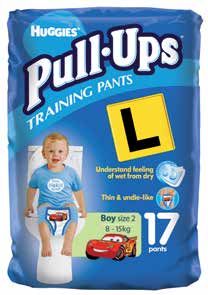
Toilet Training Tool Kit -
Out & About
Eventually, you are going to venture
out of the house with your toilet
training toddler. You probably thought
that once your child was out of nappies
life would get easier and your bag
would become lighter. This will be true
eventually, but in the early days of
toilet training, you’ll need much more.

Here are a few things that you might find useful in
your tool kit:

• Wipes & toilet roll, for wiping bottoms and hands.
• Training Pants help to teach your child to recognise
  when he or she is wet, but they’re also very
  convenient when you are out and about.
• Change of clothes and a couple of pairs of pants
  and even some socks.
• Plastic bag or towel for the car. While car seat
  covers are washable, another option might be
  absorbent Change Mats, which are a handy way
  to avoid mess.

                                                           Toilet Roll

    Wipes

                                       Change Mats

                                                                 Training Pants

                                                       8
Toilet Training Skills
Weeing and pooing on the potty or toilet is a highly complex process. It may not seem very difficult to us, but
when you break down the number of skills needed to succeed, it’s incredible that someone as young as a 2
or 3 year old could ever master it.

• Firstly, your toddler has to be able to recognise the signs that he/she needs to go to the toilet, and then hold
  on to it long enough to get there.
• Then, your little one has to remember where the potty or toilet is, walk to it, wrestle with the clothing and pull
  down their pants. All this before they even sit down to do their business.
• Finally, they need to wipe their bottom (or call you to do it!), get dressed and wash their hands

In this guide, 9 toilet training skills have been identified. We haven’t put time limits on any of these skills,
because the timing will depend entirely on the individual child. It is helpful to keep in mind that these skills are
just a guide, some children may achieve skills in a different order, and some children may achieve two or three
skills at the same time. Think of the toilet training process like a journey where your child is the tour guide.
While on this journey, you will certainly have some say as to where you go, however, ultimately it will be your
child who sets the pace. Take your cues from their behaviour and provide plenty of encouragement along
the way.

Rewards and praise along the way can work wonders. Find out what motivates your child –
a favourite treat, stickers, a fun progress chart, special meal or a phone call to a
grandparent and of course cheers and hugs will work well too.

            Different levels of rewards are appropriate for different levels
            of success. If a reward no longer motivates your child, try a
            new one to keep interest high.

  Mum,
 I’m wet!
                   I’m aware of when I’m wet!

                 This is an early sign and a very good indicator that your child is getting ready
for toilet training. This is the stage when your toddler becomes aware of having a wet or dirty
nappy or clothing. It’s also the time when your child starts to take an interest in the toilet.

HUGGIES® Pull-Ups® Training Pants are designed to help with learning this skill.

They have a tailored blue Learning Liner* in the crutch area of each pant. This tailored Learning
Liner* is designed to allow the feeling of wetness for a few moments, before slowly drawing the
moisture away. The liner is also placed in a tailored position for where boys and girls will feel
this sensation the most. This liner then helps children understand the difference between wet
and dry, which ultimately helps them learn to stay dry on their own.

Nappies or nappy-pants are not designed to teach this skill as they are designed with a super
absorbent liner which quickly draws away the moisture into the absorbent core. They will not
experience the sensation of wetness like they will when in HUGGIES® Pull-Ups® Training Pants.

            Help your child learn about ‘wet’ and ‘dry’ by playing games which demonstrate the
            difference between the two.

                                                         9
I’m happy to sit on the toilet or potty!

                 Let your child take all the time he or she needs to get used to sitting on the potty or toilet. Let
     them do it with their clothes on at first. Talk to your child to explain that they’re becoming a ‘Big Kid’ and
remind them what the potty or toilet is for. Remember, don’t insist that they sit any longer than they want to. If
your child is in a hurry to jump off you can encourage them to stay a little longer by reading a story or singing
songs!

It may take a while before your child is comfortable with the potty or toilet. Don’t push – trying to speed things
up may result in an overly anxious child and will only prolong the process.

             Be patient and understanding – continued encouragement is one of the best things
             that you can bring to the toilet training process.

                  I want to wear Big Kid pants like PULL-UPS®
                  Toilet Training Pants!

Actively encourage your child’s desire to become a Big Kid in every way you can and in all
areas of their life. It’s a powerful motivator for toilet training success. To a toddler, leaving
nappies behind is sort of like leaving babyhood behind. You can encourage your child to
feel like a Big Kid by making the move to training pants a BIG step forward.

HUGGIES® Pull-Ups® Training Pants are designed with young learners in mind. The
colourful Disney
designs mean they look like Big Kid underwear, and the soft stretchy sides help your toddler
learn to pull them on and off with ease.

Remember, your toddler may not be able to pull their training pants up and down by
themselves straightaway, it takes a little practice. Provide lots of encouragement and praise along the way.
             By storing HUGGIES® Pull-Ups® Training Pants in the drawer with your child’s clothing,
             you are encouraging Big Kid feelings and signalling to your child that these are not
                 nappies.

                  I can say when I’m going to wee or poo!

                  If your toddler says ‘I’m going to wee’ or ‘I’m going to do a poo’ - praise your
                  child for having the feeling and connecting the idea to the toilet or potty. Be natural, and
don’t overdo it. Don’t forget, when your child first starts out, the warning comes only seconds before the
actual event! But, don’t worry, this will improve, and you’ll soon be making it to the potty or toilet in time.
Little accidents are learning opportunities for next time.

Sometimes young children need help identifying cues. You can help your toddler by watching out for
behavioural cues like grimaces or poses (like shifting weight from foot to foot) that indicate they are about to
have a bowel movement.

             Put accidental poos in the potty. Sounds a bit gross, but it’s a proven way to learn. When
             your child has an accident, empty the poo from the HUGGIES® Pull-Ups® Training Pants
             into the toilet. None of us are born knowing about toilets and their uses, and we have to
             be taught by patient repetition. (Remember, don’t put the pant itself in the toilet, just the
             contents).

                                                             10
I can go to the toilet with a little help from Mum or Dad!
Notice when your child usually does a poo. Try to time potty visits for
these occasions. Be nearby to lend a hand while your child pulls off their
HUGGGIES® Pull-Ups® Training Pants and sits on the potty. The first time the poo or wee
goes in the potty will almost certainly be an accident! Let your child know how pleased you
are that they understand that wee and poo belong in the potty.
Re-sealab
le
For a toddler, putting on pants is quite an accomplishment. Like any skill, it takes time and Easy-open
sides
practice, with some children needing assistance long after they have achieved daytime
continence. Manual dexterity is what’s required, and ‘up’ is easier than ‘down’ for your little
learner. You can assist them by helping them pull their pants up and down together, try to resist the temptation
to do it for them remembering that young children learn best through support, modeling and repetition.
Be patient and consistent. At first you may want to timetable your visits so that your child sits on the toilet
or potty after each meal or snack. Most importantly let your child set the pace. If they resist, don’t force
things. Say, “Okay. We’ve got plenty of time to learn.” Stay positive and continue to provide lots of praise and
encouragement.
Backtracking is okay. Any number of things can cause a setback. A new baby, moving to
a new neighbourhood, the loss of a pet. If it happens, stay positive. Go back to training
pants and start at some of the earlier training stages. Try not to be tempted to go back
into nappies, as switching back and forth can be confusing for the child.
I can put on or take off HUGGIES® Pull-Ups®
Training Pants myself!
This may take a bit of practice and your help. Practice at regular times, when
they get up in the morning, before and after naps, and before going to bed at
night. It could take a couple of weeks before they can do it themselves, but they’ll be so proud
once they can!
HUGGIES® Pull-Ups® Training Pants pull on and off like real underwear. Thanks to the soft stretchy
sides, your child simply pulls them up to put them on and pulls them down to use the potty or toilet.
Frequent reminders during the day, especially after meals, before and after naps
and bedtime, and before leaving the house will ensure wearing HUGGIES® Pull-Ups®
Training Pants and going to the toilet will become routine. Let your child take the lead.
I can flush the toilet and wash my hands!
It’s never too soon to get your toddler into good habits. Once your child is comfortable using the
potty or the toilet, the next step is to encourage them to wipe themselves, flush the toilet and to wash
their hands.
With flushing the toilet, some kids get a kick out of the sound – but for others, they find this frightening. For these
kids, you can turn the flushing into a game by encouraging them to wave ‘bye bye’ to their poo as it disappears.
There’s no hurry with this step and they may need your help for a while. Just keep the praise and
encouragement coming!
In the early stages, while they are learning to wipe themselves, you will inevitably go
through large quantities of toilet paper. This would be a good time to show your toddler
how much to use and keep an eye on them at first.
11I can use the toilet all by myself!
Once your child can take their pants on and off and go to the toilet unassisted, they will be
happy and proud. Let your toddler know that they have done well with a cuddle or round of applause.
Children respond well to positive reinforcement, so by complimenting good behaviour, you are encouraging
your child to repeat it. This works very well with toilet training.
There will be days when your child looks like they are regressing. On those days when there seems to have
been more misses than hits, remember to stay calm as you mop up the mess. This is completely normal and
may continue on and off for sometime. Staying upbeat and positive will maintain your child’s confidence.
Adding another sticker to the HUGGIES® Pull-Ups® Training Pants Skills Wall Chart is also an effective way
to ‘reward’ your toddler for little successes along the way.
Keep the Toilet Training Skills Wall Chart in the bathroom to keep your child motivated
with each visit.
I’ve hardly had any accidents!
Accidents are common and should be expected. Praise all successes but not too much as
an overly enthusiastic adult may result in your child feeling pressured and anxious. Keep tracking toilet training
success with the HUGGIES® Pull-Ups® Training Pants Skills Chart. In the early stages, keep a track of
successful potty visits with a sticker, then for accident-free days, use a ‘super-special’ sticker.
You could buy a special pack of stickers for these special achievements. Before you know it, your toddler will
have passed a week or two without any accidents at all.
Let your child choose the super special stickers to use for accident free days.
Toilet Training Success!
This is an important accomplishment for both of you, so be sure to mark it with a special
celebration. The most meaningful reward your child can get may not be a present – but
extra time with you. Plan a visit to a special place - the zoo, a park, or a special trip. Fill in the official
Big Kid certificate included in this guide and have it proudly on display in your child’s room.
12Becoming Dry at Night
Once your child has mastered day toilet training, you may feel ready to begin to work
towards being dry at night. It’s important to note that there is a big difference between
daytime toilet training and being dry at night. During the day, your child can control their
bladder, but at night, the bladder is out of their conscious control.
Nighttime control occurs when your child’s body has developed to a point where their
bladder is able to store the amount of wee their body produces overnight or they learn to
wake-up in response to the signal sent from their bladder to their brain indicating that it is
full and needs to be emptied.
The time between achieving day toilet training and nighttime dryness can vary from child to child. While
some children will become dry at night within a few weeks or months of being toilet trained during the day,
others may take a little longer. It’s not uncommon for children to be between three and four before they are
dry at night. Some kids may still have night accidents at six or seven. However, one of the best indicators
that your child is moving toward nighttime dryness is an increase in the number of mornings that they wake
up dry.
Some hints and tips
• Make going to the toilet a part of bedtime routine. Ensure their pyjamas can be easily removed
and encourage them to practise pulling them up and down in the early stages.
• Keep wearing overnight absorbent product until your child has established a pattern where they
no longer wet at night or they learn to wake on their own. About seven consecutive dry nights is often
a good indicator that your child may be ready to sleep in undies.
• Do not restrict the amount of fluid your child drinks in the evening as this will not help them to
stay dry and can even delay the process of getting dry at night. Limiting fluids can lead to dehydration
and constipation. Chronic constipation is a common but often unrecognised cause of
nighttime wetting.
• When your child begins to sleep in undies, it may be a good idea to use
a mattress protector. You could try HUGGIES® DryNites® Bed Mats these are
disposable mattress protectors that easily fit over or beneath your child’s regular
sheets. They are designed to absorb any night-time accidents they may have when
they begin to sleep in undies again.
• A healthy diet high in fibre and leafy green vegetables is important for a healthy
bowel and bladder. Children should avoid drinks or food high in sugar and caffeine
such as cola and chocolate. Caffeine works as a stimulant causing the kidneys to produce larger
amounts of urine placing additional pressure on the bladder.
• Incentives are unlikely to help your child to become dry at night. Unlike daytime control, children
have very little control over their bladder while asleep, so while rewards can be very motivating during
the day, they do little to control children’s behaviour at night and may in fact make them feel like they
have somehow failed when they do not achieve the desired goal. Rewards or incentives can certainly
be used to encourage positive behaviours such as going to the toilet just before bedtime, maintaining
a healthy diet or drinking good amounts of water regularly throughout the day.
• Avoid too much praise for a dry night. It’s out of the child’s control when night time dryness occurs.
By all means praise the child, but too much praise will put unnecessary pressure on the child to be dry
straightaway. Accidents are very much a part of the learning process.
• Waking or lifting a child to go to the toilet during the night certainly seems like a good way to
reduce the number of wet beds, it does not however help train the bladder nor does it teach children
to learn to wake on their own. While it is a great idea to take your child to the toilet just before bedtime,
lifting or waking throughout the night means children do not get the chance to get used to the signals
that the bladder sends to the brain telling the child to wake-up and empty their bladder nor does the
bladder have the opportunity to stretch and develop.
13Frequently Asked Questions
Q. Is 18 months too young to start toilet training? My mother keeps telling me
that all her kids were trained by 18 months but it doesn’t seem like a lot of
kids today are.
A. On average, most children begin learning to use a potty by around their second birthday, but as with
all areas of children’s development, each child is different. Research shows that bladder capacity
increases significantly between the ages of two and three, so by age three most children are able to
hold on and be dry for a reasonable amount of time. There are however a number of behaviours that
you can look for to help determine whether your toddler is ready. Look for signs of physical, mental and
emotional readiness outlined in this guide. I would wait until he shows an interest in using the toilet or
potty – forcing a reluctant toddler to toilet train is only going to create a battle for everyone and may
turn the toilet into an object worth fearing. Don’t feel pressured to start training before he is ready –
waiting for these signs will ensure the process is much easier and much less stressful for everyone!
Q. What if my child is in day care?
A. Consistency and repetition are two key components of successful toilet training. Most day care centres
or care providers will be more than happy to follow your routine for toilet training. If the centre insists
on using its own method, and it’s the only centre you can go to, then it’s probably best that you learn
their method and use it at home. Just remember, punishment does not work, encouragement does.
As for preschools that insist your child be trained by a certain age – if your child is trained by that age
congratulations. If they’re not, it’s no great tragedy. Just wait a while longer. Wanting to go to day care
or school might be just the motivation your child needs.
Q. My son has mastered wees but seems to have a fear of doing a poo
except in his nappy. Why do so many toddlers seem to have trouble
with number 2s?
A. This is incredibly frustrating although surprisingly common particularly when it comes to boys! The
challenge with mastering number 2s is that many toddlers often feel possessive of their stools, and are
reluctant to give them up! The nappy seems to offer them some sense of security so they feel more
comfortable in depositing it there.
You need to think about ways to encourage him to do it in the potty or the toilet. You may need to
revisit some of those basic strategies you used when you first started toilet training him. Encourage
him to sit on the toilet or potty after a meal, you can make this a more pleasant experience by giving
him a book to read or offering him a reward when he is successful. Don’t make a big deal if he doesn’t
go, as anxiety will only make the situation worse. Repetition and reinforcement are keys to successful
toilet training – keep talking to him about how we do our poos in the potty/toilet, read him books about
toileting, let him watch you and your husband using the toilet.
Instant flushing of the toilet can be quite traumatic for some children – you can avoid this by getting him
to poo into a potty or wait until he leaves the bathroom before flushing. Children hold onto their bowel
motions for a number of reasons. For some it is a matter of control – this is often the case when other
things in their little world seem to be out of their control. It is important to transfer the control back to
your child so that he feels that it is his decision to use the potty or toilet, just remind him that he will
need to wear a his HUGGIES® Pull-Ups® Training Pants until he is ready to poo in the toilet. It is also
worth checking his stools to make sure he isn’t constipated, as this can sometimes be the cause of
children withholding stools.
14Q. What if children get too retentive and become constipated during training?
A. You can help keep this from happening if you watch your child’s diet. Children suffering from
constipation are encouraged to adopt a diet high in fibre. High fibre foods include whole grain breads,
bran or barley cereals, fruits and raw vegetables (celery, lettuce, pear, apples, plums, peaches, grapes).
Keep to a minimum those foods that cause constipation, such as rice, rice cereal, pasta, white bread,
carrots, bananas, cheese or foods high in sugar. If a serious problem with constipation develops, see
your doctor or pediatrician.
Q. Can you leave the house with a toddler while toilet training?
A. Certainly - there is no need to feel housebound. It is important to encourage your child to go to the
toilet just before leaving the house and be aware where the toilets are when out and about. Typically
there is very little time between when a young child indicates the need to go and actually going!!! Of
course you should always take extra HUGGIES® Pull-Ups® Training Pants and an additional set of
clothes just in case you don’t make it in time. Don’t be surprised if your child shows a greater interest
in using the toilet when out and about – sometimes it has nothing to do with needing to wee and
everything to do with checking out other people’s toilets!
Q. Are boys slower to toilet train than girls?
A. No. There are differences though. Boys generally show signs of readiness later than girls and take
longer to train. However, boys are only slightly behind with the average age for girls 29 months and
31 months for boys. Boys are sometimes more anxious and resistant than girls during toilet training.
Ideally, boys should learn to wee sitting down first, as they may be reluctant to sit when it comes to
doing poos.
Q. How long should I expect toilet training to take?
A. In toilet training development there is great variation from child to child. In general, the more ready a
child is the quicker the process. The average time it takes for a child to toilet train during the day is
between 3 and 6 months. Just work at the pace set by your child and don’t worry if there are a few
setbacks along the way – be patient and continue to encourage your child. Only begin when your child
has shown most of the readiness skills, if you start too early it will just take longer.
Q. Why should I put my toddler in training pants? What’s the difference between
nappies & nappy-pants and training pants?
A. The difference is in the way that your child perceives himself or herself. Your child wants to grow up and
be independent. Wearing training pants makes your child feel more independent as they can pull on and
off without your help. HUGGIES® Pull-Ups® Training Pants feature Disney Princess and Disney/Pixar
Cars 2 designs and the training pant itself is much thinner so that it looks and feels more like underwear.
Using HUGGIES® Pull-Ups® Training Pants will also signify to your child that they are moving away
from nappies during the day. Unlike nappies and nappy-pants, HUGGIES® Pull-Ups® Training Pants
feature the ‘Learning Liner*’ which allows your child to feel the sensation of wetness after a wee, so that
they start to learn the difference between wet from dry. Nappies and Nappy-Pants, on the other hand,
are designed to absorb wetness immediately, so your child will not be feeling wetness after an accident.
Q. What is the ‘learning Liner’ ? And how does it work?
A. This is a blue layer inside the HUGGIES® Pull-Ups® Training Pants which allows the toddler to feel the
sensation of wetness. The Learning Liner* stays wet for a few minutes before drying, to allow the child
to feel the difference between wet from dry. Feeling the difference between wet from dry, will help the
toddlers learn to ultimately stay dry on their own.
15Some toilet training tips from
Pull -Ups®mums
‘Toilet training is not a race. Be guided by YOUR child ‘I encourage my daughter to use the toilet by
and THEIR readiness, and you may be pleasantly giving her a sticker on her hand everytime she uses
surprised. ‘ the toilet.’
Jelena, Tamworth, NSW Helen, Rye, VIC
‘When he can pull his pants up and down, he is ready ‘Hang a bell near the toilet, so every time your child
to start trying ...’ does something in the toilet they can ring it, and
Lillian, East Corrimal, NSW everyone will know!’
Angel, North Booval, VIC
‘Get really quick on your feet, because when they say
they gotta go, they mean they GOTTA GO!!!’ ‘Make sure their shorts or trousers have elasticised
Rosemary, Kilburn, SA waists so they are quick to pull down when the time
comes to go.’
‘Be patient and enjoy this moment. Even though Jackie, Mangere Bridge, New Zealand
it can be frustrating it’s another milestone that is
passing by.’ ‘Reward chart - place stamps/stickers on there when
Lee, Mt Colah, NSW they successfully try to go to the toilet.’
Kirstie, Engadine, NSW
‘I put an animal/alphabet poster on the wall and we
sing and talk about the animals while we wait for..... ‘Get excited when your child comes to you saying
you know what!’ “I’m Wet”, because at least they have recognised the
Cindy, Burpengary, QLD need for a change in pants.’
Wendy, Prospect, TAS
‘Being silly – boys love it. We’ll go the zoo zoo zoo if
you do a poo poo poo!!’ ‘Relax, take your time and don’t stress. All kids
Catherine, Balgowlah, NSW end up toilet trained eventually – it doesn’t have to
be today!’
‘Lots of clapping, cheering, dancing around in circles Wendy, Eaglehawk, VIC
when my toddler went in the potty or toilet worked
for me.’ ‘Patience is the key, don’t compare your child to
Jill, Drewvale, QLD others they will all get it in their own time. Rewards
are always a great incentive.’
‘Make it fun. I sing nursery rhymes while I wait for my Rebecca, Sinnamond Park, QLD
daughter to go. Now she knows her alphabet.’
Kristine, Green Valley, NSW
HUGGIES® Pull-Ups® Training Pants come in 3 different sizes for girls and boys
SIZE 2: 8 to 15kg SIZE 3: 14 to 18kg SIZE 4: 17kg +
For more information about HUGGIES® Pull-Ups® Training Pants
Australia New Zealand
Call: 1800 028 334 Call: 0800 733 703
Write: Kimberly-Clark Australia, Write: Kimberly-Clark New Zealand,
52 Alfred Street, Milsons Point, NSW 2061 PO Box 97-347, South Auckland Mail Centre
Website: Website:
® Registered Trademark/ *Trademark Kimberly-Clark Worldwide, Inc. © 2013 KCWW © Disney. © Disney/PixarThis certificate shows that
has successfully finished toilet training
and is now a ‘Big Kid’!
Princess Stamp of Approval
Date
©Disney ® Registered Trademark Kimberly-Clark Worldwide, Inc. © 2010 KCWWThis certificate shows that
has successfully finished toilet training
and is now a ‘Big Kid’!
Cars 2 Stamp of Approval
Date
©Disney/Pixar ® Registered Trademark Kimberly-Clark Worldwide, Inc. © 2011 KCWWYou can also read


