Toyota Industries Report - Toyota Industries Corporation
←
→
Page content transcription
If your browser does not render page correctly, please read the page content below
Toyota Industries Report

     Year ended March 31, 2018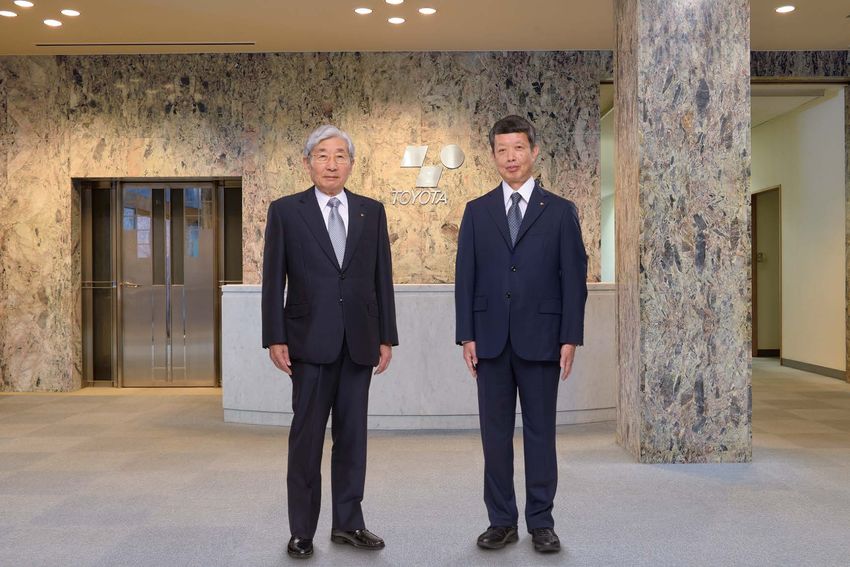
Message from the
Chairman and President
Firstly, we would like to extend our sincere appreciation for    throughout the supply chain and by improving productivity
your continued support of Toyota Industries Corporation          in administrative functions. At the same time, we intend
and the Toyota Industries Group.                                 to strengthen risk management in order to quickly and
    In fiscal 2018 (ended March 31, 2018), the global            appropriately respond to changes in world affairs.
economy remained strong overall on the back of an                    Besides these approaches, we will focus on the timely
expansion in consumer spending and exports in Europe             launch of appealing products demanded by customers
and the United States despite such uncertainties as the          worldwide and improve earnings power by expanding
slowing economic growth in China and geopolitical risks.         the value chain and strengthening solution proposal
The Japanese economy progressed favorably due mainly             capabilities. We will also proactively utilize the Internet of
to an increase in exports as well as a recovery in domestic      Things (IoT), artificial intelligence (AI) and other cutting-edge
demand including consumer spending and capital                   technologies. Through such measures, we aim to raise the
investment.                                                      competitiveness of our businesses. In addition, we plan
    In this business environment, Toyota Industries              to develop our next growth pillars by promoting strategic
Corporation and its Group companies (“Toyota Industries”)        technology and product development while also embracing
undertook efforts to ensure customer trust through a             open innovation.
dedication to quality first as well as to expand sales by            To support such business development, we will
responding flexibly to market trends. As a result, in fiscal     continue our efforts to create an organization and
2018 Toyota Industries posted an increase in net sales.          workplace environment that enables diverse human
The increase was attributable mainly to higher unit sales of     resources to fully demonstrate their abilities and develop
such products as materials handling equipment and car            personnel who can play active roles in the global arena.
air-conditioning compressors as well as to newly                     In other areas, Toyota Industries will create a workplace
consolidating U.S.-based Bastian Solutions LLC and               environment that places top priority on safety; thoroughly
Netherlands-based Vanderlande Industries Holding B.V.,           enforce compliance, including observance of laws and
both of which are engaged in the logistics solutions             regulations; and proactively participate in social contribution
business. In terms of overall profit, despite increases in raw   activities. By carrying out these initiatives, we aim to
materials costs and labor costs, Toyota Industries recorded      meet the overall trust of society and grow harmoniously
an increase in profit due mainly to vigorous sales efforts,      with society. With regard to protection of the global
cost reduction activities throughout the Toyota Industries       environment, we will undertake Group-wide initiatives in
Group, the positive impact of exchange rate fluctuations         seeking to realize “a zero CO2 emissions society in 2050.”
and changes in retirement benefit plans.                             Through these initiatives, we aim for sustainable growth
    With regard to the future economic outlook, the global       of each business and strive to support industries and
economy is expected to continue to grow. However,                social foundations around the world and contribute to an
uncertainties surrounding the business environment               enriched lifestyle and comfortable society as described in
preclude optimism, as the impact of trade frictions arising      Toyota Industries’ Vision 2020 plan.
from protectionist policies in the United States, the future
trend in financial policies in respective countries and          In closing, we would like to sincerely ask for your continued
geopolitical risks require close monitoring.                     understanding and support.
    Under these circumstances, Toyota Industries is further
strengthening its business foundation and addressing key         July 2018
management issues to raise corporate value by leveraging
the Group’s comprehensive strengths.
    As immediate tasks, we will endeavor to bolster our
management platform to respond quickly to drastic
changes in the business environment. Specifically, based                                    Tetsuro Toyoda
on our quality first approach, we aim to build a stronger                                   Chairman
production foundation by maintaining and improving
productivity on a global basis. Furthermore, we will strive to
build a lean corporate structure by thoroughly eliminating
waste, by pursuing excellence in quality, cost and                                          Akira Onishi
product lead time (the period from production to delivery)                                  President

                                                                                   Chairman Tetsuro Toyoda (left)/President Akira Onishi (right)

                                                                                                                                                   1
Toyota Industries’ Value Creation Process
by
eeds
rs’ n
us tome
We aim to contribute to our stakeholders by making the most of the core assets and strengths we have accumulated
ticip ate c
to date in promoting our diverse businesses such as materials handling equipment, logistics solutions, vehicle, engine, s t h at an
vice ses
car air-conditioning compressor, car electronics and textile machinery and by engaging in value creation.
s a n d ser busines
duct ong
i d i n g pro ergies am
Basic Philosophy Prov ging syn
a
[Respect for the Law] lever
Toyota Industries is determined to comply with the letter and spirit of the law, in Japan and overseas, and to be fair and transparent in all its dealings.
After-Sales
[Respect for Others]
Toyota Industries is respectful of the people, culture, and traditions of each region and country in which it operates. It also works to promote economic
Value Creation Development Production Sales Services
growth and prosperity in those regions and countries.
[Respect for the Natural Environment] Core Assets and Strengths Product Highest-level Accurately Finely tuned
Through its corporate activities, Toyota Industries works to contribute to regional living conditions and social prosperity and also strives to offer products development SEQCD* that keeps identifying diverse after-sales services
and services that are clean, safe, and of high quality. leveraging synergies evolving by sharing customer needs and that take advantage
Human Resources among businesses best practices in reflecting them in of extensive network
[Respect for Customers] Business Main products
Toyota Industries conducts intensive product research and forward-looking development activities to create new value for its customers. and services manufacturing product and technological
• Diverse human resources comprised of more than segment development capabilities
[Respect for Employees] 60,000 employees
Toyota Industries nurtures the inventiveness and other abilities of its employees. It seeks to create a climate of cooperation, so that employees and the • Human resources development that underpins
Company can realize their full potential. Others ¥60.3 billion
sustainable growth
Textile Machinery ¥65.5 billion
Materials
handling
Product Development & Manufacturing Capabilities Materials equipment
Handling For end-users
• Product development capabilities that leverage the
advantages of engaging in diverse businesses Equipment Logistics
We encapsulated the spirit of founder solutions
Sakichi Toyoda in the Toyoda • Manufacturing capabilities and production engineering
Precepts, which serve as Toyota that support high-quality and stable production
Industries’ corporate creed and upon • Know-how on in-house development of production
Offering unique solutions by engaging in everything from development to production, sales and after-sales services FY2018
Contributing
which our Basic Philosophy is based. Automobile Net Sales
equipment that contributes to the differentiation of
product appeal ¥595.0 billion ¥2,003.9 to Our
Vehicle
For Toyota billion Stakeholders
Motor Corporation
Global Network Engine
Materials Handling Equipment
• Production bases around the world ¥1,283.0 billion
Automobile Contributing to further improving competitiveness of Toyota cars by leveraging our strengths in manufacturing capabilities
Toyota Industries’ • Solid supply chain built on mutual cooperation with
CSR Activities Contribution in Car
non-business areas business partners
Contribution as air-conditioning
a corporate citizen Fairness, transparency, • Extensive lift truck sales and service networks in compressor For automakers
respect for human rights Foundation of respective regions around the world
Ethical responsibility / and cultures, environmental business activities Car electronics
Compliance conservation
Corporate social
responsibility Financial Foundation Providing key components of various products for automakers around the world by leveraging our technological capabilities
Continuous provision of
Economic responsibility products and services Contributions through • Sound financial foundation
(business responsibility) that contribute to society business activities
• High rating bestowed by rating agencies Textile Textile For end-users
(fund procurement capability) Machinery machinery
Based on long-accumulated experiences, committing ourselves to cutting-edge technologies and quality to provide products
and services to customers around the world
Society (company’s raison d’etre) * S: Safety, E: Environment, Q: Quality, C: Cost, D: Delivery
[Main Scope of CSR Activities]
• Adhering to a quality first approach, we ensure monozukuri (manufacturing) that quickly responds to the diverse,
ever-changing needs of customers. (Relationship with Our Customers)
• We encourage open procurement and seek co-existence and co-prosperity with our business partners (suppliers)
based on mutual trust. (Relationship with Our Business Partners)
• We strive for timely and appropriate information disclosure while promoting good communications with shareholders Our Continuous
and investors. (Relationship with Our Shareholders and Investors) Commitment
• We aim to create safe and secure workplaces where each and every associate can exercise their diverse potentials
and play active roles. (Relationship with Our Associates)
• We fulfill our role as a good corporate citizen and actively undertake social contribution activities.
(Relationship with Our Local Communities)
2 Toyota Industries Report 2018 4 5
CONTENTS

Message from the Chairman and President                            Inside cover–1                    Financial Section / Corporate Information
Toyota Industries’ Value Creation Process                                        2, 4–5            Financial Section
Contents                                                                                3              Consolidated Statements of Financial Position                                 76–77
   Company Introduction                                                                                Consolidated Statements of Profit or Loss                                          78
Outline of Businesses                                                                6–7               Consolidated Statements of Comprehensive Income                                    79
Consolidated Eleven-Year Summary                                                     8–9               Consolidated Statements of Changes in Equity                                  80–81
Consolidated Financial and Non-Financial Highlights                              10–12                 Consolidated Statements of Cash Flows                                         82–83
   Strategies and Businesses                                                                       Corporate Information
Top Message                                                                      14–21                 Board of Directors, Audit & Supervisory Board
Special Features                                                                                         Members and Managing Officers                                               84–85

    1 Augmenting the Logistics Solutions Business in
                                                                                                       Major Production Bases                                                             86
       Response to Changing Customer Needs                                       22–25                 Investor Information                                                               87
    2 Contributing to a Zero CO2 Emissions Society
       through Environmental Technologies                                        26–29
Business Activities
   Materials Handling Equipment                                                  30–34
   Automobile                                                                    35–40
   Textile Machinery                                                                  41
   Promotion of ESG Initiatives
Corporate Governance                                                             43–48
   Corporate Governance Structure / Internal Control System /
   Compliance / Management of Confidential Information / Risk
   Management
Relationship with Stakeholders
   Relationship with Our Customers                                               49–50
   Relationship with Our Business Partners                                            51
   Relationship with Our Shareholders and Investors                                   52               Editorial policy
                                                                                                       In aiming to realize a deeper understanding of the Toyota Industries
   Relationship with Our Associates                                              53–56
                                                                                                       Group among a broad spectrum of stakeholders, the Annual Report
   Relationship with Our Local Communities                                       57–58                 and Social and Environmental Report have been combined into the
                                                                                                       Toyota Industries Report from the fiscal year ended March 31, 2008.
Environmental Initiatives                                                                                  In addition to the Toyota Industries Group’s management policies,
   Vision for Environmental Activities                                                59               the report provides easy-to-understand information regarding its
                                                                                                       business, corporate governance, social and environmental activities
   Structure to Implement Environmental Management                                    60               over the past year as well as its future direction.
                                                                                                       Period covered by the report
   Environmental Impact Flow and Environmental                                                         This report focuses on activities carried out in fiscal 2018 (April 1,
     Accounting                                                                       61               2017 to March 31, 2018), but also includes some information
   Sixth Environmental Action Plan                                               62–63                 outside this period.
                                                                                                       Organizations covered in the report
   Establishing a Low-Carbon Emission Society                                    64–65                 Toyota Industries Corporation and its consolidated subsidiaries
                                                                                                       Reference guidelines
   Establishing a Recycling-Based Society                                        66–67
                                                                                                       • Global Reporting Initiative (GRI) Standard
   Reducing Environmental Risk and Establishing                                                        • ISO 26000
     a Society in Harmony with Nature                                            68–69                 • Japan’s Ministry of the Environment Environmental Accounting
                                                                                                          Guidelines (2005 Version)
   Environmental Management                                                      70–73                 • Japan’s Ministry of the Environment Environmental Reporting
                                                                                                          Guidelines (2012 Version)
   Third Party Assurance of Environmental
     Performance Data                                                                 74

Cautionary Statement with Respect to Forward-Looking Statements
This report contains projections and other forward-looking statements that involve risks and uncertainties. The use of the words “expect,” “anticipate,” “estimate,” “forecast,” “plan”
and similar expressions is intended to identify such forward-looking statements. Projections and forward-looking statements are based on the current expectations and estimates
of the Toyota Industries Group regarding its plans, outlook, strategies and results for the future. All such projections and forward-looking statements are based on management’s
assumptions and beliefs derived from the information available at the time of producing this report and are not guarantees of future performance. Toyota Industries undertakes no
obligation to publicly update or revise any forward-looking statements in this report, whether as a result of new information, future events or otherwise. Therefore, it is advised that you
should not rely solely upon these projections and forward-looking statements in making your investment decisions. You should also be aware that certain risks and uncertainties could
cause the actual results of Toyota Industries to differ materially from any projections or forward-looking statements discussed in this report. These risks and uncertainties include,
but are not limited to, the following: (1) reliance on certain customers, (2) product development capabilities, (3) intellectual property rights, (4) product defects, (5) price competition,
(6) reliance on suppliers of raw materials and components, (7) environmental regulations, (8) success or failure of strategic alliances with other companies, (9) exchange rate
fluctuations, (10) share price fluctuations, (11) effects of disasters, power blackouts and other incidents, (12) latent risks associated with international activities and (13) retirement
benefit liabilities.
The fiscal year ended March 31, 2018 is referred to as fiscal 2018 and other fiscal years are referred to in a corresponding manner.

                                                                                                                                                                                                3
Outline of Businesses
Materials Handling Equipment
The smooth flow of goods links the world and enriches the lives of people
and society. Toyota Industries meets diverse customer needs in logistics
by providing a diverse range of materials handling equipment such as lift
trucks and offering advanced and efficient logistics solutions. Through
these businesses, Toyota Industries helps customers the world over.
Internal-combustion lift truck Reach-type electric lift truck Low lift truck Automated lift truck Simple AGV Automated storage
The Materials Handling Equipment Segment develops, produces, sells and (automatic guided vehicle) and retrieval system
provides services for a broad range of products, from industrial vehicles centered
around a full lineup of lift trucks (0.5- to 43-ton capacities) to materials handling
Company Introduction
systems. Lift trucks, which capture the top global market share*, are delivered to Net Sales Operating Profit Percentage of Net Sales
customers around the world under the TOYOTA, BT, RAYMOND and CESAB
(¥ Billion) (¥ Billion)
brands. Toyota Industries also strives to provide finely tuned after-sales services 120
1,500
so that customers can always use our products in the best possible condition. Shuttle-type automated Sorter/conveyer
100
storage and retrieval system 1,200
We have also enhanced our business domain to include the provision of such
80
components as lift truck attachments and motors as well as sales financing. In 900
60 64.0%
the area of logistics solutions, Toyota Industries works closely with subsidiaries 600
40
Bastian Solutions LLC and Vanderlande Industries Holding B.V. by leveraging Electric lift truck
300 20
each company’s strengths to pursue business expansion on a global scale.
0 0
* Survey by Toyota Industries Corporation Picking system Airport baggage Aerial work platform (FY) 16 17 18 (FY) 16 17 18
handling system
Strategies and
Businesses
Automobile
Get behind the wheel with a solid, reassuring feel and enjoy comfortable
driving. Besides vehicle assembly, Toyota Industries produces various
components such as engines and compressors, the latter of which comprises
the heart of car air conditioners to keep the vehicle interior comfortable, as well
as car electronics. From vehicle assembly to parts production, the Automobile
Segment engages in a wide range of car-related businesses, leveraging Vitz (Yaris outside Japan) Diesel engine Gasoline engine Electric compressor Variable-displacement Fixed-displacement
ESG Initiatives
Promotion of
synergies among its business divisions in development and production. RAV4 (hybrid model)
(hybrid model) type compressor type compressor
Net Sales Operating Profit Percentage of Net Sales
Vehicle With its strengths as an industry leader in safety, the environment, quality, cost and delivery, the Vehicle Business produces compact to midsize automobiles.
(¥ Billion) (¥ Billion)
Engine In addition to diesel engines produced under a comprehensive structure ranging from planning and development to production, we also produce gasoline engines. 600 40
Toyota Industries’ car air-conditioning compressors are highly acclaimed in terms of their reliability at high operating speeds and quiet operation in addition 30
Car Air-Conditioning 400 29.7%
to such excellent environmental performance features as compactness, light weight and fuel efficiency. The Car Air-Conditioning Compressor Business
Corporate Information
Compressor 20
Financial Section /
captures the world-leading market share in unit sales*.
200
Oxygen-supplying air Hydrogen circulation DC-DC converter 10
Car Electronics The Car Electronics Business develops and produces electronics products primarily for electric-powered vehicles such as hybrid vehicles. compressor for fuel pump for fuel cell vehicles
cell vehicles
0 0
* Survey by Toyota Industries Corporation (FY) 16 17 18 (FY) 16 17 18
Textile Machinery
A soft texture caressing your skin and gently enveloping your body. Toyota Industries produces spinning machinery that spins
high-quality yarns and high-speed, energy-saving weaving machinery that produces fabrics. We deliver textile machinery to
customers around the world that incorporates advanced technologies and is imbued with our dedication to quality.
Ring spinning frame Roving frame Comber
The Textile Machinery Division, our original business, began with the
Net Sales Operating Profit Percentage of Net Sales
invention of the automatic loom by founder Sakichi Toyoda. Presently, we
undertake fully integrated operations from development and production (¥ Billion) (¥ Billion)
3.3%
to sales and after-sales services for spinning machines that spin twisted 80 8
fiber bundles into yarn and weaving machines that weave spun yarn into
60 6
fabrics. Our textile machinery is supplied to markets worldwide. Thanks
to superb reliability and high productivity, our air-jet looms have won 40 4
extensive acclaim from customers around the globe, capturing the
20 2
world-leading market share in terms of unit sales*. JAT810 air-jet loom Cotton classing instrument Yarn testing instrument
* Survey by Toyota Industries Corporation 0 0
(FY) 16 17 18 (FY) 16 17 18
6 Toyota Industries Report 2018 7
Consolidated
Eleven-Year Summary
Consolidated Eleven-Year Summary
Toyota Industries Corporation
Years ended March 31 Millions of yen
International Financial Reporting
Generally Accepted Accounting Principles in Japan (JGAAP)
Standards (IFRS)
2018 2017 2016 2015 2014 2013 2012 2011 2010 2009 2008
For the Year
Net sales ¥2,003,973 ¥1,675,148 ¥1,696,856 ¥2,166,661 ¥2,007,856 ¥1,615,244 ¥1,543,352 ¥1,479,839 ¥1,377,769 ¥1,584,252 ¥2,000,536
Operating profit (loss) 147,445 127,345 137,026 117,574 107,691 77,098 70,092 68,798 22,002 (6,621) 96,853
Profit before income taxes*1 209,827 181,986 191,386 170,827 138,133 86,836 80,866 73,911 31,756 14,343 126,488
Profit (loss)*2 168,180 131,398 194,270 115,263 91,705 53,119 58,594 47,205 (26,273) (32,767) 80,460
Investments in tangible assets*3 ¥ 115,458 ¥ 77,393 ¥ 75,418 ¥ 126,395 ¥ 109,479 ¥ 89,459 ¥ 58,404 ¥ 38,254 ¥ 26,963 ¥ 104,495 ¥ 104,205
Company Introduction
Depreciation*3 77,738 73,253 78,253 70,782 64,153 57,954 59,830 62,372 73,238 87,219 83,744
Research and development expenses 77,647 69,524 65,432 47,785 46,326 39,057 32,070 27,788 26,826 33,646 36,750
Per share of common stock (yen):
Earnings (loss) per share*2, *4
Basic ¥ 541.67 ¥ 420.78 ¥ 618.34 ¥ 367.06 ¥ 292.76 ¥ 170.36 ¥ 188.02 ¥ 151.51 ¥ (84.33) ¥ (105.16) ¥ 257.50
Diluted 541.67 420.78 618.33 366.99 292.57 170.35 188.02 151.51 (84.33) (105.16) 257.43
Share of equity attributable to owners of the parent 8,223.82 7,125.37 6,678.80 7,500.16 5,640.08 4,719.66 3,662.26 3,300.17 3,390.02 2,987.16 4,483.32
Strategies and
Businesses
Cash dividends per share 150.00 125.00 120.00 110.00 85.00 55.00 50.00 50.00 30.00 40.00 60.00
At year-end
Total assets ¥5,258,500 ¥4,558,212 ¥4,317,282 ¥4,650,896 ¥3,799,010 ¥3,243,779 ¥2,656,984 ¥2,481,452 ¥2,589,246 ¥2,327,432 ¥2,965,585
Share of equity attributable to owners of the parent 2,553,391 2,240,293 2,098,658 2,425,929 1,829,326 1,524,933 1,197,841 1,075,939 1,104,929 977,670 1,453,996
Capital stock 80,462 80,462 80,462 80,462 80,462 80,462 80,462 80,462 80,462 80,462 80,462
Number of shares outstanding (excluding treasury stock) (thousands) 310,487 310,489 314,226 314,155 313,730 312,207 311,687 311,564 311,570 311,577 311,589
ESG Initiatives
Promotion of
Cash flows
Net cash provided by operating activities ¥ 268,567 ¥ 239,094 ¥ 248,049 ¥ 182,191 ¥ 155,059 ¥ 151,299 ¥ 101,718 ¥ 153,661 ¥ 203,452 ¥ 65,768 ¥ 188,805
Net cash used in investing activities (340,324) (86,925) (532,238) (160,769) (118,483) (274,210) (9,403) (187,574) (36,855) (114,217) (138,789)
Net cash provided by (used in) financing activities 153,303 789 124,495 (8,918) 6,183 7,050 10,279 (85,728) (38,230) 120,971 (33,992)
Cash and cash equivalents at end of year 323,830 243,685 92,399 248,706 226,406 179,359 296,811 195,566 317,590 188,011 121,284
Indices
Corporate Information
Financial Section /
Operating profit ratio (%) 7.4 7.6 8.1 5.4 5.4 4.8 4.5 4.6 1.6 (0.4) 4.8
EBITDA (millions of yen)*5 ¥ 313,055 ¥ 276,193 ¥ 279,444 ¥ 248,854 ¥ 216,175 ¥ 155,234 ¥ 161,876 ¥ 150,481 ¥ 90,521 ¥ 71,608 ¥ 222,125
Return on equity (ROE) (%)*6 7.0 6.1 8.7 5.6 5.7 4.1 5.4 4.5 (2.6) (2.8) 5.1
Return on assets (ROA) (%)*7 3.4 3.0 4.3 2.7 2.6 1.8 2.3 1.9 (1.1) (1.2) 2.5
D/E ratio (%)*8 45.7 43.6 43.0 32.0 39.9 45.4 53.8 56.8 60.3 68.6 37.4
Ratio of share of equity attributable to owners of the parent*9 48.6 49.1 48.6 50.7 46.6 45.4 43.0 41.4 40.8 40.0 47.1
Number of employees (persons) 61,152 52,623 51,458 52,523 49,333 47,412 43,516 40,825 38,903 39,916 39,528
*1: The figures prior to fiscal 2016 are ordinary income under JGAAP.
*2: Profit (loss) attributable to owners of the parent
*3: Investments in tangible assets and depreciation apply to property, plant and equipment. They do not include materials handling equipment leased
under operating leases.
*4: Earnings (loss) per share is computed on the average number of shares for each year.
*5: Profit before income taxes + Interest expenses – Interest and dividends income + Depreciation and amortization (including assets other than property,
plant and equipment)
*6: Profit (loss) attributable to owners of the parent / Average share of equity attributable to owners of the parent at the beginning and the end of the
fiscal year
*7: Profit (loss) attributable to owners of the parent / Average total assets at the beginning and the end of the fiscal year
*8: Interest-bearing debt / (Share of equity attributable to owners of the parent – Subscription rights to shares)
*9: (Share of equity attributable to owners of the parent – Subscription rights to shares) / Total assets
Note: Toyota Industries has adopted IFRS beginning from the end of fiscal 2017. The figures in fiscal 2016 have been reclassified in accordance with IFRS.
8 Toyota Industries Report 2018 9
Consolidated Financial and
Non-Financial Highlights
Consolidated Financial and Non-Financial Highlights
Financial Information (FY2018) Non-Financial Information (CSR) (FY2018)
Net Sales Operating Profit Investments in Tangible Assets Consolidated Number of Employees Ratio of Non-Japanese Employees Consolidated Subsidiaries
¥ 2,003.9 billion ¥ 147.4 billion ¥ 115.4 billion 61,152 persons 65.2 % 254 companies
Share of Equity Attributable to Owners of Ratio of New Female Graduates in Ratio of New Female Graduates in Ratio of Employees with Disabilities
Depreciation Research and Development Expenses
the Parent Administrative Positions (Non-Consolidated) Engineering Positions (Non-Consolidated) (Non-Consolidated)
¥ 77.7 billion ¥ 77.6 billion ¥ 2,553.3 billion 41.7 % 15.7 % 2.37 %
Company Introduction
Consolidated Number of Employees/Ratio of
Net Sales Operating Profit/Operating Profit Ratio Profit before Income Taxes Non-Japanese Employees Consolidated Subsidiaries Participants of Japan’s Subcontracting Law Seminar
(¥ Billion) (¥ Billion) (%) (¥ Billion) (Persons) (%) (Companies) (Persons)
2,500 150 10 250 70,000 70 300 1,200 1,187 1,180
8.1 7.6 7.4 8 65.2
6 209.8 60,000 60.1 60.4 60 250 254
2,000 2,003.9 137.0 200 1,000 978
120 147.4 191.3
127.3 61,152
181.9 50,000 214
1,696.8 1,675.1 50 207
52,623 200 800
51,458
1,500 90 150
Strategies and
40,000
Businesses
150 600
1,000 60 100 30,000
100 400
20,000
500 30 50
10,000 50 200
0 0 0 0 0 0
(FY) 2016 2017 2018 (FY) 2016 2017 2018 (FY) 2016 2017 2018 (FY) 2016 2017 2018 (FY) 2016 2017 2018 (FY) 2016 2017 2018
Operating Profit Operating Profit Ratio (right) Consolidated Number of Employees
Ratio of Non-Japanese Employees (right)
ESG Initiatives
Promotion of
Frequency Rate of Lost Workday Injuries Participants of Age-Based Health Education Persons Having Completed Guidance Program on
Profit* Investments in Tangible Assets Depreciation (Non-Consolidated) (Non-Consolidated) Prevention of Lifestyle Diseases (Non-Consolidated)
(¥ Billion) (¥ Billion) (¥ Billion) (%) (Persons) (Persons)
200 194.2 120 80 78.2 77.7 0.10 2,500 2,445 1,200
115.4
73.2
2,157 2,142 1,056
168.1 100 1,000
0.08 2,000
150 60
131.3 80 77.3 800
75.4 0.06
0.06 1,500 717
Corporate Information
Financial Section /
100 60 40 600 556
0.04 1,000
40 0.03 400
50 20
0.02 500
20 200
0 0 0 0 0.00 0 0
(FY) 2016 2017 2018 (FY) 2016 2017 2018 (FY) 2016 2017 2018 (FY) 2016 2017 2018 (FY) 2016 2017 2018 (FY) 2016 2017 2018
* The figures for profit attributable to owners of the parent are presented.
Total Assets/Share of Equity Attributable to Owners of the Parent/ Number of New Graduates in Administrative Positions/ Number of New Graduates in Engineering Positions/ Ratio of Employees with Disabilities
Research and Development Expenses Cash Dividends Per Share/Dividend Payout Ratio Ratio of Share of Equity Attributable to Owners of the Parent Ratio of Females (Both Non-Consolidated) Ratio of Females (Both Non-Consolidated) (Non-Consolidated)
(¥ Billion) (¥) (%) (¥ Billion) (%) (Persons) (%) (Persons) (%) (%)
80 77.6 150 150 35 6,000 60 40 50 150 20 2.5
2.37
138 2.24 2.27
69.5 5,258.5 36 133
65.4 125 5,000 40 15.7
120 120 30 48.6 49.1 50 120 15 2.0
60 30 34.6 41.7
40.7
4,000 48.6 30 121
29.7 4,558.2 14.3
90 27.7 25 4,317.2 40 90 10 1.5
26 27
40 3,000 20
8.7
60 20 60 5 1.0
2,000 2,553.3
20 19.4 2,098.6 2,240.2 10
30 30 0.5
1,000
0 0 0 0 0 0
(FY) 2016 2017 2018 (FY) 2016 2017 2018 (FY) 2016 2017 2018 (FY) 2016 2017 2018 (FY) 2016 2017 2018 (FY) 2016 2017 2018
Cash Dividends Per Share Dividend Payout Ratio (right) Total Assets Share of Equity Attributable to Owners of the Parent Number of New Graduates in Administrative Positions Number of New Graduates in Engineering Positions
Ratio of Share of Equity Attributable to Owners of the Parent (right) Ratio of Females (right) Ratio of Females (right)
10 Toyota Industries Report 2018 11
Consolidated Financial and Non-Financial Highlights
Non-Financial Information (Environment) (FY2018)
Energy Consumption (Consolidated) CO2 Emissions (Consolidated) Water Consumption (Consolidated)
16,939 TJ 913,123 t-CO 2 4,873 km 3
Discharge of Treated Wastewater
(Consolidated)
Raw Material Consumption (Consolidated) Waste Generation (Consolidated)
Strategies
2,407 km 3 790,022 t 122,521 t and
Businesses
Energy Consumption (Consolidated) CO2 Emissions (Consolidated) Water Consumption (Consolidated)
(TJ) (t-CO2) (km3)
20,000 1,000,000 5,000 4,873
939,753 913,123 4,661
909,436
16,939
Steadily Carry Out Growth Strategies
16,520 4,136
800,000 4,000
15,000
by Leveraging the Strengths of
11,403 600,000 3,000
10,000
Each Business Field
400,000 2,000
5,000
200,000 1,000
0 0 0
(FY) 2016 2017 2018 (FY) 2016 2017 2018 (FY) 2016 2017 2018
Discharge of Treated Wastewater
(Consolidated) Raw Material Consumption (Consolidated) Waste Generation (Consolidated)
(km3) (t) (t)
2,500 800,000 790,022 150,000
2,370 2,407 745,407
712,293
2,169
122,521
2,000 120,000
600,000
1,500 90,000 87,917
79,688
400,000
1,000 60,000
200,000
500 30,000
0 0 0
(FY) 2016 2017 2018 (FY) 2016 2017 2018 (FY) 2016 2017 2018
PRTR*1 Law Designated Substances Emissions/Transfer of PRTR Law Designated Top Message P14−21
(Japan Consolidated) Substances (Japan Consolidated) VOC*2 Emissions (Consolidated)
(t) (t) (t)
Special Features P22−29
2,000 600 1,500 1,489 1,460 1,453
571
503 1 Augmenting the Logistics Solutions Business in Response to Changing Customer Needs
500
1,579 1,200
1,500 1,447 439 2 Contributing to a Zero CO2 Emissions Society through Environmental Technologies
1,370
400
900 Business Activities P30−41
1,000 300
600 Materials Handling Equipment / Automobile / Textile Machinery
200
500
300
100
0 0 0
(FY) 2016 2017 2018 (FY) 2016 2017 2018 (FY) 2016 2017 2018
*1: Short for Pollutant Release and Transfer Register, the PRTR law is a *2: Short for Volatile Organic Compounds
scheme whereby businesses measure the release and transfer of PRTR
designated pollutants and report their performance to the government.
The government then compiles this data and releases it to the public.
12 Toyota Industries Report 2018 13
Top Message
Top Message
and other Toyota Group companies. Such a capital connection is one
Capturing Changes in the Business means to ensure even closer collaboration among Group companies.
This is essential in prevailing over ever-intensifying competition caused by
Environment and Vigorously Promoting the accelerated trend toward electrification and increasing use of Internet
of Things (IoT) technology in the automobile industry. Financial stability
Initiatives for Sustainable Growth facilitates investments for future growth.
*1: Survey by Toyota Industries Corporation
Toyota Industries was founded in 1926 to manufacture and sell the
Business Development Scenario for Future Growth
Type G automatic loom invented by founder Sakichi Toyoda. Considered as
Here, I would like to highlight our efforts to attain sustainable growth in
Company Introduction
the origin of the Toyota Group, we have evolved and attained growth through
the two fields that represent our core businesses, specifically materials
positive competition with other Toyota Group companies. In this section,
handling equipment and car air-conditioning compressors.
President Akira Onishi presents Toyota Industries’ characteristics and
strengths that have resulted from such evolution and growth as well as 1) Materials Handling Equipment
a scenario we created for future growth. The Materials Handling Equipment Segment mainly consists of the Lift
Truck Business, in which we already enjoy the global top share*2, and the
Akira Onishi President
Logistics Solutions Business, which we have been augmenting in recent
years. In the Lift Truck Business, we seek to expand our value chain that
Strategies and
encompasses after-sales services, the supply of spare parts and sales
Businesses
financing operations, in addition to developing new internal-combustion
and electric-powered lift trucks.
Our Characteristics and Strengths *2: Survey by Toyota Industries Corporation
Management Based on Diverse Business Portfolio and
Readiness to Adapt to Change Lift Truck Business Logistics Solutions Business
In addition to our founding business of textile machinery, we engage in
ESG Initiatives
Toyota Industries’ Global
Promotion of
Top Share*1 Products Value chain
diverse businesses ranging from materials handling equipment to car
air-conditioning compressors, vehicles and engines. Automobile-related Products
businesses and non-automobile businesses centered on materials Operates mainly in North Designing
America and has an excellent
handling equipment are the two major pillars of our business, and this distribution centers
system building capability
reflects one of our characteristics of not relying exclusively on one specific
business domain. Internal-combustion lift truck Warehouse truck
Corporate Information
We boast the world’s No. 1 market share*1 for lift trucks, car air-
Financial Section /
conditioning compressors and air-jet looms. Having a top share product in Operates mainly in Europe Automated baggage
as well as globally and has storage and retrieval
each business segment is a strength of Toyota Industries. Lift truck
a strength in starting up system for airports
Sales
Meanwhile, we have been reinforcing our business related to internal- financing
Acquiring large-scale projects
Electric lift truck Fuel cell lift truck dealers
combustion vehicles. We expect them to remain mainstream for some time operations
in the future primarily in the growing emerging country markets. We also
recognize the trend toward vehicle electrification as a driver for our growth
Sells automated storage and
and have been steadily preparing ourselves for possible future changes in retrieval systems, automatic
the market. guided vehicles (AGVs), etc., Unit-type automated
Telematics After-sales service Attachment Component
These efforts have led to the dispersion of management risk and mainly in Japan storage and retrieval
Car air-conditioning compressor system
contributed to our stable business performance. We also believe that we
can reinforce business in each segment by promoting horizontal alignment
among business divisions in such areas as development and production
and by sharing the strengths of each. In the Logistics Solutions Business, we are responding to the growing
That we are able to collaborate with Toyota Group companies for many need to handle a large number of small-lot parcels in warehouses
years and encourage positive competition in safety, the environment, following the recent expansion of the e-commerce market. Through
quality, cost and delivery (SEQCD) provides us with a tremendous Air-jet loom collaboration with U.S.-based Bastian Solutions LLC and Netherlands-
advantage. based Vanderlande Industries Holding B.V., which became our subsidiaries
Also, we hold a number of stocks in Toyota Motor Corporation (TMC) in fiscal 2018, Toyota Industries is augmenting business globally while
14 Toyota Industries Report 2018 15
Top Message
mutually leveraging the strengths of each. core of such collaboration, has constantly been attaining steady growth
We believe that we have established a structure necessary Sales Breakdown of the Materials Handling in business performance. In its warehouse-related business, it received
to attain future growth in each of these businesses. We are Equipment Segment an order from a Dutch fresh food supplier for a solution that combines
now at the stage to yield positive results by harnessing the Sales of lift trucks and a shuttle system and case picking system to enable highly efficient
strengths of this structure. other materials handling warehouse logistics. In the area of baggage handling systems for airports,
Logistics solutions equipment Approx. 40%
Within the Materials Handling Equipment Segment, sales Approx. 20% in which Vanderlande boasts the global top share*4, Rotterdam The Hague
of materials handling equipment, mainly lift trucks, account Airport will introduce a system utilizing the company’s autonomous vehicle
for about 40% of total sales, while value chain-related sales, technology for the first time in the world. It is an innovative baggage
including those from lift truck after-sales services, the supply of conveying system that not only enables efficient baggage handling but also
spare parts and sales financing operations account for about Attachments, FY2018 flexibly accommodates layout changes and system expansions.
Toyota L&F Customer Center Osaka
40%. The last 20% is derived from logistics solutions sales. components, ¥1,283.0 billion In Japan, we established a new customer center in June 2018 in
Company Introduction
sales financing operations
Since this segment does not rely solely on sales of materials and sales through Suita City, Osaka. The center is capable of making proposals on various n Global Compressor Market*5 and Unit Sales of
handling equipment, our business performance is relatively Aichi Corporation, etc. combinations of materials handling equipment and solutions to resolve Toyota Industries
After-sales services, (Million units)
immune to short-term changes in the lift truck market. supply of spare parts, etc.
different logistics issues of customers. Utilizing the center as our third Electric
80
logistics showroom following the ones in Chiba and Aichi prefectures, we type
Next, I would like to provide an overview of our future growth Value chain in the Lift Truck Business Approx. 40% will enhance our customer response mainly in western Japan. Internal-
60 combustion
scenario for each of the three sales categories in the Materials Through these initiatives, we will facilitate collaboration between the Lift Compressor market
type
Handling Equipment Segment. Truck Business and Logistics Solutions Business in the Materials Handling Electric
n Global Lift Truck Market*3 40
type
Equipment Segment with an aim to achieve growth over the medium term.
Strategies and
(Thousand units)
n Lift Truck Market
Businesses
1,500 *4: Survey by Toyota Industries Corporation Internal-
20 combustion
We expect continued, moderate growth in the lift truck market Unit sales of Toyota Industries type
underpinned by steady growth in the world economy and an expected 2) Car Air-Conditioning Compressor 0
1,000 (FY) 15 16 17 18 19 2X
increase in global logistics volume spurred mainly by new demand in An expansion of the global automobile market and an increase in the *5: Survey by Toyota Industries Corporation
the expanding e-commerce market. Against this backdrop, we plan to number of cars equipped with air conditioners are expected to contribute
increase sales by developing a broad range of high-quality products that 500 to the sustainable growth of the car air-conditioning compressor
satisfy diverse customer needs, undertaking sales activities based on our market. Among various types of compressors, compressors for internal- Channeling Our Unique,
Accumulated Resources into Both Types
well-developed distribution networks and promoting solution-based sales combustion vehicles will maintain a high level of demand, while the electric
ESG Initiatives
Promotion of
0
with a focus on resolving customers’ logistics issues. (Year) 08 09 10 11 12 13 14 15 16 17 18 20 compressor market is expected to expand over the medium to long term. Human resources Technologies/know-how
*3: Survey by Toyota Industries Corporation
In response to the recent, accelerated trend toward electrification, Facilities created in-house Funds
n Value Chain-Related the compressor industry is increasingly concentrating resources on the
n Unit Sales of Toyota Industries
As for value chain-related initiatives, our efforts are divided into three fields: electric type. Toyota Industries, on the other hand, makes sure to channel Internal-combustion type
(Thousand units)
services, sales financing operations and components. In the services field, 300 its unique, accumulated resources into both compressors for internal- Focus on this type as a
in order to continue generating profits we will utilize our networks, which Others
combustion vehicles, which are expected to remain mainstream for the mainstream product for the Industry as a
Corporate Information
time being
whole focusing
we have strengthened by acquiring dealers along with other measures, and time being, and also electric compressors, for which demand is anticipated
Financial Section /
Aim for a 50% market share by on electric type
200 strengthening our already
provide services during the entire product lifecycle through maintenance Europe to grow in the future. We will utilize our extensive resources encompassing superior product appeal
services and the supply of spare parts. At the same time, we will augment human resources, technologies and know-how and work steadily to
proposals for logistics improvement by using telematics to ensure efficient 100
North
differentiate ourselves in both fields. Electric type
fleet operations, reduce accidents, encourage fuel-efficient practices and America To achieve even greater competitiveness, we have been undertaking Steadily respond to anticipated demand growth
Japan
promote automation. In the field of sales financing operations, we already the following initiatives in terms of development and production. As Leverage our market share, which is higher than internal-
0 combustion type, to gain from an expansion of the electric-
have in place a system to undertake these operations in-house in the (FY) 09 10 11 12 13 14 15 16 17 18 19 21 for development, we conduct a range of rigorous evaluation tests for powered vehicle market
United States and Europe. In the future, we will extend our global reach to compressors in realistic vehicle environments to satisfy stringent vehicle
capture customers’ needs for equipment leasing and rentals. In terms of conformance requirements of
components, we will enhance the product appeal of our engines, motors automakers. Through these
and controllers, which are manufactured in-house, with the aim of further tests, we offer a high level of
differentiating the performance of both of our internal-combustion lift trucks performance, including excellent
and electric lift trucks. Overall, we will continue to make the most of our fuel efficiency.
now reinforced value chain. With automakers repeating a
process of trial and error for the
n Logistics Solutions promotion of vehicle electrification,
In the category of logistics solutions, we have been promoting regional it is increasingly important for us,
and functional collaboration among Bastian, Vanderlande and Toyota as a component manufacturer, to
Baggage handling system utilizing autonomous vehicle
Industries based on the strengths of each. Vanderlande, positioned at the technology for airports respond to their varying requests. Vehicle conformance test based on our know-how of conducting both simulations and experimental evaluations
16 Toyota Industries Report 2018 17Top Message
As the holder of the top Toyota Industries will continue to seek more compact and lighter
market share, we will seek compressors with higher fuel efficiency. We will also strive to attain a more
even closer collaboration superior performance in terms of quieter operation and lower vibration,
with automakers worldwide which will become more important in vehicle electrification.
to create a firm platform for While making these efforts to pursue greater product appeal in
the development of electric the existing domains, we will also concentrate on developing new
compressors. business areas.
In terms of production, For example, we expect that the number of heat-emitting components
more and more stringent fuel used within a vehicle, such as electronic devices and batteries, will
efficiency standards adopted increase as vehicle electrification progresses and automated driving
every year have necessitated becomes more widespread. In order for these components to function
Company Introduction
an increasingly complex at peak capacity, it is critical to keep the heat down. To respond to this
compressor structure. As need, we plan to conduct development with a focus on utilizing the cooling
such, manufacturing capabilities that ensure stable mass production of function of a compressor not only for vehicle interior air conditioning but
high-quality products at any production base have become more important also for key components.
than ever. In producing compressors for internal-combustion vehicles and Besides this cooling functionality, we have applied compression
electric compressors, machining technology plays a vital role. As such, technology used in compressors to develop an oxygen-supplying air
we develop specialized facilities and cutting tools in-house to ensure compressor, which is the “heart” of a fuel cell vehicle (FCV), and hydrogen
high-precision and high-speed machining. This is the foundation of our circulation pump. These components have been adopted in TMC’s
Strategies and
compressors’ high levels of performance and reliability. MIRAI FCV. We intend to further increase the appeal of our products and
Businesses
We also use IoT technology to link our mother plants in Japan with contribute to the realization of a hydrogen-based society.
production bases outside Japan and carry out detailed data management
in each work process as an effort to further ensure stable quality on a 3) Textile Machinery
global basis. Textile machinery is our original business. I would like to
present a case in China, one of our important markets,
where orders for our mainstay air-jet looms are increasing
Characteristics and Strengths by Compressor Type following the enforcement of more stringent environmental
ESG Initiatives
Promotion of
Electric-powered vehicles regulations in the country.
Internal-combustion vehicles The Wujiang District in the city of Suzhou, Jiangsu
(HV, PHV, EV & FCV)*6
Province, is the largest production center of synthetic
Fixed-displacement type Variable-displacement type Electric type fiber textiles in China. There, more stringent environmental JAT810 air-jet loom
regulations were adopted in 2017, mandating factories
operating water-jet looms that use water to insert weft yarn to weave
Corporate Information
fabrics to conduct appropriate wastewater treatment. This has prompted
Financial Section /
replacement demand for air-jet looms, which do not use water, and
provided us with an opportunity to increase orders by promoting sales of
our air-jet looms, renowned for their excellent energy saving performance,
in the Chinese market.
Driven by the power of the engine Driven by an internal motor As seen from this example, we believe there may be additional
opportunities to expand sales in the Chinese market of our materials
Keep air conditioning at handling equipment and car air-conditioning compressors, both boasting
Standard type with a Save fuel by automatically a comfortable level at all times, high environmental performance, depending on how China tightens its
Characteristics consistent cooling capability adjusting the cooling capability including start-stop operation of regulations in the future.
HVs and PHVs
Accurately Responding to Changing Customer Needs
Utilize machinery and electronics
Add greater price competitiveness Expand sales mainly in developed technologies and consistent In recent years, technological trends, customer needs and other market
Strengths & to the existing strength of countries by taking advantage of manufacturing capabilities to circumstances have changed dramatically around the world. The
sales expansion high reliability and supply products the excellent fuel efficiency and capture opportunities in the automobile industry, in particular, is said to have entered a period of
policy mainly to emerging countries globally stable productivity expanding electric-powered vehicle
drastic change that occurs only once in 100 years. The need to reduce
market
CO2 emissions has accelerated the electrification of vehicles, and various
*6: HV: Hybrid vehicle; PHV: Plug-in hybrid vehicle; EV: Electric vehicle; FCV: Fuel cell vehicle types of electric-powered vehicles ranging from hybrid vehicles (HV) to
18 Toyota Industries Report 2018 19Top Message
Toyota Industries’ Products Fitted in Electric-Powered Vehicles
[HV / PHV / EV] [FCV] Oxygen-supplying
air compressor 3.0 L displacement diesel engine*7
DC-DC converter Plastic glazing Hydrogen circulation pump
PCU (for assisting power
generating motor)
Electric compressor
Assisting power
generating motor PCU (for swing electric motor)
Company Introduction
Hybrid unit
New hybrid engine (with an integrated motor) and PCU Hybrid hydraulic excavator ZH200-6 of
Hitachi Construction Machinery
*7: The Toyota 1KD diesel engine that has been mounted in lift trucks since 2013. Among the
Charging stand Four-wheel drive DC-AC inverter On-board charger Inverter for hydrogen Boost reactor 74 kW-class engines, it complies with the 2014 standards stipulated by the Off-Road Vehicle
rear inverter circulation pump Act without adopting the urea Selective Catalytic Reduction (SCR) system, a world first.
Contributing to Vehicle Electrification with a Broad Range of
Elemental Technologies from Power Source Devices to Lighter Weight Components
Strategies and
Hitachi Construction Machinery Co., Ltd.
Businesses
In this way, we respond to ever-changing customer needs in a timely
and accurate manner. By doing so, we intend to contribute to society and
FCVs are likely to gain popularity depending on regional characteristics and achieve sustainable corporate growth.
customers’ preferred vehicle usage.
Utilizing a variety of technologies such as power source technologies Future Direction of Business Operations
we have accumulated for more than 30 years, the Compressor Division
and the Electronics Division collaborate to develop and manufacture In order to achieve further growth with a focus on our core businesses of
ESG Initiatives
Promotion of
devices for use in electric-powered vehicles. materials handling equipment and car air-conditioning compressors, we
Among such devices, a DC-AC inverter equipped to use home electric will meet changing customer needs and enhance our competitive edge by
appliances in a vehicle has drawn much public attention as an emergency providing logistics solutions and responding to vehicle electrification.
power source following the Great East Japan Earthquake, during which Moreover, to extend our reach from the existing business domains for
it was used to feed power to evacuation shelters. In Japan, it is fitted in achieving sustainable corporate growth, we will also channel our resources
official cars of local governments and increasingly used as a self-sustained and take on challenges in new business areas.
Corporate Information
disaster prevention measure in apartments. We intend to propose other Because the world keeps changing faster and faster, we have taken
Financial Section /
possible uses of this product. Using a DC-AC inverter as an emergency power source
the necessary action to respond to these rapid changes. Inspired
Electric-powered vehicles themselves must extend in a disaster-awareness camp by our corporate creed, we will step up our efforts to conduct
their driving range in order to gain popularity. In addition to forward-looking activities based on our areas of specialization.
improving batteries and other devices, this requires reducing For a few years from fiscal 2019, we anticipate somewhat
vehicle body weight. difficult times as we prepare for future growth. The involved
Toyota Industries has developed plastic glazing that is costs could be large and may have a negative impact on our
about 40% lighter than its glass counterpart. This product business performance. We intend to overcome these difficult
has already been used in the panoramic roof and rear times and continue our growth by taking advantage of operating
window of various vehicles, including TMC’s Prius a. diverse businesses, with each business segment making
In addition, our plastic glazing is easy to process, thus concerted efforts.
providing diverse vehicle design options. The entire Toyota Industries Group will work as a team
The need for electrification is also growing not just in the toward this goal, while always going back to our vision to
automobile field but also in the construction machinery field. “support industries and social foundations around the world
In response, Toyota Industries has developed a new by continuously supplying products/services that anticipate
hybrid unit for construction machinery by utilizing a pool of customers’ needs in order to contribute to an enriched lifestyle
engine and power electronics technologies accumulated in and comfortable society.”
the fields of materials handling equipment and automobiles. Toyota Prius a
The unit has been mounted in a hybrid hydraulic excavator of
20 Toyota Industries Report 2018 21Special Feature 1
Special
Feature 1
Augmenting the Logistics Solutions Business in
Response to Changing Customer Needs
In recent years, the environment surrounding logistics operations has been undergoing a drastic change.
Economic growth in emerging countries and increasing e-commerce transactions worldwide have led to an
expansion of global logistics volume. At the same time, new issues, including labor shortages in Japan
caused by its declining birthrate, aging society and dwindling population and soaring labor costs in
emerging countries, have also become prevalent. These circumstances have resulted in rapidly growing
needs for operational automation and higher logistics efficiencies. This Special Feature highlights how our
Logistics Solutions Business has been responding to such changing logistics needs and describes the
future direction of our efforts. To date, Toyota Industries has concentrated on providing
more efficient logistics solutions to customers in Japan,
Company Introduction
the United States and Europe. In the latter two regions, our
fleet management systems to centrally manage a fleet of lift
trucks and increase the efficiency of their operations have
been on the market for quite some time. In Japan, we have
been providing total solutions, including automated storage
and retrieval systems, automatic guided vehicles (AGV),
warehouse management systems (WMS) and other logistics
systems and equipment, with a focus on resolving logistics
issues from the customer’s perspective.
Strategies and
Businesses
ESG Initiatives
Promotion of
Telematics (fleet management system)
As mentioned earlier, more distribution centers have
For example, in the field of lift trucks, we have responded n Growth of the E-Commerce Market been built to deal with a rapid expansion of e-commerce
Toyota Industries’ Global Business Centered on to the ever increasing need for electric lift trucks by expanding transactions. At these centers, logistics solutions that
(US$ Billion)
Lift Trucks our lineup from conventional lift trucks that use lead-based 4,000 combine software and equipment, such as lift trucks for which
Corporate Information
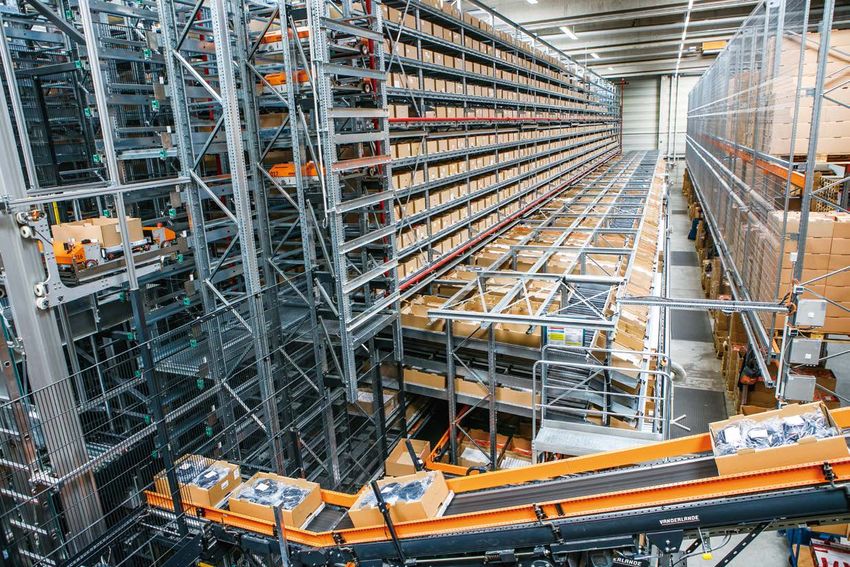
batteries to include models equipped with lithium-ion batteries we enjoy the world’s top share*1, automated storage and
Financial Section /
3,500
In the Materials Handling Equipment Business centered and fuel cells, so that we can propose optimal products to retrieval systems, conveyors and sorters, play an important
around lift trucks, Toyota Industries has been leading each and every customer. 3,000 role. To respond to a drastic change in logistics needs, we
the industry based on its strengths derived from global Additionally, we have started offering our own sales recognized that we must augment our Logistics Solutions
2,500
production, sales and service networks and from its extensive financing services to provide more purchasing options for Business globally and improve our responsiveness to
product lineup and customizing capability to meet customer customers depending on their financing needs. We have also 2,000 satisfy these evolving needs. Based on this recognition, we
needs in every usage condition and business category. taken on the lift truck business of Tailift Co., Ltd., a Taiwanese welcomed two logistics systems companies into the Toyota
1,500
In addition to merely providing products, we operate an manufacturer of lift trucks having strengths in low- to middle- Industries Group, namely, U.S.-based Bastian Solutions LLC
enhanced, total support structure encompassing after-sales priced models, as an effort to respond to a broader range of 1,000 in April 2017 and Netherlands-based Vanderlande Industries
services to ensure that customers always use our products in customer needs. Holding B.V. in May 2017.
500
optimum condition. Through this structure, we help customers A rapid expansion of e-commerce transactions in recent *1: Survey by Toyota Industries Corporation
in different industries to achieve greater efficiencies in their years has prompted an increase in the number and size of 0
(FY) 2015 2016 2017 2018 2019 2020
diverse logistics operations. warehouses, and we expect this trend to continue for the
(See page 31 for details of our global Materials Handling foreseeable future. The increasing popularity of e-commerce Asia Pacific North America Western Europe
Equipment Business.) has also pushed up the number of small-lot deliveries to Central and Eastern Europe Latin America Middle East & Africa
individual consumers, necessitating quicker, more frequent
and accurate operations from receiving orders to sorting and Source: C
reated by Toyota Industries based on “Study Report on a Structural Analysis of the
ICT Industry in the IoT Era and Verification of ICT’s Multifaceted Contributions to
Responding to Changing Logistics Operations delivery. Economic Growth,” Japan’s Ministry of Internal Affairs and Communication (2016)
E-commerce operators and transportation companies
Toyota Industries has made efforts to quickly and accurately now need to process a large number of parcels in a short
respond to customers’ logistics needs that have changed with time, and we have been fielding many requests for our
the times. proposals for establishing more efficient logistics operations. Automated logistics equipment: automated storage and retrieval system and conveyor
22 Toyota Industries Report 2018 23You can also read


