TRACEABILITY MANUFACTURING REPORT: Enabling Farm-to-Table Track & Traceability with Mobile Technologies
←
→
Page content transcription
If your browser does not render page correctly, please read the page content below
TRACK     &
                                                1

                                        Farm-to-Table: Track & Traceability
 TRACEABILITY
      MANUFACTURING REPORT:
   Enabling Farm-to-Table Track &
Traceability with Mobile Technologies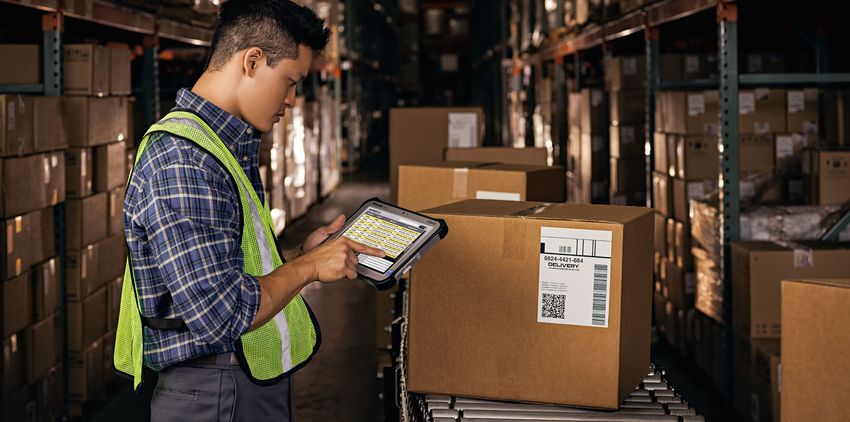
2

Executive Summary

                                                                                                                       Farm-to-Table: Track & Traceability
The FDA Food Safety Modernization Act (FSMA),                Now, the food industry is required to adopt more
signed into law in 2011, is the most sweeping reform         reliable, accurate and robust track and trace processes
of U.S. food safety laws in more than 70 years.              up and downstream—from sourcing to delivery. As a
It aims to ensure that the U.S. food supply is safe by       result, food producers, manufacturers and distributors
shifting the focus from responding to contamination          are quickly working to modernize their operations and
to preventing it. These new standards aim to help
                 1
                                                             tackle the subsequent technology challenges that arise.
reduce the effects of foodborne illnesses, which affect
                                                             A critical component to achieve FSMA compliance is
48 million Americans each year—including 3,000
                                                             the integration of rugged and reliable enterprise-grade
deaths and 128,000 hospitalizations.2 Under the FSMA,
                                                             mobile devices with automatic identification and data
the Food and Drug Administration has new rules and
                                                             capture (AIDC) systems, such as barcode or RFID
oversight responsibilities for implementing the new
                                                             technology. This hardware and software solution
food safety system, specifically in the areas of
                                                             enables increased insight into the supply chain
prevention, inspection, compliance and response.3
                                                             through all stages of food production—from farm
While the overall benefits of the FSMA are clear, the law    to table. Once U.S. food manufacturers understand
does significantly impact the entire food supply chain,      the technology considerations and how to address
creating compliance challenges for manufacturers and         the challenges associated with implementing an
their suppliers. These new regulatory challenges further     integrated mobile data capture solution, they will be
compound manufacturers’ existing concerns, such as           equipped with an efficient solution that not only helps
maintaining product quality, lowering costs to increase      to achieve regulatory compliance, but also improves
profits and meeting the distribution demands of              other business challenges.
retailers—all while satisfying consumers’ evolving tastes.

                                               New data capture solutions can
                                               increase insight into the supply
                                               chain—from farm to table—
                                               helping to ease the regulatory
                                               compliance burden.
A Fully Integrated                                          Organizations implementing a fully automated track              3
                                                            and trace process along the supply chain must be
Automated Track and

                                                                                                                    Farm-to-Table: Track & Traceability
                                                            prepared to address additional complications
Trace Process                                               introduced by this process.

For many food producers, manufacturers and                  Automating data collection will increase available
distributors, an automated track and trace process          data. This data overload can result in data mining
that is fully integrated with the supply chain will         issues where stakeholders cannot find, analyze or
address existing business challenges and new FSMA           report on relevant data. An automated data
regulations. Ideally, this solution will contain several    management system can help address these
key elements:                                               problems. However, to be truly effective, it must
                                                            meet three key requirements:
   Automated data collection via rugged mobile
   devices using barcode or RFID technology.                1. Automated data capture must take
                                                               place across the food supply chain in a
   Data aggregation to provide supply chain
                                                               consistent, secure and reliable manner.
   intelligence.
                                                            2. Data capture and delivery must be
   Integration into existing processes or
                                                               accessible anywhere and in all conditions,
   redefining processes to incorporate
                                                               from the farm field, to the factory floor,
   track and trace.
                                                               to a distribution center, retailer or
One of the major challenges for many U.S. food                 corporate boardroom.
organizations is the lack of visibility across the supply
                                                            3. Data must be processed in real time.
chain. As food supply chains grow increasingly
complex, it becomes more difficult for each element         These challenges require a robust data management
of the supply chain to remain visible to other              system consisting of rugged data capture hardware
elements in a single, comprehensible view.                  and track and traceability software. Some
                                                            organizations may be forced to invest in a technology
Many agriculture and manufacturing organizations’
                                                            overhaul to implement an automated track and trace
data collection methods rely on legacy systems and
                                                            process, while others may need to simply upgrade
paper-based processes. While some are decades old,
                                                            pieces of their existing infrastructure.
the industry continues to use these systems due to
costs associated with developing and implementing
new approaches or reluctance to change standard
operating procedures. These legacy processes can
contribute to inaccuracies during data transcription
and make real-time auditing nearly impossible.                   The food industry supply chain—
With the FSMA’s impending compliance deadlines,
                                                                 from farmers to retailers—must
the U.S. food industry can no longer afford to delay
in re-evaluating legacy systems and must modernize               be prepared to address challenges
their technology infrastructure. While the individual
regulations vary based on product category, nearly               created by data overload from
every juncture in the food supply chain—from
farms to retailers—will be subject to increased                  new traceability systems.
and improved record-keeping standards.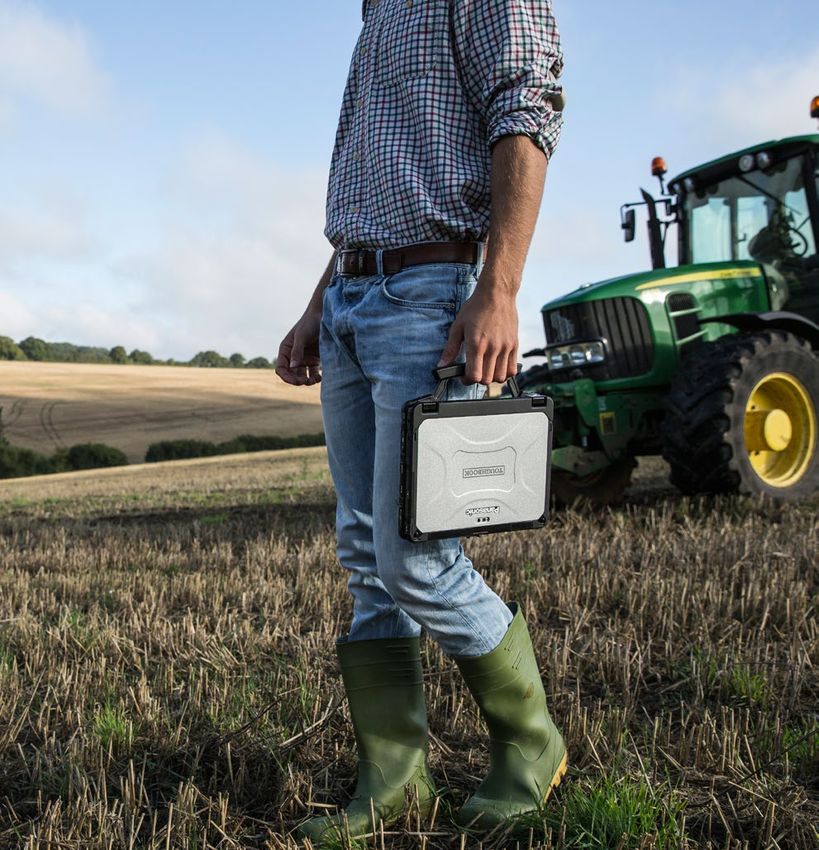
For example, those using classic keyboard-based        improve process quality, which in turn helps them                 4
devices or Windows CE devices will want to update to   deliver products that are both superior in quality

                                                                                                                 Farm-to-Table: Track & Traceability
touch-based hardware to increase mobility and ease     and lower in price.
of use. No matter how data collection is currently
managed, electronic systems will need to be updated
                                                         Consider the example of a batch of
to integrate new technology that will better
                                                         tomatoes contaminated with listeria.
accommodate new regulations.
                                                         With manual-based systems, accurately tracking
                                                         if ingredients were sourced from an affected
                                                         batch was difficult. Spreadsheets and other
                                                         documents would have to be carefully reviewed,
                                                         and the process could be so time-intensive, the

   Mobile traceability technology                        tainted ingredients could have found their way
                                                         onto store shelves or consumers’ kitchens. With
   sales are expected to reach                           traceability solutions, however, information on
                                                         ingredient sourcing for specific lots can be
   $14.1 billion by 2020 with annual                     instantly retrieved from a database. This data
                                                         allows food manufacturers to intervene earlier on
   growth of nearly 9%.4                                 and prevent the cost and bad publicity of a recall.

                                                       A successful track and trace system for the food
                                                       supply chain should consist of rugged mobile devices

Mobile Solutions Enable                                implemented alongside software technologies such
                                                       as radio-frequency identification (RFID), barcodes and
Better Traceability                                    Internet of Things (IoT).
Some food producers, manufacturers and
                                                       The winning combination of these technologies is
distributors may feel overwhelmed by the new
                                                       proving to provide great advantage, and the food
traceability requirements, but understanding the
                                                       industry is rapidly integrating it. According to Allied
possible solutions can help organizations know
                                                       Market Research, traceability technology sales are
how to start. The concept of traceability is better
                                                       on pace to reach $14.1 billion by 2020 with annual
understood when broken down into two parts:
                                                       growth of nearly 9%.4
   Track follows a specific product through
   the supply chain, primarily helping with
   logistics and inventory management.

   Trace, on the other hand, identifies the
   origin of a specific product or ingredient.
   This is essential for product recall and
   investigation.

Traceability allows organizations to consistently,
accurately and quickly identify product origins in
order to better manage product integrity. This
ability then helps organizations identify areas to
RFID                                                       for traceability and data management requires only               5
                                                           minimal human participation, resulting in less error

                                                                                                                    Farm-to-Table: Track & Traceability
RFID devices provide many advantages for food              and more real-time reporting. Like any technology,
traceability. They can be read from a great distance       RFID does have disadvantages. Any liquid or metal
and do not require a line of sight between the RFID        between the RFID tags and the reader can weaken
tag and sensor. Up to 40 RFID tags can be read at          the signal (such as in very moist environments),
once, allowing data to be gathered in bundles rather       making accurate readings difficult in these scenarios.
than one at a time. This speed delivers a much             A RFID system is also more expensive than some
faster read rate than other approaches.                    other solutions.

RFID tags can also use read/write technology, making       Barcode
them even more versatile. Information about an
object can be stored on its RFID tag, then read later by   Barcode technology brings many advantages and
a different user. Data can also be encrypted or erased     provides a cost-effective option for FSMA compliance.
as needed, adding extremely high security to RFID.         Barcodes are small, imperceptibly light and
For example, RFID tags could be used with pallets to       inexpensive. They are also widely used, helping to
track shipments of foodstuffs. Adding data about the       reduce implementation costs, training and the cost of
ingredients’ source could be written to the RFID tag,      cross-system integration. Barcode scanners can be
thus enabling specific pallets to be easily located in     built to include good ergonomics, such as angled rear
case of recall. Because data about ingredients is          scanners for easier barcode scanning at different
tracked along the entire supply chain, only affected       levels and screen viewing, so long-term use by workers
shipments would need recalling. This insight helps         is comfortable. Unlike RFID, barcodes have no privacy
significantly minimize the total cost of recalls and can   implications due to stored data.
even eliminate the need to pull unaffected products
                                                           One way barcodes enhance food manufacturing is
from store shelves.
                                                           by improved inventory management. Whenever a
Finally, the physical RFID tags are quite rugged, with     product is stored, moved or shipped, a barcode scan
the result that they are far more reusable than            can record storage location. This provides an accurate
barcodes. All these advantages mean that using RFID        snapshot of current inventory data for production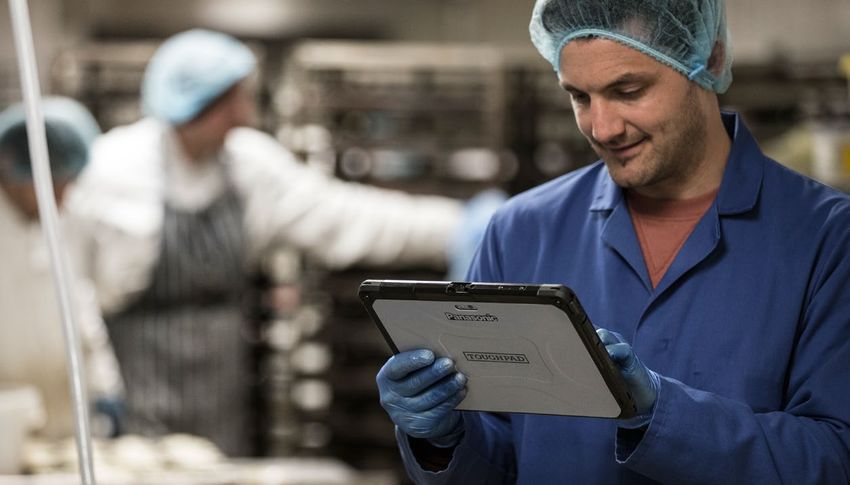
and sales. This data can also be used to automatically       products. This data can then be used to create                      6
generate manifests during shipment to customers.             real-time dashboards and give actionable insights

                                                                                                                         Farm-to-Table: Track & Traceability
                                                             into the supply chain.
Though barcodes provide many benefits, the
technology also has its limitations. Barcodes are only
one-way communication; they can be scanned, but              Rugged Mobile Devices
additional information cannot be written into barcodes
                                                             Most consumer mobile devices are not fit to be
as they move along the supply chain. Another
                                                             used in the field or in manufacturing. Rugged
limitation is that barcodes require a direct line of sight
                                                             hardware purpose-built for these challenging
between the code and the scanner. Scanners must
                                                             environments is essential to enabling track and
be close to the barcode and they must be scanned
                                                             trace technologies along the entire food
individually. This means deploying barcode solutions
                                                             supply chain.
requires additional human labor as compared to RFID.

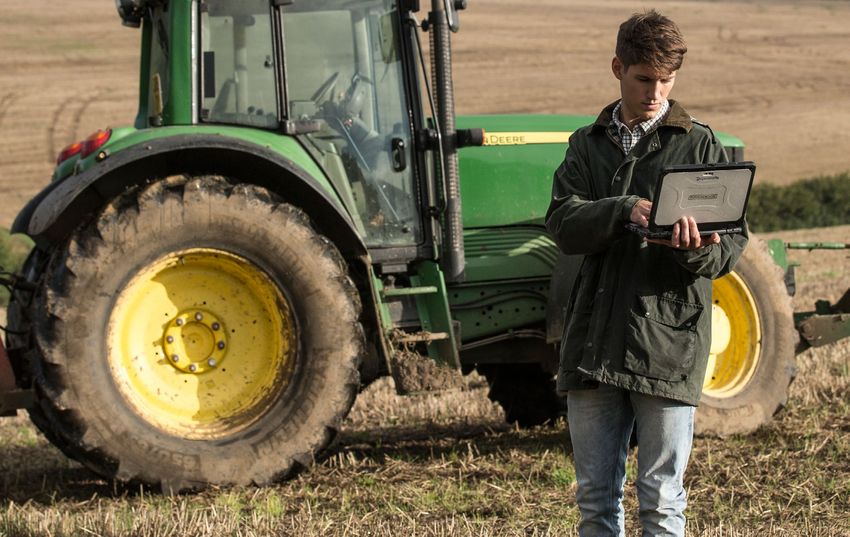
                                                                On the Farm
Internet of Things (IoT)                                     Agricultural field workers need bright devices that
                                                             are visible during daylight, weather-resistant screens,
IoT, the newest approach to traceability, offers the
                                                             long battery life, locking controls, network connectivity
food industry the ability to monitor multiple
                                                             and the ability to physically wash off dirt, dust and
information sources in real time. Handheld devices
                                                             grime. Devices in these settings also need security
that provide IoT data enable instant logging, readings
                                                             measures to prevent accidental or intentional harm.
and consequently faster decision making. For example,
                                                             By deploying rugged devices based on enterprise
ingredient sourcing, manufacturing and final delivery
                                                             versions of the Android or Windows operating
to retailers can all provide IoT data and create a
                                                             systems, workers in the field could gather FSMA
real-time, holistic view of manufacturing operations.
                                                             compliant data with minimal training. It’s also critical
Many businesses are taking interest in this approach;
                                                             to use enterprise-grade mobile devices in agricultural
Gartner reports IoT spending for vertical-specific
                                                             operations where hazardous conditions are present.
business is expected to reach $911 billion by 2020.5
                                                             For example, the environment in and around grain
Data collected by employees through IoT devices              silos is highly flammable due to the fine particles that
can be combined with neural network technology,              are in the air. Having rugged mobile devices that
instantly providing analysis based on the most               conform to iSafe/ANSI standards provides a level of
relevant data. This ability is especially useful for         protection from sparking or electromagnetic
fresh foods and cold chain manufacturing, where              discharge that could cause an explosive event.
real-time information about temperature and other
environmental conditions can prove crucial in ensuring          At the Plant
and documenting quality. It can also help organizations      Manufacturing plants, on the other hand, need devices
make real-time changes to help reduce spoilage               that can be customized for line workers, operation
or contamination.                                            managers and other shop floor employees. In these
                                                             environments, fully-rugged tablets and handhelds,
Of course, IoT is still an evolving technology. In its
                                                             especially those with long battery life and low failure
current iteration, implementing IoT is too expensive
                                                             rates, can reduce costly downtime and boost
to deploy for individual product tracking like RFID or
                                                             efficiency. In addition, food manufacturers often need
barcode technology. However, it excels as a way to
                                                             to consider sanitization requirements when selecting
gather data from the devices scanning individual
                                                             mobile devices. For example, a facility that produces
7
Farm-to-Table: Track & Traceability
products with and without nut ingredients needs to At the Store
be extremely diligent in sanitizing the production Responding to a recall notice quickly is critical for food
lines as they switch from one product to the next. retailers. Not only do they need to determine whether
Not performing this type of maintenance on the affected shipments arrived in their stores, they need
equipment can cause cross contamination issues that to compare what is left on the shelf with what has
create potentially life-threatening allergic already been sold. Through handheld devices, food
consequences for the consumer. This maintenance retailers can quickly scan existing stock and learn
process typically involves hot water and/or additional how much affected stock is in the hands of consumers.
chemicals for wipe down. Having devices that can Individual recalled food items can be identified in a
survive repeated exposure to water and chemicals is matter of moments, even if they are intermingled with
a must for these environments. non-affected items. This reduces the amount of time
and potential risk to consumers faced during a recall.
In the Warehouse
In shipping and receiving or distribution centers, Fortunately, rugged mobile devices are available
workers need to access critical stock and location in multiple form factors, including smartphones,
information in real time and in the most effective laptops, tablets, 2-in-1 convertible tablets and
way. From receiving and moving, to ordering and handheld barcode scanners, so any organization
dispatching stock items, rugged handheld devices requiring track and traceability can benefit from
with an angled rear barcode reader ensure the this technology. Organizations in the food industry
smooth running of warehouse operations. In should select a technology partner who can offer
addition, look for mobile devices that forklift the correct form factor, level of ruggedness and
operators can use and easily detach, allowing associated peripherals which best suit the job
for a single device on and off a forklift. and environment at hand.The Benefits of 3. These technologies improve customer 8
satisfaction as seen through traceability’s
Mobile Devices for
Farm-to-Table: Track & Traceability
effect on recall management. Because the
Food Manufacturers exact source of affected ingredients can be
traced during recalls, the recall accuracy,
Rugged mobile devices that are purpose-built to
timeliness and costs are improved, helping
withstand the specific requirements of food
to preserve brand perception. According to the
manufacturers offer several benefits.
Grocery Manufacturer’s Association, an average
1. Production costs decrease and operational recall costs $10 million, takes 14 days to identify
efficiencies improve when automating data and 34 days to enact. By the time product recalls
collection. Data collected from barcode and are enacted, only 40% of affected products can be
RFID technologies can be automatically used collected.6 Enacting recalls more quickly enables
to inform supply decisions, thereby decreasing organizations to improve the public perception of
delays due to sourced material shortage. the brand’s responsibility and also remove more
This real-time information allows food affected product. A quicker response means that
manufacturers to optimize existing processes fewer customers will have a low-quality experience.
and maximize resource allocation.
Deploying purpose-built devices can benefit the entire
2. Using track and traceability technologies food supply chain—from farm to table. Combining
improves safety and quality control. Good traceability technologies with rugged purpose-built
traceability systems minimize the production mobile devices allows companies to have the exact
of unsafe or poor quality food products, hardware for their specific production processes,
ensuring public health and decreasing improving operations and minimizing downtime.
liability. The systems also help maintain food
authenticity by verifying ingredient sourcing.9
Farm-to-Table: Track & Traceability
Panasonic Mobility and Traceability
Specializing in purpose-built devices for manufacturing needs,
Panasonic delivers solutions in a variety of accessible form factors,
including handheld barcode scanners, tablets, convertible 2-in-1 laptops
and laptops in screen sizes ranging from 4.7 inches to 20 inches.
Whether employees collect data from a remote field 2% failure rate. Panasonic Toughbook computers,
or a distribution center, the rugged performance of tablets and handheld devices remain functional and
Panasonic Toughbook devices is unmatched. connected in the harshest environments, such as in
According to VDC Research, the most important extreme inclement weather, hostile field conditions
criterion for a manufacturer purchasing mobile and around heavy machinery and equipment.
devices to support their workforce is quality/ Loaded with enterprise versions of Windows 10 or
reliability.7 As a core manufacturer, Panasonic sets the Android operating system, security never
the industry standard for reliability with a less than compromises ease-of-use.
Food manufacturers seeking to improve track and traceability
through mobile technologies should contact Panasonic today.
us.panasonic.com/Toughbook
(888) 245-6344
EnterpriseSolutions@us.panasonic.com
Sources
1. http://www.fda.gov/Food/GuidanceRegulation/FSMA
2. http://www.fda.gov/Food/GuidanceRegulation/FSMA
3. http://www.fda.gov/downloads/Food/GuidanceRegulation/FSMA/UCM379984.pdf
4. https://www.alliedmarketresearch.com/food-traceability-tracking-market
5. http://www.gartner.com/newsroom/id/3165317
6. http://www.gmaonline.org/downloads/research-and-reports/WP_RecallExecution.pdf
7. VDC Research – 2016 Mobile’s Place in the Connected Factory
©2016 Panasonic Corporation of North America. All rights reservedYou can also read


