Tropical Cyclone Michael | Report #14
←
→
Page content transcription
If your browser does not render page correctly, please read the page content below
Tropical Cyclone Michael | Report #14
REPORT TIME & DATE: 4:30 PM EDT | Tuesday, October 16, 2018
INCIDENT START DATE: Wednesday, October 10, 2018
PRIMARY LOCATION(S): Alabama, Florida, Georgia, North Carolina, South Carolina, Virginia
REPORT DISTRIBUTION: Public
NOTE: Beginning on Wednesday, October 17, DOE will issue a single report per-day on impacts from Hurricane Michael.
EXECUTIVE SUMMARY
Hurricane Michael made landfall near Mexico Beach, Florida as a category 4 storm on Wednesday
October 10, then moved across Georgia, South Carolina, North Carolina, and southeastern Virginia on
October 11, before moving into the Atlantic. Michael caused significant damage to portions of the
Florida Panhandle and southwestern Georgia and numerous power outages across the affected region.
Electricity Sector Summary
Customer Outages as of 4:00 PM EDT:
o Alabama: 2,303 customer outages (0.09%), decrease of 16% since last report
o Florida: 138,588 customer outages (1.37%), decrease of 1% since last report
o Georgia: 59,000 customer outages (1.25%), decrease of 16% since last report
o North Carolina: 4,287 customer outages (0.1%), decrease of 49% since last report
o Virginia: 6,219 customer outages (0.2%), decrease of 38% since last report
o Total: 210,711 customer outages, decrease of 9% since last report
Restoration efforts are underway across the affected region. Efforts in the hardest-hit areas may
be prolonged due the level of damage, which will require partial system rebuilds.
Fluctuation in the outage numbers is expected and normal during large-scale restoration efforts.
Mutual assistance networks have been activated and over 36,000 personnel are supporting the
restoration efforts from 27 states.
Oil & Natural Gas Sector Summary
For the week ending on October 5, the Lower Atlantic Region (WV, VA, NC, SC, GA, and FL) had
28.1 million barrels of total gasoline stocks, according to the Energy Information Administration.
This is 9% higher than the 5-year average for this time of year.
As of 1:30 PM October 16, 5.4% of Florida gas stations (including 34% of Florida Panhandle
stations), 3.4% of Georgia gas stations, and 2.6% of Alabama gas stations were reported out-of-
service due to lack of fuel and/or power. Not all stations have been updated following the storm.
PAGE 1 OF 7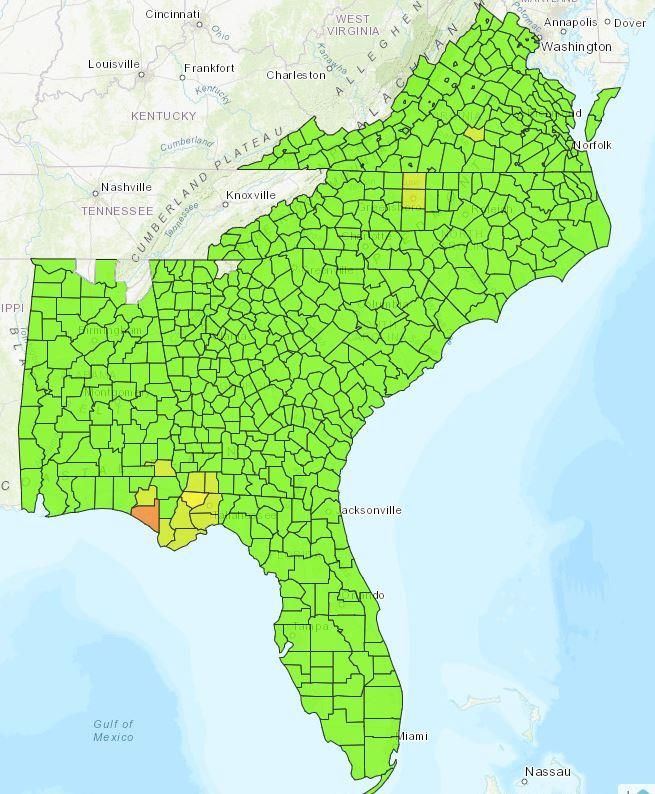
SITUATION REPORT                                                                                         October 16, 2018

                                               ELECTRICITY SECTOR
POWER OUTAGES

                                            Outage Map (as of 4:00 PM EDT)

                               ELECTRICITY OUTAGES AS OF 3:00 PM EDT 10/16/2018
                                       Source: ESF-12 Responders & EAGLE-I
                                     Current           Percent of Total Customers                 24-Hour Peak
       Impacted State
                                Customers Outages        in State without Power                 Customer Outages
         Alabama                      2,303                       0.09%                               6,004
          Florida                    138,588                      1.37%                              150,898
          Georgia                     59,000                      1.25%                               84,835
       North Carolina                 4,287                       0.09%                               26,914
       South Carolina                  314                        0.01%                               2,653
          Virginia                    6,219                       0.17%                               25,751
           Total                     210,711                         -                                  *
 *There is no sum of the Peak Customer Outage column because peaks for individual utilities occur at different times; a total
 would not reflect peak outages.

                                                                                                                  Page 2 of 7
SITUATION REPORT October 16, 2018
ELECTRICITY IMPACTS & RESTORATION EFFORTS
Crews in the impacted area continue to perform damage assessments and restorations. Some
restorations in the hardest hit areas may be prolonged due to the extent of damage.
The electric industry has mobilized over 36,000 personnel, including utility crews, contractors, and
mutual assistance workers from 27 states to support the restoration efforts.
Fluctuation in the outage numbers is expected and normal during large-scale restoration efforts.
Alabama
2,303 Customer Outages ↓ 16% since Oct 16, 7:00 AM EDT 6,004 24-hr Peak Outages
Significantly Impacted Utilities
o Wiregrass Electric Coop: 2,005 Customer Outages
Florida
138,588 Customer Outages ↓ 1% since Oct 16, 7:00 AM EDT 150,898 24-hr Peak Outages
Significantly Impacted Utilities
o Gulf Power (Southern Company): 55,222 Customer Outages
o West Florida Electric Coop Association: 17,733 Customer Outages
o Talquin Electric Coop: 15,369 Customer Outages
o Duke Energy Florida: 12,860 Customer Outages
o Tallahassee Electric: 2,603 Customer Outages
Georgia
59,000 Customer Outages ↓ 16% since Oct 16, 7:00 AM EDT 84,835 24-hr Peak Outages
Significantly Impacted Utilities
o Mitchell EMC: 13,163 Customer Outages
o Grady EMC: 7,188 Customer Outages
o Georgia Power: 4,072 Customer Outages
o Diverse Power: 830 Customer Outages
o Sumter EMC: 1,081 Customer Outages
North Carolina
4,287 Customer Outages ↓ 49% since Oct 16, 7:00 AM EDT 26,914 24-hr Peak Outages
Significantly Impacted Utilities
o Duke Energy: 3,965 Customer Outages
Virginia
6,219 Customer Outages ↓ 38% since Oct 16, 7:00 AM EDT 25,751 24-hr Peak Outages
Significantly Impacted Utilities
o VA Electric Cooperatives: 2,893 Customer Outages
o Dominion Power: 2,456 Customer Outages
Page 3 of 7SITUATION REPORT October 16, 2018
PETROLEUM SECTOR
PETROLEUM SECTOR OVERVIEW
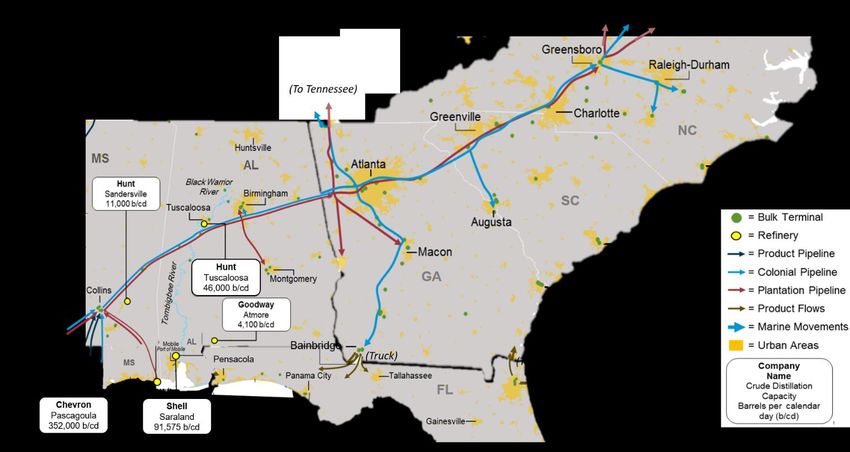
The map below highlights the petroleum fuels supply chain in the area threatened by Hurricane Michael.
OFFSHORE PRODUCTION AND OIL & GAS PLATFORMS
As of 12:30 PM EDT, October 15, 198,622 b/d (11.7%) of the oil production and 168 MMcf/d (6.6%) of
the natural gas production in the federally administered areas of the U.S. Gulf of Mexico are shut-in,
according to estimates by the Bureau of Safety and Environmental Enforcement (BSEE).
U.S. Gulf of Mexico Oil & Gas Production Status
as of 12:30 PM EDT 10/16/2018
Shut-In
Production Pre-Event
(10/16)
Crude Oil (b/d) 1,700,000 130,138
Natural Gas (MMcf/d) 2,560 90
Pre-Event Evacuated
Infrastructure
Count (10/16)
Manned Platforms 687 0
Rigs 37 0
Source: BSEE
Page 4 of 7SITUATION REPORT October 16, 2018
PORTS
All ports in the Southeast have fully reopened except for Panama City, which is open with restrictions (daylight
operations only) as of Oct. 12. The Port of Panama City has reported significant damage with an estimated
timeline of 3 weeks to return to normal operations. The Port has commercial power.
FUEL STOCKS
For the week ending on October 5, the Lower Atlantic Region (WV, VA, NC, SC, GA, and FL) had 28.1
million barrels of total gasoline stocks, according to the Energy Information Administration (EIA). This is
9% higher than the 5-year average for this time of year.
For the week ending on October 5, the Lower Atlantic Region had 12.6 million barrels of total distillate
stocks, according to EIA. This is equivalent to the 5-year average for this time of year.
Florida Department of Emergency Management (FDEM) is monitoring statewide fuel stocks and retail
fuel supplies; no reported supply shortages, distribution issues, or retail fuel shortage reported as of
October 9.
RETAIL FUEL STATIONS
As of 1:30 PM October 16, 5.4% of Florida gas stations (including 34% of Florida Panhandle stations),
3.4% of Georgia gas stations, and 2.6% of Alabama gas stations were reported out-of-service due to lack
of fuel, lack of power, or both, according to GasBuddy.com.
Disclaimer: Data may not be current. 87% of stations in Pensacola, 80% in Panama City, 82% in Tallahassee, 36% in Thomasville, 34% in Albany, and 58% in
Dothan have updated status since 10/09/18.
Page 5 of 7SITUATION REPORT October 16, 2018
EMERGENCY DECLARATIONS & WAIVERS
EMERGENCY DECLARATIONS
To provide vital supplies and transportation services to a disaster area in the United States, emergency
declarations may be issued by the President, Governors of States, or Federal Motor Carrier Safety Administration
(FMCSA). These declarations trigger the temporary suspension of certain Federal safety regulations, including
Hours of Service, for motor carriers and drivers engaged in specific aspects of the emergency relief effort. See 49
CFR 390.23 for the actual emergency regulation.
State Emergency Declarations and HOS Waivers as of 7:30 AM EDT 10/13/2018
Effective Dates
State* Details Status
Start End
AL, FL, GA, LA, MS,
FMCSA Regional Emergency Declaration 10/09 11/09 Active
NC, SC, TN
Florida* State of Emergency Declaration 10/07 12/06 Active
South Carolina** State of Emergency Declaration 10/08 11/07 Active
Alabama State of Emergency Declaration 10/08 11/07 Active
Georgia* State of Emergency Declaration 10/09 10/16 Active
North Carolina* State of Emergency Declaration 10/10 Until Rescinded Active
Kentucky State of Emergency Declaration 10/10 11/10 Active
Virginia State of Emergency Declaration 10/11 11/11 Active
Sources: U.S. Department of Transportation; Governor Office Websites
*Includes 35 counties in northern Florida, 108 counties in southern Georgia, and 66 counties in North Carolina. See Declarations for
the full listing.
**South Carolina issued a thirty day extension of its Hurricane Florence emergency declaration
FUEL WAIVERS
The Environmental Protection Agency (EPA), working with the Department of Energy (DOE), responds quickly to
address fuel supply disruptions caused by hurricanes or other natural disasters by issuing emergency waivers of
certain fuel standards in affected areas. The table below lists fuel-related waivers issued by the EPA:
Fuel Waivers as of 7:30 AM EDT 10/13/2018
Effective Dates
State Waiver Status
Start End
Restriction on red-dyed diesel fuel for highway use.
Allows the sale, distribution, and use of red dyed non-road locomotive and
Florida marine (NRLM) diesel fuel for use in utility, emergency response and other 10/12 10/26 Active
diesel-powered highway vehicles responding to/assisting in recovery efforts
in the panhandle area of Florida. Diesel fuel must meet the 15ppm standard.
Sources: U.S. Environmental Protection Agency; State Governments
Page 6 of 7SITUATION REPORT October 16, 2018
OTHER FEDERAL WAIVERS
On October 10, PHMSA issued an Emergency Stay of Enforcement for pipeline and LNG facility operators affected
by Hurricane Michael. Under the stay, PHSMA does not intend to take enforcement action relating to operators’
temporary noncompliance with operator qualification requirements found in 49 C.F.R. §§ 192.801–192.809 and
195.501–195.509, or pre-employment and random drug testing requirements found in 49 C.F.R. § 199.105(a), (c)
arising from the use of personnel for pipeline activities related to response and recovery. The stay which went into
effect on October 10 will remain in effect for 45 days until November 24, unless PHMSA determines an extension
is required. In addition, on October 10, PHMSA issued an Emergency Assistance Personnel waiver for Alabama,
Florida, Georgia, North Carolina, and South Carolina affected by Hurricane Michael. For 30 days following October
10, PHMSA waived the notice required under 49 U.S.C. § 60118(d),which necessitates a 60-day review period for
States to notify PHMSA that it intends to waive a pipeline safety regulation adopted by the State pursuant to State
certification under 49 U.S.C. § 60105 for the above listed requirements.
Page 7 of 7You can also read


