Tutorial: DB-Main 9.1.1 (based on DB-Main help) - Profa. Dra. Sarajane Marques Peres www.each.uspnet.usp.br/sarajane
←
→
Page content transcription
If your browser does not render page correctly, please read the page content below
Tutorial: DB-Main 9.1.1
(based on DB-Main help)
       Profa. Dra. Sarajane Marques Peres
        www.each.uspnet.usp.br/sarajane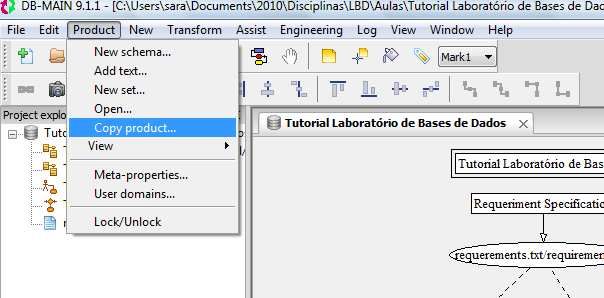
Este tutorial foi originalmente criado para a versão 9.1.1 do Db-main.
   Contudo, o produto gerado é compatível à versão 9.1.6 e a forma de trabalho na
     ferramenta não foi alterada (pelo menos não para as funcionalidades usadas na
                                                construção do .lun deste tutorial).
             Se você encontrar algum problema no tutorial, por favor, escreva para
sarajane@usp.br, e coloque no assunto da mensagem: [Tutorial DBMain] – Problema
                                                                      encontrado.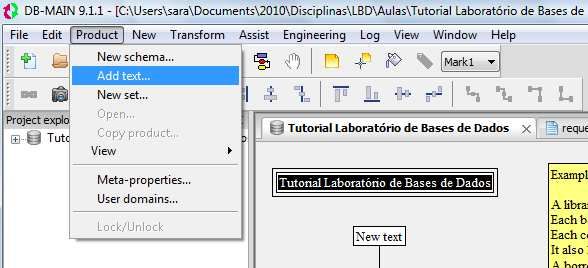
DB-Main 9.1.1 – General Information
 General Purpose Modeling Tool For Database Applications
 Engineering
   supporting toolset for system engineering;
   modeling tool development environment – Computer Aided
   Software Engineering (CASE) tool.

 A product of the Laboratory of Database Application
 Engineering University of Namur.

 Developed and distributed by: REVER S.A. (Belgium)

 Web Site: www.db-main.eu       Support: dbm@rever.eu Basic
 file extension: .lun

 Release 9.1.1 – February, 2012.
Modelling funcionalities (examples)
 This tool offers support for some forward and reverse
 engineering activities.

 Foward engineering

   A generic, wide-spectrum representation model for conceptual,
   logical and physical objects;
   A graphical representation of ERA Schemas, UML Class, Activity and
   Use Case Diagrams;
   A generic model that describes procedural components of
   information systems at various abstraction levels as well as their
   relations;
   Semantic and technical semi-formal annotations attached to each
   specification object;
Modelling funcionalities (examples)
 Reverse engineering

  Code parsers extracting physical schemas from SQL, COBOL,
  CODASYL, IMS, XML DTD and RPG source programs;

  Interactive and programmable source text analyzers that can
  be used, a.o., to detect complex programming patterns or
  clichés in source texts, and to build data flow diagrams
  through program variables;
Modelling funcionalities (examples)
 CASE - Typical features

   A toolbox of semantics-preserving transformational operators
   intended to carry out in a systematic way such activities as
   conceptual normalization, development of optimized logical
   and physical schemas from conceptual ones, and conversely
   (i.e. reverse engineering);

   A set of assistants. An assistant is a kind of expert in a specific
   kind of tasks, or in a class of problems. It is intended to help
   the analyst to carry out frequent, tedious or complex tasks.
Modelling funcionalities (examples)
 Meta level functions

   Java Interface for DB-MAIN (JIDBM) language and the Voyager
   2 allow the engineer (analyst or method engineer) to develop
   new functions that can be seamlessly incorporated into the
   tool;

   Extension of the repository : new properties can be
   dynamically added and managed through plug-ins;

   Methodological customization: the tool is methodologically
   neutral and can assist the analyst in following a large spectrum
   of methodologies.
Basic Interface Views
                            Our project

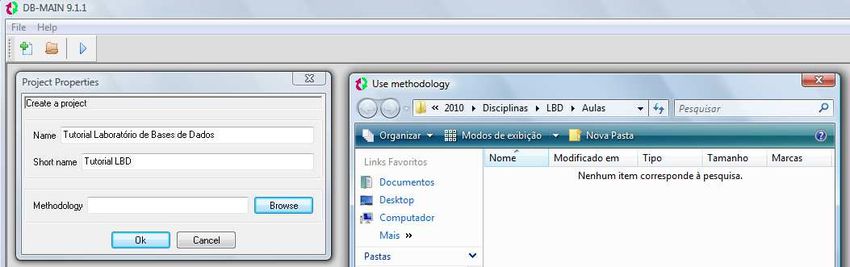
                  to choose a *.LUM file containing a method
                  to be followed during the project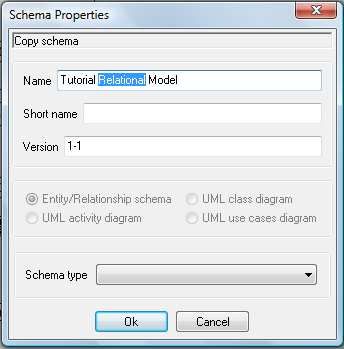
Basic Interface Views

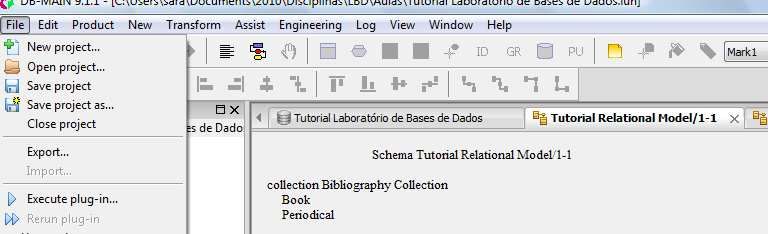
Engineering methods must be written in MDL (Method Description Language) and compiled
with the external MDL compiler to produce a *.LUM file. This file can be associated to the
project at creation time (File/New project menu item). If no method is specified, the default
one allows to do anything.
Basic Interface Views

                        The Property Box (or similar)
                        with context description must
                        be completed (in the course
                        student project).
Object: Notes Simplified requirements system.
A note is a kind of post-
it that can be inserted
in a schema or
attached to some
objects of a schema.
The links between a
note and its owners are
represented
by dotted lines, except
for those associated to
schemas.
Use in your project
in order to improve
the specification
legibility !!
No menu NEW.Inserting Text Information
System documentation!!
Double Click!Building a Use Case Diagram
Linking the new schema to other object
Use Case – Toolbar

                                                           Actor
    Use Case
                                                           Generalization
        Actor                                         Association
                Extend       Include      Use Case
                Relationship Relationship Generalization
Use Case - Definitions Use Case: A use case is a kind of classifier representing a coherent unit of functionality provided by a system, a subsystem, or a class. a use case generalization from a use case A to a use case B indicates that A is a specialization of B (is a kind of relation). Actor: an actor represents a coherent set of roles that users can play when interacting with a system. An actor materializes any resource (man, machine, ...) that can be associated with an action. an actor generalization from an actor A to an actor B indicates that an instance of A can communicate with the same kinds of use-case instances as can do an instance of B (is a kind of relation).
Use Case - Definitions
 These are also kinds of relations:
   an extend relationship from a use case A to a use case B
   indicates that an instance of B may be augmented by the
   behavior specified by A;
   an include relationship from a use case A to a use case B
   indicates that an instance of A will also contain the behavior
   specified by B;
   an association between a use case and an actor indicates the
   participation of an actor in a use case.
Use Case – building the diagram

                                   Double Click!

                   Use Case Diagram
                   Developing Enviroment
Use Case - elements
To name the association,
click on the middle in
the straigth-line.Building an Activity Diagram
Activity Diagram
Developing EnviromentActivity Diagram – Toolbar
Horizontal Vertical Signal Signal
Synchronization Synchronization Sending Receipt
Action State
Initial State Decision State Control Object
Final State Flow Flow
ObjectActivity Diagram - definitions Objects are used as input or output of action states. an internal object can be a data type, a variable, a constant or any object that is known by the action states of the schema but that is unknown outside; an external object is defined in a data schema and used in a UML Activity Diagram. Such is the case of entity types, attributes, collections or rel- types. State (or object state) is a picture of an object at a precise time. In fact, an object that can be transformed during the process described by the activity diagram can be in a different state before and after one of the actions. For instance, a glass can be empty before the action of filling it, and full after that action. Since only the empty glass can be put in a cupboard and only the full glass can be drunk, it is important, for other actions, to distinguish the various states of the object.
Activity Diagram - definitions
 Action state is a shorthand for a state with an entry action and at least one
 outgoing transition involving the implicit event of completing the entry
 action.

 Initial state is a special kind of action state that represents the beginning of
 an activity diagram.

 Final state is a special kind of action state that represents the completion
 of an activity diagram.

 Synchronization state, either horizontal or vertical allows to synchronize
 concurrent regions. It is used in conjunction with forks and joins to insure
 that one region leaves a particular state before another region can enter a
 particular state.

 Decision state is expressed when conditions are used to indicate various
 possible transitions that depend on boolean conditions.
Activity Diagram - definitions
 Signal sending shows a transition sending a signal.

 Signal receipt shows a transition receiving a signal.

 Control Flow: to open a dialog box for selecting the action
 state(s) implied in a control flow;
   a control flow indicates the order of execution of action states;

 Object Flow: to open a dialog box for selecting the object(s)
 implied in a object flow;
   an object flow indicates input object states or output objects
   (internal or external) of an action state;
Activity Diagram - elements
                                                                         Vertical
                                                                         Synchronization
                    Object                                                                                    State
                                       Signal
                                       Receipt

                  Object
                  Flow

  Initial State              Control
                                                         Decision
                             Flow

                                                                                                    Signal
                                                                                                    Sending

                                                 Action State

                                                                                           Horizontal
                                                                                           Synchronization

                                                                Final State
Building an Entity-Relationship Model
Labeling the schemaEntity Relationship Model – Toolbar
New
Role / Rel-type Identifier
Link
Entity Type Processing Unit
Relationship Next Attribute Collection
Type
First Attribute GroupEntity Relationship Model - definitions Entity type materializes a class of entities that represent objects. These objects can be real world abstract or concrete entities. They can also be abstract or concrete data structures, such as records, tuples or segments. An entity type can have any number (including zero) of attributes. An entity type can be a subtype of one or several other entity types. Rel-type (relationship type) represents a class of associations between entities. It has two or more roles and any number (including zero) of attributes. A role is the partner of an entity type.
Entity Relationship Model - definitions
 An attribute represents a property of entities or associations
 of the same type. It is either atomic or compound; an atomic
 attribute has a domain of values; each attribute is subject to a
 cardinality constraint [min-max]. This constraint allows to
 specify optional/mandatory (min = 0 or 1) attributes as well as
 single-valued/multivalued (max = 1 or > 1) attributes.
 The possible domains of values are listed below:
   boolean; char; compound; date; float; index; numeric; sequence;
   varchar; object type;
   user-defined: can be atomic or compound, it can be associated with
   several attributes (in the attribute properties dialog box, select user-
   defined type in the type combo-box and then the user-defined domain
   in the new combo-box). A user-defined domain is defined for the
   current project.
Entity Relationship Model - definitions
 A multivalued attribute has a collection type. The possible
 collection types are listed below:

   set: the values of the attribute are distinct and there is no ordering
   relation between them.
   bag: the values are not necessarily distinct and there is no ordering
   relation between them.
   unique list: the values are distinct and ordered.
   list: the values are not necessarily distinct but they are ordered.
   unique array: the values are distinct and ordered. Each value is
   stored into a cell and a cell can be empty.
   array: the values are not necessarily distinct but they are ordered.
   Each value is stored into a cell and a cell can be empty.
Entity Relationship Model - definitions
 Role is a place holder in a rel-type. It is played by one or
 several entity types (mono-ET role or multi-ET role) and is
 given a cardinality constraint that states the minimum and
 maximum number times connected entities can play this role.

 Group is associated to a parent object (entity type, rel-type or
 multivalued compound attribute). A group is a set of attributes
 and/or roles and/or other groups that play some functions
 together for the parent object. The possible functions of a
 group include: identifier, coexistence, exclusive, at-least-one,
 user constraint and access key.
Entity Relationship Model - definitions

 Collection is a repository of entity types. In logical and
 physical schemas, collections can be used to represent
 files and the like.

 In a data schema (ER or UML Class Diagram), an anchored
 processing unit is any dynamic or logical component of
 the described system that can be associated with a
 schema, an entity-type or a relationship type.
Entity Relationship Model - elements
                                                                Entity Type
Collection

                                                                              Obs: entity without
                                                                              primary key ?!?!?!
                               Identifier

                                            Processing Unit                    Group

             Role / Rel-type
             Link

                                                              Relationship
                                                              Type
                                                                                       How to ...
Entity Relationship Model – how to
Entity Relationship Model – how to

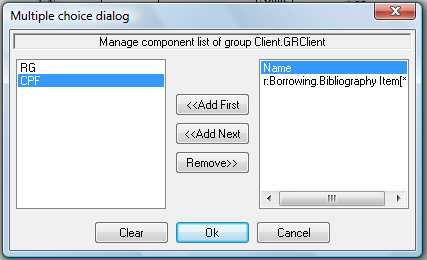
            If the cluster has the disjoint property, the new group is submitted to
            the exclusive constraint.
            If the cluster has the total property, the new group is submitted to the
            at-least-one constraint.
            If the cluster has the partition property, the new group is submitted to
            both the exclusive and the at-least-one constraints (i.e. the exactly-one
            constraint).
Entity Relationship Model – how to
Choose an attribute or a relationship type and
create the group.
Choose an entity or a relationship type and
associate the unit processing.
Os objetos que serão criados no SGBD como triggers, views, etc.Entity Relationship Model – how to
Link/association between entity and relationship types. ATENÇÃO!!!!!
Reading:
A bibliography item can appears 0 ou 1
time in the borrow event (relationship),
i.e., a bibliography item can be borrowed
or not.
A client can appears 0 ou N times in the
borrow event (relationship), i.e., a client
can borrow some (or several) items or not.
Classic view
N 1
É a notação MIN-MAX – pg. 52 – Navathe!Entity Relationship Model – how to
Mark the parent attribute
and choose, in the toolbar,
the option “First Attribute”.
Mark the attribute and
choose, in the toolbar,
the option “Next Attribute”.Building an Relation Model through an automatic mapping (1) Do not execute the mapping with the original ER model. The mapping will replace the ER model by the relational model. We cannot redo!!!!!! Create a schema copy!!!!!!!!!!!!!!!!!!!
Building an Relation Model through an
automatic mapping (2)

 Double Click!
Building an Relation Model through an
automatic mapping (3)

                                        Analysing!!!!
Relation Model -automatic mapping –
analysing ...
ER Model Relational Model
Compound
Attribute
Primary key = index!
Foreign key
“equ” – total: All
Multi-valored Bibliography items
are associated to
Attribute Samples.Relation Model -automatic mapping –
analysing ...
Relationship 1-N
ER Model Relational Model
From
Generalization
Relationship.Relation Model -automatic mapping –
analysing ...
Relationship N-M
ER Model Relational Model
equ 1-N the participation is
required.
The symbol acc (for access key)
ref 0-N the participation is not is associated with each
required identifier and each foreign key.Relation Model -automatic mapping –
analysing ...
Relationship 1-N (0-N)
With specific feature – unit processing.
ER Model
The primary
key is only one
of the foreign
keys.
Relational ModelRelation Model -automatic mapping –
analysing ...
Generalization - Specialization.
ER Model Relational Model
Ref: Foreign key – not total: Some
Bibliography Items are Periodicals,
others are Books.
If the cluster has the disjoint property, the new group is submitted to the exclusive constraint.
If the cluster has the total property, the new group is submitted to the at-least-one constraint.
If the cluster has the partition property, the new group is submitted to both the exclusive and the at-
least-one constraints (i.e. the exactly-one constraint).Text Standard
Text Standard

                Index!
Data Dictionary
Only in the text view mode.Data Dictionary
Generating the SQL Script
Generating the SQL Script

                            FIM!!
You can also read


