Electronic Visit Verification - February 19, 2019
←
→
Page content transcription
If your browser does not render page correctly, please read the page content below
Electronic Visit
  Verification
   February 19, 2019
W ELCOM E
Restroom location

HCPF Introductions

                     2
Agenda
1. Introductions

2. Brief Overview of EVV

3. Review State EVV Technology

4. Overview of State training options

5. Provider Survey Results

6. Discuss Sandata Meeting

7. Top FAQ’s

8. Open Forum

                                         3
M eeting Guidelines
We ask that you:

•   Mind E-manners

•   Identify yourself when speaking

•   Share the air

•   Listen for understanding

•   Stay solution and scope focused

                                      4
M eeting Purpose
The purpose of this meeting is to engage providers, members, and other
stakeholders as the Department works to implement EVV for community based
services offered through both the State Plan and Waivers.

And specifically to:
• Review EVV, the legislative mandate, and the scope of implementation
• Discuss EVV in more detail the State EVV Solution
• Review Provider Survey Results
• Address stakeholder concerns
• Provide a platform to gather stakeholder feedback

                                                                            5
Stakeholder Engagem ent Considerations

                                     6
W hat is EVV?
• Electronic visit verification (EVV) is a technology solution
  which electronically verifies that home and community-
  based services are actually delivered to people needing
  those services by documenting the precise time service
  begins and ends.

• Includes multiple point-of-care visit verification
  technologies, such as telephonic, mobile, web portal
  (Santrax) verification inputs

                                                                 7
W hy is EVV required?
• Section 12006 of the 21st Century Cures Act requires all state Medicaid
  agencies implement an EVV solution to manage their Personal Care
  services by January 1, 2019, and for all Home Health services by January
  1, 2023.

• States that do not implement EVV will incur a reduction of Federal
  funding.

• H.R. 6042 delays FMAP reductions from 2019 to 2020

• The Department is implementing EVV for all Colorado required services
  on January 1, 2020
                                                                          8
W hat m ust EVV Capture?
Type of service performed
Individual receiving the service
Date of the service
Location of service delivery
Individual providing the service
Time the service begins and ends
9State EVV M odel
Hybrid Model
• Colorado selected a vendor that will provide EVV solutions while
allowing all providers to choose alternative/existing EVV systems, if
they meet state specifications
10Benefits of Hybrid M odel
• Advocates for Provider and Member choice
• Providers have a no cost solution through the state if they so choose
• Providers have centralized platform to use without running their own
procurements. Alleviating burden, if they choose
• Centralized platform facilitates linking EVV with MMIS claims data
11K ey Term inologies
Term Meaning
State EVV Solution State EVV system available to
providers at no cost
Provider Choice System EVV system procured, purchased, and
used by a provider
Alternate Vendor Vendor who manages a provider choice
system
12Colorado EVV Technologies
Mobile Application Telephony
Provider Web Portal
( Santrax)
13W hich Services Require EVV?*
• Personal Care • In-Home Support Services (IHSS)
• Pediatric Personal Care • Independent Living Skills Training (ILST)
• Home Health • Physical Therapy ( provided in the home)
- RN, LPN, CNA, PT, OT, SLP • Occupational Therapy (provided in the home)
• Private Duty Nursing • Speech Therapy (provided in the home)
• Hospice • Behavioral Services (provided in the home)
• Homemaker • Pediatric Behavioral Services
• In-Home Respite • Youth Day
• Consumer Directed Attendant Support Services (CDASS) • Durable Medical Equipment (requiring in-home set up)
*Subject to change 14State EVV Solution
OverviewM obile Application : M VV
• Mobile Visit Verification (MVV): A GPS enabled mobile application
downloaded on a smartphone or tablet
• Bring your own device method that works on iPhone and Android
• GPS Enabled
• Captures location when a caregiver clocks-in/clocks-out
• No continual location reporting
• Caregivers log-in with unique Sandata ID or email address
• Preferred State technology
16M obile Application : M VV
• MVV available in Spanish, Somali, Russian, Chinese Mandarin, and
Arabic Egyptian
• Member identified through Medicaid ID or Sandata unique Client ID
• All EVV data in encrypted
• Application times out after five minutes
• Password has to be updated every 60 days
• After 5 unsuccessful log in attempts in 15 minutes the caregiver
will be locked out
17M VV in Rural Areas
• State Solution application will work in rural area
• MVV will automatically switch to “Disconnected Mode” when
smartphone is not connected to a network
• EVV data will be saved for a later transmission when the
caregiver logs-in and network connectivity (Cellular or Wi-Fi) is
established
• After 25 hours the visit data is purged
18Questions or Com m ents
Telephony (TVV)
• Each provider ID has two toll-free multi-language numbers
• Both numbers are accessible 24 hours a day, 7 days a week
• Non-GPS option
• Client phone is preferred for TVV
• Location captured through ANI technology
• Member identified by Sandata Client ID
• Caregivers identified by Sandata ID
20Questions or Com m ents
Provider Portal
• Used for visit maintenance and administrative tasks
• Limited capacity for manual entry of EVV data
• Used by Providers who utilize State EVV Solution
• View and verify visits
• Address expectations or errors
• Audit information
22Ex ceptions in State System
In Visit Maintenance, exceptions are created when the EVV system
identifies a missing data element or incomplete information
For each exception, the following have been defined:
• “Fix” – must be fixed for the visit to be considered complete
• “Ack” – visit must be acknowledged by a system user to be
considered complete
• “Disabled” – Exceptions can be disabled by the Department. They
will not be shown in Visit Maintenance or require attention for a visit
to be complete
23Reason Codes
• When an EVV visit is manually added, changed, or fixed a
provider agency must associate a reason code with the visit
• Reason codes are associated with the manual changes to visits to
address why the changed occurred
• There is also the ability to add a note for additional clarification
when reason codes are selected
24Reason Code Description Note Required?
Member Santrax ID/Medicaid ID not N
entered
Staff forgot to clock in/clock out N
Wrong service selected N
Wrong member selected N
Service not selected N
Member not home N
Member refused services N
Cell phone not charged N
Sandata mobile application problems N
No cell coverage N
TVV - Phone disconnected N
TVV - Phone in use by N
Member/family
Other Y
25Questions or Com m ents
Setting Up Sandata Account
For Providers who have over 80
members, the EVV State Solution
vendor, Sandata, will provide a
one-time batch upload of member
and caregiver information.
27Data Aggregator • Provider Choice systems must connect to the Data Aggregator • Providers using Provider Choice systems may view visit data • Providers will have unique identifier to log-in
Questions
   or
Com m ents
Electronic Visit
 Verification
Roadmap 2019
Project                     Develop
               Kickoff                       and              Develop
                                                              Colorado             Collect              User
                                           Finalize                              Stakeholder
                2018                       Training
                                                             Rules and
                                                             Regulation           Feedback         Acceptance
                                             Plan              Draft             on EVV CCR         Testing

Electronic Visit                                                                                                     State
                                                                                                                    System
Verification                                                                                                          and
                                                                                                                   Aggregator
Implementation               Release
                            Technical                                     Configure               Collect
                                                                                                Stakeholder
                                                                                                                      Live
                                                  Provider                 CDASS
Roadmap                   Specifications
                           for Provider           Training                Module and
                                                                          Scheduler
                                                                                                Feedback on
                                                                                                 CDASS and
                                                                                                 Scheduler
                              Choice
                             Systems
 2018-2020     Test
             Provider
              Choice
             Systems
                                                                                           Continued
                         Provider                                 Begin                  stakeholder             Go Live
                        Access to             Provider                                   feedback for           Mandatory
                          State                                    Soft                   system and
                                                                                                                   Use
                         System               Training           Launch
                                                                                              policy
                                                                                        improvements
                                                                                            for 2020              2020
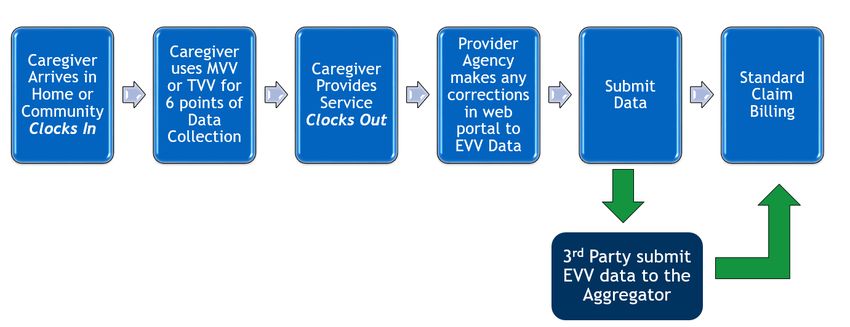
EVV GO-Live Corresponding Process
32EVV Process High Level Ex am ple
33Provider Survey
Finalized ResultsQuick Facts on Provider Survey Response
Rate: 613
• 70% of Providers reported having between 0-20 direct care workers
• 60% of Providers were not familiar with the requirements of the Cures Act
• Providers main concern is how EVV may disrupt billing
• Majority of providers reported they currently do not utilize an EVV system
• Providers preferred training method is Independent eLearning
• Low stakeholder engagement reported
• Providers indicate support is needed to decide on State EVV Solution vs. Provider
Choice System
35Questions
Subcom m ittee
  Updates
Subcom m ittee Updates
 Training/Communication

 System

 Privacy

 Participant Directed

                          38
Training Overview
Provider Training for State EVV Solution
• A “Train-the-Trainer” model for agencies will be offered through the
  Department's EVV vendor.

• This training model allows for a few individuals knowledgeable about the
  business to attend training then take the information learned back to the office
  and train the other staff.

• The “trainer” can then train provider agency staff utilizing training materials
  provided by the State EVV vendor.

• The Department recommends at least one of the individuals who attends
  training be an administrator.

                                                                                     40
Types of Training Offered
Instructor Led Classroom Training
Instructor Led Web-Based
“Webinar” Training
Independent Web-Based Training
41I nstructor Led Classroom Training
• This is an in-depth, hands-on review of the EVV environment, including
features, structure, limitations and requirements.
• Classroom training is in a computer lab setting where each participant has a
dedicated computer.
• Classroom sessions can accommodate up to 30 participants per session.
Duration: Approximately seven hours
Participation: Limited to two people per provider ID
Training is restricted to agency staff.
42I nstructor Led W ebinars
• These sessions cover the same content delivered in the classroom session, in
three (3) two-hour sessions.
• Participants attend from a remote location, using their own computer with
internet access.
• Webinars can accommodate up to 70 attendees per session.
Duration: Approximately three (3) two-hour sessions
Participation: Limited to two people per provider ID.
Training is restricted to agency staff.
43I ndependent W eb-based Training
• This method allows a training participant to independently access online role-
specific training materials.
• The materials are available 24 hours a day, seven days a week, which may be
more convenient for provider with busy schedules.
• Independent Web-based Training can be a great resource as a training
refresher or a way to train new providers.
Duration: Self-paced, based on role
Participation: Unlimited
44Questions
Sandata      M eeting Confirm ed

                When:
            March 19,2019

               Where:
              EVV General
          Stakeholder Meeting

                                   46
Departm ent Deliverables
Contract executed with DXC
Held kickoff meeting with DXC and Sandata
Confirmed Service List
Provider Survey
EVV FAQ
Updated EVV Implementation Timeline
Provider Choice System Technical Specifications
EVV Service Code List
47Top FAQ’S
1. How does a Provider agency know if EVV applies to them?
2. How much time does a provider agency have to decide if they will
use the state system?
3. Do members need a phone for telephony to work?
4. How will the mobile app work in rural environments?
48Nex t Steps
• Develop Updated EVV Timeline
• Develop Outreach Materials (i.e. Service Codes)
• Next Stakeholder Meetings:
- Participant Directed: February 26, 2019
- Training/Communications: February 27, 2019
• Sandata at March Stakeholder Meeting
49Your Feedback M atters
50Contact
Danielle Walker
303.866.6265
EVV@state.co.us
51You can also read


