Recognition of handwritten Roman Numerals using Tesseract open source OCR engine
←
→
Page content transcription
If your browser does not render page correctly, please read the page content below
Proc. Int. Conf. on Advances in Computer Vision and Information Technology (2009) 572-577

        Recognition of handwritten Roman Numerals using
                Tesseract open source OCR engine
                           Sandip Rakshit 1, Amitava Kundu2 , Mrinmoy Maity2,
                           Subhajit Mandal2 , Satwika Sarkar2, Subhadip Basu 2 #
                             1
                              Techno India College of Technology, Kolkata, India
                2
                    Computer Science and Engineering Department, Jadavpur University, India
                                 #
                                     Corresponding author. E-mail: subhadip@ieee.org

Abstract: The objective of the paper is to recognize handwritten samples of Roman numerals using Tesseract open
source Optical Character Recognition (OCR) engine. Tesseract is trained with data samples of different persons to
generate one user-independent language model, representing the handwritten Roman digit-set. The system is
trained with 1226 digit samples collected form the different users. The performance is tested on two different
datasets, one consisting of samples collected from the known users (those who prepared the training data samples)
and the other consisting of handwritten data samples of unknown users. The overall recognition accuracy is
obtained as 92.1% and 86.59% on these test datasets respectively.

                                                             key aspects of handwritten character recognition
                1. INTRODUCTION                              systems. Tesseract is one such OCR engine covered
                                                             under open source Apache licence 2.0, designed for
    Any Optical Character Recognition (OCR) system           recognition of printed characters of any script.In the
eases the barrier of the keyboard interface between          current work, instead of developing a new handwritten
man & machine to a great extent, and help in office          OCR engine from scratch, we have used Tesseract 2.01
automation with huge saving of time and human effort.        for recognition of handwritten numerals Roman script.
Such a system allows desired manipulation of the             Tesseract OCR engine provides high level of
scanned text as the output is coded with ASCII or            recognition accuracy on poorly printed or poorly
some other character code from the paper based input         copied dense text. In one of our earlier works [9], we
text. For a specific language based on some alphabet,        had developed a system for estimation of recognition
OCR techniques are either aimed at printed text or           accuracy of Tesseract OCR engine on handwritten
handwritten text. The present work is aimed at the           character samples of lower case Roman script collected
later.                                                       from a single user. The performance of this OCR
    Handwritten digit recognition is one of benchmark        engine was also tested extensively on handwriting
problem of research for the pattern recognition              samples of multiple users in [10]. With these findings
community. In general, OCR systems have potential            we can say that Tesseract open source Ocr Engine can
applications in extracting data from filled in forms,        be suitably tested and trained for recognition of
interpreting handwritten addresses from postal               handwritten characters as well.
documents for automatic routing, automatic reading of           In the current work, training samples are collected
bank cheques etc. The key component of such                  from three different users to generate a single user
application software is an OCR engine, enabled with          model for handwritten Roman numerals .The trained
the key functional modules like line extraction, line-to-    model is tested on fresh samples of the same users(who
word segmentation, word-to-character segmentation,           participated in the preparation of the training samples )
character recognition and word-level lexicon analysis        and also on handwritten samples of different other
using standard dictionaries.                                 users. The objective of the work is to test the
    Development of an effective handwritten OCR              generality of the Tesseract OCR engine for recognition
engine with high recognition accuracy is a still an open     of digit patterns of handwritten Roman numerals using
problem for the research community. Lot of research          a user independent language model.
efforts have already been reported [1-8] on different
Proc. Int. Conf. on Advances in Computer Vision and Information Technology (2009) 572-577
2. OVERVIEW OF THE TESSERACT OCR 3. THE PRESENT WORK
ENGINE
In the current work, Tesseract 2.01 is used for
Tesseract is an open source (under Apache License recognition of handwriting samples of Roman
2.0) offline optical character recognition engine, numerals using an user independent language set . Key
originally developed at Hewlett Packard from 1984 to functional modules of the developed system are
1994. Tesseract was first started as a research project discussed the following sub-sections.
in HPLabs, Bristol [11-12]. In the year 1995 it is sent
to UNLV where it proved its worth against the 3.1. Collection of the dataset
commercial engines of the time [13]. In the year 2005
Hewlett Packard and University of Nevada, Las Vegas, For collection of the dataset for the current
released it. Now it is partially funded by Google [14] experiment, we have concentrated on hand written
and released under the Apache license, version 2.0. digits of Roman script only. Six handwritten document
The latest version, Tesseract 2.03 is released in April, pages were collected from the three different users. For
2008. In the current work, we have used Tesseract each user, two pages from each total six pages are
version 2.01, released in August 2007. collected for preparing the training set for the testing
Like any standard OCR engine, Tesseract is purposes, we have considered two types of users i.e
developed on top of the key functional modules like, known users and unknown users. Known users are the
line and word finder, word recognizer, static character persons who participated in preparation of the training
classifier, linguistic analyzer and an adaptive classifier. samples.For known user we consider two pages
However, it does not support document layout constituting the test dataset-1 (TD1)and for unknown
analysis, output formatting and graphical user user we consider three pages, i.e. the test dataset-2
interface. Currently, Tesseract can recognize printed (TD2).
text written in English, Spanish, French, Italian,
Dutch, German and various other languages.
As for example to train Tesseract in English
language 8 data files are required in tessdata sub
directory. The 8 files used(also called a language set)
for English are to be generated as follows:
tessdata/eng.freq-dawg
tessdata/eng.word-dawg
tessdata/eng.user-words
tessdata/eng.inttemp
tessdata/eng.normproto
tessdata/eng.pffmtable
tessdata/eng.unicharset (a) (b)
tessdata/eng.DangAmbigs
Fig. 1(a-b). Sample document pages containing
training sets of isolated characters and free flow text
Frequency Distribution
140
120
100
frequency
Training Data
80
Test Data for known user
60
Test Data for Unknown User
40
20
0
0 1 2 3 4 5 6 7 8 9
Digit label
Fig. 2. Frequency distribution of different character samples during trainingProc. Int. Conf. on Advances in Computer Vision and Information Technology (2009) 572-577
The training dataset contains around 1226 samples the training process, discussed below, to create a new
of isolated Roman digits collected from three different language set. Then use Tesseract again using the newly
users .The test dataset 1 and test dataset 2 consists of created language set to label the rest of the box files
249 and 349 samples respectively collected from the corresponding to the remaining training images using
known and the unknown users, the frequency of the process discussed in section 3.2.
different digit samples in the training set and the two For each of our training image, boxfile pairs, run
test sets is shown in Fig. 2. Tesseract in training mode using the following
command:
3.2. Labeling training data
tesseract fontfile.tif junk nobatch box.train
For labeling the training samples using Tesseract
we have taken help of a tool named bbTesseract [14]. The output of this step is fontfile.tr which contains
To generate the training files for a specific user, we the features of each character of the training page. The
need to prepare the box files for each training images character shape features can be clustered using the
using the following command: mftraining and cntraining programs:
tesseract fontfile.tif fontfile batch.nochop makebox mftraining fontfile_1.tr fontfile_2.tr ...
The box file is a text file that includes the characters in This will output three data files: inttemp , pffmtable
the training image, in order, one per line, with the and Microfeat, and the following command:
coordinates of the bounding box around the image.
The new Tesseract 2.01 has a mode in which it will cntraining fontfile_1.tr fontfile_2.tr ...
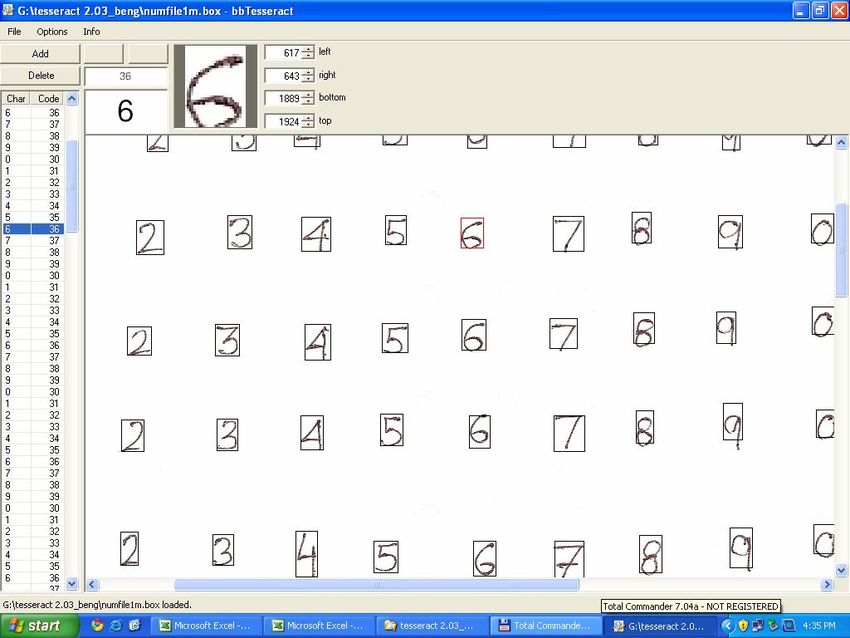
output a text file of the required format. Some times
the character set is different to its current training, it This will output the normproto data file. Now, to
will naturally have the text incorrect. In that case we generate the unicharset data file, unicharset_extractor
have to manually edit the file (using bbTesseract) to program is used as follows:
correct the incorrect characters in it. Then we have to
rename fontfile.txt to fontfile.box. Fig. 3 shows a unicharset_extractor fontfile_1.box fontfile_2.box ...
screenshot of the bbTesseract tool.
Tesseract uses 3 dictionary files for each language.
Two of the files are coded as a Directed Acyclic Word
Graph (DAWG), and the other is a plain UTF-8 text
file. To make the DAWG dictionary files a wordlist is
required for our language. The wordlist is formatted as
a UTF-8 text file with one word per line. The
corresponding command is:
wordlist2dawg frequent_words_list freq-dawg
wordlist2dawg words_list word-dawg
The third dictionary file name is user-words and is
usually empty. The final data file of Tesseract is
DangAmbigs file. This file cannot be used to translate
characters from one set to another. The DangAmbigs
file may be empty also.
Fig. 3. A sample screenshot of a segmented training
Now we have to collect all the 8 files and rename
page using the bbTesseract tool
them with a lang. prefix, where lang is the 3-letter code
for our language and put them in our tessdata
3.3. Training the data using Tesseract OCR engine
directory. Tesseract can then recognize text in our
language using the command:
For training a new handwritten character set for any
user, we have to put in the effort to get one good box
tesseract image.tif output -l lang
file for a handwritten document page, run the rest ofProc. Int. Conf. on Advances in Computer Vision and Information Technology (2009) 572-577
4. EXPERIMENTAL RESULTS
For conducting the current experiment, the training
set is generated from isolated handwritten digit
samples of three different users.As mentioned earlier ,
the test samples are collected in two datasets TD1 and
TD2.All the samples are digitized using a flatbed
scanner of resolution 300 dpi.
To estimate the performance of the present
technique the following expression is developed.
Recognition accuracy = (Ct / (Cm + Cs))*100
B B B B B B
where Ct = the number of character segments
B B
producing true classification result and Cm = the B B
number of misclassified character segments and Cs B
signifies the number of character Tesseract fails to
B
segment, i.e., producing under segmentation. The
rejected character/word samples are excluded from
computation of recognition accuracy of the designed
system.
To evaluate the generality of recognition capability
of Tesseract OCR Engine over handwritten samples of
different users, a single language set is prepared from
all the training samples. The performance is tested on
two different test datasets, viz., TD1 and TD2. Table-1
shows an analysis of recognition performance of the
user independent dataset on the test data .As observed
from the experiment, the overall recognition
accuracy(excluding rejection samples) is obtained as
92.1% and 86.59% for TD1 and TD2 respectively. The
rejection rates for the two datasets are observed as
10.4% and 10.8% respectively.
Table 1. Classification results on the test dataset
Data set Total Misclass- Rejec- Success
characters ification tions
TD1 249 20 26 92.1
TD2 349 39 38 86.59
The reason behind high rejection rate of
handwritten digit samples is because of the inability of
Tesseract to segment digit samples into unique
rectangular regions. Since these errors does not
contribute to the recognition efficiency of the
Tesseract OCR engine, we have excluded those
samples from estimating the success rate of the user-
independent language set for recognition of isolated
handwritten Roman digit samples.
5. CONCLUSION
As observed from the experimental results,
Tesseract OCR engine fares reasonably with respect toProc. Int. Conf. on Advances in Computer Vision and Information Technology (2009) 572-577
the core recognition accuracy on user-independent Problem”, IEEE Trans. Pattern Analysis and Machine
handwritten samples of Roman numerals. The Intelligence, vol. 20,pp 1016-1023, 1998.
performance of the system is validated on sample [3] A. Amin “Off-Line Arabic Character Recognition: The
datasets of known and unknown users. A major State of the Art”, Pattern Recognition, vol. 31, No. 5.
pp. 517-530, 1998.
drawback of the current technique is its failure to avoid [4] B. B. Chaudhuri and U. Pal, “A Complete Printed
segmentation errors in some of the digit samples. The Bangla OCR System”, Pattern Recognition, vol. 31, No.
performance of the designed system may be improved 5. pp. 531-549, 1998.
by incorporating more training samples, collected from [5] S. Basu, C. Chawdhuri, M. Kundu, M. Nasipuri, D. K.
users of varying age groups and professions. The Basu, “A Two-pass Approach to Pattern Classification”,
system may further be extended for user-specific/user- N.R. Pal et.al. (Eds.), ICONIP, LNCS 3316, pp. 781-
independent recognition of handwritten characters of 786, 2004.
different Indic script. [6] Sargur Srihari, Anantharaman Ganesh, Catalin Tomai,
In a nutshell, the developed technique shows Yong-Chul Shin, and Chen Huang, “Information
Retrieval System for Handwritten Documents”, DAS
enough promise in using an open source OCR engine
2004, LNCS 3163, pp. 298–309, 2004.
for recognition of handwritten numerals of Roman [7] G. Nagy, “At the frontiers of OCR”, Proc. IEEE 80(7),
script with a fairly acceptable accuracy. IEEE, USA, Jul 1992, pp 1093-1100.
[8] I. Marosi, “Industrial OCR approaches: architecture,
ACKNOWLEDGEMENTS algorithms and adaptation techniques”, Document
Recognition and Retrieval XIV, SPIE Jan 2007, 6500-
One of the authors, Mr. Sandip Rakshit is thankful 01.
to the authorities of Techno India College of [9] S. Rakshit, S. Basu, “Recognition of Handwritten
Roman Script Using Tesseract Open source OCR
Technology for necessary supports during the research
Engine,” in proc. of National Conference on NAQC-
work. Dr. Subhadip Basu is thankful to the “Center for 2008, pp. 141-145, Kolkata.
Microprocessor Application for Training Education [10] S.Rakshit, S. Basu, “Development Of A Multi-User
and Research”, “Project on Storage Retrieval and Handwriting Recognition System Using Tesseract Open
Understanding of Video for Multimedia” of Computer Source Ocr Engine” in proc. of the International
Science & Engineering Department, Jadavpur conference on C3IT-2009, pp.240-247.
University, for providing infrastructure facilities [11] R.W. Smith, “The Extraction and Recognition of Text
during progress of the work. from Multimedia Document Images,” PhD Thesis,
University of Bristol, November 1987.
[12] R. Smith. An overview of the Tesseract OCR engine. In
REFERENCES
ICDAR’2007, International Conference on Document
[1] R.M. Bozinovic and S.N. Srihari, “Off-line Cursive Analysis and Recognition, Curitiba, Brazil, Sept. 2007.
Script Word Recognition”, IEEE Trans. Pattern [13] S.V. Rice, F.R. Jenkins, T.A. Nartker, The Fourth
Analysis and Machine Intelligence, vol. 11,pp 68-83, AnnualTest of OCR Accuracy, Technical Report 95-03,
1989. InformationScience Research Institute, University of
[2] P.K. Wong and C. Chan, “Off-line Handwritten Chinese Nevada, Las Vegas,July 1995.
Character Recognition as a Compound Bays Decision [14] http://code.google.com/p/tesseract-ocrYou can also read


