University of Johannesburg - UNDERGRADUATE PROGRAMMES - 2019 FACULTY OF EDUCATION
←
→
Page content transcription
If your browser does not render page correctly, please read the page content below
FACULTY OF EDUCATION
UNDERGRADUATE
PROGRAMMES
2019
The primary school teacher
       education programme is
      integrated with students’
        practice over four years
      in the UJ-founded, Funda
        UJabule School. This is
    unique in the country. At this
    school students observe how
     children develop, they work
    closely with teachers and are
        mentored by teachers.

Education

2                                    UNIVERSITY OF JOHANNESBURG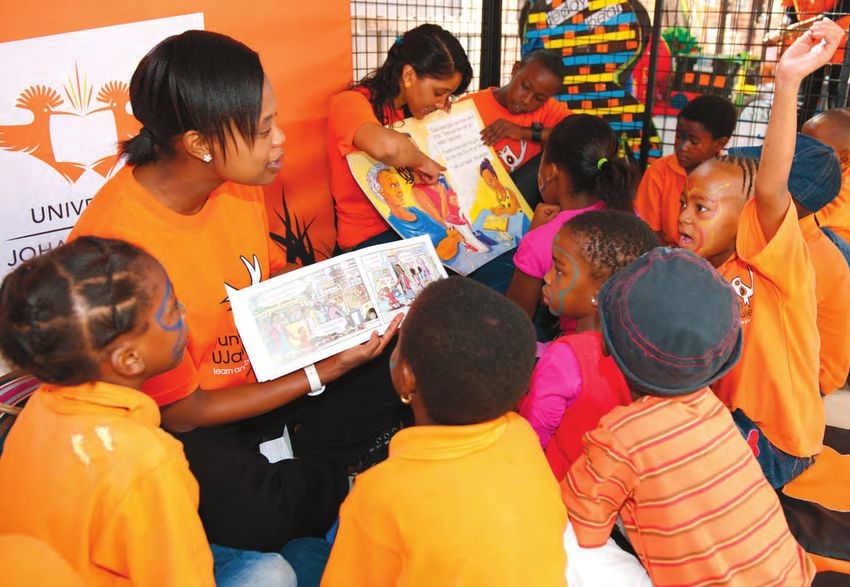
The Faculty of Education at UJ is committed to
knowledge making for 21 century education. To
this end the Faculty offers initial teacher education
programmes (Bachelor of Education degrees).
Teacher education for primary school teaching
BEd in Foundation Phase Teaching (Grades R-3)
BEd in Intermediate Phase Teaching (Grades 4-7)
Teacher education for secondary school teacher education
BEd in Senior Phase and FET Teaching (Grades 7-12)
In addition to the BEd in Senior Phase and FET teaching a
second route is available for graduates who are interested in
teaching at the secondary school level. This programme is
the Postgraduate Certificate in Education (PGCE).
PGCE (Further Education and Training Teaching)
(Grade 10-12)
PGCE: (Senior Phase & Further Education and
Training Teaching) (Grade 7-12)
Through its teacher education programmes, the Faculty strives
to prepare teachers who are caring, accountable and critically
reflective about the who, what, how and why of teaching in
a diversity of contexts. Through integrating coursework at
the University and practicum at schools the Faculty creates
learning opportunities for student-teachers to acquire
a thorough understanding of learning and development
in childhood/adolescence
sound subject knowledge
an understanding of contextual factors that impact
learning and schooling
an appreciation of the demands of the teaching profession
a repertoire of teaching strategies and skills
a reflective stance towards teaching.
The primary school teacher education programmes are
unique in the country. The coursework is integrated with
practical experience over four years in the UJ founded,
Funda UJabule School. At this school, which is situated on
the Soweto campus, students observe how children learn
and develop, they work closely with teachers and they are
mentored by the teachers.
Disclaimer: Due to limited space, fulfilling all the
minimum entry requirements does not guarantee
acceptance into a programme.
2019 UNDERGRADUATE PROGRAMMES 3
English as a first or second
                                                                                                                    additional language
                                      Qualification Code

                                                                             home language
                                                            Minimum APS
                 PROGRAMME

                                                                             English as a

                                                                                                                                                                                              CAMPUS
                                                                                                                                                                      CAREER
                                                                                                  AND/OR
    DEGREE PROGRAMMES FOR PRIMARY SCHOOL TEACHING
    BEd Degree in Foundation Phase Teaching (4 years)
    FOUNDATION PHASE                B5BFPQ                   26           5 (60%+)                 OR            6 (70%+)                           Educator focusing on                      SWC
    TEACHING                                                                                                                                        primary school teaching
    GRADE R-3
    BEd Degree in Intermediate Phase Teaching (4 years)
    INTERMEDIATE PHASE              B5BITQ                   26           5 (60%+)                 OR            6 (70%+)                           Educator focusing on                      SWC
    TEACHING                                                                                                                                        primary school teaching
    GRADE 4-7

                                                                                                                    English as a first or second
                                                                                                                    additional language
                                      Qualification Code

                                                                             home language
                                                            Minimum APS
                 PROGRAMME

                                                                             English as a

                                                                                                                                                                                              CAMPUS
                                                                                                                                                                      CAREER
                                                                                                  AND/OR

    DEGREE PROGRAMMES FOR HIGH SCHOOL TEACHING
    BEd Degree in Senior Phase and Further Education and Training (Grade 8-12) – LIFE ORIENTATION
    PSYCHOLOGY                      B5LOPQ                   26           5 (60%+)                 OR            6 (70%+)                           Educator focusing on                      APK
                                                                                                                                                    high school teaching
                                                                                                           English as a first or
                                      Qualification Code

                                                                                                           second additional
                                                                           English as a home
                                                           Minimum APS

                                                                                                                                                                               Mathematical
                 PROGRAMME

                                                                                                                                                     Mathematics
                                                                           language

                                                                                                           language

                                                                                                                                                                                              CAMPUS
                                                                                                                                                                               Literacy
                                                                                               AND/OR

                                                                                                                                                                    AND/OR

    BEd Degree in Senior Phase and Further Education and Training (Grade 8-12)
    – BUSINESS AND MANAGEMENT STUDIES
    ACCOUNTING                      B5BSAQ                 26             5(60%+)              OR          6 (70%+)                                4 (50%)           –             –          APK
    BUSINESS MANAGEMENT             B5BSBQ                 26             5(60%+)              OR          6 (70%+)                                4 (50%)          OR         6 (70%)        APK
    ECONOMICS                       B5BSEQ                 26             5(60%+)              OR          6 (70%+)                                4 (50%)           –             –          APK
    CAREER: Educator focusing on high school teaching

4                                                                                                                                                                  FACULTY OF EDUCATION
English as a first or second
additional language
Qualification Code
home language
Minimum APS
PROGRAMME
English as a
Afrikaans
CAMPUS
CAREER
AND/OR
AND/OR
BEd Degree in Senior Phase and Further Education and Training (Grade 8-12)
– LANGUAGE EDUCATION
AFRIKAANS B5LAFQ 26 OR AND Educator APK
5 (60%)
6 (70%+)
4 (50%+)
focusing on
high school
teaching
ENGLISH B5LAEQ 26 OR – – APK
5 (60%)
6 (70%+)
ISIZULU B5LAZQ 26 OR – – APK
5 (60%)
6 (70%+)
IsiZulu must be your
home language
SEPEDI B5LASQ 26 OR – – APK
5 (60%)
6 (70%+)
Sepedi must be your
home language
English as a first or
Qualification Code
second additional
English as a home
Physical Sciences
Minimum APS
Mathematical
PROGRAMME
Mathematics
Life Sciences
Geography
language
language
CAMPUS
Literacy
AND/OR
AND/OR
AND/OR
AND/OR
BEd Degree in Senior Phase and Further Education and Training (Grade 8-12)
– GEOGRAPHY, LIFE SCIENCES, MATHEMATICS EDUCATION AND PHYSICAL SCIENCES
GEOGRAPHY B5SGEQ 26 APK
5 (60%+)
6 (70%+)
4 (50%+)
OR
6 (70%+)
OR
3 (40%+)
OR
3 (40%+)
AND
3 (40%+)
LIFE SCIENCES B5SLSQ 26 – – APK
5 (60%+)
6 (70%+)
4 (50%+)
OR
6 (70%+)
AND
4 (50%+)
OR
4 (50%+)
MATHEMATICS B5SMMQ 26 – – – – – – APK
5 (60%+)
6 (70%+)
4 (50%+)
OR
6 (70%+)
PHYSICAL B5SPSQ 26 – – – – – – APK
5 (60%+)
6 (70%+)
4 (50%+)
AND
4 (50%+)
SCIENCE
CAREER: Educator focusing on high school teaching
2019 UNDERGRADUATE PROGRAMMES 5
POSTGRADUATE CERTIFICATE IN EDUCATION (PGCE)
Though this is noted as a postgraduate qualification it still forms part of the initial preparation for
teachers, thus listed in this undergraduate prospectus. There are two options to choose from as listed
below. The PGCE is offered over two years for part time study and one year for full time study.
PGCE (Further Education and Training Teaching)
Qualification code: A5FTTQ
Campus: Auckland Park Kingsway Campus (APK)
Admission requirements: A first degree on level 7 with a minimum of 360 credits with two school
related subjects, one on second year level and one on third year level. Assessment of prior learning
could also lead to entry or an advanced credit standing.
NOTE: The Postgraduate Certificate in Further Education and Training Teaching consists of three one-year modules with the
following options:
Education and Teaching Studies plus specialisation in two Teaching Methodology and Practicum modules in FET Teaching.
Education and Teaching Studies plus specialisation in one Teaching Methodology and Practicum module in FET Teaching
and one support specialisation.
Education and Teaching Studies plus specialisation in one Teaching Methodology and Practicum module in FET Teaching
and one research project.
Students should have sufficient knowledge of the disciplines underpinning the specific teaching
specialisations (subjects) to teach that particular school subject. All methodologies listed are offered
subject to a minimum of 10 student registrations.
Methodologies associated to this qualification
Accounting Life Sciences Geography IsiZulu Visual Arts Engineering and Design
Business Studies Physical Sciences English Sepedi History Electrical Engineering
Economics Mathematics Afrikaans Design Arts Civil Technology Mechanical Engineering
Support methodologies associated to this qualification
Information and Communication Technology
Physical Education
Research associated to this qualification
History Research
PGCE (Senior Phase & Further Education and Training Teaching)
Qualification code: A5SFTQ
Campus: Auckland Park Kingsway Campus (APK)
Admission requirements: A first degree on level 7 with a minimum of 360 credits with two school
related subjects, one on third year level and one on first year level. An approved National Diploma on
level 6 with a minimum of 360 credits from an accredited higher institution with two school related
subjects, one on second year level and one on third year level. Assessment of prior learning could
also lead to entry or an advanced credit standing.
NOTE: PGCE (Senior Phase & FET Teaching) consists of three one-year modules with the following options:
Education and Teaching Studies
Teaching Methodology and Practicum A in Senior Phase
Teaching Methodology and Practicum B in FET Phase Teaching
The latter two modules focus on student’s Pedagogical Content Knowledge
Students should have sufficient knowledge of the disciplines underpinning the specific teaching
specialisations (subjects) to teach that particular school subject. All methodologies listed are offered
subject to a minimum of 10 student registrations.
6 FACULTY OF EDUCATION
Methodologies associated to this qualification
Accounting Life Sciences Geography IsiZulu Visual Arts Engineering and Design
Business Studies Physical Sciences English Sepedi History Electrical Engineering
Economics Mathematics Afrikaans Design Arts Civil Technology Mechanical Engineering
Technology Business and Natural Arts and Culture Social Sciences Languages: English OR
Management Sciences Afrikaans OR IsiZulu
Studies OR Sepedi
ADMISSION REQUIREMENTS for the BEd programmes
A valid National Senior Certificate (NSC) with admission for degree purposes.
Minimum APS of 26, excluding Life Orientation.
A Bachelor’s degree endorsement (the minimum entry requirements to study towards a degree) does not guarantee
admission to the BEd.
Preliminary admission is based on the results obtained in the final Grade 11 examination.
Final admission is based on the final Grade 12 results.
ADMISSION REQUIREMENTS: National Certificate (vocational) (NCV)
Subject to institutional admission requirements, the minimum admission requirement to Bachelor’s degree programme is a
National Certificate (Vocational) Level 4 issued by the Council for General and Further Education and Training. The minimum
legislative requirements for admission to a Bachelors’ degree include the achievement of:
Three (3) fundamental subjects between 60-69% – including English as language of learning and teaching.
Three vocational subjects from the designated list between 70-79%.
ADMISSION REQUIREMENTS for applicants holding the National Senior Certificate
for Adults (NASCA) or the Amended Senior Certificate (ASC) for qualifications in the
Faculty of Education.
The B-degree endorsement is a legal requirement to be admitted into the undergraduate programmes in the Faculty
of Education. Thus for both the NASCA and ASC for admission to a programme in the Faculty of Education the Senate
Discretionary Approval process will be followed.
Applications will be dealt with by the Faculty Teaching and Learning Committee for recommendation to the Faculty Board.
Faculty Board will then refer the approved applications to Senate for Senate Discretionary approval.
2019 UNDERGRADUATE PROGRAMMES 7
ADDITIONAL INFORMATION
Bachelor of Education in Foundation Phase Teaching
PURPOSE OF THE PROGRAMME
The purpose of the qualification is to deliver professionally qualified beginner teachers for the
foundation phase. This is done by providing student teachers with a well-rounded education that
equips them with the required subject content knowledge base, teaching competence, a sound
and nuanced understanding of the integrated nature of theory and practice in education and the
context of the teaching profession in South Africa. The programme focuses specifically on child
development, literacy, numeracy (mathematics) and the knowledge that underpins life skills.
OUTCOMES OF THE PROGRAMME
Students who complete this programme will be able to:
•   Teach the foundation phase curriculum (numeracy, literacy and life-skills) proficiently
•   Use advanced literacy skills for teaching
•   Support and nurture learning and development in diverse educational contexts.
•   Identify and address barriers to learning in the early years of schooling
•   Teach literacy in English and Sotho or IsiZulu (as first language and additional language).
•   Formulate a personal teaching philosophy and critically reflect on their teaching philosophy and
    how it relates to teaching conduct.

8                                                                              FACULTY OF EDUCATION
INTERNATIONAL STUDENTS
Please note that a separate process is followed for international students. In addition to the
above-mentioned, a study permit and medical insurance certificate must be produced. Contact the
International Office at: 011 559 3129.

DURATION OF THE PROGRAMMES: 4 YEARS FULL-TIME STUDY ONLY.
CURRICULUM (All modules are compulsory)

 FIRST YEAR OF STUDY

 First Semester Modules                                Second Semester Modules
 Education Studies 1A                                  Education Studies 1B
 Teaching Studies 1A                                   Teaching Studies 1B
 Introduction to Zulu for the Foundation Phase 1A OR   Zulu for the Foundation Phase 1B O Sotho for the
 Introduction to Sotho for the                         Foundation Phase 1B
 Foundation Phase 1A
 Mathematics for the Foundation Phase 1A               Mathematics for the Foundationc Phase 1B
 Teaching Methodology and Practicum 1A                 Teaching Methodology and Practicum 1B
 English for the Foundation Phase 1A                   English for the Foundation Phase 1B
                                                       Culture and the Natural Environment for the
                                                       Foundation Phase

Special notes:
• For the module Introduction to Zulu/ Sotho for the Foundation Phase the following applies:
  Students, who pass a proficiency test in Zulu/Sotho, may enrol for a suitable module in another
  program offered on the SWC or for a module in the BEd Intermediate Phase.
• Teaching methodology and practicum are integrated. This implies that students will engage
  in learning from practice, learning in practice and learning from service, aiming at developing
  specialised pedagogical content knowledge and teaching competence in each subject area.
• The students spend on a regular basis time in the teaching school linked to the University on the
  UJ Soweto Campus. They engage in structured observation and progressively take up limited
  classroom assistance and teaching responsibilities. This allows for continuous integration of
  theory and practice. The fourth year of the programme will strongly focus on developing the
  student teacher as reflective practitioner. During their fourth year students will be placed at
  different schools on the list of approved schools for Work Integrated Learning (WIL). During their
  placements in schools they will not only take on teaching responsibilities, but they will also do
  assignments which will require the demonstration of integrated and applied knowing. These
  assignments will form the basis for engaging in critical reflection during coursework on campus.
• The curriculum does not include the development of basic ICT competence as fundamental
  learning. Students who do not pass a basic ICT competency test will be required to attend
  compulsory ICT skills training.

2019 UNDERGRADUATE PROGRAMMES                                                                             9
PRACTICUM WHICH INCLUDES WIL
 Study         Duration      Assessment
 period

 First Year    2 weeks       Practicum which includes WIL and service learning amounts to 2 weeks. The WIL at
                             schools consists mainly of structured observation, linked to assignments which are
                             formally assessed.
 Second Year   2 weeks       Practicum which includes WIL and service learning amounts to 2 weeks. The WIL at
                             schools consists mainly of structured observation, linked to assignments which are
                             formally assessed.

 Third Year    6 weeks       Practicum which includes WIL and Service learning amounts to 6 weeks. During WIL at
                             schools students take up teaching responsibilities which are formally assessed by their
                             teacher mentors and also by staff. Students also submit assignments which are formally
                             assessed.

 Fourth Year   10 weeks      During WIL at schools students take up teaching responsibilities which are formally
               at selected   assessed by the teacher mentors and also by staff. Students also submit assignments
               schools       which are formally assessed.

WHAT FINANCIAL SUPPORT IS AVAILABLE?
The Funza Lushaka Bursary Programme for Teachers enables students of high academic potential
and commitment to undertake initial teacher education and upon qualification to enter the service
of provincial departments of education. The bursaries are designed to help meet the national need
for high calibre teachers in priority areas.
For more information please visit www.funzalushaka.doe.gov.za.
The National Student Financial Aid Scheme (NSFAS) may be contacted at
011 559 3642/3906 on the Auckland Park Kingsway Campus (APK) and
011 559 5507/5509 on the Soweto Campus (SWC).
Email: nsfas@uj.ac.za, www.bursaries.co.za
HOW CAN I APPLY?
Please apply online at www.uj.ac.za/apply
FACULTY CONTACT DETAILS
Auckland Park Kingsway Campus 011 559 3251
Soweto Campus 011 559 5562
Email eduqueries@uj.ac.za / eduqueriesapk@uj.ac.za
Website www.uj.ac.za/edu
The Faculty reserves the right to change information in this brochure.
Please consult the Faculty’s website for latest developments.

10                                                                                          FACULTY OF EDUCATION
2019 UNDERGRADUATE PROGRAMMES 11
Bachelor of Education in Intermediate Phase Teaching
PURPOSE OF THE PROGRAMME
The Bachelor of Education in Intermediate Phase Teaching prepares students to teach learners
from Grades 4 to 7. The purpose of the qualification is to deliver professionally qualified beginner
teachers for the intermediate phase. This is done by providing student teachers with a well-
rounded education that equips them with the required subject content knowledge base, teaching
competence, a sound and nuanced understanding of the integrated nature of theory and practice in
education and the context of the teaching profession in South Africa.
OUTCOMES OF THE PROGRAMME
• Students who complete this programme will be able to:
• Teach English as First and Additional language and communicate in either Sotho or Zulu.
• Teach at least three school subjects from the following subject areas: Mathematics, Science and
  Technology, Social Sciences, Life Skills, and Zulu/Sotho, in accordance with learners’ needs and
  the requirements of the school curriculum.
• Support and nurture learning and development in diverse educational contexts.
• Teach fundamental mathematical concepts which underpin the Intermediate Phase school
  curriculum.
• Identify and address barriers to learning in the classroom.
• Formulate a personal teaching philosophy and critically reflect on their teaching philosophy and
  how it related to teaching conduct

INTERNATIONAL STUDENTS
Please note that a separate process is followed for international students. In addition to the
above-mentioned, a study permit and medical insurance certificate must be produced. Contact the
International Office at: 011 559 3129.

12                                                                            FACULTY OF EDUCATION
DURATION OF THE PROGRAMMES: 4 YEARS FULL-TIME STUDY ONLY.
CURRICULUM (All modules are compulsory)
    FIRST YEAR OF STUDY

    First semester modules                                      Second semester modules
    Education Studies 1A                                        Education Studies 1B
    Teaching Studies 1A                                         Teaching Studies 1B
    Introduction to Mathematics for the Intermediate            Introduction to Mathematics for the Intermediate
    Phase 1A                                                    Phase 1B
    English as language of teaching                             English as language of teaching
    and learning 1A                                             and learning 1B
    Introduction to Social Science for the Intermediate Phase
    1A
    Introduction to Science and Technology for the
    Intermediate Phase 1A
                                                                Introduction to Zulu for the
                                                                Intermediate Phase 1B OR
                                                                Introduction to Sotho for the
                                                                Intermediate Phase 1B

                                                                Introduction to Culture and the Natural Environment
                                                                for the Intermediate Phase 1B

Special notes:
•     For the module Introduction to Zulu/ Sotho for the Foundation Phase the following applies:
      Students, who pass a proficiency test in Zulu/Sotho, may enrol for a suitable module in another
      program offered on the SWC or for a module in the BEd Intermediate Phase.
•     Teaching methodology and practicum are integrated. This implies that students will engage
      in learning from practice, learning in practice and learning from service, aiming at developing
      specialised pedagogical content knowledge and teaching competence in each subject area.
•     The students spend on a regular basis time in the teaching school linked to the University on the
      UJ Soweto Campus. They engage in structured observation and progressively take up limited
      classroom assistance and teaching responsibilities. This allows for continuous integration of
      theory and practice. The fourth year of the programme will strongly focus on developing the
      student teacher as reflective practitioner. During their fourth year students will be placed at
      different schools on the list of approved schools for Work Integrated Learning (WIL). During their
      placements in schools they will not only take on teaching responsibilities, but they will also do
      assignments which will require the demonstration of integrated and applied knowing. These
      assignments will form the basis for engaging in critical reflection during coursework on campus.
•     The curriculum does not include the development of basic ICT competence as fundamental
      learning. Students who do not pass a basic ICT competency test will be required to attend
      compulsory ICT skills training.

2019 UNDERGRADUATE PROGRAMMES                                                                                         13
PRACTICUM WHICH INCLUDES WIL
Study period Duration Assessment
First Year 2 weeks Practicum which includes WIL and service learning amounts to 2 weeks. The WIL at
schools consists mainly of structured observation, linked to assignments which are
formally assessed.
Second Year 2 weeks Practicum which includes WIL and service learning amounts to 2 weeks. The WIL at
schools consists mainly of structured observation, linked to assignments which are
formally assessed.
Third Year 6 weeks Practicum which includes WIL and Service learning amounts to 6 weeks. During WIL
at schools students take up teaching responsibilities which are formally assessed by
their teacher mentors and also by staff. Students also submit assignments which are
formally assessed.
Fourth Year 10 weeks During WIL at schools students take up teaching responsibilities which are
at selected formally assessed by the teacher mentors and also by staff. Students also submit
schools assignments which are formally assessed.
WHAT FINANCIAL SUPPORT IS AVAILABLE?
The Funza Lushaka Bursary Programme for Teachers enables students of high academic potential
and commitment to undertake initial teacher education and upon qualification to enter the service
of provincial departments of education. The bursaries are designed to help meet the national need
for high calibre teachers in priority areas.
For more information please visit www.funzalushaka.doe.gov.za.
The National Student Financial Aid Scheme (NSFAS) may be contacted at
011 559 3642/3906 on the Auckland Park Kingsway Campus (APK) and
011 559 5507/5509 on the Soweto Campus (SWC).
Email: nsfas@uj.ac.za, www.bursaries.co.za
HOW CAN I APPLY?
Please apply online at www.uj.ac.za/apply
FACULTY CONTACT DETAILS
Auckland Park Kingsway Campus 011 559 3251
Soweto Campus 011 559 5562
Email eduqueries@uj.ac.za / eduqueriesapk@uj.ac.za
Website www.uj.ac.za/edu
The Faculty reserves the right to change information in this brochure.
Please consult the Faculty’s website for latest developments.
14 FACULTY OF EDUCATIONBachelor of Education in Senior Phase and FET Teaching PURPOSE OF THE PROGRAMME The purpose of the Bachelor of Education in Senior Phase (SP) and Further Education and Training (FET) teaching is to deliver professionally qualified beginner teachers for the Senior and FET phase of schooling. This is done by providing student teachers with a well-rounded education that equips them with specialised teaching competence in at least three specialisations: (one SP subject and two FET subjects or one SP subject, one FET subject and one support role), and a nuanced understanding of the integrated nature of theory and practice in education and the context of the teaching profession in South Africa. 2019 UNDERGRADUATE PROGRAMMES 15
OUTCOMES OF THE PROGRAMME
1. Teach three specialisations (one SP subject and two FET subjects or one SP subject, one FET
   subject and one support role) linked to the following subject domains and learning support
   specialisations.
   Subject Domains
   • Humanities
   • Science and Technology
   • Languages
   • Business and Management
   Learning Support Specialisations
   • Addressing Neurodevelopmental Learning Needs
   • Physical Education
   • School ICT Support Specialist
   • School Library and Information Centre Support
2. Support and nurture learning and development in diverse educational contexts.
3. Identify and address barriers to learning in the classroom.
4. Formulate a personal teaching philosophy and critically reflect on their teaching philosophy and
   how it relates to teaching conduct
ADDITIONAL REQUIREMENTS
Applicants must meet the criteria set by other faculties with regard to the chosen academic majors.
All additional criteria for specific methodologies have to be met as well.

INTERNATIONAL STUDENTS
Please note that a separate process is followed for international students. In addition to the
above-mentioned, a study permit and medical insurance certificate must be produced. Contact the
International Office at: 011 559 3129.

DURATION OF THE PROGRAMMES: 4 YEARS FULL-TIME STUDY ONLY.
CURRICULUM (All modules are compulsory)
 FIRST YEAR OF STUDY

 First semester modules                              Second semester modules
 Education Studies 1A                                Education Studies 1B

 Teaching Studies 1A                                 Teaching Studies 1B

                                                     English as Language for Teaching and Learning
 Academic Literacy for Education (Year Module)

 Electives
 1st Academic Major 1A                               1st Academic Major 1B

 2nd Academic Major 1A                               2nd Academic Major 1B

16                                                                                   FACULTY OF EDUCATION
SPECIFIC REGULATIONS FOR THE BED IN SENIOR PHASE AND FET TEACHING
• Teaching methodology and practicum are integrated. This implies that students will engage
in learning from practice, learning in practice and learning from service, aiming at developing
specialised pedagogical content knowledge and teaching competence in each subject area.
• The fourth year of the programme will strongly focus on developing the student teacher as
reflective practitioner. During their fourth year students will be placed in different schools on the
list of approved schools for Work Integrated Learning (WIL). During their placements at schools
they will not only take on teaching responsibilities, but they will also do assignments which will
require the demonstration of integrated and applied knowing. These assignments will form the
basis for engaging in critical reflection during coursework on campus.
• The fourth year module follows a “commuting” (Korthagen et al 2001)2 structure. In the fourth
year a practice-to-theory-to-practice approach is followed – an alternation between practical
in-school experiences, reflection on these experiences, relating experiences to relevant theory,
and bringing theory to bear on fresh situations. The academic coursework on campus is
primarily aimed at preparing students for their placement in schools, but also affords students
the opportunity to reflect on their experiences in schools and to enrich these experiences
through invoking theory, which in turn will initiate the next cycle in the practice-to-theory-to-
practice approach. During placement at schools, students will be required to take on teaching
responsibilities, as well as completion of assignments which will require the demonstration of
integrated and applied knowing.
• The curriculum does not include the development of basic Information Communications
Technology (ICT) competence as fundamental learning. Students who do not pass a basic ICT
competency test will be required to attend compulsory ICT skills workshops
• Students do the academic majors with other faculties therefore the content is not reflected in the
presentation. The home department principle applies that other faculties take full responsibility
for the modules. However the learning support specializations and the Technology related majors
are offered by the Faculty of Education and are included in this presentation.
PRACTICUM WHICH INCLUDES WIL
Study period Duration Assessment
First Year 1 weeks
Second Year 3 weeks The WIL at schools consists mainly of structured observation linked to
assignments which are formally assessed
Third Year 3 weeks During WIL at schools students take up teaching responsibilities which are
formally assessed by the teacher mentors and also by staff. Students also
submit assignments which are formally assessed.
Fourth Year 12 weeks at During WIL at schools students take up teaching responsibilities which are
selected schools formally assessed by the teacher mentors and also by staff. Students also
submit assignments which are formally assessed.
2019 UNDERGRADUATE PROGRAMMES 17Final note:
1. The following four (4) subjects might not be known to you; here are some additional information
regarding these subjects:
Subject Content
Physical Education The purpose of this subject is to develop the role of the
teacher as a support specialist in secondary schools in
order to address movement programmes in the holistic
development of the secondary school learner
Addressing Neurodevelopmental Learning Needs The purpose of this module is to assist the teacher in
developing knowledge about neurodevelopment in
adolescence.
School ICT Support The purpose of this subject is to assist students in
developing sufficient knowledge and skills to enable them
to fulfil the role of ICT Support Specialist in an FET school.
For this module, the ICT Support Specialist role focuses on
the development of an appropriate ICT implementation
strategy for a school
School Library and Information Centre Support The purpose of this module is to assist students in
developing sufficient knowledge and skills to enable them
to fulfil the role of Information Management (IM) Support
Specialist in a secondary school.
For this module, the IM Support Specialist role focuses
on the development of an understanding of the role and
function of the school library and information centre.
WHAT FINANCIAL SUPPORT IS AVAILABLE?
The Funza Lushaka Bursary Programme for Teachers enables students of high academic potential
and commitment to undertake initial teacher education and upon qualification to enter the service
of provincial departments of education. The bursaries are designed to help meet the national need
for high calibre teachers in priority areas.
For more information please visit www.funzalushaka.doe.gov.za.
The National Student Financial Aid Scheme (NSFAS) may be contacted at
011 559 3642/3906 on the Auckland Park Kingsway Campus (APK) and
011 559 5507/5509 on the Soweto Campus (SWC).
Email: nsfas@uj.ac.za, www.bursaries.co.za
HOW CAN I APPLY?
Please apply online at www.uj.ac.za/apply
FACULTY CONTACT DETAILS
Auckland Park Kingsway Campus 011 559 3251
Soweto Campus 011 559 5562
Email eduqueries@uj.ac.za or eduqueriesapk@uj.ac.za
Website www.uj.ac.za/edu
The Faculty reserves the right to change information in this brochure.
Please consult the Faculty’s website for latest developments.
18 FACULTY OF EDUCATION2019 UNDERGRADUATE STUDIES 69
You can also read


