UNLEASHING THE POWER OF SMALL - NANOLABNL, THE NATIONAL NANOTECHNOLOGY INFRASTRUCTURE IN THE NETHERLANDS
←
→
Page content transcription
If your browser does not render page correctly, please read the page content below
UNLEASHING
THE POWER
OF SMALL
NANOLABNL, THE NATIONAL NANOTECHNOLOGY
INFRASTRUCTURE IN THE NETHERLANDS
EXECUTIVE SUMMARY

 How a sustained nanotechnology
 infrastructure can prepare the Netherlands
 for a role in global transitions

   	NanoLabNL: the national open-access infrastructure for                     	Only one way to perform competitive nanoscience
    nanoresearch and nano-innovation                                              he promises offered by nanotechnology are emerging from
                                                                                 T
  NanoLabNL is the Netherland’s national facility for nanotechnology
 	                                                                              the continuous and uniquely rapid development of high-end
    and one of the leading consortia of its kind in Europe. Its open-            equipment. This means there is only one way to perform competitive
    access infrastructure for R&D at the nanoscale is utilised by over           nanoscience: by continuously investing in equipment that is at
    1300 researchers and more than 90 companies. It thus hosts                   the absolute forefront of performance. This is simply too costly to
    many public-private partnerships. NanoLabNL is co-ordinated as               do without public funding, yet it has become increasingly difficult
    one infrastructure while its facilities are distributed over five cities:    to secure the necessary investments in a sustainable manner.
    Groningen, Enschede, Amsterdam, Delft and Eindhoven. Each of the             Therefore sustainable funding and embedment in national policy is
    cleanrooms in NanoLabNL is a hub where nanoscientists such as                crucial.
    quantum engineers, smart-materials designers and medical scientists
    from both academics and industry meet to fabricate, characterise            	Backbone for public-private ecosystems, talent magnet
    and experiment with nanodevices. Some do fundamental research;               and driver of frontier research
    others focus on product development. Without this infrastructure,            If its level of excellence is sustained, NanoLabNL can form the
    they could not even dream of doing new research or developing new             backbone for vibrant public-private ecosystems, enabling the
    devices.                                                                      Netherlands to come up with the innovations the world needs now.
                                                                                  It is a magnet for talent and a driver of frontier research. Moreover,
   	NanoLabNL is indispensable if the Netherlands wants to                   being centrally co-ordinated and building on existing infrastructure,
         play a role in global transitions                                        NanoLabNL delivers this in an efficient and effective way.
     anoLabNL hosts key enabling technologies that are at the heart
    N
    of several huge transitions that society faces today: towards clean         	NanoLabNL is open to strategic partnerships
    energy, a safe society, personalised health care and sustainable             It takes a great diversity in strength and expertise to face up
    agriculture. The aim is to solve huge societal challenges with                to today’s technological and societal challenges. Therefore,
    innovations rooted in fundamental research. NanoLabNL is a                    NanoLabNL reaches out to partners beyond its current ecosystem,
    crucible for performing such groundbreaking research, for training            be they from research, industry or government. Do you see an
    new generations of skilled high-tech workers and for developing               opportunity to join forces? Please get in touch! NanoLabNL is ready
    innovative products. If the Netherlands wants to play a part in the           to play an integral part in any co-ordinated national effort that can
    impending global transitions, NanoLabNL is indispensable.                     employ the power of small.

 2 Unleashing the power of small                                                              NanoLabNL, the national nanotechnology infrastructure in the Netherlands   3
NanoLabNL
NANOLABNL                          Key to a vibrant public-private ecosystem
                                                            key to a vibrant public-private ecosystem

                                                                                                                                          ground-breaking knowledge
                                                                                                                                          new inventions
                                                                                                                                          intellectual property
                                                                                                                                          startups
                                                                                                                                          innovative products
                                                                                                                                          international co-operation

                                                                                                             photonics
                                                                                                             researchers

                                                   smart materials
                                                        designers                                               industrial
                                                                                                                researchers

                                                                             NanoLabNL
                                                                         cleanroom facilities

                talent and expertise                                                                                                         highly skilled
                from science and                                                                                                             tech-workers
                industry

                                                                          quantum               medical
                   long-term investments                                  engineers             scientists
           new state-of-the-art equipment
              public-private partnerships

 4 Unleashing the power of small                                                                                     NanoLabNL, the national nanotechnology infrastructure in the Netherlands   5
CONTENTS

                                  1   How controlling the very small can help with huge transitions                                      8

                                        Vast possibilities                                                                               8

                                        Well-positioned for a prominent role                                                             9

                                  2   NanoLabNL: making a little go a long way                                                           14

                                        More than the sum of its parts                                                                   14

                                        Single access point                                                                          20

                                        International anchoring                                                                          21

                                  3   Harvesting fruits from NanoLabNL                                                               26

                                        Talent magnet and key supplier of skilled researchers                                        26

                                        Research at the frontier                                                                     26

                                        Start-ups, driving innovation ever further                                                       33

                                        Giving industry a competitive edge                                                               42

                                        Inviting new guests                                                                              48

                                        Dutch Research Agenda                                                                            49

                                        The battle against COVID-19                                                                      49

                                        In conclusion                                                                                    49

                                        Acknowledgements                                                                                 54

                                        Credits                                                                                      55

6 Unleashing the power of small                               NanoLabNL, the national nanotechnology infrastructure in the Netherlands    7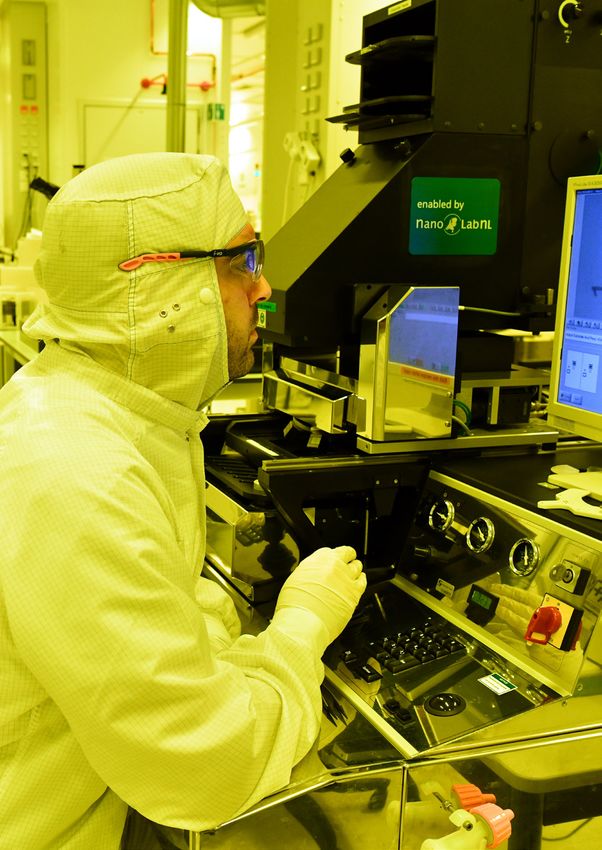
1                                                                      Well-positioned for a prominent role
                                                                               The Netherlands is well positioned to play a prominent role in global
                                                                               transitions thanks to its first-rate universities, highly trained workforce
                                                                               and excellent track record in innovation.
                                                                               Many of the scientists and engineers working on key enabling
                                                                               technologies experiment and develop things at the nanoscale. They

HOW CONTROLLING THE VERY SMALL CAN                                             do this because they need the ‘special effects’ that can only emerge
                                                                               on such a small scale, because they want to manipulate a material at
HELP WITH HUGE TRANSITIONS                                                     the most fundamental level, or simply because they want to miniaturise
                                                                               devices and components. Nanotechnology is therefore a primary
                                                                               enabler for scientific and technological progress. And luckily, the
 Vast possibilities                                                            Netherlands is excellently equipped for R&D at the nanoscale, thanks to
 Small things can still be very strong. While modest in land mass and          its well-co-ordinated infrastructure: NanoLabNL.
 population, the Netherlands scores high in international innovation
 rankings. One key enabler of the current Dutch competitiveness is
 an increasingly rapidly expanding branch of science that operates on
 a tinier-than-tiny scale: Nanotechnology. It involves the growth and
 sculpting of matter at a scale of 1 millionth of a millimetre, the level of                  WHAT IS NANOLABNL ?
 atoms and molecules. When you go this small, nature starts behaving
 in surprising new ways. If one were to crumble a lump of gold into                                   NanoLabNL is the national infrastructure for nanotechnology
 nanoparticles, for instance, their colour would not be yellow but red,                               in the Netherlands, providing an open-access infrastructure for
 purple or green, depending on their exact sizes. In essence, the physical                            R&D at the nanoscale. The network of facilities is distributed
 and chemical properties of matter change radically when it is controlled                             over seven labs in five cities: Zernike Nanolab in Groningen,
 at the nanoscale. This phenomenon not only offers fascinating science                                MESA+ Nanolab in Enschede, AMOLF NanoLab in Amsterdam,
 that can revolutionise our understanding of matter, it also opens up vast                            Kavli Nanolab, Else Kooi Laboratory and TNO Nanolab in Delft
 opportunities for technological innovations – innovations that will help us                          and NanoLab@TU/e in Eindhoven.
 solve urgent societal problems and create sustainable economic value.
                                                                                                      NanoLabNL offers the use of facilities to universities, research
 Science and technology that make use of the power of small – including                               institutes, start-ups and industry. The seven laboratories are
 quantum technology, photonics and advanced materials science −                                       managed as one infrastructure to co-ordinate investments,
 are at the heart of some of the huge transitions the world needs to                                  supplement and enhance each other’s work and exchange
 make. These include transitions towards clean energy, a safer world,                                 best practices. Thanks to this co-operation, the Netherlands
 more effective and affordable health care, and sustainable agriculture                               as a whole can provide the infrastructure for the full spectrum
 that can feed a growing population. Concrete products include                                        of nanoresearch, both fundamental and applied, as well as
 superefficient solar cells, compact batteries for storing energy, safe                               proof-of-concepts, demonstrations and small-scale production.
 global communication networks supported by quantum encryption, vastly                                Together, the available tools, processes and techniques
 improved communication and computing using light to handle big data                                  facilitate a range of research from biotechnology to integrated
 flows at low power consumption, nanosensors that can detect just about                               photonics and from quantum engineering to photovoltaics.
 anything from cancer to explosives, smart filters for clean water and
 food production, early diagnostics through ‘lab-on-a-chip’ technology or
 personalised medical treatment thanks to ‘organ-on-a-chip’ technologies.

 8 Unleashing the power of small                                                               NanoLabNL, the national nanotechnology infrastructure in the Netherlands   9
Cinzia Silvestri on how
                                   a start-up was born in
                                   NanoLabNL
                                   Dr Cinzia Silvestri is CEO and co-founder of Bi/
                                   ond, a start-up company developing organ-on-a-
                                   chip technology at the Else Kooi Laboratory.

                                   ‘By spending time in the Else Kooi Laboratory, talking
                                   to people involved in a myriad of different fields from
                                   biomedical to quantum computing, you realise how
                                   a single material can be multipurpose. Organs-on-
                                   chips have been built with a rudimentary technique.
                                   We thought: why not bring in an added value with
                                   microelectronics?

                                   ‘Doing microelectronics is like cooking. Once you
                                   master the basic techniques, you can push the
                                   boundaries – like adding exotic ingredients to a
                                   traditional dish – thus building bridges between
                                   different fields. Creating an organ-on-a-chip using the
                                   fabrication technology of mass-produced computer
                                   chips results from this out-of-the-box thinking.

                                   ‘Applying microelectronics to consumer technology is
                                   nice, but it is even more rewarding to use it to reduce
                                   animal testing and create personalised medicine. The
                                   first time I saw heart cells beating on our chip, I found
                                   it unbelievable! It gives you satisfaction to know that
                                   you are working towards a greater good.’

10 Unleashing the power of small                                                               NanoLabNL, the national nanotechnology infrastructure in the Netherlands   11
David Reinhoudt on
                                   the roots of NanoLabNL
                                   and why it is a collective
                                   undertaking
                                   Prof. David Reinhoudt is emeritus professor of
                                   supramolecular chemistry, former director of the
                                   MESA+ Institute at the University of Twente and
                                   a co-founder of NanoLabNL.

                                   ‘I think NanoNed was the first large, multidisciplinary
                                   research programme in the Netherlands.
                                   Multidisciplinarity was still rare when we started
                                   out, in the nineties. But to make any progress in the
                                   nanofield – to make a lab-on-a-chip for instance,
                                   or a medical sensor – you need chemistry, physics,
                                   electronic engineering, optics, mathematics, social
                                   science, etc. So for purely scientific reasons,
                                   different groups had to work together in order to do
                                   nanoresearch anyhow. That multidisciplinary aspect
                                   was and still is typical of nanotechnology.

                                   ‘Another reason to pull together was that the
                                   infrastructure needed to do research at the
                                   nanoscale was so expensive that it was impossible
                                   for any one university to buy it. For that reason, Hans
                                   Mooij (of Delft), George Robillard (of Groningen)
                                   and I ventured out together. When we got the large
                                   subsidy from the ICES-KIS fund in 2004, we co-
                                   ordinated who would buy what devices. We had a
                                   good rapport; we did not begrudge each other our
                                   success. It worked out fine, and it should continue to
                                   work out fine.’

12 Unleashing the power of small           NanoLabNL, the national nanotechnology infrastructure in the Netherlands   13
2

NANOLABNL:                                                                                                            A second unique property of a nanofabrication facility is that the
MAKING A LITTLE GO A LONG WAY                                                                                         groundbreaking promises offered by nanotechnology emerge from the
                                                                                                                      continuous and uniquely rapid development of the capabilities of high-
                                                                                                                      end equipment. This equipment development is fuelled in great part
                                                                                                                      by the extreme speed at which the semiconductor industry advances.
 More than the sum of its parts                                                                                       Thus there is only one way to perform competitive nanoscience: by
 The number of different areas that nanotechnology serves – from                                                      continuously investing in equipment that is at the absolute forefront of
 materials for energy to biotechnology and from quantum engineering                                                   performance.
 to integrated photonics – is far too large for a single location in the
 Netherlands. Some 1,300 researchers each year need direct access                                                     The challenges that these two characteristic aspects of a
 to local facilities. What makes their science excel is an immediate turn-                                            nanofabrication facility pose are best met through co-ordination
 around of device fabrication, characterisation and experimentation,                                                  and collaboration. NanoLabNL does just that, by offering
 which together form the cycle of development.                                                                        facilities that provide the needed local access
                                                                                                                      while ensuring an efficient exchange of
 To the various researchers in this diverse range of fields,                                                          knowledge and an optimal use of
 nanotechnology facilities are as indispensable as a workshop.                                                        scarce resources.                          TODAY
                                                                                                                                                                                                        NO
 Nonetheless, a nanofabrication facility differs from a traditional workshop                                                                                                                     M  NA
                                                                                                                                                                                          A  NTU
 in two essential ways. First, the processes through which nanodevices                                                                                                                  QU
 are made are so challenging to control, and at the same time so crucial                                                                                                                        A    CHIP
                                                                                                                                                                                       A   N ON
 for the functioning of the devices, that scientists cannot simply leave                                                                                                            ORG           ICS
                                                                                                                                                                                         P H OTON
 them to skilled technicians, as is done in other fields of research. Rather,                                                                                                       TE D
                                                                                                                                                                            IN TEGRA
 they need to perform those processes themselves.                                                                                                                                                    CHIP
                                                                                                                                                                                        LAB ON A

                                                                                                                                                                                         ELECTRONICS

                                                                                                                                                                            PROCESSES, PRINCIPLES
                                                                                                                             FUNDAMENTAL SCIENCE ON MATERIALS,

                                                                  MICRO - NANO RESEARCH FACILITIES               NANOLABNL
 Applications of nanotechnology
 emerging in different areas over time
 Source:
 Dutch Roadmap Nanotechnology                1990               1994            1998             2002   2006   2010               2014                2018                    2022                   2026

 14 Unleashing the power of small                                                                                                           NanoLabNL, the national nanotechnology infrastructure in the Netherlands   15
Wiebke Albrecht on
                                   the importance of state-
                                   of-the-art experimental
                                   infrastructure
                                   In May 2021, Dr Wiebke Albrecht started her
                                   Hybrid Nanosystems group at the Amsterdam
                                   research institute AMOLF, one of the
                                   NanoLabNL locations.

                                    ‘My specialisation is studying single nanoparticles
                                   with a combination of optical techniques and
                                   advanced electron microscopy. It is fundamental
                                   research, but the nanoparticles I study are extremely
                                   promising as enablers of new technologies. Once we
                                   understand their behaviour, we can use them for a
                                   wide range of applications: from hypothermic cancer
                                   therapy to solar harvesting.

                                   ‘To me, state-of-the-art cleanrooms are a key feature
                                   of AMOLF. If we want to cross new boundaries in
                                   nanofabrication and nanocharacterisation and test
                                   new ideas, we need cutting-edge technology. I like
                                   the way AMOLF stays ahead of new technological
                                   developments, and I will be a part of that myself by
                                   co-creating new equipment with specialised tech
                                   companies. In this way we will not only be able to
                                   follow the technology, but also drive it.

                                   ‘I think it’s amazing that through NanLabNL and
                                   other Dutch networks, expensive infrastructure is
                                   made accessible. Ideally you would collaborate
                                   on a supranational scale, but you have to start
                                   somewhere. It’s a good thing that this is happening,
                                   and it’s also one of the reasons why the Netherlands
                                   is a good place to do research.’

16 Unleashing the power of small                                                           NanoLabNL, the national nanotechnology infrastructure in the Netherlands   17
Albert van den
                                   Berg on the
                                   unique character of
                                   NanoLabNL
                                   Prof. Albert van den Berg is professor of
                                   lab-on-a-chip technology at the University
                                   of Twente and chairman of Nano4Society, a
                                   research programme strongly associated with
                                   NanoLabNL.

                                   ‘NanoLabNL offers national coverage, ensuring
                                   that researchers in each location have access to
                                   the right equipment. This makes the Netherlands
                                   unique. Where other countries have more internal
                                   competition between the laboratories, there are
                                   no competitors here. Everyone collaborates in
                                   NanoLabNL. By networking and perhaps by being
                                   more efficient, we can maintain similar facilities more
                                   cost-effectively than other countries do.

                                   ‘NanoLabNL has many benefits. Its first priority is
                                   educating young people, second comes inventing
                                   and developing new technology, third is valorisation:
                                   bringing new technology to the market. If only half
                                   of these valorisations is successfull, we are doing
                                   well! NanoLabNL is like a flywheel, continuously
                                   reinventing itself.’

18 Unleashing the power of small   NanoLabNL, the national nanotechnology infrastructure in the Netherlands   19
Through smart specialisation, NanoLabNL is more than the sum of its International anchoring seven parts – not only in cost-effectiveness, but also in putting together NanoLabNL is not only a national access point, but an international minds and expertise. NanoLabNL’s leaders are all internationally one as well. In 2017, together with its French, Swedish and Norwegian renowned scientists who are capable of looking far ahead. They can sister-organisations, NanoLabNL helped establish EuroNanoLab. This recognise the lines of research that hold promise for the next decades European network currently offers an online one-stop-shop and open and furnish the labs accordingly, so that their users can always be at the access to nanotechnology research facilities at 44 cleanrooms in 15 forefront of science. countries. While all seven laboratories naturally have similar basic facilities, each one has its own specialisation and key areas of strength. Expertise in quantum technology is concentrated in Delft, for instance, while Eindhoven focuses on integrated photonics and Twente specialises in lab-on-a-chip research. Amsterdam has great strength in nanophotonics, and Groningen a longstanding programme on nanomaterials science. Single access point Co-creation is a core Dutch strength, and NanoLabNL embodies it perfectly. From the beginning, NanoLabNL’s leaders have cherished the national network’s open-access model, ensuring easy admittance and synergy. Each of the seven laboratories taking part in the national network is located on a university campus, close to students and academics and also close to many small and large high-tech companies. Regular users of one lab may occasionally need to use expensive equipment at another lab. They can book the equipment online, along with support from experienced local users. All labs share a single online access point to all equipment and to the expertise available in the network. It is accepted practice that the intellectual property rights for whatever is discovered in one of the local labs go to whoever made the discovery. NanoLabNL is the backbone of a well-organised national public- private ecosystem. It serves not only science but the private sector as well. Tech companies can work together with scientists within public- private partnership programmes, or they can use NanoLabNL’s highly specialised cleanrooms to test new product lines. Young start-ups are encouraged to use the nanolabs as well, which gives them a chance to start at a high technological level long before they can afford their own labs. In the nanolabs, students and postdocs thus work alongside EuroNanoLab at a glance engineers from private companies, each with their own objectives, but EuroNanoLab is an initiative to establish a large scale nanofabrication research together pushing the limits of what the combination of talent and high- infrastructure distributed throughout Europe end equipment can do. 20 Unleashing the power of small NanoLabNL, the national nanotechnology infrastructure in the Netherlands 21
Talieh Ghiasi on the
                                   attractions of the Top
                                   Master of Nanoscience
                                   programme
                                   Talieh Ghiasi is a PhD student in the physics
                                   of nanodevices (spintronics), working in the
                                   group of Prof. Bart van Wees at the University of
                                   Groningen.

                                   ‘I received my bachelor’s and master’s degrees in
                                   Tehran, in solid-state physics. In 2014, I came to the
                                   Netherlands to start the ‘Top Master of Nanoscience’
                                   programme at the University of Groningen. It is quite
                                   a well-known programme, with a specific scholarship.
                                   Students become familiar with the multidisciplinary
                                   aspects of nanoscience, including mesoscopic
                                   physics, chemistry, biology and nanomedicine.

                                   ‘I chose to work with Prof. Bart van Wees because
                                   I was most interested in specialising in the physics
                                   of nanodevices. We address fundamental physics
                                   questions, but those also have direct applications.
                                   With spintronics, we are working on a replacement
                                   for electronics as we know it. It is going to make our
                                   electronics high-speed and ultracompact, with less
                                   heat dissipation. These spintronic devices not only
                                   have great impact in memory and sensory systems,
                                   but they also provide revolutionary advances in
                                   information-transfer technology.’

22 Unleashing the power of small            NanoLabNL, the national nanotechnology infrastructure in the Netherlands   23
Guus Rijnders on what
he is most proud of
Prof. Guus Rijnders is professor of inorganic
materials science at the University of Twente
and chair of NanoLabNL.
‘What strikes me personally the most is that when I
walk through the labs, I see top researchers at the
peak of their careers mingling freely with young
researchers and people from companies. They have
built their own ecosystem in which young people are
being trained by more senior researchers. Together,
they do great work. It could result in a new finding
that leads to an excellent article in a scientific journal,
or it could lead to a new product that goes to market.
It is as if we are constantly putting new train wagons
on the rails: each one starts out as fundamental
research but could eventually lead to a marketable
product. And while that is happening, we keep
putting new wagons on the rails. It is the combination
of all this that makes me proudest: being at the heart
of excellent science and innovations.’
24 Unleashing the power of small NanoLabNL, the national nanotechnology infrastructure in the Netherlands 253
HARVESTING FRUITS FROM NANOLABNL Facts & Figures Averages per year, 2013-2020
Talent magnet and key supplier of skilled
researchers Use of NanoLabNL (in hours)
NanoLabNL is a perfect example of a core value in the Dutch academic 159,028
system: the intertwining of research and education. Besides being Use of NanoLabNL (in persons)
1,275
a place of exciting research, the NanoLabNL network is the national
incubator for new generations of highly skilled researchers, providing
them with hands-on experience in designing, creating and testing at
the nanoscale. These young researchers are greedily absorbed by
academia and the high-tech industry, or they end up launching their
own start-ups. This well-trained workforce is known to be one of the Zernike NanoLab Groningen
factors that makes the Netherlands an attractive business climate for AMOLF NanoLab Amsterdam
MESA+ NanoLab Twente
foreign investors. In addition, NanoLabNL’s world-class cleanrooms are
a veritable talent magnet. From all over the world, they draw promising Kavli NanoLab Delft
tenure-trackers to the Netherlands who wish to use the infrastructure Else Kooi Laboratory Delft
TNO NanoLab Delft
Start-ups/spin-offs
for their research. In turn, this kind of groundbreaking research attracts 5
smart and sought-after young researchers from all over the world who NanoLab@TU/e Eindhoven
keenly consider the available expertise deciding where to do their
PhD or postdoctoral research. Many of these researchers will remain
PhD projects Patents
501
in the Netherlands and become a national asset in the face of global 22
competition.
Research at the frontier
Publications Industrial use (% of total use)
1,240 22%
NanoLabNL’s infrastructure has led to scientific breakthroughs that
could eventually provide new solutions to the world’s challenges. This is
demonstrated by the awards won by research done in the nanolabs and
by the fact that the Netherlands ranks ninth worldwide when it comes to
the number of patent applications at the European Patent Office.
26 Unleashing the power of small NanoLabNL, the national nanotechnology infrastructure in the Netherlands 27Ronald Hanson
on the emergence
of nanotechnology
applications
Prof. Ronald Hanson is the former scientific
director of QuTech, the centre for quantum
technology co-founded by the Delft University
of Technology and TNO, and chairman of the
supervisory board of Quantum Delta NL.
‘The development of nanotechnology research
has progressed in three phases. In the beginning,
we focused on studying fundamental phenomena.
In phase two, we developed applications based
on those phenomena. We are now in phase three,
where completely new research areas have
emerged from nanotechnology research done in
the Netherlands, such as quantum technology and
biomedical applications.
‘Currently, we are not only able to make
nanostructures, but also to apply them. And various
applications are beginning to emerge. It takes time
to develop a new technology like nanotechnology
to the point where you understand what you can
do with it and what its added value is compared
to existing technology. Nanotechnology has been
developed over the past 10 to 20 years and is
currently a key enabling technology for many new
applications, with quantum technology already
having become a key enabling technology itself.’
28 Unleashing the power of small NanoLabNL, the national nanotechnology infrastructure in the Netherlands 29Simon Groeblacher
on the attraction of the
Dutch nanolabs
Prof. Simon Groeblacher is professor of
quantum physics at Delft University of
Technology
‘The availability of the broad range of facilities in
the different NanoLabNL labs was one of the main
reasons I came to the Netherlands. With my group,
I am studying the quantum behaviour of massive
mechanical systems coupled to a laser field inside
an optical cavity. The mechanical oscillators range
from hundreds of nanometres to several millimetres
in size. They all need to be fabricated in a completely
controllable environment so as not to destroy
the very fragile quantum nature of these devices.
The cleanroom facilities in Delft provide a unique
environment and are a key ingredient in the success
of my lab.’
30 Unleashing the power of small NanoLabNL, the national nanotechnology infrastructure in the Netherlands 31NANORESEARCH PROGRAMMES
Among the scientific successes made possible by the Dutch nanolabs
so far is the work of Bart van Wees, who in 2016 was awarded a Spinoza
Prize – the most prestigious Dutch prize for scientific achievement,
The NanoNextNL research programme (2010-2016) established a solid public-private collaboration aimed considered the highest honor in Dutch science − for his nanoscale
at applications of nanotechnology, with 130 participating companies. Since then, several high-tech electronic devices that make use of the quantum mechanical properties
collaborative research programmes targeting societal challenges have emerged, all of which depend on of electrons and may prove to be much faster and more energy-efficient
the NanoLabNL research infrastructure. These include Nano4Society, the National Agenda for Quantum than traditional electronics. Van Wees developed these devices in the
Technology, PhotonDelta, the Netherlands Organ-on-Chip consortium hDMT and related routes in the Dutch nanolab in Groningen. Ronald Hanson likewise received a Spinoza Prize
Research Agenda. for having successfully entangled particles separated from each other by
1 km. He did so with devices made in the nanolab in Delft. His findings
may eventually aid in the development of the quantum computer.
Technology-driven research in NanoNextNL has led to top science with very high impact Marileen Dogterom won the Spinoza Prize 2018 for her investigations
of the cytoskeleton of a living cell, an important step towards building a
Citation impact of NanoNextNL publications human-made cell in the lab. The NanoLabNL cleanroom facilities in Delft
• Close to 900 publications (until March 2016) and AMOLF enabled her to study biological structures in a controlled
• Over 140 published in high impact journals, impact factor >10 way. These celebrated researchers are just a few examples that
• 443 analysed (published in 2010-2014) demonstrate the excellence of the facilities at NanoLabNL.
Start-ups, driving innovation ever further
Sometimes nano-trained graduates have an idea so revolutionary that
Average impact of Belonging to large companies are not ready to embrace it yet. So they start their own
publications normalised 1.94 23% 10% best cited
per field (MNCS) papers worldwide enterprise in the vicinity of lab facilities. Each of the Dutch nanolabs is
a hub where young companies can use nanofabrication devices that
they could never afford to purchase themselves. This enables them to
Average impact of
journals normalised develop innovative products. On average, NanoLabNL produces six
1.65
per field (MNJS) high-tech start-ups per year over a wide range of fields.
Business orientation of NanoLabNL’s commercial users
Citation impact of publications from NanoNextNL themes (Source: CWTS, 2016) medical
World average pharmaceutical
RATA instrumentation/equipment
Energy
Nanomedicine sensor and components
Food materials, chemistry and coatings
Beyond Moore
Nanomaterials services
Bio-nano other
Nanofabrication
Sensors/Actuators
Normalised citation impact: 0,00 1,00 2,00 3,00 4,00 5,00 Start-ups related to NanoLabNL are active in a wide range of application areas.
Source: Business Orientation NanoNextNL, Enabling MNT, by Henne van Heeren
32 Unleashing the power of small NanoLabNL, the national nanotechnology infrastructure in the Netherlands 33Marc Hendrikse on the
power of our economy
Dr Marc Hendrikse, formerly CEO of high-tech
company NTS-Group, is figurehead of the Top
sector High-tech Systems and Materials.
‘The power of our economy is that we use insights
from fundamental research to build key technologies,
and through cooperation between universities,
institutes for applied science and industry, we
convert these into innovations that eventually
produce ample economic value.
‘Now we are slowly beginning to see towards which
applications we’re heading: photonic computer
chips, ultrafast data centres, labs on chips, organs
on chips. We are approaching market introduction
with these technologies – something we would never
have been able to do if we had not taken that first
step and invested in fundamental research, including
building advanced nanolaboratories. But to think
that nanoscience has reached its goals would be a
huge mistake. We are world leaders in technology
development, but if we do not carry our investments
in nanoscience through to the end, our competitors
will run off with the economic gain.’
34 Unleashing the power of small NanoLabNL, the national nanotechnology infrastructure in the Netherlands 35Constantijn van
Oranje-Nassau on the
importance of technology
hotspots
Constantijn van Oranje-Nassau is an envoy of
TechLeapNL.
‘Labs play an important role as the physical access
point to high tech. They are hotspots of technology
development. COVID-19 showed how critical the
access to labs is for many companies that are in their
early phases and cannot finance their own labs. The
quality of the labs determines the quality of their
results.
‘The lab alone is not enough, however, especially
if it is highly specialised. Innovation thrives on the
interaction between people from different disciplines,
so that ideas will arise on how to use an extremely
advanced technique to solve a specific problem in
another sector. Therefore it is important that labs
are embedded in a broader innovation environment
where different disciplines meet and new ideas can
emerge.’
36 Unleashing the power of small NanoLabNL, the national nanotechnology infrastructure in the Netherlands 37Elham Fadaly on the
role of NanoLabNL in her
celebrated research
Dr Elham Fadaly recently obtained her PhD cum
laude at Eindhoven University of Technology
(TU/e). Her discovery of light emission in silicon
was proclaimed Breakthrough of the Year 2020
by Physics World.
‘My doctoral research on the fabrication of
nanomaterials for optoelectronic applications has
attracted attention because it could potentially lead
to the development of the first silicon-based laser,
or spark a second revolution in silicon technology,
bringing silicon photonics within reach.
‘The cutting-edge facilities in NanoLabNL have been
a key enabler for the success of my experimental
research work, particularly in reaching undiscovered
territories in the field of nanomaterials fabrication.
The accessibility of and training on a wide range
of advanced fabrication and characterisation tools
played a crucial role in my career as a researcher.
They allowed me to expand my understanding of
theoretical concepts via experimenting with them in
the lab and testing new innovative ideas directly.
‘Working in the nanolab at TU/e while having access
to the facilities in other NanoLabNL sites nationwide
has been an excellent opportunity to connect and
benefit from top-notch researchers in academic
institutions and start-ups working in the NanoLabNL
network.’
38 Unleashing the power of small NanoLabNL, the national nanotechnology infrastructure in the Netherlands 39Pieter Duisenberg
on the Netherlands as
a delta of knowledge
Pieter Duisenberg RC is president of the
VSNU, the Association of Universities of the
Netherlands.
‘I believe in a world where the winner takes all, even
though this is not always a very nice world. In a
globalised environment, physical boundaries have
become irrelevant. For knowledge and research
this means that If you want to excel you have to be
number one or number two as quality goes. Then
you will attract talented people and companies. If you
are not the top, then people and companies will not
make this choice.
‘It is important that we position the Netherlands as
a delta of knowledge, the place to be if you want
to innovate. The whole world should know: team.
nl stands for cocreation, international pioneering
and entrepreneurship. That should be our branding.
NanoLabNL could contribute hugely to this
positioning. In this way they can server a broader
interest than only science.’
40 Unleashing the power of small NanoLabNL, the national nanotechnology infrastructure in the Netherlands 41SUCCESSFUL START-UPS NanoNextNL’s industrial research led to a 4-fold return-on-investment
Return-on-investment
Some examples of established companies that have evolved from the nanolabs and When extrapolating the expectations on the return-on-investment, the
have become true flywheels for fast innovation: 91 M€ invested in industrial NanoNextNL research (subsidy + matching)
would generate >400 M€ in the years to come:
By now well-established high-tech companies, Lionix and Micronit both started 20
years ago in the MESA+ nanolab at the University of Twente. Lionix has grown into an
international supplier of customised photonic chips and microfluidics. Micronit currently
91 M€ > 400 M€
employs over 100 people and offers lab-on-a-chip and MEMS solutions to industrial INVESTED RETURN
clients.
VSParticle spun off from the nanolab at the Delft University of Technology in 2014. This Financial investments
producer of machines for making and handling nanoparticles currently has over 20 A total of 110 companies were involved in NanoNextNL. Their total budget for
employees. this programme was 91 M€ of which 40 M€ was subsidy.
High-tech company Delmic develops revolutionary microscopy techniques to visualise Philips 17.7 M€
biological processes and materials for energy conversion. Born out of the nanolabs of Holst Centre 12.0 M€
Delft and Amsterdam, it continues to collaborate with academic partners and industry LioniX BV 4.8 M€
giants such as Thermo Fisher to pioneer new breakthroughs. FEI Company 4.3 M€
ASML 3.1 M€
ASM Europe B.V. 2.7 M€
Friesland Campina 2.5 M€
Unilever R&D 2.4 M€
Giving industry a competitive edge KWR Water B.V. 2.2 M€
As specific nanotechnologies approach commercialisation, NanoLabNL PANalytical BV 1.7 M€
is increasingly home to high-tech companies as well. In fact, the labs are Nanomi B.V. 1.7 M€
an ideal ecosystem to stimulate or even spark public-private partnership NXP 1.6 M€
programmes. NanoLabNL’s open-access facilitates informal meetings NT-MDT 1.6 M€
between students, academics and industry representatives from various SmartTip BV 1.6 M€
disciplines. This fosters creativity and facilitates a smooth technology Nanosens 1.5 M€
transfer. It also allows graduates to find jobs that match their skills and Others 29.3 M€
interests. Source: NanoNextNL End Term Report
ASML, for instance, based near the nanolab in Eindhoven, is the global
leader in manufacturing nanolithography machines for the semiconductor
industry. It not only benefits indirectly from the nanolabs through well- The companies that took part in the NanoNextNL research programme
trained researchers, but it also makes use of facilities directly. Sometimes also included other large multinationals such as Philips, DSM and Unilever
ASML commissions tailor-made components for small series. For as well as smaller high-tech industrial members of the branch organisation
example, a series of sensors that the Else Kooi Laboratory in Delft was MinacNed. In PhotonDelta, 15 companies are currently collaborating with
commissioned to develop ended up in machines used for extreme Dutch universities and TNO in public-private partnerships that require state-
ultraviolet lithography (EUV). ASML has a strategic partnership with the of-the-art research infrastructure in the cleanrooms for nanoresearch. These
Eindhoven University of Technology, supporting the operation of the are just a few examples of the many large and small companies that profit from
world’s only 3-inch InP wafer 193nm scanner. NanoLabNL’s infrastructure.
42 Unleashing the power of small NanoLabNL, the national nanotechnology infrastructure in the Netherlands 43Jos Benschop on the
benefits of NanoLabNL
for ASML
Prof. Jos Benschop is senior vice president
of technology at ASML, the world’s leading
producer of chipmaking machines, based in
Veldhoven, Netherlands.
‘The primary benefit that NanoLabNL has for
companies such as ASML is that it generates
well-trained people with hands-on experience in
nanotechnology. People who have not just created
powerpoints, but who have actually realised devices,
after having designed and measured them. This is
the primary reason why we need the infrastructure.
Secondly, the infrastructure is also important for our
research. We use the results of academic research
groups and collaborate with them. They perform
research for us in the nanolabs; they are either
embedded in NanoLabNL or associated with it.
‘In the past, a lot has been invested in
nanotechnology infrastructure in the Netherlands.
This was a good choice. If you want to remain at the
top level in science and technology, you have to
keep investing. It would be incredibly stupid to let it
pass away.’
44 Unleashing the power of small NanoLabNL, the national nanotechnology infrastructure in the Netherlands 45Marileen Dogterom
on the ‘projectification’
of funding
Prof. Marileen Dogterom is professor of
bionanoscience and department chair at the
Delft University of Technology and Medical
Delta professor at Leiden University.
‘The present funding system in the Netherlands does
not provide a stable base for research infrastructures.
They have to acquire funding every few years, and
whoever is the “hottest” at that point in time has the
best chance. It is fine to finance research in a project-
based structure, for this fits how research works. But
financing large infrastructures as if they were projects
does not match their character, nor does it match the
needs of long-term research programmes that need
such infrastructures.
‘Nanoscience is still cutting-edge, but this
has become less apparent. Instead of being a
revolutionary new technology, it is now more of a
standard need for many scientists, like microscopes.
Those were also revolutionary at one time, but not
anymore. But they, too, keep getting better and
better, and we will always need them.’
46 Unleashing the power of small NanoLabNL, the national nanotechnology infrastructure in the Netherlands 47Inviting new guests Dutch Research Agenda
With a voucher system, NanoLabNL invites companies that are unfamiliar NanoLabNL plays a crucial part in the Dutch Research Agenda, the
with nanotechnology to make use of its infrastructure and technical scientific framework for contributions to the solution of urgent societal
assistance. It also offers consultancy services to companies that suspect challenges. In particular, it is indispensable for the routes ‘Quantum/nano
nanotechnology could help to improve their products. revolution’, ‘Materials made in Holland’, ‘Personalised medicine’, ‘Energy
transition’, ‘Smart industry’, ‘Building blocks of matter and foundations
of space and time’, ‘Measuring and detecting’ and ‘Value creation by
responsible access to the use of big data’.
The battle against COVID-19
HIGH-TECH SOLUTIONS FOR Unexpectedly perhaps, nano-based companies even play a part in the
SOCIETAL CHALLENGES
battle against COVID-19. Photonic technologies that originated in the
nanolabs are being used in detecting the virus and creating immunity
against it. Nanoresearchers are working on an ultrarapid COVID-19 test
Public-private research that originated in the nanolabs has proven to be successful. kit that will make diagnostics more accessible and affordable throughout
the world.
In Eindhoven, researchers managed to create light in silicon, a breakthrough that
could be scaled up in industry.
Indium phosphide photonic integrated circuits and TriPleX were developed in the IN CONCLUSION
nanolabs in Eindhoven and Twente. In PhotonDelta, these technologies are used
for several applications including precision farming, medical scanners, sensors for Nanoscience and nanotechnology in the Netherlands currently form
aircraft wings and 5G telecommunication. an extraordinarily productive and internationally acclaimed knowledge
ecosystem. Besides being an important centre for nanoscience,
Since it was founded in 2014, Dutch national icon QuTech – the advanced NanoLabNL is also indispensable for high-interest key enabling
research centre for quantum computing and quantum internet – has been joined technologies including quantum technology, lab-on-a-chip and organ-on-
by Microsoft and Intel. Microsoft and QuTech are currently frequent users of the a-chip technologies and photonics. The labs are a necessary condition
nanolabs in Delft. for performing groundbreaking fundamental research, training new
generations of skilled high-tech workers and developing innovative
In the Twente nanolab, thin nanolayers are fabricated that end up in the optical products. All these things, in turn, are vital if the Netherlands wants to
components of Zeiss that, in turn, are used in ASML scanners. Finally, research play a prominent role in the huge and necessary transitions the world is
institute ARCNL, in which ASML is a partner, makes frequent use of NanoLabNL’s currently facing.
Amsterdam facilities to produce ever-smarter and ever-smaller technology.
Investments in NanoLabNL guarantee a relatively high return. For
Philips and the universities collaborating in NanoNextNL developed a sensitive one thing, both the material and social infrastructure for doing top
method for detecting kidney or liver disease on the spot with a single finger prick. nanoresearch is already in place, For another, the organisation of
The start-up LipoCoat coats contact lenses with dirt-repellent nanocoatings. NanoLabNL guarantees maximum efficiency and minimum overlap. To
stimulate a Dutch contribution to global transitions, NanoLabNL is very
happy to offer advice to and exchange expertise with any initiative that
works towards the same goal.
48 Unleashing the power of small NanoLabNL, the national nanotechnology infrastructure in the Netherlands 49René Penning de Vries
on new opportunities
Dr René Penning de Vries is chairman of
PhotonDelta, a network for the development of
photonic applications.
‘Quantum technology, photonics and applications of
surface modifications at nanometre scale are going
to take off massively. We need to support that with
excellent research. In the absence of continued
investments, we will slowly start missing out on
new opportunities. Internationally, many parties,
e.g. in China and America, have ambitions. We have
solid expertise in certain areas, and we should
take advantage of that. If not, we will become a
small player, similar to what we saw in football with
Amsterdam’s team, Ajax.
‘Our strength in the Netherlands is our ability to make
those connections. We can see the advantages.
We are strong in cooperation throughout the entire
network, from fundamental research to applications.
If you only do fundamental research, you can publish
in Nature or Science, but it won’t generate many
more benefits.’
50 Unleashing the power of small NanoLabNL, the national nanotechnology infrastructure in the Netherlands 51Michel de la Bachelerie
on the importance of
European sovereignty at
minimal costs
Prof. Michel de Labachelerie is research director
of the French CNRS laboratory Femto-ST and
chair of the EuroNanoLab consortium.
‘At an international level, nanotechnology is
progressing quickly, especially in Asia. It is important
to understand the competition and ensure European
sovereignty in the capability to do research.
NanoLabNL and other European labs should be able
to maintain reasonable know-how to be able to face
future problems. Invest in nanotechnology to have at
least the know-how to fabricate it; afterwards, you can
decide if it is economically worthwhile to manufacture it
here or not.
‘Our research could be very new, breakthrough
research. When you invest, focus on equipment that
can be used in such basic and exploratory research of
high risk and expected high gain. For that is the first
thing. In the Netherlands, the NanoLabNL network can
help to reduce the costs of the investment by avoiding
duplications. This makes NanoLabNL of high value
to the country. The same goes for the French and
Swedish networks set up in 2004, and the Norwegian
network, which followed the same example, in 2008.’
52 Unleashing the power of small NanoLabNL, the national nanotechnology infrastructure in the Netherlands 53Acknowledgements Credits
The following persons have contributed their knowledge, experiences and ideas by Text: Mariette Huisjes, with contributions from Ineke Malsch,
means of interviews. This manifesto summarises their main arguments and includes some Ewold Verhagen, Raoul Oostenbrink and Guus Rijnders
illustrative quotes scattered throughout in sidebars. Graphic design: FOTON Visuele Communicatie, Tjerk de Vries
Infographic page 4/5: Theo Barten
Dr Wiebke Albrecht, group leader of Hybrid Nanosystems at NWO Institute AMOLF
Text editing: Tom Johnston
Prof. Jos Benschop, scientific director of ASML
Photocredits:
Prof. Albert van den Berg, University of Twente, chairman of NanoNextNL
Portraits
Prof. Marileen Dogterom, group leader Kavli Institute for Nanoscience, Delft University of Cinzia Silvestri: Biond; David Reinhoudt: Eric Brinkhorst; Wiebke
Technology Albrecht: Wiebke Albrecht; Albert van den Berg: University of Twente;
Talieh Ghiasi: Talieh Ghiasi; Guus Rijnders: University of Twente; Ronald
Pieter Duisenberg, RC, president of VSNU, Association of Universities in the Netherlands
Hanson: Studio Oostrum; Simon Groeblacher: Simon Groeblacher; Marc
Dr Elham Fadaly, postdoctoral researcher at Eindhoven University of Technology Hendrikse: NTS Groep; Constantijn van Oranje: TechLeap; Elham Fadaly:
Eindhoven University of Technology; Jos Benschop: ASML; Marileen
Prof. Simon Groeblacher, group leader at Delft University of Technology
Dogterom: TU Delft; René Penning de Vries: PhotonDelta; Michel de la
Talieh Ghiasi, MSc, PhD student at the University of Groningen Bachelarie: CNRS; Pieter Duisenberg: VSNU
Prof. Ronald Hanson, principal investigator QuTech, chairman of the steering board of
Photos
Quantum Delta NL
P.6, 17,18,25,35,45: NanoLabNL/Eric Brinkorst; p. 11: Biond; p.12: Twente
Dr Marc Hendrikse, figurehead of the Topsector Hightech Systems & Materials University image repository; p. 22: Shutterstock/Gorodenkoff; p. 28:
Marieke de Lorijn; p. 31: Simon Groeblacher Lab; p.36: Shutterstock/Matej
Prof. Michel de Labachelerie, chairman of EuroNanoLab
Kastelic; p. 39: Sicco van Grieken; p. 40 Shutterstock/Di Soccio Massimo;
Constantijn van Oranje-Nassau, LLM, envoy of TechLeap p. 46, 53: iStock; p.50 PhotonDelta
Dr René Penning de Vries, figure head of PhotonDelta
Graphic figures: Foton Visuele Communicatie
Prof. David Reinhoudt, co-founder of NanoLabNL
© NanoLabNL, 2021
Prof. Guus Rijnders, chairman of NanoLabNL
Dr Cinzia Silvestri, CEO and co-founder of Bi/ond
You are free to redistribute the material in any medium or format if you
give appropriate credit and if you do not remix, transform or build upon
the material. You may not use the material for commercial purposes.
54 Unleashing the power of small NanoLabNL, the national nanotechnology infrastructure in the Netherlands 55ENABLING R&D IN
NANOTECHNOLOGY
56 Unleashing the power of smallYou can also read


